ISSN: 2306-9007 Almousa (2014) 779
I
www.irmbrjournal.com June 2014I
nternationalR
eview ofM
anagement andB
usinessR
esearch Vol. 3 Issue.2R
M
B
R
The Influence of Risk Perception in Online Purchasing
Behavior: Examination of an Early-Stage Online Market
MOUDI ALMOUSA
Department of Food Sciences and Human Nutrition King Saud University, Riyadh, Saudi Arabia
Email: [email protected]
Tel: +966 5
Abstract
The study investigates the influence of Saudi Arabian consumers perceived risk in online shopping on the process of e-commerce adoption. The Technology Acceptance Model (TAM) (Davis, 1989), is taken as a reference framework for this study to predict attitudes towards internet shopping and online purchase intentions in an early stage market. Six types of perceived risk dimensions were investigated including; financial, social, performance, time, psychological, and privacy risks. Data were obtained from 320 Saudi Arabian internet users. Results in general suggest that consumers perceived risk has a strong negative effect on consumers attitude and intention to shop in the internet. Consumers perceived privacy and psychological risks as the most significant risk factors affecting internet shopping, followed closely by performance and financial risks.
Key Words: Risk Perception, Internet Shopping, E-Commerce, Saudi Arabia, Consumer Behavior.
Introduction
The introduction of the internet as a shopping channel offered a new opportunity for both manufacturers and retailers to reach potential consumers in a more efficient way. Yet, it represents a challenge for retailers to understand online consumer behavior and adjust marketing strategies accordingly. Using the internet as a shopping channel has witnessed a rapid growth during the past decade. Despite this steady growth, online sales are still accounts for a small percentage (7%) of total consumer sales (Forrester report, 2010).
Previous literature indicated that consumers' perceived risk during online purchasing influences their intention of doing so (O'cass, 2001; Shih, 2004; Salisburry et al., 2001; O'cass and Fenech, 2003; Park, Lee, and Ahn, 2004; Pavlou, 2003; and Van der Heijden, Verhagen, and Creemer, 2003). Before purchasing a product, a consumer typically considers the various risks associated with the purchase. In this perspective, this study will attempt to investigate the influence of consumers' perceived risk in online shopping on attitude and intention towards e-commerce adoption in Saudi Arabia. Specifically, the perceived risk will be investigated as a multidimensional concept, where investigating it as a one-dimensional perspective is the predominant in internet literature. It helps in explaining not only do consumers face risk during online shopping, but explains the kind of risks consumers face when shopping online.
ISSN: 2306-9007 Almousa (2014) 780
I
www.irmbrjournal.com June 2014I
nternationalR
eview ofM
anagement andB
usinessR
esearch Vol. 3 Issue.2R
M
B
R
(Davis, 1989), and an Extended E-commerce Acceptance Model (Herrero Crespo, Bosque, and Salmones Sanchez, 2009) including constructs of perceived risk, were used as a reference framework for this study.
The Technology Acceptance Model
The technology Acceptance Model (TAM) developed by Davis (1989) were adopted from the Theory of
Reasoned Action (Ajzen and Fishbien, 1980) which is designed to explain human behaviors in general. In
accordance with this theory, the TAM proposes that the use of computers is determined by behavioral intention, which measures individual's intention to perform a specific behavior. The TAM proposes two specific beliefs; perceived ease of use and perceived usefulness, which determine individual's intention to use a technology. It assumes that perceived usefulness will be influenced by the perceived ease of use of the technology. Similarly, the perceived ease of use influences both, attitude towards the technology and perceived usefulness of it. The model represents the most widely applied theoretical framework in information systems in general and in internet marketing in particular (Lee, Kozar, and Larsen, 2003). The theory addresses attention to the investigation of beliefs that influences individual's attitude and intention (Davis, Bagozzi, and Warshaw, 19989). It has received extensive empirical support through validations, applications, and replications. Moreover, it has demonstrated to be a useful theoretical model in explaining and understanding user behavior in technology implementation. Specifically, studies investigating internet shopping adoption supports the main relationships proposed on it (Salisburry et al. 2001; Fenech and Fenech and O'Cass 2001; O'Cass and Fenech 2003, Herrero Crespo et al. 2009; Shih 2004).
Online shopping in Saudi Arabia
The internet was introduced in Saudi Arabia in 1998. During 2001, there were one million users and around 9.6 million users in the beginning of 2009 with a 35% annual growth and 38% usage among the population, while usage among the rest of the world is 28.7% (World Internet User Statistics report, 2010). The total annual online sale in Saudi Arabia has increased throughout the years $278 million during 2002, $556 million during 2005 and $800 million during 2009. This sales figure in 2009 is accounted for %20 of total electronic trade in the country, which estimated at 15 billion Saudi riyals, with an average S.R. 400 per
transaction (Alriyadh, July7th, 2010). The Saudi population is a predominantly young and computer savvy
generation, and internet penetration is on the rise which creates higher demand for internet usage and maybe more online purchases. Moreover, the Saudi Arabian market is considered the largest in the Middle East, with forecasted average annual private consumption growth at 7.9% between 2011 and 2014 (Business Monitor International, 2010). Although there is a good body of research regarding online shopping in general in developed countries, there is still shortage in research regarding developing countries.
Earlier research regarding information technology adoption has showed that social and cultural aspects may cause significant resistance to adopt new technology (Abdul-Gader, 1999). However, along with the above mentioned statistics, globalization, and increasing technology consumption in developing countries, there is a need to better understand e-commerce adoption and specifically risk perception of internet shopping in developing countries.
Perceived Risk
ISSN: 2306-9007 Almousa (2014) 781
I
www.irmbrjournal.com June 2014I
nternationalR
eview ofM
anagement andB
usinessR
esearch Vol. 3 Issue.2R
M
B
R
shopping (O'cass, 2001; Shih, 2004; Salisburry et al., 2001; O'cass and Fenech, 2003; Park, Lee, and Ahn, 2004; Pavlou, 2003; Van der Heijden, Verhagen, and Creemer, 2003).
Risk perception has been introduced in consumer behavior and marketing literature in early 60's (Bauer, 1960), and in the context of online shopping research with the introduction of residential internet in early 1990's (Jarvanpaa and Todd, 1997; Jarvenpaa and Tractinsky 1999; and Mitchell, 1999). Research indicated that perceived risk in online shopping has a negative effect on e-commerce adoption (Heijen, Verhagenm, and Creemers, 2003: Park, Lee, and Ahn 2004), attitude towards online shopping (O'Cass 2001, Shih 2004, Heijen, et al., 2003) and intention to adopt online shopping (Joines, Scherer, and Scheufele 2003; Korgaonkar and Wolin, 1999; Salisbury, Pearson, and Miller, 2001). Although previous research shows that consumers perceive benefits of the internet (Salisbury et al. 2001; O’Cass and Fenech 2003; Park, Lee, and Ahn 2004; Shih 2004), they at the same time perceive risk when shopping in none-store format (Jarvenpaa and Todd (1997) and Featherman and Pavlou (2003). Using the above model and the reviewed literature the following hypotheses were formulated:
H1: Perceived risk in e-commerce negatively influences attitude to shop online. H2: Perceived risk in e-commerce negatively influences intention to shop online.
H3: Perceived risk in e-commerce negatively influences perceived usefulness to shop online. H3: Perceived risk in e-commerce negatively influences perceived ease of use to shop online.
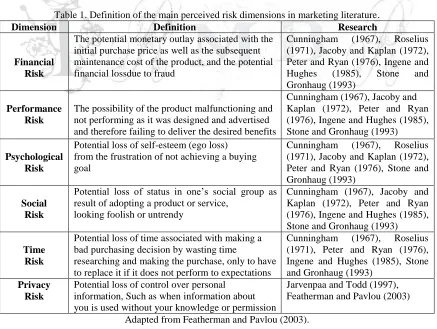
Since the concept of perceived risk introduced in the marketing literature, several dimensions of risk have been identified. The most established risk dimensions include, financial risk, performance risk, psychological risk, social risk, time risk, and privacy risk (Forsythe and Shi, 2003; Forsythe, Liu, Shannon, and Gardener, 2006, Bhatnagar, Misra, and Rao, 2000) . Definition for each risk dimension and the most important studies related to the subject matter are shown in table 1.
Table 1. Definition of the main perceived risk dimensions in marketing literature.
Dimension Definition Research
Financial Risk
The potential monetary outlay associated with the initial purchase price as well as the subsequent maintenance cost of the product, and the potential financial lossdue to fraud
Cunningham (1967), Roselius
(1971), Jacoby and Kaplan (1972), Peter and Ryan (1976), Ingene and
Hughes (1985), Stone and
Gronhaug (1993)
Performance Risk
The possibility of the product malfunctioning and not performing as it was designed and advertised and therefore failing to deliver the desired benefits
Cunningham (1967), Jacoby and Kaplan (1972), Peter and Ryan (1976), Ingene and Hughes (1985), Stone and Gronhaug (1993)
Psychological Risk
Potential loss of self-esteem (ego loss) from the frustration of not achieving a buying goal
Cunningham (1967), Roselius
(1971), Jacoby and Kaplan (1972), Peter and Ryan (1976), Stone and Gronhaug (1993)
Social Risk
Potential loss of status in one’s social group as a result of adopting a product or service,
looking foolish or untrendy
Cunningham (1967), Jacoby and Kaplan (1972), Peter and Ryan (1976), Ingene and Hughes (1985), Stone and Gronhaug (1993)
Time Risk
Potential loss of time associated with making a bad purchasing decision by wasting time
researching and making the purchase, only to have to replace it if it does not perform to expectations
Cunningham (1967), Roselius
(1971), Peter and Ryan (1976), Ingene and Hughes (1985), Stone and Gronhaug (1993)
Privacy Risk
Potential loss of control over personal information, Such as when information about you is used without your knowledge or permission
Jarvenpaa and Todd (1997), Featherman and Pavlou (2003)
ISSN: 2306-9007 Almousa (2014) 782
I
www.irmbrjournal.com June 2014I
nternationalR
eview ofM
anagement andB
usinessR
esearch Vol. 3 Issue.2R
M
B
R
Privacy risk has been added to e-marketing literature as an additional dimension (Jarvenpaa and Todd,
1997, and Forsythe and Shi, 2003). Privacy risk is the potential loss of control over personal information,
such as invasion of privacy. Consumers perceive privacy risk during online shopping where they have to provide personal and credit card information to online retailers. Jarvenpaa and Todd (1997) is one of few studies that examined the influence of perceived risk from a multidirectional perspective. Findings of the study indicated the influence of economic, social, performance, physical, and privacy risks on attitudes towards online shopping. In addition to the previous study, Forsythe and Shi (2003), found that the effect of performance, time, and financial risks affect the purchase frequency of online shopping. Similarly, Crespo, Bosque, and Salamones (2009), concluded that economic and performance risk dimensions have a greater influence than social and time dimensions on e-commerce adoption. Nathan (2008) investigated factors affecting e-commerce in Saudi Arabia along with consumers from other Arab countries. The study finds that Perceived Risk and Trust are mediated by consumers’ Knowledge. Arab consumers were found unique in their e-commerce adoption behaviour in this sense. Their perceived Risk Perception leads to better understanding of the e-commerce system. No other research was found regarding the influence of perceived risk on online shopping adoption in Saudi Arabia. Thus, this research attempted to fill-up the gap in this area of study.
Using the above model and the reviewed literature, the following hypotheses were formulated: H5a: The overall perceived risk in shopping online is determined by the social risk associated with it. H5b: The overall perceived risk in shopping online is determined by the financial risk associated with it. H5c: The overall perceived risk in shopping online is determined by the performance risk associated with it.
H5d: The overall perceived risk in shopping online is determined by the psychological risk associated with it.
H5e: The overall perceived risk in shopping online is determined by the time risk associated with it. H5f: The overall perceived risk in shopping online is determined by the privacy risk associated with it.
This study attempts to extend the body of research on perceived risk in Internet shopping from the perspective of consumers in a developing country, namely, Saudi Arabia. It attempts to expand the knowledge gaps related to the theoretical understanding regarding the influence of cultural differences on
consumer behavior regarding perceived risk in online shopping.In addition, this study investigates further
the difference on perceived risk between online shoppers and none shoppers.
Method
Survey instrument
ISSN: 2306-9007 Almousa (2014) 783
I
www.irmbrjournal.com June 2014I
nternationalR
eview ofM
anagement andB
usinessR
esearch Vol. 3 Issue.2R
M
B
R
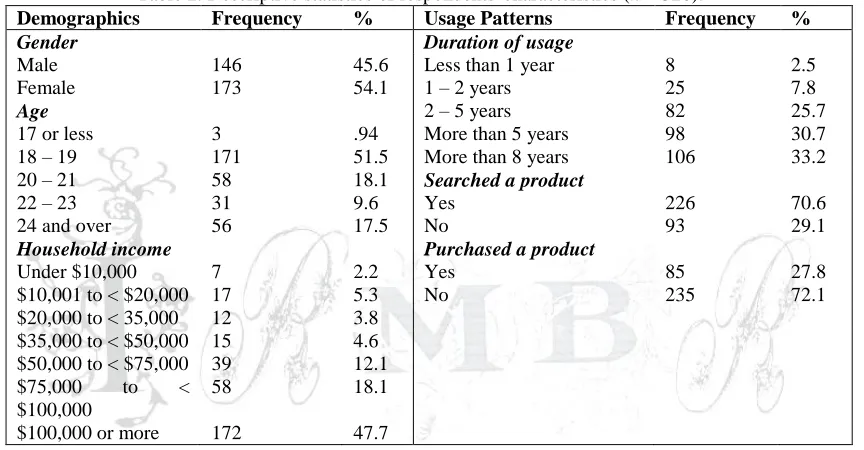
The questionnaire first was constructed in English. A translation and back-translation method (Brislin, 1986) was used in this study. A professional translator translated the questionnaire into Arabic. Then, two bilingual university professors translated the Arabic-written questionnaire into English again. The first and second versions of the questionnaire were compared and few changes were done accordingly. A pilot study was conducted with 20 respondents to insure validity of the instrument, and then minor changes were made accordingly. Subsequently, the questionnaire was posted online through the e-services of one of the largest universities in Saudi Arabia, and then a message explaining the purpose of the survey as-well-as the questionnaire link was sent to a random sample of 1200 students via SMS and e-mail messages. Respondents were asked to complete a self administered web-based questionnaire. The survey was posted online starting from November 23, 2011 to December 30, 2011. A total of 320 surveys were completed and used for further data analysis. A brief description of the respondents is presented in table 2.
Table 2. Descriptive statistics of respondents' characteristics (n = 320).
Demographics Frequency % Usage Patterns Frequency %
Gender Duration of usage
Male 146 45.6 Less than 1 year 8 2.5
Female 173 54.1 1 – 2 years 25 7.8
Age 2 – 5 years 82 25.7
17 or less 3 .94 More than 5 years 98 30.7
18 – 19 171 51.5 More than 8 years 106 33.2
20 – 21 58 18.1 Searched a product
22 – 23 31 9.6 Yes 226 70.6
24 and over 56 17.5 No 93 29.1
Household income Purchased a product
Under $10,000 7 2.2 Yes 85 27.8
$10,001 to < $20,000 17 5.3 No 235 72.1
$20,000 to < 35,000 12 3.8
$35,000 to < $50,000 15 4.6
$50,000 to < $75,000 39 12.1
$75,000 to <
$100,000
58 18.1
$100,000 or more 172 47.7
Results
Internal consistency was calculated using Cronbach's alpha. Table 2 shows the descriptive statistics for the constructs and the reliability (Cronbach's alpha) of the scales. The cronbach reliability coefficient of the measured variables was within the acceptable range (Table 3).
Table 3. Descriptive Statistics and reliability Indices for Constructs.
The main independent variable chosen for this study is the overall perceived risk. The effect of the overall perceived risk during online shopping on perceived usefulness, perceived ease of use, attitude and intentions towards online shopping was tested using structural equation model. The influence of perceived risk was hypothesized to have a negative influence on perceived usefulness, perceived ease of use,
Alpha S.D.
Mean Construct
.92 1.26
3.76 Intention
.91 1.93
4.19 Attitude
.83 1.85
4.28 Perceived usefulness
.78 1.36
4.24 Perceived ease of use
.91 1.34
ISSN: 2306-9007 Almousa (2014) 784
I
www.irmbrjournal.com June 2014I
nternationalR
eview ofM
anagement andB
usinessR
esearch Vol. 3 Issue.2R
M
B
R
consumers' attitude, and intention to shop on the internet. An early estimation of the structural equation model by the robust method indicated that H3 is not significant. Thus, no relevant effect of the overall perceived risk on the perceived ease of use of the internet is seen. Accordingly, a re-specification of the structural equation model was made by removing the mentioned relationship. Results indicated a strong negative relationship between the overall perceived risk and consumers' perceived usefulness of online shopping, attitude towards online shopping and intention to shop online ( P < .01 level or lower), which supports H1, H2 and H4. The study further tested the multidimensional characteristics of risk associated with internet shopping. Results indicated that all six dimensions in the model has a significant factor loading, with privacy and psychological risks dimensions have the most effect, followed closely by performance and financial dimensions. Thus, H4a – H4f are supported (P < .01 level or lower). The structural model estimation indicated that the model fits with no constraints, (χ2 = 131.2, BBNFI = 0.911,
BBNNFI = 0.902, CFI 0.921= , IFI =0.921 , RMCEA = 0.072). Overall, the R2 coefficientvalues show a
sufficient level of variance explanation for dependant variables (R2 = .423, .361) for attitude and intention respectively, on perceived risk, as they are above the acceptable values for social science research (Gliem and Gliem, 2003). Though, the low value for the perceived usefulness (R2 = .017) signify the need to consider other explanatory variables, since it coincides with previous findings by Herrero Crespo, Boque,
and Garcia (2009).Table 4 shows the results of estimation and hypothesis testing.
Table 4. Hypothesis Testing Results.
1) Standard error of β
For further analysis, the difference between internet buyers and non-buyers was tested regarding perceived risk for the six different dimensions (Table 5). Results of the t-test obtained show that there are significant differences between groups in the weight of all six risk dimensions regarding internet shopping. The weight of privacy and psychological aspects in the perceived risk in internet shopping is higher for consumers with previous experience in internet shopping (P = .000).
Table 5. Mean Differences between Internet Buyers and Non-buyers.
Sig t
Non-buyers (N=235) Internet buyers
(N= 85) Total Respondents
(N=320)
Mean Mean Mean .000 -5.277 4.490 3.656 4.292 Overall Risk .000 -5.480 4.702 3.514 4.430 Privacy Risk .000 -5.091 4.540 3.300 4.288 Psychological Risk .001 -3.267 4.380 3.792 4.198 Time Risk .000 -4.186 3.536 2.709 3.348 Social Risk .003 -2.980 4.810 4.244 4.656 Performance Risk .003 -3.040 4.974 4.376 4.830 Financial risk
Hypothesis Causal Relationship β S.E.1 P Results
H1 Risk Attitude -.272 .056 .000 Supported
H2 Risk Intention -.206 .037 .000 Supported
H3 Risk PU -.233 .037 .000 Supported
H4 Risk PEOU -.017 .070 .423 Rejected
H5a Risk Social Risk .685 .036 .003 Supported
H5b Risk Financial Risk .810 .052 .000 Supported
H5c Risk Performance Risk .813 .048 .000 Supported
H5d Risk Psychological Risk .872 .047 .000 Supported
H5e Risk Time Risk .761 .043 .001 Supported
ISSN: 2306-9007 Almousa (2014) 785
I
www.irmbrjournal.com June 2014I
nternationalR
eview ofM
anagement andB
usinessR
esearch Vol. 3 Issue.2R
M
B
R
Discussion
Past research indicated that internet shopping decisions are inherently more risky than brick and mortar shopping decisions (O'Cass 2001, Shih 2004; Heijen, et al., 2003; and Herrero Crespo, Boque, and Garcia,
2009).Yet many researchers have not explored how perceived risk dimensions may operate separately to
influence such decisions and what kinds of risk dimensions play a significant role in the influence of e-commerce adoption. This study examines factors influencing consumers' acceptance of e-e-commerce that were proposed in the TAM with perceived risk as an additional construct. The influence of six underlying risk dimensions; financial, performance, social, time, psychological, and privacy, were examined. Finally, the mean differences between online buyers and non-buyers in the perceived six risk dimensions were examined.
Results in general suggest that consumers' perceived risk has a strong negative effect on consumer's attitude and intention to shop in the internet. Results of the study also provides evidence that consumers' perceived risk reduces consumers' intention to purchase online. These research findings coincide with scholars' arguments that the perceived risk in online shopping has a negative effect on attitude towards online shopping (O'Cass 2001, Shih 2004, and Heijen, et al., 2003) and intention to adopt online shopping (Joines, Scherer, and Scheufele 2003; Korgaonkar and Wolin, 1999; and Salisbury, Pearson, and Miller, 2001).
Finally, for both samples; internet buyers and none buyers, the perceived risk multidimensional characteristics is recognized by all six dimensions; economic, performance, social, time, psychological, and
privacy. Saudi Arabian consumers perceived high risk in all six risk dimensions. This observable fact can
be explained by Hofstede's (1980) cultural differences theory, where uncertainty avoidance is one of the most predominant characteristics of people living in this region. Cultures high in uncertainty avoidance avoid risk-taking because of fear of loss or failure (Bontempo, Bottom, and Weber, 1997).
Though, Saudi Arabian consumers perceived privacy and psychological risk as the most significant risk
factors affecting internet shopping, followed closely by performance and financial risks. Moreover, internet
buyers and non-buyers showed significant mean differences in all six constructs with the highest mean
difference observed in privacy and psychological risks. The non-buyer sample perceived higher risk in all
six risk dimensions than the sample with previous experience in e-commerce.
This research findings shed light on Saudi consumers perceived risk in online shopping as-well-as what type of risks are perceived the highest among them. Managerially, this research provides marketers with the importance of consumer’s risk perception as-well-as types of risk Saudi consumers face when shopping online. Upon results of this study, marketers can customize risk-reduction strategies associated with the Internet shopping environment.
For marketers, awareness of the attributes of risk perception is important because consumers’ perceived risk level becomes a crucial factor in Internet purchasing. Marketers must know which risk-reduction strategy is important to Saudi consumers in the Internet to reduce their concerns more specifically. The information presented here provides Internet marketers with a picture of the target market for Internet sites and the relationship between perceived risks and patronage behavior.
ISSN: 2306-9007 Almousa (2014) 786
I
www.irmbrjournal.com June 2014I
nternationalR
eview ofM
anagement andB
usinessR
esearch Vol. 3 Issue.2R
M
B
R
References
Abdul-Gader, A.H. (1999). Managing Computer-Based Information Systems in Developing Countries: A
Cultural Perspective. Idea-Group Publishing, Hershey, PA.
Ajzen, I., and M. Fishbein (1980). Understanding attitudes and predicting social behavior. Englewood Cliffs, NJ: Prentice Hall.
Akaah, I.P. and Korgaonkar, P. (1988). A conjoint investigation of the relative importance of risk relievers
in direct marketing, Journal of Advertising Research, August/September, 38-44.
Bauer, R.A. (1960). Consumer behaviour as risk taking. In Dynamic marketing for a changing world, ed.
R.S. Hancock, 389–98. Chicago: American Marketing Association.
Bhatnagar, A., S. Misra, and H.R. Rao (2000). On risk, convenience, and internet shopping behaviour.
Communications of the ACM 43, no. 11: 98–105.
Bontempo, Robert N., William P. Bottom, and Elke U. Weber (1997), Cross-Cultural Differences in Risk
Perception: A Model-Based Approach, Risk Analysis (17), No. 4, pp. 479-488.
Cox, D. F., & Rich, S. U. (1967). Perceived risk and consumer decision makingThe case of telephone shopping. In D. F. Cox (Ed.), Risk taking and information handling in consumer behavior (pp. 487-506). Boston: Harvard University.
Cunningham, S.M. (1967). The major dimensions of perceived risk. In Risk taking and information
handling in consumer behavior, ed. D.F. Cox, 82–108. Boston, MA: Harvard University Press. Davis, F.D. (1989). Perceived usefulness, perceived ease of use and user acceptance of information
technology. MIS Quarterly 13, no. 3: 319–39.
Davis, F.D., R.P. Bagozzi, and R.R. Warshaw (1989). User acceptance of computer technology: A
comparison of two theoretical models. Management Science 35, no. 8: 982–1003.
Dowling, G. R., & Staelin, R. (1994). A model of perceived risk and intended riskhandling activity.
Journal of Consumer Research, 21, 119–134.
Eastlick, M.A. and Feinberg, R.A. (1999) ‘Shopping motives for mail catalog shopping’Journal of Business
Research, Vol. 45, No. 3, pp.281–289.
Featherman, M.S., and P.A. Pavlou (2003). Predicting E-services adoption: A perceived risk facets
perspective. International Journal of Human–Computer Studies 59: 451–74.
Fenech, T., and A. O’Cass (2001). Internet users’ adoption of Web retailing: User and product dimensions.
Journal of Product and Brand Management 10, no. 6: 361–81.
Forsythe, S.M., and B. Shi (2003). Consumer patronage and risk perceptions in internet shopping. Journal
of Business Research 56, no. 1: 867–75.
Forsythe, M., Liu, Shannon, and Gardner, L. (2006). Development of a scale to measure the perceived benefits and risks of online shopping. Journal of Interactive Marketing 20 (2): 55-75.
Herrero Crespo, A., Boque, R., and Garcia, M. (2009). The influence of perceived risk on Internet shopping
behavior: a multidimensional perspective. Journal of Risk Research Vol. 12, No. 2, 259–277.
Heijen, H.V.D., Verhagenm T. and Creemers, M. (2003). Understanding online purchasing intentions: contributions from technology and trust perspectives. European Journal of Information Systems, 12, pp. 41 – 48.
Internet Usage World Stats (2008). Internet usage statistics. Available: www.internetworldstats.com.
Hofstede, Geert H. (1984). Culture's Consequences: International Differences in Work-Related Values, Newbury Park, CA: Sage Publications.
Ingene, C.A., and M.A. Hughes (1985). Risk management by consumers. In Research in consumer
behavior, ed. J. Sheth, Vol. 1, 103–58. Greenwich: JAI Press Inc.
Jarvenpaa, S.L., and P.A. Todd (1997). Is there a future for retailing on the internet. In Electronic marketing and the consumer, ed. R.A. Peterson, 139–54. Thousand Oaks, CA: Sage Publications. Jarvenpaa, S.L. and Tractinsky, N. (1999). Consumer trust in an Internet store: a cross-cultural validation.
ISSN: 2306-9007 Almousa (2014) 787
I
www.irmbrjournal.com June 2014I
nternationalR
eview ofM
anagement andB
usinessR
esearch Vol. 3 Issue.2R
M
B
R
Joines, J.L., C.W. Scherer, and D.A. Scheufele (2003). Exploring motivations for consumer web use and
their implications for e-commerce. Journal of Consumer Marketing 20, no. 2: 90–108.
Jacoby, J., and B. Kaplan (1972). The components of perceived risk. In Proceedings of the Third Annual
Conference of the Association for Consumer Research, ed. M. Venkatesan, 382–93. Ann Arbor, MI: Association for Consumer Research.
Korgaonkar, P.K., and L.D. Wolin (1999). A multivariate analysis of web usage. Journal of Advertising Research 39, no. 2: 53–68.
Lee, Y., K.A. Kozar, and K.R.T. Larsen (2003). The technology acceptance model: Past, present, and
future. Communications of the Association for Information Systems 12: 752–80.
Mitchell, V.-W. (1999). Consumer perceived risk: Conceptualizations and models. European Journal of
Marketing. 33(1), 163-195.
Morgan, R.M., and Hunt, S.D. (1994). The commitment-trust theory of relationship marketing. Journal of
Marketing, 58, 20–38.
Nathan, R. (2008). Electronic Commerce Adoption in the Arab Countries – An Empirical Study.
Multimedia University, Malaysia.
O’Cass, A., and T. Fenech (2003). Web retailing adoption: Exploring the nature of internet users web
retailing behavior. Journal of Retailing and Consumer Services 10: 81–94.
Park, J., D. Lee, and J. Ahn (2004). Risk-focused e-commerce adoption model: A cross-country study.
Journal of Global Information Technology Management 7, no. 2: 6–30.
Peter, J.P., and M.J. Ryan (1976). An investigation of perceived risk at the brand level. Journal of Marketing Research 13, no. 2: 184–8.
Pavlou, P.A. (2003). Consumer intentions to adopt electronic commerce – incorporating trust and risk in
the technology acceptance model. International Journal of Electronic Commerce 7, no. 3: 101–34.
Salisbury, W.D., R.A. Pearson, A.W. Pearson, and D.W. Miller (2001). Perceived security and World Wide
Web purchase intention. Industrial Management and Data Systems 101, no. 4: 165–76.
Shih, H.P. (2004). An empirical study on predicting user acceptance of e-shopping on the Web.
Information and Management 41: 351–68.
Stone, R.N., and K. Gronhaug (1993). Perceived risk: Further considerations for marketing discipline.
European Journal of Marketing 27, no. 3: 39–50.
Taylor, S., and P.A. Todd (1995). Understanding information technology usage: A test of competing
models. Information Systems Research 6, no. 2: 144–76.