Reversible Data Hiding over Facebook
Ran Lyu
*, Jian-Tao Zhou, Wei-Wei Sun, Li Dong
Department of Computer and Information Science, University of Macau, Macau, China.
Received 08 July 2017; received in revised form 15 August 2017; accepted 28 August 2017
Abstract
Facebook, the most popular Online Social Network (OSN), could be used as a platform to share secret messages
through JPEG images online. However, due to the various lossy operations conducted over Facebook, the data
embedded into the JPEG images can be easily destroyed, making the data extraction infeasible. More importantly, all
these operations are carried out without users’ interference. In this paper, we first perform an in -depth investigation of
the various lossy operations that Facebook applies to uploaded images. Based upon such prior knowledge, we
propose a DCT-domain data hiding scheme that can effectively embed a large amount of data and successfully extract
them out from the downloaded images, defeating the uncontrolled lossy operations. Compared with the
state-of-the-art techniques, the proposed method offers much higher embedding capacity, and can extract the data
successfully with very high probability. Furthermore, the restored image upon data extraction is of high quality, and
the file size expansion is negligible. Extensive experimental results are provided to validate our findings.
Keywords: data hiding, JPEG, reversible data hiding, Facebook
1.
Introduction
Facebook, the most popular Online Social Network (OSN), could be used as a pla tform to share secret messages through
JPEG images online. The operations conducted by Facebook (including resizing, JPEG compression, etc) are much more complex
than other social networks [1]. Although the idea of sharing the hidden message over Facebook is attractive, it faces many
inevitable challenges. Huang [2] proposed a very robust steganography for pure JPEG. However, Huang's method is not robust
to overflowing caused by re-compression on Facebook. Hiney [3] tested nine steganography methods on Facebook. The
experimental results have shown that these methods work well offline, but perform poorly on Facebook. Castiglione analyzed
how some prevalent OSNs processed the uploaded images [1] and proposed two steganography schemes [4] with low
embedding capacity on Facebook. Nagaraja [5] proposed Stegobot, using the YASS [6] specifically, which has the limitation of
the embedding capacity. Ning [7] proposed an approach 2-LSB inspired by LSB [8]. The drawbacks are two-fold: lower
embedding capacity compared to LSB; lacks of discussion about visual quality. Amsden [9] proposed to transmit hidden
information using JPHide and JPSeek [10] over a cover photo on Facebook (failed over album images).
In this work, we first perform an in-depth investigation of the various lossy operations that Facebook applies to uploaded
images. Based upon such prior knowledge, we propose a DCT-domain data hiding scheme. Compared with the state-of-the-art
techniques, the proposed method offers much higher embedding capacity, and can e xtract the data successfully with very high
probability. The rest of the paper is organized as follows. The investigation of Facebook is given in Section 2. The proposed
scheme and system are described in Section 3. Experimental results are shown in Section 4. Finally, the conclusion is given in the
Section 5.
2.
Analysis of the Operations Conducted over Facebook
We upload 1338 gray uncompressed images from UCID-v2 [11] to Facebook, and then download them. The published
images are compressed using quality factor (QF) chosen by Facebook. The quantization tables are extracted from the
downloaded images. It is observed that all the quantization tables match the International JPEG Group standard [12]. It turns out
that the employed QF varies from 71 to 92. We then make a hypothesis for the re-compressed image of Facebook: the QF chosen
by Facebook should be smaller than or equal to the one in uploaded image. To verify this assumption, we compress images with
QFs vary from 50 to 100 and upload them to Facebook. Then we download them and extract the quantization tables from the
downloaded images. The statistical results agree with our assumption. We have an important observation: for JPEG images
compressed by QF≤71, the QFs of downloaded image are all consistent with 71.
3.
Facebook Message Sharing System (FMSS)
To clearly describe the Facebook Message Sharing System (FMSS), the related terms are defined: cover image, the original
image; stego image, the embedded image; FBstego image, the published stego image over Facebook; restored image, the image
restored from the FBstego image after extraction; QFembed, the QF used in stego image offline; QFFB, the QF used in the FBstego
image on Facebook. The following roles are involved in the FMSS: sender, Facebook and receiver. Sender compresses the cover
image with QFembed=71 before embedding which forces Facebook chooses QFembed=QFFB in re-compression. In FMSS, we fully
trust the sender and receiver that they can act exactly as we wish. Facebook might damage the data hiding scheme accidentally.
However, Facebook will follow a fixed process during re-compression. Therefore, we take the Facebook as semi-trusted.
3.1. Block selection algorithm
Even we make QFembed=QFFB, the Inverse and Forward Discrete Cosine Transform (IDCT and FDCT) in re-compression of
Facebook still has a chance to cause the failure of data hiding. Given I’ as the embedded image before the pixel operations in JPEG.
The pixel operations include truncation and rounding, which cause the overflowing Err: I’-Round(Truncate(I’)). Since overflowing phenomenon is inevitable in JPEG algorithm, we check the embedded block whether it's overflow with large Err value
or not. Not all blocks in an image have large Err of overflowing phenomenon and we call them stable blocks referring stable QF.
The new selection method of stable blocks needs a map for each image to identity positions. It's need to reduce the additional
storage introduced by map. We call embeddable blocks Qualified Block (QB) and others Unqualified Block (UB). A flag bit
bF{1,0} needs to be inserted to determine the QBs and UBs . In this solution, the burden is only related to the number of
embedded blocks, but not the size of the image. To achieve higher capacity in the embedding process, we adopt the same
strategy proposed by Huang [2]: embedding bits in block with more zero coefficients.
3.2. Embedding algorithm
By spanning QB in zigzag, we build a qualified embedding coefficients vector Q and shifting coefficients vector S with size
of n and m, respectively. Each secret message bit can be represented as b∈{1,0}. The proposed embedding algorithm for QB is as Eq. (1)-(3):
Qi’=Qi+sign(Qi)·b i=1,…,n-1 Qi∈{ AC coefficients of each QB and | Qi |=1} (1)
Sj’=Sj+sign(Sj) j=1,…,m Sj∈{ AC coefficients of each QB and | Sj |=2} (2)
The flag bit bF=1 is embedded into the last Qi by Eq. (3). To make sure of efficiency, there should be at least one valid
message bit and the flag bit in a QB, so the length of Q should be greater than 1, i.e., n≤2. The blocks with low capacity and
overflowing phenomenon can be set as UBs. By spanning each UB in zigzag sequence, the first coefficient with the value of ±1
or ±2 counting backwards is u. For UB, we only need to embed the flag bit 0 by: u'=sign(u). If there's no u in current UB, we can
just do nothing and move to next block. Sender scans the blocks to check they're QBs or UBs by proposing block selection. Then
message bits and flag bits are embedded following the embedding algorithm ab ove. Not all blocks need to be scanned while
embedding since the embedding process might finish before scanning all blocks. A reasonable choice for visual quality is to s top
embedding scanning and keep the following blocks unchanged.
3.3. Data extraction and image restoration algorithm
Given the secret message M with the length of L. L can be represented by l bits. Here l is a fixed and predefined number.
Therefore, sender embeds L and M with l+L bits totally. In the experiment, we set l=16. The receiver downloads the FBstego image from Facebook and extracts the secret message bits from it. The receiver scans the blocks to check if they're QBs or UBs
by extracting the flag bits. The receiver can calculate the length of the embedding bits L by first l extracted bits. Specifically, in
message extraction part, the vector Qi
*is built in each block and the restored AC coefficients Q k
*' can be calculated by Eq. (4).
Qk *
'=sign(Qk *
) k =1,…,p Qk
*∈{
AC coefficients that | Qk *
|=1 or | Qk *
|=2} (4)
If p = 0 or Qp *
=1 (it indicates bF=0), the block is UB and we move to next block. Otherwise, take the block as QB. Each
extracted bit b' in QBs is calculated by: b'=0 if |Qk *
|=1 or b'=1 if |Qk *
|=2. For each QB, the restored AC coefficients Qk *
' can be calculated by Eq. (5):
Qk *'=sign(Qk *) (5)
The scanning procedure continues. Note that after the extraction of l + L bits, the rest blocks won't be scanned and restored
because there's no change in them during embedding process.
4.
Experimental results
We select test images from UCID [11] and convert these color images into gray. The size of images in experiments is either
384·512 or 512·384. In our experiments, Facebook does not resize those images. We implement four competing methods: Huang's method [2]; LSB, 2-LSB and LSB+2-LSB based on [7]. Note that LSB+2-LSB are called MixLSB in our experiments. For fair
comparison, these four competing methods (Huang's method [2], LSB[7], 2LSB[7] and MixLSB[7]) and our proposed method are
all compressed with QFembed=71 before embedding. The embedding bits are randomly generated and all cover images are
compressed by JPEG standard [12].
4.1. Data extraction accuracy
The 1338 images in UCID [11] are all used for comparing accuracy. We use bit error rate (BER) to describe the performance
of accuracy for each method, which is defined in Eq. (6).
BER=#(error)/#(embedded) (6)
where #(·) is the function of calculating the number of bits. Clearly, lower BER indicates better performance. As we can see
from the Table 1, even excluding the influence of QFembed, our method is still much better than other methods in terms of BER. The
four compared methods are all very close to this rate. Huang's method is designed for pure JPEG and not robustness to
overflowing. Ning's methods are failed on the current Facebook system. One of potential reasons might be the updating of
Facebook. The superior performance of our method is attributed to the proposed block selection algorithm. The selected blocks
are robustness to re-compression of JPEG and other unknown functions on Facebook.
Table 1 Comparison of Bit Error Rate (BER) of 1338 images in UCID for each method Method Proposed Huang[2] LSB[7] 2LSB[7] MixLSB[7]
BER 0.18% 44% 46% 48% 46%
4.2. Embedding capacity
Since the successfully embedded bits are almost zero for four competing methods, it has no need to discuss their embedding
capacity performance. The 1338 images in UCID [11] are all used to evaluate the capacity of the proposed scheme. The average
embedding capacity for our method is about 12064 bits in 384·512 image, which achieves a high embedding rate: 6.1%.The capacity of our method is related to the number Qualified Blocks (QBs ), which has a lot to do with the content of the image itself.
In other words, an image with more QBs is likely to achieve higher capacity. Therefore, sorting out high -capacity image based on
the number of QBs can improve the average embedding capacity. We sort 1338 cover images from largest capacity to lowest and
embed bits in high-capacity image. The refined average capacity is about 20000 bits in 200 images.
4.3. File size expansion
In order to evaluate the performance of file size expansion, we randomly select 100 images from UCID [11]. We only choose
the size values of FBstego images in each method. We compress cover images with QFembed=71 in JPEG standard and call it as
JPEG71. We upload JPEG71 on Facebook and download to obtain FBJPEG71. We add JPEG71 images and FBJPEG71 images in
comparison, because the ideal size is not only small, but also close to the same image without embedding rates. The variation of
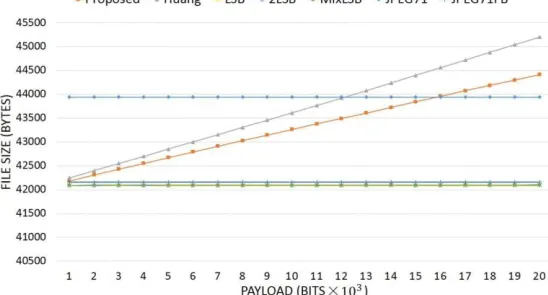
file size for different payloads is measured by bytes and the results are shown in Fig. 1. As can be seen, LSB, 2LSB and MixLSB
have no increment in file size and are almost the same size. This is because these three methods use VLI coding [13] which won't
affect the entropy codes of JPEG. JPEG71 and FBJPEG71 are unchanged for no embedding bits. Co mpared to Huang, we have
smaller average file size and slower trend of growth. And most of file size values in proposed method are located in the spac e
between FBJPEG71 to JPEG71, which contributes to covertness.
Fig. 1 File size (bytes) of FBstego image
4.4. Image visual quality
To evaluate the performance of visual quality, we randomly select 100 images from UCID [11]. The performance of visual
quality is evaluated by Peak Signal-to-Noise Ratio (PSNR) and Structural Similarity Index (SSIM). One example of the proposed
from 1000 bits to 20000 bits. We use Mutual Information (MI) to describe the mutual dependence between the two random
variables: X and Y. X is the real embedded sequence and Y is the sequence extracted by steganography. The mutual information
of X and Y is donated by I(X;Y) and H(·) is the function of calculating the entropy of a random sequence. MI can be calculated by Eq. (7):
MI=I(X;Y)=H(X)+H(Y)-H(X,Y) (7)
(a) Cover image (b) Steego image (embedded 10000 bits)
(c) JPEG71 image (d) Restored image (embedded 10000 bits)
Fig. 2 One example of proposed method (a) Original image in steganography (b) The image embedded with 10000 bits by proposed method (c) The image restored form FBstego (d)The image compressed by JPEG in quality factor 71
(a) SSIM (b) PSNR
Fig. 4 Visual quality of stego images VS cover images
(a) SSIM (b) PSNR
Fig. 5 Visual quality of stego images VS JPEG71 images
(a) SSIM (b) PSNR
Fig. 6 Visual quality of restored images VS cover images
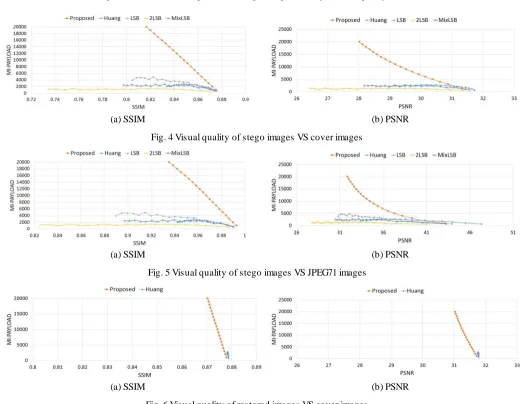
The results of visual quality described by SSIM and PSNR for five methods are shown in Fig s. 4-6. The Y-axis is the multiply
of MI and payload: MI·payload. We use SSIM and PSNR as the X-axis to show for same visual quality, which method can
achieve larger useful capacity. This evaluation of combin ing the influence of visual quality, the accuracy and the capacity. Since
only our method and Huang's method are reversible, the other three methods are not shown for restoring images. The MI and
see that the proposed method has much better MI·payload than four competing methods with same visual quality. The visual
quality of our proposed method is mainly concentrated in bigger value of SSIM and PSNR, which outperforms four competing
methods. With the increment of payload, our proposed method shows a more outstanding and stable performance of the MI and
visual quality than these four methods. Our method won't be influenced by the unstable blocks. Thus, MI and visual quality are
stable with the payload growing. In conclusion, our method has great and stable performance on visual quality and MI.
5.
Conclusions
Many previous literatures noticed that Facebook had huge potential on sharing secret messages. In this work, we
performed an in-depth investigation of the various lossy operations on Facebook based on the experimental data. Based upon
such prior knowledge, we built a Facebook message sharing system called FMSS that can effectively embed a large amount of
data and successfully extract them out from the downloaded images, defeating the uncontrolled lossy operations on Facebook.
The experiments revealed that the proposed method offers much higher embedding capacity, and can extract the data
successfully with very high probability compared with t he state-of-the-art techniques. Furthermore, the restored image upon
data extraction is of high quality, and the file size expansion is negligible.
References
[1] A. Castiglione, G. Cattaneo, and A. De Santis, “A forensic analysis of images on online social networks,” International Conf. Intelligent Networking and Collaborative Systems (INCoS), IEEE Press, January 2011.
[2] F. Huang, X. Qu, H. J. Kim, and J. Huang, “Reversible data hiding in jpeg images,” IEEE Transactions on Circuits and Systems for Video Technology, vol. 26, no. 9, pp. 1610-1621, September 2016.
[3] J. Hiney, T. Dakve, K. Szczypiorski, and K. Gaj, “Using facebook for image steganography,” International Confer. Availability, Reliability and Security (ARES), IEEE Press, August 2015.
[4] A. Castiglione, B. D'Alessio, and A. De Santis, “Steganography and secure communication on online social networks and online photo sharing,” International Conf. Broadband and Wireless Computing, Communication and Applications (BWCCA), IEEE Press, October 2011.
[5] S. Nagaraja, A. Houmansadr, P. Piyawongwisal, V. Singh, P. Agarwal, and N. Borisov, “Stegobot: a covert social network botnet,” International Workshop on Information Hiding, Springer Berlin Heidelberg, 2011.
[6] K. Solanki, A. Sarkar, and B. Manjunath, “Yass: Yet another steganographic scheme that resists blind steganalysis,” International Workshop on Information Hiding. Springer Berlin Heidelberg, pp. 16-31, 2007.
[7] J. Ning, I. Singh, H. V. Madhyastha, S. V. Krishnamurthy, G. Cao, and P. Mohapatra, “Secret message sharing using online social media,” IEEE Conf. Communications and Network Security (CNS), IEEE Press, October 2014.
[8] N. F. Johnson and S. Jajodia, “Exploring steganography: Seeing the unseen,” Computer, vol. 31, no. 2, pp. 26-34, February 1998.
[9] N. D. Amsden, L. Chen, and X. Yuan, “Transmitting hidden information using steganography via facebook,” International Conf. Computing, Communication and Networking Tech nologies (ICCCNT), IEEE Press, July 2014.
[10] A. Latham, “Steganography,” http://linux01.gwdg.de/alatham/stego.html [online]. Accessed 11, October 2016.
[11] G. Schaefer and M. Stich, “Ucid - an uncompressed colour image database,” Proceedings of SPIE, vol. 5307, pp. 472-480, 2003.
[12] G. K. Wallace, “The jpeg still picture compression standard,” IEEE transactions on consumer electronics, vol. 38, no. 1, pp. xviii-xxxiv, February 1992.