M
ARZENAF
ERDYN−D
ROSIK, K
ATARZYNAJ
ELITO, E
VAK
ŐRÖSSY, K
AMILAB
OJANEK,
M
IRELLAJ
AKSZ, M
ICHAŁŚ
WIERSZCZ, P
RZEMYSŁAWN
OWAK, R
YSZARDB
RUSImpairments of the Central Serotoninergic System
in Rats Lesioned With DSP−4 as Neonates
Zaburzenia funkcji ośrodkowego układu noradrenergicznego
u szczurów z lezją wywołana DSP−4 stosowanym we wczesnym okresie
rozwoju postnatalnego
Department of Pharmacology, Medical University of Silesia, Zabrze, Poland Adv Clin Exp Med 2008, 17, 6, 607–614
ISSN 1230−025X
ORIGINAL PAPERS
© Copyright by Silesian Piasts University of Medicine in Wrocław
Abstract
Objectives.The aim of the present study was to investigate the effect of neonatal DSP−4 treatment on the central serotoninergic system in adult rats.
Material and Methods. On the first and third days after birth, rats were injected with either DSP−4 (50 mg/kg, s.c.) or 0.9% NaCl (1.0 ml/kg s.c., controls). When the rats attained 10 weeks of age, both the control and DSP−4 groups were divided into two subgroups injected with either saline or the inhibitor of serotonin (5−hydroxytrypta− mine, 5−HT) synthesis p−chlorophenylalanine (p−CPA). Then the rats were subjected to the Porsolt forced swim test following acute administration of the 5−HT1B ligands (agonist CP 94253, 4.0 mg/kg ip, and/or antagonist SB 216641, 4.0 mg/kg ip). Afterwards the content of monoamines and their metabolites as well as the 5−HT synthesis rate were determined in the striatum.
Results.CP 94253 induced depression−like behavior in the control rats, but not in the DSP−4−treated animals. The 5−HT1Breceptor antagonist SB 216641 per se did not influence the examined parameters in either group, but when injected 30 min beforehand, it significantly abolished the CP 94253−induced depression−like behavior in the con− trol rats. Depression−like behavior inp−CPA pretreated control rats was no longer observed. The content of nora− drenaline (NA) in the striatum was significantly reduced in the DSP−4−treated rats compared with the controls, but the levels of dopamine (DA), 5−HT, and their metabolites were not affected by DSP−4 treatment. Neither CP 94253 nor SB 216641 altered NA, DA, DOPAC (3,4−dihydroxyphenylalanine), HVA (homovanillic acid), 5−HT, or 5−HIAA (5−hydroxyindoleacetic acid) content in the striatum of either examined group (control and DSP−4). In contrast, the 5−HT synthesis rate was significantly attenuated in the striatum after CP 94253 application and SB 216641 was able to antagonize this effect in the tested brain area of the control rats. Conversely, CP 94253 failed to significantly inhibit the rate of 5−HT synthesis in the DSP−4−treated rats.
Conclusions.These data suggest that presynaptic 5−HT1Bautoreceptors underwent desensitization in the DSP−4− treated rats. Consequently, a neonatal chemical lesion of central noradrenergic neurons modifies central serotoner− gic activity in rats in adulthood (Adv Clin Exp Med 2008, 17, 6, 607–614).
Key words: DSP−4, lesion, 5−HT1Breceptor, depression−like behavior, rats.
Streszczenie
Cel pracy. Ocena wpływu lezji układu noradrenergicznego wykonanej u noworodków szczurzych na funkcje ośrodkowego układu serotoninergicznego u dorosłych zwierząt.
Serotonin (5−HT) and noradrenaline (NA) are markedly involved in the pathophysiology of mood disorders, for example depression [1]. The major brainstem cell body nucleus for 5−HT is the dorsal raphe nucleus (DRN). Selective 5−HT reup− take inhibitors (SSRIs), which acutely increase extracellular 5−HT levels, produce an initial decrease in the DRN 5−HT firing rate in rats, whereas long−term administration produces a return to the basal firing rate. This initial reduc− tion in firing is brought about by negative feed− back to inhibitory 5−HT1Asomatodendritic autore−
ceptors, and these receptors become desensitized during long−term exposure to endogenous or exogenous agonists [2]. It has also been confirmed that NA reuptake inhibitors produce a beneficial effect in the treatment of depression, as do dual 5−HT− and NA− or selective NA−reuptake inhibitors [3]. Because the locus coeruleus (LC), the major NA brainstem nucleus, projects to the DRN and the DRN projects to the LC, there is ample oppor− tunity for cross−modulation [4–6]. The aberrant relationship between 5−HT and NA may be impor− tant in stress−related psychopathologies such as depression and anxiety disorders.
The present authors previously demonstrated that systemic neonatal treatment with the selective NA neurotoxin N−(2−chloroethyl)N−ethyl−2−bro− mobenzylamine (DSP4) produces marked and per− manent alteration of the postnatal development of central noradrenergic neurons in rats. It was shown that this animal model represents a good means for studying interactions between specific neurotrans− mitter systems. By engaging this animal model it was demonstrated, for example, that a DSP−4 lesion markedly altered the reactivity of dopamine (DA) D1, D2, and D3 receptors [7], modified the
convulsant effect of bicuculline and pentylenete− trazole [8], diminished the vulnerability to diazepam−evoked anxiolytic−like behavior [9], and increased GABA turnover in the prefrontal cortex of adult rats [10]. However, there is a paucity of data on the effect of DSP−4 treatment on sero− toninergic system functioning and, more specifi−
cally, on 5−HT1B receptor reactivity. A growing
body of evidence indicates that 5−HT1B receptors
play an important role in modulating the behav− ioral, neurochemical, and cellular effects of some drugs (ethanol and cocaine), food intake, aggres− sive behavior, and depression [1, 3]. Some obser− vations suggest that increased 5−HT1Bautoreceptor
activity induces depressive and related anxiety symptoms and that downregulation of DRN 5−HT1B
autoreceptors by antidepressants may be crucial in normalizing 5−HT transmission and relieving symptoms of depression or anxiety [2]. Therefore the goal of this study was to determine whether DSP−4 treatment of newborn rats has pharmaco− logical, neurochemical, and behavioral conse− quences on the serotoninergic system and, more specifically, on the reactivity of 5−HT1Breceptors.
Material and Methods
Rats and Treatment
The experiment was carried out on male Wistar rats (University Animal Department, Katowice, Poland) which were housed under con− trolled environmental conditions in a well−venti− lated room at 22 ±2°C and under a 12-h light: 12-h dark cycle (lights on 7:00 a.m. to 7:00 p.m.). The animals received food and water ad libitum. Offspring rats were weaned at 21 days and segre-gated by sex.
The central noradrenergic system of the new− born rats (84 animals) was lesioned with DSP−4 (Sigma, St. Louis, MO, USA). The rats were injected on the first and third days of postnatal life with either DSP−4 (50 mg/kg s.c.) or 0.9% NaCl (1.0 ml/kg s.c.). The DSP−4 was dissolved in dis− tilled water immediately before injection. The rats continued to be housed as above until 8−10 weeks for further experimentation.
The experiments were carried out in the morn− ing in male rats only, handled in accordance with
Wyniki i wnioski. W teście rezygnacji Porsolta CP 94253 stosowany u szczurów z grupy kontrolnej działał depre− sjogennie, a wpływ ten znosiło wcześniejsze SB 216641. Takiego działania nie obserwowano natomiast u zwierząt z lezją układu noradrenergicznego. Po podaniu p−CPA depresjogenny efekt CP 94253 zanikał u szczurów z grupy kontrolnej. Zawartość noradrenaliny w prążkowiu była istotnie mniejsza w grupie DSP−4, zawartość dopaminy, se− rotoniny i ich metabolitów nie różniła się między badanymi grupami zwierząt. CP 94253 oraz SB 216641 nie wpły− wały na stężenie amin biogennych i ich metabolitów, CP 94253 natomiast istotnie zmniejszył intensywność synte− zy 5−HT w prążkowiu u szczurów z grupy kontrolnej, pozostając bez wpływu na badany parametr u zwierząt z le− zją układu noradrenergicznego. Na podstawie przeprowadzonych badań należy stwierdzić, że chemiczna lezja ośrodkowego układu noradrenergicznego wywołana podaniem neurotoksyny DSP−4 szczurzym noworodkom pro− wadzi do desensytyzacji receptorów 5−HT1Bi tym samym modyfikuje ośrodkowe przekaźnictwo serotoninergicz− ne u dorosłych zwierząt (Adv Clin Exp Med 2008, 17, 6, 607–614).
the principles and guidelines described in the NIH booklet Care and Use of Laboratory Animals. All procedures were reviewed and approved by the Lo− cal Ethics Committee for Animal Care.
In the present study, two highly selective 5−HT1B ligands were used: CP 94253 (4.0 mg/kg
i.p.), which is a full agonist, and SB 216641 (4.0 mg/ /kg i.p.), a potent and specific 5−HT1B receptor
antagonist. Based on earlier findings, both 5−HT1B
ligands (in a dose range of 1.0–5.6 mg/kg) affect rat and mouse behavior [11]. In the present study, an intermediate dose (4.0 mg/kg) of each ligand was tested.
Porsolt Forced Swim Test
Depressive behavior was tested by the Porsolt forced swim test [12], a standard animal test of depression often used to show the efficacy of anti− depressants. Immobility during forced swimming can be reduced by a range of clinically active anti− depressant drugs.
The rats were individually placed in a narrow cylinder of water from which there is no escape. After an initial period of vigorous activity, the rats adopt a characteristic immobile posture, which has come to be known as behavioral despair or learned helplessness. The rats in this study were habituat− ed to the forced swim cylinder. Each animal was placed for 10 minutes in a cylindrical tank (50 cm high, 22 cm in diameter) filled with water (25°C) to 25 cm. No scoring of immobility was performed during habituation. The rats were then returned to their home cages.
One day after habituation, the rats of both test groups (control and DSP−4) were divided into four subgroups receiving the follow treatments: two sa− line injections (each 1.0 ml/kg i.p.), with a 30−min interval; saline (1.0 ml/kg i.p.) and 30 min later CP 94253 (4.0 mg/kg i.p.); SB 216641 (4.0 mg/kg i.p.) and 30 min later saline (1.0 ml/kg i.p.); SB 216641 (4.0 mg/kg i.p.) and 30 min later CP 94253 (4.0 mg/kg i.p.).
One hour after the last injection the rats were placed in the cylinder for 5 minutes to score mobility. Mobility consisted of upward−directed movements of the forepaws along the side of the cylinder as well as swimming in the cylinder. Immobility consisted of no additional activity other than that required to keep the head above water.
The same procedure was performed on rats (control and DSP−4 treated) formerly pretreated with the 5−HT synthesis inhibitor p−chloropheny− lalanine (p−CPA, 100 mg/kg i.p., twice, every 24 h).
Tissue Sample Preparation
The animals were treated with saline (1.0 ml/kg i.p.), CP 94253 (4.0 mg/kg i.p.), and/or SB 216641 (4.0 mg/kg i.p.) according to the paradigm des− cribed in the Porsolt forced swim test. Rats of all the tested groups were decapitated 30 min after the last injection and the striatum was rapidly dissect− ed and placed on dry ice, weighed, and stored at –70°C until assay. The samples were homogenized for 15–20 sec in ice-cold trichloracetic acid (0.1 M) containing 0.05 mM ascorbic acid. After centrifugation (5000 × g, 5 min), the supernatants were filtered through 0.2-µm cellulose membranes (Titan MSF Microspin filters, Scientific Resources Inc., Eatontown, UK) and injected onto the HPLC/ED column. Levels of DA, 3,4-dihydrox-yphenylacetic acid (DOPAC), homovanillic acid (HVA), 5-HT, and 5-hydroxyindoleacetic acid (5-HIAA) as well as NA were assayed by HPLC/ED [13].
The mobile phase consisted of 75 mM NaH2PO4, 1.7 mM 1−octanesulphonic acid, 5 µM
EDTA (all Avocado, Research Chemicals Ltd.), 100 µl triethylamine (Sigma), and 9.5% acetoni− trile (Lab−Scan), adjusted to pH 3 with phosphoric acid (Fluka). The flow rate was maintained at 0.7 ml/min at a temperature of 22C and the oxi-dation potential was fixed at +700 mV with 10 nA/V sensitivity. Peaks were automatically integrated by a UCI-100 universal chromatographic interface (Dionex, Germany). The instrumentation included a model 141 electrochemical detector with flow cell, a model 302 piston pump with a 5SC head, a model 802 manometric module (Gilson, France), a thermostat for the STH 595 column (Dionex, Germany), a Hypersil BDS C18 precolumn (10 ×
×4 mm, 3 µm), and a Hypersil BDS C18 chromato− graphic column (250 × 4.6 mm, 3 µm, Thermo− −Quest, UK).
5−HT Synthesis Rate
The synthesis rate of 5−HT was assessed by the indirect chromatographic method of Carlsson et al. [14] in which the accumulation rate of 5−hydroxytryptophane (5−HTP) was analyzed fol− lowing acute treatment with the aromatic amino− acid decarboxylase inhibitor hydroxybenzylhy− drazine (NSD−1015).
0°C. The tissues were frozen on dry ice and stored in a deep freeze (–70°C) until assay. In the exam-ined part of brain the content of 5-HTP, a precur-sor of 5-HT, was assayed by HPLC/ED according the same procedure as described above.
Data Analysis
Group differences were assessed by an analy− sis of variance (ANOVA) and the post−ANOVA test of Newman−Keuls. Apvalue < 0.05 was taken as the level of significant difference.
Results
Porsolt Forced Swim Test
There was no significant difference in immo− bility time between the control and DSP−4−lesioned rats after saline administration. CP 94253 alone (4.0 mg/kg ip) increased the immobility time in the control rats (vs. saline treatment (p< 0.05), but not in the DSP−4−lesioned rats. The 5−HT1Bantagonist
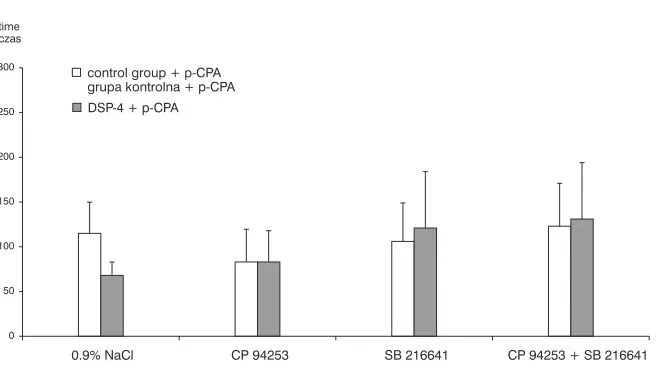
SB 216641 alone did not influence immobility time. However, when injected 30 min before CP 94253 it markedly abolished the CP 94253 effect on immobility. Neither CP 94253 nor SB 216641 altered immobility time in the DSP−4−treated rats compared with the respective controls (after saline administration) (Fig. 1). In the p−CPA−pretreated animals neither CP 94253 nor SB 216641 had sig− nificant effect in the Porsolt forced swimming test in either tested group (control and DSP−4, Fig. 2).
Tissue Assay
In the DSP−4−treated rats there was a marked decrease in striatal NA content versus the controls. However, the levels of DA, 5−HT, and their metabolites were not altered by DSP−4 treatment. Neither CP 94253 (4.0 mg/kg i.p.) nor SB 216641 (4.0 mg/kg ip) altered NA, DA, DOPAC, HVA, 5−HT, or 5−HIAA content in the striatum of the control and DSP−4−treated rats (Tab. 1). p−CPA (100 mg/kg i.p., twice every 24 h) reduced striatal 5−HT and 5−HIAA content of the control and DSP−4 rats by 90–95%, while the levels of NA, DA and their metabolites remained unaltered (Tab. 2).
5−HT Synthesis Rate
No differences were noted in the 5−HT synthe− sis rate in the striatum of control and DSP−4 rats (after saline injection). CP 94253 (4.0 mg/kg i.p.) diminished the 5−HT synthesis rate in the control rats, but was without effect in the DSP−4 rats. SB 216641 had no effect on the 5−HT synthesis rate in either group (Fig. 3).
Discussion
5−HT1B receptors are expressed in the central
nervous system of rodents and its homologous 5−HT1D beta receptor is expressed in humans.
Autoradiographic studies showed that 5−HT1B
receptors are located in both serotonergic and non− serotonergic neurons, where they act as auto− or
0 50 100 150 200 250 300
0.9% NaCl CP 94253 SB 216641 CP 94253 + SB 216641
control group grupa kontrolna DSP-4
time czas
Fig. 1.Effect of neonatal DSP−4 treatment on immobility time after CP 94253 (4.0 mg/kg i.p.) and/or SB 216641 (4.0 mg/kg i.p.) administration in adult rats (n = 6–8), * p < 0.05
heteroreceptors, respectively. 5−HT1Breceptors are
widely distributed in the brain, but are particularly abundant on axon terminals in the ventral pal− lidum, globus pallidus, substantia nigra, and dorsal subiculum and moderately expressed in the cere− bral cortex, the molecular layer of the hippocam− pus, the entopeduncular nucleus, caudate putamen, and deep nuclei of the cerebellum [15]. Because of their role in the regulation of multiple neurotrans− mitters and neuropeptides, 5−HT1Breceptors repre−
sent a potential target for therapeutics for depres− sion, anxiety, and other mood disorders [16].
Behavioral Studies
The present study analyzed the effect of a neonatal noradrenergic lesion on the serotoniner− gic system in adult rats and, more specifically, on the reactivity of 5−HT1B receptors. It was shown
that the selective 5−HT1B receptor agonist CP
94253 (4.0 mg/kg i.p.) produced depression−like behavior in control animals, but was without effect in DSP−4−treated rats. Tatarczyńska et al. [17] demonstrated that CP 94253, like imipramine, had an anti−immobility action, whereas SB 216641 and GR 127935 did not affect immobility time in mice.
0 50 100 150 200 250 300
0.9% NaCl CP 94253 SB 216641 CP 94253 + SB 216641 control group
grupa kontrolna + p-CPA
+ p-CPA DSP-4 + p-CPA
time czas
Fig. 2.Effect of neonatal DSP−4 treatment on immobility time after CP 94253 (4.0 mg/kg i.p.) and/or SB 216641 (4.0 mg/kg i.p.) administration in adult rats pretreated with p−CPA (100 mg/kg i.p. twice every 24 h) (n = 6–8), * p < 0,05
Ryc. 2. Wpływ lezji ośrodkowego układu noradrenergicznego wywołanej podaniem DSP−4 u noworodków szczurzych na łączny czas bezruchu po podaniu p−CPA (100 mg/kg IP; 2 razy w odstępach 24 h) oraz CP 94253 (4,0 mg/kg IP) i/lub oraz SB 216641 (4,0 mg/kg IP) w teście pływania Porsolta (n = 6–8), * p < 0,05
Table 1.Effect of neonatal DSP−4 treatment on concentrations of NA, 5−HT, 5−HIAA, DA, DOPAC, and HVA in the stria− tum after CP 94253 (4.0 mg/kg i.p.) and/or SB 216641 (4.0 mg/kg i.p.) administration in adult rats (n = 6–8)
Tabela 1. Wpływ lezji wywołanej podaniem DSP−4 u noworodków szczurzych na zawartość NA, 5−HT, 5−HIAA, DA, DOPAC i HVA w prążkowiu u dorosłych szczurów po podaniu CP 94253 (4,0 mg/kg IP) i/lub SB 216641 (4,0 mg/kg IP) (n = 6–8)
Group Substances NA 5−HT 5−HIAA DA DOPAC HVA
(Grupa) (Związki)
Control 0.9% NaCl 109.3 ±9.8 318.2 ±20.0 250.1 ±24.8 7052.4 ±622.3 909.7 ±79.0 743.2 ±78.0 (Kontrolna) CP 94253 117.5 ±11.8 338.1 ±19.7 250.9 ±25.1 7315.8 ±287.5 741.1 ±46.3 736.9 ±72.9 SB 216641 124.8 ±13.4 301.5 ±31.2 284.4 ±21.3 7595.6 ±269.8 937.0 ±44.6 790.6 ±52.2 CP 94253 + 111.4 ±21.0 308.4 ±26.3 243.8 ±18.5 742.5 ±539.5 836.7 ±65.8 689.4 ±42.1 SB 216641
DSP−4 0.9% NaCl 45.9 ±6.7 * 377.6 ±32.1 295.5 ±35.6 7075.4 ±719.0 930.6 ±128.7 783.6 ±97.8 CP 94253 30.5 ±6.9 * 381.9 ±40.9 287.6 ±37.1 7033.1 ±706.7 850.4 ±88.7 659.7 ±54.9 SB 216641 54.6 ±9.8 * 334.6 ±30.5 282.9 ±29.3 6641.4 ±560.7 889.6 ±101.7 771.7 ±93.1 CP 94253 + 62.9 ±18.0 * 384.3 ±30.0 272.9 ±28.0 7221.9 ±971.2 875.8 ±107.0 654.9 ±146.3 SB 216641
* p < 0.05; Control vs. DSP−4.
They concluded that the selective agonist (CP 94253) and antagonists (SB 216641 and GR 127935) of 5−HT1Breceptors produced effects that
are characteristic of anxiolytics in the preclinical models used. However, CP 94253 also mimics an antidepressant drug. The present results contrast with the earlier report, although it is important to recognize that a different animal model (mouse) was used in the earlier study as well as a higher dose of 5−HT1Bagonist.
Interestingly, the present study also showed that CP 94253 did not influence immobility time in the DSP−treated rats compared with the respective controls (DSP−4 after saline administration, Fig. 1).
To the best of the present authors’ knowledge, there are no other data on the effect of selective 5−HT1B receptor agonists in DSP−4 rats used for
detecting depression−like behavior.
Surprisingly, p−CPA pretreatment abolished the depression−like behavior evoked by CP 94253 administration in the control rats. It is likely that the 5−HT1Bagonist−elicited behavioral response is
strongly dependent on serotoninergic system inte− grity, particularly 5−HT1B autoreceptors. 5−HT1B
heteroreceptors located on other neuronal pheno− types (e.g. dopaminergic, noradrenergic) do not appear to be so deeply involved in the depression− like activity of CP 94253 because the observed
Table 2.Effect of p−CPA (100 mg/kg ×2) pretreatment on the concentrations of NA, 5−HT, 5−HIAA, DA, DOPAC, and HVA in the striatum of adult control and DSP−4 rats (n = 6–8).
Tabela 2. Wpływ p−CPA (100 mg/kg IP×2) na zawartość NA, 5−HT, 5−HIAA, DA, DOPAC i HVA (ng/g świeżej tkanki) w prążkowiu u szczurów z grupy kontrolnej oraz DSP−4 (n = 6–8)
Grupa NA 5−HT 5−HIAA DA DOPAC HVA
(Group)
Striatum Control 109.3 ±9.8 318.2 ±20.0 250.1 ±24.8 7052.4 ±622.3 909.7 ±79.0 743.2 ±78.0 (Prążkowie) (Saline)
Control 125.3 ±12.8 48.5 ±7.7 * 17.9 ±3.8 * 7361.0 ±702.4 869.1 ±59.2 713.2 ±60.3 (p−CPA
100 mg/kg IP)
Striatum DSP−4 45.9 ±6.7 * 377.6 ±32.1 295.5 ±35.6 7075.4 ±719.0 930.6 ±128.7 783.6 ±97.8 (Prążkowie) (saline)
DSP−4 47.9 ±6.0 * 34.9 ±7.9 * 10.8 ±3.0 * 6629.3 ±465.8 827.3 ±43.8 719.3 ±56.7 (p−CPA
100 mg/kg IP)
* p < 0.05; Control (saline) vs. Control (p−CPA) and DSP−4 (saline) vs. DSP−4 (p−CPA).
* p < 0.05; grupa kontrolna (saline) vs.grupa kontrolna (p−CPA) id DSP−4 (saline) vs. DSP−4 (p−CPA).
0 50 100 150 200 250 300 350 400
0.9 % NaCl CP 94253 SB 216641 CP 94253 + SB 216641
control group grupa kontrolna
DSP-4
time czas
Fig. 3.Effect of neonatal DSP−4 treatment on 5−HT synthesis rate in the stria− tum after CP 94253 (4.0 mg/kg i.p.) and/or SB 216641 (4.0 mg/kg i.p.) admin− istration in adult rats (n = 5), *p< 0.05; control (saline) vs. control (CP 94253)
Ryc. 3. Wpływ lezji ośrodkowego układu noradrenergicznego wywołanej podaniem DSP−4 u noworodków szczurzych na intensywność syntezy 5−HT w prążkowiu po podaniu CP 94253 (4,0 mg/kg IP) oraz SB 216641 (4,0 mg/kg
behavioral changes in the control rats were abol− ished by p−CPA pretreatment (functional elimina− tion of 5−HT1B autoreceptors). In contrast, in the
DSP−4−lesioned rats, absence of the depression− like effects of CP 94253 was observed in both test− ed models. In conclusion it is likely that this effect (the absence of CP 94253−elicited behavioral effects in DSP−4 rats) is brought about by desensi− tization of 5−HT1B autoreceptors in DSP−4−
−lesioned animals.
Biochemical Studies
The present study demonstrated that DSP−4 treatment markedly reduced NA content in the striatum in comparison with control rats. This is in agreement with the present authors’ previous study [18]. As shown, neither CP 94253 (4.0 mg/ /kg i.p.) nor SB 216641 (4.0 mg/kg i.p.) influenced NA, DA, DOPAC, HVA, 5−HT, or 5−HIAA content in the striatum of the control and DSP−4−treated rats. p−CPA (100 mg/kg i.p., twice every 24 h) reduced striatal 5−HT and 5−HIAA content of the control and DSP−4 rats by 90–95%, while NA, DA, and their metabolites were unaltered.
It was also shown that CP 94253 (4.0 mg/kg i.p.) inhibited the striatal 5−HT synthesis rate in the con− trol rats, but had no effect in the DSP−4−treated rats (Fig. 3). It is notable that 5−HT1Breceptors act as ter−
minal receptors and are involved in the regulation of the release of various neurotransmitters (e.g. NA, DA, GABA) [19,20], including 5−HT itself. The lat− ter was demonstrated, for example, by Bortolozzi et al. [21], who showed that the 5−HT1Breceptor ago−
nist CP 93129 reduced dialysate 5−HT in the DRN by 30–40% of baseline values. Hasegawa et al. [22] also showed that a single dose of CP 93129 was without effect on 5−HT synthesis rate in the DRN, but significantly reduced it in nearly all projection areas (e.g. the cortex). Interestingly, in the present study CP 94253 did not affect the 5−HT synthesis rate in the DSP−4−treated rats. The unaltered 5−HT synthesis rate in these animals appears to be the con− sequence of 5−HT1Bautoreceptor desensitization.
The present study suggests the existence of regulatory mechanisms in DSP−4−lesioned rats altering the functional efficacy of 5−HT1Breceptors
and, accordingly, affecting serotonergic activity since striatal 5−HT1Breceptors appear to be desen−
sitized in these rats.
References
[1] Millan MJ:The role of monoamines in the actions of established and "novel" antidepressant agents: a critical review. Eur J Pharmacol 2004, 500, 371–384.
[2] Blier P:The pharmacology of putative early−onset antidepressant strategies. Eur Neuropsychopharmacol. 2003, 13, 57–66.
[3] Frazer A:Serotonergic and noradrenergic reuptake inhibitors: prediction of clinical effects from in vitropoten− cies. J Clin Psychiatry 2001, 62 Suppl 12, 16–23.
[4] Haddjeri N, Blier P, de Montigny C:Noradrenergic modulation of central serotonergic neurotransmission: acute and long−term actions of mirtazapine. Int Clin Psychopharmacol 1995, 10 Suppl 4, 11–17.
[5] Millan MJ, Lejeune F, Gobert A, Brocco M, Auclair A, Bosc C, Rivet JM, Lacoste JM, Cordi A, Dekeyne A: S18616, a highly potent spiroimidazoline agonist at alpha(2)−adrenoceptors: II. Influence on monoaminergic trans− mission, motor function, and anxiety in comparison with dexmedetomidine and clonidine. J Pharmacol Exp Ther 2000, 295, 1206–1222.
[6] Couto LB, Moroni CR, dos Reis Ferreira CM, Elias−Filho DH, Parada CA, Pelá IR, Coimbra NC: Descriptive and functional neuroanatomy of locus coeruleus−noradrenaline−containing neurons involvement in bradykinin−induced antinociception on principal sensory trigeminal nucleus. J Chem Neuroanat 2006, 32, 28–45. [7] Nowak P, Labus Ł, Kostrzewa RM, Brus R: DSP−4 prevents dopamine receptor priming by quinpirole.
Pharmacol Biochem Behav 2006, 84, 3–7.
[8] Bortel A, Nitka D, Słomian L, Nowak P, Korossy E, Brus R, Kostrzewa RM:Neonatal noradrenergic lesion with DSP−4 modifies the convulsant effect of bicuculline and pentylenetetrazole in adult rats. Behavioral and bio− chemical studies. Ann Acad Med Sci 2008, 62, 46–52.
[9] Bortel A, Świerszcz M, Jaksz M, Nitka D, Słomian L, Nowak P, Brus R:Anxiety−like behaviour in neonatal− ly DSP−4 treated rats. Behavioural and biochemical studies. Ann Acad Med Sci 2007, 61, 485–491.
[10] Bortel A, Nowak P, Brus R:Neonatal DSP−4 treatment modifies GABA−ergic neurotransmission in the prefrontal cortex of adult rats. Neurotox Res 2008, 13, 247–252.
[11] Lin D, Parsons LH:Anxiogenic−like effect of serotonin(1B) receptor stimulation in the rat elevated plus−maze. Pharmacol Biochem Behav 2002, 71, 581–587.
[12] Porsolt RD, Anton G, Blavet N, Jalfre M:Behavioural despair in rats: a new model sensitive to antidepressant treatments. Eur J Pharmacol 1978, 47, 379–391.
[13] Magnusson O, Nilsson LB, Westerlund D:Simultaneous determination of dopamine, DOPAC and homovanil− lic acid. Direct injection of supernatants from brain tissue homogenates in a liquid chromatography−electrochem− ical detection system. J Chromatogr 1980, 221, 237–247.
hydroxylase activities in brain in vivo using an inhibitor of the aromatic amino acid decarboxylase. Naunyn Schmiedebergs Arch Pharmacol 1972, 275, 153–168.
[15] Bonaventure P, Voorn P, Luyten ML, Jurzak M, Schotte A, Leysen JE: Detailed mapping of serotonin 5−HT1Band 5−HT1Dreceptor mRNA and ligand binding sites in guinea pig brain and trigeminal ganglion: Clues for function. Neuroscience 1998, 82, 469–484.
[16] Halazy S, Lamothe M, Jorand−Lebrun C:5−HT1B/1Dantagonists and depression. Exp Opin Ther Patents 1997, 7, 339–352.
[17] Tatarczyńska E, Antkiewicz−Michaluk L, Kłodzińska A, Stachowicz K, Chojnacka−Wójcik E:Anti−depres− sant−like effect of the selective 5−HT1B receptor agonist CP 94253: a possible mechanism of action. Eur J Pharmacol 2005, 516, 46–50.
[18] Dąbrowska J, Nowak P, Brus R:Desensitization of 5−HT(1A) autoreceptors induced by neonatal DSP−4 treat− ment. Eur Neuropsychopharmacol 2007, 17, 129–137.
[19] Molderings GJ, Werner K, Likungu J Gothert M:Inhibition of noradrenaline release from the sympathetic nerves of the human saphenous vein via presynaptic 5−HT receptor similar to the 5−HT1D subtype. Naunyn Schmiedebergs Arch Pharmacol 1990, 342, 371–377.
[20] Yan QS, Zheng SZ, Yan SE:Involvement of 5−HT1B receptors within the ventral tegmental area in regulation of mesolimbic dopaminergic neuronal activity via GABA mechanisms: a study with dual−probe microdialysis. Brain Res 2004, 1021, 82–91.
[21] Bortolozzi A, Amargós−Bosch M, Toth M, Artigas F, Adell A:In vivoefflux of serotonin in the dorsal raphe nucleus of 5−HT1A receptor knockout mice. J Neurochem 2004, 88, 1373–1979.
[22] Hasegawa S, Watanabe A, Nishi K, Nguyen KQ, Diksic M:Selective 5−HT1B receptor agonist reduces sero− tonin synthesis following acute, and not chronic, drug administration: results of an autoradiographic study. Neurochem Int 2005, 46, 261–272.
Address for correspondence:
Przemysław Nowak
Department of Pharmacology Medical University of Silesia ul. H. Jordana 38
41−808 Zabrze Poland
Tel.: +48 32 272 26 83 E−mail: [email protected]
Conflict of interest: None declared