A Novel Variance-Based Intra-Frame Rate Control Algorithm for H.264/AVC
Fu-Chuang Chen,Yi-Pin Hsu
Institute of Electrical Control Engineering, National Chiao Tung University P.O. BOX 25-92, Hsinchu 30099, Taiwan, ROC.
e-mail: [email protected], [email protected]
Abstract. To enhance image quality and retain a limited bit budget, intra-frame in the frame type selection plays a significant role in video coding systems because the frame is treated as a key frame for temporal domain reference. This pa-per presents an algorithm to predict accurate quantization parameters by developing variance-based distortion measurements. Firstly, the intra-frame rate control in JVT-G012 is analyzed before discussing possible drawbacks. Current algorithms in-cludes JVT-G012 and Yan’s algorithm based on mean square error metrics for intra-frame rate controls are compared to show that the proposed distortion metric is useful to estimate quantization parameters. Experimental results show that the proposed algorithm can significantly improve video quality up to 0.19 dB and 1.28 dB, compared with the algorithm JVT-G012, which is implemented in the H.264 reference software JM 15.0 and Yan’s algorithm.
Keywords:intra-frame, JVT-G012, quantization parameter, rate control, JM15.0.
1. Introduction
Image quality is a significant issue in multime-dia applications, such as video streaming and surveil-lance technologies. To achieve higher image quality in video encoding systems, the rate control method must first be implemented, and for an accurate fitting of the image quality, a large number of intra-frame must be inserted in each image grouping. The pur-pose of a rate control is to predict a suitable quanti-zation parameter (QP) for intra-frame under the spec-ified bits target. However, the work is difficult, one main reason being that the image content is time-varied, and the fixed QP cannot fit for all images. In the H.264/AVC video coding standard, the QP spec-ifies the quantization step size, which subsequently influences image quality and bit budget. The QP also affects rate-distortion optimized mode-decision and motion-estimation process. The QP can be used to control the bit stream, thereby maximizing the cod-ing efficiency without overflow or underflow channel rates. Li et al. [1] proposed an approximated quadric model in JVT-G012; a one-pass rate control method to predict a possible QP for H.264/AVC, and a lin-ear model to predict distortion by utilizing the mean absolute difference (MAD) to solve the chicken-and-egg issue. In the quadric model, which was derived in Chiang and Zhang [2], because the QP is a typical closed-form, it can be acquired directly. Due to its ef-ficiency, JVT-G012 has been adopted in H.264/AVC
current P-frame might cause a possible issue with JVT-G012 because the bit budget and buffer con-straint are given. Therefore, providing an estimate of the QP is difficult because the quadratic model is inadequate when the MAD is not precise and the complexity of the current frame is not utilized. This issue highlights the necessity for designing a rate control algorithm that includes frame-complexity for H.264/AVC.
Overall, rate control strategy can be divided into two parts: intra-frame and inter-frame. However, the implementation of an efficient rate control algorithm should help achieve the balanced allocation between image quality and the assigned bits budget, due to the limited bandwidth in a wireless environment. Several rate control methods for H.264/AVC are either intra-frame or inter-intra-frame, especially the inter-intra-frame rate control methods [3]-[8] and the intra-frame rate con-trol methods [5],[12]-[14]. The first method consists of the optimal rate control combining a rate model and a distortion model [3]-[5], and the other method consists of the real-time rate control [6]-[8].
The original quadratic model is based on statis-tic distribution, and the rate-distortion theory is ap-plied to generate an R-Q(rate-quantization)/R-D(rate-distortion) model. The method of selecting the dis-tribution model, rate model, and distortion model is becoming a significant topic. A new rate distortion model combining several logarithmic functions and
A NOVEL VARIANCE-BASED INTRA-FRAME RATE CONTROL
ALGORITHM FOR H.264/AVC
The Lagrange method has also been used to con-struct a new R-D model in Liu et al. [4] and Wang and Kwong [5]. These studies propose an R-D op-timized rate control algorithm with an adaptive ini-tial QP determination scheme that is unlike the JVT-G012 quadratic form. Though these studies present new models, calculating the MAD requirement still requires looking to previous MAD values. Even if these models are excellent and robust enough to de-termine the QP shift, the deciding the final QP still involves predicting the MAD. Secondly, the models in [6]-[8] use a quadratic form as the main skeleton to more accurately modify MAD prediction. Stud-ies in Jiang and Ling [6] and in Wang and Yan [7] propose adaptive MAD predictions. Frame complex-ity, which combines a buffer status operation, is the main consideration in this approach, and the MAD ratio and empiricism are used to change the QP. Ex-perimental results in Kwon et al. [8] show that the estimation error of the quadratic model can be sig-nificantly reduced to perform a simplified and effi-cient form. The original quadratic model can drop second-order term without sacrificing any consider-able performance, and a model parameter can mod-ify the first-order term, much like original quadratic model. The order of power can also be changed to a different frame type. In the current video coding standard H.264/AVC, for inter-frame rate control, es-timating the QP requires the quadratic equation when the assumed source is the Gaussian source distribu-tion model expressed by the Taylor series. A more efficient scheme in video coding systems comprises the intra-frame encoding. Because the intra-frame is treated as a reference frame for post P-frame or B-frame encoding, the two processes of motion estima-tion and compensaestima-tion according to reference frame will influence the results of bits consumption and PSNR degree. If the QP for an intra-frame is too small, a large number of bits are overspent to encode the intra-frame, and the subsequent inter-frame can-not allocate enough target bits. The intra-frame rate control algorithm has been embedded in the refer-ence software JM 15.0 [9], which is based on bits per pixel (BPP), frame rate, and the bits budget to decide QP. Although the BPP can provide a reference QP value for intra-frame encoding, the image-complexity property and the wide range of QP are not utilized to enhance overall video quality. In Wang and Kwong [5] and in Wu and Kim [12], according to image and larger video training, obtaining an approximate equa-tion is necessary to estimate the QP value. For actual application, the information of image density and gra-dients is used in Wang and Kwong [5], and an im-age distortion such as MAD is also employed in Wu
and Kim [12] as the indicator, to calculate the final QP value. In Hsia and Wang [13], image edge char-acteristics and BPP are applied to construct an equa-tion for QP estimaequa-tion. The image edge characteristic applies a Laplacian matrix of Gaussian (LoG) oper-ators. In Zhou et al. [14], according to extensive ex-perimentation results, the combination of image gra-dients and histograms, both including luminance and chrominance coefficients, is extremely useful to rep-resent QP estimation under the exponent-based equa-tion.
To achieve correct QP estimation for intra-frame rate control, this study proposes an algorithm based on variance-based distortion measurements, integrated on the current video encoding system JM15.0. The proposed model uses variance between the current and previously reconstructed MB to acquire differ-ent distortion in off-line training with a specified QP range. After obtaining the model parameters, the study implements them for real video sequence in the intra-frame rate control.
The remainder of the paper is organized as fol-lows: Section 2 reviews the intra-frame rate control in JVT-G012 for QP computation. Section 3 introduces the proposed intra-frame rate control algorithm with a variance-based distortion. Section 4 evaluates the proposed algorithm and presents simulation results. Finally, Section 5 offers conclusions.
2. Intra-frame rate control analysis in JVT-G012
Each first frame in a picture group is a critical ref-erence frame for post processing. In JVT-G012 [1], the algorithm of intra-frame QP selection is formu-lated as follows:
QP =
35, BP P 6L1
25, L1< BP P 6L2
20, L2< BP P 6L3
10, BP P > L3
(1)
BP P = R
F×W×H (2)
where R is the assigned bit rate, F is the frame rate, and W and H connote image width and height, respectively. The set of three parameters{L1, L2, L3} are predefined as {0.1,0.3,0.6} for QCIF video se-quences and{0.2,0.6,1.2}for CIF video sequences, respectively. However, unsuitable BPP leads to un-controllable bits allocation and image quality because the image content is not considered. The large QP is selected in the formula (1) when a large budget R is applied in the formula (2). However, if the image
tent is complex the QP should be slightly reduced to maintain complete image quality.
(a)
(b)
Figure 1. Comparison of the bits consumption and corresponding PSNR are shown in "News", "Bridge-close" and "Foreman"
video sequences.
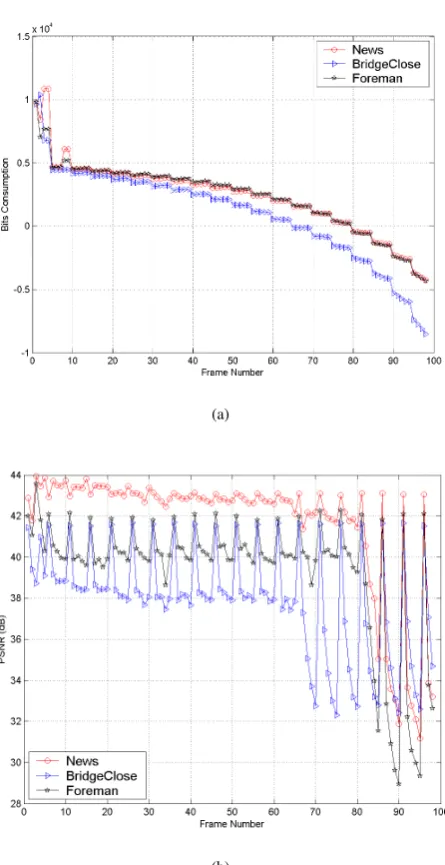
To prove the condition of unsuitable QP estima-tion in Li et al. [1], the "News", "Bridge-close" and "Foreman" video sequences in Figure 2 are selected for evaluation. For the main parameters comprising 300 Kbps for the target bit rate, 30 fps frame rate, the encoding structure is IPPPPIPPPP, and JVT-G012 de-cides the entire intra-frame QP is constant by Li et al. [1]. The presence of an unbalanced bit allocation is worth noting. Because several frames consume more
bits in the front video sequence, the status of bits un-derflow occurs in the hind video sequence. Though the large number of bits is used to encode frames be-tween the1stand5thframe when a small QP is
ap-plied, the increase in image quality is barely notice-able. During the interval between the61st and99th
frame, the image quality is large reduced to balance the target bits budget, resulting in unsmooth visual-ization. In summation, the two drawbacks comprise the uncontrollable bits allocation and noticeable de-cay in image quality. Thus developing an efficient rate control algorithm for intra-frame is an essential strat-egy.
3. Proposed variance-based intra-frame rate con-trol algorithm
This section comprises three parts: the mean square error (MSE)-based distortion measurement, the variance-based distortion measurement performed via theoretical deduction to analyze the distortion property, and the variance-based intra-frame rate con-trol algorithm.
3.1. Analysis of MSE-based distortion measure-ment
Wang and Kwong [11] verified the relation be-tween MSE and quantization step (Qstep).
Obtain-ingQsteprequires estimating MSE from the previous
frame. A real application equation is expressed as fol-lows:
Qstep=ρ×M SE (3)
whereρis the variable for difference video se-quences. To fit Qstep estimation more accurately,
however, Yan and Wang [10] have proposed a gradient-based equation to modify the formula (3) as follows:
Qstep=η×M SEprev×
(Grad
curr
M G ×
1
1− BFprev
Buf f erSize
+θ) +ε (4)
Where η, θ and ε are variables for difference video sequences. M SEprev is the previous frame MSE andBFprevis the previous buffer fullness after encoding the ithgroup of picture (GOP).Gradcurr
is the gradient value of the current frame, and MG is the average gradient value of the previously encoded I-frame in this sequence. According to various en-coding test sequences, the relationship betweenQstep
and the gradient value is quasi-linear. This study also considers the buffer fullness to further improve the
,
QP estimation and avoid the buffer overflow or un-derflow. The image complexity and bits buffer status are used to adaptively modifyQstepbecause the MSE
cannot accurately reflect QP estimation.
According to the above analysis, the distortion will primarily influenceQstep the estimation; thus,
attempting to discuss the relation between distortion and QP becomes an important topic. Distortion is per-formed via the quantization process in the video en-coding system. According to the theoretical defini-tion, the MSE can be expressed as follows:
M SE = 1
N
N X
i=0
(xCurri −xQuani )2
= 1
N
N X
i=0
(xCurri −x Curr i QP ) 2 = 1 N N X i=0
(xCurri )2(1−QP−1)2
(5) whereN represents all the image pixels,xCurr
i
andxQuani are the current image and the quantized image at the ith pixel, respectively. In the formula
(5), the MSE is influenced by image content and QP value. The increase in QP enlarges the MSE when the image content is constant, and vice versa.
3.2. Deduction and analysis of the variance-based distortion measurement
The theorem in [9] provides the original defi-nition of the rate-distortion form used in this study. This section discusses several necessary aspects for enhanced modeling operation. The relation between rate (R) and distortion (D) can be formulated as fol-lows:
R(D) =s×D+
Z ∞
−∞
Q(u) ln(λ(u))du (6)
wheres60,d(u, v)is an error metric measure-ment, D andλ(u)are defined as follows:
D=
Z ∞
−∞
Z ∞
−∞
λ(u)Q(u)P(v)esd(u,v)d(u, v)dudv
λ(u) = [
Z ∞
−∞
P(v)esd(u,v)d(u, v)dv]−1
(7)
Consider a source, Q(u), that outputs an in-dependent Gaussian random variable. The original source can be treated as P(v), which is also an in-dependent Gaussian random variable, with the as-sumption that a squared-error distortion measure is
d(u, v) = (u−v)2. Suppose the termsσandβ repre-sent the standard deviation of the outputQ(u)and in-putP(v)source, respectively. TakingQ(u)and sub-stitutingP(v), into the formula (7) yields the follow-ing relation:
D= α
2β2
α2+β2 + (
α2 α2+β2)
2α2 (8) whereα2= −1
2S . Therefore,α
2is directly related to the parameterS, whereasβ2is unrestricted. Thus
β2is chosen to satisfyα2+β2=σ2, producing the following relation onS:
D=α2=−1
2S (9)
The expression forR(D)then becomes
R(D) = 1 2ln(
σ2
D) (10)
The formula (10) is a well-known equation that can be expressed via the Taylor series to perform a close-form equation for QP estimation in the current H.264 rate control scheme.
According to the aforementioned observations in the formula (9), the distortion is evidently arbitrarily variable. The conditionα2+β2=σ2and the formula (9) lead to the following equation:
D=σ2−β2 (11) The analytic result (11) is an analytic and novel equation to estimate distortion. This equation is used to develop an efficient rate control algorithm. This study performs a new variance-based distortion mea-surement. The formula (12) shows a detailed deduc-tion process for evaluating the distordeduc-tion:
D=σ2−β2
= 1
N
N X
i=0
(xCurri −Mα)2−
1
N
N X
i=0
(xQuani −Mβ)2
= 1
N
N X
i=0
(xCurri −Mα)2−
1 N N X i=0 (x Curr i QP − Mα QP) 2 = 1 N N X i=0
(xCurri −Mα)2(1−QP−2)
whereN comprises all the image pixels,xCurr i
andxQuani are the current image and the quantized image at theith pixel, respectively. The terms Mα
andMβare the mean value of the current image and
quantized image. This distortion,D, comprises two items to compare with the formula (5): the first item is the consideration of the image mean, and the other is the new QP equation.
3.3. The study’s proposed intra-frame rate con-trol algorithm
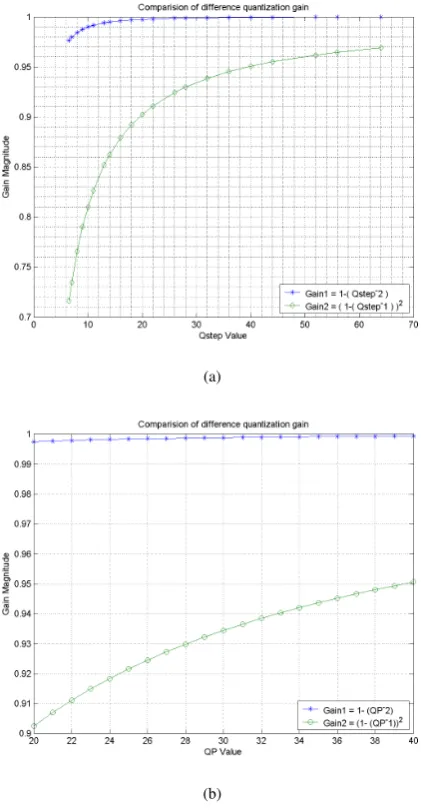
In past approaches Wang and Kwong [11], the estimated QP could be obtained via distortion, and the relative parameters are obtained via pre-training, the main reason being that the QP estimation of the first frame in the video sequence is not referential to any frame. Although the MSE can reflect actual QP estimation, the precision is not accurate. Due to this reason, the image content is considered in Yan and Wang [10] for adaptive QP modification. The train-ing procedure requires the linear relationship between QP and the distortion, but the intrinsic problem is not clearly identified. To compare the formulas (5) and (12), the main effect item is QP for distortion ob-tainment. Explaining the QP effect necessitates set-ting the bit rate to 400 kbps and the range ofQstep
from 6.5 to 64 (QP is between 20 and 40) to plot the relationship. Figure 2 shows the selection of two different variables to present the gain magnitude. Re-sults demonstrate that the linear mapping property in Gain1 is a better fit than Gain2, and the vibration is also small because this property can perform a more accurate QP estimation in the training procedure than the nonlinear mapping property [12]-[14]. Thus, se-lecting a variance-based distortion for QP estimation is more suitable than selecting an MSE-based distor-tion.
When the variance-based distortion utilizes ei-ther of the two parameters, the linear mapping prop-erty is also sustained. The QP parameter is more suitable thanQstepfor constructing the
quantization-distortion (Q-D) relation equation, as follows:
QP =γ×D+δ (13) Whereγandδare variables for difference video sequences. The formula (13) also includes the image complexity through the variance information to more accurately reflect the QP estimate. To integrate the intra-frame QP estimation in JVT-G012, the descrip-tion of the algorithm is represented as follows: if the input frame is first in the entire video sequence, QP value estimation can be achieved via the formula (1), restoring the reconstructed image variance. If the in-put frame is the first frame in the next GOP, the
dis-(a)
(b)
Figure 2. Comparison of the difference quantization gain is shown in two different equations: (a) using theQstep variable, and (b) using the QP variable.
tortion could be calculated via current frame variance and the previous intra-frame variance. According to the distortion, the estimated QP value can be obtained by the formula (13). The QP estimation for the inter-frame is calculated by the JVT-G012 quadric close-form, which is also implemented in JM15.0. A whole view of the intra-frame rate control is depicted in Fig-ure 3.
4. Experimental results
Figure 3. Integration of JVT-G012 and variance-based intra-frame rate control.
target bit rate is 300 Kbps for " Foreman," and " News," and 400 Kbps for "Bridge-close," "Highway," and "Grandma." Each sequence was coded at 15 fps according to the IPPPPIPPPP structure. The reference frame was set to 5, and the search window was set to 15. CAVLC, RDO, and rate control were also en-abled. The study equally selected other relative pa-rameters for JM15.0 [1], Yan and Wang [10], and the proposed algorithm. To obtain the model parameters in the off-line operation, five QPs were attempted, in-cluding 20, 25, 30, 35, and 40 in the first frame of the video sequence, and their respective distortions D were recorded. Via linear regression and recorded dis-tortions D, the good Q-D performance curve was con-structed. Table 1 lists the model parameters ofγand
δon various test sequences.
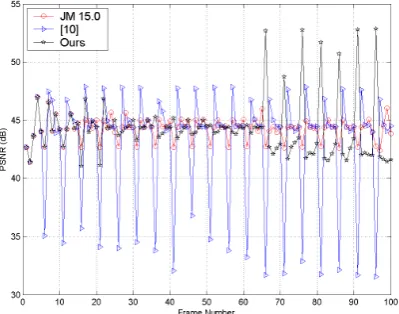
Figure 4 shows the frame-by-frame PSNR com-parison of three algorithms for the "Highway" video sequences. Since the JVT-G012 algorithm in the intra-frame QP estimation is not adaptive, all the intra-frames utilize the same QP. Yan and Wang [10] predicted that QP can sometimes be unsuitable; for example, a disadvantage is that the inter-frame only uses the large QP to preserve the target budget. Our proposed algorithm leads to image quality enhance-ment in the65thframe,71stframe,75thframe,81st
frame,85thframe,91stframe and96thframe in Fig-ure 4 especially. The proposed algorithm significantly enhances the PSNR in intra-frame and also holds suit-able quality in inter-frame when compared to JVT-G012 and Yan and Wang [10].
Figure 5 displays the bits consumption for "Fore-man" and "News" test video sequences. The figure demonstrates that the proposed algorithm can main-tain smoother and more suitable bits operation than both JVT-G012 and Yan and Wang [10], because both use QP values which are too small for previous frames, consuming large numbers of bits. In our
al-Figure 4. PSNR comparison of JVT-G012, Yan and Wang [10] and our proposed algorithm
on "Highway" video sequence.
gorithm, bit allocation is smoother, not only for frames, but also for inter-frames because the intra-frame receives suitable QP and saves bit count for post inter-frame encoding. Our result sustains smooth image quality and is highly suitable for limited band-width networks.
The proposed algorithm is more adaptive, pro-ducing smooth frame type changes, because it can ad-just the QP by using complexity measurements. This study adopts a formula in Wang and Kwong [5] to fur-ther evaluate the bit rate mismatch quantification, as follows:
4R= |Rt−Rb|
Rb
×100% (14)
whereRtis the bit rate of the test algorithm and
Rbis the target bit rate.4Rrepresents the degree of
mismatch in the produced bit rate, and the small4R
indicates that the QP-produced bit rate is closer to the budget, and vice versa. Table 2 presents detailed nu-merical simulation results, showing that the proposed algorithm can provide excellent performance, up to 0.19 dB and 1.28 dB better PSNR than JVT-G012 and Yan and Wang [10], respectively, while the output bit rate is also close to the target budget. This table also displays two gains, Gain 1 and Gain 2, to depict the performance improvement over JVT-G012 and Yan and Wang [10], respectively. Compared with JVT-G012 and Yan and Wang [10], the proposed algorithm improves results in all test sequences. These results show that the proposed algorithm produces lower4R
results than JVT-G012 for the News sequence. Table 2 also shows that the proposed algorithm is capable of controlling precision for the target bit rate. Moreover
Table 1. Model parameters of Q-D model with different video sequences
Video Sequences γ δ
Foreman 0.0465 -67.3608
News 0.5885 -40.2565
Bridge-close 0.4794 -77.6881 Highway 0.8383 -135.2993 Gradma 0.9146 -57.6692
(a)
(b)
Figure 5. Bits consumption comparison of JVT-G012, Yan and Wang [10] and the
proposed algorithm, on two different video sequences: (a)"Foreman" and (b)"
News".
the proposed algorithm presents better image quality than both JVT-G012 and Yan and Wang [10]. Further-more, the bit rate variation is near equal to JVT-G012 and Yan and Wang [10]. Thus, the proposed algorithm
can be applied to real-time multimedia data streaming and can produce excellent image quality.
(a)
(b)
(c)
Figure 6. Visual comparison of Yan and Wang [10] (left) and the proposed algorithm (right) in three different video sequences: (a)
"Foreman," (b) "News" and (c) "Highway." The frame is in the56th, 91stand96thlocation, from the top.
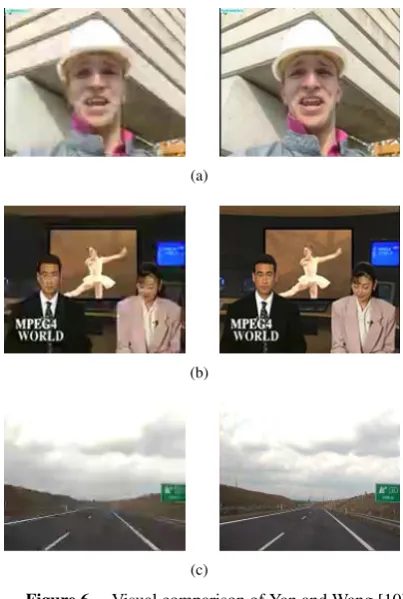
Worth noting is that since all the inter-frame QP estimates in Yan and Wang [10] are unsuitable, the inter-frame should increase QP to balance the overall bits target. To further improve fitting the algorithm to real visualization application, Figure 6 shows the re-sults of decoding frames with the Yan and Wang [10] versus the proposed algorithm in three test video se-quences, the56thframe in "Foreman", the91stframe
in "News," and the96thframe in "Highway"
Table 2. Performance of three algorithms in term of average PSNR, PSNR Std. deviation, bit rate and4R
Video Sequences Method Average PSNR(dB) PSNR Std. Deviation Bit Rates (kbps) 4R
Foreman JVT-G012 43.25 17.18 298.63 0.46
(300 kbps) [10] 42.87 18.17 298.97 0.34
Ours 43.39 17.16 298.34 0.55
Gain 1 +0.14 - -
-Gain 2 +0.52 - -
-News JVT-G012 47.26 19.09 299.50 0.17
(300 kbps) [10] 47.25 19.34 299.67 0.11
Ours 47.42 19.34 300.38 0.13
Gain 1 +0.16 - -
-Gain 2 +0.17 - -
-Bridge-close JVT-G012 41.76 16.48 399.81 0.05
(400 kbps) [10] 41.63 16.74 400.21 0.05
Ours 41.95 16.21 399.60 0.10
Gain 1 +0.19 - -
-Gain 2 +0.32 - -
-Highway JVT-G012 44.23 17.58 400.08 0.02
(400 kbps) [10] 42.96 17.86 400.13 0.03
Ours 44.24 17.25 400.76 0.19
Gain 1 +0.01 - -
-Gain 2 +1.28 - -
-Gradma JVT-G012 47.93 19.45 400.69 0.17
(400 kbps) [10] 47.86 19.44 398.49 0.38
Ours 48.12 18.96 398.62 0.25
Gain 1 +0.19 - -
-Gain 2 +0.26 - -
-the road sign in Figure 6(c), though -they are blurry, and the block effect is especially clear. The proposed algorithm can evidently improve the image quality compared to the currently used algorithm.
5. Conclusions
This paper presents a variance-based intra-frame rate control for H.264/AVC. The purpose of this pa-per is to make use of the advantage in the relationship between distortion and QP, in order to develop a more efficient method for intra-frame rate control. Experi-mental results show that the proposed algorithm can simultaneously improve both the PSNR and the bit rate. This algorithm is also constructed on a one-pass scheme. Numerous simulation results show that the proposed algorithm can also achieve a higher average PSNR and lower bit rate mismatch. The balanced bit allocation and control are suitable for strict network environment. Thus, this algorithm is better suited to H.264/AVC rate control than existing algorithms. In further work, we shall attempt to develop an adaptive method for model parameter switching and dynamic training.
References
[1] Z. Li, F. Pan, and K. Lim.Adaptive basic unit layer rate control for JVT.in proc. Joint Video Team (JVT) of ISO/IEC MPEG and ITU-T VCEG, JVTG012, 7th Meeting, Pattaya, Thailand, 2003.
[2] T. Chiang and Y. Q. Zhang. A new rate control scheme using quadratic rate distortion model.IEEE Trans. Circuit Syst. Video Technol., 1997, 7, 246 - 250. [3] J. Wei, B. H. Soong and Z. G. Li. A new rate-distortion model for video transmission using multi-ple logarithmic functions.IEEE Trans. Circuit Syst. Video Technol., 2004, 11, 694 - 697.
[4] Y. Liu, Z. G. Li and Y. C. Soh.A novel rate con-trol scheme for low delay video communication of H.264/AVC standard.IEEE Trans. Circuit Syst. Video Technol., 2007, 17, 68 - 78.
[5] H. Wang and S. Kwong.Rate-distortion optimization of rate control for H.264 with adaptive initial quanti-zation parameter determination.IEEE Trans. Circuit Syst. Video Technol., 2008, 18, 140 - 144.
[6] M. Jiang and N. Ling. Low-delay rate control for real-time H.264/AVC video coding.IEEE Trans. Mul-timedia, 2006, 8, 467 - 477.
[7] M. Wang and B. Yan.Lagrangian Multiplier Based Joint Three-Layer Rate Control for H.264/AVC.IEEE Signal Process. Lett., 2009, 16, 679 - 682.
2007, 17, 517 - 529.
[9] H.264/AVC Reference Software JM15.0. http://iphome.hhi.de, 2011.
[10] B. Yan and M. Wang. Adaptive distortion-based intra-rate estimation for H.264/AVC rate control. IEEE Signal Process. Lett., 2009, 16, 145 - 148. [11] H. Wang and S. Kwong.A rate-distortion
optimiza-tion algorithm for rate control in H.264.in proc. IEEE Conf. on Acoustics, Speech and Signal Processing, 2007, 1, 1149 - 1152.
[12] W. Wu and H. K. Kim.A novel rate control initial-ization algorithm for H.264.IEEE Trans. Consumer Electronics, 2009, 55, 665 - 669.
[13] S. C. Hsia and S. H. Wang. Adaptive video cod-ing control for real-time H.264/AVC encoder.Journal of Visual Communication and Image Representation, 2009, 20, 463 - 477.
[14] Y. Zhou, Y. Sun, Z. Feng and S. Sun. New rate-distortion modeling and efficient rate control for H.264/AVC video coding.Signal Processing: Image Communication, 2009, 24, 345 - 356.