http: // www.ijrtsm.com© International Journal of Recent Technology Science & Management 1
IJRTSM
INTERNATIONAL JOURNAL OF RECENT TECHNOLOGY SCIENCE & MANAGEMENT
“A REVIEW ON STUDY OF SWING JAW PLATES FOR SIZE REDUCTION
MACHINE”
Akash Kumar Raikwar
1, Kamal Kant Tiwari
21
M. Tech Scholar, Mechanical Engineering Dept., Oriental Institute of Science & Technology Bhopal,(M.P.), India
2
Assistant Professor, Mechanical Engineering Dept., Oriental Institute of Science & Technology, Bhopal,(M.P.), India
ABSTRACT
Crushers are machines which use a metal surface to break or compress materials mining operations use crushers, commonly classified by the degree to which they fragment the starting material with primary and secondary crushers handling coarse materials and tertiary and quaternary crushers reducing ore particles to finer gradations. This paper focuses on review of a work carried out by researchers on analysis of swing jaw plate i.e. kinematic & dynamic analysis of the jaw crusher plates due to which the design quality of jaw crusher are improved, though there were so many researcher work done on analysis, but still there is so many area of scope to develop the analysis of swing jaw plate.
KEYWORDS: Crusher, Swing Jaw Plate, Kinematic, dynamic analysis, machines, mining
I.
I
NTRODUCTIONJaw crushers generally of heavy duty steel box, fitted with fix vertical crushing “jaw” at one end and a moving “jaw” opposing it, with a method of transferring motion to the moving jaw. The moving jaw swing towards and away from the fixed jaw creating a compression action on the rock. The opening between the fixed and moving jaw tapers vertically from wide at the narrow at the bottom, thus gradually reducing the size of the rock as it move down through the crushing chamber.
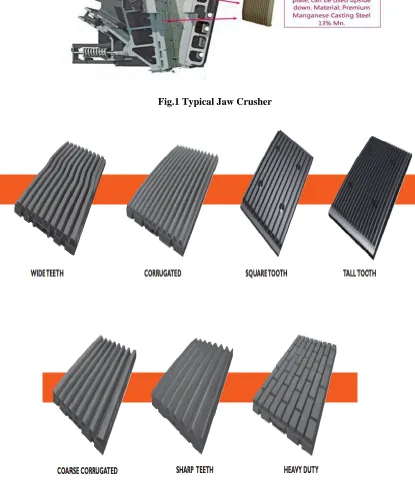
JAW CRUSHER LINER PLATE DESIGN & PROFILE SHAPES
Straight Jaw Plates: A shows a figure 2 of a standard type of Blake crusher with regular or straight jaw plates. This type of plate has been the standard from the time of its inception, emulating, in this respect, the straight concaves in the gyratory machine. And it will be noted that the theoretical action in this straight-plate jaw chamber follows quite closely the pattern of the action in the straight-concave gyratory chamber.
Non-Choking Jaw Plates: When the non-choking concave demonstrated its capabilities in the gyratory crusher, it was only
http: // www.ijrtsm.com© International Journal of Recent Technology Science & Management 2
Fig.1 Typical Jaw Crusher
http: // www.ijrtsm.com© International Journal of Recent Technology Science & Management 3
II.
LITERATURE
REVIEW
Martin (1982) [1] featured the double toggle jaw crusher mechanism as an example of a machine that uses the toggle effect to obtain a large output force that acts through a short distance, but he did not perform a static force analysis of the mechanism.
Erdman and Sandor (1991) [2] presented the determination of the mechanical advantage of a double toggle jaw crusher mechanism, as an exercise problem to be solved by(1)the method of instant centres, which is essentially a graphical method;(2)an analytical method that utilized complex number representation of vectors.
Norton (1992) [3] also discussed the mechanical advantage of linkage mechanisms and explained the toggle effect by the use of a jaw crusher mechanism of the Dodge type .
Lin and Change (2003) [4] addressed the issue of force transmissivity in planar linkage mechanisms. They derived and proposed a force transmissivity index (FTI) that considered the power flow path from the input linkage to the output linkage. They calculated the effective force ratio (EFR) as the ratio of the sum of actual power transmitted at each of the linkage joints in the power flow path to the sum of the maximum possible power that could be transmitted along the same power flow path. They then obtained the FTI as the product of the EFR and the mechanical advantage of the mechanism, thus taking into account the effect of the external load acting on the mechanism.
Chang et al. (2002) [5] extended and applied this method to parallel manipulators, defined, and proposed a mean force transmission index (MFTI). The presentation here will perform a static force analysis and obtain the mechanical advantage of the single toggle jaw crusher mechanism, from first principles.
Ashish Kumar Shrivastava, Avadesh K. Sharma (2012) [6] had represented parametric feature-based design of 3D
software and capable to solve the motion dynamics of the motion, and the reactions at the constraints of the mechanisms can be used as the inputs for any Finite element program to understand the behavior of stresses and deformations of the individual component of the machine to estimate the working life of the machine elements designed for the application. Parametric modeling functions. To reduce the development cycle and improve the design quality of jaw crusher, this paper takes full advantage of the Function module of the Pro/Engineer platform to make model simulation and dynamic analysis on the actual jaw crusher mechanism, and provided the updated path for the design and manufacture of Jaw Crusher.
Shivam Choudaha, Sunil Kumar Tiwari, Sarang Pande (2012) [7] had represented machines used to break or compress
using the metallic plates during mining of materials. The chronic problem of High Maintenance cost and extensive downtime in Jaw crusher. In this paper this problem is solved by implementing various techniques like process mapping, why analysis, Brain storming and appropriate use of plan-do-check-act (PDCA) cycle. The developments achieved by these techniques led to increase in customer satisfaction and productivity enhancement. The Customer requirement of Crushed Bath has been fulfilled by increasing the availability by 17%, Eliminating Breakdown, Reducing the MTTR by 89% and Maintenance Cost by 86% of Jaw Crusher. The study is helpful for gaining improvement in similar field as well as also in others.
A. Refahi, J. Aghazadeh Mohandesi, and B. Rezai (2009) [8] had represents Predicting the energy consumption during the
http: // www.ijrtsm.com© International Journal of Recent Technology Science & Management 4
the crushed rocks was examined and was compared to the PFC3D results. The tensile mode of fracturing is favorably modeled by the PFC3D software while the delaminating mode cannot be well modeled by PFC3D software.
Vishal N. Kshirsagar, Dr. S.K Choudhary, Prof. A.P Ninawe (2014) [9] had represented about the design of various components of can or plastic bottle crusher machine. This machine is widely used in beverage industries or in scrap dealers shop to reduce the volume of the cans/bottles. Hence in this design of various parts are necessary, and design of various parts due to which the design quality of those parts will be improved. There are s o many researchers who have done work on design and analysis also, but still there are so many areas of scope regarding this design. Overall, this project involves processes like design, fabrication and assembling of different components etc. After all process has been done, this crusher may help us to understand the fabrication and designing that involved in this project.
Eugeniusz Rusiński, Przemysław Moczko, Damian Pietrusiak, Grzegorz Przybyłek (2013) [10] investigates into the
causes of fatigue cracks of a jaw crusher supporting structure are presented. The problems appeared after short time of operation at a new crushing facility. A large number of fatigue cracks with a high growth rate and bolt failures were observed in the crusher supporting structure. Considering the high dynamic forces that occur during the operation of such equipment, an investigation into the problem was undertaken in order to prevent catastrophic failure of the crushing station. A specially developed, combined numerical and experimental method was used to determine the reasons for the problems and to solve them.
Bharule Ajay Suresh in 2009[11]Department of Mechanical Engineering National Institute of works on the swing jaw plate
for Design of lighter weight jaw plate by using and varying no of stiffeners for different thickness. as the energy required for the crushing the material decrease due to which the weight of swing jaw plate is decrease. This paper use point-load deformation failure (PDF) relationships along with interactive failure of rock particles as a model for such a weight reduction for the design and analysis of the swing plate.
Fig.3: Jaw plate with stiffeners
The present jaw plate models accurately predict the various stresses for plates. As the as the number of stiffener increases the strength/weight ratio of the jaw plate increases making it stronger than that of without stiffener. And hence the stiffened plate models which leads to 25% saving in energy, of course this 25% is an estimate.
http: // www.ijrtsm.com© International Journal of Recent Technology Science & Management 5
on the evolution of mid-point displacements, and plastic strain energy. The results obtained allow an insight into the effect of stiffener configurations and of the above parameters on the response of the plates under uniform blast loading and indicate that stiffener configurations and time duration can affect their overall behavior.
III.
CONCLUSION
Static analysis is helpful for understanding and improving the operating performance of the swing jaw plates. Static and dynamic analysis have very important significance for the life of the specific parts. Specific process will be no longer introduced. This concept of statics is followed by number of researches for their application. This review provides the background of jaw crusher kinematics to carried out further research work in same era.
REFERENCES
1. G. H. Martin, Kinematics and Dynamics of Machines, McGraw-Hill, 2nd edition, 1982.
2. G. Erdman and G. N. Sandor, Mechanism Design: Analysis and Synthesis, vol. 1, Prentice-Hall, 1991.
3. R. L. Norton, Design of Machinery: An Introduction to the Synthesis and Analysis of Mechanisms and Machines, McGraw-Hill, 1992.
4. C.-C. Lin and W.-T. Chang, “The force transmissivity index of planar linkage mechanisms,” Mechanism and Machine Theory, vol. 37, no. 12, pp. 1465–1485, 2002.
5. W.-T. Chang, C.-C. Lin, and J.-J. Lee, “Force transmissibility performance of parallel manipulators,” Journal of Robotic Systems, vol. 20, no. 11, pp. 659–670, 2003.
6. Ashish Kumar Shrivastava, Avadesh K. Sharma,“Dynamic Analysis of Double Toggle Jaw Crusher Using Pro-Mechanica”,International Journal of Engineering Research and Applications, Vol. 2, Issue 3, May-Jun 2012, pp.1132-1135.
7. Shivam Choudaha, Sunil Kumar Tiwari, Sarang Pande,“Improving Productivity of Jaw Crusher through OTIF Delivery by Reducing Down Time”, International Journal of Emerging Technology and Advanced Engineering (ISSN 2250-2459, Volume 2, Issue 10, October 2012.
8. A. Refahi, J. Aghazadeh Mohandesi, and B. Rezai,“Comparison between bond crushing energyand fracture energy of rocks in a jaw crusherusing numerical simulation”, The Journal of The Southern African Institute of Mining and Metallurgy VOLUME 109 REFEREED PAPER DECEMBER 2009.
9. Vishal N. Kshirsagar, Dr. S.K Choudhary, Prof. A.P Ninawe ,“Design Consideration in an Automatic Can/Plastic Bottle Crusher Machine”, International Journal of Engineering Research and General Science Volume 2, Issue 4, June-July, 2014
10. Eugeniusz Rusiński, Przemysław Moczko, Damian Pietrusiak, Grzegorz Przybyłek, “Experimental and Numerical Studies of Jaw Crusher Supporting Structure Fatigue Failure”, Stroj niški vestnik - Journal of Mechanical Engineering 59(2013)9, 556-563
11. Bharule Ajay Suresh, Computer aided design and Analysis of Swing Jaw Plate of Jaw Crusher, NIT Rourkela, 1-11, 2009
12. Kadid Abdelkrim “Stiffened Plates Subjected to Uniform Blast Loading “Journal of Civil Engineering and Management, Volume14, Issue3, July 2008, Pages155–161
13. J. E. Shigley and J. J. Uicker Jr., Theory of Machines and Mechanisms, McGraw-Hill Book Company, 1980.
http: // www.ijrtsm.com© International Journal of Recent Technology Science & Management 6
15. Z. Wang, H. Yu, D. Tang, and J. Li, “Study on rigid-body guidance synthesis of planar linkage,” Mechanism and Machine Theory, vol. 37, no. 7, pp. 673–684, 2002.
16. R.-C. Soong and S.-L. Wu, “Design of variable coupler curve four-bar mechanisms,” Journal of the Chinese Society of Mechanical Engineers, vol. 30, no. 3, pp. 249–257, 2009.
17. L. Mular, N. H. Doug, and D. J. Barrat, Mineral Processing Plant Design, Practice and Control: Proceedings, vol. 1, Society for Mining, Metallurgy and Exploration, 2002.
18. Carter Russell, “New Jaw Crushers are Reliable, Affordable and Transportable,” Rock Products, 1999,
19. C. W. Ham, E. J. Crane, and W. L. Rogers, Mechanics of Machinery, McGraw-Hill Book Company, 4th edition, 1958.
20. J. Denavit, R. S. Hartenberg, R. Razi, and J. J. Uicker, “Velocity, acceleration, and static-force analyses of spatial linkages,” Journal of Applied Mechanics, vol. 32, no. 4, pp. 903–910, 1965.