Copyright © 2015 IJECCE, All right reserved
A Low Cost Model for Diagnosing Coronary Artery
Disease Based On Effective Features
Hamideh Ganji Arjenaki
Faculty of Computer Engineering,Najafabad branch, Islamic Azad University, Najafabad, Iran emails: [email protected]
Mohammad Hossein Nadimi Shahraki
Faculty of Computer Engineering,Najafabad branch, Islamic Azad University, Najafabad, Iran
emails: [email protected]
Nasim Nourafza
Faculty of Computer Engineering,Najafabad branch, Islamic Azad University, Najafabad, Iran email: [email protected]
Abstract: Coronary artery disease which is one of the most dangerous diseases in the heart diseases field causes the death of many people every year. The diagnostic methods for this disease have high cost and many side effects on the patients. Even in the patients who have the similar signs of that disease, the use of these methods has high cost and unrelated side effects on them. Recently, researchers use data mining techniques to reduce the diagnosis cost of coronary artery disease. In this paper, firstly, the problem of cost of diagnosis of this disease is explained. Then, a model is proposed based on features selection to reduce the cost of diagnosis. The proposed model makes use of both genetic algorithm and perceptron neural network to select the most effective features. Then, the disease is diagnosed by Naïve Bayes classifier. Consistently, using these selected features reduces the cost. Although it is possible that the accuracy is decreased, the experimental results show that, the proposed model can maintain the accuracy.
Keywords: Disease Diagnosis, Coronary Artery Disease, Medical Data Mining, Feature Selection.
1.
I
NTRODUCTIONThe mortality rate of the disease is much more than those who lose their lives in accidents and natural disasters. The World Health Organization estimated that approximately 17 million deaths in the worldwide occur each year due to cardiovascular diseases. One of the most common and important diseases of heart disease is coronary artery disease. According to reports, about 7 million deaths resulting from the diseases occur annually in the worldwide [1].
This disease has different diagnostic methods with different precisions. As a whole, doctors often have to use several diagnostic methods which are not effective in all diagnostic diseases. Also, these methods have high cost and aggressive effect on the patients. These methods include angiography, nuclear imaging of the heart, CT angiography, and etc.
For example, diagnostic angiography method has a lot of uses in the diagnosis of heart disease and it has high cost and high side effects on the patients. There are advancements in sciences such as data mining and these advancements are used in the medical fields, treatment, prediction, and diseases diagnosis [2].
The present study consists of the following sections: the literature review, the proposed solution, the results and discussions.
2.
L
ITERATURER
EVIEWMachine learning rules are used in medical analysis from about 20 years ago unti now. The various studies have been conducted for diagnosing of heart diseases by using data mining techniques. The coronary artery disease was specifically investigated in some of these studies. Some of these studies tried to increase the accuracy of diagnosis with the total features and only a few of them focused on diagnosing of CAD with feature selection. In this study, a number of costly diagnostic methods were used to increase accuracy of disease diagnosis.
Weka and Ra used the data mining for the diagnosis of heart disease and they tried to increase the accuracy of diagnosis with various algorithms. Cheung, Ra, and Tool Diag carried out studies with various methods in order to increase the accuracy of disease diagnosis. For example, Weka and Ra tried to increase diagnosis of heart disease by using various algorithms such as IB1-4, Indocth, Folie, K, IB1C, R1, and Tz. Also, Ra and Tool Diag used the methods like RBF, MLP+BP.
Cheung (2001) used methods such as C4.5 Naïve Bayes, BNND, and BNNF to diagnose heart disease by data mining [3]. In another study, Turkoglu and Arslan (2002) used heart signal interpretation for diagnosing of heart valve disease which was based on pattern recognition, feature extraction from cardiac signals, and classification of features by using neural network [4].
Das et al. (2009) employed feature classification method by using neural networks ensamble. In this paper, the neural network ensembles technique was used for heart rhythm disorder. There were five stages for making the target model in this system. The dataset consisted of 297 lines and 13 features. The class label in this dataset was determined for presence and absence of the disease.
In the next stage, partitioning was done on the data. The input data were partitioned into two sections of train and test with the ratios of 70% to 30%. After that, the samples of dataset were selected and samples of data that were not suitable with aim of the problem were rejected. The neural network ensemble model was used for classification on selected data. Finally, the results were presented in format of an exit.
Copyright © 2015 IJECCE, All right reserved effect in increasing of accuracy, were omitted randomly
not manually.
In order to increase the performance of neural network, the ensemble mode was used. The processing power of neural network was increased according to the results that were obtained. The optimum answer was obtained by the use of three neural networks with respect to the different tests. The results were not improved by using of high number of neural network. The use of partitioning reduced the time of computation and performance than the models that were not partitioned. The omission of unrelated values reduced complication and the time of implementation.
One of the disadvantages of the used solution was to omit part of data. In fact, this solution was the use of preprocessing of sampling. But the omission of values of data was not done randomly and the data that were not suitable to the aim of the study were omitted. This made the result be unreal. Because the data that had negative effect in increasing of accuracy, were omitted randomly not manually [5].
The recent researches were tried to use the combination methods of feature selection and classification for diagnosing of this disease. Babaoglu, Findik, and Ulker (2010) presented an article and used feature selection method for diagnosing of cardiovascular. The results of their study showed that the feature selection with binary particle optimization and SVM classifier had 81% accuracy for disease diagnosis.
Shilaskar and Ghatol (2013) presented an article in the journal of Expert System with Applications. In their study, the data sets of other heart diseases were used in addition to datasets related to cardiovascular. The total features were accredited by the use of statistical distance. Features were ranked on the basis of statistical distance into reversed ranked and forward ranked respectively. In forward ranked mode, features were based on descending order and reversed ranked was vice versa.
Forward selection method was use for feature selection. The start of implementation of algorithm of forward selection is with the feature that has priority of higher selection (it is done based on ranking). If the new feature is added to the selected dataset and accuracy is not added to previous dataset, it is omitted. Otherwise, they are added to set of feature selection. This work continues until all features are surveyed.
The best results of the classification were obtained with forward selection method and with order of forward ranked for selecting features. SVM method was used for classification.
The advantages of this study can be referred to SVM classifier method that is effective classification method. Also, the use of forward selection causes the features that have negative effect in increasing accuracy, are not placed in selected feature sets and cause to improve accuracy of classification [6].
One of the disadvantages of SVM classifier is high complication of algorithm and required wide memory for doing duties in the big scale. One of the other problems the limitation of speed and size for both set of instruction
and test. While the size of characteristics is more than the size of sampling, this method shows the weak efficiency [7, 8].
In this algorithm selected high costly features. The features obtained from less expensive cost omitted because they reduced accuracy. Their precise is not as the same as expensive features [6].
3.
T
HEP
ROPOSEDM
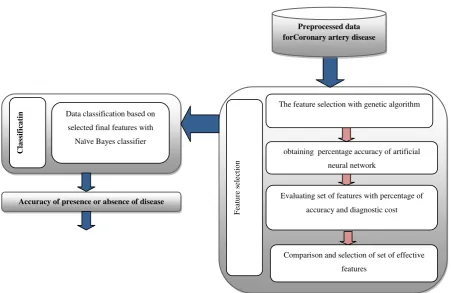
ODELThe proposed method consisted of two separated stages. The first stage is the feature selection and the another is the classification of selected features.
A. Feature Selection
According to recent research, the feature selection has the positive effect in increasing accuracy and reducing computational and financial cost. The combination method of genetic algorithm and perceptron neural network with the minimum cost and acceptable accuracy are used. In this problem, the chromosomes of genetic algorithm are considered as the same existent feature in the dataset. In order to understand the competency of chromosomes, the related features in each chromosome are identified and are classified by the use of Perceptron neural network. Fitness function F(x) is obtained in the equation 1 for evaluating perspective chromosome (the selected features) from the ration of percentage of accuracy to diagnostic features.
1 ) ( cos
) ( )
(
x t
x accuracy x
F (1)
The best chromosome has bigger value of fitness function.
B. Classification
In the previous stage, the best feature set was identified by using the combination of genetic are classified by Naïve Bayes classifier. The percentage of accuracy is considered as acceptable accuracy of algorithm. The model of proposed solution is presented in Fig 1.
4.
E
VALUATION OF THES
UGGESTEDS
TRATEGYUsing of genetic algorithms make various selections of subsets from the features. Also, it is possible to select the best subset of features which are suitable with the objective of problem (cost reduction with acceptable accuracy) by using the function of genetic algorithm evaluation [9].
Neural networks are able to classify the inputs to get proper output [10].
Perceptron neural network are extremely fast and reliable in solving and these are simpler than other neural networks [11].
Due to the power of learning in different tests, the use of perceptron neural network for evaluating the accuracyof classification of every subset incline the answer toward features with higher diagnostic accuracy.
Copyright © 2015 IJECCE, All right reserved Fig.1. Proposed Solution Model
5.
R
ESULTS ANDD
ISCUSSIONSMatlab 2012 and Weka software were used. Data set which was called heart_ stalog is originated from the database UCI [12]. The label of dataset class had two states of absence for the absence of disease and present for the presence of disease. This data set includes 13 attributes and they are described below:
Relation heart-statlog
1-@attribute age real
2-@attribute sex real
3-@attribute chest real
4-@attribute resting_blood_pressure real
5-@attribute serum_cholestoral real
6-@attribute fasting_blood_sugar real
7-@attribute esting_electrocardiographic_results real
8-@attribute maximum_heart_rate_achieved real
9-@attribute exercise_induced_angina real
10-@attribute oldpeak real
11-@attribute slope real
12-@attribute number_of_major_vessels real
13-@attribute thal real
Class-Lable@attribute class (absent, present)
The accuracy is equal to percentage of samples tested by the model are classified correctly to the total number of samples. This formula is showed in the equation 2.
classified are
samples of number total
correctly classified
are sample of number
accuracy , (2)
At first, all features are classified by SVM and Naivebayes classifiers. SVM classifier is used in method
presented in [6] that in this study used for the base methodin the recent researches. In proposed solution is used Naivebayes classifier. Result on Table 1 showed.
Table 1. Result of use all feature in classification by SVM and Naivebayes classifier.
Clas
sifier
F
ea
tu
re
se
lec
ti
o
n
Nu
m
o
f
fe
atu
re
Co
st o
f
d
iag
n
o
stic
b
y
tri
ff
p
u
b
li
c ($
)
Co
st o
f
d
iag
n
o
stic
b
y
tri
ff
p
riv
ate($
)
Ac
cu
ra
cy
(%
)
SVM Don’t
use 13
215 1518 83.70
Naivebayes Don’t
use 13
215 1518 85.18
The results on of Table 1,showed that Naïve Bayes classifer had higher accuracy compared with SVM classifer.
In this study, the method presented in [6] was compared with the proposed solution. By using forward selection method and SVM classifier in [6], nine features were selected. The percent of its accuracy was accompanied with the cost of feature diagnosis. The cost of feature diagnosis is according to tariff rates for public and private medical centers in Iran. Nine features are selected and classifies by SVM classifier.
The selected attributes are brought with the use of implementation method in subset X.
F
ea
tu
re
s
el
ec
ti
o
n
Data classification based on
selected final features with
Naïve Bayes classifier
The feature selection with genetic algorithm
obtaining percentage accuracy of artificial
neural network
Preprocessed data forCoronary artery disease
Evaluating set of features with percentage of
accuracy and diagnostic cost
C
la
ss
if
ic
a
ti
n
Comparison and selection of set of effective
features
Copyright © 2015 IJECCE, All right reserved X=(3, 6, 7, 8, 9, 10, 11, 12, 13)
In this method, there are the costly features such as number 12 and 13 which are angiography and heart scan. At first, the classification of base method and the proposed method for attributes of subset X are performed. Table 2 shows the results of implementation of SVM and Naïve Bayes classifiers on selected feature by using of Feed forward:
Table 2. Forward selection and SVM classifier was used in the base method in the recent researches for diagnosing coronary heart disease.compare accuracy of SVM and
Naïve Bayes classifer for feature selected. Clas
sifier F ea tu re S elec ti o n Nu m o f fe atu re Co st o f d iag n o stic b y tri ff p u b li c ( $ ) Co st o f d iag n o stic b y tri ff p ri v ate($ ) Ac cu ra cy (% ) SVM Forward selection 9 215 1518 85.18 Naïve Bayes Forward selection 9 215 1518 85.92
The results on of Table 2, in row 1 showed cost and accuracy with forward selection and SVM classifer that used in [6]. In next row of Table1, test repeated by Naïve Bayes classifer and accuracy is improved. Cost of diagnostic in Table2 is similar to Table1, as featuershave not been selected in this tests are not cost of diagnostic.
For evaluating of proposed solution, features selected from proposed solution were classified by SVM classifier and Naïve Bayes classifier. Then, their accuracy was compared.
The selected attributes are brought with the use of proposed solution in subset Y.
Y=(10 ،9 ،8 ،7 ،6 ،4 ،3 ،1)
The results on Table 3 showed that the use of proposed solution of diagnosis cost of disease decreased significantly and Naïve Bayes classifiers in comparison with SVM classifier had more acceptable and higher accuracy. The number of selected features with the use of proposed solution was decreased to 8 features.
Table3. Result of use proposed solution for feature selection and compare SVM classifier and Naïve Bayes classifier for feature selected
Clas sifier F ea tu re se lec ti o n Nu m o f fe atu re Co st o f d iag n o stic b y tri ff p u b li c ($ ) Co st o f d iag n o stic b y tri ff p riv ate($ ) Ac cu ra cy (% ) SVM Feed forward 8 34 226 83.33 Naivebayes Proposed model 8 34 226 85.18
Based on Table 3, Naïve Bayes classifiers had higher accuracy than SVM classifiers. Also the features that are selected by Forward Selection had high diagnostic cost.
The results of this study showed that the use of proposed solution in diagnostic costs with effective features decreased significantly and Naïve Bayes classifier is more precise and more acceptable than SVM classifier.
6.
C
ONCLUSIONThere are costly diagnostic methods for diagnosing coronary artery disease and all of diagnostic methods are not effective in disease diagnosis. To solve the aforementioned problem, is used proposed solution with combination of genetic algorithms and proceptron neural networks. This proposed led to selection of effective features with lower and more acceptable diagnostic cost. As a result, ineffective features for diagnosing of this disease are removed due to high diagnostic cost. The tests showed that the Naivebayes classifer had higher accuracy for feature selected.
7.
F
URTHERW
ORKThere are the different views for future works in this field and this field of study can be taken into consideration for other researchers. The more various data base regarding the clinical signs of patients will be used to improve the results and raise the diagnostic accuracy. Also, the proposed solution will be used in diagnosing of the cardiovascular diseases and other costly and dangerous diseases.
R
EFRENCE[1] C. Yadav, S. Lade, and M. K. Suman, "A Survey on Data Mining Techniques for the Diagnosis of Coronary Artery Disease", International Journal of Advanced Research in Computer Science and Software Engineering, vol. 3, 2013, pp. 740-744.
[2] R. O. Bonow, D. L. Mann, D. P. Zipes, and P. Libby, "Braunwald's Heart Disease: A Textbook of Cardiovascular Medicine", Elsevier Health Sciences, 2011.
[3] N. Cheung, "Machine learning techniques for medical analysis". School of Information Technology and Electrical Engineering, B. Sc. Thesis, University of Queenland, 2001.
[4] I. Turkoglu, A. Arslan, and E. Ilkay, "An expert system for diagnosis of the heart valve diseases", Expert systems with applications, vol. 23, 2002, pp. 229-236.
[5] R. Das, I. Turkoglu, and A. Sengur, "Effective diagnosis of heart disease through neural networks ensembles", Expert Systems with Applications, vol. 36, 2009, pp. 7675-7680.
[6] S. Shilaskar and A. Ghatol, "Feature selection for medical diagnosis: Evaluation for cardiovascular diseases", Expert Systems with Applications, 2013, pp. 4146-4153.
[7] H. Drucker, D. Wu, and V. N. Vapnik, "Support vector machines for spam categorization", Neural Networks, IEEE Transactions on, vol. 10, 1999, pp. 1048-1054.
[8] Z. Bin, L. Yong, and X. Shao-Wei, "Support vector machine and its application in handwritten numeral recognition", in Pattern Recognition, 2000. Proceedings. 15th International Conference on IEEE Computer Society, 2000, pp. 720-723.
Copyright © 2015 IJECCE, All right reserved [10] J. Han and M. Kamber, "Data mining: concepts and techniques",
second ed: Morgan kaufmann, 2006.
[11] H. Demuth, M. Beale, and M. Hagan, "Neural Network Toolbox™
6", User Guide, 2008, pp. 104-135.
[12] Bache, K. & Lichman, M. UCI Machine Learning Repository, Irvine, CA: University of California, School of Information and Computer Science, 2013. [Online]. Available:
http://archive.ics.uci.edu/ml
A
UTHOR’
SP
ROFILEHamideh Ganji Arjenaki was born in Shahrekord, Iran, on November 1, 1987. received her B.Sc. in computer engineering from Qom University, Qom, Iran, in 2010, and she has recently completed her MSc thesis research on a low cost method to diagnosis coronary artery disease by using effective features under the supervision of Dr. Mohammad-Hossein. Nadimi-Shahraki from IAUN in 2014. Her research interests are data mining and Applications. on which she has published papers in several conferences and journals
Dr. Mohammad Hossein Nadimi Shahraki was born in Iran. He received his Ph.D in computer science from University Putra of Malaysia (UPM) in 2010. Currently, he is a full time Assistant Professor at the Faculty of Computer Engineering of Islamic Azad University of Najafabad (IAUN), His research interests include data mining, web mining, social network mining and recommender systems.