Copyright © 2014 IJECCE, All right reserved
1
Artificial Neural Network Based Induction Motor Speed
Controller
B. O. Omijeh
Department of Electronic and Computer Engineering, University of Port Harcourt,
Rivers State, Nigeria. email:[email protected]
D.C.Idoniboyeobu
Department of Electrical Engineering, Rivers State University of Science &
Technology, Nigeria.
G. O. Ajabuego
Department of Electrical Engineering, University of Port Harcourt, Nigeria
Abstract : In this paper, Artificial Neural Networks (ANN) based efficient speed control of an Induction Motor has been achieved. The ANN is properly trained to learn the dynamics of the Induction Motor. The Model Predictive Control (MPC) architecture is employed for system identification and the design of the Neural Network Control system. The Field Oriented Control system is implemented which allows for independent control of speed and torque and increases the robustness of the motor. Finally, the motor was given a tough test by sudden addition of load torque while it was in operation. The neural network controller however, demonstrated that it is worth the hype by rapid rejection of load disturbance and quick stabilization to its reference speed.
Keywords: Induction motor, Artificial Neural Network, Field Oriented Control, ModelPredictive Control.
1.
I
NTRODUCTIONBeing in the top cadre of the most useful and popular class of available motors, Induction Motors are gradually becoming the workhouse of the industry replacing DC Motors in various servo applications and high speed drives[1]. This and many more it has achieved through its many desirable characteristics such as : high reliability, high starting thrust, no backlash and less friction, suitability for low and high speed operations, least expensive. Despite all these enticing qualities of the induction motor, it has always suffered a setback in the area of speed control as it is a highly coupled nonlinear plant and proves to be in the class of machines with the most complex and expensive speed drive.
Various methods of speed control of the induction motor had been employed such as the scalar (or the Volts/Hertz) control where the speed of the motor is controlled by scaling the voltage in proportion to the desired frequency. However, with the introduction of the Field Oriented Control system which improves the dynamics of the motor, various forms of speed control has been devised such as the P-I Control, Fuzzy Logic, Fuzzy Neural and the Artificial Neural Network Control systems. The Artificial Neural Network is a mathematical model inspired by biological neural networks. It consists of an interconnected group of artificial neurons, and it processes information using a connectionist approach to computation [2]. It has the special ability of learning which implies that it can estimate the output of a system based on its experience on a set of previously trained data.
2.
R
ELATEDW
ORKSA. Rubaai and M. Kankam in their work titled ' Adaptive Tracking Controller for Induction Motor Drives using Online Training of Neural Networks ' used the indirect model reference adaptive control system to model the neural network controller laying emphasis on the effects of sudden, random load torque changes[3].
Miloudi et al in their work entitled 'A Neural Network Based Control Design Strategy of an Indirect Vector Controlled Induction Machine Drive' proposed a system whereby the induction motor is first controlled using the P-I control method, and then data taken; and used to train the Neural Network controller[4].
Hassan et al in their work entitled 'A Neural Network Based Speed Control of a Linear Induction Motor Drive' used the Model Predictive Control approach for the control of a linear induction motor using the General Regression Neural Network (GRNN)[5].
A Model Predictive Control scheme was used by a Mishra and Choudhary in their work entitled 'Artificial Neural Network Based Controller for Speed Control of an Induction Motor using Indirect Vector Method[6]. In their work, the plant was first identified using the NN Toolbox. This led to the generation of training data which was used to train the network to obtain optimum value of weights and biases [7].
3.
D
ESIGNM
ETHODOLOGYThe control system for this drive is very similar to that of traditional control systems with a reference input (desired speed in this case), feedback (measured speed), the controller and the plant[8] [9]. The Controller is made of the artificial neurons connected in a network. The network is made of 1 input layer, 7 hidden layers and 1 output layer connected as a feed forward network and trained using the Levenberg-Marquidt algorithm. A sketch of the neural network is as shown below:
Fig.1: Neural Network Structure
Input Layer Hidden Layer Output Layer
Copyright © 2014 IJECCE, All right reserved
2
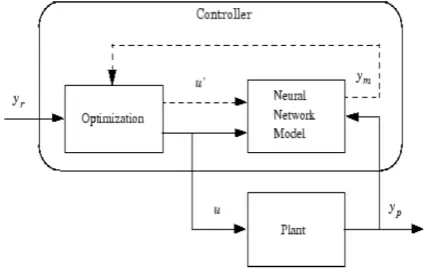
The Neural Network architecture in employed Fig.1 is of the Model Predictive Control type. This is used to identify the system as shown in Fig. 2 in the block diagram:
Fig.2: System Identification and Control Design
The Induction motor model used is a Simulink plant model with the following parameters:
Motor Parameters and Values:
Shown in Table 1 is the Induction Motor parameters and values.
Table 1: Induction Motor Parameters
Power 50HP
Voltage 460V
Frequency 60Hz
Stator Resistance(Rs) 0.0996/ohm Stator Inductance (Ls) 0.000867H
Rotor Resistance (Rr) 0.05837 ohm
Rotor Inductance (Lr) 0.000867H
Mutual Inductance(Lm) 0.0304H
4.
S
IMULINKM
ODEL OF THES
YSTEMAs stated before, the Field Oriented Control approach has been used, and this implies orienting the STATOR CURRENT VECTOR to always be at 90° with the ROTOR FLUX ANGLE so as to independently control the flux and torque thereby achieving maximum torque for any speed level. However, due to the asynchronous nature of the induction motor, the rotor flux angle cannot be directly determined by simply measuring the angle of the rotor (as is obtainable in synchronous motors). Hence, the rotor flux angle is estimated from the motor dynamics as shown in the more detailed diagram in Fig.3.
(a)Stator Quadrature-Axis Current Calculation
Block:
Stator quadrature-axis current reference iq is calculated
from the torque reference (Te*) using the relation in eqn.1;
� = . .��
�. ∗
|| ...(1)
Fig. 3: Simulation of Induction Motor Using Artificial Neural Network [10]. The Simulink building blocks of the drive system are as shown below;
Where: Lr = rotor inductance, P = number of poles Lm = mutual inductance, est = estimated rotor flux linkage
The block diagram is as shown below in Fig. 4.
Fig.4: Stator Quadrature-Axis Current Calculation Blocks
(b)Stator Direct Axis Calculation Block:
The stator direct-axis current (id) which is a function of
the rotor flux and mutual inductance is defined as;
� =�
The block is as shown in Fig.5
Fig.5: Stator Direct Axis Calculation Blocks
(c)Rotor flux position calculation block (
):
The rotor flux position which is required for co-ordinates transformation is estimated from the measured rotor speed (wm) and the slip frequency (wsl)
i.e = (wm+wsl)dt ... (2)
However, the slip frequency is a function of the stator quadrature current iq and the estimated rotor flux est and
is calculated using eqn.3.
� =��
.� . � ...(3)
The block calculation is as shown Fig.6.
Copyright © 2014 IJECCE, All right reserved
3
(d)Rotor Flux (Value) Calculation Block:
The estimated rotor flux linkage is given by eqn.4. = ��.�
+ . ... (4) Where: � = � = � � � �
The block for the estimates rotor flux value is shown in Fig.7.
Fig.7: Flux Calculation Blocks
(e)abc axes to d-q axes transformation block:
The stator current vector is transformed from abc axes to the d-q axes through the forward Clarke-park transformation give-by eqn.5.
.. (5) The abc axes to d-qaxes transformation block is shown in Fig.8.
Fig.8: abc to d-q Transformation Blocks
(f)Reverse Clarke-park transformation block:
To jump off from the rotating reference frame, there is need to convert the current id and iq (exiting in the
reference fame) back to stationary value; ia, ib and ic
(which exist in the stationary frame) and this is achieved through the reverse clark-park transformation and the relationship is as given by eqn.6.
..(6)
� = −� − �
Hence the block is as shown in Fig.9.
Fig.9: d-q to abc Transformation Blocks
(g)Current regulator block:
The three phase output currents from the Reverse Clark-Park Transformation (d-q - abc) block is passed through a current regulator which is composed of those hysteresis controller as shown in Fig.10
Fig.10: Hysteresis Current Regulation Blocks
(h)Universal Bridge Inverter
The Universal Bridge Block implements a universal three-phase power converter that consists of up to six power switches connected in a bridge configuration. It also allows simulation of converters using both naturally commutated (and line-commutated) power electronic devices (diodes or thyristors) and forced-commutated devices (GTO, IGBT, and MOSFET). This is a three terminal power semiconductor device primarily used as an electronics switch and is noted for combining high efficiency and fast switching.
The block diagram of the universal bridge is as shown in Fig. 11.
Fig.11: Universal Bridge Blocks
5.
R
ESULTS ANDD
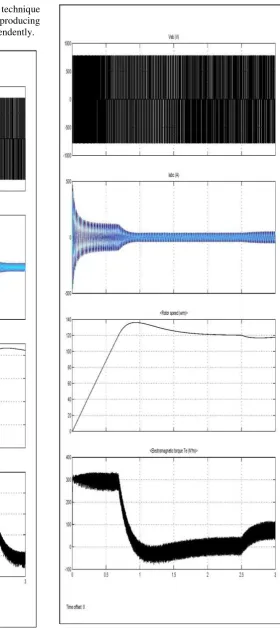
ISCUSSIONSA unit step input speed starting at 120 rad/s and maximum of 200 rad/s for a time step of 2 seconds. On
simulation as shown in Fig.12. and Fig.13, the neural network demonstrates its professionalism in
speed-tracking operations by attaining the initial reference speed of 120 rad/s under 1.2 seconds and the 200 rad/s of speed was achieved in 3 seconds. Also observed was the effective control of torque at the attainment of each reference speed; as the torque tends to zero (which is the reference torque in this paper).
Copyright © 2014 IJECCE, All right reserved
4
This proves that the neural network control technique effectively isolates the flux and torque producing components so that each can be controlled independently.
Fig.12: Performance of Speed Control of Induction Motor Using Neural Network Control with No Load torque applied with Reference Speeds of 120rad/s and 200rad/s at
step time t = 2sec
Fig. 13: Performance of Speed Control of Induction Motor
Using Neural Network Control with Load torque of60Nm applied at t = 2.5s with Reference Constant Speed of
Copyright © 2014 IJECCE, All right reserved
5
6.
C
ONCLUSIONResults have proved beyond doubt that the neural network controller has a better dynamic behavior, with a rapid settling time, no overshoot, almost instantaneous rejection of load disturbance, perfect speed tracking and deals well with parameter variations of the motor.
R
EFERENCES[1] Rubaai and M. Kankam (2000), Adaptive Tracking Controller for Induction Motor Drives Using Online Training of Neural Networks. [2] Wikipedia(2013), Artificial Neural Networks:
http://en.m.wikipedia.org/wiki/artificial_neural_network/
[3] Jammuna.V and Rama.R (2010), Artificial Neural Network Based Control of Bidirectional Chopper Fed Induction Motor Drive Using DFRT Theory.
[4] Miloudi et al (2003), A Neural Network Based Control Design Strategy of an Indirect Vector Controlled Induction Machine Drive. [5] Hassan et al (2010), A Neural Network Based Speed Control of a
Linear Induction Motor Drive.
[6] Mishra and Choudhary.P (2012), Artificial Neural Network Based Controller for Speed Control of an Induction Motor Using Indirect Vector Method.
[7] Mathworks (2013), Model the Dynamics of Three Phase Asynchronous Machine.
[8] Omijeh B. O (2009) Circuit Analysis and Simulation (With Matlab and Tina Apps), First Edition, Joint Heirs Publications Nig. LTD. [9] Mishra and Choudhary P. (2012) Artificial Neural Network Based
Controller for Speed Control of an Induction Motor Using Indirect Vector Method, International Journal of Power Electronics and Drive System (IJPEDS), Vol.2, pp. 402-408.
[10] Mathworks Inc. (2013) Asynchronous Machine, www.Mathworks.com/help/physmod/sps/powersys/ref/asynchronou smachine.html;jsessionid=8681b57a4f8e74809d56a020210e, 12 November.
A
UTHOR’
SP
ROFILEBourdillon .O. Omijeh holds a B.Eng degree in Electrical/Electronic Engineering, M.Eng and Ph.D in Electronics/Telecommunications Engineering from the University of Port Harcourt & Ambrose Alli University (A.A.U) Ekpoma, respectively. His research areas include: Artificial Intelligence, Robotics, Embedded Systems Design, Modeling and Simulation of Dynamic systems, Intelligent Metering Systems, Automated Controls, Telecommunications and ICT. He has over thirty (30) technical papers & publications in reputable National & International peer reviewed Journals. He has authored some Electrical/Electronic Engineering Text books; and also, has developed over ten(10) engineering application Software. He is a member, Institute of Electronics and Electrical Engineers (MIEEE), Corporate Member, Nigeria Society of Engineers; and also, a registered practicing Engineer with COREN. He is currently a Senior Lecturer & pioneer HOD, Department of Electronic and Computer Engineering, University of Port Harcourt, Nigeria; and also, a consultant to companies & Institutions. He is happily married with Children. E-mail: [email protected]
D.C.Idoniboyeobu holds B.Eng, M.Eng and Ph.D in Electrical/Electron-ic Engineering. His research interest is in ElectrElectrical/Electron-ical Designs, Power Systems, Machine, Renewable Energy, Control etc. He is a prolific writer with numerous Journal articles and publications. He is a member, Institute of Electronics and Electrical Engineers (MIEEE), Member, Nigeria Society of Engineers; and also, a Registered Engineer (COREN). He is a consultant to companies & organization. He is a senior Lecturer and presently, the Acting HOD, Electrical Engineering, Rivers State University of Science & Technology, Nigeria. He is happily married with Children.