WEED DYNAMICS IN MAIZE AS AFFECTED BY DIFFERENT FORMS OF DAIRY MANURE AND NITROGEN MANAGEMENT
Wisal Ahmad1*, Mohammad Tariq Jan1, Muhammad Ilyas1, Kamran Azeem2, Tariq Shah1, Moin Ullah1, Muhammad Faraz1and Kamran Khan1
https://doi.org/10.28941/24-2(2018)-2
ABSTRACT
Weeds infestation is one of the major constraints in limiting the crop productivity particularly when the organic manures are applied. Therefore an experiment was designed to study the weeds dynamics with respect to addition of different forms of dairy manure with nitrogen (N) management for improved economic yield of maize. The experiment was comprised of two forms of dairy manure, i.e. fresh and composted and their respective levels (3, 4 and 5 tons ha-1) with supplemental nitrogen application method (single split and two splits). The results of the experiment indicated that different forms and levels of manure significantly affected weeds density m-2, weeds fresh weight, weeds dry weight and grain yield whereas nitrogen application timing had no significant effect on weeds density, weeds fresh and dry weight but considerably varied the grain yield of maize. The weeds density, fresh and dry weights of the weeds were higher with the addition of fresh dairy manure as compared to composted manure. In contrast, the grain yield was higher with the addition of composted dairy manure as compared to fresh manure. Among different levels dairy manure addition at the rate of 5 tons ha-1 significantly increased the weeds density, weeds fresh and dry weights. The grain yield of maize was also higher with the addition of 5 tons manure ha-1. The grain yield was higher with the addition of supplemental nitrogen at the rate of 100 kg ha-1 in two equal splits half each at sowing and V6 stage. It was concluded that composted dairy manure at higher level of (5 t ha-1) increased the yield of maize and declined the weeds infestation.
Keywords:Composted manure, Fresh manure, Maize, Weeds, Yield.
Citation:Ahmad, W., M. T. Jan, M. Ilyas, K. Azeem, T. Shah, M. Ullah, M. Faraz and K. Khan. 2018. Weed dynamics in maize as affected by different forms of dairy manure and nitrogen management. Pak. J. Weed Sci. Res., 24 (2):69-78.
1Department of Agronomy, Faculty of Crop Production Sciences, The University of Agriculture Peshawar, Pakistan.
INTRODUCTION
Maize (Zea mays L.) is one of the important cereal crop in Pakistan. In Pakistan, it is ranked 3rdafter wheat and rice on the basis of production. Maize is used as a source of food for humans, feed for animals and in industries to make corn flakes, corn oil, corn syrup, lactic acid and alcohol etc. (Khan et al., 2011). Maize is cultivated mostly in Khyber Pakhtunkhwa (KP) and Punjab province of Pakistan. In KP, 56% of the total cultivated land is occupied by maize and contributes 63% to the total production of maize in Pakistan (MNFSR, 2015). In Pakistan, maize was raised on 1142.5 (000) ha with production of 4937 (000) tons, whereas the national average yield was 4321 kg ha-1. In Khyber Pakhtunkhwa it was raised on 463 thousand ha area which produced 909.7 thousand tons. The average yield of KP was 1965 kg ha-1(MNFSR, 2015).
There are several interrelated factors which cause low crop yield, infestation of weeds is one of the major which causes low productivity and quality of crop. Weeds are unwanted plant that grow out of place and compete with crop for light, space, nutrients and water (Kumar et al., 2013). Weeds not only reduce the fertility of the soil but also decrease crop quality and productivity by extracting the nutrients and water of them. Weeds also act as vector for infestation of insect pests and diseases. It also increases the harvesting, threshing and cleaning cost of the crop (Oad et al., 2005). According to FAO, weeds account on an average 35% losses in most of the crops worldwide. Ashiq et al. (2003) stated that yield losses from 20% to 40% were reported in most of the crop in different areas depending upon the type, intensity and severity of weeds. Rabbani et al. (2013) stated that average estimated yield loss occur in Pakistan is 11.5% compared with global average of 9.5%. Furthermore the weeds increase the cost of production for farmers and can be managed by integrated nitrogen management.
Manure is a main source of nutrients and used to improve soil fertility
but it also act as a source of weeds infestation. Organic manure like farmyard manure and poultry manure applied plots has increased weeds density and dry weight. Fresh manure release nutrients slowly throughout the growing season but the major disadvantages of fresh manure are the presence of weed seeds and unavailability of nutrients at first year of crop. The compost has less weeds seeds (Wiese et al., 1998; Eghball and lesoing, 2000) and pathogen (Wortmann et al., 2012) due to high temperature (104-149o F). Composted manure decrease weeds invasion through varying physiochemical properties of soil i.e. soil bulk density, soil temperature and water holding capacity (Singer et al., 2004). Compost application decrease seed bank of weeds in soil (Menalled et al., 2009) by releasing phytotoxic compounds in the environment which reduces the weeds seed germination and weed emergence (Hampton et al., 1999). Fresh and composted manure release nutrients in slowly as compared to inorganic fertilizers which benefit the weeds more than crop (Blackshaw, 2005).
The current study was aimed to study the weeds dynamics with respect to the application of different forms of dairy manure and their level as well as on economic yield of maize under supplemental nitrogen management.
MATERIALS AND METHODS Experimental site and design
The experiment was carried out at Agronomy Research Farm of The University of Agriculture Peshawar during summer 2015. The randomized complete block design was used to carry out the experiment with four replicates.
used as a source of nitrogen. Phosphorus and potassium were applied at the rate of 90 and 60 kg ha-1 from single super phosphate and KCl, respectively. The cultivar ‘Azam’ of maize was planted at the seed rate of 30 kg ha-1 with row to row distance of 70 cm. The crop was irrigated at 10 days interval on regular basis, however the irrigation interval was altered according to weather conditions (rainfall) and crop water requirement. however the intervals was varied on the basis of weather conditions (rainfall). Data Recorded
Data were recorded on weeds density m-2 one month after sowing by counting the average number of weeds in a quadrate of known area at three random places in each experimental unit. The weeds were then cut and weighed to record weeds fresh weight and were oven dried at 70°C for 24 hours and then weighed to record dry weight and average were worked out. Grain yield was recorded by harvesting four central rows and ears were shelled and grains were dried and weighed and converted to kg ha-1.
Compost preparation
In order to prepare compost, pit was made about 75 cm deep. The composting material (fresh dairy manure) was dumped in pit in moist condition then it was covered with plastic and buried in the soil for three weeks. The composted material was turned over completely after 1st and 2nd week to speed up the decomposition process and ensure uniformity. Compost was applied one day before sowing and incorporated in the soil. Statistical analysis
Data obtained were analyzed statistically by using analysis of variance techniques suitable for randomized complete block design. LSD test was applied at 5% level of probability upon significance (Janet al., 2009).
RESULTS AND DISCUSSION Weeds density (m-2)
Weeds density in maize crop was significantly affected by different manure forms (M) and their levels (L) while nitrogen application time had no
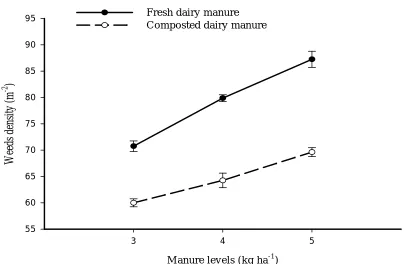
significant effect on weeds density (Table-1). Control vs fertilized and interaction between manure and their levels were also significant. Analysis of the data showed that fresh dairy manure has more number of weeds as compare to composted dairy manure. Among manure levels, manure applied at the rate of 5 t ha-1has increased number weeds followed by manure application at 4 t ha-1 while less number of weeds were counted with manure applied at 3 t ha-1. The planned mean comparison of control vs. rest indicated that unfertilized plots has less number of weeds as compare to fertilized plots. The interaction M x L indicated that increasing manure levels upto 5 t ha-1 increased the weeds density linearly with both form of manure but the increased was more prominent with fresh dairy manure as compare to composted dairy(Fig. 1). The increase in number weeds in fresh manure might be due to more weeds seeds in fresh dairy manure and decrease in number of weeds in composted dairy manure might be due to destruction of weeds seeds due to high temperature during composting. The control plots have less weeds as compare to rest plots because of no manure application. Our results are opposing Mehmeti et al. (2012) who stated that increase numbers of weeds were noted in control plots. Boguzas et al. (2010) evaluated that addition of farmyard manure had increased weeds as compared to other manures.
Weeds fresh weight (g m-2)
weeds weight were recorded with manure applied at 3 t ha-1. The planned mean comparison of control vs. rest indicated the less weeds weight were recorded with control plots as compare to rest. The interaction M x L indicated that increasing manure levels increased the weeds fresh weight linearly regardless of manure form but the increased was more prominent with fresh dairy manure as compare to composted dairy manure (Fig. 2). The increase in fresh weight of weeds might be due to increase number of weeds m-2 in fresh manure. Fresh dairy manure has a lot of weeds seeds and serves as a mean of translocation of weeds seeds to the field. Similar results were denoted by Liebman and Davis (2000) that weeds fresh weight were increased in farm yard manure applied plots. However contradictory results were reported earlier by Arif et al. (2015) who concluded that higher levels of organic manures increases yield and decrease the weeds number and weeds biomass.
Weeds dry weight (g m-2)
Weeds dry weight was significantly affected by different forms of manure (M) and their levels (L) while nitrogen application timing had no significant effect on weeds dry weight (Table 2). Control vs fertilized and interaction between manure and their levels were also significant, whereas all other interactions were non-significant for weeds dry weight in maize crop. Statistical analysis of the data indicated that fresh dairy manure has increased weeds dry weight as compare to composted dairy manure. Manure applied at the rate of 5 t ha-1 has maximum weeds dry weight whereas minimum dry weight was recorded with application of manure at 3 t ha-1.The planned mean comparison of control vs. rest showed that more dry weight were noted in the rest plots as compare to control. The interaction M x L revealed that increasing manure levels regardless of manure form increased dry weight of weeds linearly but the increased was more prominent with fresh dairy manure (Fig. 3). The increase in dry weight of weeds might be due to increase number of weeds and their fresh
weight and increase weeds seeds presence in fresh manure. The control plots have less weeds seeds due to no addition of both form of organic manure. Our results are contrary to Liebman and Davis, 2000) who stated that compost application increase the weeds and their biomass whereas Menalled et al. (2009) investigated reduced weeds population and their weight with compost. Fresh manure slowly release nitrogen and benefit the weeds more as compared to crop (Blackshaw, 2005).
Grain yield (kg ha-1)
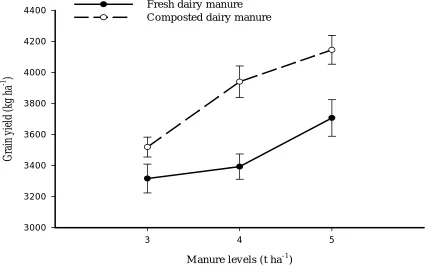
(2012) and (2013) who stated that crop growth and development are increasing with increasing application of organic manures. Negassa et al. (2001) showed that composted manure at 5 t ha-1 increase yield and yield components. N application in splits increases nitrogen use efficiency and decrease nitrogen losses due to greater management of application timing and crop uptake. Magdoff (1991) reported that application of nitrogen at proper rate and time enhances crop productivity. So careful management of N improve grain yield of maize and decrease leaching of nitrogen.
CONCLUSION S
It is concluded from this experiment that increasing the levels of fresh dairy manure up to 5 t ha-1 increased weeds infestation and decreased maize productivity. Increasing the levels of composted dairy manure up to 5 t ha-1along with 100 kg N in splits decreased weeds infestation and increased maize yield.
REFERENCES CITED
Arif, M., T. Shah, M. Ilyas, W. Ahmad, A.A. Mian, M.A. Jadoon and M. Adnan. 2015. Effect of organic manures and their levels on weeds density and maize yield. Pak. J. Weed Sci. Res. 21(4): 517-522.
Ashiq, M., M.M. Nayyar and J. Ahmad. 2003. Weed control Hand Book for Pakistan, Directorate of Agronomy, Ayub. Agriculture Research Institute, Faisalabad: Pp. 37.
Blackshaw, R.E. 2005. Nitrogen fertilizer, manure and compost effects on weeds growth and competition with spring weed. Agron. J. 97: 1612-1621.
Boguzas, V., A. Marcinkeviciene and R. Pupaliene. 2010. Weeds response to soil tillage, catch crops and farmyard manure in sustainable and organic agriculture. Zemdirbyste Agric. 97(3): 43-50.
Hampton, M.O., P.J. Stoffella and T.A. Obreza. 1999. Effect of age of composted MSW and boisolid on
weed seeds germination.
Compost Sci. Util. 7: 51-57.
Jan, M.T., P. Shah, P.A. Hollington, M.J. Khan and Q. Sohail. 2009. Agriculture Research: Design and Analysis, A Monograph. NWFP Agric. Univ. Pesh. Pak. Kumar, B., R. Kumar, S. Kalyani and M.
Haque. 2013. Integrated weed management studies on weed flora and yield in kharif maize. Trends in Biosci. 6(2): 161-164. Liebman. M., and A.S. Davis. 2000.
Integration of soil, crop and weeds management in low-external-input farming systems. Weed Res. 40: 27-47.
Magdoff, F.R. 1991. Managing nitrogen for sustainable corn systems: Problems and possibilities. Amer. J. Altern. Agric. 6: 3-8. Mahadi, M.A., S.A. Dadari, B. Kuchinda, N.C. Babaji and D.B. Ishaya. 2012. Effect of weeds control treatments and cowdung manure on yield of maize (Zea mays L.). Nigerian J. Weed Sci. 25: 70-81.
Mahadi. M.A., B.A. Babaji and A.S. Isah. 2013. Influence of weeds control and poultry manure on the productivity of maize (Zea mays L.) in the savanna ecology of Nigeria. Nigerian J. Weed Sci. 26: 64-76.
Mehmeti, A.A., I. Demaj, Demelezi and H. Rudari. 2012. Effect of post-emergence herbicides on weeds and yield of maize. Pak. J. Weed Sci. Res. 18: 27-37.
Menalled, F.D., D.D. Buhler and M.
Liebman. 2009. Composted
swine manure effects on
germination and early growth of crop and weed species under greenhouse conditions. Weed Technol. 19(4): 784-789.
Food Security and Research, Islamabad, Pakistan.
Negassa,W., K. Negisho, D.K. Frison, J. Ransom and A. Yadessa. 2001. Determination of optimum FYM and NP fertilizers for maize on farmers field. Soil Sci. Soc. J. 56: 476-484.
Oad, F.C., M.H. Siddiqui and U.A. Buriro. 2005. Growth and yield losses in wheat due to different weed densities. Asian J. Plant Sci. 6(1): 173-176.
Rabbani, N., R. Bajwa and A. Javaid. 2013. Interference of five problematic weed species with rice growth and yield. Afric. J.
Biotech. 10: 1854-1862.
Singer, J.W., K.A. Kohler, M. Liebman, T.L. Richard, C.A. Cambardella and D.D. Buhler. 2004. Tillage and compost affect yield of corn, soybean and wheat and soil fertility. Agron. J. 96: 531-537.
Wiese, A.F., J.M. Sweeten, B.W. Bean, C.D. Salisbury and E.W. Chenault. 1998. High temperature composting of cattle feedlot manure kills weed seed. Appl. Engg. Agric. 14(4): 377–380.
Table- 1. Weeds density (m-2) and weeds fresh weight (g) as affected by
different forms of manure, their levels as well as nitrogen application timing. Dairy manure (M) Weeds Density (m-2) Weeds fresh weight (g)
Fresh 79 239.7
Composted 65 223.7
Significance level ** **
Manure level (L) (t ha-1)
3 65c 226.1c
4 72b 231.9b
5 78a 237.0a
LSD (0.05) 2 2.8
N application time (T)
Single split 72 231.3
Two splits 72 232.1
Significance level ns ns
Control vs. rest
Control 54 213.8
Rest 72 231.7
Significance level ** **
Interactions Significance Significance
M x L ** **
M x T ns ns
T x L ns ns
M x L x T ns ns
Mean followed by different letters (a,b and c) are statistically different from each other at 5% level of probability.
Table-2. Weeds dry weight (g) and grain yield (kg ha-1) as affected by
different manure forms their levels as well as nitrogen application timing. Dairy manure (M) Weeds dry weight (g) Grain yield (kg ha-1)
Fresh 70.4 3472
Composted 54.7 3869
Significance level ** **
Manure level (L) (t ha-1)
3 57.1c 3418
4 62.9b 3667
5 67.6a 3926
LSD (0.05) 2.8 119
N application time (T)
Single split 62.1 3470
Two splits 63.0 3870
Significance level ns **
Control vs. rest
Control 46.0 2575
Rest 62.5 3670
Significance level ** **
Interactions Significance Significance
M x L ** *
M x T ns ns
T x L ns ns
M x L x T ns ns
Mean followed by different letters (a,b and c) are statistically different from each other at 5% level of probability.
M an u re lev els (k g h a-1)
3 4 5
W
ee
ds
d
en
si
ty
(
m
-2
)
5 5 6 0 6 5 7 0 7 5 8 0 8 5 9 0
9 5 F resh d airy m an u re
C o m p o sted d airy m an u re
Fig. 1 Interaction between manure forms and levels for weeds density (m-2)
M a n u re le v e ls (k g h a-1)
3 4 5
W
ee
ds
f
re
sh
w
ei
gh
t (
g)
2 1 5 2 2 0 2 2 5 2 3 0 2 3 5 2 4 0 2 4 5
2 5 0 F re s h d a iry m a n u re
Fig. 2 Interaction between manure forms and levels for weeds fresh weight (g)
M a n u re le v e ls (k g h a-1)
3 4 5
W
ee
ds
d
ry
w
ei
gh
t (
g)
4 5 5 0 5 5 6 0 6 5 7 0 7 5
8 0 F re sh d a iry m a n u re
C o m p o ste d d a iry m a n u re
Fig. 3 Interaction between manure forms and levels for weed dry weight (g)
M an u re lev els (t h a-1)
3 4 5
G
ra
in
y
ie
ld
(
kg
h
a
-1
)
3 0 0 0 3 2 0 0 3 4 0 0 3 6 0 0 3 8 0 0 4 0 0 0 4 2 0 0
4 4 0 0 F resh d airy m an u re
C o m p o sted d airy m an u re