Organized by C.O.E.T, Akola. Available Online at www.ijpret.com
468
INTERNATIONAL JOURNAL OF PURE AND
APPLIED RESEARCH IN ENGINEERING AND
TECHNOLOGY
A PATH FOR HORIZING YOUR INNOVATIVE WORK
STUDY ON INTEGRATION OF ADVANCE TECHNOLOGY IN GREEN BUILDING
M. K. SHARMA
1, NIKHIL BOBDE
21.Asst. Professor (Civil Department) Manav School of Engg. Vyala, Akola. 2.Asst. Professor (Civil Department) Mauli institute of Engg & Tech, Shegaon.
Accepted Date: 05/09/2017; Published Date: 10/10/2017
Abstract:
Green Building encompasses a wide range of design practices, building systems integration, product specification, and construction techniques Green building approach is consistent with the mission of most affordable housing developers, and the most community development corporation mission statements which include language about ensuring that low income people have access to safe, decent and affordable housing Generally, affordable housing projects utilize readily available, low-to medium-cost materials and systems. Customs products, such as cast-in-place recycled glass terrazzo or elaborate energy system approaches, displacement ventilation, or double-glazed facades, which are found in commercial buildings or custom residential projects, are not usually considered because of detrimental environmental problems. The challenge is to identify opportunities for innovation through the integration of good architectural and mechanical system design with thoughtful and strategic selection of materials, appliances, lighting, and equipment. The paper discusses various advance technology concepts that can be implemented for various structures.Keywords
: Green Building, Advanced performance low-E glass, integration of plants, green roof, green wall, bio filter, Tankless water heater..
Corresponding Author: M. K. SHARMA
Co Author: - NIKHIL BOBDE
Access Online On:
www.ijpret.com
How to Cite This Article:
M. K. Sharma, IJPRET, 2017; Volume 6 (2): 468-477
PAPER-QR CODE
SPECIAL ISSUE FOR
INTERNATIONAL LEVEL CONFERENCE
"ADVANCES IN SCIENCE,
Organized by C.O.E.T, Akola. Available Online at www.ijpret.com
469
INTRODUCTION"A green building is one which uses less water, optimises energy-efficiency, conserves natural resources, generates less waste and provides healthier spaces for occupants, as compared to a conventional building."
Buildings across the world have a tremendous environmental impact during their life. Globally, Buildings are responsible for at least 40% of energy use. Construction of new buildings generate large amount of solid waste and in turn, disturb natural habitat & vegetation.
Green buildings offer immense potential to reduce consumption & regenerate resources from waste and renewable sources.
A green building is one which incorporates environment friendly features. The building might appear the same like other buildings, but it is different in its approach.
Salient features of a Green Building are:
Building envelope design
Building system design (HVAC, lighting, electrical, and water heating)
Integration of renewable energy sources to generate energy on-site
Efficient use of water, water recycling and waste management
Selection of ecologically sustainable materials (with high recycled content, rapidly renewable resources with low emission potential)
Use of energy efficient and eco-friendly equipments
Indoor environmental quality (maintain indoor thermal & visual comfort and air quality)
Effective control and building management systems
BENEFITS OF GREEN BUILDINGS
A Green Home can have tremendous benefits, both tangible and intangible. The immediate and most tangible benefit is in the reduction in water and operating energy costs right from day one, during the entire life cycle of the building.
Tangible benefits:
Green buildings consume 40% ~ 60% lesser electricity as compared to conventional buildings.
Green buildings consume 40% ~ 80% lesser water as compared to conventional buildings, by utilizing ultra low
fixtures, rain water harvesting, waste water recycling etc.
Green buildings generate lesser waste by employing waste management strategies on-site.
Intangible benefits:
Enhanced air quality.
Excellent day lighting.
Health & well-being of the occupants.
Conservation of scarce national resources.
Enhanced marketability for the project.
GREEN BUILDING DESIGNING & RATING SYSTEM
A green building rating system is an evaluation tool that measures environmental performance of a building through its life cycle. It usually comprises of a set of criteria covering various parameters related to design, construction and operation of a green building. Rating programmes would help projects to address all aspects related to environment and are an effective tool to measure the performance of the building / project.
Two rating systems are followed in India:
LEED India (Leadership in Energy & Environmental Design)
Organized by C.O.E.T, Akola. Available Online at www.ijpret.com
470
IGBC which is a part of CII-Godrej GBC, has taken on the initiative of promoting the Green Building Concept in India. The council is represented by all stakeholders of the Construction Industry-Corporate, Government & Nodal agencies, Architects, Material manufacturers, Institutions, etc.
As part of indigenization of the LEED rating system, IGBC has been working on LEED – India for the past three years.
LEED India was formally launched in October 2006 but became operational from January 2007.
LEED-India has incorporated few changes like more emphasis on water conservation and adoption of local Indian codes and standards like NBC guidelines, MoEF guidelines for large projects, CPCB norms for DG set emissions, ECBC for energy efficiency, etc.
LEED® India
The Leadership in Energy and Environmental Design (LEED-INDIA) Green Building Rating System is a nationally and internationally accepted benchmark for the design, construction and operation of high performance green buildings.
LEED-INDIA promotes a whole-building approach to sustainability by recognizing performance in the following five key areas:
Sustainable site development
Water savings
Energy efficiency
Materials selection and
Indoor environmental quality
Specific LEED-INDIA programs include:
LEED® India for New Construction (LEED® India NC)
Certification Level Points
LEED – Certified 26 – 32
LEED – Silver 33 – 38
LEED – Gold 39 – 51
LEED – Platinum 52 or more
LEED® India for Core and Shell (LEED® India CS)
Certification Level Points
LEED – Certified 23 – 27
LEED – Silver 28 - 33
LEED – Gold 34 - 44
LEED – Platinum 45 - 61
IGBC, in its endeavour to extend green building concepts to all building types has developed the following rating
programmes to cover commercial, residential, factory buildings, SEZ etc
Specific IGBC programs include:
IGBC Green Homes
IGBC Green SEZ
IGBC Green Factory Building
IGBC Green Homes Rating System
Organized by C.O.E.T, Akola. Available Online at www.ijpret.com
471
Individual HomesCertification Level Points
LEED – Certified 32 - 39
LEED – Silver 40 - 46
LEED – Gold 47 - 54
LEED – Platinum 55 - 74
Multi-dwelling Units
Certification Level Points
LEED – Certified 30 - 37
LEED – Silver 38 - 44
LEED – Gold 45 - 52
LEED – Platinum 53 - 75
IGBC along with the Ministry of Commerce and Industry (MoCI) has prepared the Green SEZ guidelines. The objective of IGBC Green SEZ is to facilitate the creation of energy efficient, water efficient, healthy, comfortable and environ- mentally friendly SEZ.
IGBC Green Factory Building rating system
IGBC Green Factories rating system is the first of its kind addressing sustainability in industrial buildings. The programme is fundamentally designed to address national priorities and quality of life for factory workmen.
GRIHA
GRIHA, an acronym for Green Rating for Integrated Habitat Assessment, is the National Rating System of India. It has been conceived by TERI and developed jointly with the Ministry of New and Renewable Energy, Government of India. It is a green building 'design evaluation system', and is suitable for all kinds of buildings in different climatic zones of the country.
The rating applies to new building stock – Commercial, Institutional and Residential types of varied functions. It is endorsed by the Ministry of New and Renewable Energy, Government of India as of November 7, 2007.
GRIHA is a five star rating system for green buildings which emphasises on passive solar techniques for optimizing indoor visual and thermal comfort.
The rating system evaluates certain credit points using a prescriptive approach and other credits on a performance based approach. The rating system is evolved so as to be comprehensive and at the same time user-friendly. While LEED/IGBC or GRIHA does not certify specific building (glass) products, it does recognize that the selection of glass products plays a significant role in fulfilling LEED/IGBC or GRIHA point requirements.
1. ADVANCED PERFORMANCE LOW-E GLASS :
Glass plays a unique and important role in building design and the environment. It affects design, appearance, thermal performance and occupant comfort. The selection of the right glass is a crucial component of the design process.
India being a tropical country, we need to be careful while selecting a glass. Selection of glass has become more complex since a variety of glasses are available to choose from, ranging from performance to aesthetics.
The properties of glass have also become multifaceted, able to perform a wide variety of functions, like Solar Control to Thermal Insulation. Solar and thermal performance will often be a high priority decision along with appearance (color, transparency and reflectivity).
Organized by C.O.E.T, Akola. Available Online at www.ijpret.com
472
ENERGY MANAGEMENTKey factors which play an important role in designing the building envelope with glass are as follows.
Solar Factor (SF) / Solar Heat Gain Co-efficient (SHGC)
U-Value
Relative Heat Gain (RHG)
Visual Comfort
Solar Factor (SF) /Solar Heat Gain Co-efficient (SHGC)
A combination of the directly transmitted solar and radiant energy and the proportion of the absorbed solar energy that enters into the building’s interior. The lower the number the better solar control
U-Factor (U-Value)
This is the measurement of air-to-air thermal conductance or insulation between indoors and outdoors through the glass. The lower the number the better the insulation or thermal control.
Relative Heat Gain (RHG)
RHG is calculated as follow = (Solar heat gain factor (ASHRAE) 630° W/m2 X shading coefficient of the glass) + (Temperature Difference x U value)
Heat gain due to Solar Factor contributes to 80% of RHG value
Heat gain due to U-value contributes to 20% of RHG value
Visual Comfort
Visual Light Transmission
It is defined as the percentage of light transmitted through the glass. It does not determine the color of the glass. Glass should provide for optimum daylight inside as per the outside condition. Excessive daylight creates glare and makes the occupant uncomfortable.
Energy Conservation Building Code
Energy Conservation Building Code prepared by the Bureau of Energy Efficiency sets minimum standards for external wall, roof, glass structure, lighting, heating, ventilation and air conditioning of the commercial building. ECBC provides minimum requirement for the energy efficient design and construction of the building.
Scope
ECBC covers Buildings with an:
Electrical connected load of > 500 kW or
Contract demand of > 600 kVA and / or
Building or complexes with Air-Conditioned area > 1000 SQM
The ECBC provides design norms for:
Building envelope
Lighting system
HVAC system
Electrical system
Water heating and pumping systems
The code provides three options for compliance:
Prescriptive (Component based approach): Each system and sub-system must be complied with minimal
performance requirement as laid down by the code
Organized by C.O.E.T, Akola. Available Online at www.ijpret.com
473
Climatic ZonesAs per the climatic conditions, India has been divided into 5 climatic zones and ECBC takes these zones into consideration while building envelope design:
Composite
Hot & Dry
Warm & Humid
Temperate
Cold
WINDOW WALL RATIO (WWR)
Window wall ratio is the ratio of total window area to the total gross exterior wall Window Wall Ratio = Total Glazing Area / Total Gross Wall Area
Determination of Window Wall Ratio of a building
Determination of the performance values of the glazing like solar factor, U-value & Light transmission. (check value specific to each climatic zone and window wall ratio)
Determination of M Factor for the trade-off of solar factor requirement by the use of shading devices such as
overhangs, vertical fins etc.
Skylight
Skylight is a fenestration surface having a slope of 60 degrees from the horizontal plane. Other fenestration, even if mounted on the roof of a building, is considered vertical fenestration.
Organized by C.O.E.T, Akola. Available Online at www.ijpret.com
474
Table 1.1: Skylight U-factor & SHGC requirementsClimate Maximum U-factor Maximum SHGC
With Curb Without Curb 0 ~ 2% SRR* 2.1% ~ 5% SRR*
Composite 11.24 7.71 0.40 0.25
Hot & Dry 11.24 7.71 0.40 0.25
Warm & Humid 11.24 7.71 0.40 0.25
Moderate 11.24 7.71 0.61 0.40
Cold 11.24 7.71 0.61 0.40
*SRR: Skylight roof ratio is the ratio of the total skylight area of the roof, measured to the outside of the frame, to
the gross exterior roof
PRESCRIPTIVE REQUIREMENTS
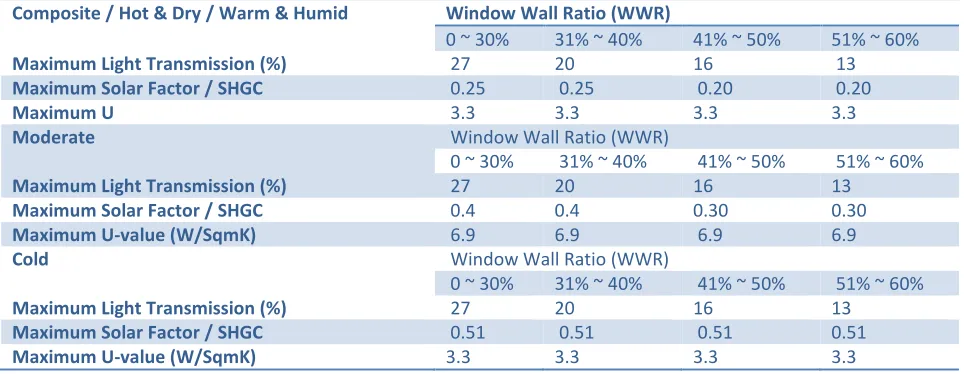
In Prescriptive approach, ECBC sets values of the light transmission, solar factor, & U-value for the different climatic zones & designed window wall ratio of the building
Table 1.2: Vertical Fenestration U-Factor (W/ m2K), SHGC requirements and Minimum VLT requirements
Composite / Hot & Dry / Warm & Humid Window Wall Ratio (WWR)
0 ~ 30% 31% ~ 40% 41% ~ 50% 51% ~ 60%
Maximum Light Transmission (%) 27 20 16 13
Maximum Solar Factor / SHGC 0.25 0.25 0.20 0.20
Maximum U 3.3 3.3 3.3 3.3
Moderate Window Wall Ratio (WWR)
0 ~ 30% 31% ~ 40% 41% ~ 50% 51% ~ 60%
Maximum Light Transmission (%) 27 20 16 13
Maximum Solar Factor / SHGC 0.4 0.4 0.30 0.30
Maximum U-value (W/SqmK) 6.9 6.9 6.9 6.9
Cold Window Wall Ratio (WWR)
0 ~ 30% 31% ~ 40% 41% ~ 50% 51% ~ 60%
Maximum Light Transmission (%) 27 20 16 13
Maximum Solar Factor / SHGC 0.51 0.51 0.51 0.51
Maximum U-value (W/SqmK) 3.3 3.3 3.3 3.3
TRADE-OFF APPROACH
building envelope components. With the off approach, the prescriptive requirement of SHGC can be trade-off with shading devices / overhangs and/or side Trade-trade-off is permitted only between -fins
Shading for all the fenestration getting direct solar radiation by using Sun Path analysis or shading norms
Internal Shading Devices (Overhangs and/or Side Fins)
Adjusted/Effective SHGC is calculated by multiplying the SHGC of the unshaded fenestration product by a multiplication factor (M)
SHGC Effective = SHGC Glass X M
Multiplication Factor (M)
(M) Is taken out from the table 1.2 based on the projection factor (P) Projection Factor (Overhangs / Side Fins)
EXCEPTION TO ECBC
SHGC requirement of a window can be affected by overhangs on a building. The term called projection factor determines how well the overhangs shade the building’s glazing.
Organized by C.O.E.T, Akola. Available Online at www.ijpret.com
475
PF = Ratio of projection divided by height from window sill to bottom of overhang (must be permanent)
ECBC provides modified SHGC values where there are overhangs and /or side-fins. An adjusted SHGC , accounting for overhangs and / or fins, is calculated by multiplying the SHGC of the unshaded fenestration product by a multiplication factor (M).
EXCEPTION TO SHGC
Vertical fenestration areas located more than 2.2m (7 ft) above the level of the floor are exempt from the SHGC requirement in (Table 1.2) if the following conditions are complied with:
Total Effective Aperture: The total effective aperture for the elevation is less than 0.25, including all fenestration areas greater than 1.0m (3 ft) above the floor level
An interior light shelf is provided at the bottom of the fenestration area, with an interior projection factor not less than”
1. 1.0 for E/W. SE, SW, NE, and NW orientations
2. 0.5 for S orientation, and
3. 0.35 for N orientation when latitude is <23
WHOLEBUILDING PERFORMANCE APPROACH
This method involves developing the computer model (for thermal, visual, ventilation, and other energy consuming process) of the Proposed Design and comparing its energy consumption with Standard Design.
Energy simulation software is necessary to show the ECBC compliance. Energy simulation is a computer-based
analytical process that helps designers to evaluate the energy performance of a building and make necessary modifications before the construction.
Perform hourly analysis of the whole year
Used to simulate air-conditioned building and predict annual energy consumption under various head
This simulation process takes into account the:
Building geometry and orientation.
Building material.
Building façade design.
Climate indoor environmental condition.
Occupant activities and schedules.
HVAC and lighting system and other parameters to analyze and predict the energy performance of a building.
4. INTEGRATION OF PLANTS
Incorporating Green plants into the Building has some design possibilities. There are two options for building to make it green. Plants can be integrate at outside and at inside. For outside, it can be done on roofs, outer vertical walls and for inside, it can be a living wall or biofilter, or potted plants placed in atriums, indoor rooms to act as a pocket of green patch into these vertical cities. This thesis covers both the sectors of this aspect to a building design, i.e. green outer and green inner.
5. GREEN ROOFS:
Organized by C.O.E.T, Akola. Available Online at www.ijpret.com
476
These heat absorption and monotony of these common roofs can be break though green roof tops. Green rooftops have begun to appeal to homeowners, businesses and even cities as an attractive way to promote environmentalism while solving the problems of conventional roofs. Green roofs supplement traditional vegetation without disrupting urban infrastructure – to take a neglected space and make it useful. The term "green roof" is generally used to represent an innovative yet established approach to urban design that uses living materials to make the urban environment more livable, efficient, and sustainable. Other common terms used to describe this approach are eco roofs, and vegetated roofs. Green Roof Technology (GRT) is the system that is used to implement green roofs on a building (Banting, D. et al., 2005). Green roofs replace the vegetated footprint that was destroyed when the building was constructed. The concept of rooftop gardens is introduced with the aim of reducing heat gain into a building and modifying the ambient conditions through photosynthesis and evapo-transpiration of plants. Results from several studies suggest that rooftop gardens can effectively cool down the immediate ambient environment by 1.5 [degrees] C. (Wong, N. H. and et al., 2002). Generally, the surface temperature readings collected from the rooftop garden were found to be lower than that recorded on a barren concrete rooftop. This shows that the thermal insulation of a building is improved in the presence of plants. High relative humidity (RH) at the rooftop garden was also observed due to the presence of plants. To prevent discomfort due to high humidity, adequate natural ventilation should be ensured (Wong, N. H. and et al., 2002). According to Benting (2005), Green roofs are constructed using components that:
• have the strength to bear the added weight;
• seal the roof against penetration by water, water vapour, and roots;
• retain enough moisture for the plants to survive periods of low precipitation, yet are capable of draining excess moisture when required
• provide soil-like substrate material to support the plants;
• maintain a sustainable plant cover, appropriate for the climatic region;
• offer a number of hydrologic, atmospheric, thermal and social benefits for the building, people and the environment;
• protect the underlying components against ultraviolet and thermal degradation (Banting, D. et al., 2005).
2. 6.TANKLESS WATER HEATERS
While nothing new in terms of advance technology, tankless water heaters are about to shine a little brighter this year than they have in the past. Not only are tankless water heaters more energy efficient compared to a standard tanked unit, they also bring some additional benefits to the party, including:
Continuous hot water - no more running out of hot water halfway through your shower because you happened
Organized by C.O.E.T, Akola. Available Online at www.ijpret.com
477
Smaller footprints - smaller units take up less space in the home, meaning more square footage can go towards
liveable space.
Cleaner water - with tankless heaters, the water isn’t sitting around in a 50 gallon tank waiting to be used. 3. One to Watch: An Award Winning Tankless Heater from Bosch
Bosch Thermotechnology Corp. was recently honoured with a Consumer Technology Association Award for the Bosch Greentherm 9900i SER, the premium model in a new line of tankless condensing water heaters: The Bosch Greentherm 9000 Series.
Tankless water heaters will be mandatory on residential buildings in California in 2017, so don’t wait until inspection time to get in-the-know about these energy efficient units.
CONCLUSION:
The aim of the paper is to find out the possible ways to integrate advance technology in green building and asses how the integration of advanced technology into the building design can help reducing the energy use, and enhance the living quality. Throughout the thesis work it was studied to establish the necessity of planting to incorporate into building, for the well-being of our economy, society and the environment. With the convergence of urbanization, globalization and a rapidly changing and expanding economy, India is experiencing a rapid spurt in building construction across a range of city activities and socio-economic spectrum, increasing consumption of building materials such as glass, cement, metals and ceramics. Maximum consumption of these energy materials is a reason for environmental degradation. LEED rating provided opportunities to introduce new products and materials. Now there is an imminent need for service providers, who would be required in large numbers, not in hundreds but thousands, as the movement is heading to reach greater heights. The green building movement is here to stay for the benefit of individuals, society and the country at large. The application of codes like ASHARE / ECBC and rating as GRIHA as a benchmark can help in designing high performance buildings. There exist tremendous opportunities to introduce new materials, equipment and technologies which can help enhance energy efficiency of buildings.
REFERENCE:
1. http://www.sei.ie
2. http://www.teriin.org/events/rooftop-solar-PV-Exp_mar.pdf
3. http://www.in.undp.org/content/dam/india/docs/user%E2%80%99s_handbook_on_solar_water_heaters.pdf
4. http://nlss.org.in/wp-content/uploads/2012/01/Paper-2-Jan12.pdf
5. www.ecovillage.org.in
6. www.mapawatt.com
7. http://www.nrel.gov/docs/legosti/fy96/17459.pdf