From Context to Outcomes: A Thriving Model for 4-H Youth
Development Programs
Mary E. Arnold Oregon State University
The contemporary Extension 4-H program is focused on positive youth development, providing experiences that increase the likelihood of enhanced wellbeing and optimal development for 4-H participants. Despite the longevity, reach, and success of the 4-H program, however, with few notable exceptions, there has been relatively little attention paid to elucidating the underlying program theory and the actions that put the theory into motion. As a result, no one model or framework guides the program uniformly across the 4-H system, resulting in numerous ways of describing and measuring the impact of the 4-H program on young people. This paper proposes a 4-H program model that connects the 4-H program context to youth developmental outcomes through the mediating process of youth thriving. The model is based on a synthesis of
extensive research conducted in the field of youth development and elucidates the processes that facilitate developmental change in youth. Implications for model use as well as professional development are considered.
Keywords: 4-H, Youth Development, Program Theory, Capacity-Building, Evaluation
Introduction
Born as a program for rural American youth at the turn of the 20th century, 4-H is still going strong, with almost six million members participating in programs in almost every county in the United States. Today, over half of youth in the 4-H program live in urban or suburban areas (National 4-H Council, 2015). The contemporary 4-H program is focused on positive youth development, providing experiences that increase the likelihood of enhanced wellbeing and optimal development for 4-H participants. Despite the longevity, reach, and success of the 4-H program, however, with few notable exceptions, there has been relatively little attention paid to elucidating the underlying program theory and the actions that put the theory into motion (Arnold, 2015). As a result, no one model or framework guides the program uniformly across the 4-H system (Arnold & Silliman, 2017), resulting in numerous ways of describing and measuring the impacts of the 4-H program on young people. In this paper I propose a new theoretical model for 4-H that connects the program context to youth developmental outcomes through the mediating process of youth thriving. The model is based on a synthesis of extensive
research conducted in the field of youth development and elucidates the processes that facilitate developmental change in youth. Implications for model use as well as professional development are considered.
4-H as Positive Youth Development
Although emphasizing the developmental needs of youth first arose in the 4-H program in the 1940s (Rosenberg, 2016), the transition to focusing on positive youth development (PYD) happened as the field of developmental science, as an academic discipline distinct from developmental psychology, emerged in the early part of the 21st century (Lerner, Fisher, &
Weinberg, 2000). The applied developmental science perspective emphasizes personal wellbeing and maximum personal development, rather than merely adequate development characterized by a lack of problems (Benson & Scales, 2009). Development is seen as ecological and dependent on the interaction of young people with the systems and contexts surrounding them. Furthermore, the interaction between a young person and his or her contexts is bidirectional, and mutually beneficial (Lerner, 2006).
As the PYD approach matured, scholars and practitioners alike worked to develop frameworks to describe, and thus ultimately measure, the necessary ingredients of PYD and the impact it has on youth. Parallel efforts were seen within the 4-H program in the development of the Targeting Life Skills Model (Hendricks, 1996), The Fourfold Youth Development Model (Barkman, Machtmes, Myers, Horton, & Hutchison, 1999), and the Essential Elements of 4-H Youth Development (Kress, 2005). These frameworks serve primarily as descriptions of the 4-H program, rather than being systematically applied across the national 4-H program to describe, measure, and understand the process of PYD within the 4-H program (Arnold & Silliman, 2017). While most 4-H professionals would likely report at least some familiarity with these models, it is questionable that very many have a clear understanding of the science behind the framework or the related implications for program development, implementation, and evaluation.
One of the key strengths of the 5C model is that it was developed and tested on a large, diverse sample of youth that included youth who were in 4-H as well as youth who were not, and the results showed that “4-H youth excel beyond their peers” (Lerner & Lerner, 2013, p. i). The results of the 4-H Study of Positive Youth Development (Lerner & Lerner, 2013) are published on the National 4-H Council website, and at least casually, it appears that the 5C model is how 4-H is described by 4-H professionals in the field (e.g., Bottomley, 2013; Jones, 2005).
Despite the extensive research and dissemination of the 4-H study in top academic journals, and despite the fact that the 5C model is the prominent way of operationalizing PYD in the scholarly literature on youth development, there has been little translation of the results into on-the-ground practice, nor integration of the model into professional development resources and opportunities for 4-H professionals. As noted by Heck and Subramanian (2009), the 5C model lacks
specificity of youth program elements and activities that lead to outcomes. As such, there is little detail of what exactly needs to happen in 4-H youth programming to promote the 5Cs beyond the three general categories of leadership, adult relationships, and skill building. In addition,
although the model emphasizes relational developmental systems (Brandstadter, 1998) and underscores the principal interactions of youth and their contexts as critical for PYD, it does not provide enough information on how these processes take place. Extensive research on the 5C model and its usefulness in describing PYD notwithstanding, its utility is underrealized with point-of service 4-H professionals, as well as specialists, who may describe 4-H in terms of the model but are left without a complete understanding of how to use it to develop, implement, and improve 4-H programming to promote PYD.
A second difficulty with the 5C model, also noted by Heck and Subramanian (2009), is that the measurement of model elements is complex and the required statistical analysis is complicated and advanced, which limits the utility of the measures that determined the model’s structure for practical program evaluation based on the model. Although others have attempted to develop instruments to measure PYD using the 5C structure (e.g., Arnold, Nott, & Meinhold, 2012), the ability to measure PYD in terms of the 5Cs is secondary to the general lack understanding of how to create and implement programs with fidelity to the 5C model in the first place.
In an effort to address these concerns and to further the conversation of the impacts of the 4-H program on youth, I propose an alternative model for 4-H. The proposed model highlights 4-H programming as a developmental context (Roth & Brooks-Gunn, 2016) and incorporates the indicators of youth thriving proposed by Search Institute (2014a) as mediators of the program experience and developmental outcomes. The construct of youth thriving is interwoven with much of the literature on positive youth development, including the 5C model (Benson & Scales, 2009, 2011; Lerner, Lerner, von Eye, Bowers, & Lewin-Bizan, 2011). In this regard, the
connection between the developmental contexts of youth programs (Roth & Brooks-Gunn, 2016), indicators of adolescent thriving (Search Institute, 2014a), and PYD outcomes.
Specifically, I propose a potential mediating effect of thriving on youth development outcomes, resulting in a model that connects the developmental context of 4-H with its intended outcomes, which has important implications for professional development (Arnold, 2015; Arnold & Cater, 2016) as well as program planning, implementation, and evaluation (Arnold, Braverman, & Cater, 2016; Lerner, 2016; Roth & Brooks-Gunn, 2016).
4-H Programs as Developmental Contexts
4-H has engaged young people in learning and growing for over a century. In its early years, 4-H consisted of agriculturally-based boys “corn clubs” and girls “canning clubs” that were developed to teach modern agricultural and homemaking techniques to young people (Rosenberg, 2016) with the goal of encouraging their parents to adopt the same techniques (Wessel & Wessel, 1982). By the mid-nineteenth century, 4-H had evolved to emphasize citizenship and health, largely in response to World War II (Rosenberg, 2016). Today, 4-H reaches youth in both rural and urban communities with a wide array of opportunities for learning, leadership, citizenship, and growth. In addition, 4-H has expanded to the U.S.
territories and internationally, most notably in Europe, Asia, and Africa. Despite these changes over time, the heart of 4-H has consisted of two essential features: (1) youth engagement in 4-H projects that are organized around youth interests, and (2) the presence of adult volunteer leaders and professional 4-H professionals who support youth learning and growth.
Recently, Roth and Brooks-Gunn (2016) proposed that the next critical step for the PYD field is to focus on advancing the theory and understanding of how program settings provide
developmental contexts for youth. Developmental contexts lie at the heart of adaptive
quality standards, and sufficient youth engagement with the program (Chaput, Little, & Weiss, 2004).
Sparks
Youth sparks are an essential ingredient of thriving. A spark is defined as a “passion for a self-identified interest or skill, or a capacity that metaphorically lights a fire in an adolescent’s life, providing energy, joy, purpose, and direction” (Scales, Benson, & Roehlkepartain, 2011, p. 264). Having a spark gives a young person a sense of direction and encourages goal setting (Benson & Scales, 2011). According to Benson and Scales (2009), a spark is different from a mere leisure activity in that (1) sparks create actions that not only contribute to the benefit of the young person but also the larger society; (2) sparks provide the intrinsic fuel for a young person’s growth in knowledge and skill; and (3) sparks enhance a young person’s networks as he or she encounters others with similar sparks, as well as adults with expertise who can facilitate learning and opportunities for engagement. Furthermore, sparks appear to be a protective factor for young people, keeping them out of trouble because of the young person’s intense focus on the source of their spark, and motivating them to succeed in other areas of their lives, such as personal, social and academic (Benson & Scales, 2011).
In a preliminary study of the concept of sparks (King et al., 2005), youth reported that any young person has the potential to have a spark, and it is a matter of helping young people find and pursue sparks. Furthermore, in some cases, it is a matter of helping youth recognize their spark when the spark has already found that young person! In this way, identifying and nurturing a youth spark is akin to facilitating identity formation, one of the critical and enduring tasks of adolescent development (Arnold, 2017; Cote, 2009, 2011; Erikson, 1950; Xing, Chico, Lambouths, Brittian, & Schwartz, 2015).
Because of its emphasis on learning that is driven by a young person’s interest, 4-H programs provide a rich context for youth to identify, explore, and sustain their personal interests, often resulting in the development of a young person’s spark. Such nourishing developmental contexts are key for facilitating youth sparks (Benson & Scales, 2009). When sparks are encompassed by positive contexts, youth are empowered to develop their sparks and to use them to enhance a common good (Scales et al., 2011). Such contexts provide supportive opportunities for youth to grow and provide encouragement to youth to overcome obstacles.
Developmental Relationships
The second important aspect of a developmental context to support youth development is the presence ofdevelopmental relationships with adults (Bowers, Johnson, Warren, Tirrell, &
2014b). Developmental relationships are found across youth ecologies, including with parents, other youth, and close adults. In the context of youth programs, developmental relationships consist of several important qualities (Bowers et al., 2015; Li & Julian, 2012). The first quality is a secure attachment between the young person and adult, reflected in mutual warmth, respect, and trust. Second, the relationship is bidirectional, with the youth and adult engaging together, with each gaining from the relationship. Third, developmental relationships increase in
complexity over time. As youth develop, their needs within the relationship will likewise change to reflect the increasing complexity of their ecologies and the skills needed to navigate them. Finally, healthy developmental relationships shift power over time. Developmental relationships with younger youth are typically highly adult driven and determined; youth-adult relationships across the adolescent years, however, reflect the youth’s increasing competence, personal autonomy, decision making, and identity formation. As youth grow, an effective program reflects these developmental changes through developmentally appropriate activities and relationships with adults (Jones & Deutsch, 2012).
Roehlkepartain et al. (2017) identified five dimensions of developmental relationships: (1) expressing care through listening, warmth, and dependability; (2) challenging growth by holding youth accountable, expecting them to do their best, and helping them reflect on failures; (3) providing support by empowering and advocating for youth as well as helping them navigate situations and systems, and setting appropriate boundaries; (4) sharing power through inclusion, respect, and collaboration; and (5) expanding possibilities by exposing youth to new ideas and opportunities and connecting them to others who can help them reach their goals.
4-H relies on trained volunteers, working side by side with professional 4-H educators to implement youth development programs, and there is evidence that the relational quality between the 4-H leader and youth is connected to 4-H life skill development (Radhakrishna & Ewing, 2011). Because 4-H programs are often led by volunteers, adult volunteers are most likely to be the adult with whom a youth experiences a developmental relationship. While 4-H volunteers are typically trained in the basics of youth development, 4-H club and risk
management, as well as organizational rules and policies (Culp, McKee, & Nestor, 2007), little focus is placed directly on the important qualities of developmental relationships with youth. As such, the developmental quality of a volunteer’s interactions with youth is likely more a function of the volunteer’s experience and nurturing intuition than the result of intentional training on developmental relationships and how to create and maintain them with youth.
Youth Program Quality Standards
development program evaluations published to date. This initial work was followed up by Roth and Brooks-Gunn’s (2003) identification of three qualities that define a positive youth
development program. These qualities include the program having a goal of promoting positive youth development; a positive program atmosphere that fosters hope and facilitates youth agency; and activities that allow youth to explore their interests, build skills, and experience leadership. Other efforts contributed significantly to the articulation of youth program quality, including Eccles and Gootman (2002) who identified eight critical elements: physical and psychological safety; appropriate structure, supportive relationships; opportunities to belong; positive social norms; support for efficacy and mattering; opportunities for skill building; and integration of family, school, and community. In a report on positive youth development programs in the United States, Catalano et al. (2004) identified 15 key program objectives discovered through a systematic analysis of published rigorous program evaluations. These objectives included promoting bonding and social, emotional, cognitive, and behavioral
competence; fostering resilience, self-determination, self-efficacy and spirituality; and providing opportunities to develop pro-socially and receive recognition for positive behavior. Because of this work, efforts to measure program quality began to emerge, resulting in numerous approaches and methods for assessing and improving youth program quality (Smith et al., 2012; Yohalem & Wilson-Ahlstrom, 2010; Yohalem, Wilson-Ahlstom, Fischer, & Shinn, 2009). The result of these efforts is an ever-increasing awareness that the context of youth program matters, and programming must be done well if it is to be effective.
Youth Program Engagement
The final ingredient of high quality youth programs is the youth themselves as reflected in their engagement in the program. I place an intentional emphasis on youth engagement in an attempt to move the PYD discourse away from the idea of linking mere youth participation (showing up) and program dosage to successful developmental outcomes. Logically, it makes sense that a youth who participates only minimally in 4-H, such as attending a few meetings in order to show at the county fair one time, might to be impacted differently than a member who is active for many years in a 4-H program that meets regularly with enrichment activities, such as community service and youth leadership. However, it is critical to note that there is scant evidence to
support that program participation alone leads to developmental outcomes (Roth, Malone, & Brooks-Gunn, 2010). Indeed, Roth et al. (2010) drew the conclusion that participation was just one aspect of multiple influences that affected achievement of developmental outcomes. For example, the Harvard Family Research Project conceptual model of participation (Weiss, Little, & Bouffard, 2005) illustrated the complexity of program participation by introducing the
Chaput et al. (2004) outline three dimensions of youth program participation that are more fully reflective of youth engagement than dosage alone. First is intensity, or the amount of time a youth spends engaged with a program; second is duration, which reflects the history of attendance, such as the number of years in a program; and third is breadth, which reflects the variety of activities and opportunities in which a youth participates while in the program. Taken together, measures of intensity, duration, and breadth provide a more nuanced and meaningful way to assess youth engagement in a program.
When combined, the elements of youth sparks, developmental relationships, program quality, and youth engagement create an enriching developmental context for youth participants in 4-H programs. Roth and Brooks-Gunn (2016) identified the next critical steps for the youth
development field as defining and understanding the developmental context of youth programs and connecting program context to outcomes in ways that illuminate the processes through which outcomes are achieved. In many ways, this call is reminiscent of the ongoing requests to understand what is inside the black box (Yohalem & Wilson-Ahlstrom, 2010), referring to the largely unexamined processes within a program that lead to outcomes. Referring specifically to 4-H programs, Arnold (2015) highlighted the need to articulate a program’s theory of change and action (Funnell & Rogers, 2011) in order to connect program settings and activities to outcomes. For 4-H, the theory of change is based in adaptive developmental relations (ADR) (Brandstadter, 1998; Theokas et al., 2005), which predicts that positive youth development takes place when youth interact with high quality contexts. Key to ADR is that the interactions between youth and developmental contexts, like 4-H, are bidirectional and mutually affirming (Theokas et al., 2005). A program’s theory of action describes the processes necessary to enact the theory of change. The basic critical question then becomes: How do the activities conducted in 4-H
programs enhance adaptive developmental regulations and thus lead to developmental outcomes? Answering this question is key to seeing inside the “black box” and to providing the specificity in 4-H program models that is currently lacking (Arnold, 2015; Arnold & Silliman, 2017; Heck & Subramanian, 2009).
From Context to Outcomes: Thriving as a Developmental Process
even international level. As such, activities within 4-H that make up the program’s theory of action are developmental activities – designed to enhance positive change in youth. According to Moshman (2005), there are four criteria that mark human change as developmental: (1) that it is extended over time, (2) that its ontogenesis is directed from within the person, (3) that there are qualitative and not merely quantitative changes, and (4) that it is a systematic progression over time. Given that 4-H activities have a developmental intention, it makes sense to consider how these activities contribute to key indicators of PYD, and how, in turn, those elements result in developmental outcomes.
The bridge between program context and outcomes, I believe, lies in youth thriving, a concept found throughout the PYD literature (Benson & Scales, 2009, 2011; Lerner et al., 2003, 2011). Research conducted by Search Institute (2014a) has focused on identifying indicators of a thriving orientation in adolescence. Early efforts by Search considered thriving a status or something that a young person has or does not have (Benson & Scales, 2011). Status alone, however, gives little insight into how a thriving youth develops over time, let alone the processes by which thriving can be supported. As such, Search researchers turned to understanding
thriving as a pathway or trajectory on the way to a positive future (Search Institute, 2014a). Consistent with developmental systems theory, adolescent thriving develops from mutual, positive interactions between youth and their developmental contexts. At the heart of thriving is that a young person is animated and motivated intrinsically by his or her spark or special sense of who they are. In this manner, thriving is best conceptualized as an orientation (Search Institute, 2014a).
A thriving orientation becomes the “fuel for a developmental journey that helps young people reach status indicators” (Search Institute, 2014a, p. 4). Status indicators are the developmental outcomes of programs, such as the 5Cs (Lerner & Lerner, 2013). Beyond the five Cs, other developmental outcomes salient to 4-H include academic motivation and success, reduction in risk behaviors, healthful choices, and high personal standards. Developmental outcomes, in turn, serve to predict a successful transition to adulthood, marked by health and well-being, economic stability, and civic engagement (Gambone, Klem, & Connell, 2002). In this manner, 4-H
programs, planned and conducted to provide a rich developmental context with program
activities that enhance thriving, lead to achievement of the program’s developmental outcomes.
Thriving, then, is the growth of attributes that mark a young person who is healthy and flourishing. According to Lerner et al. (2011), adolescent thriving is defined as youth
manifesting healthy developmental changes, and the purpose of PYD research is to identify the individual and ecological relations that promote thriving. Consistent with a PYD perspective, Benson and Scales (2011) argue that thriving is more than the absence of psychological or
behavior problems and more than just doing okay. Rather, thriving is marked by a set of positive
acknowledge that positive psychology surrounds the definition of thriving because of its emphasis on personal fulfillment, reaching one’s full potential, happiness, and optimism, but they offer important distinctions that set thriving apart. For example, the authors are careful to point out that thriving does not simply equal happiness. Youth may be thriving overall but are not happy (at least at the moment) when they are struggling, for example, through a growth experience. Adolescent growth experiences can be relatively normative, such as the adjustment to a new school, or attempts to learn a new skill, or they can be unexpected crises, such as sudden personal loss. In the context of such struggles, youth may not be happy, but the resultant unhappiness does not necessarily mean the young person is not on a trajectory of thriving.
Research conducted by Search Institute (2014a) has identified six indicators of a thriving trajectory:
Openness to Challenge and Discovery: An intrinsic desire to explore new things and
enjoy challenges.
Hopeful Purpose: Having a sense of purpose and on the way to a happy and
successful future.
Transcendent Awareness: An awareness of a sacred or transcendent force and the
role of faith or spirituality in shaping everyday thoughts and actions.
Positive Emotionality: Is positive and optimistic, and able to manage emotions
appropriately.
Pro-Social Orientation: Personal values of respect, responsibility, honesty and
caring, and helping others.
Intentional Self-Regulation: Sets goals and shapes effective strategies to achieve
them, perseveres and makes adjustment when goals are not attained.
Enhancing Youth Thriving: A Model for 4-H Youth Development Programs
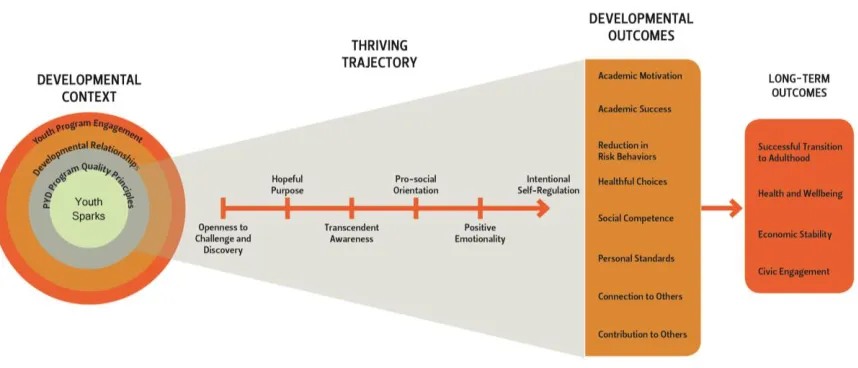
As mentioned, I propose that the bridge between the 4-H program context and developmental outcomes is youth thriving and thus present a new theoretical model for the H program: The 4-H Thriving Model. The proposed model, with its emphasis on six indicators that define a thriving orientation that is growing and changing over time, identifies an intermediate process – youth thriving – that mediates the connection between program context and developmental outcomes. As such, a high quality program leads to a youth thriving orientation, which, in turn, leads to developmental outcomes. The addition of this mediating process sets the stage for understanding how the 4-H program achieves its developmental outcomes, as shown in Figure 1.
Figure 1: Proposed 4-H Thriving Model
Developmental Outcomes
The 5C model of youth development is one of the most prevalent ways in which positive youth development outcomes are articulated in 4-H (Lerner & Lerner, 2013). As developmental outcomes, the 5Cs encompass many domains, which makes their interpretation and
understanding by those outside the youth development research field difficult. For example, if a young person is “confident,” what does that mean? Are they globally confident in all areas of their life? More likely, such confidence is domain specific, for example, being confident in school but less so in social settings. In addition, the 5Cs are often elusive for stakeholders, program funders, and practitioners to grasp fully. To be useful, developmental outcomes must be defined more precisely in light of the program’s particular goals. Accordingly, the definitions may vary from program to program based on the program’s specific developmental outcomes. Furthermore, outcomes must be salient and recognizable to nonacademic program stakeholders.
As presented in the proposed 4-H Thriving Model, the developmental outcomes align closely with the 5Cs proposed by Lerner (2007), although the definitions are modified slightly in an effort to narrow and clarify the outcomes for 4-H.
Competence – similar to Lerner (2007),this outcome refers to cognitive, social,
emotional, and vocational competence. However, in this definition, academic
competence is bracketed out as a separate developmental outcome, and specific emphasis is placed on social competence because of the important role successful social
interactions play in adaptive developmental regulations. Furthermore, research has shown that social competence is one of the most important factors in a successful transition to adulthood (Lippman et al., 2014).
Personal Standards – refers to a young person’s sense of right and wrong, and a personal
commitment to make ethical and just choices. This definition is similar to Lerner’s (2007) Character construct. However, recent cognitive interviewing revealed that the term “character” is ambiguous to some teens, invoking concepts more akin to personality than moral or ethical grounding (Nott & Vuchinich, 2016). In addition, dimensions of personal responsibility, trustworthiness, and integrity were added to complete the definition of personal standards.
Connection – reflects the importance of establishing and maintaining connections with
other people – parents, friends, teachers, mentors, community members. These
Contribution – although often described as an outcome of the 5Cs, contribution reflects
the young person’s ability and interest in giving back to others (Lerner, 2007). As
revealed by Lerner and Lerner (2013), contributing to others is a hallmark outcome of the 4-H program.
There are two Cs that are not included as developmental outcomes in the proposed model:
Confidence – as Lerner (2007) points out, a young person’s areas of confidence change
over time. While the need for academic competence remains important across adolescence, younger youth need to develop physical and social confidence, and the developmental needs of older youth focus on intellectual, moral, romantic, and creative confidence. Because of the developmental rather than status nature of confidence, it is not included as a developmental outcome. Instead, evidence of increasing confidence is contained within the thriving indicators.
Caring – refers to a young person’s ability to care for others through empathy, sympathy,
and other demonstrations of pro-social actions (Lerner, 2007). Because a pro-social orientation is a thriving indicator, caring is not considered a developmental outcome.
In addition, developmental outcomes of academic motivation and success, reduction in risk-taking behaviors, and an increase in healthful behaviors are included in the proposed model. These outcomes are included because of their particular salience to the goals of 4-H, with its emphasis on academic success and personal health and wellbeing.
Academic Motivation and Success – as Lerner (2007) points out, academic competence
and success is a key factor in positive youth development. Lippman et al. (2014)
distinguish the cognitive, emotional, and behavioral aspects of academic engagement and highlight the need for success in all three areas. As such, the academic developmental outcomes in the model include engagement, motivation, and success.
Reduction in Risk Behaviors – adolescence is a time when risk behaviors related to
health and wellbeing, such as sexual activity, substance abuse, smoking, and personal safety emerge (Kipping, Campbell, MacArthur, Gunnell, & Hickman, 2012). Positive youth development approaches have been shown to reduce risk behavior (Guerra & Bradshaw, 2008). The risk behaviors highlighted in this model relate to the use of substances and safe driving behaviors, two areas of particular risk concerns.
Healthful Choices – are adolescent behaviors that promote health and wellbeing. The
Conclusion and Implications
This paper proposes a model for 4-H that elucidates the connection between participation in a high quality program that provides a nourishing developmental context and the program’s developmental outcomes more clearly. Specifically, the model puts forth youth thriving as a mediating variable between the context of the 4-H program and subsequent developmental outcomes. Including thriving as a mediating variable in this model advances our understanding of the processes through which the 4-H program impacts youth, with resultant implications for program and professional development.
The primary reason for proposing this model for the 4-H program is to respond to the need to provide greater specificity regarding the processes through which 4-H youth development programs achieve outcomes (Arnold, 2015; Arnold & Silliman, in 2017; Heck & Subramanian, 2009), which is also a pressing need of youth development programs in general (Roth & Brooks-Gunn, 2016). Previous models and frameworks utilized in the 4-H system fall short of a clear articulation of these processes (Arnold & Silliman, 2017), resulting in the lack of a clear program theory of action (Arnold, 2015). By focusing on the processes through which PYD is promoted in 4-H programs, the purpose of program activities can be more clearly defined and thus
implemented with greater intention. Take, for example, the common and traditional 4-H activity of community service. The goals of 4-H service activities are to engage youth in developing a spirit of generosity through helping others and giving back to the community, as well as to provide an opportunity to develop leadership and civic engagement skills. These goals are embodied within the thriving indicators, perhaps most directly in the area of pro-social
orientation but plausibly within all six indicators. The 4-H Thriving Model can be used as a lens through which 4-H educators can develop more precise goals for 4-H program activities; goals that contribute to youth thriving, and thus to enhanced PYD. In the case of a community service activity, educators may look beyond just pro-social development to consider how the activity can also provide an opportunity for challenge and discovery, developing a sense of purpose and hope, connecting youth to something larger than themselves, supporting positive emotions, and assisting in goal setting. Using the 4-H Thriving Model in this way ensures the connection between participation in 4-H and subsequent developmental outcomes. As noted by Arnold (2015), the proposed model provides an “umbrella” under which local 4-H programs can be planned more intentionally to increase PYD.
The adoption and utilization of a universal model for 4-H honors and reflects the Land-Grant and Extension mission by translating rigorous academic research on youth development into
quality and theory of action because they are the ones responsible for planning and implementing the programs. Training 4-H educators to understand the principles of a high quality program context, as well as how to create and sustain such a context with fidelity, is the first step in ensuring that PYD is enhanced by the program. Additional training is needed to teach educators how to plan and implement program activities with an intentional connection to enhancing youth thriving, as illustrated in the community service example presented earlier. Such professional development is critical to creating a 4-H program that builds PYD consistently across the system.
Providing the necessary professional development to put this model to use is a daunting task because of the complexity of the 4-H system. Previous system-wide efforts in the area of professional development were moderately successful, demonstrating what is possible when the vision of multiple organizational stakeholders, along with sufficient resources, align to build organizational capacity. Take, for example, the logic modeling and evaluation professional development efforts that took place across the country 20 years ago, or more recently, the professional development efforts of the National 4-H Science Academy and the 4-H Common Measures project. Professional development efforts such as the one needed to put the 4-H Thriving Model into practice require a similar commitment to building organizational learning across all levels of the system. Preskill and Boyle (2008) described the commitment required for such an effort, highlighting the importance of organizational leadership, culture, systems, and communication to ensure transfer of learning into sustained program practice. The
multidisciplinary model presented by Preskill and Boyle (2008) was developed specifically for building evaluation capacity in organizations but has applicability for professional development capacity building efforts. Preskill and Boyle’s model describes the critical organizational elements and commitments that are necessary if 4-H is to maximize its impact on PYD through the professional development of 4-H educators and provides a roadmap for the necessary levels of buy-in and support across the organization.
References
Arnold, M. E. (2015). Connecting the dots: Improving Extension program planning with program umbrella models. Journal of Human Sciences and Extension, 3(2), 48–67. Retrieved from https://docs.wixstatic.com/ugd/c8fe6e_8dc5ad8ded104e858ee022fb1ff 055d8.pdf
Arnold, M. E. (2017). Supporting adolescent exploration and commitment: Identity formation, thriving, and positive youth development. Journal of Youth Development, 12(4), 1-15. doi:10.5195/jyd.2017.522
Arnold, M. E., Braverman, M. T., & Cater, M. (2016). Rethinking evaluation capacity in youth development programs: A new approach for engaging youth workers in program evaluation. In K. Pozzoboni & B. Kirshner (Eds.), The changing landscape of youth work: Theory and practice for an evolving field (pp. 193–209). Charlotte, NC: Information Age Press.
Arnold, M. E., & Cater, M. (2016). Program theory and quality matter: Changing the course of Extension program evaluation. Journal of Extension, 54(1), Article 1FEA1. Retrieved from http://www.joe.org/joe/2016february/a1.php
Arnold, M. E., Nott, B. D., & Meinhold, J. L. (2012). The Positive Youth Development Inventory (PYDI). Corvallis, OR: Oregon State University 4-H Youth Development Program. Arnold, M. E., & Silliman, B. (2017). From theory to practice: A critical review of positive
youth development frameworks. Journal of Youth Development, 12(2), 1–20. doi:10.5195/JYD.2017.17
Barkman, S., Machtmes, K., Myers, H., Horton, R. L., & Hutchinson, S. (1999). Four-fold youth development model (4-H 895). West Lafayette, IN: Purdue University and The Ohio State University.
Benson, P. L., & Scales, P. C. (2009). The definition and preliminary measurement of thriving in adolescence. Journal of Positive Psychology, 4(1), 95–104.
doi:10.1080/17439760802399240
Benson, P. L., & Scales, P. C. (2011). Thriving and sparks. In R. J. R. Leveque (Ed.),
Encyclopedia of adolescence (pp. 2963–2976). New York, NY: Springer.
Bottomley, L. (2013, June 7). Building youth with the five C’s: Competence [Web log post]. Retrieved from
http://msue.anr.msu.edu/news/building_youth_with_the_five_cs_competence
Brandstadter, J. (1998). Action perspectives on human development. In W. Damon & R. M. Lerner (Eds.), Handbook of child psychology: Vol. 1. Theoretical models of human development (5th ed., pp. 807–863). New York, NY: Wiley.
Catalano, F., Berglund, M. L., Ryan J. A. M., Lonczak, H. S., & Hawkins, J. D. (2004). Positive youth development in the United States: Research findings on evaluations of positive youth development programs. Prevention & Treatment, 5, 1–111. doi:10.1037/1522-3736.5.1.515a
Chaput, S. S., Little, P. M. D., & Weiss, H. (2004). Understanding and measuring attendance in out-of-school time programs. Issues and Opportunities in Out-of-School Time
Evaluation, 7, 1–12.
Cote, J. E. (2009). Identity formation and self-development in adolescence. In R. M. Lerner & L. Steinberg (Eds.), Individual bases of adolescent development (Handbook of adolescent psychology, 3rd ed., Vol 1., pp. 266–304). Hoboken, NJ: Wiley.
Cote, J. E. (2011). The place of the positive youth development perspective within the larger project of mapping human development: Invited commentary. Journal of Adolescence, 34(6), 1225–1227. doi:10.1016/j.adolescence.2011.07.012
Culp, K., McKee, R. K., & Nestor, P. (2007). Identifying volunteer core competencies: Regional differences. Journal of Extension, 45(6), Article 6FEA3. Retrieved from
https://www.joe.org/joe/2007december/a3.php
Eccles, J., & Gootman, J. (Eds.). (2002). Community programs to promote youth development.
Washington, DC: National Academy Press.
Erikson, E. H. (1950). Childhood and society. New York, NY: Norton.
Funnell, S. C., & Rogers, P. J. (2011). Purposeful program theory: Effective use of theories of change and logic models. San Francisco, CA: Jossey Bass.
Gambone, M. A., Klem, A. M., & Connell, J. P. (2002). Finding out what matters for youth: Testing key links in a community action framework for youth development. Philadelphia, PA: Youth Development Strategies Inc.
Guerra, N. G., & Bradshaw, C. P. (2008). Linking the prevention of problem behaviors and positive youth development: Core competencies for positive youth development and risk prevention. In N. G. Guerra & C. P. Bradshaw (Eds.), Core competencies to prevent problem behaviors and promote positive youth development. New Directions for Child and Adolescent Development, 2008(122), 1–17. doi:10.1002/cd.225
Heck, K. E., & Subramanian, A. (2009). Youth development frameworks (University of California 4-H Center for Youth Development Monograph). Davis, CA: University of California.
Hendricks, P. A. (1996). Targeting life skills model. Ames, IA: Iowa State University Extension. Jones, J. N., & Deutsch, N. L. (2012). Social and identity development in an after-school
Jones, K. (2005). Positive youth development and 4-H: Making the connection. Lexington, KY: University of Kentucky Cooperative Extension.
King, P. E., Dowling, E. M., Mueller, R. A., White, K., Schultz, W., Osborn, P., . . . Scales, P. C. (2005). Thriving in adolescence: The voices of youth-serving practitioners, parents, and early and late adolescents. Journal of Early Adolescence, 25(1), 94–112.
doi:10.1177/0272431604272459
Kipping, R. R., Campbell, R. M., MacArthur, G. J., Gunnell, D. J., & Hickman, M. (2012). Multiple risk behaviour in adolescence. Journal of Public Health, 34(Suppl. 1), i1–i2. doi:10.1093/pubmed/fdr122
Kress, C. (2005). Essential elements of positive youth development. In Strengthening positive youth development environments (pp. 20–23). Madison, WI: University of Wisconsin Extension 4-H Program.
Lerner, R. M. (2006). Developmental science, developmental systems, and contemporary
theories of human development. In R. M. Lerner (Vol. Ed.) & W. Damon & R. M. Lerner (Eds.), Handbook of child psychology: Vol. 1. Theoretical models of human development
(6th ed., pp. 1–17). Hoboken, NJ: Wiley. doi:10.1002/9780470147658.chpsy0101 Lerner, R. M. (2007). The good teen: Rescuing adolescence from the myths of the storms and
stress years. New York, NY: Stonesong Press.
Lerner, R. M. (2016). Evaluating programs aimed at promoting positive youth development: A relational development systems-view. Applied Developmental Science, 20(3), 175–187. doi:10.1080/10888691.2015.1082430
Lerner, R. M., Dowling, E. M., & Anderson, P. M. (2003). Positive youth development: Thriving as the basis of personhood and civil society. Applied Developmental Science, 7(3), 172– 180. doi:10.1207/s1532480xads0703_8
Lerner, R. M., Fisher, C. B., & Weinberg, R. A. (2000).Toward a science for and of the people: Promoting civil society through the application of developmental science. Child
Development, 71(1), 11–20. doi:10.1111/1467-8624.00113
Lerner, R. M., & Lerner, J. V. (2013). The positive development of youth: Comprehensive findings from the 4-H study of positive youth development. Washington, DC: National 4-H Council.
Lerner, R. M., Lerner, J. V., von Eye, A., Bowers, E. P., & Lewin-Bizan, S. (2011). Individual and contextual bases of thriving in adolescence: A view of the issues. Journal of Adolescence, 34(6), 1107–1114. doi:10.1016/j.adolescence.2011.08.001
Li, J., & Julian, M. M. (2012). Developmental relationships as an active ingredient: A unifying working hypothesis of “what works” across intervention settings. American Journal of Orthopsychiatry, 82(2), 157–166. doi:10.1111/j.1939-0025.2012.01151.x
Moshman, D. (2005). Adolescent psychological development: Rationality, morality, and identity.
(2nd ed.). Mahwah, NJ: Lawrence Erlbaum.
National 4-H Council. (2015). National 4-H Council 2015 youth impact report. Chevy Chase, MD: National 4-H Council.
Nott, B. D., & Vuchinich, S. (2016). Homeless adolescents’ perceptions of positive development: A comparative study. Child & Youth Care Forum, 45(6), 865–886.
Preskill, H., & Boyle, S. (2008). A multidisciplinary model of evaluation capacity building.
American Journal of Evaluation, 29(4), 443–459. doi:10.1177/1098214008324182 Radhakrishna, R., & Ewing, J. C. (2011). Relationships between 4-H volunteer leader
competencies and skills youth learn in 4-H programs. Journal of Extension, 49(4), Article 4RIB2. Retrieved from https://www.joe.org/joe/2011august/rb2.php
Roehlkepartain, E. C., Pekel, K., Syvertsen, A. K., Sethi, J., Sullivan, T., K., & Scales, P. C. (2017). Relationships first: Creating connections that help young people thrive. Minneapolis, MN: Search Institute.
Rosenberg, G. N. (2016). The 4-H harvest: Sexuality and the state in rural America. Philadelphia, PA: University of Pennsylvania Press. doi:10.9783/9780812291896 Roth, J. L., & Brooks-Gunn, J. (2003). What exactly is a youth development program? Answers
from research and practice. Applied Developmental Science, 7(2), 94–111. doi:10.1207/S1532480XADS0702_6
Roth, J. L., & Brooks-Gunn, J. (2016). Evaluating youth development programs: Progress and promise. Applied Developmental Science, 20(3), 188–202.
doi:10.1080/10888691.2015.1113879
Roth, J. L., Brooks-Gunn, J., Murray, L., & Foster, W. (1998). Promoting healthy adolescents: Synthesis of youth development program evaluations. Journal of Research on
Adolescence, 8(4), 423–459. doi:10.1207/s15327795jra0804_2
Roth, J. L., Malone, L. M., & Brooks-Gunn, J. (2010). Does the amount of participation in afterschool programs relate to developmental outcomes? A review of the literature.
American Journal of Community Psychology, 45(3-4), 310–324. doi:10.1007/s10464-010-9303-3
Scales, P. C., Benson, P. L., & Roehlkepartain, E. C. (2011). Adolescent thriving: The role of sparks, relationships, and empowerment. Journal of Youth and Adolescence, 40(3), 263– 277. doi:10.1007/s10964-010-9578-6
Search Institute. (2014a). The Search Institute model of thriving orientation: Overview of its evolution through recent funding from the Thrive Foundation for Youth. Unpublished paper. Minneapolis, MN: Search Institute.
Search Institute. (2014b). The developmental relationships framework. Minneapolis, MN: Search Institute.
Smith, C., Akiva, T., Sugar, S., Lo, Y. J., Frank, K. A., Peck, S. C. . . . Devaney, T. (2012).
Theokas, C., Almerigi, J. B., Lerner, R. M., Dowling, E. M., Benson, P. L., Scales, P. C., & von Eye, A. (2005). Conceptualizing and modeling individual and ecological asset
components of thriving in early adolescence. Journal of Early Adolescence, 25(1), 113– 143. doi:10.1177/0272431604272460
Weiss, H. B., Little, P. M. D., & Bouffard, S. M. (2005). More than just being there: Balancing the participation equation. New Directions for Youth Development, 2005(105), 15–31. doi:10.1002/yd.105
Wessel, T., & Wessel, M. (1982). 4-H: An American idea, 1990-1980. Chevy Chase, MD: National 4-H Council.
Xing, K., Chico, E., Lambouths, D. L., Brittian, A. S., & Schwartz, S. J. (2015). Identity
development in adolescence: Implications for youth policy and practice. In E. P. Bowers, G. J. Geldhof, S. K. Johnson, Hilliard, L. J., Hershberg, R. M., J. V. Lerner, & R. M. Lerner (Eds.), Promoting positive youth development: Lessons from the 4-H study (pp. 187–208). New York, NY: Springer.
Yohalem, N., & Wilson-Ahlstrom, A. (2010). Inside the black box: Assessing and improving quality in youth programs. American Journal of Community Psychology, 45(3-4), 350– 357. doi:10.1007/s10464-010-9311-3
Yohalem, N., Wilson-Ahlstrom, A., Fischer, S., & Shinn, M. (2009). Measuring youth program quality: A guide to assessment tools (2nd ed.). Washington, DC: Forum for Youth
Investment.