The Thirty-Third AAAI Conference on Artificial Intelligence (AAAI-19)
Model Learning for Look-Ahead Exploration in Continuous Control
Arpit Agarwal, Katharina Muelling, Katerina Fragkiadaki
Carnegie Mellon UniversityUnited States
{arpita1,katharam}@andrew.cmu.edu, [email protected]
Abstract
We propose an exploration method that incorporates look-ahead search over basic learnt skills and their dynamics, and use it for reinforcement learning (RL) of manipulation poli-cies . Our skills are multi-goal polipoli-cies learned in isolation in simpler environments using existing multigoal RL formula-tions, analogous to options or macroactions. Coarse skill dy-namics, i.e., the state transition caused by a (complete) skill execution, are learnt and are unrolled forward during looka-head search. Policy search benefits from temporal abstrac-tion during exploraabstrac-tion, though itself operates over low-level primitive actions, and thus the resulting policies does not suf-fer from suboptimality and inflexibility caused by coarse skill chaining. We show that the proposed exploration strategy results in effective learning of complex manipulation poli-cies faster than current state-of-the-art RL methods, and con-verges to better policies than methods that use options or parametrized skills as building blocks of the policy itself, as opposed to guiding exploration. We show that the proposed exploration strategy results in effective learning of complex manipulation policies faster than current state-of-the-art RL methods, and converges to better policies than methods that use options or parameterized skills as building blocks of the policy itself, as opposed to guiding exploration.
Introduction
In animals, skill composition greatly increases the effi-ciency to solve new problems (White 1959). The skills act as the “building blocks” out of which an agent can form solutions to new problem configurations as well as en-tirely new problems (Chentanez, Barto, and Singh 2005). Instead of creating a solution from low-level motor com-mands for each new challenge, skill composition enables the agent to focus on combining and adjusting higher-level skills to achieve the goal. This principle of hierarchical skill composition has been applied by researchers in Reinforce-ment Learning (RL) in the hope to achieve a similar effi-ciency for artificial agents (Sutton, Precup, and Singh 1999; Kulkarni et al. 2015). In this context, skills are often referred to as options or macro-actions (Sutton, Precup, and Singh 1999). Options realize the idea of temporally extended ac-tions that can independently accomplish a sub-goal for a de-fined set of scenarios. The higher-level policy is then tasked
Copyright c2019, Association for the Advancement of Artificial Intelligence (www.aaai.org). All rights reserved.
with obtaining the optimal sequence of options to accom-plish the task. The performance of the policy therefore criti-cally depends on the set of options available to the agent. If the option set is poorly chosen, the resulting composed poli-cies will be suboptimal (Dietterich 1999). Many researchers have tried to find a “golden” set of options (Chentanez, Barto, and Singh 2005) to compose hierarchical policies from (Dietterich 1999). However, with a growing number of options the efficiency of learning will suffer. This leads to a
trade-off between flexibility and learning speed: the fewer options, the faster the learning, the less optimal the resulting composed policy. In light of the above, this paper proposes temporally abstracted look-ahead search for exploration, yet fine-grained action composition for policy representations in the manipulation domain. In other words, a small set of gen-eralized basic manipulation policies, which we call skills or options, are learnt and their coarse transition functions are used to unroll forward a tree search during the exploration loop. Yet, policy search still operates over low-level prim-itive actions, and thus the resulting policies are not limited to coarse skill compositions, as previous hierarchical rein-forcement learning formulations (Sutton, Precup, and Singh 1999). This design choice accelerates learning while at the same time permits flexibility in option (skill) selection: as long as the set of skills and the states they visit sufficiently covers the state space necessary for complex manipulation, skills can be redundant, overlapping, or varying in duration, without loss in performance of the final policy.
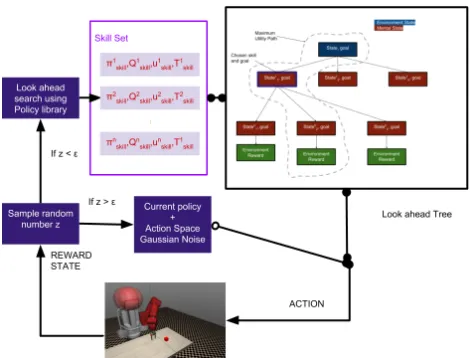
In a nutshell, our framework works as follows. We train a set of simple manipulation skills, such as grasp, transfer, and reach. Each of these skills represents a (generalized) policy that can handle a set of related goals and is parametrized by both the current state and the desired goal (see Figure 1). Each skill may involve a different number of objects, thus different skills may have different state representations. For each skill we learn a coarse-grain transition function, that, given a pair of initial and goal states, it predicts the resulting state, after execution of the skill.
Figure 1: Overview. We use learned skill dynamics with deep neural regressors and use them for look-ahead tree search, to guide effective exploration in reinforcement learn-ing of complex manipulation tasks.
path that leads closer to the desired goal configuration, and the first skill-goal of the path is executed in the real environ-ment. We execute the chosen skill with its goal parameter until termination of that skill or episode. Then, planning is repeated from the newly reached state, akin to model predic-tive control (Mayne 2014).
Our skill-based look-ahead exploration outperforms epsilon−greedy exploration, model-based RL (Sutton 1991) where the fitted dynamics model is used to sup-ply (fake) experience tuples and not for exploration, as well as policy learning over coarse parameterized skills (Hausknecht and Stone 2016), as opposed to low-level ac-tion primitives.
In summary, success of our framework depends on the following design choices, that distinguish it from previous works:
• Look-ahead with coarse-grain skill dynamics yet act with fine-grain primitives. Coarse-grain transition dynamics do not suffer from severe model error accumulation when un-rolled in time (Oh et al. 2015), as few hops are sufficient to look far into the future. Yet, policies over fine-grained ac-tions — as opposed to pretrained skills — produce smooth behaviour, being as fast and optimal as possible.
• Purposeful skill dynamics. Our dynamics model used for look-ahead is built from basic manipulation skills, as op-posed to random exploration and transitions therein (Ha and Schmidhuber 2018). This ensures that learnt dynam-ics cover important part of the state space. In contrast, dy-namics learnt from random exploration alone often miss useful states, and thus their temporal unrolling is less in-formative.
Our code is available at https://github.com/arpit15/skill-based-exploration-drl
Related work
Exploration - Intrinsic motivation Effective exploration is a central challenge in learning good control policies (Mo-hamed and Rezende 2015). Methods such as−greedy, that either follow the current found policy or sample a random action with a certain probability, are useful for local explo-ration but fail to provide impetus for the agent to explore dif-ferent areas of the state space. Exploring by maximizing the agent’s curiosity as measured by the error of predictive dy-namics (Pathak et al. 2017) expected improvement of predic-tive dynamics (Schmidhuber 1990), information maximiza-tion (Mohamed and Rezende 2015), state visitamaximiza-tion density (Bellemare et al. 2016), uncertainty of the value function es-timates (Osband et al. 2016), all have been found to outper-form−greedy, but are limited due to the underlying models operating at the level of basic actions. In manipulation, often times there are very few actions that would lead to effective new outcomes and are hard to discover from uninformative landscapes of the reward function.
Multigoal RL - Inverse dynamics The Horde architec-ture (Sutton et al. 2011) proposed to represent procedu-ral knowledge in terms of multiple Value Functions (VF) learned in parallel by multiple RL agents, each with its own reward and termination condition. VF would capture time for specific events to happen, or, used for inducing a policy for a specific goal. Work of (Schaul et al. 2015) proposed to represent a large set of optimal VF by a single unified function approximator, parametrized by both the state and goal. This takes advantage of the fact that similar goals can be achieved with similar policies, and thus allows general-ization across goals, not only across states. Hindsight Ex-perience Replay (HER) (Andrychowicz et al. 2017) intro-duces the simple idea that failed executions -episodes that do not achieve the desired goal- achieve some alternative goal, and is useful to book-keep in the experience buffer such “failed” experience as successful experience for that alternative goal. Such state and goal parametrized experi-ence is used to train a generalized policy, where actor and critic networks take as input both the current state and goal (as opposed to the state alone). Thanks to the smoothness of actor and critic networks, achieved goals that are nearby the desired one, implicitly guide learning, instead of being dis-carded. Our approach builds upon HER, both for learning the basic skills, as well as the final complex manipulation policies, yet we propose novel exploration strategies, instead of-greedy used in (Andrychowicz et al. 2017).
controls or curiosity, or at least, this result has not been ob-tained till today.
Hierarchical RL Learning and operating over different levels of temporal abstraction is a key challenge in tasks in-volving long-range planning. In the context of reinforcement learning, Sutton, Precup, and Singh (1999) proposed the op-tions framework, which involves abstracop-tions over the space of actions. At each step, the agent chooses either an one-step primitive action or a multi-one-step action policy (option). Each option defines a policy over actions (either primitive or other options) and can be terminated according to a stochas-tic function. The MAXQ framework (Dietterich 1999) de-composes the value function of a Markov Desicion Pro-cess (MDP) into combinations of value functions of smaller constituent MDPs. Work of Kulkarni et al.(2016) learns a policy for scheduling semantically meaningful goals using deep Q networks. Work of Riedmiller et al. (2018) uses sim-ple intrinsic perceptual rewards to learn subtasks and their scheduling for helping learning of extrinsic motivated (non-hierarchical) policies. Chentanez, Barto, and Singh (2005) also explored agents with intrinsic reward structures in or-der to learn generic options that can apply to a wide vari-ety of tasks. Using a notion of salient events as sub-goals, the agent learns options to get to such events. Other works have proposed parametrized actions of discrete and con-tinuous values as a form of macro-actions (temporally ex-tended actions) to choose from (Hausknecht and Stone 2016; Masson and Konidaris 2015). We compare with the model from Hausknecht and Stone in the experimental section. Other related work for hierarchical formulations include Feudal RL (Dayan and Hinton 1993) which consists of “managers” taking decisions at various levels of granular-ity, percolating all the way down to atomic actions made by the agent. Daniel et al.(2016) jointly learn options and hi-erarchical policies over them. Such joint search makes the problem more difficult to solve, moreover, options are not shared across policies of different tasks. We instead capital-ize over already known options (skills) to accelerate training of more complex ones.
Hierarchical Planning Planning has been used with known transition dynamic models of the environment to help search over optimal actions to take. Incorporating macro-actions to reduce the computational cost of long-horizon plans has been explored in He, Brunskill, and Roy(2010). In Vien and Toussaint(2015), the authors integrate a task hier-archy into Monte Carlo Tree Search. These approaches work for discrete state, action and observation spaces, and under known dynamics. Our work instead considers continuous ac-tions and states, and unknown dynamics.
Model-based RL To address the large sample complexity of model-free RL methods, researchers learn models of the domain, which they use to sample fake experience for pol-icy learning (Sutton 1991), initialize a model-free method (Nagabandi et al. 2017) which is further fine-tuned with real experience to fight the biases of the model, or is combined
with a model-free estimation of the residual errors (Chebotar et al. 2017). When the model of the domain is given, Monte Carlo tree search has shown to be very effective for explo-ration (Silver et al. 2017), and outperforms corresponding model-free RL methods (Guo et al. 2014), even when the latter are allowed to consume a great amount of (simulated) experience.
Exploration using look-ahead search over skill
dynamics
We consider a multi-goal Markov Decision Process (MDP) (Schaul et al. 2015), represented by states s ∈ S, goals
g ∈ G, actions a ∈ A. At the start of each episode, a state-goal pair is sampled from the initial state-goal distri-butionρ(s0,g). Each goalg corresponds to a reward
func-tionrg : S × A → R. At each timestep, the agent gets as
input the current statestand goalg, and chooses an action ataccording to a policyπ:S × G → A, and obtains reward
rt = rg(st,at). The objective of the agent is to maximize
the overall reward.
Learning multi-goal skill policies
We endow our agent with an initial set of manipulation skills. We define a skill as a short-horizon generalized ac-tion policy that achievesa set of related goals, as opposed to a single goal. The goal sets of individual skills are not related to the goals of our final manipulation tasks. Our framework can handle any set of skills, independent of their length, complexity, state and action spaces. Furthermore, skills can be redundant within the set. We trained three skills:
• reach, in which the gripper reaches a desired location in the workspace while not holding an object,
• grasp, in which the gripper picks up an object and holds it at a particular height,
• transfer, in which the gripper reaches a desired location in the workspace while holding an object.
The skills do not share the same state space: each involves different number of objects or it is oblivious to some part of the state space. Control is carried out in task space, by pre-dicting directlydx, dy, dzof the motion of the end-effector and the gripper opening. Task space control allows easier transfer from simulation to a real robotic platform and is ag-nostic to the exact details of the robot dynamics. The skills do not share the same action space either, e.g., the reaching skill does not control the gripper open/close motion. State and action abstraction allows faster skill training. Details on the particular skill environments and corresponding states, actions and rewards functions are included in the supple-mentary material.
Each skill is trained using Hindsight Experience Replay (Andrychowicz et al. 2017) (HER) and off-policy deep de-terministic policy gradients (DDPG) (Lillicrap et al. 2015) with standard -greedy exploration (Andrychowicz et al. 2017). This allows us to decouple exploration and policy learning. The agent maintains actorπ : S × G → Aand
respect to the loss functionLa = −EsQ(s,g, π(s,g))and
the critic minimizes TD-error using TD-target yt = rt+
γQ(st+1,g, π(st+1,g)), whereγis the reward discount
fac-tor. Similar to (Andrychowicz et al. 2017), we use a binary reward functionrgwhich is 1 if the resulting state is within
a specified radius from the goal configurationg, and 0 other-wise. Exploration is carried out by addingnormal stochas-tic noise (Andrychowicz et al. 2017) to actions predicted by the current policy.
HER, alongside the intended experience tuples of the form(st,at, rgt,g,st+1), given the resulting statesT of an
episode of lengthT, it adds additional experience tuples in the buffer, by consideringsT to be the intended goal for the
experience collected during the episode, namely, adds tu-ples of the form(st,at, r(sT)t,sT,st+1). All the tuples in
the experience buffer are use to train the actor and critic net-works using the aforementioned reward functions. For more details, please refer to (Andrychowicz et al. 2017).
Learning coarse-grain skill dynamics and success
probabilities
Multi-goal skill policies are used to obtaingeneral and pur-poseful forward dynamic models, that cover rich part of the state space and which are not easy to learn from ran-dom exploration. For theith skill, we learn
• acoarsetransition function of the formTi
coarse: (s,g)→ sf inalwhich maps an initial statesand goalgto a
result-ing final statesf inal, and
• a success probability functionui(s,g)→[0,1], that maps
the current state and goal to the probability that the skill will actually achieve the goal.
We learnTcoarse anduafter each skill is trained. Data
tu-ples are collected by sampling initial states and goals and running the corresponding skill policy. The collected data is used to train deep neural regressors for each skill, a three layer fully connected network that takes as input a state and a goal configurations and predicts the final state reached af-ter skill execution, and the probability of success. The de-tailed architecture of the dynamics neural networks is in-cluded in the supplementary. Each manipulation skill is rep-resented by (generalized) policyπ, action-value functionQ, transition dynamics and probability of success:K={Ωi= (πi,Qi, ui,Ti
coarse), i = 1· · ·N}, whereN is the number
of skills andKthe skill set. For usN = 3. Our coarse skill dynamics model learns to predict the outcome of skill exe-cution (on average 25 timesteps long) instead of predicting the outcome of low-level actions. This allows to plan over longer horizons without severe dynamics error accumula-tion. Although HER with-greedy exploration successfully learns generalized basic skills guided solely by binary re-ward functions, it fails to learn more complex skills, such as,put object A inside container B, that require longer tem-poral horizon. Next, we describe how we use knowledge of coarse skill dynamicsTcoarseand success probabilitiesufor
exploration during training of such complex manipulation policies.
Exploration with look-ahead search
We will use again DDPG with HER to train manipulation policies over low-level actions, but with a better exploration method. DDPG, being an off-policy algorithm, allows use to decouple learning and exploration. We exploit this de-coupling and place our look-ahead search at the exploration step. With probability we use the proposed look-ahead search to select the next action to tryat, otherwise we follow
the current policy learned thus farπ(st, g), wherestdenotes
the current state. We varyto be close to 1 in the beginning of training, and linearly decay it to 0.001.
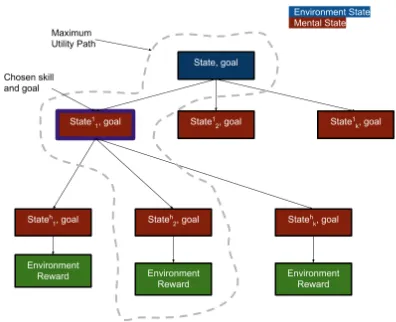
Figure 2: Look-ahead Search:From the current environ-ment state, we sample skill identities and skill sub-goals and (mentally) unfold a look-ahead tree using learned skill dy-namics. We select the first skill and sub-goal of the path with maximum utility and execute it in the “real world”.
Our look-ahead search works as follows: At each episode step, we unfold a search tree by sampling (with replace-ment) at each tree level, for each branch, a set of K skill identities (in our case one ofreach,grasportransfer), and corresponding K skill sub-goals, where K is the branch-ing factor of the search. For each sampled skill identity and sub-goal, we use the learned success probabilities of each sampled skill and sub-goal combination and prune improb-able transitions (line 13 in Algorithm 2). For the remain-ing skill/subgoal combinations we (mentally) transition to the resulting final state following the learned skill dynamics function. After unfolding the tree for a prespecified number of steps, we choose the path with the maximum total reward defined as the sum of the transition rewards(reward for go-ing from one node to other connnected node) of the skill executions as measured by the skill critic networksQiand
proximity of the final state to the desired goal configuration: R=P
(s,k∈K,gk)∈path to leaf nodeQ
k(s, g
k)+rfinal, whererfinal
Algorithm 1 HER with look-ahead search explo-ration(HERLASE)
1: Input:
2: skill setK
3: reward functionr:−1[fg(s) = 0]
4: ←1, skill terminated←true 5: Initializeπ, Q, Replay buffer B 6: forepisode = 1, Mdo
7: Sample a goalgand starting states0
8: whileepisode not donedo
9: ifrandom(0,1)< then
10: ifskill terminatedthen
11: Ωi, gi←TreeSearch(s t,g)
12: (πi, Qi, ui,Ti
coarse)←Ω
i
13: end if
14: at=πi(st, gi)
15: else
16: at=π(st, g)+ Gaussian noise
17: end if
18: st+1,rt, terminal = execution(at)
19: skill terminated←checkSkillTermination(st+1)
20: end while
21: Create hindsight experience withg0=sT
22: end for
skill episode length is reached or goal is reached. The ex-perience in terms of tuples (st,g,at, rt,st+1)populate the
experience replay buffer.
Note that the learned skill dynamicsTcoarse andumay
not match the dynamics in the current environment. The rea-son could be both due to approximation error of the neural network regressors and the difference in the environment dynamics, e.g., task environments may contain additional objects on which the gripper can collide, which were not present during skill learning. Our look-ahead exploration is described in Algorithm 2 and visualized in Figure 2. The complete exploration and reinforcement learning method is described in Algorithm 1.
Experiments
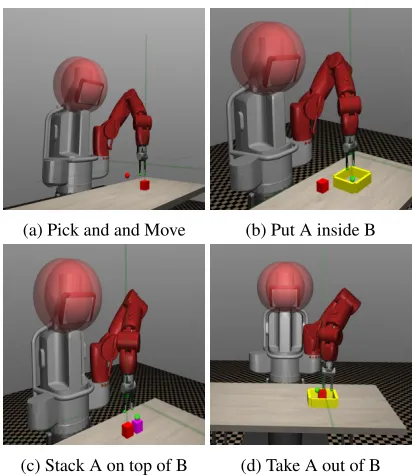
We test the proposed method in the MuJoCo simulation en-vironment (Todorov, Erez, and Tassa 2012) using a seven degree of freedom Baxter robot arm with parallel jaw grip-pers in the following suite of manipulation tasks:
• Pick and Move(Figure 3a) The robot needs to reach to-wards the object, grasp it and move to a target 3D location.
• Put A inside B(Figure 3b) The robot needs to reach to-wards the object, grasp it and put it inside the container.
• Stack A on top of B(Figure 3c) The robot needs to reach towards the red object, grasp it and put it on top of the purple object.
• Take A out of B (Figure 3d) The robot needs to reach towards the object inside the container, grasp it and take it out of the container. The objective of this environment to grasp the objective in cluster container, then move
Algorithm 2TreeSearch
1: Input:
2: maxHeight H, branchingFactor B 3: goalg, initial statesreal
t , skill setK
4: Initialize 5: root←(sreal
t ,0, 0)
6: openlist←addRoot 7: leafNodelist← {} 8: whileall path exploreddo
9: s, currHeight = getTopLeafNode(openlist)
10: sampled Set = sample skills and goal parameters(B) 11: forΩi, gi∈sampled Setdo
12: (πi, Qi, ui,Ti
coarse)←Ωi
13: ifui(s, g
i)>0.5then
14: nextState← Ti
coarse(s, gi)
15: ai ←πi(s, gi)
16: transitionReward←Qi(s, gi, ai)
17: ifcurrHeight+1<Hthen
18: AddToLeafNodelist(nextState,
transitionReward, currHeight+1)
19: else
20: AddNodeToOpenlist(nextState,
transitionReward, currHeight+1) 21: end if
22: end if
23: end for
24: end while
25: bestPath = getBestPath(leafNodeList)
26: Return first skill and goal parameter of bestPath
(a) Pick and and Move (b) Put A inside B
(c) Stack A on top of B (d) Take A out of B
out of container and move it to any 3D location in the workspace.
All the tasks in our benchmark suite require long temporal horizon policies, which is a challenge when learning from sparse rewards.
1. How well the proposed exploration strategy performs over-greedy?
2. How out learnt policies compare with policies assembled directly over macro-actions or options?
3. What is the impact of the chosen skill set to the proposed method?
4. What happens when the dynamics are quite different in the new environment?
We evaluate our method against the following baselines:
1. Hindsight Experience Replay (HER), described in (Andrychowicz et al. 2017). In this method, exploration is carried out by sampling noise from an-normal distri-bution and adding it to the predicted actions of the policy learned so far. This is a state-of-the-art model-free RL method for control.
2. Parameterized action space (PAS), described in (Hausknecht and Stone 2016). This approach uses the learned skills as macro-actions by learning a meta-controller which predicts probability over those skills, as well as the goal of each skill.
3. Parameterized action space + Hierarchical HER ( HER-PAS), as described in (Levy, Platt, and Saenko 2017). We extend the model of (Hausknecht and Stone 2016) by creating additional hindsight experience at macro-level, i.e., in the parameterized action level (skill and sub-goal). Specifically, we replace the goal state in the macro-action transitions collected during the episode which failed to achieve goalgwith theg0 =sT and evaluate all the low
level actions, chosen using the skill and sub-goal, with the new reward functionrt=rgnew(st, at).
4. Parameter Space Noise + HER(HER+ParamNoise), de-scribed in (Plappert et al. 2017), exploration is carried out in parameter space similar to evolutionary strategies.
Success plots for the different tasks for our method and baselines are shown in Figures 4. Our method significantly outperforms the baselines in terms of final performance and sample complexity of environment interactions. In “put A inside B” task 3bHER is not able to succeed at all. PAS show success early in training but converges to sub-optimal performance. This is expected due to the restriction imposed on the policy space by to the hierarchical structure.
Sensitivity to skill set selection We use skills (macro-actions) for exploration, and not for assembling a hierarchi-cal policy, as done in the option framework (Sutton, Precup, and Singh 1999). Therefore, we expect our method to be less sensitive to the skill selection, in comparison to previ-ous methods (Sutton, Precup, and Singh 1999). To quantify such flexibility we conducted experiments using three differ-ent skill sets: faster convergence. To test this hypothesis, we
(a) Pick and Move (b) Put A inside B
(c) Stack A on top of B (d) Take A out of B
Figure 4: The success plot for each manipulation task in our suite. For evaluation, we freeze the current policy and sam-ple 20 random initial states and goals at each epoch (1 epoch = 16 episodes of environment interaction).
(a) Pick and Move task (b) Put A inside B
Figure 5:Sensitivity of our method to skill set selection.
We show the success plots for “Pick and move” and “Put A inside B” tasks. Look-ahead exploration leads to slower learning when essential skills are missing. However, it is still better than random exploration.(1 epoch = 16 episodes of environment interaction).
used 3 skill setK1={transit, grasp, transfer},K2={grasp,
transfer}andK3={transit, transfer}. We tested our method
withK2on the “Pick and Move”, and “Put A inside B” tasks
and show results in Figure 5a. Exploring with all the skills (K1) leads to faster convergence of policy learning than
us-ingK2. This is easily explained as the agent needs to learn
the transit skill via interactions generated by other skills and the current policy. We did not observe any slower learning for “Put A inside B” task usingK2, as shown in Figure 5b.
The reason for this is that the transit skill is similar to the transfer skill, which is present. Learning of “Put A inside B” task usingK3 is slower (Figure 5b). This is due to the fact
that grasping is a critical skill in completing this task. How-ever our method is still able to learn the task from scratch, whileHERfails to do so.
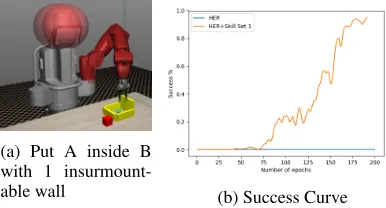
in-side B” task by making a wall insurmountable by the robot arm, shown in Figure 6a. The skill dynamics that concern end-effector states near the large wall would be completely wrong, since this wall was absent during learning of our bacis skills and therefore their dynamics. However, the pro-posed look-ahead exploration is still beneficial, as seen in Figure 6b. Our method succeed to learn task, while HER with random exploration fails to do so. We used our full skill set in this experiment, namely, transit, transfer and grasp skills.
(a) Put A inside B with 1
insurmount-able wall (b) Success Curve
Figure 6: Sensitivity of our method to model errors.In (A) we show the perturbed version of “Put A inside B” task in which a wall is very high and cannot be crossed by the agent. In (B) we show that even with wrong coarse dynamics model our approach works better than random exploration. (1 epoch = 16 episodes of environment interaction).
ScalabilityOur method trades time of interacting with the environment with time to “think” the next move by mentally unfolding a learned model of dynamics. The “thinking” time depends on the speed of the look-ahead search. We experi-mented with different branching factors for the tree search.
With-greedy the agent takes 0.4 seconds per episode (50 steps), with branching factor (bf) equal to 5 the agent takes 17 seconds, with bf=10 it takes 71 seconds, and with bf=15 it takes 286 seconds. However, for complex tasks in our bench-mark suite, we did not observe empirical advantages from larger branching factors, so all the reported results use bf=5. The sampling process and pruning could be implemented in parallel on GPU, which will render our tree search much more efficient. We are currently exploring learning-based ways to guide the tree unfolding.
Conclusion - Future work
We proposed an exploration method that uses coarse-time dynamics of basic manipulation skills for effective look-ahead exploration during learning of manipulation policies. Our empirical findings suggest that the proposed look-ahead exploration guided by learned dynamics of already mastered skills, can effectively reduce sample complexity when mas-tering a new task, to the extent that skills that are impossi-ble with naive exploration, are possiimpossi-ble with the proposed dynamics-based look-ahead exploration, suggesting an av-enue for curriculum learning of manipulation policies, by continually expanding the skill set. The resulting policies are still in the space of primitive low-level actions, which
allows flexibility on choosing skills, and on the resulting re-active policy learner.
If the proposed exploration strategies are used in environ-ments that have different dynamics than the environenviron-ments used to train the basic skills (e.g., there is a wall present, or the object sizes are very different), learning is slower, and our exploration scheme offers less advantages due to model errors. The fact that our dynamics are not updated online is a limitation of our method, and an avenue for future work. All the experiments performed in our paper are based on the centroid estimates of the objects of interest. It would be interesting to explore policies and models learned directly from visual features in future work.
Acknowledgment
The authors would like to thank Chris Atkeson for useful discussions on learning coarse dynamics models. This work was conducted in part through collaborative participation in the Robotics Consortium sponsored by the U.S Army Research Laboratory under the Collaborative Technology Alliance Program, Cooperative Agreement W911NF-10-2-0016. The views and conclusions contained in this document are those of the authors and should not be interpreted as rep-resenting the official policies, either expressed or implied, of the Army Research Laboratory of the U.S. Government. The U.S. Government is authorized to reproduce and dis-tribute reprints for Government purposes not withstanding any copyright notation herein.
References
Agrawal, P.; Nair, A.; Abbeel, P.; Malik, J.; and Levine, S. 2016. Learning to poke by poking: Experiential learning of intuitive physics. CoRRabs/1606.07419.
Andrychowicz, M.; Crow, D.; Ray, A.; Schneider, J.; Fong, R.; Welinder, P.; McGrew, B.; Tobin, J.; Abbeel, O. P.; and Zaremba, W. 2017. Hindsight experience replay. In Ad-vances in Neural Information Processing Systems, 5055– 5065.
Bellemare, M. G.; Srinivasan, S.; Ostrovski, G.; Schaul, T.; Saxton, D.; and Munos, R. 2016. Unifying count-based exploration and intrinsic motivation.CoRRabs/1606.01868.
Chebotar, Y.; Hausman, K.; Zhang, M.; Sukhatme, G. S.; Schaal, S.; and Levine, S. 2017. Combining model-based and model-free updates for trajectory-centric reinforcement learning.CoRRabs/1703.03078.
Chentanez, N.; Barto, A. G.; and Singh, S. P. 2005. In-trinsically motivated reinforcement learning. In Saul, L. K.; Weiss, Y.; and Bottou, L., eds.,Advances in Neural Informa-tion Processing Systems 17. MIT Press. 1281–1288. Daniel, C.; Van Hoof, H.; Peters, J.; and Neumann, G. 2016. Probabilistic inference for determining options in reinforce-ment learning. Machine Learning104(2-3):337–357.
Dietterich, T. G. 1999. Hierarchical reinforcement learn-ing with the MAXQ value function decomposition. CoRR cs.LG/9905014.
Guo, X.; Singh, S.; Lee, H.; Lewis, R. L.; and Wang, X. 2014. Deep learning for real-time atari game play using of-fline monte-carlo tree search planning. In Ghahramani, Z.; Welling, M.; Cortes, C.; Lawrence, N. D.; and Weinberger, K. Q., eds.,Advances in Neural Information Processing Sys-tems 27. Curran Associates, Inc. 3338–3346.
Ha, D., and Schmidhuber, J. 2018. World models. CoRR abs/1803.10122.
Hausknecht, M., and Stone, P. 2016. Deep reinforcement learning in parameterized action space. InProceedings of the International Conference on Learning Representations (ICLR).
He, R.; Brunskill, E.; and Roy, N. 2010. Puma: Planning under uncertainty with macro-actions. InAAAI.
Kulkarni, T. D.; Whitney, W.; Kohli, P.; and Tenenbaum, J. B. 2015. Deep convolutional inverse graphics network. CoRRabs/1503.03167.
Kulkarni, T. D.; Narasimhan, K.; Saeedi, A.; and Tenen-baum, J. B. 2016. Hierarchical deep reinforcement learn-ing: Integrating temporal abstraction and intrinsic motiva-tion.CoRRabs/1604.06057.
Levy, A.; Platt, R.; and Saenko, K. 2017. Hierarchical actor-critic. arXiv preprint arXiv:1712.00948.
Lillicrap, T. P.; Hunt, J. J.; Pritzel, A.; Heess, N.; Erez, T.; Tassa, Y.; Silver, D.; and Wierstra, D. 2015. Con-tinuous control with deep reinforcement learning. CoRR abs/1509.02971.
Masson, W., and Konidaris, G. 2015. Reinforcement learn-ing with parameterized actions.CoRRabs/1509.01644. Mayne, D. Q. 2014. Model predictive control: Recent de-velopments and future promise. Automatica50(12):2967 – 2986.
Mohamed, S., and Rezende, D. J. 2015. Variational infor-mation maximisation for intrinsically motivated reinforce-ment learning. In Cortes, C.; Lawrence, N. D.; Lee, D. D.; Sugiyama, M.; and Garnett, R., eds.,Advances in Neural In-formation Processing Systems 28. Curran Associates, Inc. 2125–2133.
Nagabandi, A.; Kahn, G.; Fearing, R. S.; and Levine, S. 2017. Neural network dynamics for model-based deep re-inforcement learning with model-free fine-tuning. CoRR abs/1708.02596.
Nair, A.; Chen, D.; Agrawal, P.; Isola, P.; Abbeel, P.; Malik, J.; and Levine, S. 2017. Combining self-supervised learn-ing and imitation for vision-based rope manipulation.CoRR abs/1703.02018.
Oh, J.; Guo, X.; Lee, H.; Lewis, R. L.; and Singh, S. P. 2015. Action-conditional video prediction using deep networks in atari games. CoRRabs/1507.08750.
Osband, I.; Blundell, C.; Pritzel, A.; and Roy, B. V. 2016. Deep exploration via bootstrapped DQN. CoRR abs/1602.04621.
Pathak, D.; Agrawal, P.; Efros, A. A.; and Darrell, T. 2017. Curiosity-driven exploration by self-supervised prediction. CoRRabs/1705.05363.
Plappert, M.; Houthooft, R.; Dhariwal, P.; Sidor, S.; Chen, R. Y.; Chen, X.; Asfour, T.; Abbeel, P.; and Andrychowicz, M. 2017. Parameter space noise for exploration. arXiv preprint arXiv:1706.01905.
Riedmiller, M. A.; Hafner, R.; Lampe, T.; Neunert, M.; De-grave, J.; de Wiele, T. V.; Mnih, V.; Heess, N.; and Sprin-genberg, J. T. 2018. Learning by playing - solving sparse reward tasks from scratch. CoRRabs/1802.10567.
Schaul, T.; Horgan, D.; Gregor, K.; and Silver, D. 2015. Universal value function approximators. In Bach, F., and Blei, D., eds.,Proceedings of the 32nd International Con-ference on Machine Learning, volume 37 of Proceedings of Machine Learning Research, 1312–1320. Lille, France: PMLR.
Schmidhuber, J. 1990. A possibility for implementing cu-riosity and boredom in model-building neural controllers. In Proceedings of the First International Conference on Simu-lation of Adaptive Behavior on From Animals to Animats, 222–227. Cambridge, MA, USA: MIT Press.
Silver, D.; Schrittwieser, J.; Simonyan, K.; Antonoglou, I.; Huang, A.; Guez, A.; Hubert, T.; Baker, L. R.; Lai, M.; Bolton, A.; Chen, Y.; Lillicrap, T. P.; Hui, F. X.; Sifre, L.; van den Driessche, G.; Graepel, T.; and Hassabis, D. 2017. Mastering the game of go without human knowledge. Na-ture550:354–359.
Sutton, R. S.; Modayil, J.; Delp, M.; Degris, T.; Pilarski, P. M.; White, A.; and Precup, D. 2011. Horde: A scalable real-time architecture for learning knowledge from unsuper-vised sensorimotor interaction. In The 10th International Conference on Autonomous Agents and Multiagent Systems - Volume 2, AAMAS ’11, 761–768. Richland, SC: Interna-tional Foundation for Autonomous Agents and Multiagent Systems.
Sutton, R. S.; Precup, D.; and Singh, S. 1999. Between mdps and semi-mdps: A framework for temporal abstraction in reinforcement learning. Artificial Intelligence112(1):181 – 211.
Sutton, R. S. 1991. Dyna, an integrated architecture for learning, planning, and reacting. SIGART Bull.2(4):160– 163.
Todorov, E.; Erez, T.; and Tassa, Y. 2012. Mujoco: A physics engine for model-based control. In Intelligent Robots and Systems (IROS), 2012 IEEE/RSJ International Conference on, 5026–5033. IEEE.
Vien, N. A., and Toussaint, M. 2015. Hierarchical monte-carlo planning. InAAAI, 3613–3619.