EMOTIONAL INTELLIGENCE AS A CONTRIBUTING FACTOR
OF PUPIL PERFORMANCE IN PUPILS WITH LEARNING
DIFFICULTIES
CHRISTIANA PAPASTERGIOU
A thesis submitted in partial fulfillment of the requirements
of the University of Bolton for the degree of
Master of Philosophy
2 Acknowledgements
I am indebted to Dr. David Kitchener (University of Bolton) for his expert guidance throughout the duration of my studies.
I am also grateful to my Dr. Angeliki Triantafyllaki for sharing her expertise and knowledge as well as for valuable guidance and encouragement extended to me.
3
Table of Contents
List of Tables …………... ... 7
List of Figures……… ... 8
Abstract………. 9
Introduction ……….10
LITERATURE REVIEW-CHAPTER 1 1.1 Emotional Intelligence 1.1.1 Definitions………...……... 13
1.1.2 Models………... ... 15
1.1.3Theories………... 22
1.2 Pupil Performance 1.2.1 Definitions and Theories………...……...24
1.2.2 Social and Emotional Learning………...…... 26
1.3 Learning Disabilities-Difficulties 1.3.1 Definitions………... ... 30
1.3.2 Dyslexia……….. ... 32
1.3.3 Dysgraphia………. ... 34
1.3.4 Calculating Disorders (Dyscalculia)………... 36
1.3.5 Attention Deficit Hyperactivity Disorder (ADHD)………...……... 38
1.4 Linking Emotional Intelligence - Pupil Performance - Learning Difficulties 1.4.1 Linking EI to academic performance/success……….……. 39
1.4.2 Linking EI to Pupil Performance………..…... 42
1.4.3 Relation of EI to Learning Disabilities………... 44
4 METHODOLOGY-CHAPTER 2
2.1 Research Questions………... ... 48
2.2 Method………... 48
2.3 Research Tools 2.3.1 Observation Protocols………... 50
2.3.2 Questionnaire……….... 52
2.3.3 Interviews………... 56
2.4 Sample ………... 57
2.5 Research Procedure 2.5.1 Pilot study………...……... 60
2.5.2 Access and Entry to School/classroom………..……... 61
2.5.3 Timeline………... 62
2.6 Analysis………....……... 63
2.7 Ethical Issues………...…….. 68
Summary………..……... 69
FINDINGS-CHAPTER 3 3.1 Case study Analysis 3.1.1 Introduction……… 70
3.1.2 Stratos……….……... 71
3.1.3 Anastasia………... 80
5
3.1.5 Vasilis………... 94
3.1.6 Yiannis……….……... 99
3.2 Cross Case Study Analysis………. ... 104
3.2.1 Comparison between the 5 cases according to codes (pupil performance & EI)………... 104
3.2.2 Classroom data according to codes………... 106
DISCUSSION-CHAPTER 4.1 The relation between EI and Pupil Performance………... 113
4.1.1 Emotional distraction in relation to Intrinsic Motivation of Participation and Openness to Success and Failure………... 115
4.1.2 Emotional Perception and Appraisal (EPA) in relation to Lack of Compliance to classroom rules and School Stress Management………... 117
4.1.3 Self – esteem / Self confidence in relation to Trust in abilities and knowledge………....…... 120
Summary………... 122
4.2 Towards a framework of concern………... 123
4.2.1 EI in Language and Mathematics………... ... 124
6
4.2.3 Pupils’ Relationships………... 126
4.2.4 Pupil’s Assessment………... 127
CONCLUSION……….…... 129
Limitations of the study………...…... 131
Implications for Further Research………... 132
References………..…... 134
APPENDICES APPENDIX 1 - RESEARCH TOOLS……….……... 163
APPENDIX 2 - INTERVIEWS………..……...…... 173
APPENDIX 3 - QUESTIONNAIRES………...…….... 186
7
List of tables
Table 2.1: Short description of the rest of the pupils of the sample………... 58
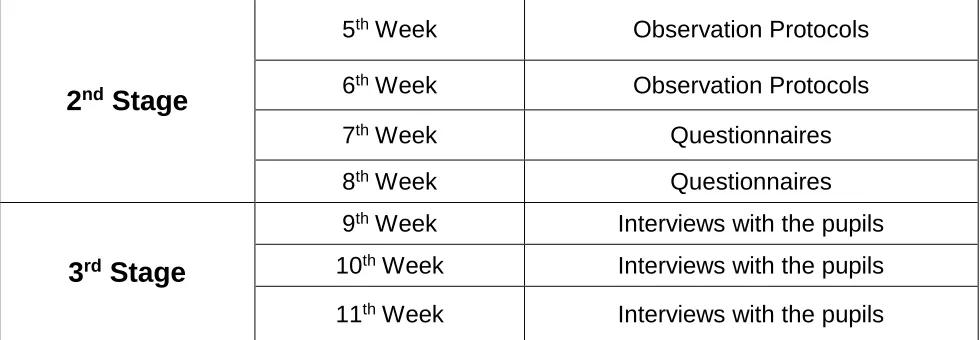
Table 2.2: Timeline of the research………... 62
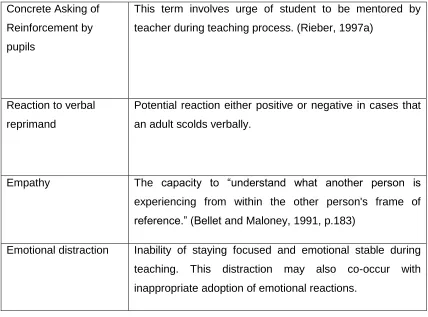
Table 2.3: Codes for EI………... 63
Table 2.4: Codes for EI and Pupil Performance... 65
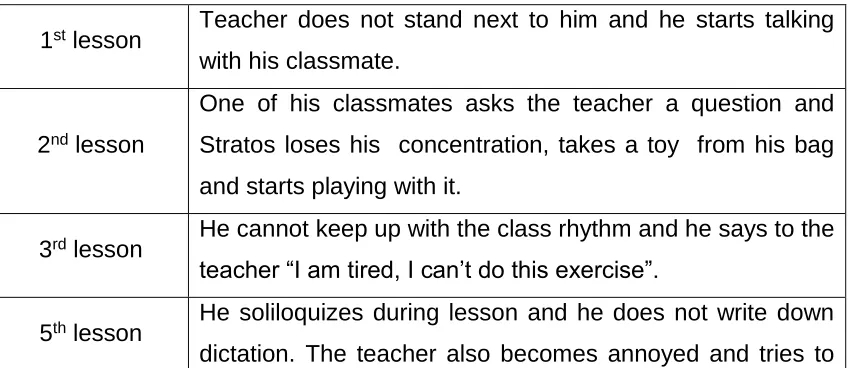
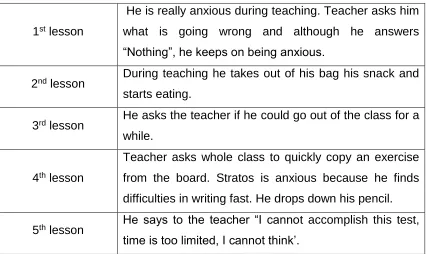
Table 3.1: Stratos’ behavior showing emotional distraction………. ... 72
Table 3.2: Stratos’ relationship with the teacher………... 73
Table 3.3: Stratos’ stress management………...…... 78
Table 3.4: Observations concerning Anastasia’s trust in abilities………... 81
Table 3.5: Field notes concerning Anastasia’s reaction to verbal reprimand………... 82
Table 3.6: Observational data concerning Anastasia’s trust in abilities and knowledge………... 83
Table 3.7: Observational data concerning Anastasia’s intrinsic motivation………...…... 83
Table 3.8: Observational data concerning Andy’s trust in abilities and knowledge…... 88
Table 3.9: Observational data concerning Andy’s openness to success…………...…... 89
Table 3.10: Observational data concerning Andy’s openness to failure………... 89
Table 3.11: Observation data concerning Vasilis’ compliance to classroom rules……... 95
Table 3.12: Observational data concerning Vasilis’ reactions to the teacher’s verbal reprimand... 95
Table 3.13: Observational data concerning Vasilis’ trust in abilities and knowledge…... .97
Table 3.14: Observational data concerning Yiannis’ trust in abilities and knowledge... .100
8
Table 4.1: Proposal of descriptive assessment………..……… 127
List of Figures
Figure 2.1: NVivo screenshot of selecting Codes………... 67Figure 2.2: NVivo screenshot of Observation Coding………....……… 68
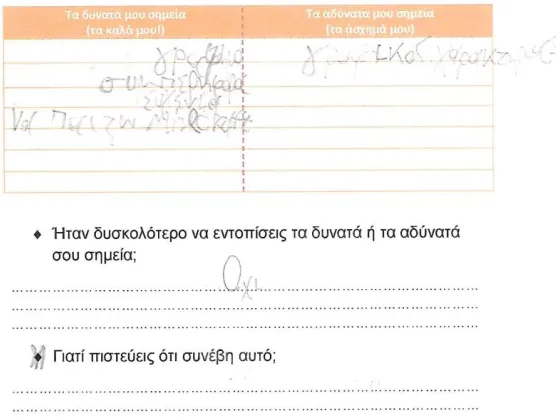
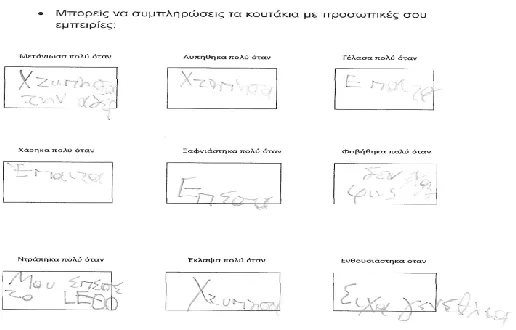
Figure 3.1: Stratos’ questionnaire excerpt a………....……… 75
Figure 3.2: Stratos’ questionnaire excerpt b……… 76
Figure 3.3: Stratos’ questionnaire excerpt c………....……… 77
Figure 3.4: Anastasias’ questionnaire excerpt a……….……… 84
Figure 3.5: Anastasias’ questionnaire excerpt b………...……… 85
Figure 3.6: Andy’s questionnaire excerpt a………...……… 90
Figure 3.7: Andy’s questionnaire excerpt b……….……… 91
Figure 3.8: Andy’s questionnaire excerpt c……….. 92
Figure 3.9: Yiannis’ questionnaire excerpt ………. ……… 93
Figure 3.10: Eleanna’s questionnaire excerpt………..….. 108
Figure 3.11: Annika’s questionnaire excerpt ………..……… 109
Figure 4.1: The Relation between EI and Pupil Performance………...……… 114
Figure 4.2: Pupils filling out the questionnaire……… ……… 122
9 Abstract
The present study aimed at investigating the impact of Emotional Intelligence on pupil performance. Existing literature, even if it is limited, has revealed that such a relationship exists under particular circumstances. It was therefore interesting to look at this relationship under the prism of learning difficulties. The current study expands current literature in that it examines the relationship of emotional intelligence and pupil performance taking into consideration the influence of specific learning difficulties. Studies up to this point have not shed light on this triangulating relationship.
A case study methodology is utilized whereby a small sample of 13 primary school pupils (ages 9-10 years old) with learning difficulties is selected within a private school in Piraeus, Greece. Three research tools were employed to assess the impact of Emotional Intelligence on pupil’s school performance: observation protocols, questionnaires and interviews. Data collection produced a range of qualitative data in the form of texts that were analyzed via the NVivo software program.
The findings revealed that Emotional Intelligence can impact on pupil performance in pupils with learning difficulties, as pupils with higher level of Emotional Intelligence managed to have better learning results. More specifically emotionally intelligent pupils were open to success and failure, had a growing intrinsic motivation for participation, complied with classroom rules, managed more effectively school stress and had higher levels of self-esteem.
The study has implications for the development of primary school curricula that take Emotional Intelligence into account when designing subject materials. The findings of this study may also assist stakeholders in the education sector in developing a better understanding of the impact of Emotional Intelligence on the performance of primary school pupils. By so doing, pupil performance could be improved, even in populations with learning difficulties.
10
INTRODUCTION
Emotional intelligence involves the capacity to perceive emotions, incorporate
emotion-related feelings, understand the emotional information and manage them in an effective
way (Mayer, Salovey, and Caruso, 2004b).
The construct of Emotional Intelligence has been discussed a lot the last decades and
researchers have created a lot of concepts, models and theories. In 1997 Mayer and
Salovey have introduced the four-branch model of Emotional Intelligence (Mayer and
Salovey, 1997). This model has been very useful for educational purposes (Bracket,
Rivers, and Salovey, 2011). The first branch, emotion perception, is the ability to
recognize and express emotions, which include bodily cues and thoughts. The second
branch, facilitating thought, is the ability to use emotion to facilitate problem solving.
The third branch, understanding emotion, is the awareness of hoe emotions combine
and how we interpret meanings. The fourth branch, emotion management, is the ability
to improve negative emotions and retain positive emotions in oneself and others. These
four branches are important for the current study, as they allowed me to create the research tools and assess pupil’s Emotional Intelligence, while I was looking at the
potential influence on pupil performance.
Pupil performance is used in education terminology in order to describe the range of pupils’ learning outcomes in formal education. On the contrary, poor performance
sometimes has as a result failure that means pupils attainment has fallen below an
expected standard. In case of failure pupils and often parents experience frustration.
Oyinloye (2005) attributes the problem of low achievement to low level of Emotional Intelligence among students. He believes that “pupils who lack emotional intelligence
show some adjustive challenges or in some ways fail to handle effectively the demands
of school work. Such pupils might be said to have little or no Emotional Intelligence and may not be capable of attaining personal goals which include high achievement.”
It is apparent that at the heart of primary education is a kind of pupil performance that
11
examination. Schools do know emotional domains and personality factors contribute to
the success of students (Nelson and Low, 2003). Based on that modern educators
could success in their mission to help their pupils achieve more education through
Emotional Intelligence concept. Thus, they could give children the chance to have a
better start to life (Myers and Diener, 1995).
It has been hypothesized that Emotional Intelligence may be linked to pupil
performance. Four major studies conducted on large samples in South Africa, Canada
and the United States (Bar-On, 1997b, 2003; Parker et al., 2004; Swart, 1996) clearly
indicate that there is a relationship between Emotional Intelligence and pupil
performance. More current studies have also had similar findings (Brouzos et al., 2014;
Bracket, Rivers, and Salovey, 2011; Ferrando et al., 2010; Hogan et al., 2010; Jiwen
Song et al., 2010; Malekar and Mohanty, 2011; McCann et al., 2011; Laborde,
Dosseville, and Scelles, 2010; Rafaila, 2015).
The results of these studies informed the current investigation that aims to determine
whether particular aspects of Emotional Intelligence are related to pupil performance in
a particular population: pupils with learning difficulties. It is important to examine the
relationship between these two constructs because we may be able to predict which of
these pupils will be successful in the school environment. In addition, if there is a relationship, then improving such populations’ Emotional Intelligence might increase pupils’ chances of school success.
Being a teacher myself, my goal in working with pupils is twofold: the acquisition of
academic and social skills in order to create a personal investment in learning and of course increase students’ engagement and enthusiasm for school. The challenge is
even bigger if we talk about pupils with learning difficulties. Increasing their
performance means supporting pupil to meet the defined academic standards of the
school, as well as underlying social and behavioral needs. In my opinion performance of pupil’s with learning difficulties could be improved with the intervention of personality
facets and of course emotions take up the first place in that case. This was my
12
The thesis is divided into four chapters. The first one is devoted to the literature review
and it incorporates definitions, theories and models of the three constructs of the study;
Emotional Intelligence, Pupil Performance and Learning Difficulties. At the end of this
chapter with the analysis of each one of these terms, a link is attempted between these
terms through prior studies that have investigated their potential relationships.
In the second chapter, Methodology, the aim and rationale of the study and the
research questions are presented. Further the method of the study, which is case
study analysis, as well as the research tools, their strengths and weaknesses, are
discussed. The last sections of this chapter describe the research procedure, the time
frame and also ethical issues specific to the current study.
The next chapter, Analysis of the findings, is divided in two sections. The first section
presents thoroughly the five case studies, whereas the second aims at a cross case
study analysis which initially focuses on the comparison of the case studies and further
on the analysis of the findings regarding the remaining pupils in the sample.
The fourth chapter has different sub-sections. The most robust section of this chapter
though is the discussion that is split in two parts. The first part discusses the findings of
the study in relation to the existing literature, whereas the second one suggests a
potential framework of Emotional Intelligence which could be integrated within Greek
schools.
The conclusion focuses on the implications and limitations of the study and on
proposals for further research. The appendices are found at the end of the Thesis and
include the interview schedule, the translated interviews of the children, as well as the
13
CHAPTER 1
Review of the Literature
This section describes the concept of Emotional Intelligence in terms of definitions and
existing theories. It aims also to explore the links between the three pylons of the
current study: Emotional Intelligence, Pupil Performance and Learning difficulties. An
analysis of the concept of Pupil Performance reveals its key components and facets,
also in relation to Emotional Intelligence; likewise the broad literature addressing
Learning Difficulties is approached by highlighting those that hold more relevance for
the current study.
1.1 Emotional Intelligence
1.1.1 Definitions
Emotional intelligence (EI) has become a major topic of interest since the publication of
a bestseller by the same name in the mid-90s (Goleman, 1995a). Despite the fact that
the last decades interest in this concept has been increased, scholars and researchers
have been studying EI for the greater part of the twentieth century, and we could find its
historical roots to the nineteenth century (Darwin, 1872/1965).
In 1983, Harvard psychologist Howard Gardner introduced the idea of “multiple intelligences” which included not only verbal and mathematical skills but also
interpersonal and intrapersonal effectiveness. In 1985, Wayne Leon Payne wrote a
doctoral dissertation which included the term "emotional intelligence" in the title. This seems to be the very first academic use of the term "emotional intelligence” (Hein,
2005).
EI according to Mayer and Cobb (2000) refers to an individual’s ability to recognize the
14
one’s own and others’ feelings and emotions, to discriminate among them and to use this information to guide one’s thinking and actions” (Salovey and Mayer, 1990, p.189).
EI involves the capacity to perceive emotions, incorporate emotion-related feelings,
understand the emotional information and manage them in an effective way (Mayer, Salovey, and Caruso, 2004b). It includes “the ability to accurately perceive emotions, to
assess and generate emotions so as to assist thought, to understand emotional
knowledge and to reflectively regulate emotions so as to promote emotional and intellectual growth.” (Mayer and Salovey, 1997, p.5). They therefore suggested an
alternative definition few years after in order to conceptualize better the construct of EI :
“EI includes the ability to engage in sophisticated information processing about one’s own and others’ emotions and the ability to use this information as a guide
to thinking and behavior. That is, individuals high in EI pay attention to, use,
understand, and manage emotions, and these skills serve adaptive functions that potentially benefit themselves and others” (Mayer, Salovey, and Caruso,
2008, p.503).
Therefore, EI refers specifically to the combination of intelligence and emotion and the
impact of this combination in everyday life (Ciarrochi, Chan, and Caputi, 2000).
According to Mayer, Salovey and Caruso (2004a), EI has relevance for all ages and
researchers define it as the capacity to identify, control and assess the emotions at a
personal and interpersonal level. EI is also defined as the ability to reason about
emotions and emotional information, and of emotions to promote thought (Mayer and
Salovey,1997).
In 2007, based on the academic work of the Jack Mayer and Peter Salovey, Hein
defined EI as “the innate potential to feel, use, communicate, recognize, remember, describe, identify, learn from, manage, understand and explain emotions”. The main difference between Mayer Salovey’ s and Hein’s definition is that describes EI as an
innate potential. This means that each of us has born with a specific and unique potential for the following components of EI; Emotional sensitivity, Emotional memory,
15
Caruso (2004) gave an extended definition by broadening the limits of EI and defined it as “the ability to accurately identify emotions, use emotions to help you think,
understand what causes emotions and manage to stay open to these emotions in order to capture the wisdom of our feelings.” (coming from a radio interview, February 2004).
EI has also been generally described as a competency to perceive and express in an
accurate way emotion, to use emotion to facilitate thought, to understand emotions, and
to manage emotions for emotional growth (Brackett, Mayer, and Warner, 2004).
Coleman (2008) gave a more concrete definition by suggesting that EI is the ability to
recognize one's own and other people's emotions, to discriminate between different
feelings and label them appropriately, and to use emotional information to guide
thinking and behavior.
It seems that the definition of EI has different dimensions and consists of numerous
abilities which represent the wide range of identifying, understanding and expressing
emotions, taking into consideration all the variables in terms of social interaction.
1.1.2 Models
From Darwin to the present, a plethora of different conceptualizations and definitions of
the construct of EI have appeared regarding the way this terminology is defined,
measured and applied. The Encyclopedia of Applied Psychology (Cherniss, 2004)
suggests that there are three major EI models: (a) the Mayer and Salovey model (1997)
that defines this construct as the ability to perceive, understand, manage and use
emotions to facilitate thinking; (b) the Goleman model (1998) that views it as an
assortment of various competencies and skills that contribute to successful managerial
performance; and (c) the Bar-On model (1997b) that describes EI as an array of
interrelated emotional and social competencies and skills that influence intelligent
behavior.
Mayer and Saloveys’ theory of EI integrates aspects from the fields of intelligence and
16
used as a guide for this study’s research tools, serving as a theoretical background.
From intelligence theory comes the idea that intelligence involves the capacity to carry
out abstract reasoning. From research conducted on emotions, comes the concept that
emotions are signals that convey regular and discernible meanings about relationships
and that there is a number of basic emotions which are universal (Mayer, Salovey, and
Caruso, 2002a). The authors propose that individuals vary in their ability to process
information of an emotional nature and in their ability to relate emotional processing to
a wider cognition (Stys and Brown, 2004). Mayer and Salovey's conception of EI is
based within a model of intelligence which struggles with defining EI within the standard
criteria for a new type of intelligence (Mayer et al., 2003).
The current measure of Mayer and Salovey’s model of EI, the Mayer-Salovey-Caruso
EI Test (MSCEIT) was normed on a large sample of respondents worldwide. “The
MSCEIT is designed for individuals 17 years of age or older and aims to measure the
four abilities described in Salovey and Mayer's model of EI. Each ability (perception,
facilitation of thought, understanding, and regulation) is measured using specific tasks.
Perception of emotion is measured by rating the extent and type of emotion expressed
in different types of pictures. Facilitation of thought is measured by asking people to
draw parallels between emotions and physical sensations, as well as emotions and
thoughts. Understanding is measured by asking the subject to explain how emotions
can blend from other emotions.
The Mayer-Salovey-Caruso EI Test includes 141 items. The scale provides six scores:
an overall EI score (Emotional Intelligence Quotient-EIQ), two area scores (Experiential
Emotional Intelligence-EEIQ and Strategic Emotional Intelligence- SEIQ) and four
branch scores representing the four branches of EI. Each score is expressed in terms
of a standard intelligence with a mean score of 100 (average score) and a standard
deviation of 15. Furthermore the manual provides qualitative ratings and descriptions
that correspond to each numeric score. For example, an individual who receives an
overall EIQ of 69 or less would be rated 'considerable development' whereas someone
scoring 130 or more would be rated 'significant strength' (Mayer, Salovey, and Caruso,
17
Reuven Bar-On was the one of the first who developed measures of EI and used the term "Emotion Quotient". Bar-On model’s includes five components of EI: intrapersonal,
interpersonal, adaptability, stress management, and general mood. Bar-On proposes
that EI is a developing skill and that it can be improved through training, programming,
and therapy (Bar-On, 2002).
“Bar-On's model of EI relates to the potential for performance and success, rather than performance or success itself, and is considered process-oriented
rather than outcome-oriented. It focuses on an array of emotional and social
abilities, including the ability to be aware of, understand, and express oneself,
the ability to be aware of, understand, and relate to others, the ability to deal with
strong emotions, and the ability to adapt to change and solve problems of a social or personal nature” (Fani, 2015, p.12).
Daniel Goleman, a psychologist and science writer who has occupied with brain and
behaviour research for the New York Times, discovered the work of Salovey and Mayer
in the 1990's. Inspired by their findings, he began to conduct his own research in the
area and eventually he came up with the book Emotional Intelligence (1995), which introduced and familiarized both the public and private sectors with the idea of EI.
Goleman's model outlines four main EI constructs. The first, self-awareness, is the
ability to read one's emotions and recognize their impact while using feelings to guide
decisions. Self-management, the second construct, involves controlling one's emotions
and the ability to adapt oneself to changing circumstances. The third construct, social
awareness, includes the ability to sense, understand, and react to other's emotions
while comprehending social networks. Finally, relationship management, the fourth
construct, involves the ability to inspire, influence, and develop others while managing
conflict or under difficult circumstances (Goleman, 1998). Goleman includes a set of
emotional competencies within each construct of EI. Emotional competencies are
considered as learned capabilities that must be developed to achieve outstanding
performance. Goleman posits that individuals are born with a general EI that
determines their potential for learning emotional competencies (Boyatzis, Goleman,
18
EI is also frequently described as two different models, the trait model and the ability
model (Bastian, Burns, and Nettelbeck, 2005; Petrides and Furnham, 2003). The ability
model, as defined by Mayer, Salovey and colleagues (2004), describes a competency or ability to accurately perceive and identify one’s own emotions as well as the
emotions of others, and to use this knowledge to make desirable responses. They
suggest that the ability model entails that EI is an ability that can be taught through training and similar to the traditional tests measuring intelligence.
The ability EI model is mostly assessed by the Multifactor Emotional Intelligence Scale
(MEIS) or by the more recent Mayer- Salovey-Caruso EI Test (MSCEIT) (Mayer,
Salovey, and Caruso, 2004a). Mayer and colleagues assess EI as a skill or ability
rather than as a self-report of perceived emotional competence.
In contrast, trait models are mainly assessed via self-report and are designed to
measure emotional abilities and positive social behaviors (Conte, 2005). The oldest
measure of trait EI is the Emotional Quotient Inventory (EQ-i; Bar-On, 1997), a self
report measure of traits related to emotional and social knowledge that influences an individual’s ability to cope in an effective way.
A second self-report measure of trait EI, the Emotional Competency Inventory (ECI), is based on Goleman’s (2003) model of EI and purports to assess abilities or
competencies in four areas: self-awareness, self-management, social awareness, and
relationship management.
A key difference between the ability and trait models is the manner in which they are
assessed. The different ways in which these EI models are assessed have direct
bearing on the other types of constructs with which they are correlated and the types of
EI that are being measured. For example, the MSCEIT, which assesses ability EI,
appears to be distinct from trait EI both conceptually and empirically. The MSCEIT is
only correlated with trait measures of EI such as the EQ-i and ECI (Mayer, Salovey,
and Caruso, 2004a), and actually shows higher correlations with traditional measures
of intelligence (Conte, 2005), academic success as measured by GPA (Mayer et al.,
19
The MSCEIT is also only correlated with measures of personality (Brackett, Mayer, and
Warner, 2004; Mayer, Salovey, and Caruso, 2004a; Conte, 2005).
On the other hand, measures of trait EI such as the EQ-i and ECI appear to overlap heavily with the constructs of personality and coping style. Moreover, despite claims of
these types of EI measures being associated with improved outcomes, the EQ-i was
shown to be a poor predictor of success as measured by GPA in a study of 160
Canadian college students (Conte, 2005). Although some researchers suggest that
higher scores on the ECI are associated with greater effectiveness in the workplace
(Emmerling and Goleman, 2003), other researchers suggest that ECI overlaps too
much with measures of personality and motivation to be a useful and distinct construct
(Conte, 2005; Petrides, Frederickson, and Furnham, 2004; Van der Zee, Thijs, and
Schakel, 2002). This has led critics of the EI concept to suggest that EI contributes little
to our knowledge despite what decades of research on the concepts of cognitive
intelligence personality, and coping has already shown (McCrae, 2000).
There is a significant amount of debate within the EI literature concerning the two
models of EI (ability vs. mixed), as many researchers have attempted to address the
issue of which model represents EI in the most accurate way. Supporters of the ability
model propose that the mixed model of EI is less genuine. Ability model supporters
argue that research based on ability measures has demonstrated that EI is a clearly
defined construct with evidence of incremental validity (Brackett and Mayer, 2003).
However, some researchers believe that the ability model focuses too strictly on
traditional intelligence-based psychometric criteria. They argue that intelligence should
incorporate many more facilities which have traditionally been beyond its scope.
Researchers, such as Howard Gardner, support that standardized intelligence tests are
not so appropriate to assess success in school or life, so they could not be used for a
mixed model of EI (Gardner, 1999).
The last decades and despite these critics mentioned above, numerous research
studies have been conducted that showed a positive interaction between EI and
20
cognitive factors. Important is that even if the relationship between EI and personality
and these areas of performance is strong and consistent, there is still room for
improvement (Mc Cann, 2003).
Among the most famous models, the Bar-On model, provides the theoretical basis for
the EQ-i, which was originally developed to assess various aspects of this construct as
well as to examine its conceptualization. According to this model, emotional-social
intelligence is a cross section of interrelated emotional and social competencies, skills
and facilitators that determine how effectively we understand and express ourselves,
understand others and relate with them, and cope with daily demands. The emotional
and social competencies, skills and facilitators referred in this conceptualization include
the five key components described above; and each of these components comprises a
number of closely related competencies (Bar-On, 2006).
Bar-On proposed that “to be emotionally and socially intelligent is to effectively
understand and express oneself, to understand and relate well with others, and to successfully cope with daily demands, challenges and pressures.” (IOLC, 2011, p.501).
The characteristics of the emotionally and socially intelligent people include the ability to be aware of others’ emotions, feelings and needs, and to establish and maintain
cooperative, constructive as well as satisfying relationships. More specifically being
emotionally and socially intelligent means that the person is able to manage changes at
any level of life (personal, social and environment), solve problems and taking
decisions. In other words individuals need to be optimistic, positive and self-motivated
(Bar-On, 2006).
The term “Emotional quotient” (EQ) was also introduced by Reuven Bar-On in 1988. He
developed an assessment tool to measure EQ, the Emotional Quotient Inventory
(EQ-i). According to Bar-On (2002), EI is "an array of non cognitive capabilities,
competencies, and skills that influence one's ability to succeed in the coping with
environmental demands and pressures" (Bar-On, 2002, p.14). Broadly defined, EI
"addresses the emotional, personal, social, and survival dimensions of intelligence"
21
The EQ-i, as a self-report measures emotionally and socially intelligent behavior
(emotional-social intelligence). The EQ-I has the first measure widely used measuring emotional-social intelligence since its first publication (1996). “The original version of
the EQ-i comprises 133 items in the form of short sentences and employs a 5-point response scale with a textual response format ranging from “very seldom or not true of me” (1) to “very often true of me or true of me” (5). The EQ-i is suitable for individuals
17 years of age and older” (Bar-On, 2006). Based on the Flesch- Kincaid
(Kincaid,1975;1988) formula of readability, which was designed to indicate how difficult
a reading text in English is to understand, the reading level in English has been
assessed at the North American sixth grade level. It takes approximately 30 minutes to
complete the inventory; and it typically takes less time to complete the online version. A list of the inventory’s items is found in the Bar-On EQ-i Technical Manual (Bar-On,
2006).The EQ-i includes the following four validity indicators: Omission Rate (number of
omitted responses), Inconsistency Index (degree of response inconsistency), Positive
Impression (tendency toward exaggerated positive responding) and Negative
Impression (tendency toward exaggerated negative responding).
(http://www.reuvenbaron.org)
Critically discussing the three models
The three models, which have analytically been presented above, have some critical
differences. The first model, created by Peter Salovey and John Mayer, describes E.I.
as a cognitive ability. Reuven Bar-On regards E.I. as a mixed intelligence that includes
cognitive ability and personality aspects. This model emphasizes how cognitive and
personality factors influence general well-being. The third model, introduced by Daniel
Goleman, also perceives E.I. as a mixed intelligence involving cognitive ability and
personality aspects. However Goleman's model focuses on how cognitive and
personality factors determine success within the workplace.
Although the three models of EI differ in terms of that they conceptualize EI there are
theoretical and statistical similarities between the various models. All the models aim to
22
one’s own emotions and the emotions of others (Goleman, 2001). The three models
also agree that there are certain key components to EI, and there is even some
consensus on what those components are. One of this components is for example
emotional perception and emotional management.
Statistical analysis has shown the above mentioned relationship between elements of
the models. Studying the descriptions of the measures of EI, it could be assumed that
different measures of EI are related and may be measuring similar components (Stys
and Brown, 2004). Brackett and Mayer (2003) found significant similarities between the
Mayer-Salovey-Caruso EI Test and the interpersonal EQ scale of the Bar-On Emotion
Quotient Inventory. In the same vein similarities have been also between self-report
measures of EI.
As the current study conceptualizes EI as a skill or ability rather than a self-reported measure of perceived emotional competence, it employs Mayer and Salovey’s model in
analyzing the data. More precisely, it takes into consideration the four abilities of their
model (perception, facilitation of thought, understanding, and regulation) in order to
design research tools and effectively categorize the collected data.
1.1.3 Theories
EI researchers discuss a number of human capacities related to identifying and
understanding emotions and also involving emotional information processing. In 1990,
Salovey and Mayor proposed that these abilities made up a unitary EI, as in the abstract of the 1990 article they wrote “This article presents a framework for EI, a set of skills hypothesized to contribute to the accurate appraisal and expression of emotion in
oneself and in others, the effective regulation of emotion in self and others, and the use of feelings to motivate, plan and achieve in one's life.” (p.2)
In a 1997 publication Mayer and Salovey listed four branches and offered a detailed
chart reflecting their thoughts. In that article they say that the branches in the chart are
23
integrated processes. For example, the lowest level branch concerns the (relatively)
simple abilities of perceiving and expressing emotion. In contrast, the highest level
branch concerns the conscious, reflective regulation of emotion." (p.10).
Looking at the model from the left to the right we could assume that early developed
abilities are to the left branch whereas later developing abilities are to the right.
Additionally Mayer and Salovey (2004, p.36) also supported that "people high in EI are
expected to progress more quickly through the abilities designated and to master more
of them.". The Four branches of EI, discussed below, are Perception Appraisal and
Expression of Emotion; Emotional Facilitation of Thinking, Understanding and
Analyzing Emotions; Employing Emotional Knowledge; and Reflective Regulation of
Emotions to Promote Emotional and Intellectual Growth.
Perception, Appraisal and Expression of Emotion consists of different abilities. On the first level it is recognized as the ability to identify emotion in one’s physical states,
feelings and thoughts. Further, it includes the ability to identify emotions in other
people, designs, artwork through language, sound, appearance and behavior and
accurate expression of emotions and needs related to those feelings. On the final level it depicts one’s ability to discriminate between accurate and inaccurate, or honest vs.
dishonest expressions of feeling.
Emotional Facilitation of Thinking represents emotions prioritize thinking by directing attention to important information. Furthermore, through emotional facilitation, emotions
are sufficiently vivid and available that they can be generated as aids to judgment and
memory concerning feelings. It also encourages consideration of multiple points of view
and finally encourages specific problem-solving approaches such as when happiness
facilitates inductive reasoning and creativity.
Understanding and Analyzing Emotions by employing Emotional knowledge is fundamentally the ability to label emotions and recognize relations among the words
and the emotions themselves and the ability to interpret the meanings that emotions convey regarding relationships. It also represents one’s ability to understand complex
24
The advanced level of EI is Reflective Regulation of Emotion to Promote Emotional and Intellectual Growth. This level involves abilities such as staying open to both
pleasant and unpleasant feelings, engaging or detaching from an emotion depending upon its judged informativeness or utility. Furthermore, it “represents the ability to
reflectively monitor emotions in relation to oneself and others and to manage emotion in
oneself and others by moderating negative emotions and enhancing pleasant ones, without repressing or exaggerating information they may convey” (Mayer and Salovey,
1997,p.14). (Hein, 2007)
Theories of EI support that EΙ can be developed and improved. Research has
supported the idea that EI competencies can be significantly improved over time. This
development can be divided into personal and social competences. Personal
competence consists of self-awareness and self-management. Social competence
consists of social awareness and relationship management, including empathy,
leadership, communication, change catalyst, conflict management, building bonds,
teamwork and collaboration. (Emmerling and Goleman, 2003) Theories of EI, which are
presented above, suggest different levels, from basic to the highest that are internalized
progressively. Theories reveal a developmental model of EI from childhood to
adulthood. Within each level, skills can be identified that are early developing and skills
that await greater maturity.
1.2 Pupil Performance
1.2.1 Definitions and Theories
Pupil performance is used in education terminology in order to comprehend the range
of learning outcomes concerning pupils and students. It is a broad term that integrates aspects of pupils’ progress, goals, performance, as well as the improvement of
interpersonal and intrapersonal skills.
Slavin and Madden (2001) assumes that a key aspect in pupil performance is to
measure what a pupil has gained during teaching and not only his grades and point
25
sometimes caught in the trap of measuring strictly an individual’s attainment based only
on numeric scores.
Ann Colley and colleagues (1994) suggested that there are at least four-scale
achievement that a school needs to develop. First of all, dealing with the capacity to
remember and use facts. This aspect refers to the type of performance that public
examinations tend to measure mostly in written form and it focuses on memorizing and
reproducing knowledge abilities of the pupil. A step above we find practical and spoken
skills including also problem-solving and investigation skills. Another aspect of
performance according to Hargreaves and his colleagues (1995) are personal and
social skills and foremost the ability to communicate with and relate to others. It also
refers personal facets such as initiative, self-reliance and leadership potential. The final
aspect consists of motivation, self-esteem and self-confidence (MacGilchrist et al.,
2004).
Pupil performance could be broken down in three broad categories: what will pupils
attain, what pupils’ progress will be and how will the pupils respond in lessons and around the school. The word ‘performance’ describes the end-result of the educative
process. This incorporates the attainment, progress and response of pupils, and other
goals (Gipps, 1994). However, Merriam Webster dictionary (2013) defines pupil performance as ‘the act of performing’ and more specifically the action and work to be
performed so as to accomplish or bring to completion. Furthermore the term involves
execution, accomplishment and fulfillment. In the present study, the term performance
is related to grades, progress and the overall presence a pupil has within the class.
Pupil’s performance, as mentioned above, is a multifaceted topic that is also influenced
by socio-emotional characteristics. More specifically, learning social and emotional
skills can have a positive impact on pupil attainment and performance. Emotions can support or impede pupils’ learning, their academic engagement, work ethic,
commitment, and ultimate school success (Coleman and Hoffer, 1987; Coleman,
Hoffer, and Kilgore, 1982).
Pupil performance is influenced by a number of specific social and emotional
26
2002) have the strong belief that most of their basic abilities can be developed through
dedication and hard work so they persist when faced with learning challenges. These
pupils also set goals, manage stress and organise their school work. The result is to
achieve by the end of the school year higher grades (Ditton, Krüsken, and
Schauenberg, 2005), and use problem-solving skills to barrier any other obstacles
aiming at doing better academically (Domina, 2005).
Social and emotional competencies have been found to be a more significant
determinant of pupil attainment compared to IQ (Duckworth and Seligman, 2005). Many
studies in secondary and university education have shown connections between
emotional variables and academic performance (Bandura, 2001).
1.2.2 Social and Emotional Learning
Strongly connected to EI theories are Socio- Emotional Learning programs (SEL). SEL
is the process through which children and adults acquire the knowledge, attitudes, and
skills associated with the core areas of social and emotional (SE) competency and it
consists of different categories; Self-Awareness: identifying and recognizing emotions; accurate perception; recognizing strengths, needs, and values;
self-efficacy, Self-Management: impulse control and stress management; self-motivation and discipline; goal setting and organizational skills, Social Awareness: perspective taking; empathy; difference recognition; respect for others, Relationship Skills: communication, social engagement, and relationship building; working cooperatively;
negotiation, refusal, and conflict management; help seeking, Responsible Decision-making: problem identification and situation analysis; problem solving; evaluation and reflection; personal, social, and ethical responsibility (Collaborative for Academic,
Social, and Emotional Learning, CASEL, 2003).
“Social and emotional learning (SEL) is the process through which children and adults
acquire and effectively apply the knowledge, attitudes, and skills necessary to
understand and manage emotions, set and achieve positive goals, feel and show
27
decisions. “ (Elias, 2004, p.53). Emotional learning programs could have positive effect
on social behaviors, fewer conduct problems, less emotional distress, and ultimately
improve test scores and grades (Greenberg et al. 2003).
Socio-Emotional Learning skills could be taught, practiced, and applied to diverse
situations so that students will be supplied with the skill to use them as part of their
daily behavior (Weissberg et al., 2003). Zins et al. (2004) believe that through SEL
programming, pupils and students could improve their connection to school, classroom
behavior, and academic achievement.
Important findings concerning SEL come from a key review of research conducted on interventions that promote children’s social and emotional development (Durlak and
Dupre, 2007). This review of more than 700 studies included school, family, and
community interventions and it was designed to promote social and emotional skills in
children and adolescents between the ages of 5 and 18. There were three main:
studies about (a) school-based interventions, (b) after-school programs, and (c)
programs for families. The meta- analysis of this study revealed that SEL programming
promotes the development and use of these SE competencies in terms of creating safe
and supportive school, family, and community learning environments in which children
feel safe, secure, respected, connected to school, and engaged in learning (CASEL,
2011).
Elias et al. (1997) have also indicated that schools will be most successful and
effective in case that they promote academic, social and emotional learning.
Researchers support the idea that lifelong learning and academic performance are also
improved through SEL. Emotions can facilitate their learning and their ultimate success in school and life (Zins, 2004). “Additional research shows that prosocial behavior in
the classroom is directly linked with positive intellectual outcomes and performance on standardized achievement tests” (Zins, 2004, p.3-4). These findings are critical for
teachers, who can use social-emotional learning methods to manage their classroom
more effectively and to cope with students. School-based programmes of social and
emotional learning can indeed help young people to acquire the skills they need to
make good academic progress. The next section refers to Social Emotional Learning
28
Social and Emotional Learning Methods include a variety of methods. In 2000 Adelman
and Taylor proposed a school model in accordance with SEL programs including
coordination, classroom-focused enabling, support for transitions and home
involvement in schooling. The focus was on helping schools create positive
environments conductive to learning. Success in schools could be reflected in many
ways not only regarding strict score criteria but also social behaviour. Effective SEL
interventions are also aiming at enhancing the social environment factors that influence
learning in order to be able to create a caring, supportive and conductive to success
learning environment (Hawkins et al.,1998).
Furthermore, a range of correlational and longitudinal studies have shown correlations
between emotional variables and academic performance (Caprara et al., 2000; Wang
et al., 1997). Emotional learning programs could have a positive impact not only related
to social behaviors but also could influence positively stress management as well as
performance (Greenberg et al., 2003). Through systematic instruction, SEL skills “may
be taught, modeled, practiced, and applied to diverse situations so that students use them as part of their daily behavior” (Durlak et al., 2011, p.406).
The main findings of a recent study (Roger et al., 2008), which implemented SEL
programs in students demonstrated improvement in multiple areas of their personal life
and academic level, while it simultaneously affected positively social behaviors,
attitudes toward self, school and others and academic performance. Furthermore,
research conducted indicates that social and emotional learning (SEL) programming for
primary school pupils is a very promising approach to reduce problem behaviors by
promoting positive adjustment and enhancing performance (Diesktra, 2008; Greenberg
et al., 2003; Weissberg, Kumpfer, and Seligsman, 2003).
In order to present an effective intervention through these SEL programs we could say
that in the center of this program exist emotional, social and interpersonal skills and
cognitive abilities. The program influences by teacher background, the
school/classroom context and socio-emotional competence. Further it also have
implication in community, district, state and federal policy. These terms include a big
number of interactions and potential relationships. It is emerged that in order to
29
community is required. To focus on EI though we could say that SEL programs offer the
opportunity to make even pupils that they do not have developed appropriately their EI
the opportunity not only to perform better but to feel safer and more positive towards
learning. Social and Emotional Learning is not focused on the classroom or an
individual subject, but it is a strategy that penetrates the function and more specifically
the mentality of the school.
Connected to this growing body of literature, “it is widely believed that SEL programs
are among the most successful youth development programs offered to school- age youth.” (Casel, 2008, p.3). At the same time they were positively influenced regarding
their social behaviors, attitudes toward self, school and others and academic
performance. Furthermore, a big number of studies, conducted during the past few
decades, indicated that social and emotional learning (SEL) programming is also
beneficial for elementary school students as it reduces problem behaviors promoting
positive adjustment, and enhances attainment (Diesktra, 2008; Greenberg et al., 2003;
Weissberg, Kumpfer, and Seligsman, 2003).
Summarising the review of the literature so far, we could conclude that there is a
gradually increasing number of scientifically based research studies supporting the
relation between social and emotional behaviors (EI) and success in school and
ultimately in life (Pupil Performance). As the literature review revealed, EI is perceived
as a relatively new construct and this is the main reason for the existence of a high
number of definitions and theories. While most definitions have many aspects in
common, a crucial difference seems to have been developed between those that are
more connected to traits and personality and associated measures and those that are
directed towards performance and ability. Parts of the latter definitions could be used to
find the potential link in order to be able to predict success in school, academics and
other areas. Although several studies have been conducted so far in the field of EI and
achievement-success, as described in sections 1.4.1 and 1.4.2, there is a lack of
research concerning pupil performance in primary school. This lack of research is even
more obvious in the field of learning difficulties, a field drawing much scholarly interest
30 1.3 Learning Disabilities-Difficulties
In this sub-section, we will first refer to some important terminology notes. In UK education services the term ‘learning difficulty’ is used to describe ‘specific learning difficulties’, for example dyslexia, but it does not include a significant general
impairment of intelligence. General impairments in learning are described by terms such as ‘moderate learning difficulty’, ‘severe learning difficulty’ and ‘profound multiple learning difficulty’. These terms could be seen as interchangeable with the term ‘learning disability’ as they are used by experts in order to describe moderate, severe
and profound learning disabilities. In other English speaking countries the use of the term ‘intellectual disability’ is increasing. In the U.S.A the term ‘learning disability’ is
used for a wide range of specific learning disorders. These difficulties are particularly
correlated to reading and writing (dyslexia) and mathematics (dyscalculia)
(www.bild.org.uk).
In the present study the term Learning Difficulties have been chosen as it describes
more accurate the deficits of the sample. However, learning disability is more
commonly used in the international literature and this is the reason that it is presented
in a lot of the references below.
1.3.1 Definitions
Learning disability is a general category of special education including disabilities in any
of seven specific areas: (1) receptive language (listening), (2) expressive language
(speaking), (3) basic reading skills, (4) reading comprehension, (5) written expression,
(6) mathematics calculation, and (7) mathematical reasoning. These types of
disabilities are often difficult to be distinguished as they may co-exist with other social
skill deficits and emotional or behavioral disorders such as attention deficit disorder
(AD/HD). LD is often assumed as reading disability or dyslexia, but this does not appeal
to the real content of difficulty as mentioned above (Lyon, 1989; 1995). It seems crucial
though to mention that learning disabilities are mostly connected to deficits in reading
31
“Learning Disabilities refer to a number of disorders which may affect the
acquisition, organization, retention, understanding or use of verbal or nonverbal
information. These disorders affect learning in individuals who otherwise
demonstrate at least average abilities essential for thinking and/or reasoning. As such, learning disabilities are distinct from global intellectual deficiency.”
In addition, neurodevelopmental syndromes are also considered as “specific learning difficulties‟. These difficulties include: dyspraxia, specific language impairment (SLI)
and hyperactivity and attention deficit (Deponio, 2005). A child may often exhibit more
than one of these complex syndromes and it is widely believed that the co-occurrence
of these disabilities may be caused by overlapping developmental pathways and
interacting genetic and environmental influences (Duane, 2002).
The population of the current research had specific language disorders such as
dyslexia (difficulties in verbal and written language), dysgraphia (difficulties in
orthography or/and handwriting), and/or ADHD, which I proceed now to discuss. One
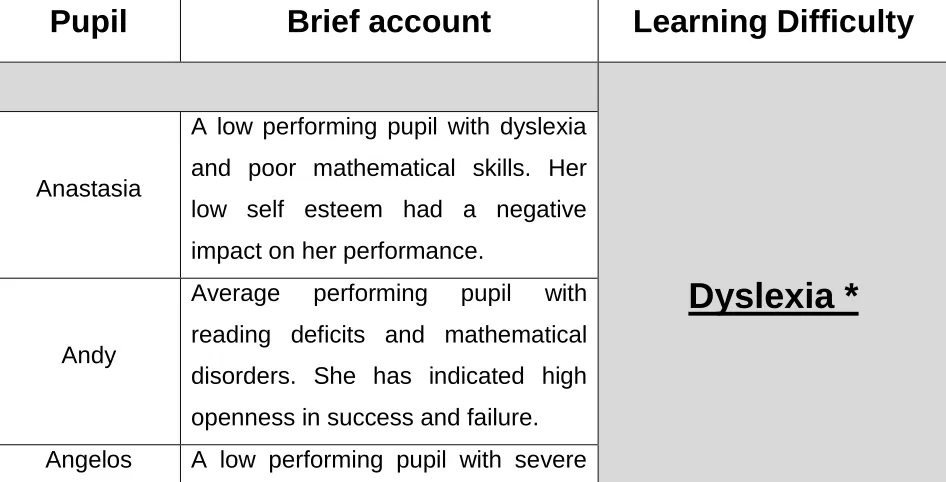
pupil of the sample was also marginally diagnosed with dyscalculia by the teacher of
the class. In some cases one or more learning difficulties were co-existing.
The Learning Disability Association of Canada (2002) has also supported that learning
disabilities and difficulties follow the child across the life span and are often correlated
to under-achievement or achievement which demands high levels of effort and support.
These disorders though are not connected to hearing and/or vision problems,
socio-economic factors, cultural or linguistic differences, lack of motivation or ineffective
teaching. These factors may also play an important role in the learning process of
pupils with LD. Last but not least, LD may co-exist with various conditions including
attentional, behavioral or emotional disorders. Handling individuals with learning
disabilities requires a carefully planned program including early identification,
specialized assessments and interventions involving home, school, community and
workplace settings (Official Definition of Learning Disabilities, 2002).
LD being at the heart of special needs, remains one of the least understood and most
debated disabling conditions that affect children and interest much researchers and
32
often contentious, disagreements regarding the definition of the disorder, diagnostic
criteria, assessment practices, treatment procedures, and educational policies (Lyon,
1994, 1995; Lyon and Moats,1993).
People with learning disabilities are not a homogeneous group as they vary in the way
they handle their difficulties and they present differential strengths and weaknesses.
However, in terms of diagnosis and classification there are specific features and criteria
set worldwide. There are three criteria for learning disability: (1) Significant impairment
of intellectual functioning; (2) Significant impairment of adaptive/social functioning; (3)
Age of onset before adulthood. (American Association on Mental Retardation, 1992;
World Health Organisation, 1992 (ICD-10); American Psychiatric, Association, 1994
(DSM-IV); Department of Health, 1998).
All these three criteria must co-exist at the same time in an individual in order to be considered to have a learning disability. “Difficulties in assessing adaptive/social
functioning have contributed, in the past, to a tendency amongst clinicians to
concentrate on assessment of intellectual functioning only. The assumption has been
that, provided a significant impairment of intellectual functioning has been demonstrated, similar deficits in adaptive/social functioning are likely.” (British
Psychological Society, 2000, p.4).
1.3.2 Dyslexia
Dyslexia is one of the most discussed terms in educational research as it is one of the
most common learning difficulties of school population worldwide. Dyslexia is a specific
learning disability, even though the general LD category incorporates a wide range of
disorders in listening, speaking, reading, writing, and mathematics. During the last
decade it was recommended that the term learning disabilities, in order to describe
reading difficulties, should be replaced by the term specific disabilities defined in terms
of coherent and operational domains (Lyon et al., 2003).
33
learning difficulty’. The term ‘dyslexia though continues to be used in research and by
the public to describe this specific learning difficulty (Wearmouth and Berryman, 2009).
There exist many definitions of dyslexia which differ in the way that they approach this
learning difficulty. ‘Dyslexia is evident when accurate and fluent word reading and/or
spelling develops very incompletely or with great difficulty. This focuses on literacy
learning at the “word level‟ and implies that the problem is severe and persistent despite appropriate learning opportunities.’ (British Psychological Society, 2005, p.18).
Other definitions have been given by the World Federation of Neurology, the
International Classification of Diseases, 10th Revision (ICD-10), or the Diagnostic and
Statistical Manual of Mental Disorders IV (DSM-IV). Another definition by Dr. Reid Lyon
(1995), the Chief of the Child Development and Behavior Branch of the National
Institute of Child Health and Human Development at the National Institutes of Health,
follows:
“It is a specific language-based disorder of constitutional origin characterized by
difficulties in single word decoding, usually insufficient phonological processing.
These difficulties in single word decoding are often unexpected in relation to age
and other cognitive and academic abilities; they are not the result of generalized
developmental disability or sensory impairment. Dyslexia is manifested by
variable difficulty with different forms of language, often including, in addition to
problems with reading, a conspicuous problem with acquiring proficiency in writing
and spelling." (p.19).
Definitions are numerous, depending on the review or the study conducted. The
common point between the definitions is the notion that dyslexia involves a difficulty in
learning to read; where the term reading could be defined as the process of extracting
and constructing meaning from written text for some purpose (Vellutino et al., 2004).
Dyslexia is a learning disability that influences the way the brain processes written form
material and is typically connected to difficulties in word recognition, spelling and
decoding. Those diagnosed with dyslexia have difficulties with reading comprehension.
34
effects of dyslexia could vary from person to person, but the common point among
dyslexic people is that they read at levels significantly lower than typical for people of
their age (Lyon,1995).
The main deficit theories concerning dyslexia are three: (a) the phonological theory
(Blomert et al., 2004; Frith, 1997; Lyon et al., 2003; Shaywitz et al., 1999), this is by far
the most researched and developed theory; (b) the cerebellar theory (Nicolson et al.,
2001; Ramus et al., 2003); and (c) the magnocellular (auditory and visual) theory
(Blomert et al., 2004; Heiervang et al., 2002; Pammer and Vidyasagar, 2005; Ramus et
al., 2003; Stein, 2001).
The diagnosis of dyslexia faces many challenges and is influenced also by the lack of
agreement regarding its definition. The most commonly used diagnostic tools are
Development of Dyslexia Early Screening Test (DEST), Cognitive Profiling System
(CoPS), Wechsler Intelligence Test for Children (WISC). It is crucial to recognize that
dyslexia often co-occurs with deficits in attention (Shankweiler et al., 1995; Shaywitz
and Fletcher, 1994), mathematics (Fletcher and Loveland, 1986), and/or spelling and
written expression (Lindamood, 1994; Moats, 1994).
Dyslexic pupils can be supported by intervention programs either at school or at home
in order to allow them to improve their reading and writing skills and more specifically
linguistic coding, sublexical awareness and skills, visual coding, working memory and
permanent memory) and metalinguistic processes (Vellutino et al., 2004). The success
of any intervention program is focused prior diagnosis, which would allow the expert to select the precise program that would target an individual pupil’s weaknesses (Given
and Reid, 1999; Torgesen, 2000).
1.3.3 Dysgraphia
Dysgraphia is a Specific Learning Difficulties (SpLDs) and it is described as a
deficiency to write not only primarily in terms of handwriting, but also in terms of