The Journal of Public Space ISSN 2206-9658
2019 | Vol. 4 n. 1
https://www.journalpublicspace.org
EDITORIAL TEAM
Editor in Chief
Luisa Bravo, City Space Architecture, Italy
Scientific Board
Davisi Boontharm, Meiji University, Japan
Simone Brott, Queensland University of Technology, Australia Julie-Anne Carroll, Queensland University of Technology, Australia
Margaret Crawford, University of California Berkeley, United States of America Philip Crowther, Queensland University of Technology, Australia
Simone Garagnani, University of Bologna, Italy Pietro Garau, Sapienza University of Rome, Italy Carl Grodach, Monash University, Australia
Chye Kiang Heng, National University of Singapore, Singapore Fiona Hillary, RMIT University, Australia
Miquel Marti, Universitat Politècnica de Catalunya, Spain Darko Radovic, Keio University, Japan
Estanislau Roca, Universitat Politècnica de Catalunya, Spain Joaquin Sabate, Universitat Politècnica de Catalunya, Spain Robert Saliba, American University of Beirut, Lebanon Claudio Sgarbi, Carleton University, Canada
Hendrik Tieben, Chinese University of Hong Kong, Hong Kong
Strategic Advisory Board
Cecilia Andersson, UN-Habitat Global Public Space Programme, Kenya Tigran Haas, KTH Royal Institute of Technology, Sweden
Maggie McCormick, RMIT University, Australia
Michael Mehaffy, KTH Royal Institute of Technology, Sweden Laura Petrella, UN-Habitat Global Public Space Programme, Kenya
Advisory Board for Research into Action
Ethan Kent, Project for Public Spaces, United States of America Gregor Mews, Urban Synergies Group, Australia
Luis Alfonso Saltos Espinoza, LASE+CityUrb, Ecuador
Assistant Editor
Zoë Atkinson Fiennes, City Space Architecture / Three Graces Galleries, Italy / UK
Journal Manager
Luisa Bravo, City Space Architecture, Italy
TH
E
JO
U
R
N
A
L
OF
PU
B
L
IC
SP
A
C
The Journal of Public Space | 2019, Vol. 4 n. 1 | Editorial Team and Policies
Correspondents and Peer Reviewers
Europe and Middle EastGem Barton, Brighton University, United Kingdom
Michael Barke, University of Northumbria at Newcastle, United Kingdom Simon Bell, Estonian University of Life Sciences, Estonia
Pedro Ressano Garcia, Universidade Lusófona, Portugal Henning Eichinger, Reutlingen University, Germany
Konstantinos Ioannidis, Aristotle University of Thessaloniki, Greece Marjut Kirjakka, Aalto University, Finland
Yoav Lerman, Tel Aviv University, Israel Nicola Marzot, TU Delft, Netherlands Vitor Oliveira, University of Porto, Portugal
Lakshmi Priya Rajendran, Anglia Ruskin University, United Kingdom Yodan Rofe, Ben-Gurion University of the Negev, Israel
Massimo Santanicchia, Iceland Academy of the Arts, Iceland Goran Vodicka, University of Sheffield, United Kingdom Katharine Willis, Plymouth University, United Kingdom Parisa Ziaesaeidi, Erfan Institute of Higher Education, Iran
America
Camilo Vladimir de Lima Amaral, Universidade Federal de Goias, Brazil Roberto Andrés, Universidade Federal de Minas Gerais, Brazil
Deland Chan, Stanford University, United States of America
Dave Colangelo, Portland State University, United States of America
Thomas Fowler, California Polytechnic State University, United States of America Amir Gohar, University of California Berkeley, United States of America
Maria Goula, Cornell University, United States of America Adrian Gras-Velazquez, Swarthmore College, United States
Matthew D. Lamb, Pennsylvania State University, United States of America Marieta Maciel, Universitade Federal de Minas Gerais, Brazil
Leonardo Parra, Universidad de Los Andes, Colombia
Renato Rego, Universidade Estadual de Maringá - UEM, Brazil
Asia
Pak Damrongsak, Thammasat University, Thailand Sohee Kim, Asian Institute of Technology, Thailand
The Journal of Public Space | 2019, Vol. 4 n. 1 | Editorial Team and Policies
ISSN 2206-9658 | City Space Architecture / UN-Habitat | III Africa
Sahar Attia, Cairo University, Egypt
Izak van Zyl, Cape Peninsula University of Technology, South Africa
Australia and New Zealand
Christopher Brisbin, University of South Australia, Australia Liz Brogden, Queensland University of Technology, Australia Martin Bryant, University of Technology Sydney, Australia
Glenda Caldwell, Queensland University of Technology, Australia Philippa Carnemolla, University of Technology Sydney, Australia Debra Cushing, Queensland University of Technology, Australia Emilio Garcia, University of Auckland, New Zealand
Morten Gjerde, Victoria University of Wellington, New Zealand Kai Gu, University of Auckland, New Zealand
Daniel O'Hare, Bond University, Australia
Anoma Kumarasuriyar, Queensland University of Technology, Australia Manfredo Manfredini, University of Auckland, New Zealand
Michael Marriott, Queensland University of Technology, Australia Ari Mattes, University of Notre Dame, Australia
Linda Matthews, University of Technology Sydney, Australia John Mongard, The Designbank, Australia
Milica Muminović, University of Canberra, Australia Kaan Ozgun, University of Queensland, Australia
Mark Pennings, Queensland University of Technology, Australia Gavin Perin, University of Technology Sydney, Australia
Helena Piha, Queensland University of Technology, Australia Dorina Pojani, University of Queensland, Australia
Paul Sanders, Queensland University of Technology, Australia Leigh Shutter, Griffith University, Australia
Thomas Sigler, University of Queensland, Australia
Claudia Justino Taborda, Queensland University of Technology, Australia Mark Taylor, University of Newcastle, Australia
The Journal of Public Space | 2019, Vol. 4 n. 1 | Editorial Team and Policies
FOCUS AND SCOPE
The Journal of Public Space is the first, international, interdisciplinary, academic, open access journal entirely dedicated to public space.
Established on a well-consolidated global network of scholars and professionals, The Journal of Public Space is committed to expand current scholarship by offering a global perspective and providing the opportunity for unheard countries to speak up and to discuss neglected as well as emerging topics that are usually sidelined in mainstream knowledge.
The Journal of Public Space is addressing social sciences and humanities as a major field, and is interested also in attracting scholars from several disciplines. It will perform as a scholarly journal but also as an interdisciplinary platform of discussion and exchange by scholars, professionals, organizations, artists, activists and citizens, whose activities are related to public space.
The Journal of Public Space will be enriched by hosting papers on design projects, art performances and social practices, fostering civic engagement and non-expert knowledge.
TOPICS
Authors are welcome to submit original research articles dealing with themes relating to the vision of the journal, which may include, but are not confined to:
SPACE SOCIETY SYSTEMS
Architecture Urban Planning Urban Design Urban Morphology Urban Resilience Landscape architecture Interior design
Interactive and visual design Art City transformation Infrastructure Environment Ecology Climate change Gender Human scale People Everyday life Social engagement Health and safety Perception and senses Human rights Social justice Education Heritage History Culture Geography Anthropology Ethnography Community empowerment Migrations Conflicts Inclusion/Exclusion Informality
Sub and fringe cultures
Economy Political power Governance
The Journal of Public Space | 2019, Vol. 4 n. 1 | Editorial Team and Policies
ISSN 2206-9658 | City Space Architecture / UN-Habitat | V
POLICIES
Peer Review Process
A double blind peer review process, based on a distinguished board of editors and
editorial advisors, ensures the quality and high standards of research papers. Each paper is assessed by two reviewers and any identifying information in relation to the author is removed during the review process. Reviewers follow an evaluation framework and recommendation guidelines to ensure objectivity and fairness.
Submitted articles should not have been previously published. If publication or
dissemination through presentation has occurred, then the article should acknowledge this and pay due credit to the original source.
Publication Ethics Statement
The Journal of Public Space aligns itself with the Committee on Publication Ethics (COPE) best practice guidelines for dealing with ethical issues in journal publishing.
http://publicationethics.org/
Open Access Policy
The Journal of Public Space is licensed under a Creative Commons Attribution- NonCommercial 4.0 International License. It provides immediate open access to its content on the principle that making research freely available to the public supports a greater global exchange of knowledge.
https://creativecommons.org/licenses/by-nc/4.0/
CONTACT
PublisherCity Space Architecture non-profit cultural association Via Paolo Giovanni Martini 26/d 40134 Bologna, ITALY
www.cityspacearchitecture.org
in cooperation with
KTH Royal Institute of Technology Centre for the Future of Places Stockholm, Sweden
https://www.kth.se/en https://www.cfp.abe.kth.se/
RMIT University Melbourne, Australia
https://www.rmit.edu.au/ Partner
UN Habitat - United Nations Human Settlements Program Nairobi, KENYA
The Journal of Public Space | 2019, Vol. 4 n. 1 | Editorial Team and Policies
Call for papers | 2019 issues
The Journal of Public Space welcomes full papers for 2019 issues, to be published in April, August and December.
Deadline for April issue: January 10, 2019 Deadline for August issue: May 10, 2019
Deadline for December issue: September 10, 2019
Submissions will be ongoing throughout the year. Submission can be made:
- using the OJS platform by registering online. If you are already a registered author you can log in using your username and password;
- by sending an email to the Editor in Chief Luisa Bravo at this email address: [email protected].
Before submitting, please read: - the Focus and Scope of the journal - the Author Guidelines
Full papers should be between 5.000 and 8.000 words.
The Journal of Public Space
ISSN 2206-9658 2019 | Vol. 4 n. 1
https://www.journalpublicspace.org
ISSN 2206-9658 | City Space Architecture / UN-Habitat
TABLE OF CONTENTS
EDITORIAL
Strengthening our civil servants’ mission for the common good
Luisa Bravo 1-2
SPACE
Dressed bodies and built environments: the interactive composition of public space
Clemens Thornquist
3-14
Street vending management in Bangkok: the need to adapt to a changing environment
Narumol Nirathron, Gisèle Yasmeen
15-32
SOCIETY
Not in my face please. Stress caused by the presence of smokers in places with restorative qualities
Chamila Subasinghe
Assessment of User Happiness in Campus Open Spaces Alshimaa A. Farag, Sama R. Badawi, Rahma M. Doheim
Understanding people’s needs for a vivid public realm as a key towards enhancing modern neighbourhoods’ liveability. Nasr City in Cairo as a case study
Merham M. Keleg, Marwa Abdellatif
33-44
45-64
65-92
SYSTEMS
Public space quality evaluation: prerequisite for public space management
Pushplata Garg, Seema Praliya 93-126
VIEWPOINT
Leading urban change with people powered public spaces. The history, and new directions, of the Placemaking Movement
Ethan Kent
127-134
Placemaking in the European context: the movement is here to stay
Jeroen Laven, Anna Louise Bradley, Levente Polyak 135-154
Cover image: Schouwburgplein in Rotterdam. Picture by Eric Fecken
TH
E
JO
U
R
N
A
L
OF
PU
B
L
IC
SP
A
C
The Journal of Public Space | 2019, Vol. 4 n. 1 | Table of Contents
DISCLAIMER
The designations employed and the presentation of the material in this journal do not imply the expression of any opinion whatsoever on the part of the Secretariat of the United Nations concerning the legal status of any country, territory, city or area or of its authorities, or concerning the delimitation of its frontiers or boundaries, or regarding its economic system or degree of development. The analysis, conclusions and recommendations of this publication do not necessarily reflect the views of the United Nations Human Settlements Programme.
Reference in this journal of any specific commercial products, brand names, processes, or services, or the use of any trade, firm, or corporation name does not constitute endorsement, recommendation, or favouring by UN-Habitat or its officers, nor does such reference
The Journal of Public Space
ISSN 2206-96582019 | Vol. 4 n. 1
https://www.journalpublicspace.org
ISSN 2206-9658 | 1
EDITORIAL
Strengthening our civil servants’ mission
for the common good
Luisa Bravo
City Space Architecture, Italy
This issue of The Journal of Public Space marks our Editorial Team’s fourth year of activities, that I’m proudly leading as Editor in Chief. Over the past three years we have published eight issues, 121 papers from more than 140 authors from 30 countries, engaging more than 60 academic reviewers at the global level. More than 50% of those papers were double blind peer reviewed, following academic standards; other published papers included reports from United Nations events (like the Habitat III conference and the 9th World Urban Forum) or reports concerning art-based or placemaking-led projects, professionals’ viewpoints, artists’ portfolios, editorials from influential scholars, leading experts affiliated to global NGOs and practitioners serving as guest editors.
While we receive submissions through our website, via the Open Journal System platform, we are also currently working on two special issues this year: one to be published at the end of the summer on The Entrepreneurial City. Social Entrepreneurialism and New Forms to Interact in Public Space, in collaboration with The Chinese University of Hong Kong in Hong Kong and the International Forum on Urbanism (IFoU), and the other, to be published at the end of the year on Public health and well-being in public open spaces through climate responsive urban planning and design, in collaboration with James Cook University in Australia.
On May 29, at the first UN-Habitat Assembly in Nairobi, I signed a Letter of Agreement with UN-Habitat—the United Nations Human Settlements Programme— on behalf of City Space Architecture which marked the beginning of our cooperation to further develop The Journal of Public Space. In addition to celebrating this amazing achievement that we
accomplished a mere six years after founding City Space Architecture and three years after launching The Journal of Public Space, we recently welcomed two new academic partners, who will be cooperating with us during the coming years: KTH Royal Institute of
Technology, Centre for the Future of Places, based in Stockholm (Sweden) and RMIT University, based in Melbourne (Australia).
The network around the journal is expanding and providing exciting opportunities and new partnerships. We are already planning special issues for 2020, and beginning to organise our participation in the 10th World Urban Forum that will take place in Abu Dhabi in February 2020. We are building momentum on public space culture and we are currently redefining our strategic approach, in order to become more inclusive and to cover a broad range of topics and fields of expertise, from different perspectives.
In this issue we are publishing two viewpoints related to the Placemaking movement, one from Ethan Kent, Co-director of the newly established PlacemakingX and Senior Fellow at
Strenghtening our civil servants’ mission for the common good
Project for Public Spaces in New York, and another from Jeroen Laven, Anna Bradley and Levente Polyak from Placemaking Europe, the European chapter of the global Placemaking movement, founded by STIPO in Rotterdam. Each viewpoint opens a new section of the journal, aimed at incorporating placemaking as a relevant field of action: we are interested in publishing articles related to design projects and community-led interventions, collecting successful and also unsuccessful stories, from research into action, from theory to
implementation, providing case studies, best practices on capacity building, education and empowerment, tackling the complexity of the process, at the community and governmental level, from top-down to bottom-up, with a particular focus on youth. We want to open the discussion to all those who are actively working and fighting daily, on the ground, to
promote public space as a common good, to those who are agents of change and are pushing local, regional and national governments to change, to adapt, to reconsider policies and regulations and to look for solutions related to innovation and creative bureaucracy. At the same time we are inviting leading academic scholars to join our Editorial Team, as part of the Scientific Committee, to contribute to our mission by providing insightful advice and qualified contents for the journal. We are starting a very exciting journey and we know that we will only be successful if we are, all of us, able to work together.
Figure 1. Luisa Bravo, Editor in Chief of The Journal of Public Space, at the first UN-Habitat Assembly in Nairobi, with Laura Petrella, Leader of the City Planning Extension and Design unit at UN-Habitat, signing the Letter of Agreement for
the cooperation in developing The Journal of Public Space, during an event at the City Stage, on 29 May 2019.
To cite this article:
Bravo, L. (2019). Strengthening our civil servants’ mission for the common good. The Journal of Public Space, 4(1), 1-2, DOI 10.32891/jps.v4i1.1162
The Journal of Public Space
ISSN 2206-9658 2019 | Vol. 4 n. 1
https://www.journalpublicspace.org
ISSN 2206-9658 | 3
Dressed bodies and built environments: the
interactive composition of public space
Clemens Thornquist
University of Borås, The Swedish School of Textiles, Sweden [email protected]
Abstract
The human body has been pivotal in much architectural research. Researchers of public space often underscore its interactive and transformative qualities as linking to a
broader understanding of the different individual social practices taking place in such spaces. What seems to be lacking however is an analysis of the relationship between the dressed body and the built environment which together constitute a public space. The aim of this paper is to explore and elaborate on the interaction between dressed bodies and architectural structures and outline an alternative approach to understanding the different aesthetic forces at play in the constitution of public space. Using a
photographic series of piloted experimental sites, this paper points out how the aesthetics of fashion enrich, contribute to, and change the aesthetics of urban architectural environments. The result prompts a clearer understanding of the interaction between dressed bodies and architecture and offers guidance for future research designed to bridge the gap between the aesthetics of the scale of the body and the scale of building and infrastructure in the constitution of public space.
Keywords: fashion, architecture, public space, environmental composition, urban design
TH
E
JO
U
R
N
A
L
OF
PU
B
L
IC
SP
A
C
E
To cite this article:
Thornquist, C. (2019). Dressed bodies and built environments: the interactive composition of public space. The Journal of Public Space, 4(1), 3-14, DOI 10.32891/jps.v4i1.662
This article has been double blind peer reviewed and accepted for publication in The Journal of Public Space.
Dressed bodies and built environments
1. Fashion and architecture: some common-ground notions
Dress and shelter are fundamental to social life. While conditions in the physical world frequently force us to put on clothes and shelter in dwellings, the social world only asks that we be dressed and live in houses. Dress, as Entwistle (2000) notes, not only
protects our modesty and reflects a natural body or a given identity, it also enhances that body and through the materials used adds a diversity of meaning to it that would otherwise not be there. As such, dress negotiates the tension between the human desire to stand out and be different and the equally human desire to fit in and be accepted (Simmel, 1911). Similar needs and desires are also consequential in architectural design. The need to feel at home and be “camouflaged” within the environment, to fit in and be accepted, is central to architectural constructions. In addition, in the exercise of fashion, this process of assimilation is not merely a physical operation. Dressing in clothing requires us to assimilate on a mental level, to think
ourselves into the environment (Leach, 2006). Similarly urban space and urban cities have also been recognised as the self-awareness of inhabitants’ psychological, social, and economical production (Lefebvre, 1991). In his documentary film Notebook on Cities and Clothes, Wenders (1989) elaborates:
Identity …of a person, of a thing, of a place. Identity. The word itself gives me shivers. It rings of calm, comfort, contentedness. What is it, identity? To know where you belong? To know your self worth? To know who you are? How do you recognize identity? We are creating an image of ourselves. We are attempting to resemble this image… Is that what we call identity? Between the image we have created of ourselves and …
ourselves? Just who is that, ‘ourselves’ ? … We live in the cities. The cities live in us. Time passes.
Fashion and architecture do not only express ideas of personal, social, and cultural identity and reveal a person’s aesthetic pleasures or narcissistic self-absorption; dress and built environments also reflect similar interests of the targeted audience and clients. Perhaps this is particularly true for consumers and clients who celebrate the fluid play with signs and simulacra in dress and in architecture that works to dissolve the connection between political economies and the real (Baudrillard, 1983; 1998) and where fashion consumption is increasingly more integrated in the shaping of contemporary architecture and its public spaces (Koolhaas et al. 2002).
Clemens Thornquist
The Journal of Public Space, 4(1), 2019 | ISSN 2206-9658 | 5 and the present, those in power and those under it and between the culturally
sophisticated and the naïve. In Benjamin’s (2007: 261) words:
Fashion has a flair for the topical, no matter where it stirs in the thickets of long ago; it is a tiger’s leap into the past. This jump, however, takes place in an arena where the ruling class gives the commands. The same leap in the open air of history is the dialectical one, which is how Marx understood the revolution.
Sabatino, for example, has demonstrated in a series of cases that the issues of what he calls the primitive or savage “exemplify a diffused phenomenon that has engendered the competing politics of modern identity that in turn have shaped nineteenth- and
twentieth-century architecture and urbanism” (Sabatino, 2008:362). On a similar note, Morton (2000) has commented that even where world expositions have aimed to separate the ‘native’ from colonialism—for example where one “demonstrated Europe's sophistication in art deco style, while the colonial pavilions were ‘authentic’ native environments for displaying indigenous peoples and artifacts from the colonies,”—the two are instead often mixtures of both.These problematic issues are also seen in fashion (Rovine, 2009), where the matter is complicated further still, by the notion that what constitutes “a dress” or a “liveable house” may vary within a particular culture and from culture to culture; what is an appropriate house or legal or illegal dress also varies from situation to situation as well as from nation to nation.
More particularly, the competition or struggle between the savage and the cultivated, between the historic and the contemporary, between the colonised and the coloniser have also been manifested in three realms applicable to both architecture and fashion: (1) in the dialogue between culturally-developed styles and more archaic typologies, (2) in the desire to restore nature to the city or in clothing, or to exit the city or fashion in search of rural environments and elemental clothing, and (3) in the desire to integrate the tectonics and technologies of vernacular architecture and fashion with
contemporary construction practices of buildings and clothing (Sabatino, 2008; Loppa, 2003). In more pragmatic terms, perhaps, and regardless of moral and ethical
considerations, relatable approaches of both architecture and fashion to materials engineering and new technologies have raised questions about the interdisciplinary nature of contemporary design. Here the architects’ “fearless adoption of new design technologies and the resultant construction methods” have for example been compared with the fashion designers’ “struggle for liberation from convention” to shape and redefine the appearance of the female body (Hodge et al., 2006: 11).
Fashion and architecture do however not only share similar socio-functional aims and challenges; each of them also competes and challenges one another in the process of constituting urban environments and public spaces through its constructed elements. As Reinhardt (2007: 182) observes, “both clothing fashion and architecture produce
surfaces that convey a cultural message relating to occupation, program, status, or individual profile.” They operate on several different levels beyond personalised configuration for habitation and protection from direct exposure to disturbing influences (Barnard 2002) or establishment of a private and secure zone within a
Dressed bodies and built environments
considering their relationship to the dressed body. Similarly, while the dressed body is most often situated in a constructed environment, it cannot be fully understood without reference to its built environment. Researchers have explored the relationship between the body and buildings (e.g. Dodds and Tavenor, 2002); what is lacking is an analysis of the relationship between fashion as the dressed body and architecture as the built environment from the perspective of how together they establish the dynamic aesthetics of urban environments, public spaces, and infrastructure.
In this paper I will adopt a first-person perspective to present a proposal for a
methodology that attempts to artistically analyse the co-created aesthetic impact that the interaction between dressed bodies and buildings has on public spaces. A central reason for developing such a method is to find paths to in-depth artistic analyses that can bridge the gap between fashion theories that leave out the built environment and architectural theories that leave out the dressed bodies in the process of aesthetically co-producing public spaces, urban environments, and interior places.
2. Co-creation of public space through the interaction between dressed bodies and built structures
A public space has been described as the stage upon which the drama of communal life unfolds and as a place that provides channels for movement, nodes of communication, and common ground for play and relaxation. As such, a public space in its being a human-made environment may be said to “afford[s] casual encounters in the course of daily life that can bind people together and give their lives meaning and power” (Carr et al., 1992:45). In line with this thinking around constructed public space, Carr et al. suggest how to best design such spaces, using a framework where three critical human dimensions would guide the process of designing public spaces: the users' essential needs, their spatial rights, and the meanings they seek.
In architecture, this approach may be related to the conventional idea that the built environment is not immediately responsive to change. Reinhardt (2007) explains that while various spatial, material, or structural alternatives may be explored in the design phase, during construction a selection results in the artificially constructed space becoming a constant. If variation is inscribed into the constructed space, it may still all too often induce conformity because it generally allows for only a series of
predetermined alternatives through structures or environments that accommodate multiple functions at the same time, sequentially, or at periodically recurring events (Preiser et al. 2017) rather than being responsive to unforeseen contingencies. If the built environment is instead to be flexible, adaptable, and a responsive space, Reinhardt (2007:182) argues, these options must be embedded into the architectural spatial system, both in the design process and in the built space itself: “strategies of
compression, intensity, or elasticity might therefore enable a dynamic spatial capacity— in response and interaction—not exclusively through a physical operation, but through phenomenal or interpretative shifts.”
Clemens Thornquist
The Journal of Public Space, 4(1), 2019 | ISSN 2206-9658 | 7 existence of at least two sexes have to do with how we understand and experience space? In fashion, the contrary has been argued. Lipovetsky (1994: 149), for example, concludes in her analysis of fashion and change that today’s fashion economy has created a social agent in its own image: “the fashion person who has no deep attachments, a mobile individual with a fluctuating personality and tastes” with such openness to change that it “requires a rethinking of the classic charges brought against frivolous society, accusing it of organized waste and bureaucratic-capitalist irrationality.” The result, she argues, is a new type of kinetic, open personality fundamental to
societies in rapid transformation and constituted through fluctuations in dress.
While designers of public spaces on the one hand may be guided by frameworks similar to the one suggested by Carr et al. (1992) — the users' essential needs, their spatial rights, and the meanings they seek — other research related to the functional and expressional aesthetics of the interactions between body and space recognise the vague dynamics and ambiguous meanings that are not only attributed to public spaces but also emerge from them (Kenniff, 2018). Lefebvre (1991: 26) expresses it this way:
(Social) space is a (social) product […] the space thus produced also serves as a tool of thought and of action; that in addition to being a means of production it is also a means of control, and hence of domination, of power; yet that, as such, it escapes in part from those who would make use of it.
For Lefebvre.then, the street is a central space for understanding innovative social practices; it transforms the spatial-temporal form of the space itself into something that it was not before (Lefebvre, 2003). From this perspective, often influenced by the revival of the 1980s’ material-semiotic method of actor-network-theory (e.g. Latour 2005), human and non-human aspects are considered to have reciprocity and shared agency in the co-construction of socio-material assemblages. As Farías (2009:14) maintains:
The notion of urban assemblages in the plural form provides an adequate conceptual tool to grasp the city as a multiple object, to convey a sense of its multiple enactments. There are many reasons for using this notion. Firstly, it is a term that provides a concrete and graspable image of how the city is brought into being and made present in
ensembles of heterogeneous actors, material and social aspects. This idea of a socio-material and socio-technical ensemble is the most literal meaning of assemblage.
Dressed bodies and built environments
rise to volatile and unexpected spaces through its relationship with the built environment.
3. Method
In the shift from the understanding of the aesthetics of space as something emerging from the interaction between dressed bodies and constructed environments and from space as a socio-material construction to space as more of an abstracted aesthetical composition, Leibniz’s (2006) notion of space as an unconventional a-priori may be useful. In this kind of space—in which both space and time are not considered real entities but virtual relationships—space is a process that develops through the structuring of matter as a result of the relationship between objects, a view that corresponds to the hypothesis that dressed bodies co-create the aesthetics of public space in their interaction with the built environment. As unconventional a-priori, such space is also not the sum of ideal spatial relations but prior to its parts and divisions. In other words, spaces co-created by dressed bodies and built constructions (may) give rise to new spatial typologies. In Leibniz (2000:47) words:
I observe, that the traces of moveable bodies, which they leave sometimes upon the immoveable ones on which they are moved; have given men occasion to form in their imagination such an idea, as if some trace did still remain, even when there is nothing unmoved. But this is a mere ideal thing, and imports only, that if there was any unmoved thing there, the trace might be marked out upon it. And it is this analogy, which makes men fancy places, traces and spaces; though those things consist only in the truth of relations, and not at all in any absolute reality.
For Leibniz, according to Evangelidis (2018: 3), this suggests that spatial and temporal relationships between objects and events are immediate and not reducible to space-time point relations, and all movement is the relational movement of bodies. As such, space is infinitely divisible and space is an order of potentialities – in this case
aesthetic potentialities.
Moving from understanding the aesthetics of clothes and buildings in a more
representative way to the aesthetics of spaces as a dynamic expression emerging from the interaction between dressed bodies and dressed spaces also means that the traditional ‘context plus object gives meaning’ is disturbed. Hegel (1949) notes that to use a method that methodologically positions the result in a historical sketch or to trace the process of how it came to light is perhaps of interest but is of no significance to the expounding of philosophical truth, or in this case, is of no significance to judging the aesthetic effect of dressed bodies and dressed space on the construction of social spaces. Instead of forming a context that adds rigor to the understanding of
Clemens Thornquist
The Journal of Public Space, 4(1), 2019 | ISSN 2206-9658 | 9 al. 2011). For this reason, the proposed methodbuilds on the photographic work of Hilla and Bernd Becher (Lange, 2006), where single images are grouped in grids where each image reflects the others from different perspectives. From this standpoint, the significance of Becher’s work is here lies not so much in the content of the work itself but in its normative and self-instituting epistemological structure. The method may be described as photographic clustering, or as Stimson (2004) drawing on Foucault argues, an epistemology and a system of dispersion that is “neither a configuration, nor a form” but instead a process or “a group of rules that are immanent in a practice” (Foucault, 1976: 37, 46).
The focus of this photographic method, or the type of methodology that this method suggests, is firstly an expressional opportunity and a challenge to the way spaces are established aesthetically at a foundational level before any more precise and particular theoretical meaning-making occurs. The method aims to be sensitive and open to the diversity of meanings and expressions that are generated on a more sublime level. For example, while a fashion brand may give rise to more framed connotations or designs in architecture may utilise a clearer semiotic structure, the multitude of expression in the interaction of simple dressed bodies and ‘dressed spaces’ is much more complex and open to meanings, and meanings tend to emerge more from the process of interaction (Wiberg, 2018; Baudrillard, 2002). Through employing the method I will also propose some of the connections that can be made between the various theorists in these related areas on a fundamental aesthetic level, suggesting how one might make a study of public space and urban environments through photography. In doing so, I will also outline a theoretical perspective that takes as its starting point the idea that public space and urban environments are co-constructed and that dressed bodies are fundamental in constituting social order.
4. Results & Discussions
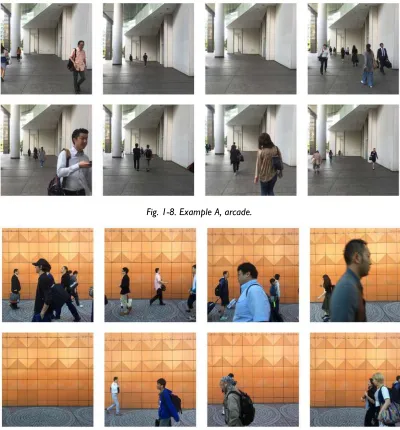
The following settings present the pre-study and pilot of this method. The investigation is based on three different spaces with three different aesthetics in relation to form and material in the dressed bodies and the built constructions. While it is common to consider public spaces as non-profit, non-commercial, places for social gathering like squares and parks (e.g. Carr et al. 1992), I will in this pilot study also include semi-public sites of consumption such as hotels, museums, streets, and other spaces. This choice is based on the argument that consumption has become integral in the formation of architecture (Koolhaas et al., 2002) and the formation of social urban gathering places (Zukin, 1995), and in ways similar to non-commercial places, allows people to interact and gather in social congregation apart from the home (Oldenburg, 1991, Lofland, 1998). Much as Humphreys (2010) and Zukin (1995) have, I will look at cases of public spaces in the broader sense of “non-domestic physical sites that are distinguished by their relative accessibility” (Humphreys, 2010: 764), those that more accurately reflect the everyday practice of urban life. The settings for the pilot test are: A, fig.1-8 an arcade; B, fig. 9-16, a street; C, fig. 17-24, a church; D, fig. 25-32, a museum.
Dressed bodies and built environments
pink color in traditional form has already had a strong impact in that a single body works to shift the entire dynamics of the space, something that does not occur in the same way with multiple bodies dressed in more traditional formal wear in black, white, and blue. This is contrasted in setting D, where the number and type of expression of the dressed bodies in relation to the room is more constant, where the strong black graphic postures and the internal relationship between the two dressed graphic bodies are significant for their overall impact on the perceived space. In instances, the built structure and dressed bodies together seem even to amplify each other into an all-new dynamic. In example B, the street, which is marked by a strong sensory and material presence of a building material (colour) and pavement material (texture), the dressed bodies appear to be more marginalised, conditioned by the frame of the wall and the pavement.
Fig. 1-8. Example A, arcade.
Fig. 9-16. Example B, street.
Clemens Thornquist
The Journal of Public Space, 4(1), 2019 | ISSN 2206-9658 | 11 Fig. 17-24. Example C, church.
Fig. 25-32. Example D, museum.
Dressed bodies and built environments
5. Conclusions: congregations and constructions
The aim of this pilot study was to develop a method of artistically analysing the aesthetic construction of public spaces by focusing on the interaction between dressed bodies and built constructions from a first-person perspective. The examples demonstrate that the dressed bodies have a significant impact on the aesthetics of the space as perceived by the observer and occupant of the space. Conversely the degree and type of the impact—in the sense of cultural meanings or functionalities—are more complex to determine. However, the more fundamental aesthetic qualities of the space as an a priori structure for meaning-making and other particular social functions and
expressions are made evident. Moreover, in the example a primary dynamic sensory experience is at play that dominates the composition and perception of the space as the dressed bodies interact with the built structures.
The need to consider dress and dressed bodies in the understanding of public space is apparent. Not only does it confirm the notion that dressed bodies are overlooked in their interaction with built environments in challenging and co-constructing public spaces – habitat and occupational patterns – it rather suggests that dressed bodies may be the starting point for designing public space. The result demonstrates further that methods should be developed to help design spaces from the notion of dressed bodies before any activity is considered. Finally, the result suggests theories of fashion dealing with the dressed body be considered and connected to theories of public space and urban environments to encourage more dynamic conceptions and more dynamic possibilities of space.
Several limitations exist in any pilot study. Although certain dynamics and ambivalence arising between the forces of the dressed bodies and the built structures could be identified, they remain perhaps more suggestive than rigorous because of the small number of examples, limited number of people, or similarly, first-person perspectives. Moreover, while the structure of the particular photographic approach in this study, such as perspective, framing, lens angle and the clustering of the images, may on the one hand be required for the photographs to be effective in a visual cluster analysis, on the other hand, different ways of photographing may be developed for a more complex dynamic analyses of different variables in the relationship between dressed bodies and built environments in the co-creation of public space. Similarly, while one method of photography may be appropriated for a particular issue related to a particular constructed public space, different methods of photographic analysis may need to be explored to appropriately analyse different modes of dressing and building that together co-create public or semi-public space aesthetics. Thus, although the methods have been proven valuable for one form of aesthetic analysis of the co-creation of public space by dressed bodies and built environments, further development of the method is
Clemens Thornquist
The Journal of Public Space, 4(1), 2019 | ISSN 2206-9658 | 13
References
Barnard, M. (2002). Fashion as Communication. London: Routledge. Baudrillard, J. (1983). Simulations. New York: Semiotext(e).
Baudrillard, J. (1998). The Consumer Society: Myths and Structures. London: Sage. Benjamin, W. (2002). The Arcades Project. Cambridge: Harvard University Press.
Benjamin, W. (2007). Theses on the Philosophy of History. In H. Arendt (Ed.) Illuminations (pp. 253-264). New York City: Schocken Books.
Bourriaud, N. (2002). Relational aesthetics. Paris: La presses du reel.
Carr, S., Francis, M., Rivlin, L. & Stone, A. (1992). Public Space. Cambridge: Cambridge University Press.
Deleuze, G. (2004). Difference and Repetition. London: Continuum.
Dodds, G. & Tavenor, D. (2002). Body and Building. Essays on the Changing Relation of Body and Architecture. Cambridge, Mass.: MIT Press.
Entwistle, J. (2000). Fashion and the Fleshy Body: Dress as Embodied Practice. Fashion Theory: The Journal of Dress, Body and Culture, 4(3): 323–348.
Evangelidis, B. (2018). Space and Time as Relations: The Theoretical Approach of Leibniz. Philosophies, 3(2), 9-0.
Farías, I. (2009). Decentring the Object of Urban Studies. In T. Bender & I. Farías (Eds), Urban Assemblages: How Actor-Network Theory Changes Urban Studies (pp. 1–24). Abingdon, UK: Routledge.
Foucault, M. (1976). The Archaeology of Knowledge. New York: Harper & Row. Gehl, J. (2010). Cities for People. Washington, DC: Island Press.
Grosz, E. (2001). Architecture from the Outside. Cambridge: MIT Press. Hegel, G. (1949). The phenomenology of mind. London: Allen & Unwin.
Hodge, B., Mears, P., & Sidlauskas, S. (2006). Skin and Bones: Parallel Practices in Fashion and Architecture. New York: Thames & Hudson.
Humphreys, L. (2010). Mobile social networks and urban public space. New Media & Society,12(5), 763-778.
Koolhaas, R.,Cha, T-W. &Chung, C. (2001). Harvard Design School guide to shopping. Köln: Taschen.
Lange, S. (2006). Bernd and Hilla Becher: life and work. Cambridge: MIT Press.
Latour, B. (2005). Reassembling the social: An introduction to actor-network-theory. Oxford University Press.
Leach, N. (2006) Camouflage. Cambridge: MIT Press.
Lipovetsky, G. (1994). The Empire of Fashion: Dressing Modern Democracy, New Jersey: Princeton University Press.
Dressed bodies and built environments
Loppa, L. (2003). Modemuseum Patronen: Patterns. Antwerp: Ludion.
Leibniz, G. W. (2000). G. W. Leibniz and Samuel Clarke: Correspondence. Indianapolis, Indiana; Hackett.
Leibniz, G. W. (2006). Discourse on Metaphysics and the Monadology. London: Dover. Lefebvre, H. (1991). The Production of Space. Oxford, UK: Basil Blackwell.
Lefebvre H. (2003). The urban revolution. University of Minnesota Press, Minneapolis, London. Lofland, L. H. (1998). The Public Realm: Exploring the City’s Quintessential Social Territory. New
York: Aldine de Gruyter.
Morton, P. (2000). Hybrid Modernities. Cambridge: MIT Press.
Oldenburg, R. (1991). The Great Good Place: Cafes, Coffee Shops, Community Centers, Beauty Parlors, General Stores, Bars, Hangouts and How They Get You Through the Day. New York: Paragon House.
Preiser, F.E., Hardy, A. E. & Wilhelm, J. J. (2017). Adaptive Architecture: Changing Parameters and Practice London: Taylor & Francis.
Rajagopalan, M. (2012). Preservation and Modernity: Competing Perspectives, Contested Histories and the Question of Authenticity. In. G. Crysler, S. Cairns & H. Heynen.The SAGE handbook of architectural theory (pp. 309-324). London: SAGE.
Reinhardt, D. (2007). Elastic Space: Latent Formations in Fashion and Architecture. Architectural Theory Review,12(2), 181-194.
Rovine, V. (2009). Colonialism's Clothing: Africa, France, and the Deployment of Fashion. Design Issues, 25(3), 44-61.
Sabatino, M. (2008). The primitive in modern architecture and urbanism. The Journal of Architecture, 13 (4): 355-364.
Semper, G. (1989). The Four Elements of Architecture. Cambridge: Cambridge University Press. Simmel, G. (1911). Philosophische Kultur: Gesammelte Essais. Leipzig.
Stimson, B. (2004). The Photographic Comportment of Bernd and Hilla Becher.
http://www.tate.org.uk/research/tateresearch/tatepapers/04spring/stimson_paper.htm [2012-01-20]
Versluis, A. and Uyttenbroek, E. (2014). Exactitudes Expanded with 10 New Series. Rotterdam: NAI.
Wenders, W. (1989). [DVD] Notebook on Cities and Clothes. Road Movie Filmproduction/Centre national D’art et de Culture Georges Pompidou.
Wiberg, M. (2018). The Materiality of Interaction. Notes on the Materials of Interaction Design.
Cambridge: MIT Press.
Wood. J, Kamps. T., & Harrison, P. (2011). John Wood and Paul Harrison: Answers to Questions. Houston: Contemporary Art Museum.
The Journal of Public Space
ISSN 2206-96582019 | Vol. 4 n. 1
https://www.journalpublicspace.org
ISSN 2206-9658 | 15
Street vending management in Bangkok:
the need to adapt to a changing environment
Narumol Nirathron
Thammasat University, Thailand [email protected]
Gisèle Yasmeen
University of British Columbia, Canada [email protected]
Abstract
This research paper proposes that the administration of street vending in Bangkok is incompatible with both changes in the economic and social situation in Thailand and a significant growth in street vending around the world, reflecting a growing appreciation of its important role. To support this argument, the paper presents; street vending policy measures that have been implemented since the founding of Bangkok in 1973; the paradigm shift in employment since the Asian Economic Crisis in 1997; and empirical data from a study of street vending in four districts in Bangkok in 2016. The study collected data from street vendors and buyers in Bangrak, Pathumwan, Phranakhon and Samphanthawong. The sample size of the vendors in each district was 100 and participants were selected through random sampling. A sample of 50 consumers in each district was selected through
convenience sampling. From a policy perspective, the main findings of the study document a recurring pattern of efforts to restrict street vendors’ access to public space for the
purposes of vending, despite strong consumer demand and the valuable role vendors play in urban public space. The municipal policies are also, often, at odds with national economic development policy. The survey data refering to vendors and consumers indicates
continued strong supply and demand, despite restrictive policies implemented by the Bangkok Metropolitan Administration (BMA). From the documentary study and the field data, the paper recommends that the BMA should realign the administration of street vending in accordance with the roles and functions of the livelihood as well as the dynamics of the economic and social situation, and international trends.
Keywords: municipal administration, street vending, economic and social dynamics
TH
E
JO
U
R
N
A
L
OF
PU
B
L
IC
SP
A
C
E
To cite this article:
Nirathron, N., Yasmeen, G. (2019). Street vending management in Bangkok: the need to adapt to a changing environment. The Journal of Public Space, 4(1), 15-32, DOI 10.32891/jps.v4i1.562
This article has been double blind peer reviewed and accepted for publication in The Journal of Public Space.
Street vending management in Bangkok
Introduction
Despite street vending being a clear occupational phenomenon around the world, there are few good estimates of the number of those engaged in the trade. In this paper, street vending refers to the “trading of goods of various types on a daily basis, including food items, to the general public, in a street, land, sidewalk, footpath, pavement or any other public space from a temporary built-up structure” (Nirathron, 2005). The concept of public space in Thai society is complex, and while engaging with these conceptualisations is not the focus of this article, we acknowledge work that has been done in the area
(Oranratmanee and Rachakul, 2014; Yasmeen, 2006).
The mainstream stance on street vending in various countries in the global south, including Thailand, is centered on a juxtaposition between the necessity of its presence for livelihoods and its intrusion on public space, its being an obstacle to traffic, and its creating what is often seen as unfair competition for larger businesses. As an economic activity in the informal economy, street vending is often viewed as a backward economic activity, generating less income for the community when compared to formal trading, thus impeding productivity, prosperity and “modern” urbanisation (Cross, 2000: 40; Department of City Planning, 2012). Bangkok has its own unique pattern of urbanisation and gentrification, as explained by Askew (2002). The fact that there is always conflict for space, in particular in urban areas, puts street vending in a risky position compared to formal businesses, particularly with respect to
pedestrians. Thus, curtailing of street vending has become a universal phenomenon though we have seen a resurgence in street vending around the world, including in the global north (Poon 2015). Street vending continues to thrive because it operates at a low cost and is able to satisfactorily respond to consumer needs. It also generates employment and livelihoods, especially among workers with a relative lack of education and skills. More recently, the issue of “inclusive cities” has been raised in favour of street vending, since it helps create equal opportunity among the general public, especially the poor and disadvantaged: providing them with the opportunity of a better urban life, employment and livelihood, as well as social inclusion (The World Bank, 2015). It also relates to the 2030 Agenda for Sustainable
Development and its 17 Sustainable Development Goals (SDGs), with reference to SDG11: Make cities and human settlements inclusive, safe, resilient and sustainable (Simon, 2016; Dahmen, Leslie, Bhushan, & Rani, 2014).
The Bangkok Metropolitan Administration (BMA) has been making attempts to curtail street vending since 1973, continuing during the first governor’s administration despite periodic relaxation in light of the economic and political situation. However, some important changes took place when the Act on the Maintenance of Cleanliness and Orderliness in the Country, B.E. 2535 (1992) was passed, authorising local officials (with the approval of traffic officials) to allow the sale of goods in “public places or establishments”. Statistically, the period that saw the most relaxation was between 2011 and 2013, which designated more than 700
temporarily permitted areas for street vending. Over 20,000 vendors were officially registered, not to mention a far greater number of cases which went unregistered
(Nirathron, 2017). Since 2014, these temporary vending places have been gradually disallowed under the operation known as “Returning the Pavements to the Public”. The BMA has
Gisèle Yasmeen, Narumol Nirathron
The Journal of Public Space, 4(1), 2019 | ISSN 2206-9658 | 17 The BMA’s management of street vending attaches importance to spatial arrangements, while economic development clearly follows the trend of neo-liberalism, driven by globalisation, in which self-employed work has become more prominently associated with a larger gap in income disparity. (Nirathron, 2006). However, attempts to provide street vending space have not had much success, while the number of vendors continues to grow, thus causing
obstacles to traffic flow. The issue has been raised on social media where groups such as the “Thai Group against Street vending” and “Hey, this is Thailand Footpath”, which advocate for pedestrian rights, were formed: calling for a stringent regulation of street vending.
This paper recommends that a review be made of the BMA’s management of street vending which, despite its consistency, is not compatible with changes in the social and economic situation. The paper is divided into five sections. The first section describes schools of thought on the informal economy and the development of street vending, together with theories that explain the presence of street vending in various phases. The second section discusses the development of street vending management in Bangkok, which, despite its consistency, does not correspond to the socio-economic situation. The third section presents the findings of the study on vendors and buyers in four districts of Bangkok, thus re-affirming the role and importance of street vending in the generation of work and reduction of economic disparities. The fourth section summarises and presents recommendations for the management of street vending in Bangkok in light of the changing economic and social situation.
Schools of Thought on the Informal Economy and Development of street
vending in Bangkok
As a largely informal economic activity, there a number of schools of thought regarding the informal economy in general that warrant being summarised here (see Table 1). The Table builds on Chen’s work published in 2012 by adding a new category referred to as the “inclusionist” school, advocating the need for pro-poor urban planning and collective organisation, which is an approach this paper finds attractive for both analysis and planning purposes.
Table 1: Schools of Thought on the Informal Economy (Brown and McGranahan, 2016)
School of Thought
General view and focus Causal roots of informal economy
Policy Implications Major influencers
Dualist The informal economy is a pre-modern sector acting as an intermediate space between the mainstream formal system and complete unemployment. Focused on ‘survivalist’ activities by the working poor with few (if any) links with the formal economy.
Labour supply far exceeding the demand brought about by industrialisation.
More state regulation designed to foster informal productivity and more appropriate forms of access to resources, including capital, in addition to the removal of unnecessary state
restrictions.
Street vending management in Bangkok
Legalist The informal economy is a market-led response by
entrepreneurs to excessive state regulation (as opposed to a temporary condition of excess labour supply). Focused on ‘plucky’ micro-entrepreneurial activity.
Excessive state
regulation. Less state regulation and more free market policies designed to enable/unlock the growth potential of informal entrepreneurs (particularly through the legalisation of informal property rights).
H. de Soto
Voluntarist The informal economy is a result of producers and traders who choose to operate informally after weighing the costs and benefits of informality versus formality.
Focused on opportunistic informal producers and traders.
Efforts to avoid taxation and costly regulation in the formal economy.
Bringing of informal firms and their workers into the formal regulatory
environment in order to increase the tax base and reduce unfair competition for formal businesses.
A.R. Levenson & W.F. Maloney
Structuralist The informal economy is an attempt by formal sector capital, acting with the complicity of the state, to reduce wages and enhance flexibility by exploiting unprotected informal workers. Focused on vulnerable workers exploited by formal sector capital.
Capitalist growth in the context of economic crises.
More regulation of commercial and
employment relationships between the informal and formal economies in order to address unequal relationships between ‘big business’ and subordinate producers.
M. Castells & A. Portes / C. Moser
Inclusionist The informal economy is a result of anti-poor policies and regulations and systems of governance that exclude the poorest informal producers and traders from accessing formal employment and basic urban services and space in the city to both live and work.
Focused on the political agency of poor informal dwellers and workers in cities.
Anti-poor policies and regulations, and increasingly neoliberal systems of urban governance.
Collective mobilisation among informal residents and workers as a counter- hegemonic practice of resistance and inclusion.
Holding local governments accountable for poor urban dwellers and workers in the process.
I. Lindell / F. Miraftab / D. Mitlin / V. Watson
Vending was one of the most traditional forms of trade in Thai culture before the
Gisèle Yasmeen, Narumol Nirathron
The Journal of Public Space, 4(1), 2019 | ISSN 2206-9658 | 19 The increased number of Thai street vendors in Bangkok in the period after World War II can be explained in terms of the Dualist School and the Structuralist School in that the growth was due to the role of “re-production” of capitalism whereby goods and services were provided cheaply to workers, thus helping to reduce their cost of living. When workers were able to live on low wages, their capitalist counterparts could retain more of the surplus value and minimalise the friction caused by discrepancy in the capitalist economy. Taking up street vending occupations was, therefore, a strategy for survival for rural surplus workers, most of whom had a low income and little education. As they could not get a job in the formal economy, by implication these activities were undertaken for survival purposes. This trend became exacerbated in 1997 when the Asian economic downturn resulted in a large number of workers being laid off. Many turned to street vending in order to earn income. A new set of explanations for the expansion of street vending is seen in the paradigm shift in international employment in which technological development and intensive
competition in the production and manufacturing sectors have resulted in greater “flexibility” in employment. However, it is clear that since 1997 the number of vendors who are not poor have been increasing (Nirathron, 2006). More middle-class vendors have joined this occupation. A prominent example is Mr. Sirivat Voravetvuthikun, a realtor affected by the economic crisis in 1997 who decided to sell sandwiches on the street (Thaipublica 2012; Sirivat Sandwich, 2013; Yasmeen 2003). Yasmeen and Nirathron’s 2014 study further confirms this trend (Yasmeen and Nirathron 2014).
Street vending management in Bangkok
Management of street vending in Bangkok: approaches not compatible with economic and social changes
The management of street vending in Bangkok over the years has reflected an
ambivalent attitude towards the acceptance and rejection of street vending, while the national policy has been geared towards the promotion of self-employment as a means towards poverty reduction and economic self-reliance since the 3rd National Economic
and Social Development Plan.
Ever since the establishment of the BMA in 1973, regulation of street vending has been on the agenda of every BMA executive team (Bangkok Metropolitan Administration, 1995, p. 55). The BMA’s attempt to remove street vending from Bangkok footpaths was initiated when its first governor took office in 1973. Yet, poverty and economic
downturns caused by subsequent oil crises forced the administration to relax its measures and “promote” selling food on the pavements to lower the cost of living of the general public. BMA district offices therefore turned to promoting the sale of cheap street food on the pavement (Bangkok Metropolitan Administration, 1995).
Although the BMA views street vending as a problem of orderliness against a certain paradigm of urbanisation, the Maintenance of Cleanliness and Orderliness in the Country Act, B.E. 2535 (1992) authorises the Administration, with the approval of traffic officials, to demarcate temporary places for vendors and penalise those who sell their wares outside the permitted areas. Meanwhile, complaints have been made by the public as to the sale of goods in the prohibited areas, though many people do not agree with the strict measures taken against the vendors. There has been news about the exploitation of street vending in the form of “unofficial service fees” – or bribes – extorted from the vendors in exchange for permission to do business even after the government’s recent operation of “Returning the Pavement to the Public” (Public Relations Division, BMA, 2018).
Based on the study of the development of the policy on street vending management since 1973, it has been found that, on the whole, despite some policy differences in each
administration there are recurring patterns in the management of the issue. In other words, attempts have been made to regulate street vending areas and solve problems as they come without due consideration of the impacts that may follow. There has been no long-term approach to the issue that can reflect the understanding of the changes in economic and social realities. The policy and measures on the management of street vending can be summarised as follows (Nirathron, 2017; Yasmeen and Nirathron, 2014)1:
1. 1973-1977: This represents the attempt to regulate, with the issuance of bylaws. “Street vending” was defined and put under control, requiring permission from the Bangkok governor to operate. Temporary permission was granted in some areas. Measures were seriously supervised and enforced. Vendors staged demonstrations, and the government compromised.
2. 1977-1981: Initially strict measures were enforced, but the oil crisis forced the BMA to permit vendors to sell their goods as a means to generate employment and lower costs of living. Attempts were made to supervise the work by establishing “municipal police”, responsible for regulation and control but the unit was subsequently
1The duration of each period represents the term of office of Bangkok Governor. Thus, the year at the
Gisèle Yasmeen, Narumol Nirathron
The Journal of Public Space, 4(1), 2019 | ISSN 2206-9658 | 21 abolished. Individuals who exploited the vendors by claiming that they could negotiate with officials for the permission to do business were arrested.
3. 1981-1985: This period marked a strict supervision together with promotion of self-employment. Temporary selling places were designated; however, the attempt was subsequently abandoned, as the BMA had no legal authority to do so.
4. 1985-1992: The “City Law Enforcement Department” was established, responsible for controlling vending that might obstruct the pavement, while permission was temporarily granted at “designated areas” with a “clean, safe, and orderly” slogan to promote harmonious coexistence between vendors and pedestrians. Regulations and laws were successfully amended to make it possible to designate temporary vending areas. At the same time, the 6th National Economic and Social Development Plan was
announced, promoting self-employment in various forms for the first time. 5. 1992-1996: This was an important transitory period in which two important acts
were legislated, authorising the BMA to designate temporary vending areas with the approval of traffic officials. Places were designated and marked with clear signs. A registry of vendors was set up, together with their records, in temporarily-permitted vending areas, while those selling outside the designated areas would be fined. 6. 1996-2004: An important economic event took place in 1997 – the Tom Yum Kung
Crisis. The government created a “Thai Help Thai” project to support small-scale, self-employed people. A survey of vendors was conducted to find out how many there were and to set up additional temporarily-permitted vending areas. This was a time when food sanitation was given important consideration. People Bank Projects were created, providing funding support for small-scale, self-employed entrepreneurs, especially street vendors.
7. 2004-2008: Arresting and fining vendors who sold their goods outside the permitted areas continued. More temporary vending areas were designated. An important development was the creation of hawkers and street vendors committees at district level, illustrating that important stakeholders were encouraged to participate in the management process, albeit to a limited extent.
8. 2009-2014: Supervision and control continued. Those who sold their goods outside the permitted areas were fined. The BMA admitted that street vending would not disappear from Bangkok and recognised the significance of its cultural dimension. Therefore, a project entitled “street vending, a Bangkok charm” was created to promote tourism. More temporary areas were designated in 2013.
9. 2014-2018: Another regulation was put in place, putting an end to all the temporary vending areas to “return the pavement to the public”. The BMA set up new areas for vendors. Some rejected the new proposals, while others went back to sell in the original places, risking being fined and arrested.2
The above-mentioned management measures all reflect how a spaced-based approach has been adopted without due regard to the integration of social and economic needs. Public space has been routinely prioritised over other dimensions despite the significant roles and functions street vending plays. First, street vendors “play a structural role in Bangkok’s economy and food system, providing affordable services for formal and informal workers alike” (Reed, Roever and Nirathron, 2017). They also play a valuable role in animating public
2As of December 2017 there are 10,578 street vendors in 232 designated areas. The plan to cancel all