ACERP: Vol. 5, No. 1, (Winter 2019) 31-35
Advanced Ceramics Progress
Research Article
J o u r n a l H o m e p a g e : w w w . a c e r p . i r
Study on appropriate and modified conditions for flash sintering process by
simulation modeling
1 Department of Metallurgy and Materials Science, Iran University of Science and Technology, Tehran, Iran 2 Renewable Energy Department, Niroo Research Institute (NRI), Tehran, Iran
P A P E R I N F O A B S T R A C T
Paper history:
Received 19 June 2019
Accepted in revised form 1 July 2019
Flash sintering is one of the newest techniques for sintering ceramics to near full density. It occurs in an appropriate combination of temperature and electric field. Temperature measurement is one of the most serious challenges in this process. In the present study, we tried to model a flash sintering process of 8YSZ and 3YSZ with finite element method to make an assessment for temperature distribution and also to estimate the critical values of temperature and electric field intensity. Results indicated the correlation between furnace temperature and electric field intensity and also uniformity of current passage through the sample can be observed by simulation modeling.
Keywords: sintering flash sintering FEM Simulation numerical method 8YSZ
3YSZ
1. INTRODUCTION *
Flash sintering is a novel technique for sintering ceramics and some other kinds of materials [1]. The first report of this phenomenon by Raj et al. (2010) claims that sintering of 3YSZ could happen in less than 5 seconds at 850°C instead of keeping in 1400°C for a few hours [2]. Since then, lots of researchers have studied this topic. One of the most important and attractive points about this technique is energy sufficiency which is resulted from its significant lower sintering temperature and working time in comparison with other conventional sintering techniques [3, 4]. The other advantage of this method is the ability to reach nearly full density [3, 5]. It is worth mentioning that as discovered, in many applications such as solid oxide fuel cell (SOFC) membrane, the very dense materials are inevitably needed for desirable functions [6].
The process involves applying an electric field to a sample placed in an electric furnace. The sintering onsets accompanied by a non-linear increase in conductivity which results in a power surge and
*Corresponding Author Email: [email protected]
consequently, ultra-rapid heating. The power supply is set to a predetermined current limit, which will switch from voltage to current control right after approaching to this specific value and will remain within steady-state conditions till the power supply shuts down [7]. despite many experiments and investigations that have been done till now, the undergoing mechanism of this phenomenon is still unclear and the question of “How ultra-rapid densification could happen during the flash stage?” is an open point of view for future works [1, 8]. The values of properties needed for solving the related equations are supposed to be nearly constant, except the electrical conductivity, which exhibits a sharp variation as the temperature increase. So, it can be said that one of the most important factors determining the capability of a material to sinter with flash sintering method, is the electrical conductivity [1].
Such as most of the papers contributing to flash sintering experiments, DC power supply was used in this. It’s notable that shrinkage during the flash stage of experiment is not modeled and dimensions of the sample
S. Mohammad Alizadeh et al. / ACERP: Vol. 5, No. 1, (Winter 2019) 31-35 32
was considered unchanged. In other words, densification was not taken into account in this model.
There are some different controversial suggestions about the mechanism responsible for ultra-rapid densification during flash stage [1, 8-12]. Joule heating due to current passage through the sample is the main mechanism, which is supported by strong evidences making it irrefutable [7]. So, this model was based on this mechanism and attended to calculate the heat generation due to power dissipation through the sample and also heat loss which in this case dominantly occurs by radiation; as it is well known that the effect of convection in high temperature is negligible [13, 14].
2. MATERIAL & METHODS
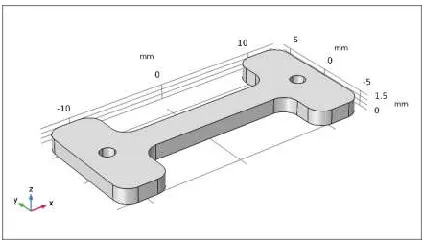
The geometry of the sample in Ref. [15] was used in this work. As it is shown in Figure 1, the dimensions of the sample are 21×3×1.5 mm. The interior surfaces of the holes was considered as the electrode contact surface.
Figure 1. Geometry of bone shaped sample. The dimensions are 21 mm of gage section and 21×1.5 mm2 of rectangular
cross section
The governing equations for this simulation include Maxwell’s equations which are given by Equation (1), (2) and (3).
∇.J=Qj.V (1)
J=(σ+ϵ0ϵr )E+Je (2)
E=-∇ϕ (3)
Where J is the current density vector, σ is the electrical conductivity, ϕ is the electric scalar potential, E is the electrical field vector, ϵ0 and ϵr are respectively vacuum permittivity and relative permittivity.
The Other one is the transient heat transfer equation:
ρC ∂θ
∂tdV = ∇(k∇θ)dV + q dV
+ (q̇ , q̇ , q̇ , q̇ )
(4)
Where ρ, Cp, θ, t, V and k are respectively the density, specific heat, temperature, time, volume, thermal conductivity. The terms q̇ , q̇ , q̇ and q̇ refer to the heat flux terms on the various surfaces, which respectively account for heat dissipation by conduction, convection, and radiation and q ̇_e is the internal heat generation, which in this model refers to the heat generation related to Joule heating.
The heat generation by Joule heating is given by Equation 5 [16]:
q = (−∇ϕ)σ(−∇ϕ) (5)
The software modeling was done by COMSOL Multiphysics that uses finite element method to couple all these equations and solve them simultaneously by considering the contributed initial and boundary conditions including heat radiation of the sample, applied voltage on electrodes, initial voltage and initial temperature which supposed to be equal to furnace temperature.
The materials used in this simulation include 3 mol stabilized Zirconia (3YSZ) and 8 mol% Yttria-stabilized Zirconia (8YSZ) which are the most candidate materials for flash sintering experiments. The value of each the property needed for solving the equations are shown in Table 1 [6, 15]. Relative emissivity supposed to be 0.7 of magnitude [7].
TABLE 1. Material Properties
Material Density (kg m-3
)
Thermal Conductivity
(W m-1
K-1
)
Specific Heat (J kg-1
K-1
)
3YSZ 6050 2.7 600
8YSZ 5680 1.7 502
The relationship of temperature and electrical resistivity for 3YSZ powder is given by Equation 6, where Q is the activation energy for the conduction mechanism and R is the gas constant [6]. This relationship for 8YSZ powder is some different and could be found in [16] with all the related details.
ρ = ρ exp Q
RT (6)
The mesh was automatically created by the software and include tetrahedron and triangle elements. The average element quality is 0.66, the element volume ratio is 0.004 which is the ratio between the volume of largest and smallest element.
3. RESULTS & DISCUSSION
S. Mohammad Alizadeh et al. / ACERP: Vol. 5, No. 1, (Winter 2019)31-38 33
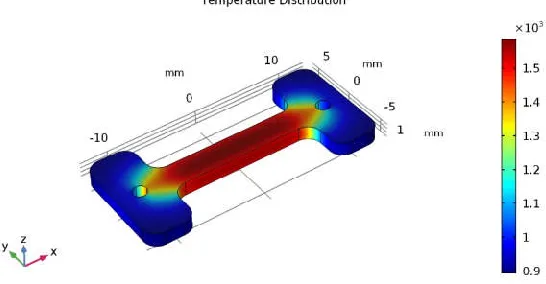
The Obtained result is in agreement with the previous work done by Grasso et al. [15]. Our model was validated by this consistency.
Figure 3 shows a similar 3D plot of temperature distribution for 8YSZ sample after flash when steady state condition was reached. The electric field, current density and furnace temperature was 100 V/cm, 110 mA/mm2 and 800°C, respectively. As can be seen, the temperature distribution exhibits symmetrical form,
which it was not unexpected if only Joule heating was considered. However, in experimental data, it has been observed that the area near anode has the maximum temperature. In fact, there is an asymmetric temperature distribution in flash sintered samples [11]. The reason for this contradiction between our result and experimental data could be related to this point that electrochemical effects are not taken into account in this model.
Figure 2.Temperature distribution of 3YSZ sample 3 seconds after flash. The electric field, furnace temperature and current density were 120 V/cm, 850°C and 67 mA/mm2, respectively
Figure 3. Temperature distribution of 8YSZ sample 3 seconds after flash. The electric field was 100 V/cm, furnace temperature was 700°C, and current density was 140 mA/mm2
Inhomogeneity of current passage through the sample is one of the problems that causes non-uniform properties of the final sample due to partially sintering. It can even lead to cracking. So, providing uniformity is necessary. Figure 4-(a) shows the current density distribution 4 seconds after the flash. Figure 4-(b) shows the comparison between the maximum and minimum current density one of the most effective and also easiest ways to modify the current homogeneity is to change the electrode configuration. In particular, increasing the contact points, twisting electrodes around the sample,
using paste for better conductivity and etc. So the results of this model are useful to find the appropriate electrode configuration.
ACERP: Vol. 5, No. 1, (Winter 2019) 31-35
Figure 4. (a) Current density distribution in the mid-cross-section of the sample 4 seconds after flash (b) The maximum and minimum current density versus time. The electric field was 75 V/cm and furnace temperature was 650°C
ACERP: Vol. 5, No. 1, (Winter 2019) 31-35
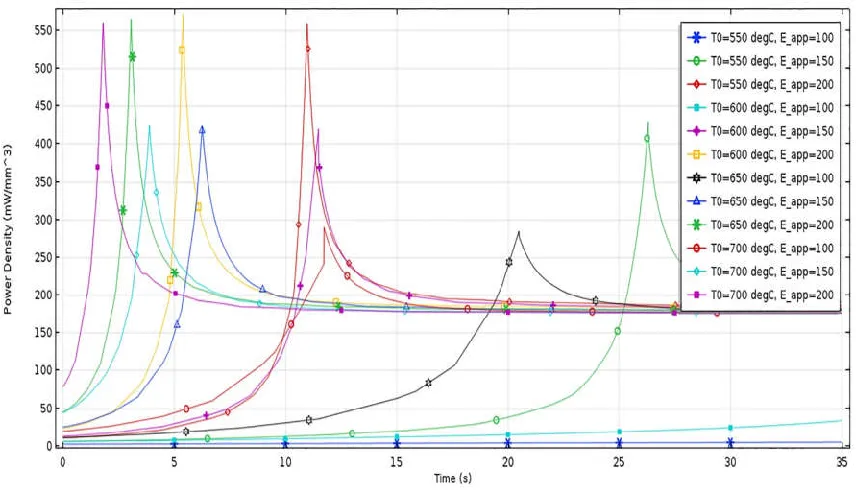
It is suggested that the nucleation phenomenon leads to a correlation between electric field intensity and incubation time while the model of this work is only based on Joule heating and did not consider anything about nucleation. Furnace temperature can also affect incubation time in a way similar to electric field intensity. Lower furnace temperatures lead to prolongation of incubation time, and of course lower than a specific temperature in a specific applied electric field that flash doesn’t take place. There is a critical value for furnace temperature as well as electric field intensity. The suggested equations for these two critical values can be found in [7]. The model developed in this work has the ability to estimate the critical values, so one can find the optimum parameters in a short time. The capability of 8YSZ to flash sinter was significantly lower than that of 3YSZ, which is related to higher electrical conductivity of 8YSZ.
4. CONDLUSIONS
The below results are summarized as the final conclusion of this paper:
1. Modeling with numerical methods is such an advantageous way for researchers working on flash sintering to get a sight on the process, so that pick can find optimum values and make modified configurations. 2. According to previous works, electric field intensity and furnace temperature are proportional to incubation time in stage I of the flash sintering process. This correlation is in agreement with the result of simulation in this model which verifies this correlation.
3. The critical values of temperature and electric field can be estimated by the simulation model developed in this study.
4. Uniformity of the current passage through the sample during flash stage can be observed by the simulation model in this work.
5. Compared to 3YSZ, flash sintering of 8YSZ can occur at lower furnace temperatures due to the higher electrical conductivity of 8YSZ.
6. Developing a model for flash sintering which considers electrochemical effects is a good prospect to deal with in the future works.
5. ACKNOWLEDGMENT
The authors would like to express gratitude to supporters in “Niroo Research Institute”.
6. REFERENCE
1. Yu, M., Grasso, S., McKinnon, R., Saunders, T, Reece, M.J.,
"Review of flash sintering: materials, mechanisms and modelling", Advances in Applied Ceramics, Vol. 116, (2017), 24-60.
2. Cologna, M., Rashkova, B., Raj, R., "Flash Sintering of Nanograin Zirconia in <5 s at 850°C", Journal of the European Ceramic Society, Vol.93, (2010), 3556-9.
3. Yoshida, H., Sakka, Y., Yamamoto, T., Lebrun, J.-M., Ra,j R.,
"Densification behaviour and microstructural development in undoped yttria prepared by flash-sintering", Journal of the European Ceramic Society, Vol. 34, (2014), 991-1000. 4. Nie, J., Zhang, Y., Chan, J. M., Huang, R., Luo, J., "
Water-assisted flash sintering: Flashing ZnO at room temperature to achieve ~98% density in seconds", Scripta Materialia, Vol. 142, (2018), 79-82.
5. Du, Y., Stevenson, A.J., Vernat, D., Diaz, M., Marinha, D.,
"Estimating Joule heating and ionic conductivity during flash sintering of 8YSZ", Journal of the European Ceramic Society, Vol. 36, (2016), 749-59.
6. Xu, X., "31 - Ceramics in solid oxide fuel cells for energy generation", Advances in Ceramic Matrix Composites (Second Edition), Woodhead Publishing, (2018), 763-88.
7. Todd, R.I., Zapata-Solvas, E., Bonilla, R.S., Sneddon, T., Wilshaw, P.R., "Electrical characteristics of flash sintering: thermal runaway of Joule heating", Journal of the European Ceramic Society, Vol. 35, (2015), 1865-77.
8. Downs, J.A., "Mechanisms of Flash Sintering in Cubic Zirconia", University of Trento, (2013).
9. Ji, W., Parker, B., Falco, S., Zhang, J.Y., Fu, Z.Y., Todd, R.I.,
"Ultra-fast firing: Effect of heating rate on sintering of 3YSZ, with and without an electric field", Journal of the European Ceramic Society, Vol. 37, (2017), 2547-51.
10. Liu, D., Cao, Y., Liu, J., Gao, Y., Wang, Y., "Effect of oxygen partial pressure on temperature for onset of flash sintering 3YSZ", Journal of the European Ceramic Society, Vol. 38, (2018), 817-20.
11. Liu, G., Liu, D., Liu, J., Gao, Y., Wang, Y., "Asymmetric temperature distribution during steady stage of flash sintering dense zirconia", Journal of the European Ceramic Society, Vol. 38, (2018), 2893-6.
12. Naik, K.S., Sglavo, V.M., Raj, R., "Flash sintering as a nucleation phenomenon and a model thereof", Journal of the European Ceramic Society, Vol. 34, (2014), 4063-7. 13. Raj, R., "Joule heating during flash-sintering", Journal of the
European Ceramic Society, Vol. 32, (2012), 2293-301. 14. Biesuz, M., Dong, J., Fu, S., Liu, Y., Zhang, H., Zhu, D., Hu,
C., Grasso, S., "Thermally-insulated flash sintering", Scripta Materialia, Vol. 162, (2019), 99-102.
15. Grasso, S., Sakka, Y., Rendtorff, N., Hu, C., Maizza, G., Borodianska, H., Vasylkiv, O., "Modeling of the Temperature Distribution of Flash Sintered Zirconia", Journal of the Ceramic Society of Japan, Vol. 119, (2011), 144-6. 16. Pereira da Silva, J.G., Lebrun, J.M., Al-Qureshi, H.A., Janssen,
R., Raj, R., "Temperature Distributions During Flash Sintering of 8% Yttria-Stabilized Zirconia”, Journal of the American Ceramic Society, Vol. 98, (2015), 3525-8.
17. Downs, J.A., Sglavo, V.M., "Electric Field Assisted Sintering of Cubic Zirconia at 390°C", Journal of the American Ceramic Society, Vol. 96, (2013), 1342-4.
18. Francis, J.S.C., Raj, R., "Influence of the Field and the Current Limit on Flash Sintering at Isothermal Furnace Temperatures",