Anne U. Gold is Director of Education & Outreach at CIRES at the University of Colorado and the principal investigator for the Lens on Climate Change project. A climate scientist by training, she now focuses on science outreach and training for educators, students and the general public around climate and general geoscience topics.
Erin Leckey is a science educator who has worked with students in a variety of formal and informal settings. She uses her background in geology and ecology to help people understand the current changes in Earth’s climate.
Megan Littrell-Baez is an educational researcher for the Lens on Climate Change project. A cognitive psychologist by training, she has experience in educational research design, curriculum development, data analysis, and assessment of educational programs’ impacts on student learning.
Lesley K. Smith, is Associate Director of CIRES Education & Outreach. A limnologist by training, she has been involved with science outreach for the past 15 years. She’s developed a number of professional development programs for teachers, as well as community college and graduate students.
Susan Lynds is the LOCC program formative evaluator. A specialist in STEM evaluation, she has assessed for effectiveness
Student-Produced Short Films About Impacts of Climate Change on Local
Communities: An Effective Approach That Combines Art and Place-Based
Learning
Opportunities and challenges of program implementation with secondary school students
Anne U. Gold, Cooperative Institute for Research in Environmental Sciences (CIRES), University of Colorado Boulder
Erin Leckey, Cooperative Institute for Research in Environmental Sciences (CIRES), University of Colorado Boulder
Megan Littrell-Baez, Cooperative Institute for Research in Environmental Sciences (CIRES), University of Colorado Boulder
Lesley Smith, Cooperative Institute for Research in Environmental Sciences (CIRES), University of Colorado Boulder
Susan Lynds, Cooperative Institute for Research in Environmental Sciences (CIRES), University of Colorado Boulder
Abstract:
Here we describe how science learning can be enhanced through filmmaking. Combining the creative process of film production and its engaging storytelling and artistic components with science learning allows students to take ownership over their learning process and makes science accessible to learners who might not be reached through traditional science classrooms. We describe a model in which students develop a short film that investigates how climate and environmental change impacts their lives and their communities. Students are guided by college student mentors or teachers through a five-step program that includes: (1) selection and research of their topic, (2) development of a storyboard and script, (3) filming, (4) editing, and (5) a capstone screening event showcasing the final film. Through this process, students deepen their understanding of climate science and its complexity, while increasing their appreciation of the impacts of climate on society. Students also gain exposure to science and technology careers, while gaining confidence in their ability to complete a project.
Student-Produced Short Films About Impacts of Climate Change on Local Communities: An Effective Approach That Combines Art and Place-Based Learning
Introduction
Film and digital storytelling are powerful ways for learners to engage with a range of science, technology, engineering, and math (STEM) topics and to connect these topics to their own lives. Furthermore, through producing a film that examines how climate or environmental change impacts their communities, students can become agents of social change. When students increase their awareness of such environmental change and have a voice to share their
knowledge, they can become builders of resilience through initiating community dialogue. By creating films on topics of local relevance, students provide conversation-starters around which their families, peers, and other community members can share their interest. Public polls indicate that 44% of Americans say that they have personally experienced the effects of global warming and 64% think global warming is affecting weather in the United States (Leiserowitz et al., 2017). Young Americans see and experience these changes, and can be instrumental in increasing awareness and preparedness for their families and communities (Stevenson, King, Selm, Peterson, & Monroe, 2017; Williams, McEwen, & Quinn, 2017). In this way, climate science not only increases interest in science and technology for students, it also empowers them to move towards social change. This approach follows the successful model of place-based education where learners connect over locally-relevant topics with a science topic (Gruenewald & Smith, 2008; Semken & Freeman, 2008). As David Sobel (2012), a key figure in the
development of place-based education theory, states, “learning must begin with the tangible.” Student-produced videography is a unique way for students to take ownership over their learning about a topic of their choice while they develop valuable and transferable scientific and technical understanding and develop professional communication skills (Kolka, 1967; Kearney & Schuck, 2005, 2006; Levin, 2011). Here we describe an approach where we use filmmaking as a way for students to share a personal connection to a climate or environmental topic while learning technical skills.
The Lens on Climate Change (LOCC) program design is embedded in sociocultural learning theories and thus is tying the learning process closely to the sociocultural environment of the student (Cole, 1996; Lave & Wenger, 1991; Vygotsky, 1978). This approach includes guidance from near-peer mentors—undergraduate and graduate students—and members of their community, including local scientists and other experts. Mentors expose students to a variety of career choices in science and technology disciplines such as technical assistants, broadcast engineers, light and audio technicians, filmmakers, scientists, and science communicators. These interactions have the potential to spur interest and contribute to closing the STEM career
participation gap. More broadly, mentors act as influential role models (Tierney & Grossman, 2000) and can increase mentees’ academic performance (DuBois, Holloway, Valentine, & Cooper, 2002; Karcher, Davis, & Powell, 2002; Diversi & Mecham, 2005; Garringer, 2010; Herrera, Grossman, Kauh, & McMaken, 2011). The program design also facilitates the involvement of peers, parents, and community members. The here-described approach to combining art and science learning provides diverse students with access to opportunities, experiences, and skills that prepare them to participate in the digital world (Watkins, 2012; Vickery, 2014).
navigated many challenges in the implementation of the program. Here we describe the project design; we highlight challenges we faced and solutions we found during program
implementation. We hope that this discussion will be particularly useful to those interested in implementing a similar program.
Program Description
The LOCC program supports students in their science learning through the production of a short film about local impacts of climate or environmental change and exposes them to creative science and technology career opportunities. The program design as described here is facilitated by a university-based project team; however, the project components can be (and have been) adapted for implementation by informal educators and classroom teachers as part of their regular teaching, using existing resources and basic technological equipment (Figure 1).
Figure 1. Lens on Climate Change program steps.
Our team has developed three different models of implementation (see Program Implementation Types below); each includes the following five program steps but vary in the timing and
practical details. Participating student groups are supported by a science graduate student mentor or science teacher in the research phase and for the development of the science message, and by a film student mentor or technology teacher in the film production phases.
Step 1: Topic Selection and Topic Research
Students are guided in identifying a film topic that is relevant to their lives and communities by their science mentor or science teacher. We kick off our LOCC program with a meeting in which we engage students in reviewing the basics of climate change using group discussions and hands-on activities (examples hands-on cleanet.org) to establish their basic climate content understanding. As part of this introductory session, we also show examples of student-produced short films about climate change to inspire and empower students (see film examples on the LOCC website at
http://cires.colorado.edu/outreach/LOCC). Student participants are then guided by their science
mentor or science teacher in brainstorming locally-relevant topics that align with their personal interests. For example, students are encouraged to think about community mitigation or
adaptation strategies (e.g., renewable energy, air quality issues, flood/drought/fire protection) or their hobbies (e.g., fishing, skiing, outdoor sports) through guiding questions. During the
Student-Produced Short Films About Impacts of Climate Change on Local Communities: An Effective Approach That Combines Art and Place-Based Learning
After student groups identify the topics of their films, they conduct research to learn more about their topics in general, as well as the topics’ local impacts. For example, students who select the impact of drought on agriculture could research precipitation and air temperature over the last several decades, as well as the impact of limited water or the types of crops that farmers plant. Students are also encouraged to speak with their family members or others who are long-time residents of their community about changes that they have observed. Identifying problems in their community often leads students to include possible solutions or mediating actions in their films; including these elements not only increases the positive reception of the message, but also gives the students a sense of hopefulness and empowerment. The science mentors guide the student groups in finding the critical information and local data to learn about their topic.
Students that don’t have much experience in conducting independent research are also guided on how to identify authoritative websites and credible data sources. A powerful way for students to learn about the local relevance of their topics is through interviews with scientists, local experts, or other stakeholders. Such interviews provide students with both information and an opportunity to hear a different perspective on their topic. Interviews are also an important tool to help
students learn basic communication skills, such as how to listen effectively and ask follow-up questions. Student groups are encouraged by their mentors or teachers to write a list of guiding interview questions as they prepare for the interview. Writing these interview questions helps students organize their thoughts and identify gaps in their understanding of the topic.
Step 2. Developing a Storyboard
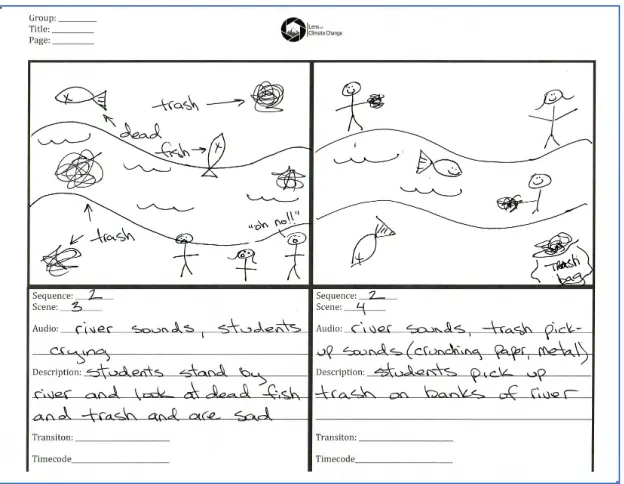
As student groups compile the information they gathered in the research phase, they are guided on how to organize their findings into concept maps or other visual organizers. Linking facts and ideas in this way helps students to see the threads of their developing story and identify where they need additional information. Concept maps are also a practical tool that can be built upon to develop their storyboards and scripts in subsequent steps of the filmmaking process. While developing their concept map, students should consider the message they plan to deliver with their film, identify the audience for their film, and choose the film style they want to produce (e.g., documentary, fictional story, cartoon). These factors weave together to form the film narrative, the story the film is telling. The film narrative is the foundation for the film script in which students outline the plot, describe their characters, and identify settings for different scenes. From their film script, students develop their storyboard (Figure 2), consisting of a sequence of drawings with directions (e.g., camera placement and indications of character movement) and dialogue. Each cell in a storyboard represents one film shot and includes a rough sketch of the characters and their actions. The storyboard helps students stay organized
Figure 2. An example student storyboard.
Step 3. Filming
Following the structure of their storyboards, students develop a list of shots they need for their film. The film style, the topic, and the film’s storyline drive the types of film elements (e.g., narration, location-specific shots, expert interviews, or animations) that will be included. A detailed shot list helps students plan their time and organize their film files. Site visits and filming on location at sites where climate change can be seen and recorded is impactful and fun for students (Figure 3).
Figure 3. LOCC students producing their films.
Student-Produced Short Films About Impacts of Climate Change on Local Communities: An Effective Approach That Combines Art and Place-Based Learning
For example, capturing high quality audio during outdoor filming is often challenging due to wind or other background noise. An experienced film mentor can help support student success in these settings by suggesting possible camera angles and microphone placement. Nevertheless, a few scenes usually must be re-shot, or audio re-recorded in a controlled setting. If on-location shoots are not possible, existing photos can be used to achieve a similar effect, using B-roll imagery that supports the film’s narrative, such as photos taken by community members or local organization. Students can also use free Creative Commons images or video footage to
supplement the footage they shoot themselves. Film files can be stored on cloud-based servers, such as Dropbox or Google Drive for easy access by all group members.
If students are including interviews with experts or community members, they can invite experts for in-person interviews during a visit to the school or during a field trip, or conduct the
interview virtually through video connections. Many free video software packages, such as Google Hangouts or Zoom, allow recording of sessions; video interview footage can then be included in the film. The science mentors or teachers in the LOCC program help students identify experts and can help set up interviews.
Step 4. Editing
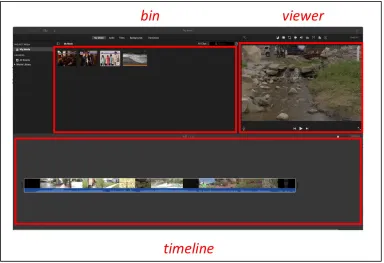
Once students have all film components recorded, film mentors help students import audio and video components into editing software to begin assembling their film. Editing applications that are included in basic Apple or Microsoft software packages are iMovie and Movie Maker. Using their storyboard and shot list as guides, students put their footage into film sequence and decide how one shot transitions into the next. Most editing software packages include three
components—a bin, a timeline, and a viewer (Figure 4).
All video footage and still imagery is loaded into the bin as a holding place. The timeline is where the actual film is assembled—all video and audio tracks are dragged from the bin to the
timeline to arrange the film. The viewer displays the film and allows reviewing. During this
editing phase, students first create a so-called “rough cut” of their film that includes the best footage and all film elements, but is not polished. At this stage, students can reorganize the film to ensure the best flow. In the LOCC program, we ask student groups to present their rough cuts to other student groups and mentors for big-picture feedback on their films. Student feedback and constructive critiques will help student groups revise the rough cuts. Students may include changes to the sequence of scenes, clarify their storyline, add additional information through text or graphics, or strengthen the message of the film during their revisions. In the development of the “final cut” of the film, students incorporate edits, visual effects, music, credits, and title. Some student groups also include bloopers or a short trailer for their films. It is important for the students to check the audio volume throughout the film to ensure that it is consistent. Film
mentors also guide students in appropriate use of copyrighted music and other licensed materials.
Step 5. Film Screening
A capstone film screening event is a powerful way to share the students’ work with peers, families, and the public. The screening event provides an opportunity to celebrate the students’ accomplishments and allows them to speak to the public as experts on their films. The screening date also constitutes a firm deadline for student groups to finish their films. For the LOCC screening events, we bring multiple student teams together to screen their films together. A brief keynote address by a local scientist or community leader adds to the sense of ceremony and helps students to see their film as a contribution to scientific communication. After the screening of each film, student groups come on-stage and answer questions from the audience about their films and their topics. Providing a venue for students to discuss their films has been empowering for students, and they report feeling excited and proud to share their work. Such film screenings can be held in class-wide, school-wide or community settings. Student films can be submitted to local, regional, or national environmental film festivals, or student groups can use them as capstone projects for after-school programs (e.g., 4H or leadership programs), or as part of school project assignments. Many students like to share their films through social media platforms with friends; however, privacy regulations require that all people visible in the film have signed a media release form. Our LOCC team collects these media releases from all participants.
Program Implementation Types
The five-step sequence has been implemented in three different versions of the LOCC program, each equal to about 40 hours of work: (i) an out-of-school implementation, where student groups meet before or after school with their mentors and a teacher and work for 3 to 4 months during the school year on the development of the film; (ii) an in-class implementation, where teachers work with their entire class as part of regular instruction on developing the short films over the duration of multiple weeks; and (iii) a 1-week summer program where students and mentors work intensively for 1 week together on the development of the films.
Student-Produced Short Films About Impacts of Climate Change on Local Communities: An Effective Approach That Combines Art and Place-Based Learning
career paths with the students.
Program Implementation in Regular Coursework Although the Lens on Climate Change program was initially designed to be implemented through program staff (including a program manager, an educational researcher, and administrative support), the basic program (steps 1-5 above) can be implemented by a single educator as part of regular instruction or during an after-school program. The combination of creativity through art,
filmmaking, and science learning has shown to be a powerful addition to different science curricula and need not be limited to explorations of climate science. Other visual storytelling formats can be used as an alternative to the here-described short film format. We recommend that teachers check out detailed instructions and lesson plan suggestions in our Science Scope article (Oonk et
al., 2017, see also on LOCC website).
Evaluation and Findings
Reflection data from LOCC mentors and teachers suggest that the creative components of the project were inspirational and motivating for participating students. Teachers who participated in the school-year implementation report that students liked how the science research resulted in the tangible product of a film. Teachers and mentors also reported that the self-directed learning format was inspiring and transformational. Specifically, students were more aware of climate and environmental impacts in their communities and were inspired to make changes in their daily lives to reduce fossil fuel consumption. Teachers and mentors reported that, through the
program, students gained a deeper understanding of climate science in general and their topic in particular. Students learned in their work with the mentors that critical thinking and questioning are necessary to gain a solid understanding of the overall concept, and they developed an understanding about the process of science and science communication. They learned about the complexities of science and its relevance to their lives. These learning gains were primarily achieved through the research that students conducted on their topics, the process of conducting interviews, and the positive influence of their mentors. Mentors reported that students were motivated by working with the filming equipment and learning film production from experts. One mentor also described that students learned how to take on a large project by taking small steps each week.Other life skills that students gained through the project include the ability to work with other students and work as a team towards an end product. Mentors and teachers also describe an increase in students’ interest in careers around science and film making. Participating students asked many questions during the career panels and of their mentors about their personal path.
Program Implementation Challenges and Solutions
and the bullet points describe solutions that were most effective.
Research Program
Research Approval: Implementing a rigorous educational research program in a project that targets middle and high school students presents a number of challenges. Research approval is required by school districts, as well as by the institutional review board (IRB) of your institution, to protect students’ privacy. While the IRB guidelines vary by institution, they strictly regulate working with minors even when only survey data are being collected. Parental consent and student assent is required to use survey data in a research study.
• Determine research application deadlines for the school district(s) with which you
intend to work. Have contacts, all research instruments, and, if necessary, letters of support ready in advance.
• Determine the window when research programs are allowed to be active during the
school year. Often, districts reserve the beginning and end of the school year for testing and do not allow research programs to operate during those times.
• Allow sufficient time for the IRB and school district approval processes and to
monitor applicable deadlines in order to secure approval before program activities start.
• Make consent forms informative but easy to understand. Consent forms can be
intimidating to parents and students; therefore, include a brief cover letter with forms (translated, if appropriate) that explains in plain language what the goals of the study are, as well as why they are being asked to provide consent and assent.
• Use both sticks and carrots to get consent and media release forms returned early.
Providing incentives such as small gift cards or cookies can help ensure that that forms are returned, and having teacher or parental liaisons who are able to reach out directly to parents is a good back-up.
Conducting research with students: A rigorous research design requires the use of validated survey instruments to answer the research question. It may also require that students in a
demographically-similar control group be included in the study. Depending on the types of data being collected (e.g., focus groups or interviews), working with secondary students can present challenges, but most can be overcome by being prepared and providing rewards at every turn. A research design usually requires identical implementation across different sites. Implementing programs as part of regular instruction without research components allows for flexibility in adapting the program to site-specific constraints.
• Pilot your surveys and interview questions with real students, preferably from the pool
you plan to use in your program. Reading and content knowledge levels can vary widely, especially for middle school students, and surveys often take much longer than
anticipated.
• Keep surveys as short as possible and provide immediate rewards. Some students
struggle with maintaining focus and motivation during surveys. Understanding how long the survey should take to complete will help determine appropriate rewards.
• Control groups are most successful when the students are part of a larger group
(such as a parallel course) that will be together over the duration of your
Student-Produced Short Films About Impacts of Climate Change on Local Communities: An Effective Approach That Combines Art and Place-Based Learning
Because the control group students only participate at the beginning (pretest) and the end of the program (posttest), it is critical to obtain their consent forms before they complete the initial surveys and to reward them immediately for all research instruments they complete. For the summer programs, it was easiest to recruit control group and LOCC participant students when we worked with established programs, such as the I Have A
Dream Foundation. From these programs, some students chose to participate in the
LOCC program, while others engaged in different activities during the same time.
• Focus group interviews should include only a few students and be strongly facilitated
so that even shy students are encouraged to share their experiences. Concentrate strong personalities into one group or plan to have targeted questions for each group member, so that one student doesn’t dominate the conversation.
Program Design
Program Implementation: We implemented the program as an intensive short course in the summer, as a weekly after-school activity, and as an in-class program. The school-year implementation (both in-class and after-school) provides a multi-month process in which students learn and explore their topic and digest much of the experiences slowly; thus, it allows for repeated reflection. The summer implementation provides an intensive immersion into the project and the topic for a shorter time period. Both implementations have their pros and cons.
Solutions to general challenges:
• Keep student teams focused and on-task throughout project by having activities for
each meeting planned.
• Identify program milestones (see steps 1-5) and set dates to reach each milestone to
help student groups stay on track and finish their films (see teacher and mentor handbooks with example milestones on the LOCC website).
• Support student groupsthat struggle with identifying a topic by outlining a set of
climate change topics that are relevant to their community to kick-start their
brainstorming process. Topic selection is an important part of students taking ownership over their own learning and connecting with the topic.
• Scaffold the research phase (step 1) for middle school students, including guidance on
how to identify search terms, discussion about selecting credible sources, support in interpreting scientific data, and help with reading scientific texts.
• Discuss the scope of the film and the use (and boundaries) of humor to ensure that
student films include a scientific message. Mentors and teachers may set expectations around how much scientific information should be included in film (e.g., films must include scientific data to back up claims, sources must be cited). Bloopers may be appropriate to incorporate additional funny elements.
• Introduce a variety of film elements, such as footage collected through skits,
interviews, on-site field trips, whiteboard animations, or drawings to help students develop ideas for their film that match available resources. For on-site filming, approval from property owners may be necessary.
• Identify a role for each student in the group—for example, director, interviewer, film
production.
• Films can be developed in low-tech environments where students use either smart
phones or hand-held cameras and free movie editing software, if schools or programs don’t have access to high tech equipment.
Solutions to challenges specific to after-school programs:
• Highlight the commitment for students in after-school programs to regularly
participate in order to experience the entire film development process. Clear
communication about the participation requirements to both parents and students will ensure regular attendance throughout the program.
• Align the program duration with the semester schedule when the program is
implemented with college student mentors (film and/or science mentors) to avoid
scheduling conflicts. Programs that straddle semesters might cause schedule conflicts for college student mentors whose course schedules change.
• Set dates for field trips and screening event early to ensure full participation. On-site
filming, visitation of a college or film school campus, or a public screening event are enriching activities that will likely have to be scheduled outside of the regular meeting times.
Solutions to challenges specific to summer programs:
• Week-long summer programs require only a short and clearly defined commitment
from students and mentors; however, highlighting that attending the entire week is critical will ensure that group work won’t be interrupted by variable group size.
• Encourage students to regularly reflect on the topic during the intensive week-long
summer program implementation and to circle back on the film’s message. The condensed film production schedule may keep students so busy that they don’t take the time to reflect on their film messaging in the same way as they may throughout a school-year implementation.
• Keep notes and paperwork (scripts and storyboards) organized and stored in a way
that makes it easy for students to find and review their work.
Partnerships (mentors, scientists, multiple groups): The LOCC program design builds on many partnerships, as well as the logistical support of a coordinated team. While the partnerships add value and increase the quality of the program, managing the partnerships and scheduling joint events pose significant logistical challenges.
• Partner with teachers who are committed to the project and are aware of the project
design steps. Such teacher partners help with student recruitment, support logistical connections to the schools, and inspire and motivate the students; thus, they help retain students in the program throughout the school year.
• Train mentors to work with younger students. Training should include skill building
around asking guiding questions, keeping students’ attention and focus, managing group dynamics, and tips for managing student behavior.
• Know the background check requirements of the school districts in which you plan
Student-Produced Short Films About Impacts of Climate Change on Local Communities: An Effective Approach That Combines Art and Place-Based Learning
• Encourage mentors to talk with their group about their own career path and their
experience in higher education. Discussing the hurdles they have faced and how they navigated them has been inspiring to participating students. Graduate student mentors play an important role in sparking enthusiasm for science or technology careers in participating students.
• Budget mentor stipends at a competitive rate to allow them to work in the program
instead of other jobs. College student mentors enrich the program significantly; however, they usually can’t afford to participate in the program unless they are being paid.
Diversity: The LOCC program targets middle and high school students from groups that are traditionally underrepresented in STEM fields. Working with students who are not presented with many extra-curricular science activities increases the impact of the program but also poses unique challenges.
• Recruit students through partners who have a track record of working with the
target studentgroup; partners may be teachers for after-school programs or
coordinators of established programs for out-of-school programs. Those partners will already have the trust from students and parents. This may also avoid a notion that an external group tries to indoctrinate students with a political or social agenda.
• Recruit mentors or career panelists that share ethnic or social background with the
target students. Such mentors or panelists are in a unique position to be role-models for participating students.
• Work with a trusted community partner if offering a program at a location that is
remote to the location of the program coordination team to ensure local commitment and accountability.
• Offer parent information meetings (ideally, during the evenings for working parents)
or send detailed parent information materials for interested students to raise parent support for the program.
• Provide additional ways for the community and parents to be involved. Parents who
have restrictive work or child-care schedules may not be able to attend events, but still will want to be involved. Invite them to be part of costume or prop-making, informal interviews, or posting event flyers. Additionally, ensure that parents or community members who can’t attend the screening know where to access the films online.
Conclusion
In the LOCC program, we have found that the five steps model towards the development of a film provides a coherent framework for successfully engaging middle and high school students in self-directed research and exploration of climate change. By using their research to develop a film that speaks to their community about current and future environmental change, students become powerful agents who encourage conversations and resilience-building around these topics. We have found that this program makes students feel an increased sense of
empowerment and results in them being more aware of the effects that climate change is having on their lives.
nature and can be overcome by recognizing them and planning for them in advance. The 5-step model that we are describing can easily be adapted for implementation in different learning environments, such as after-school programs, summer workshops, college courses, and project-based learning within K-12 schools.
Student-Produced Short Films About Impacts of Climate Change on Local Communities: An Effective Approach That Combines Art and Place-Based Learning
Acknowledgements
Funding for this project was provided by the National Science Foundation (DRL- 1513320). The authors acknowledge the work of all mentors, teachers, and students who participated in the program.
References
Cole, M. (1996). Cultural psychology: A once and future discipline. Cambridge, MA: Harvard University Press.
Diversi, M., & Mecham, C. (2005). Latino(a) students and Caucasian mentors in a rural after-school program: Towards empowering adult-youth relationships. Journal of Community
Psychology, 33(1), 31-40. doi: 10.1002/jcop.20034
DuBois, D. L., Holloway, B. E., Valentine, J. C., & Cooper, H. (2002). Effectiveness of
mentoring programs for youth: A meta-analytic review. American Journal of Community
Psychology, 30(2), 157–197. doi: 10.1023/A:1014628810714
Garringer, M., (2010). Planning a school based mentoring program. Lessons Learned, 1(4).
Gruenewald, D. A., & Smith, G. A. (2008). Place-based education in the global age. New York, NY: Routledge.
Herrera, C., Grossman, J. B., Kauh, T. J., & McMaken, J. (2011). Mentoring in schools: An impact study of Big Brothers Big Sisters school-based mentoring. Child Development,
82(1), 346-361. doi: 10.1111/j.1467-8624.2010.01559.x
Karcher, M. J., Davis III, C., & Powell, B. (2002). The effects of developmental mentoring on connectedness and academic achievement. The School Community Journal, 12(2), 35-50. Kearney, M., & Schuck, S. (2005). Students in the director's seat: Teaching and learning with
student-generated video. Proceedings of ED-MEDIA 2005—World Conference on
Educational Multimedia, Hypermedia & Telecommunications, 2864-2871.
Kearney, M., & Schuck, S. (2006). Spotlight on authentic learning: Student developed digital video projects. Australasian Journal of Educational Technology, 22(2). doi:
10.14742/ajet.1298
Kolka, M. E. (1967). Homemade movies in the classroom. Journal of Geography, 66(5). 248-249. doi: 10.1080/00221346708981247
Lave, J., & Wenger, E. (1991). Situated learning: Legitimate peripheral participation. Cambridge, England: Cambridge University Press.
Leiserowitz, A., Maibach, E., Roser-Renouf, C., Rosenthal, S., Cutler, M., & Kotcher, J. (2017):
Climate change in the American mind: October 2017. Yale University and George
Mason University. New Haven, CT: Yale Program on Climate Change Communication. Levin, H. (2011). Authentic doing: Student-produced web-based digital video oral histories. Oral
History Review, 38(1). 6-33. doi: 10.1093/ohr/ohr046
Oonk, D., Leckey, E., Gold, A.U., Margot-Sneider, J., Littrell-Baez, M., Smith, L., & Lynds, S. (2017). Lens on climate change: Using place-based learning to explore climate change effects. Science Scope, 41(2). 86-94.
Semken, S., & Freeman, C. B. (2008). Sense of place in the practice and assessment of place-based science teaching. Science Education, 1042-1057. doi: 10.1002/sce.20279 Sobel, D. (2012). Place-based education: Connecting classrooms and communities. Great
Barrington, MA: The Orion Society.
Stevenson, K. T., King, T. L., Selm, K. R., Peterson, M. N., & Monroe, M. C. (2017). Framing climate change communication to prompt individual and collective action among adolescents from agricultural communities. Environmental Education Research, 1-13. doi: 10.1080/13504622.2017.1318114
Tierney J. P., Grossman, J. B., (2000). Making a difference: An impact study of Big Brothers Big
Student-Produced Short Films About Impacts of Climate Change on Local Communities: An Effective Approach That Combines Art and Place-Based Learning
Vickery, J. R. (2014). The role of after-school digital media clubs in closing participation gaps and expanding social networks. Equity and Excellence in Education, 47(1). 78-95. doi: 10.1080/10665684.2013.866870
Vygotsky, L. S. (1978). Mind in society. Cambridge, MA: Harvard University Press. Watkins, S. C. (2012). Digital divide: Navigating the digital edge. International Journal of
Learning and Media, 3(2). 1-12. doi: 10.1162/IJLM_a_00072
Williams, S., McEwen, L. J., & Quinn, N. (2017). As the climate changes: Intergenerational action-based learning in relation to flood education. The Journal of Environmental
Education, 48(3), 154-171. doi: 10.1080/00958964.2016.1256261