ISSN: 2333-6080(Print), 2333-6099(Online) Copyright © The Author(s). All Rights Reserved. Published by American Research Institute for Policy Development DOI: 10.15640/jmm.v4n2a8 URL: https://doi.org/10.15640/jmm.v4n2a8
The Influence of Consumer Ethnocentrism, Perceived Value and Brand Credibility
on Purchase Intention: Evidence from Indonesia’s Banking Industry
Patria Laksamana
1Abstract
The study aims to investigate the effects of consumer ethnocentrism, perceived value and brand credibility on purchase intention. A questionnaire was developed and completed by 301 respondents and the context of the study was foreign bank in Indonesia. Results reveal that ethnocentric consumers has a negative impact on perceived value and brand credibility. However, it has been found that purchase intention was influenced by consumer ethnocentrism, perceived value and brand credibility..
Keywords: consumer ethnocentrism, perceived value and brand credibility on purchase intention
1. Introduction
As we live in a borderless marketplace, there are numerous domestic or foreign products to choose from for consumers. One of the main reason for a consumer selecting a product is based on country of origin (COO). In fact, it has been the focus from previous research such as Fetscherin and Toncar (2010), Balabanis and Diamantopoulos (2004), Hui and Zhou (2003), Chao (2001) and Chung and Pysarchik (2000) to name a few.
Consumers in emerging market such as China prefer products or brands from developed countries for high social status and modernity (L. Zhou & Hui, 2003). In other words, a developed country has better evaluations for its products from consumer and vice versa (Bandyopadhyay, Reese, & Reese, 2014; Klein, Ettenson, & Krishnan, 2006). However, there are some positive attitudes toward domestic brands due to patriotism and pride (Klein, Ettenson, & Morris, 1998; Shimp &Sharma, 1987) known as ethnocentrism. Consumer ethnocentrism based upon the responsibility and morality for consumer purchasing domestic brands as opposed to foreign brands.
As high involvement product such as bank is not just merely about price or location,it also involves image and reputation. Consequently, it includes rational economic valuations and feelings (Roig, Garcia, Tena, & Monzonis, 2006). Therefore, perceived value is one of the important things for bank for winning the market (Marple & Zimmerman, 1999). Following Sanchez, Callarisa, Rodriguez, and Moliner (2006)and Roig et al. (2006), there are six dimensions in perceived value; functional value of the establishment, functional value of the personnel, functional value of the service, functional value price, emotional value and social value.
Further, the importance of credibility leads to brand credibility. For delivering the promise that has been made to the consumers, it needs trustworthiness, expertise and attractiveness (Erdem, Swait, & Louviere, 2002). The current study focuses on thecommercial banking industry in Indonesia. Out of total 120 commercial banks with 18.114 bank offices in Indonesia, there are 14 (11.6%) are joint venture banks with 268 bank offices. Hence, only 10 (8.3%)are foreign owned banks with 196 bank offices(BankIndonesia, 2013).
That makes only approximately 20% bank in Indonesia is fully or partially owned by foreign entities.
The study is to respond from previous research such as Chryssochoidis, Krystallis, and Pereas (2007)for broadening the study to ethnocentric in terms of products and countries of origin. Hence, with the rise of regional trade blocs such as ASEAN Economic Community (AEC), there is a need to study ethnocentrism in to more relevant elements (Seidenfuss, Kathwala, & Dinnie, 2013). Within this relational framework, the objective of thestudy are twofold: first, to determine the impact of consumer ethnocentrism on purchase intention; and, second, to compare the significance of consumer ethnocentrism, perceived value and brand credibility on purchase intention. 2. Ground Theory
2.1.Social Identity Theory
Based on the social identity theory (SIT) by Tajfel and Turner (1986), social class influenced people because they want to be identified as a group member. This attachment includes gender, age group, religion and organizational association. Consequently, individuals may choose several brand alternatives based on the closest one to their identities. For example, a domestic brand may have a bigger chance to be selected by cosumers as opposed to a foreign brand. 3. Literature Review and Hypotheses Development
3.1.Consumer Ethnocentrism
Consumer ethnocentrism is defined as “the beliefs held by consumers about the appropriateness, indeed morality, of
purchasing foreign made products”(Shimp &Sharma, 1987, p. 280). It should be noted that most studies have demonstrated
that the higher tendency ethnocentric consumer, the higher they negatively judged foreign made products(e.g., Kaynak & Kara, 2002; Shimp & Sharma, 1987; Tong & Li, 2013). This is because consumer ethnocentrism focuses on being loyal to purchase local products as opposed to foreign products due to morally responsible and patriotism tendencies. Interestingly, it has been found that older consumer with low educational level tend to have highly ethnocentric attitude , whilst younger consumer with higher education level are less ethnocentric (Chryssochoidis et al., 2007; Orth & Firbasova, 2003; Seidenfuss et al., 2013). On the contrary, non-ethnocentric or low-ethnocentric consumers tend to be more tolerable for foreign products. They evaluated the product based on more objective judgments(Shimp & Sharma, 1987).The most widely used measurement scale in the consumer ethnocentric is consumer ethnocentric tendencies scale (CETSCALE) by Shimp and Sharma (1987). Some previous studies have been found that consumers with high ethnocentric tendencies tend to judge domestic brands favorably and emotionally. This leads to a positive relationship between consumer ethnocentrism and domestic brands and vice versa.
3.2.Consumer Ethnocentrism and Perceived Value
As perceived value is one of the important things for bank for winning the market(Marple & Zimmerman, 1999), ethnocentrism has been found influenced perceived quality of domestic and foreign products(Chryssochoidis et al., 2007). However, consumer ethnocentrism also has been found negative on quality judgment for foreign products (Klein et al., 1998). Therefore, our first hypothesis is:
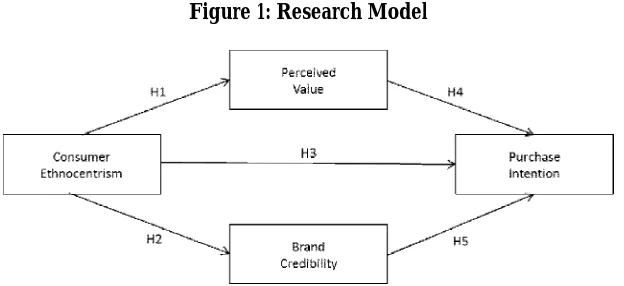
H1: There is a negative relationship between consumer ethnocentrism and perceived value.
3.3.Consumer Ethnocentrism and Brand Credibility
H2: There is a negativerelationship between consumer ethnocentrism and brand credibility.
3.4.Consumer Ethnocentrism and Purchase Intention
As the impact of COO has a very dynamic nature (Lampert & Jaffe, 1998), one could argued that the impact would be similar to ethnocentrism (Seidenfuss et al., 2013). Han (1989) has demonstrated that COO has an impact for purchase intention. However, most studies have demonstrated that the higher tendency ethnocentric consumer, the higher they negatively judged foreign made products (e.g., Kaynak & Kara, 2002; Shimp & Sharma, 1987; Tong & Li, 2013). Further, the affect of ethnocentrism on purchase intention found to be moderate for necessity product (Javalgi, Khare, Gross, & Scherer, 2005).Therefore, we then posit:
H3: There is a negative relationship between consumer ethnocentrism and purchase intention.
3.5.Perceived Value and Purchase Intention
Perceived value is the instrument for consumer in judging and valuating a product, service/relationship and cost (Lovelock, 1991; Roig et al., 2006). Thus, it has been found that value plays an important role for consumer to purchase and repurchase (Dodds, Monroe, & Grewal, 1991). Therefore:
H4: There is a positive relationship between perceived value and purchase intention.
3.6.Brand Credibility and Purchase Intention
The corporate-brand credibility is consumers’ belief in a corporate’s brand (Li, Wang, & Yang, 2011) that includes trust, expertise and likability (Fombrun, 1996). Therefore, when a consumer need to decide a high involvement product like bank, it includes rational economic valuations and feelings (Roig et al., 2006). As brand credibility influenced purchase intention (Lafferty, Goldsmith, & Newell, 2002; Li et al., 2011), the final hypothesis is:
H5: There is a positive relationship between brand credibility and purchase intention.
Therefore, Figure 1 is the research model for the study.
Figure 1: Research Model
4. Methodology
The measurement came from previous research. For consumer ethnocentrism was measured by CETSCALE from the study of Shimp and Sharma (1987). As for perceived value adopted GLOVAL scale from Roig et al. (2006) and brand credibility was taken from Erdem and Swait (2004). Finally, purchase Intention adopted from Bolton and Drew (1991).
The inferential statisticswas applied for this study along with itsseveral statistical analysis. First, Exploratory Factor Analysis (EFA) was used for factor loading significance. Only factor loading with values over .50 accepted. Therefore, items with loading less than .50 were eliminated for further statistical analysis(Hair, Black, Babin, & Anderson, 2006). Second, reliability test wasused for consistency, stability and credibility of the presented findings (Hair et al., 2006). The higher the construct, the higher the reliability is. Whereas values below .60 considered unacceptable(DeVellis, 2003). Finally, for testing hypotheses ANOVA was used for testing a dependent variable with two or more independent variables (Zikmund, Ward, Lowe, Winzar, & Babin, 2011).
5. Result
Out of the total sample of 301 respondents, 141 (46.8%) were men and 160 (53.2%) were women. The majority of respondents were aged between 21-30 (159 people; 52.8%), professionals in private sectors (134 people; 44.5%) and bachelor degree education background (129 people; 42.9%) with the monthly income less than Rp.5.000.000,- (161 people; 53.5%). The respondents were also asked whether they have account(s) in a foreign bank or not. It turns out that 95 (31.6%) respondents have the account whereas the majority of 206 (68.4%) respondents do not have it.
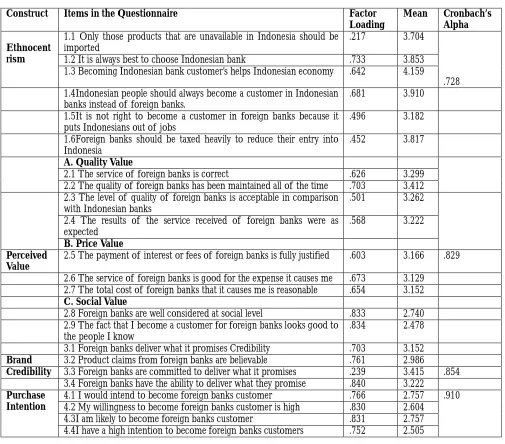
For the purpose of studying the factor structure, exploratory factor analysis (EFA) was conducted. Out of 23 items, 4 items had factor loading less than .50. They are ethnocentrism 1.1, ethnocentrism 1.5, ethnocentrism 1.6 and brand credibility 3.3 (Table 1). Following Hair et al. (2006), they need to be eliminated for further statistical analysis.
Table 1: Exploratory Factor Analysis and Inferential Statistics
Construct Items in the Questionnaire Factor
Loading
Mean Cronbach’s
Alpha
Ethnocent rism
1.1 Only those products that are unavailable in Indonesia should be imported
.217 3.704
.728
1.2 It is always best to choose Indonesian bank .733 3.853
1.3 Becoming Indonesian bank customer’s helps Indonesian economy .642 4.159
1.4Indonesian people should always become a customer in Indonesian banks instead of foreign banks.
.681 3.910
1.5It is not right to become a customer in foreign banks because it puts Indonesians out of jobs
.496 3.182
1.6Foreign banks should be taxed heavily to reduce their entry into Indonesia
.452 3.817
A. Quality Value
2.1 The service of foreign banks is correct .626 3.299
2.2 The quality of foreign banks has been maintained all of the time .703 3.412
2.3 The level of quality of foreign banks is acceptable in comparison with Indonesian banks
.501 3.262
2.4 The results of the service received of foreign banks were as expected
.568 3.222
B. Price Value Perceived
Value
2.5 The payment of interest or fees of foreign banks is fully justified .603 3.166 .829
2.6 The service of foreign banks is good for the expense it causes me .673 3.129
2.7 The total cost of foreign banks that it causes me is reasonable .654 3.152
C. Social Value
2.8 Foreign banks are well considered at social level .833 2.740
2.9 The fact that I become a customer for foreign banks looks good to the people I know
.834 2.478
3.1 Foreign banks deliver what it promises Credibility .703 3.152
Brand 3.2 Product claims from foreign banks are believable .761 2.986
Credibility 3.3 Foreign banks are committed to deliver what it promises .239 3.415 .854
3.4 Foreign banks have the ability to deliver what they promise .840 3.222
Purchase Intention
4.1 I would intend to become foreign banks customer .766 2.757 .910
4.2 My willingness to become foreign banks customer is high .830 2.604
4.3I am likely to become foreign banks customer .831 2.757
4.4I have a high intention to become foreign banks customers .752 2.505
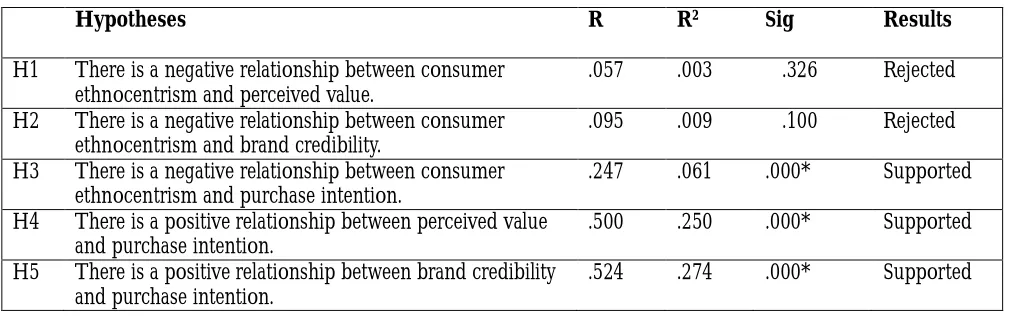
As H1 stated that there is a negative relationship between consumer ethnocentrism and perceived value, it has been demonstrated that the significance level is only .326. In other words, it is not statistically significant. Therefore, H1 is rejected. Similarly, H2 posited that there is a negative relationship between consumer ethnocentrism and brand credibility has significance value at .100. It causes not statistically significant. Consequently, H2 is rejected.
Finally, the findings also support the hypothesis that brand credibility influences purchase intention (H5). It has been found that there is a very strong signifance value at .000 with correlation at 52.4% (R) and 27.4% (R²) of purchase intention was explained by brand credibility.
In sum, Table 2 indicates that H1 and H2 were rejected, whereas H3, H4 and H5 were supported with statistically significant well above the conventional 95% confidence level.
Table 2. Results of Model Tests
Hypotheses R R² Sig Results
H1 There is a negative relationship between consumer ethnocentrism and perceived value.
.057 .003 .326 Rejected H2 There is a negative relationship between consumer
ethnocentrism and brand credibility.
.095 .009 .100 Rejected H3 There is a negative relationship between consumer
ethnocentrism and purchase intention.
.247 .061 .000* Supported
H4 There is a positive relationship between perceived value and purchase intention.
.500 .250 .000* Supported
H5 There is a positive relationship between brand credibility and purchase intention.
.524 .274 .000* Supported
Notes: * significant at .01
6. Discussion and Conclusion
Results reveal that consumer ethnocentrism is not significantly impacts perceived value; consumer ethnocentrism also found not significantly affects brand credibility; consumer ethnocentrism found to be significantly affect purchase intention; perceived value significantly impacts purchase intention; brand credibility found to be affects purchase intention. These findings offer new insights for both research and managerial implications.
First, ethnocentrism was not found affects perceived value and brand credibility. This is on the contrary from previous studies (e.g. Kaynak & Kara, 2002; Klein et al., 1998; Tong & Li, 2013). The best explanation for this is respondents were fall into low-ethnocentric consumers who evaluate foreign bank based on more permissive and tolerable for foreign products (Shimp & Sharma, 1987). However, purchase intention was not affected by consumer ethnocentrism. This is in accordance with previous study that ethnocentrism has a negative response toward foreign product (Nijssen & Van Herk, 2009), therefore ethnocentric consumers do not have any intention for establishing relationship or engage with foreign bank one way or another.
Second, not suprisingly, purchase intention was affected by both perceived value dan brand credibility but not by consumer ethnocentrism. In other words, consumers were rational when they decided to select a foreign bank.
7. Limitations and Future Research
These limitations suggest directions for future research. First, one limitation is that the current study only based on cross-sectional data. Therefore, longitudinal studies would be sufficient for future research.
Secondly, as the competition is very fierce banking industry, customers were also considered for advertisement, country of origin and personalised services. Therefore, future study may include those considerations.
Finally, caution should be noted in generalizing the results across all industries. Therefore, it is recommended that empirical research in various customer segments and industries are needed to further understand consumer ethnocentrism in these different contexts.
References
Balabanis, G., & Diamantopoulos, A. (2004). Domestic country bias, country-of-origin effects, and consumer ethnocentrism: a multidimensional unfolding approach. Journal of Academy of Marketing Science, 32(1), 80-95.
Bandyopadhyay, S., Reese, J., & Reese, S. (2014). Country-of-origin perceptions, consumer ethnocentrism, and product evaluations in the Indian market. International Journal of Business and Social Science, 5(9), 21-30.
BankIndonesia.(2013). Indonesian banking statistics (Vol. 11/8, pp. 70). Jakarta: Bank Indonesia.
Bolton, R. N., & Drew, J. H. (1991).A longitudinal analysis of the impact of changes on customer attitudes. Jounal of Marketing, 55(1), 1-10.
Chao, P. (2001). The moderating effects of country of assembly, country of parts, and country of design on hybrid product evaluations. Journal of Advertising, 30(4), 67-81.
Chryssochoidis, G., Krystallis, A., & Pereas, P. (2007). Ethnocentric beliefss and country-of-origin (COO effect: impact of country, product and product atributes on Greek consumers' evaluation of food products. European Journal of Marketing, 41(11/12), 1518-1544.
Chung, J.-E., & Pysarchik, D. T. (2000). A model of behavioral intention to buy domestic versus imported products in Confusian culture. Marketing Intelligence & Planning, 18(5), 281-291.
DeVellis, R. F. (2003). Scale development: Theory and applications (2nd ed.). California: Sage Publications.
Dodds, W. B., Monroe, K. B., & Grewal, D. (1991). The effect of price, brand and store information on buyers product evaluations. Journal of Marketing Research, 28(August), 307-312.
Erdem, T., &Swait, J. (2004).Brand credibility, brand consideration and choice. Journal of Consumer Research, 31(1), 191-199.
Erdem, T., Swait, J., & Louviere, J. (2002).The impact of brand credibility on consumer price sensitivity. International Journal of Research in Marketing, 19(1), 1-19.
Fetscherin, M., &Toncar, M. (2010). The effects of the country of brand and the country of manufacturing of automobiles: an experimental study of consumers' brand personality perceptions. International Marketing Review, 27(2), 164-178.
Fombrun, C. J. (1996). Reputation: realizing value from the corporate image. Boston, MA: Harvard Business School Press.
Hair, J. F., Black, W. C., Babin, B. J., & Anderson, J. C. (2006). Multivariate data analysis (6th ed.). London: Prentice-Hall.
Hamin, & Elliot, G. (2006).A less-developed country perspectives of consumer ethnocentrism and "country of origin" effects: Indonesia evidence. Asia Pacific Journal of Marketing and Logistics, 18(2), 79-92.
Han, C. M. (1989). Country image: halo or summary construct? Journal of Marketing Research, 26(May), 222-229. Hui, M., & Zhou, L. (2003). Country-of-manufacture effects for known brands. European Journal of Marketing,
37(1/2), 133-153.
Javalgi, R. G., Khare, V. P., Gross, A. C., & Scherer, R. F. (2005). An application of the consumer ethnocentrism model to French consumers. International Business Review, 14(3), 325-344.
Klein, J. G., Ettenson, R., & Krishnan, B. C. (2006). Extending the construct of consumer ethnocentrism: when foreign products are preferred. International Marketing Review, 23(3), 304-321.
Klein, J. G., Ettenson, R., & Morris, M. D. (1998). The animosity model of foreign product purchase: an empirical test in the People's Republic of China. Journal of Marketing, 62(1), 89-100.
Lafferty, B. A., Goldsmith, R. E., & Newell, S. J. (2002). The dual credibility model: the influence of corporate and endorser credibility on attitudes an purchase intentions. Journal of Marketing Theory and Practice, 10(3), 1-12. Lampert, S. I., & Jaffe, E. D. (1998).A dynamic approach to country-of-origin effect. European Journal of Marketing,
32(1/2), 61-78.
Li, Y., Wang, X., & Yang, Z. (2011). The effects of corporate-brand credibility, perceived corporate-brand origin, and self-image congruence on purchase intention: evidence from China's auto industry. Journal of Global Marketing, 24(1), 58-68.
Lovelock, C. (1991). Services marketing, text, cases and readings. Englewood Cliffs, NJ: Prentice-Hall. Marple, M., & Zimmerman, M. (1999).A customer retention strategy. Mortgage Banking, 59(11), 45-49.
Nijssen, E. J., & Van Herk, H. (2009).Conjoining international marketing and relationship marketing: exploring consumers' cross-border service relationships. Journal of International Marketing, 17(1), 91-115.
Orth, U., & Firbasova, Z. (2003).The role of consumer ethnocentrism in food product evaluation. Agribusiness, 19(2), 137-153.
Roig, J. C. F., Garcia, J. S., Tena, M. A. M., & Monzonis, J. L. (2006). Customer perceived value in banking services. International Journal of Bank Marketing, 24(5), 266-283.
Sanchez, J., Callarisa, L. L. J., Rodriguez, R. M., & Moliner, M. A. (2006).Perceived value of the purchase of a tourism board. Tourism Management, 27(3), 437-452.
Seidenfuss, K.-U., Kathwala, Y., &Dinnie, K. (2013). Regional and country ethnocentrism: broadening ASEAN origin perspectives. Asia Pacific Journal of Marketing and Logistics, 25(2), 298-320.
Shimp, T. A., & Sharma, S. (1987). Consumer ethnocentrism: construction and validation of the CETSCALE. Journal of Marketing Research, 14(8), 280-289.
Swartz, T. A., &Iacobucci, D. (2000).Handbook of services marketing and management. Thousand Oaks: Sage Publications.
Tajfel, H., & Turner, J. C. (1986).The social identity theory of intergroup behaviour. In S. Worchel & W. G. Austin (Eds.), Psychology of Intergroup Relations (pp. 7-24). Nelson-Hall, Chicago, IL.
Tong, X., & Li, C. (2013).Impact of brand personality and consumer ethnocentrism in China's sportswear market.Asia Pacific Journal of Marketing and Logistics, 25(3), 2013.
Zhou, L., & Hui, M. K. (2003).Symbolic value of foreign products in the People's Republic of China. Journal of International Marketing, 11(2), 36-58.
Zhou, N., & Belk, R. W. (2004).Chinese consumer readings of global and local advertising appeals. Journal of Advertising, 33(3), 63-76.