Research Paper: The Effect of Phonological Awareness on
the Auditory Memory in Students With Spelling Problems
Fereshteh Baezzat1*, Mahmood Moradi2, Mahshad Motaghedifard1
1. Department of Psychology, Faculty of Humanities and Social Sciences, University of Mazandaran, Babolsar, Iran.
2. Department of English Language and Literature, Faculty of Humanities and Social Sciences, University of Mazandaran, Babolsar, Iran.
* Corresponding Author:
Fereshteh Baezzat, PhD
Address: Department of Psychology, Faculty of Humanities and Social Sciences, University of Mazandaran, Babolsar, Iran. Tel: +98 (910) 3103242
Objectives: In this research study, the effect of training phonological awareness skills on the improvement of auditory memory in students with spelling problems in third grade at primary schools in Sari City, Iran, was investigated.
Methods: The research method used in the study was quasi-experimental with pre-tests, post-tests, and a control group. The statistical population consisted of all the students from third grade at primary schools in Sari. The study sample was chosen based on purposive sampling and random sampling methods. First the teachers were asked to introduce students with spelling problems, out of whom 20 students were selected through three diagnostic tests: Wechsler intelligence test for children (2006), Baezzat writing disorder test (2010), and Cornoldi test of verbal memory (1995). These students were then randomly assigned to two groups: experimental and control groups. The experimental group received phonological awareness skills training in 13 sessions but the control group did not receive any intervention.
Results: The data were analyzed by Mixed ANOVA (Analysis of Variance) with repeated measures. The results indicated that there was a significant difference between the experimental and the control group’s scores (F=171.12, P=0.001), indicating that phonological awareness training improved the auditory memory of students with spelling problems. Follow up tests showed that the effect of phonological awareness training was sustained after three months’ duration.
Discussion: This study recommends that learning disorder experts and psychologists train phonological awareness skills in order to improve the auditory memory of students with spelling problems.
A B S T R A C T
Article info:Received: 21 Jun. 2017 Accepted:09 Oct. 2017
Keywords:
Phonological awareness, Spelling problems, Auditory memory
Citation: Baezzat F, Moradi M, Motaghedifard M. The Effect of Phonological Awareness on the Auditory Memory in Stu-dents With Spelling Problems. Iranian Rehabilitation Journal. 2018; 16(1):83-90. https://doi.org/10.29252/NRIP.IRJ.16.1.83
:
: https://doi.org/10.29252/NRIP.IRJ.16.1.83
Use your device to scan
1. Introduction
ecently, researchers are increasingly in-trigued by the role of memory in academic and social learning in schools. Many stud-ies have shown that memory failure is linked with difficulties in reading, writing, spelling, and phonology [1]. Therefore, the relationship between learning and memory is inevitable in a way that learning ability is totally related to memory. The effects of a learning experience need to be retained so that accu-mulation of these experiences leads to learning. If a child has problems recognizing or recalling auditory, visual, or tactile information, his/her performance and learning will be affected by new problems in any assignments that require processing in one or more of these areas [2].
Auditory memory is the ability to save and recall what was heard. Even with a sound sense of hearing, students with an impaired auditory memory are likely to have problems answering questions related to se-quential events in a story, missing the first or the final sounds of words when writing the spelling of the words, remembering teacher’s oral instructions, distinguishing between sounds they already heard, matching meanings with words, learning names of objects, learning math-ematical concepts and calculations, and following in-structions [3].
Auditory perception is directly related to auditory memory, i.e. a process of organizing and interpreting auditory information. Problems in auditory perception do not affect what is heard through the ears but involve the way the information is interpreted and processed by the brain. A hearing disorder may directly influence lan-guage and the speech process, but problems in auditory perception may affect all areas of learning particularly reading and writing [3]. Studies on memory processes also indicate that teachers consider them related to the students’ daily performances and state that they have numerous problems concerning assignments which in-volve memory [4].
According to researchers, one of the main reasons for such children having problems in memory-related assignments is that, unlike their normal peers, they do not use meta-cog-nitive strategies. Another cause of poor auditory memory might be poor language skills which make verbal memo-rization difficult. Weakness in using meta-cognitive strat-egies in memory-related assignments means that children with spelling problems suffer from problems in the meta-cognitive domain in general [5-8].
Given that one of the main problems in children with spelling problems is a failure of auditory memory, the importance of effective teaching methods consisting of phonological awareness is more evident than ever be-fore. Phonological awareness is a kind of meta-cognitive ability in using the phonological system which requires informed thinking. It includes the ability to comprehend and change spoken units of language, i.e., phonemes, and awareness of larger units such as syllables and syl-lable codas [5-7]. When children are able to identify words, syllable divisions, and the sounds of letters and can match a letter with the sound, they have the ability to write. Awareness of the sounds helps children to cat-egorize oral words and then write them. When writing or spelling words, children rely on the relationship between letters and sounds and the phonological codes. In addi-tion to phonological awareness, phonological analysis skills in the identification and use of unfamiliar words are considered essential for reading and writing [7].
Thus, phonological awareness training can have a great impact on reading, writing, and memory. Phonologi-cal awareness is referred to as an individual’s ability to recognize, distinguish, and manipulate spoken language phonemes without considering the size of the word unit and its meaning. Phonological awareness skills include identification of syllables, rhymes, phonemes, and ana-logical skills. Most researchers who work in the area of phonological skills focus on the awareness of phonemes, syllables, and syllable chains as separate units of phono-logical awareness skills [9].
Research data show that phonological awareness of syllables takes place earlier than intra-syllable units and phonemes [10]. Concerning the sequential develop-ment of phonological awareness, researchers state that it starts with an awareness of syllables and goes on to an awareness of intra-syllable units (syllable onsets and rhymes). The ability to divide words hierarchically into individual phonemes, which cannot be attained before the first grade of primary school, is achieved at the end of the development [11]. Schaefer et al. [11] also state that counting syllables is easier than counting phonemes as syllables are the basic units of speech production and their detection is also easier during speech. In contrast, phonemes are influenced by the coordination in the pro-duction of words and are, therefore, harder for children to be aware of them. Regarding the stages of phonologi-cal awareness development, Stackhouse and Wells [12] assert that 50 percent of children at the age of four can divide words into syllables and count them, which at the age of five reaches 90 percent.
In the various phonological awareness skills research studies performed on growing children in Iran, only the three skills consisting of syllable identification, division of words into syllables, and combination of syllables were examined in children aged five to six. In these stud-ies, the children achieved high scores (90%) in the syl-lable awareness skills. However, despite the fact that the children demonstrated a good ability in the three above skills, if syllable awareness skills had been measured by different assignments such as syllable deletion, they might have demonstrated a lower ability because of the more complexity of syllable awareness skills [10].
Considering that some children with spelling problems have inadequate auditory memory, identification of these factors can prove effective in planning preventive mea-sures for primary school students. One of the factors af-fecting the auditory memory of primary school students with spelling problems is phonological awareness. An individual enjoying phonological awareness has the abil-ity to remember and substitute the constituting units of a phrase, i.e. words, syllables, and sounds, irrespective of the meaning of the words. Such abilities are essential for spelling. It is believed that children with spelling prob-lems have difficulties in phonological encoding, i.e., the process of transforming the letter chains into phonemes. Before a child starts writing in a dictation, she/he should be able to segment a word into its constituting sounds and use appropriate letters for writing those sounds, and in reading they should have the ability to decode the sounds of the written letters [12].
Most studies on phonological awareness in Iran inves-tigated the effect of teaching reading on phonological awareness and its development [13]. However, these stud-ies have not examined the role of teaching phonological awareness strategies in the improvement of the auditory memory in children with spelling problems. Moreover, the results from clinical observations of primary schools in Iran indicate that some students have significant prob-lems in spelling. These students are not usually able to spell words or combine letters to make words. They usu-ally make mistakes in their listening comprehension of some words. They may also leave out prefixes or suffixes in dictations, which may be due to their inadequate audi-tory memory [14]. Given this research gap, undertaking a study which investigates the effect of teaching phonologi-cal awareness on the auditory memory of students with spelling problems is inevitable. The hypotheses in this research, therefore, are expressed as follows:
Phonological awareness training package improves the auditory memory in students with spelling problems. The
effect of phonological awareness training package on stu-dents with spelling problems is stable after three months.
2. Methods
The method used in this study was quasi-experimental with a pre-test, a post-test, and a control group.
Statistical population, sample, and sampling method
The statistical population of this study consisted of all the students with spelling problems studying in the third grade in the primary schools of Sari during the aca-demic year 2013- 2014. Based on purposive sampling, they were sampled first by asking the teachers to intro-duce students with spelling problems. Then, 20 of them were chosen using diagnostic tests of spelling and verbal memory. These students were then randomly divided into two groups, one experimental and one control group with 10 students in each group. The experimental group was subjected to phonological awareness training but the control group did not receive any intervention.
Instruments
Three instruments were used in this study: a revised version of the Wechsler intelligence test for children [15] to measure the IQ of the students, Cornoldi test of verbal memory [16] to measure auditory memory, and Baezzat writing disorder test [17] to diagnose spelling problems. Each of these instruments is explained below.
Wechsler Intelligence Test for Children
A revised version of Wechsler intelligence test for chil-dren was used to measure the IQ of the students with spelling problems. This test was originally developed in 1945 by Wechsler. It was translated into Persian, adapt-ed, and standardized by Shahim [15] for children aged 6-13 in Shiraz, Fars Province, Iran. Shahim’s study re-ported a reliability of 44-99%. The test includes two ma-jor subtests of verbal intelligence (including the minor subtests of information, similarities, arithmetic, vocabu-lary, comprehension, and digit span) and nonverbal intel-ligence (including picture completion, picture arrange-ment, block design, object assembly, coding, mazes, and symbol search).
Cornoldi Test of Verbal Memory
and abstract words that were given to the students. The test has 9 trials (plus a practice trial). There were 3 trials for each of either 4, 6 or 8 drawings of familiar objects (e.g. a dress, a cake, a castle, a pig, etc.) located on a 4×4 matrix. For each trial, the examiner first asked the child whether all the pictures were clear and then invited him/ her to observe the matrix for 100 s, memorizing both the pictures and their positions. When a picture was unclear, it was explained by the experimenter. The matrix was then removed and the children had to recall the names of the pictures and to show their positions. When the chil-dren were unable to recall both pieces of information, they were asked to give either the positions or the names. As discussed in the "Introduction," we calculated a ver-bal score represented based on the number of perfectly remembered pictures (each verbal response referable to the pictures was considered valid). The reliability of the
test using the Cronbach alpha was 0.81,which is appro-priate compared to similar studies [16].
Baezzat Writing Disorder Test
A writing disorder (spelling component) test developed and validated by Baezzat [17] was used to diagnose the spelling problems in the third grade students. The most common clinical symptoms of spelling problems include adding, removing, replacing and moving letters in the word, overwriting, symmetry, grammatical errors, and other errors [18]. Therefore, these clinical symptoms were considered as the criteria for the determination of student spelling error types. Criterion-referenced meth-od was used to determine the validity of the test. The criterion used for calculating the validity coefficient was the students’ mean scores on reading and spelling. The results showed that there were significant negative
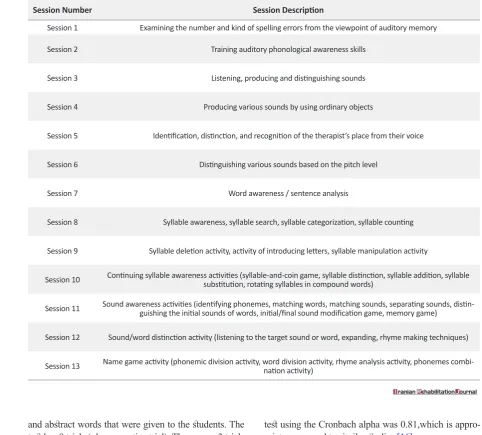
cor-Table 1. The training sessions of the phonological awareness package
Session Number Session Description
Session 1 Examining the number and kind of spelling errors from the viewpoint of auditory memory
Session 2 Training auditory phonological awareness skills
Session 3 Listening, producing and distinguishing sounds
Session 4 Producing various sounds by using ordinary objects
Session 5 Identification, distinction, and recognition of the therapist’s place from their voice
Session 6 Distinguishing various sounds based on the pitch level
Session 7 Word awareness / sentence analysis
Session 8 Syllable awareness, syllable search, syllable categorization, syllable counting
Session 9 Syllable deletion activity, activity of introducing letters, syllable manipulation activity
Session 10 Continuing syllable awareness activities (syllable-and-coin game, syllable distinction, syllable addition, syllable substitution, rotating syllables in compound words)
Session 11 Sound awareness activities (identifying phonemes, matching words, matching sounds, separating sounds, distin-guishing the initial sounds of words, initial/final sound modification game, memory game)
Session 12 Sound/word distinction activity (listening to the target sound or word, expanding, rhyme making techniques)
relations at P<0.01 between the sub-test errors (letters, words, sentences, and the total) and the scores of reading and spelling. The correlation between the reading scores and the total test errors was -0.58 (r=-0.58) and the corre-lation between the spelling scores and the total test errors was -0.59 (r=-0.59). Therefore, the results indicated that the writing disorder test was sufficiently valid to measure the third grade students’ spelling problems adequately.
Administration of the instruments
After administering the verbal memory pre-test to the experimental and control groups, the experimental group received phonological awareness skills training while the control group did not receive any training. Following the training, the verbal memory post-test was given to both groups. Follow-up tests were also given to both groups three months after the training to examine whether the effects of the training were maintained. The data were analyzed using repeated measures analysis of variance.
Training through the phonological awareness package
The phonological awareness training package was de-veloped based on the meta-cognitive perspective and in-cludes thirteen training sessions. The overall framework of this package was adapted from a phonological aware-ness training program [19]. The contents of the program were adjusted based on the features of the Persian
lan-guage by Baezzat et al. [14]. The training sessions of the package are presented in Table 1.
3. Results
Mixed Repeated Measures ANOVA with LSD (Least Significant Difference) Post Hoc Test was used to ana-lyze the data. The results in Table 2 show that the mean scores of the auditory memory tests given to the ex-perimental group increased from 7.1 in the pre-test, to 13.8 in the post-test, and to 12.60 in the follow-up test (P<0.01). However, no differences were observed in the mean scores of the control group.
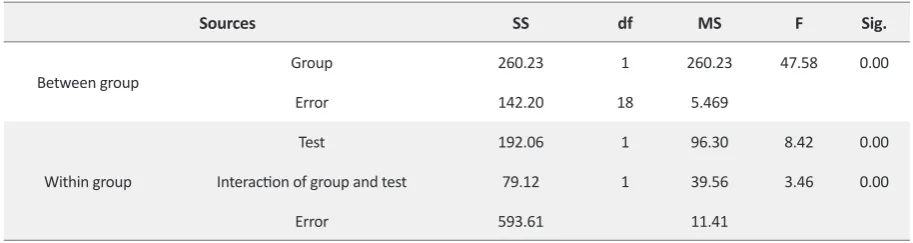
Using mixed analysis of variance with repeated mea-surements, we analyzed the effect of teaching phono-logical awareness strategies on the improvement of the auditory memory in third grade students with spelling problems. The results show that the main effect as well as the interaction effect of group and test are significant at a P<0.001 (Table 3). Therefore, phonological aware-ness training led to a significant improvement of the au-ditory memory of the experimental group compared to that of the control group.
Analysis of the main effects
Since the interaction effect of the test and group was significant at P<0.001 level, simple main effects were
Table 2. The mean scores of the auditory memory test
SD M
Test Group
2.18 7.10
Pre-test
Experiment group Post-test 13.80 3.39
3.68 12.60
Follow up
1.52 6.90
Pre-test
Control group Post-test 7.30 1.96
1.95 8.30
Follow up
Table 3. The effects of group and test on the auditory memory using mixed ANOVA
Sig. F
MS df
SS Sources
0.00 47.58
260.23 1
260.23 Group
Between group
5.469 18
142.20 Error
0.00 8.42
96.30 1
192.06 Test
Within group Interaction of group and test 79.12 1 39.56 3.46 0.00
11.41 593.61
tested, i.e., the effect of the test on each group was tested separately through the One-Way repeated measurements ANOVA. The results in Table 4 indicate a significant dif-ference of the main effect of the test for the experimen-tal group at P<0.001. This means that there was a signifi-cant difference between the mean scores of the pre-test, post-test, and the follow-up test. However, there was no significant difference between the mean scores of the control group. In other words, the results indicated that phonological awareness training contributed to the sig-nificant development of the auditory memory of the ex-perimental group compared to that of the control group.
Table 5 shows that all the four F figures (171.12) are significant at P<0.001. This indicates that teaching pho-nological awareness skills significantly improved the
auditory memory of the experimental group compared to the control group.
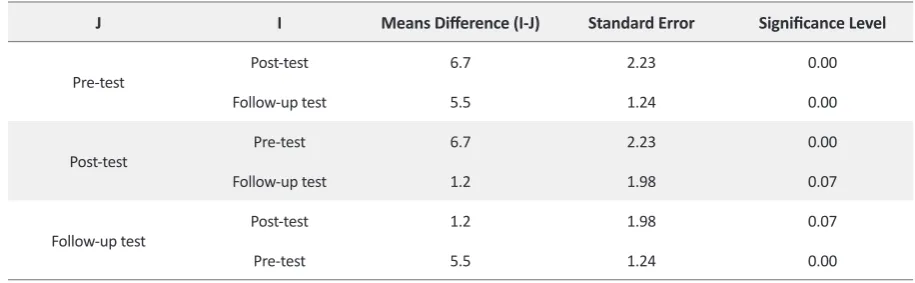
As the overall significance value only indicated that there was a significant difference somewhere among the groups, it was necessary to a run post hoc test to exam-ine which group was significantly different from which other group. In other words, each pair of the groups was examined through the post hoc test (using LSD) for pos-sible differences in their mean scores.
The results in Table 6 show that there is a significant difference between the pre-test and the post-test and be-tween the pre-test and the follow-up test, but there is no significant difference between the post-test and the fol-low-up test. In other words, the results of the post hoc test
Table 4. The effects of test on the auditory memory
Sig. F
MS df
SS Source
Group
0.00 31.81
276.12 1
276.12 Test
Experimental group
8.68 18
156.23 Error
0.95 0.71
15.02 1
15.02 Test
Control group
21.12 1
21.12 Error
Table 5. The F results of repeated measurements concerning the auditory memory
Sig. F
df2 df1
F
Value
Source
0.00 31.81
17 2
171.12 0.95
Pillai
0.00 17
2 171.12
0.04 Wilkes
0.00 17
2 171.12
20.13 Hotling
0.00 0.71
17 2
171.12 20.13
Ray max.root
Table 6. Post hoc test of the mean scores of the auditory memory pre-test, post-test and follow-up test
J I Means Difference (I-J) Standard Error Significance Level
Pre-test Post-test 6.7 2.23 0.00
Follow-up test 5.5 1.24 0.00
Post-test Pre-test 6.7 2.23 0.00
Follow-up test 1.2 1.98 0.07
Follow-up test Post-test 1.2 1.98 0.07
showed that the phonological awareness training caused the experimental group’s auditory memory to be retained after three months compared to the control group.
In summary, the statistical results showed that the pho-nological awareness training package improved the au-ditory memory in students with spelling problems. The package also helped the effect of the therapy to be main-tained in the students after three months.
4. Discussion
Since deficiency in auditory memory is one of the main problems among children with spelling problems, this study examined the effect of phonological awareness training package on improving the auditory memory in third grade primary school students with spelling prob-lems in Sari. The results of the study indicate that training in phonological awareness strategies caused a significant improvement in the auditory memory of the experimen-tal group compared to the control group. The results also showed that the effect of phonological awareness training was sustained in the auditory memory of the students. Therefore, it can be concluded that providing training in the strategies related to phonological aware-ness improves the auditory memory in students with spelling problems. In a highly steady orthography where each letter represents its own phoneme, learning to store and recalling names of concrete visual objects play a crucial role in both development of phonemic awareness and reading.. The findings of this study confirm the re-sults obtained by others [5, 6, 20-22], thus emphasizing a strong relationship between phonological awareness, memory, and dictation.
According to these researchers, phonological aware-ness is a meta-cognitive ability in using the phonological system which involves conscious thinking. In fact, pho-nological awareness is the ability to recognize sounds in words and is an essential skill for spelling and dictation. When children can identify words, syllables, and sounds and can make a connection between letters and sounds, they are able to write. Awareness of sounds helps them categorize orally delivered words and then write them. When children write or spell a word, they rely on the relationship between letters and sounds or phonologi-cal codes [9]. In addition to this awareness of sounds, sound segmentation skills are essential for identifying and using unfamiliar words, for reading and writing a word, and for decoding and remembering a word [23]. Thus, the training package used in this study developed the phonological awareness, and as a result, the auditory memory of the students with spelling problems via
rais-ing their awareness of letters, sounds, syllables, relation-ship between letters and sounds, identification of initial, middle, and final sounds of words, sound combination and manipulation, etc.
Therefore, phonological awareness skills are essential for dictation process and memory and are the best pre-dictors of writing skills and auditory memory. Phono-logical awareness requires that students be able to divide words into syllables and make a connection between letters and sounds so as to acquire oral language skills. Phonological awareness is not established by itself but requires other cognitive skills as well. These skills usual-ly emerge at the age of 5 or 6 when children begin school [24]. Sound awareness helps children to classify words coming from the speech and then write them.
Nakeva et al. [22] argued that children with difficul-ties with the phonological representation task were older when diagnosed and had an older age at amplification. Further, these children displayed broader cognitive dif-ficulties, suggesting that reduced access to auditory stimulation may have wide-ranging effects on cognitive development.
5. Conclusion
Learning disorder experts and psychologists can help develop the auditory memory of students with spelling problems by teaching phonological awareness strategies.
Acknowledgments
Authors wish to express their gratitude to faculty of hu-manities and social sciences, university of Mazandaran for supporting this project.
Conflict of Interest
The authors declared no conflicts of interest.
References
[1] Cohen RL, Netley C, Clarke MA. On the General-ity of the short-term memory-reading abilGeneral-ity relationship. Journal of Learning Disabilities. 1984; 17(4):218–21. doi: 10.1177/002221948401700406
[3] Lerner JW, Johns B. Learning disabilities and related disabil-ities: Strategies for success. Belmont, California: Wadsworth Publishing; 2014.
[4] Hallahan DP, Lloyd JW, Kauffman JM, Weiss M, Martinez EA. Learning disabilities: Foundations, characteristics, and ef-fective teaching. London: Pearson; 2004.
[5] Sinha A, Rout N. Auditory perception of non-sense and fa-miliar Bengali rhyming words in children with and without SLD. International Journal of Pediatric Otorhinolaryngology. 2015; 79(12):2300–7. doi: 10.1016/j.ijporl.2015.10.032
[6] Boets B, Wouters J, van Wieringen A, Ghesquière P. Audi-tory processing, speech perception and phonological ability in pre-school children at high-risk for dyslexia: A longitudinal study of the auditory temporal processing theory. Neuropsy-chologia. 2007; 45(8):1608–20. doi: 10.1016/j.neuropsycholo-gia.2007.01.009
[7] Maehler C, Schuchardt K. Working memory in children with specific learning disorders and/or attention deficits. Learning and Individual Differences. 2016; 49:341–7. doi: 10.1016/j.lin-dif.2016.05.007
[8] Snowling MJ, Hulme C. Annual Research Review: The nature and classification of reading disorders - a commen-tary on proposals for DSM-5. Journal of Child Psychol-ogy and Psychiatry. 2011; 53(5):593–607. doi: 10.1111/j.1469-7610.2011.02495.x
[9] Goswami U, Bryant P. Phonological skills and learning to read. New York: Wiley Online Library; 1990.
[10] Treiman R, Zukowski A. Children's sensitivity to syllables, onsets, rimes, and phonemes. Journal of Experimental Child Psychology 1996; 61(3):193-215. doi: 10.1006/jecp.1996.0014
[11] Schaefer B, Fricke S, Szczerbinski M, Fox-Boyer AV, Stack-house J, Wells B. Development of a test battery for assess-ing phonological awareness in German-speakassess-ing children. Clinical Linguistics & Phonetics. 2009; 23(6):404–30. doi: 10.1080/02699200902770187
[12] Stackhouse J, Wells B. Children's speech and literacy diffi-culties: A psycholinguistic framework. Hoboken, New Jersey: John Wiley & Sons; 1997.
[13] Mostaghimzadeh E, Soleimani Z. [The effect of phonologi-cal awareness training on reading skills of mentally retarded second grade primary schoolgirls (Persian)]. Advances in Cognitive Science. 2005; 7(2):22-8.
[14] Baezzat F, Farrokhnia M, Hoseini Z, Yazdandost R, Samimi A. [Phonemic awareness training package (Persian)]. Tehran: Special Learning Disabilities Center in Shahid Beheshti Uni-versity; 2008.
[15] Shahim S. [Revised scale IQ and Kessler for Children, ad-aptation and standardization (Persian)]. 4th edition. Shiraz: Shiraz University Press; 2006.
[16] Cornoldi C, Vecchia RD, Tressoldi PE. Visuo-spatial work-ing memory limitations in low visuo-spatial high verbal intel-ligence children. Journal of Child Psychology and Psychiatry. 1995; 36(6):1053–64. doi: 10.1111/j.1469-7610.1995.tb01350.x
[17] Baezzat F. [Construction, validity and reliability of test of written expression disorder (spelling components) in primary school students of 3nd to 5rd grade in Tehran (Persian)]. Final
report of research project. Tehran: Shahid Beheshti University Research Deputy; 2010.
[18] Graham S, Harris K. Writing better: Effective strategies for teaching students with learning difficulties. Baltimore, Mary-land: Brookes Publishing; 2005.
[19] Virginia Department of Education. Ideas and activities for developing phonological awareness skills. Virginia: Virginia Department of Education; 1998.
[20] Lazard DS, Lee HJ, Gaebler M, Kell CA, Truy E, Giraud AL. Phonological processing in post-lingual deafness and cochlear implant outcome. NeuroImage. 2010; 49(4):3443–51. doi: 10.1016/j.neuroimage.2009.11.013
[21] Weisi F, Rezaei M, Lotfi G, Valadbeigi A. [Comparison of Phonological Awareness between children with cochlear implants and children with hearing aids (Persian)]. Pajouhan Scientific Journal. 2013; 11(2):35-8.
[22] Nakeva von Mentzer C, Lyxell B, Sahlén B, Dahlström O, Lindgren M, Ors M, et al. The phonics approach in Swedish children using cochlear implants or hearing aids: inspecting phonological gain. Journal of Communication Disorders, Deaf Studies & Hearing Aids. 2014; 2(3):117. doi: 10.4172/2375-4427.1000117
[23] Gillon GT. Phonological awareness: From research to prac-tice. New York: Guilford Press; 2007.