VOLUME 41, ARTICLE 19, PAGES 545
-
578
PUBLISHED 21 AUGUST 2019
https://www.demographic-research.org/Volumes/Vol41/19/ DOI: 10.4054/DemRes.2019.41.19
Research Article
Economic rationales for kin marriage:
Assessing the evidence using Egyptian panel data
Rania Salem
Sarah Shah
© 2019 Rania Salem & Sarah Shah.
This open-access work is published under the terms of the Creative Commons Attribution 3.0 Germany (CC BY 3.0 DE), which permits use, reproduction, and distribution in any medium, provided the original author(s) and source are given credit.
1 Introduction 546
2 Background 547
2.1 Defining kin marriage 547
2.2 Correlates of kin marriage in the MENA 547
2.3 Rationales for kin marriage in the MENA and beyond 548
2.4 The Egyptian case 551
2.5 Summary and hypotheses 553
3 Data and methods 554
3.1 Data 554
3.2 Sample 554
3.3 Analyses 554
3.4 Variables 556
3.4.1 Focal kin marriage variable 558
3.4.2 Hypothesized predictors of kin marriage 558
3.4.3 Hypothesized outcomes of kin marriage 559
3.4.4 Control variables 560
4 Results 561
4.1 Univariate results 561
4.2 Multiple regression results 561
5 Discussion and conclusions 569
6 Acknowledgements 573
Economic rationales for kin marriage:
Assessing the evidence using Egyptian panel data
Rania Salem1 Sarah Shah2
Abstract
BACKGROUND
Although kin marriage is widely practiced in the Middle East, its underlying motivations have not been thoroughly tested.
METHODS
We assess evidence for two economic rationales motivating kin unions using a national sample of Egyptians who wed between the 2006 and 2012 waves of the Egypt Labor Market Panel Surveys. The first rationale for kin marriage involves consolidating family property through the marriage of relatives; the second involves avoiding the costly outlays made when nonrelatives wed.
RESULTS
We find that respondents whose natal households owned agricultural land had higher relative risks of marrying a first cousin, and this relationship is significant for the overall sample and for men. Additionally, we find a positive association between value of natal household agricultural enterprise and marriage to a relative for men only. These findings provide limited evidence supporting the first rationale. For the second rationale, we find that women who wed relatives, reported lower bride’s side matrimonial expenditures and lower deferred dower values. However, women who wed first cousins reported higher prompt dower values, indicating mixed support for the second rationale.
CONTRIBUTION
This study uses nationally representative longitudinal data with proper temporal ordering of key variables to statistically test two motivations for kin marriage. This analysis is carried out for Egypt, the most populous country of the world region containing some of the highest rates of kin marriage. Our results call into question two
common assumptions about the economic rationales motivating kin marriage. We offer explanations for these unexpected findings in our conclusions.
1. Introduction
The Middle East and North Africa (MENA) is exceptional among world regions in its high rates of marriage between close relatives (Reilly 2013). Conjugal unions between cousins and other relatives have historically been the preferred form of marriage across the MENA (Casterline and El-Zeini 2003; Sholkamy 2008). The current prevalence of kin marriages is high but varies across the region. Considering figures from the late 1990s, it appears that the prevalence of consanguineous unions ranges from approximately 21% of all marriages in Lebanon (Jurdi and Saxena 2003) and 23% of all marriages in Turkey (Tabutin et al. 2005), to about 65% of all marriages in Sudan (Jurdi and Saxena 2003) and 66% of all marriages in Palestine (Tabutin et al. 2005).
Scholars of family formation in the MENA report that those who practice kin marriage articulate several rationales for this type of conjugal union. Two of these rationales are based on economic considerations. The first economic rationale involves the desire to consolidate family assets and property through the marriage of kin group members. A second economic consideration that promotes kin marriage has to do with the reduced matrimonial expenditures involved in such unions.
2. Background
2.1 Defining kin marriage
Many accounts related to the topic of kin marriage investigate consanguinity specifically. While a consanguineous union technically refers to a marriage between biological relatives, it has typically been operationalized to include unions between first or second cousins (Abbasi-Shavazi, Mcdonald, and Hosseini-Chavoshi 2008). Among consanguineous unions in the MENA, marriage to one’s patrilateral parallel3 first cousin holds a special place (Khuri 1970; Sholkamy 2008). These are marriages between the son and daughter of two brothers, or father’s brother’s daughter/son marriages (FBD/S marriages). In the current study, we are interested in kin endogamy (hereafter, endogamy) more generally; that is, marriage between not only first and second cousins but also more distant kin that may be related to one another biologically or through marriage.
2.2 Correlates of kin marriage in the MENA
The existing literature offers insights into the sociodemographic correlates of kin marriage in the MENA region. Generally, most studies find a negative association between women’s education and kin marriage, although some have documented notable exceptions where more educated women have elevated odds of marrying a relative (Abbasi-Shavazi, Mcdonald, and Hosseini-Chavoshi 2008; Bittles 1994; Harkness and Khaled 2014; Weinreb 2008). Kin marriage is usually inversely associated with wealth and is more common in rural areas (Abbasi-Shavazi, Mcdonald, and Hosseini-Chavoshi 2008; Bittles 1994; Harkness and Khaled 2014). In the MENA, kin marriage is practiced among Arab and non-Arab groups alike, as well as among Muslims, Christians, Jews, and Druze (Bittles 1994; Weinreb 2008).
Although the literature on correlates of kin marriage helps answer the question of who practices kin marriage in the region, the literature does not adequately account for why it is practiced. Some scholars have assumed that the practice of kin marriage is driven and maintained by features that characterize societies prior to modernization, specifically, the selection of spouses based on collective rather than individual interests. Indeed, some scholars have tried to explain why kin marriage persists over time in spite
3
of modernization theory’s prediction that it would diminish with ‘development.’ Modernization theory assumes that as modernization progresses, selection of marriage partners according to individual preferences would replace family selection of mates. This perspective assumes that, if left to make their own choice of marriage partner, male and female marriage candidates will prefer to wed non-kin spouses, whereas marriage partners chosen by family members will tend to be from the kin group. More specifically, Goode (1963; cited in Abbasi-Shavazi, Mcdonald, and Hosseini-Chavoshi 2008) posited that women’s increasing education and labor force participation would cause them to demand more input in the mate selection process, leading to reductions in the practice of endogamy.
In fact, observed kin marriage rates have failed to follow the pattern of rapid decline predicted by modernization theorists. A reduction in rates of certain types of consanguineous marriage have been observed in some countries or communities, while in others, researchers have found that consanguineous marriages continue to occur at the same or higher rates, even in settings where women’s education and Western cultural norms are widespread (Abbasi-Shavazi, Mcdonald, and Hosseini-Chavoshi 2008; Harkness and Khaled 2014; Weinreb 2008). Although this literature offers insights into how the prevalence in kin unions varies with societal changes longitudinally, we contend that the question of the underlying motivations for the practice of kin marriage has not been adequately addressed by the empirical literature.
2.3 Rationales for kin marriage in the MENA and beyond
wealth, assets, and property, it may apply to family-owned economic enterprises as well.
A second economic consideration related to kin marriage is the reduced matrimonial expenditures involved in such unions (Caldwell, Reddy, and Caldwell 1983; Casterline and El-Zeini 2003; Hoodfar 1997; Reilly 2013; Weinreb 2008). In the MENA region, custom dictates that fewer or less costly marriage assets will be exchanged when relatives wed. Marriage costs include expenditures on jewelry, furniture, appliances, housing, celebrations, and, among Muslims, prompt dower4 (or mahr). While the prompt dower is a sum of money that the Muslim groom or his family is obliged to give to the bride in advance of marriage, the deferred dower5 (ormuakhar) is a sum of money promised to the Muslim bride in the event of divorce or the death of the husband, but it is not actually paid unless one of these two events comes to pass. The financial outlays involved in marriage costs are made by the bride and groom and their families and can be quite burdensome (Singerman 2007). When the bride and groom are related, however, existing trust between the families allows them to reduce the financial demands typically expected of each party to the marriage (Reddy 1988; Reilly 2013). Weinreb (2008) adds that prompt dower (mahr) as well as deferred dower (muakhar) are usually lower in consanguineous marriages for two reasons. First, the prompt dower of an exogamous bride is often higher in order to compensate for her low status as an exogamous bride. The endogamous bride has a lower prompt dower that reflects her status as an already highly valued member of the kin group (Weinreb 2008). Second, the deferred dower is lower for endogamous brides. This is because either the marriage is considered more stable (Hussain 1999; also see Saadat 2015 for evidence from Egypt that consanguineous marriages are less likely to end in divorce6) or because it would be easier to extract the deferred dower from a relative (Weinreb 2008).
These two economic rationales for kin marriage have been subjected to limited empirical scrutiny in the MENA and internationally. Using survey data from Egypt, Weinreb (2008) tests the first economic rationale for kin marriage and asks whether women from wealthy families will marry cousins in order to preserve family wealth. He
4 In Egypt, the prompt dower consists of a sum of cash that is given by the Muslim groom or his family to the
bride before marriage (usually at or after engagement). The Muslim bride typically uses this money to purchase household goods, clothing, and other items for her trousseau (Hoodfar 1997; Salem 2018). Roughly 85%–90% of the population of Egypt is Muslim.
5 In Egypt and elsewhere, the deferred dower is a sum of money noted in Muslim marriage contracts as an
entitlement owed to the wife in case of the husband’s death or divorce. Although it is not paid at the time of marriage, its value is the subject of negotiations around the time of marriage (Hoodfar 1997).
6
finds that consanguinity is generally more prevalent among poorer women, “though wealthier than average within their communities” (2008: 204). Do and colleagues (2013) undertake a related analysis using survey data from a rural subdistrict in Bangladesh and demonstrate that the larger a woman’s father’s landholdings are, the less likely she is to be in a consanguineous marriage. However, they also find that women in consanguineous unions are more likely to receive or expect to receive inheritances or transfers from their parents (Do, Iyer, and Joshi 2013). Although their results are instructive, both studies rely on current measures in the conjugal household as predictors of kin marriage, thus obscuring the direction of causality underlying the relationship between wealth or property and kin marriage, and casting doubt on their findings regarding the first rationale for kin marriage. Specifically, Weinreb employs a wealth variable measured in the conjugal rather than the natal household (2008), while Do, Iyer, and Joshi use a measure of father’s current landholdings (2013) rather than landholdings prior to the daughter’s marriage. Another limitation of Weinreb’s study is that his wealth measure captures household amenities and consumer durables (such as televisions and washing machines) that are not likely to be inherited.
Reddy (1988) and Do, Iyer, and Joshi (2013) ask whether matrimonial expenditures are reduced in consanguineous unions, and thus offer empirical tests of the second economic rationale for kin marriage. Using data from three caste groups in a district in South India, Reddy finds that marriage payments are less common in kin marriages compared to marriages between nonrelatives (1988). Do, Iyer, and Joshi’s data from Bangladesh indicate that women in consanguineous marriages are less likely to bring a dowry7 to their marriages, and that the same women report lower dowry values compared to women who did not wed relatives (2013).
The two economic rationales for kin marriage discussed above do not necessarily share modernization theory’s assumption that women are passive actors in the process of union formation under conditions of modest educational attainment and low employment rates among women. Evidence from the MENA suggests that women often favor kin marriage (Sholkamy 2008), seeing it as a means to draw on familial social support and familial economic resources to achieve their personal goals (Hoodfar 1997), and as a way to minimize the risk of abuse at the hands of their husbands (Rugh 1984). This contrasts with much of the rest of the anthropological literature, which has characterized cousin marriage as an exchange of children between male siblings seeking to advance their own interests (Lévi-Strauss 1969). Although the feminist literature often assumes that the family is an unequal institution that subjugates women (Ferree 2010), women may use kin marriage to mitigate the risks and disadvantages inherent to the patriarchal institution of marriage.
7 Unlike a dower, which is a transfer from the groom’s side to the bride’s side, a dowry is a transfer from the
So, for example, the first economic rationale for kin marriage enables women who are customarily denied their share of parental inheritance another route to secure familial resources, through marriage to a relative. Despite Islam’s guarantee of (an unequal) inheritance for Muslim daughters, women in a male dominated society may nevertheless find laying claims to their inheritance of familial property and land difficult when competing with male relatives, who also have claims on the inheritance and who are the women’s social and economic safety nets in cases of marital conflict, divorce, or widowhood. For this reason, women often forfeit their claims to inheritance rather than risk jeopardizing their relations with male kin (Hoodfar 1997; Hussain 1999; Khuri 1970). By marrying a relative, women may increase their chances of receiving an inheritance, but they may also access familial resources through their husband’s inheritance.
The second economic rationale highlights the ways in which brides, grooms, and their families potentially minimize their own financial outlays on marriage through marriage within the kin group. This may be especially salient for poorer families, particularly in settings where access to credit is limited (Do, Iyer, and Joshi 2013). However, reducing their own and their families’ outlays on their marriages may come with a tradeoff for women. Some evidence indicates that women in consanguineous marriages are disadvantaged in terms of their status and power within their conjugal households. For instance, one study finds that consanguineous unions are negatively associated with three domains of women’s agency using national data from Egypt (Crandall et al. 2016), while another study that uses similar data finds that Egyptian women’s family decision making is significantly lower among those who married a cousin, compared to those in non-kin unions (Salem and Shah 2016).8 If greater access to familial resources in the form of matrimonial expenditures confers greater status or power upon wives (see Salem 2018 for evidence that higher matrimonial expenditures by the bride’s side as well as higher deferred dower values are associated with greater decision-making power for wives), this would suggest that women may use kin marriage to secure a share of their family’s inheritances but at the cost of reduced power within the conjugal relationship.
2.4 The Egyptian case
As the MENA region’s most populous country, Egypt is an important case to examine if we are to arrive at a better understanding of the motivations underlying kin
8
endogamy. According to the Egypt Demographic and Health Surveys (EDHS), today kin marriage characterizes roughly three in every ten marriages nationally. Among ever-married Egyptian women between the ages of 15 and 49 years, 30 (El-Zanaty and Way 2009) and 32% (Ministry of Health and Population, El-Zanaty and Associates, and ICF International 2015) were currently or most recently married to a relative of some kind in 2008 and 2014, respectively. This overall prevalence represents a drop in kin marriage from a prevalence of 40% of all marriages in 1992 (Weinreb 2008). This drop corresponds with variation in the prevalence of kin marriage by current age, with older women in Egypt generally more likely to report having been related to their husbands before marriage compared to younger women (El-Zanaty and Way 2009; Ministry of Health and Population, El-Zanaty and Associates, and ICF International 2015).
The most recent statistics available for Egypt indicate that first cousin marriages dominate the practice of kin endogamy. In 2014, approximately half of all endogamous marriages were between first cousins (17% of all marriages), about equal percentages of all endogamous marriages were between second cousins (7% of all marriages) or other blood relatives (7% of all marriages), and only 1% were between relatives by marriage (Ministry of Health and Population, El-Zanaty and Associates, and ICF International 2015). As in other settings, in Egypt descriptive statistics indicate that kin marriage is more common among those with modest educational attainment, and among the poorest segments of the population. There is also considerable geographic variation in kin endogamy. Rural areas are characterized by higher rates of kin marriage compared to urban areas, as are Upper (Southern) Egypt and the frontier governorates compared to other regions of the country (El-Zanaty and Way 2009; Ministry of Health and Population, El-Zanaty and Associates, and ICF International 2015).
2.5 Summary and hypotheses
Although anthropologists have long studied kin marriage in the MENA region, the insights they offer are limited by their small sample sizes and limited geographic scope. At the same time, there is a dearth of generalizable survey research on consanguinity and kin marriage in the region.9 We underscore three reasons why existing investigations of kin marriage should be extended. First, kin marriage has been shown to have negative effects on infant and child morbidity and mortality in populations where the practice is concentrated across generations (Bittles 2001). Second, kin marriage has potential implications for women’s power and status within the family, as noted above (Hoodfar 1997; Reilly 2013; Salem 2018; Sholkamy 2008; Weinreb 2008). Third, scholars need to explore alternative explanations that account for the persistence of kin endogamy in spite of modernization theory’s prediction that it would diminish substantially over time (Abbasi-Shavazi, Mcdonald, and Hosseini-Chavoshi 2008).
Although several research agendas may benefit from a better understanding of kin endogamy, many important questions having to do with kin marriage in the MENA region, where it is most widely practiced, remain unexplored. Most importantly, the motivations underlying kin marriage posited by the literature have not, to our knowledge, been systematically and adequately tested with nationally representative survey data. The current paper aims to fill this gap by assessing evidence for the two rationales for kin marriage described above using longitudinal survey data from Egypt containing properly sequenced variables.
Based on the literature discussed above, we structure the analysis that follows according to the following hypotheses:
Hypothesis 1: The consolidating family assets hypothesis: Respondents in kin unions will be more likely than respondents in other unions to report that their natal households owned agricultural land or household enterprises, or that they owned land or enterprises of greater value. In gender-specific analyses, female respondents in kin unions will be more likely than female respondents in other unions to report that their natal households owned agricultural land or household enterprises, or that they owned land or enterprises of greater value, while this relationship will not be significant for male respondents.
9
Hypothesis 2: The minimizing matrimonial expenditures hypothesis: Respondents in kin unions will report lower matrimonial expenditures by the bride and her family (henceforth, bride’s side), lower matrimonial expenditures by the groom and his family (henceforth, groom’s side), as well as lower expenditures on prompt and deferred dowers, compared to respondents in non-kin unions.
3. Data and methods
3.1 Data
In order to assess the rationales for kin marriage summarized in the forgoing discussion, survey data that include variables on the kinship status of spouses before marriage, on the presence and value of household land or a family enterprise in the parental generation, and on the past matrimonial expenditures of brides and grooms are required. These requirements are met by the Egypt Labor Market Panel Survey (ELMPS) 2006 and 2012. This panel dataset is a nationally representative household survey involving face-to-face interviews of individual survey respondents by trained field personnel, who recorded responses using pencil-and-paper questionnaires.
3.2 Sample
Questions related to marriage and family life in the ELMPS 2012 were restricted to ever-married respondents within a specific age range (18–39 years old). The panel ELMPS sample used in our analysis consists of individuals who were interviewed in 2006 and in 2012. The response rate for the 2012 wave of the survey was 77% (Assaad and Krafft 2013). In order to ensure the proper temporal ordering of predictor and outcome variables, we included only those respondents who were never-married in 2006 but who were ever-married in 2012, yielding a sample of 2,798 respondents aged 18–39 in 2012 from 1,890 natal households interviewed in 2006, comprising 331 primary sampling units (PSUs).
3.3 Analyses
analysis controlling for sampling weights and variance at the PSU and household level10 to test the probability of kin marriage according to land and enterprise ownerships of the respondent’s natal household in 2006. Multinomial logistic regression was employed because the outcome variable of kin marriage is a three-way categorical variable (see below). While the three responses do represent an ordering of relational proximity, from nonrelative, to non-first cousin relative, to first cousin, ordinal logistic regression would not be appropriate because the proportional odds assumption is violated according to a Brant test (results available upon request). This model tests the consolidating family assets hypothesis. The analysis sample consisted of all respondents who first married between the two waves of the ELMPS survey and were 18–39 years old in 2012. To investigate if gendered patterns would emerge, we split the sample and present regressions for men and women in addition to the overall sample (see Tables 2–6 below).
Second, we regressed matrimonial expenditures on kin marriage with cluster analysis controlling for sampling weights and variance at the PSU and household level. In addressing the minimizing matrimonial expenditures hypothesis, we used linear regression to test the association between kin marriage and logged matrimonial expenditures by the bride’s side and by the groom’s side, as these outcomes were normally distributed and continuous. Here our analysis sample consisted of the female subset of the larger analysis sample for the models testing bride’s side’s expenditures, and the male subset for the models testing groom’s side expenditures. This was necessary because, besides having married endogamously or not, bride’s and groom’s characteristics are hypothesized to be important predictors of the matrimonial expenditures they and their families make (see Table 7 below). In the next model testing the minimizing matrimonial expenditures hypothesis, we ran a Tobit regression to test the association between kin marriage and prompt dower on the one hand and kin marriage and deferred dower on the other. Tobit models, which handle data where the outcome variable is censored and its values are partially unknown or missing, were preferred because there were a large number of zeros in the distributions for prompt and deferred dower. The item asking about prompt dower in the ELMPS 2012 questionnaire instructed interviewers to record any value under one Egyptian pound as zero. Many Egyptian Muslim families do not exchange a prompt dower, but in order to meet the Islamic requirement of a prompt dower they use a token dower of 25 Piasters, which is recorded in the marriage contract but not actually exchanged, and which would have been recorded as zero in our data. With regards to the deferred dower, it is also necessary for a valid marriage contract for Muslims, so we treated the zero values as censored. Here the analysis sample consisted of Muslim women who fell within our
10 When we control for variation at a higher level of aggregation, we implicitly control for variation at lower
larger sample, since only Muslims exchange dowers and since the bride’s characteristics are hypothesized to be important determinants of the value of the dowers (see Table 8).
For all analyses, controlling for sampling weights and variance at the PSU and household level was important given the regional and household correlations observed in 2006. Regression without sample weights and clusters would make inappropriate assumptions about the independence of error and variance between data points – specifically, between respondents within the same PSU or siblings from the same household. Using cluster analysis allowed for grouped analysis of error terms, instead of forcing the inappropriate assumption that the shared higher-level effects were independent from one respondent to another within a PSU or household. In other words, for our analyses, only respondents with different PSU and household identifiers were treated as independent.
3.4 Variables
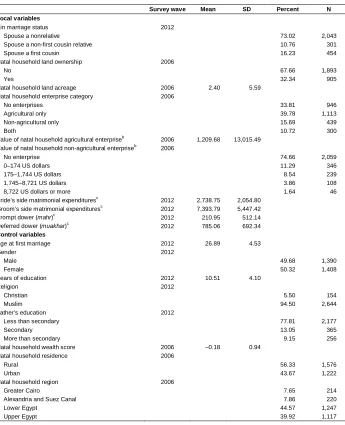
Table 1: Sample characteristics of panel respondents (N = 2,798)a
Survey wave Mean SD Percent N
Focal variables
Kin marriage status 2012
Spouse a nonrelative 73.02 2,043 Spouse a non-first cousin relative 10.76 301 Spouse a first cousin 16.23 454 Natal household land ownership 2006
No 67.66 1,893
Yes 32.34 905
Natal household land acreage 2006 2.40 5.59 Natal household enterprise category 2006
No enterprises 33.81 946
Agricultural only 39.78 1,113 Non-agricultural only 15.69 439
Both 10.72 300
Value of natal household agricultural enterpriseb 2006 1,209.68 13,015.49 Value of natal household non-agricultural enterpriseb 2006
No enterprise 74.66 2,059
0–174 US dollars 11.29 346
175–1,744 US dollars 8.54 239 1,745–8,721 US dollars 3.86 108 8,722 US dollars or more 1.64 46 Bride’s side matrimonial expendituresc 2012 2,738.75 2,054.80
Groom’s side matrimonial expendituresc 2012 7,393.79 5,447.42
Prompt dower (mahr)c 2012 210.95 512.14 Deferred dower (muakhar)c 2012 785.06 692.34
Control variables
Age at first marriage 2012 26.89 4.53
Gender 2012
Male 49.68 1,390
Female 50.32 1,408
Years of education 2012 10.51 4.10
Religion 2012
Christian 5.50 154
Muslim 94.50 2,644
Father’s education 2012
Less than secondary 77.81 2,177
Secondary 13.05 365
More than secondary 9.15 256 Natal household wealth score 2006 –0.18 0.94
Natal household residence 2006
Rural 56.33 1,576
Urban 43.67 1,222
Natal household region 2006
Greater Cairo 7.65 214
Alexandria and Suez Canal 7.86 220
Lower Egypt 44.57 1,247
Upper Egypt 39.92 1,117
3.4.1 Focal kin marriage variable
Kin marriage is the focal variable of this study, utilized as both a hypothesized predictor and outcome of our models. Ever-married respondents interviewed in the ELMPS 2012 were asked whether they were related to their spouses before marriage, with the possibility of reporting that they were maternal or paternal first cousins, blood relatives, relatives through marriage, or unrelated. Using Wald chi2 tests of linear hypotheses following multinomial logistic regressions, we found that there were no statistically significant differences between kinds of relations when regressed on salient variables. We therefore opted to collapse all first cousin categories to provide more parsimonious analyses. When used as an outcome, kin marriage is measured as a three-way categorical variable (0 = spouse was a nonrelative before marriage or omitted, 1 = spouse was a non-first cousin relative, and 2 = spouse was a first cousin). Thus, only spouses who were first cousins (= 2) are considered separately; all other kinds of relatives (= 1), including relatives by marriage, are collapsed into one category. When used as a predictor variable, a categorical variable compared cousin and other kin marriage to marriage with nonrelatives (the omitted category) (see Table 1).
3.4.2 Hypothesized predictors of kin marriage
The focal predictors of kin marriage explored in this study include reports from the 2006 wave of the Egypt panel survey on household agricultural land and enterprise ownership, followed by questions on the value of total agricultural and non-agricultural enterprise capital for up to four enterprises. Because this is the household in which unmarried respondents lived in 2006, we consider it to be the respondent’s natal household. The ELMPS 2006 household questionnaire included a question about the household’s ownership of agricultural land. Natal household land ownership is dummy-coded, with no ownership as the omitted category. The area of agricultural land owned was originally measured infeddan andkirat (a regional system of measuring land area). Onefeddan is equivalent to 24kirat or 1.038 acres of land. The land area was converted to acres to create a variable for natal household land acreage, which is included in our models as a continuous variable (see Table 1).
household reported ownership (alone or jointly with someone else) of any one of 19 different types of agricultural equipment or any one of 14 different types of livestock. Respondents were also asked about the capital values of the agricultural equipment owned by the household. Capital values were calculated according to the number of each type of equipment (including proportionate shares of those jointly owned with other households) and the average value assigned to the equipment by the respondents. Respondents were also asked about the capital value of the livestock owned by the natal household, which was calculated according to the number of the animals and the value assigned to the animals by the respondents. We assessed the assigned values of both equipment and animals by the corresponding survey questions that asked respondents, “If you sold one of those […] today, how much money could you get for it?” Total value of natal household agricultural enterprise capital thus included the value of equipment and animals owned by the natal household in 2012 US dollars (see Table 1).
In the 2006 ELMPS, respondents were also asked whether the household in which they resided owned a non-agricultural enterprise. Non-agricultural enterprises were measured in a separate questionnaire item asking whether any member of the household “own[s] and work[s] in a non-agricultural project or private activity that aims to produce a service or good for sale.” Value of natal household non-agricultural enterprise capital was captured in a survey question asking “What is the estimate of value of the current capital of the [non-agricultural enterprise] economic unit?” The values were recorded as an ordinal variable with seven response ranges in the original dataset; we collapsed the original seven values to four values (converted to 2012 US dollars) and included a fifth value to serve as the omitted category comprised of respondents who reported no household ownership of non-agricultural enterprises (see Table 1).
3.4.3 Hypothesized outcomes of kin marriage
families, grooms, and grooms’ families to each component of marriage costs. For our analyses, we lump together the contributions of brides and their families on the one hand and grooms and their families on the other hand to determine how kin marriage is associated with each side’s contributions to marriage costs. Our survey data also included measures of the prompt dower paid by Muslim grooms to their brides as well as the deferred dower recorded in the Muslim couples’ marriage contracts. Both measures were standardized to 2012 US dollars (see Table 1).
3.4.4 Control variables
The control variables used in our analyses, including values for categorical variables and the year of survey wave, are age at marriage and age at marriage squared11 (continuous; 2012), gender (male = 0, female = 1; 2012), years of education (continuous; 2012), religion (Christian = 0, Muslim = 1; 2012), father’s education (less than secondary = 0, secondary = 1, more than secondary = 2; 2012), natal household wealth score calculated using principal factor analysis based on measures of household amenities and consumer durables12 (continuous; 2006), natal household residence (rural = 0, urban = 1; 2006), and natal household region (Greater Cairo = 0, Alexandria and Suez Canal = 1, Lower Egypt = 2, Upper Egypt = 3; 2006). These variables are listed in Table 1 above. A number of other control variables were tested but omitted from the final models for various reasons.13
11
We control for age at marriage rather than current age for a number of reasons. Age at marriage has been found to be younger in kin marriages. In our data, younger men and women appear to be more likely to marry a relative, but this is attributable to selectivity bias. This selectivity bias is due to the fact that those in the lower portion of the age range in 2006 who already married by 2012 might be more likely to marry relatives, and to the fact that older individuals of the analysis sample who would marry a relative were already out of the sample because they married before 2006. The latter type of selection found confirmation in our data: women who married kin were selected out of the analysis sample because of the young age at which they married kin. We partially correct for this by controlling for age at first marriage.
12 In constructing the wealth variable, the ELMPS team used the first factor only, since it loaded or scored in
alignment with the concept of wealth, with almost all assets entering positively, and only a few that signal poverty (like a black and white TV or kerosene cooker) entering negatively. The factor analysis was turned into the predicted value ‘wealth’ by converting the factor loadings into scoring coefficients with regression scoring, creating ‘wealth’ out of standardized versions of the underlying variables (Filmer and Pritchett 2001; Schneeweiss and Mathes 1995).
13
4. Results
4.1 Univariate results
Descriptive statistics summarizing the characteristics of our analysis sample can be found in Table 1. Less than a third (27%) of ELMPS respondents married endogamously, with 16% of all marriages occurring between first cousins. Respondents reported an average of 2 acres of household agricultural land ownership. Though the sample range of acreage was from 0 to 42 (not shown), a majority of respondents (68%) reported no land ownership. Nearly one-third (34%) of respondents reported that their natal households owned neither an agricultural nor a non-agricultural enterprise in 2006. Approximately 11% of respondents reported that their natal households owned both an agricultural and a non-agricultural enterprise in 2006. Half (51%) of respondents reported household ownership of an agricultural enterprise (equipment or livestock) and a quarter (26%) reported household ownership of a non-agricultural enterprise in 2006 (not shown). Natal households’ agricultural enterprise capital had a mean value of approximately $1,200 US dollars (in 2012 US dollars). Natal households’ non-agricultural enterprise capital modal value was quite modest in value (see Table 1).
The average sum spent by the bride and her family on marital expenses was approximately $2,700 US dollars (in 2012 US dollars), a sum that was dwarfed by that spent by grooms and their families (approximately $7,40014 in 2012 US dollars). Brides received a mean of about $200 US dollars in prompt dower, and they were promised about $800 in deferred dower on average.
4.2 Multiple regression results
To answer our first research question, we tested respondents’ natal family land and enterprise ownership and values (2006) to establish their relationship with eventual marriage to kin (2012). Because the dependent variable is a three-way categorical
14 These sums may seem large, but in Egypt, matrimonial outlays are sometimes the biggest intergenerational
variable, we used multinomial regression, where the base comparison group was comprised of respondents who married nonrelatives. In order to assess gender-specific patterns, we split our sample and present regressions for men and women in addition to the overall sample. Tables 2–6 display the results of these analyses, net of various controls.
Table 2: Relative risk ratios from multinomial logistic regressions of kin marriage on natal household land ownership using PSU clusters
All respondentsa Male onlyb Female onlyc First cousin Non-first
cousin relative
First cousin Non-first cousin relative
First cousin Non-first cousin relative
Natal household land ownership 1.292 † 0.996 1.474 * 1.003 1.111 1.010 Age at first marriage 0.619 *** 0.654 ** 0.673 † 0.893 0.860 0.559 ** Age at first marriage squared 1.007 ** 1.008 ** 1.006 1.003 0.999 1.012 ** Female 0.415 *** 0.715 † – – – – Years of education 0.989 1.000 0.981 1.018 0.997 0.988 Father’s education
Less than secondary – – – – – – Secondary 0.645 † 0.986 0.321 ** 0.619 1.027 1.500 More than secondary 0.433 ** 0.599 0.286 ** 0.436 † 0.707 0.844 Natal household wealth score 0.880 0.799 * 0.907 0.835 0.851 0.756 † Urban natal household 0.878 0.631 * 0.892 0.734 0.900 0.525 * Natal household region
Greater Cairo – – – – – –
Alexandria and Suez Canal 1.117 1.052 1.239 0.583 0.853 2.353 Lower Egypt 0.904 0.698 0.779 0.560 1.072 1.034 Upper Egypt 1.493 1.773 † 1.267 1.447 1.808 2.566 Constant 406.527 *** 33.386 * 130.936 0.559 5.959 100.561 †
Number of PSU 331 296 299
Note: †p< .10; *p< .05; **p< .01; ***p< .001.a Sample includes all ELMPS respondents who were never-married in the 2006 wave,
ever-married in the 2012 wave, and between the ages of 18–39 in 2012 (N = 2,798).b Sample includes all female ELMPS
respondents who were never-married in the 2006 wave, ever-married in the 2012 wave, and between the ages of 18–39 in 2012 (N = 1,408).c Sample includes all male ELMPS respondents who were never-married in the 2006 wave, ever-married in the 2012 wave, and between the ages of 18–39 in 2012 (N = 1,390).
Acreage of agricultural land was not significantly related to marriage to a first cousin or to marriage to a non-first cousin relative in any of the samples.
magnitude and significance. For male respondents, natal household land ownership was associated with a 47% higher relative risk of marrying a first cousin, compared to households that did not own land (RRR = 1.474; p < 0.05). For the female-only sample, the association was not significant.
Table 3: Relative risk ratios from multinomial logistic regressions of kin marriage on natal family household land acreage using PSU clusters
All respondentsa Male onlyb Female onlyc First cousin Non-first
cousin relative
First cousin Non-first cousin relative
First cousin Non-first cousin relative
Natal household land acreage 1.005 0.989 1.003 0.980 1.008 1.003 Age at first marriage 0.619 *** 0.654 ** 0.675 † 0.897 0.860 0.559 ** Age at first marriage squared 1.007 ** 1.008 ** 1.006 1.003 0.999 1.012 ** Female 0.413 *** 0.711 * – – – – Years of education 0.989 1.000 0.981 1.019 0.997 0.988 Father’s education
Less than secondary – – – – – – Secondary 0.632 † 0.995 0.315 ** 0.631 1.016 1.498 More than secondary 0.432 ** 0.604 0.289 ** 0.450 † 0.707 0.845 Natal household wealth score 0.886 0.794 * 0.914 0.821 0.854 0.757 † Urban natal household 0.807 0.611 * 0.768 0.686 0.887 0.527 * Natal household region
Greater Cairo – – – – – –
Alexandria and Suez Canal 1.110 1.049 1.224 0.580 0.852 2.354 Lower Egypt 0.925 0.696 0.804 0.555 1.083 1.035 Upper Egypt 1.542 1.783 † 1.345 1.464 1.818 2.563 Constant 451.951 *** 34.295 * 148.261 0.559 6.007 100.109 †
Number of PSU 331 296 299
Note: †p< .10; *p< .05; **p< .01; ***p< .001.a Sample includes all ELMPS respondents who were never-married in the 2006 wave,
ever-married in the 2012 wave, and between the ages of 18–39 in 2012 (N = 2,798).b Sample includes all female ELMPS
respondents who were never-married in the 2006 wave, ever-married in the 2012 wave, and between the ages of 18–39 in 2012 (N = 1,408).c Sample includes all male ELMPS respondents who were never-married in the 2006 wave, ever-married in the 2012 wave, and between the ages of 18–39 in 2012 (N = 1,390).
Table 4: Relative risk ratios from multinomial logistic regressions of kin marriage on natal family household enterprise using PSU clusters
All respondentsa Male onlyb Female onlyc First cousin Non-first
cousin relative
First cousin Non-first cousin relative
First cousin Non-first cousin relative
Natal household enterprise category
No enterprises – – – – – – Agriculture only 1.316 1.283 1.488 1.251 1.147 1.368 Non-agriculture only 1.009 0.915 0.939 0.780 1.094 1.133 Both 1.190 1.294 1.238 1.447 1.136 1.164 Age at first marriage 0.616 *** 0.651 ** 0.666 † 0.887 0.858 0.554 ** Age at first marriage squared 1.007 ** 1.008 ** 1.006 1.003 0.999 1.012 ** Female 0.411 *** 0.718 † – – – – Years of education 0.990 1.000 0.984 1.020 0.997 0.987 Father’s education
Less than secondary – – – – – – Secondary 0.649 † 1.008 0.315 ** 0.622 1.038 1.561 More than secondary 0.443 ** 0.608 0.294 ** 0.436 † 0.717 0.877 Natal household wealth score 0.894 0.807 * 0.935 0.839 0.854 0.764 † Urban natal household 0.893 0.715 † 0.906 0.854 0.906 0.587 † Natal household region
Greater Cairo – – – – – –
Alexandria and Suez Canal 1.103 1.047 1.221 0.582 0.846 2.318 Lower Egypt 0.880 0.662 0.749 0.535 1.053 0.985 Upper Egypt 1.454 1.660 1.240 1.360 1.770 2.403 Constant 417.303 *** 30.455 * 145.249 0.529 5.870 92.062 †
Number of PSU 331 296 299
Note: †p< .10; *p< .05; **p< .01; ***p< .001. a Sample includes all ELMPS respondents who were never-married in the 2006 wave,
ever-married in the 2012 wave, and between the ages of 18–39 in 2012 (N = 2,798). b Sample includes all female ELMPS respondents who were never-married in the 2006 wave, ever-married in the 2012 wave, and between the ages of 18–39 in 2012 (N = 1,408). c Sample includes all male ELMPS respondents who were never-married in the 2006 wave, ever-married in the 2012 wave, and between the ages of 18–39 in 2012 (N = 1,390).
Table 5 presents regressions of marital outcomes on the capital value of agricultural enterprises owned by the natal family. While agricultural enterprise value did not have any bearing on marital outcomes for the overall and female samples, there was a positive and significant association for the male-only sample for marriage to both first cousins (RRR = 1.001; p < 0.05) and non-first cousin relatives (RRR = 1.001; p < 0.05). While the value of agricultural enterprise was a significant predictor of kin marriage for men (p < 0.05), the coefficient suggested a nominal relationship (RRR = 1.001).15
15 In order to address the possible effect of multicollinearity between urban or rural residence and ownership
Table 5: Relative risk ratios from multinomial logistic regressions of kin marriage on natal family household agricultural enterprise value using PSU clusters
All respondentsa Male onlyb Female onlyc First cousin Non-first
cousin relative
First cousin Non-first cousin relative
First cousin Non-first cousin relative
Value of natal household
agricultural enterprise 1.001 1.001 1.001* 1.001 * 1.001 0.999 Age at first marriage 0.628*** 0.659 ** 0.683† 0.895 0.863 0.558** Age at first marriage squared 1.007** 1.008 ** 1.006 1.003 0.999 1.012** Female 0.414*** 0.720 † – – – – Years of education 0.989 1.000 0.981 1.018 0.998 0.988 Father’s education
Less than secondary – – – – – – Secondary 0.644† 0.997 0.329** 0.636 1.021 1.497 More than secondary 0.444** 0.606 0.301** 0.438 † 0.706 0.841 Natal household wealth score 0.870† 0.789 * 0.884 0.813 0.850 0.757† Urban natal household 0.835 0.658 * 0.829 0.795 0.880 0.520* Natal household region
Greater Cairo – – – – – –
Alexandria and Suez Canal 1.106 1.050 1.214 0.581 0.851 2.353 Lower Egypt 0.913 0.689 0.778 0.545 1.079 1.037 Upper Egypt 1.505 1.729 † 1.271 1.374 1.820 2.575 Constant 372.528*** 29.063 * 121.394 0.506 5.837 102.871†
Number of PSU 331 296 299
Note: †p< .10; *p< .05; **p< .01; ***p< .001.a Sample includes all ELMPS respondents who were never-married in the 2006 wave, ever-married in the 2012 wave, and between the ages of 18–39 in 2012 (N = 2,798). b Sample includes all female ELMPS
respondents who were never-married in the 2006 wave, ever-married in the 2012 wave, and between the ages of 18–39 in 2012 (N = 1,408).c Sample includes all male ELMPS respondents who were never-married in the 2006 wave, ever-married in the 2012
wave, and between the ages of 18–39 in 2012 (N = 1,390).
In the final table addressing our first research question, we used categories of the value of non-agricultural enterprise capital to predict kin marriage outcomes. Compared to respondents whose natal families did not own non-agricultural enterprises, those who reported a natal family enterprise value between $1,745–8,721 US dollars were 45% marginally less likely to marry a first cousin (RRR = 0.553; p < 0.10) in the full sample. No other category of non-agricultural enterprise value was statistically significant for outcomes of marriage to a first cousin, and none of the categories were statistically significant for marriage to a non-first cousin relative or for the gender-specific models (see Table 6).
Table 6: Relative risk ratios from multinomial logistic regressions of kin marriage on natal family household non-agricultural enterprise value using PSU clusters
All respondentsa Male onlyb Female onlyc First cousin Non-first
cousin relative
First cousin Non-first cousin relative
First cousin Non-first cousin relative
Value of natal household non-agricultural enterprise
No enterprise – – – – – –
0–174 US dollars 0.840 1.041 0.629 1.011 1.117 1.100 175–1,744 US dollars 1.228 0.658 1.236 0.694 1.132 0.570 1,745–8,721 US dollars 0.553† 1.212 0.575 1.056 0.482 1.463 8,722 US dollars or more 1.455 0.863 1.566 0.503 1.316 1.280 Age at first marriage 0.619*** 0.654 ** 0.673† 0.892 0.860 0.560 ** Age at first marriage squared 1.007** 1.008 ** 1.006 1.003 0.999 1.012 ** Female 0.410*** 0.714 † – – – – Years of education 0.988 1.001 0.979 1.018 0.997 0.989 Father’s education
Less than secondary – – – – – – Secondary 0.625* 0.976 0.307** 0.611 1.020 1.488 More than secondary 0.433** 0.591 0.287** 0.428 † 0.703 0.841 Natal household wealth score 0.883 0.808 * 0.913 0.854 0.858 0.757 † Urban natal household 0.814 0.623 * 0.783 0.733 0.870 0.509 * Natal household region
Greater Cairo – – – – – –
Alexandria and Suez Canal 1.100 1.051 1.203 0.589 0.836 2.386 Lower Egypt 0.953 0.683 0.842 0.560 1.089 1.002 Upper Egypt 1.593 1.741 † 1.418 1.460 1.849 2.503 Constant 467.919*** 34.146 * 164.186† 0.578 6.054 98.916 †
Number of PSU 331 296 299
Note: †p< .10; *p< .05; **p< .01; ***p< .001.a Sample includes all ELMPS respondents who were never-married in the 2006 wave,
ever-married in the 2012 wave, and between the ages of 18–39 in 2012 (N = 2,798). b Sample includes all female ELMPS respondents who were never-married in the 2006 wave, ever-married in the 2012 wave, and between the ages of 18–39 in 2012 (N = 1,408). c Sample includes all male ELMPS respondents who were never-married in the 2006 wave, ever-married in the 2012 wave, and between the ages of 18–39 in 2012 (N = 1,390).
Other variables’ associations with kin marriage warrant description, as they confirm some of the patterns noted in previous research on kin endogamy in the MENA but contradict others. Tables 2–6 consistently indicate that respondent age at first marriage was negatively associated with kin marriage statuses (p < 0.001), but respondent age at first marriage squared was positively associated with both kin marriage statuses (p < 0.01) in the full sample. This indicates a nonlinear pattern such that the youngest- and oldest-marrying respondents were more likely to marry a relative.16 In the gender-specific samples, this pattern held true only for women
16
marrying a non-first cousin relative (p < 0.01 across Tables 2–6). The variable capturing respondents’ own education was not significantly associated with kin marriage across all models. While paternal education levels bore no association with respondents’ relative risk of marrying a non-first cousin relative for the overall sample, paternal education was significantly related to relative risk of marrying a first cousin. Those whose fathers had completed secondary (p < 0.1) or more education (p < 0.01) were significantly less likely to marry first cousins, compared to respondents whose fathers had completed less than secondary education. In the gender-specific regressions, paternal education was significantly related to the relative risk of marrying a relative for men only and was not significantly related to kin marriage for women. Those men whose fathers had completed secondary (p < 0.01) or more education (p < 0.01) were significantly less likely to marry first cousins, compared to men whose fathers had completed less than secondary education. Those men whose fathers had completed more than secondary education were marginally less likely to marry non-first cousins relatives (p < 0.1), compared to men whose fathers had completed less than secondary education. Increased natal family wealth17 was associated with a lower relative risk of marrying a kin group member across all models, when it proved to be significant. More specifically, greater natal household wealth was consistently associated with a statistically significant reduced relative risk of marrying a non-first cousin relative for the full sample (p < 0.05) and also for the female-only sample (p < 0.1). Likewise, urban residence of the natal household was associated with a lower relative risk of marrying a relative across all models, when it proved to be significant. More specifically, having an urban natal household was consistently associated with a statistically significant reduced relative risk of marrying a non-first cousin relative for the full sample (p < 0.05 or p < 0.1) and also for the female-only sample (p < 0.05 or p < 0.1).
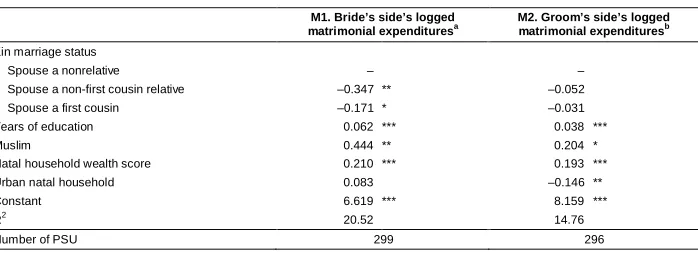
To answer our second research question, we next compared the marriage costs of those who married endogamously to those who did not marry relatives using linear regressions where the outcomes of interest were logged matrimonial expenditures by the bride’s side and groom’s side for women and men, respectively (see Table 7). The bride’s side’s matrimonial expenditures were lower amongst those who married first cousins (β = –0.347; p < 0.01) or non-first cousin relatives (β = –0.171; p < .05) compared to nonkin unions. In other words, compared to respondents in non-kin unions, families contributed 29% less towards matrimonial expenditures for women who married a non-first cousin relative and 16% less for women who married a first
17
cousin, all else being held equal. The mean value of the bride’s side’s matrimonial expenditures for women married to nonrelatives was the highest ($2,902 US dollars). In comparison, the bride’s side’s matrimonial expenditures were lower for women married to first cousins ($2,379 US dollars) and non-first cousin relatives ($2,171 US dollars). To put these figures in context, consider the fact that women in our analysis sample who were working for a wage earned an average of $141 US dollars monthly. The negative associations between kin marriage and the groom’s side’s matrimonial expenditures were not statistically significant for either category of kin unions.
Table 7: Beta coefficients from linear regressions of logged matrimonial expenditures (2012 US dollars) on kin marriage using PSU clusters
M1. Bride’s side’s logged matrimonial expendituresa
M2. Groom’s side’s logged matrimonial expendituresb
Kin marriage status
Spouse a nonrelative – – Spouse a non-first cousin relative –0.347 ** –0.052 Spouse a first cousin –0.171 * –0.031 Years of education 0.062 *** 0.038 ***
Muslim 0.444 ** 0.204 *
Natal household wealth score 0.210 *** 0.193 *** Urban natal household 0.083 –0.146 ** Constant 6.619 *** 8.159 ***
R2 20.52 14.76
Number of PSU 299 296
Note: †p< .10; *p< .05; **p< .01; ***p< .001.a Sample includes all female ELMPS respondents who were never-married in the
2006 wave, ever-married in the 2012 wave, and between the ages of 18–39 in 2012 (N = 1,408). b Sample includes all male ELMPS
respondents who were never-married in the 2006 wave, ever-married in the 2012 wave, and between the ages of 18–39 in 2012 (N = 1,390).
women married to nonrelatives was the highest ($791 US dollars). In comparison, the mean value of the deferred dower was less for women married to first cousins ($635 US dollars) and non-first cousin relatives ($580 US dollars). These figures are not insubstantial considering, again, that wage-earning women in our analysis sample made an average of $141 US dollars monthly, and wage-earning men made an average of $190 US dollars monthly.
Table 8: Tobit regressions of 2012 US dollars prompt (mahr) and deferred dower (muakhar) values on kin marriage using PSU clustersa
M1. Prompt dower (mahr) M2. Deferred dower (muakhar)
Kin marriage status
Spouse a nonrelative – – Spouse a non-first cousin relative –52.539 –224.915 ** Spouse a first cousin 284.003 * –159.926 † Years of education –8.215 7.022 Father’s education
Less than secondary – –
Secondary –156.803 197.955 ** More than secondary 337.331 † 446.634 *** Natal household wealth score –54.827 66.451 * Urban natal household –81.738 20.881 Constant –526.737 *** 632.498 ***
Number of PSU 296 296
Note: †p< .10; *p< .05; **p< .01; ***p< .001.a Sample includes all Muslim female ELMPS respondents who were never-married in the 2006 wave, ever-married in the 2012 wave, and between the ages of 18–39 in 2012 (N = 1,327).
5. Discussion and conclusions
economic rationales for kin marriage. We discuss our results for each of these hypotheses, considering the implications of our findings for existing scholarship on the topic, and conclude with a discussion of the limitations of our analyses.
Our first hypothesis predicted that respondents whose natal household owned agricultural land or family enterprises, or who owned land or enterprises of higher value, would be more likely to marry relatives than respondents whose natal households did not report such resources. The existing literature argues that a key rationale for kin marriage lies in the concern natal families have in preserving family property by ensuring that any inheritance passed on to children stays in the family through children’s marriage to kin group members. Furthermore, we hypothesized that when examined separately by gender, women would be more likely to marry kin if their natal families owned land or enterprises, or if the value of land or enterprises was higher. The existing literature contends that women have a higher incentive to marry endogamously because kin marriage offers an indirect way to lay claim on family resources. Our analysis offers a rare empirical investigation of the forgoing claims and indicates that there is only some evidence to support our first hypothesis or the theoretical literature.
Table 9: Summary of findings for regressions of kin marriage on natal family land and enterprises
All respondents Male only Female only
First cousin Non-first cousin relative
First cousin Non-first cousin relative
First cousin Non-first cousin relative
Natal household land ownership + † + * Natal household land acreage
Natal household enterprise category No enterprises
Agriculture only Non-agriculture only Both
Value of natal household agricultural
enterprise + * + *
Value of natal household non-agricultural enterprise No enterprise
0–174 US dollars 175–1,744 US dollars
1,745–8,721 US dollars – † 8,722 US dollars or more
These results together call into question the commonly held belief that kin endogamy is an economic strategy for consolidating family property or assets, and it can be accounted for in two ways. First, some scholars have argued that although Islam calls for daughters’ inheritance rights, in practice, Muslim women in many societies seldom inherit property upon their parents’ death. Instead, property is passed on to their male siblings (Casterline and El-Zeini 2003; Hoodfar 1997). As mentioned earlier, some researchers argue that women surrender their inheritance rights in order not to antagonize their brothers, who they depend on for social and material support should they remain unmarried, experience conflict with their husbands, or become widowed or divorced (Hoodfar 1997). If this is the case and kin endogamy does not encourage families to pass on resources to daughters, this may explain the absence of a relationship between most of our measures of property owned in the parental generation on the one hand and kin endogamy in the children’s generation on the other hand for the overall sample and the female-only sample. Second, others have pointed out that only families whose property ownership exceeds a certain threshold are concerned with keeping property in the family through children’s marriage to a relative (Casterline and El-Zeini 2003; Khuri 1970). If this is limited to very few families, this may similarly account for the fact that we found a somewhat inconsistent association between kin marriage and the presence and value of land and economic enterprises in the natal family.18
18 We ran interaction terms between natal household wealth in 2006 with the focal predictors in Tables 2–8
The fact that some significant associations did emerge for the male-only sample requires further investigation. Most accounts in the existing literature focus on women’s motivations for marrying endogamously, but few attempt to describe the parallel motivations for men. Future research should examine how men view the advantages and disadvantages of kin unions and specifically whether men pursue kin unions as a strategy for consolidating family property, particularly among men whose natal families own land or agricultural enterprises of higher value.
Our second hypothesis posited that respondents in kin unions would report lower matrimonial expenditures compared to respondents in other unions. We found that there was a significant reduction in matrimonial expenditures for the bride and her family in instances where marriage was to any type of relative, compared to instances where marriage was to non-kin, thus lending partial support to Hypothesis 2. Contrary to Hypothesis 2, grooms and their families spent just as much on kin unions compared to non-kin unions. Our results also showed that while deferred dowers were lower among women who married first cousins or other relatives as expected, prompt dowers were not lower but rather higher among women who married first cousins (see Table 10). These findings shed light on a commonly reported rationale for kin unions, namely that they lower the matrimonial expenditures needed to seal a match. Although many ethnographic accounts hold that kin marriages offer brides and grooms the advantage of reduced material expectations and greater affordability in a context of what are often prohibitively high marriage costs, we find only some evidence to confirm this claim. The minimizing matrimonial expenditures hypothesis was supported for the female-only sample alone. Even as the results for the prompt dower outcomes of kin marriage status were contrary to our expectations, they align with economic motivations to minimize matrimonial expenditures: because Egyptian women use their prompt dower to supplement their marital trousseau (Amin and Al-Bassusi 2004), increases in prompt dower would likely mean decreases in the bride’s side matrimonial expenditures. The fact that endogamously wed brides and their families spend less on marriage costs and receive lower deferred dowers is also noteworthy because they may compromise wives’
status and power within the conjugal union. Salem (2018) shows that the value of matrimonial expenditures by the bride’s side along with the value of the deferred dower are positively associated with wives’ decision-making power, while the value of the prompt dower is negatively associated with women’s decision making. Taken together with the finding that Egyptian women’s decision making is reduced in kin unions (Crandall et al. 2016; Salem and Shah 2016), it may be that the matrimonial expenditures are mediating the influence of kin marriage on women’s decision-making power within the conjugal union.
Table 10: Summary of findings for regressions of matrimonial expenditures on kin marriage
Bride’s side logged matrimonial expenditures
Groom’s side logged matrimonial expenditures
Prompt dower (mahr)
Deferred dower (muakhar)
Kin marriage status Spouse a nonrelative
Spouse a non-first cousin relative – ** – ** Spouse a first cousin – * + * – †
There are a number of limitations of the foregoing analyses. The relationships we investigate are necessarily associational and not causal. Although in most cases we have sequenced variables so that they follow the proper temporal ordering, the possibility of spurious or endogenous relationships driving the associations found between predictors and outcomes cannot be ruled out. Subsequent work on this topic should investigate the use of instrumental variables or other approaches to making causal claims.
6. Acknowledgements
References
Abbasi-Shavazi, J.M., Mcdonald, P., and Hosseini-Chavoshi, M. (2008). Modernization or cultural maintenance: The practice of consanguineous marriage in Iran.
Journal of Biosocial Science 40(6): 911–933.doi:10.1017/S0021932008002782.
Amin, S. and Al-Bassusi, N.H. (2004). Education, wage work and marriage: Perspectives of Egyptian working women.Journal of Marriage and the Family 66(5): 1287–1299.doi:10.1111/j.0022-2445.2004.00093.x.
Assaad, R. and Krafft, C. (2013). The Egypt labor market panel survey: Introducing the 2012 round. IZA Journal of Labor and Development 2: 1‒30.
Assaf, S. and Khawaja, M. (2009). Consanguinity trends and correlates in the Palestinian territories. Journal of Biosocial Science 41(1): 107–124. doi:10.1017/S0021932008002940.
Barakat, B. and Basten, S. (2014). Modelling the constraints to consanguineous marriage when fertility declines. Demographic Research 30(9): 277–312. doi:10.4054/DemRes.2014.30.9.
Barbour, B. and Salameh, P. (2009). Consanguinity in Lebanon: Prevalence, distribution and determinants. Journal of Biosocial Science 41(4): 505–517. doi:10.1017/S0021932009003290.
Ben Halim, N., Ben Alaya Bouafif, N., Romdhane, L., Ben Atig, R.K., Chouchane, I., Bouyacoub, Y., Arfa, I., Cherif, W., Nouira, S., Talmoudi, F., Lasram, K., Hsouna, S., Ghazouani, W., Azaiez, H., El Matri, L., Abid, A., Tebib, N., Ben Dridi, M.-F., Kachboura, S., Amouri, A., Mokni, M., Ben Arab, S., Dellagi, K., and Abdelhak, S. (2012). Consanguinity, endogamy, and genetic disorders in Tunisia. Journal of Community Genetics 4(2): 273–284. doi:10.1007/s12687-012-0128-7.
Ben Halim, N., Hsouna, S., Lasram, K., Rejeb, I., Walha, A., Talmoudi, F., Messai, H., Ben Brick, A.S., Ouragini, H., Cherif, W., Nagara, M., Ben Rhouma, F., Chouchene, I., Ouechtati, F., Bouyacoub, Y., Ben Rekaya, M., Messaoud, O., Ben Ammar, S., El Matri, L., Tebib, N., Ben Dridi, M.-F., Mokni, M., Amouri, A., Kefi, R., and Abdelhak, S. (2016). Differential impact of consanguineous marriages on autosomal recessive diseases in Tunisia. American Journal of
Bittles, A.H. (1994). The role and significance of consanguinity as a demographic variable. Population and Development Review 20(3): 561–584. doi:10.2307/ 2137601.
Bittles, A.H. (2001). Consanguinity and its relevance to clinical genetics. Clinical
Genetics 60(2): 89–98.doi:10.1034/j.1399-0004.2001.600201.x.
Caldwell, J.C., Reddy, P.H., and Caldwell, P. (1983). The causes of marriage change in South India. Population Studies 37(3): 343–361. doi:10.1080/00324728.1983. 10408866.
Cameron, A.C., Gelbach, J.B., and Miller, D.L. (2006). Robust inference with multi-way clustering. Cambridge: National Bureau Of Economic Research (Technical Working Paper Series 327).doi:10.3386/t0327.
Casterline, J.B. and El-Zeini, L.O. (2003).Consanguinity in the Arab region: Current patterns and prospects for change. Paper presented at the Institutions, Ideologies, and Agency, Family Change in the Arab Middle East and Diaspora Conference, Chapel Hill, USA, September 2003.
Cherkaoui Jaouad, I., Chafaï Elalaoui, S., Sbiti, A., Elkerh, F., Belmahi, L., and Sefiani, A. (2009). Consanguineous marriages in Morocco and the consequence for the incidence of autosomal recessive disorders.Journal of Biosocial Science 41(5): 575–581.doi:10.1017/S0021932009003393.
Crandall, A., VanderEnde, K., Cheong, Y.F., Dodell, S., and Yount, K.M. (2016). Women’s age at first marriage and postmarital agency in Egypt.Social Science Research 57: 148–160.doi:10.1016/j.ssresearch.2016.01.005.
Do, Q.-T., Iyer, S., and Joshi, S. (2013). The economics of consanguineous marriages.
The Review of Economics and Statistics 95(3): 904–918. doi:10.1162/REST_
a_00279.
El-Kheshen, G. and Saadat, M. (2013). Prevalence of consanguineous marriages among Shi’a populations of Lebanon. Journal of Biosocial Science 45(5): 675–682. doi:10.1017/S0021932012000843.
El-Zanaty, F. and Way, A. (2009). Egypt demographic and health survey 2008. Cairo: Ministry of Health and Population. https://dhsprogram.com/pubs/pdf/FR220/ FR220.pdf.
Ferree, M.M. (2010). Filling the glass: Gender perspectives on families. Journal of