Lights, Camera, Action: Using Wearable
Camera and Interactive Video Technologies
for the Teaching & Assessment of Lab
Experiments
Tatyana Devinea, Clare Gormleyb and Patrick Doylec
Corresponding author: [email protected]
aBiomedical Diagnostics Institute, Dublin City University, Dublin 9, Ireland bTeaching Enhancement Unit, Dublin City University, Dublin 9, Ireland
cSchool of Nursing and Human Sciences, Dublin City University, Dublin 9, Ireland
Keywords: wearable technology, laboratory teaching, laboratory assessment, interactive video, video education
International Journal of Innovation in Science and Mathematics Education, 23(2), 22-33, 2015
Abstract
In laboratory practicals, demonstrating laboratory techniques and equipment handling to students require frequent repetition. Also, it is difficult to identify whether students understand the relationship between theoretical concepts and their practical execution. Furthermore, for exclusively online courses, students’ physical presence in the laboratory is not possible so appropriate teaching and assessment alternatives need to be employed. While the medium of video offers potential for addressing these issues, creating video can require specific production expertise and equipment. This study explores how relatively inexpensive wearable camera technology may provide an alternative approach for the rapid production of lab-based videos. It describes how this technology was used by an academic to video laboratory experiments relating to biomedical diagnostics. It also explains how an interactive question was embedded within the video to assess students’ understanding of the concepts demonstrated. Data was drawn from student and demonstrator feedback surveys, and the experiences of the lecturer involved in this project are discussed. A number of distinct benefits of this approach were identified, including its preparatory potential akin to a flipped classroom, its rapid production time, the non-intrusive nature of the recording, the advantages over text descriptions, and the relatively low cost. The advantages and limitations of the embedded question format are also discussed. The study includes practical recommendations for other academics considering this technology and suggests further applications for potential use in laboratory learning.
Introduction
paper-and-pencil tests. A student might get a perfect score on written tests but not be able to handle apparatus in the laboratory."
More recently, an Australian investigation of first year students attending lab-based classes suggested that students, especially those without prior lab experience, do not always receive “adequate introduction” to the equipment and practice of the lab (Rice, Thomas, & O’Toole, 2009, p. 46). Johnstone (1997) has written about the dangers of overwhelming students with information in the laboratory context, describing the lengthy list of items that a student has to perform, observe, and recall in order to make sense of a set of experiment instructions. Abraham (2011), reviewing 32 years of research in the field, writes that laboratory skills in particular are best taught by direct instruction strategies that inform and demonstrate but that lecturers do not always choose the method that is best suited to what they want to teach.
The use of video offers the ability to demonstrate lab-based experiments with distinct educational benefits. This medium has grown enormously in recent years (Harrison, 2015; Kaufman & Mohan, 2009) with increasing recognition of its potential for enhancing pedagogy and reducing cognitive overload. For example, recent implementations of the flipped classroom approach, where students are asked to review videos and other types of learning material in advance of class time, have highlighted the value of video-based learning as a preparatory learning aid (Lancaster & Read, 2013). However, recording video in a laboratory setting is not necessarily a straightforward endeavour: academics may not have access to the production expertise to set up and position the camera correctly, tripods and other equipment may be disruptive to a busy lab, and there are health and safety risks to consider. If an external production team is engaged, there are also significant costs involved, an issue which is all too frequently ignored in the literature (Winslett, 2014). This is where wearable technology may play a role.
The potential of wearables
This new element where a student can observe a scientific experiment through the demonstrators’ eyes is both interesting and captivating. Instructors and students who have participated in the GoPro FPS learning activity found this new technique to be a useful tool in enhancing their knowledge and understanding of scientific experiments. (p. 1520)
Furthermore, another study on the use of flipped teaching in chemistry laboratory learning found that instructor-narrated videos of practicals together with pre-lab questions helped students to reorganise the information so that practical procedures and theory became clearer to them (Teo, Tan, Yan, Teo, & Yeo, 2014).
Whatever method of filming is used, sound pedagogical practice suggests that efforts need to be made to ensure that videos do not replicate or encourage a passive learning experience. The importance of active learning has been long recognised (Biggs & Tang, 2007). Among their seven principles of good practice for undergraduate education, Chickering and Gamson (1987) reinforce that when teaching undergraduate students, it is important to promote active forms of learning, provide prompt feedback, and respect diverse ways of learning. In popular culture, interactive techniques are increasingly being added to video (Grossman, 2014) in an attempt to engage viewers more deeply. In addition there is some evidence to suggest that instructional video is most effective when it requires students to complete learning activities such as multiple choice questions before continuing (Vural, 2013). He suggests that a video should encourage and motivate learners to attend to their learning by performing activities such as answering questions to continue to the next part of the video. He also found that students who experienced a question-embedded approach also tended to spend more time with the learning materials because “they might think that similar questions would be asked in the final exam” (p. 1322).
The purpose of this pilot study was to explore whether a point-of-view video recorded by a lecturer using a wearable camera and featuring interactive video techniques could potentially assist with the teaching and assessment of laboratory experiments. In addition, this study investigates how the inclusion of interactivity and feedback within such a video was perceived by students.
Methodology
The research was conducted over five months (November 2014 - March 2015) and predominantly focused on gathering feedback from two separate groups of students and one group of lab demonstrators.
• Group 1: 9 full-time postgraduate (PG) students taking a taught Master of Science
(MSc) degree course in Biomedical Diagnostics
• Group 2: 29 undergraduate (UG) students enrolled in the third year of a Genetics and
Cell Biology full-time Bachelor of Science (BSc) degree course
• Group 3: 4 lab demonstrators responsible for demonstrating laboratory techniques to
students, monitoring students’ activities in the laboratory, overseeing practical performance and providing guidance to students during the session. The demonstrators are postgraduate PhD candidates in year 2 or 3 of their research project.
here is a specific group of students who have reviewed a specific learning intervention at a specific point in time. The research was undertaken as an exploratory study to identify whether this type of learning intervention may be worthy of further development and integration into future courses.
How and what was filmed
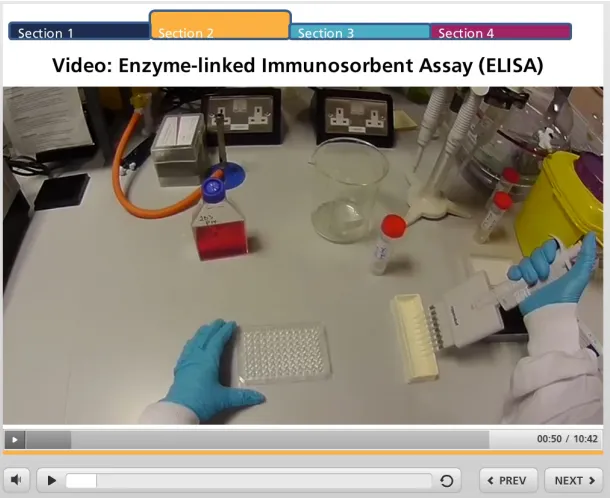
The process of performing an indirect enzyme-linked immunosorbent assay (ELISA) was filmed by an academic using a Panasonic HX-A100 camera. The Panasonic HX-A100 is a lifestyle or action head-mounted camera. It is a light (167 g) and portable camera that consists of two connected components: the lens and the recording unit. The recording unit is similar in size to a pack of cards and can be easily placed in a shirt pocket or placed in the supplied strap. The lens is connected to the recording unit by a 70cm long lead. The design allows the lens to be attached to a supplied headband to enable a point-of-view (POV) camera angle. The user can start and stop recording using buttons on the recording unit but to access further settings, an app called the Image App needs to be downloaded to a smartphone. The app, in this case Image App version 1.9.1, connects to the camera via a wireless hotspot and once connected the user can use their smartphone to straighten and adjust the camera angle, select different resolutions (720p, 1080p), and select slow motion. Most importantly the app acts as a monitor so that the lecturer doing the recording can check if the appropriate shots are being captured.
Figure 1. Screenshot from the ELISA video.
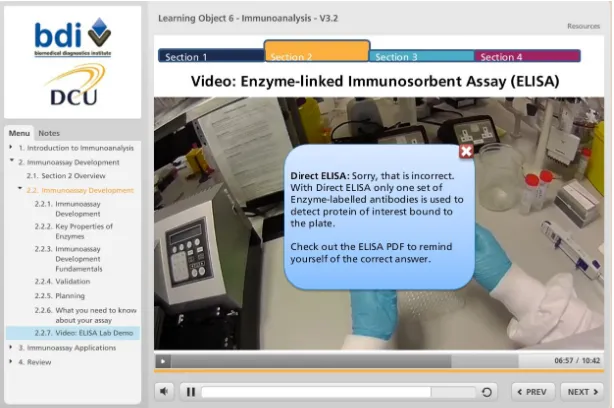
The main purpose of the video was to demonstrate the immunoassay technique to students. To enable active listening and to encourage students to refer to the content of the theoretical material, an interactive exercise in the form of a question appeared automatically at 6 minutes 57 seconds. This question appeared at the same time as a verbal prompt from the academic. The learner was required to answer the question correctly in order to proceed with watching the video. This interactive element of the video was created using Articulate Storyline software. The multiple choice question asked learners to identify what type of ELISA was being performed and offered four options as shown in Figure 2. When students clicked the (correct) Indirect Elisa option, the video continued and the audio narration confirmed the right answer.
When students clicked any of the other three (incorrect) options, they were given feedback on their chosen answer and directed to an accompanying PDF document where they could read brief feedback and learn for themselves which option was correct (Figure 3). Both the video and the interactive exercise were presented within a learning object on the learning management system alongside other content on the topic of immunoanalysis.
Figure 3. Sample of feedback provided upon selecting an incorrect option.
Survey design
In order to evaluate the potential of this format, we surveyed 38 full-time students who were taking practical lab-based courses within two groups. These students could compare the learning experience from watching the video to their physical laboratory session. The two groups of students were asked to watch the video and complete a 10 question survey (provided as Appendix 1) that asked them to express their opinions on this format of lab-based video and embedded interactive exercise. 26 out of 29 undergraduate and all 9 postgraduate students participated in the survey.
Since this research was exploratory in nature, we asked predominantly open-ended questions to capture as many perspectives as possible. Draft survey questions were reviewed by a critical friend and were subsequently revised. The two groups of students were asked to view the video of the ELISA technique in advance of their laboratory-based practical session during which they would be performing this immunoassay technique. Both the video and the survey were distributed to the students via the learning management system Moodle 2.6 one week before the practical session.
Four demonstrators, who had previous experience with delivering the laboratory-based practical training of this technique to students, were also asked to fill in a short survey (see Appendix 2). The demonstrators were asked to take a note of the changes in performance and overall understanding of the technique by the students who watched the video in comparison to the previous cohorts of students who did not watch the video.
towards positivity should be acknowledged. Furthermore, because this particular video was published within a learning object, we only know whether students opened the learning object, not how long they spent on the video itself or if they stopped watching it before completion. Notwithstanding these limitations, the following section describes our findings to date.
Results
Student response to the video
All the respondents reported that they found the 10 minute video of the technique useful for understanding the technique and 34 out of 35 stated that they would like to have such videos available to them before each practical session. Students commented that it was useful to view the steps involved and hear the explanations as to why various components were being added while the technique was being performed. The consensus amongst the students was that this type of virtual demonstration of a practical technique possesses advantages over a text manual or verbal explanation by the lecturer. The removal of the waiting time typical of laboratory experiments, and the relative ease and speed at which individual steps could be viewed were noted. In addition, over 40% of the respondents (15 out of 35) volunteered comments about the point-of-view that the video was shot from. These students particularly liked that having the camera at eye-level gave them a clear view of what was being done at every stage of the experiment.
Student response to the interactive exercise
The interactive exercise embedded within the video was also broadly welcomed by both cohorts of students. 33 out of 35 respondents found its presence useful and motivating. In their responses the majority of the students commented that the interactive question significantly enhanced their attention to the video and encouraged learning. In fact, over a third of respondents (12 out of 35) expressed a wish for more interactive exercises to be included in such videos to encourage learning and understanding. Students who responded positively commented that the interactive question made them think about the steps in the video more closely when considering how to answer.
However, it should be stated that not everyone valued the mid-video question design and one of the negative comments made about the exercise referred to the position of the question itself. The student stated that they would have preferred the question to be at the end of the video as they found it disconcerting to have a question mid-way through without having full knowledge of the procedure.
Lab demonstrator response
Discussion
The use of pre-recorded video of a scientific experiment as a mode of student preparation for practical sessions has been previously described for secondary school science in a flipped class approach by Bergmann and Sams (2012). In higher education, a variation of the flipped classroom approach is traditionally used as a means of preparation for all practical sessions, because students are usually asked to read their practical manual before attending laboratory sessions. From the results of our anonymous survey, students favoured the pre-recorded video of the technique to the laboratory manual as means of preparation. This was also echoed by the demonstrators, who agreed that watching the video better prepared the students for the practical session because their technical performance in the lab was noticeably improved.
However, before reading too much into these results a note of caution should be sounded. In addition to the study limitations described earlier, it is important to beware of the “everything works” syndrome described by Winslett (2014). In the literature to date, video usage is being reported on favourably when comparing the value of having some video materials with having no video at all. As Winslett describes, this overwhelming positivity towards inclusion of video in teaching does not take account of particular production styles and how they might influence the success or failure of video as a teaching tool. With all 35 students seeing this type of video used in this context for the first time, there may be an element of the novel versus the norm that is skewing our results.
Several respondents mentioned that they would like to see all the lab equipment and reagents clearly labelled and it was suggested that text subtitles could be used to aid deeper comprehension of the experiment. Such additional information can be incorporated using video editing software. Another level of detail could be afforded by inserting images, graphs and drawings to illustrate the theoretical concepts that are discussed. This could significantly add to the teaching value of the video, by providing an opportunity to demonstrate the material previously presented to the students in the lecture or textbook in direct association with the practical application. There are also opportunities for students to annotate the video, thereby promoting further levels of interactivity and active learning. Freely available software such as Thinglink (available from www.thinglink.com) could be employed to do this. However the extra time required to annotate videos should not be underestimated and should be carefully considered.
he refers to as “game-informed approaches” allows students to take highly individualised pathways through content, take consequences for their actions, and revisit routes and procedures as they wish. Branching video scenarios can encompass all of these elements. From a production perspective, one challenge of the wearable camera that should be noted is that the person recording must be aware of any habitual unconscious head movements, such as shaking or nodding while talking. Unintentional head movement can potentially introduce unsteadiness that can be distracting for viewers. This issue can be challenging to avoid, particularly for those new to video production and requires some practice. However, the time spent on preparation for filming and post-production processing was relatively low. In addition to the three hours required for recording, the video took approximately three hours to edit and it took approximately two more hours to create the interactive question, leading to eight hours in total. It should be acknowledged that the lecturer in this case was assisted by a multimedia specialist and a learning technologist and additional time would be required without access to this type of expertise.
Furthermore, in our study, the majority of students apparently relied solely on the video for all information and failed to do any other preparatory work, such as reading the lab manual or the associated text. Therefore this should be taken into account when creating such videos: as much information as possible should be included within the video or indeed several videos may need to be created to cover every desired learning outcome of the practical session.
Potential for assessment
We also investigated the use and application of the interactive exercise embedded within the video as means of assessing understanding of the theory behind the assay. Although we experienced some technical issues in creating and timing this exercise, in our opinion it improved the learning outcomes because it required students to demonstrate knowledge of the previously studied material and directed them to that information as required. This type of interactive exercise was praised by the students and the majority expressed a wish for more interactive questions to be available within any such video. The embedded exercise not only adds an element of interactivity to the video, but can also be used for assessment of understanding of the topic or concept by the individual student or by the class in general. While not used in this particular case, the Articulate Storyline software facilitates the inclusion of scores so that students could be graded on the basis of their ability to answer specific questions on a specific topic. In other words, the interactive video could potentially be used for summative (not purely formative) assessment.
However, there are limitations of the interactive video format that should be considered. When asked whether the interactive question embedded within the video was a useful assessment tool in their view, all lab demonstrators agreed that such exercises are important to stimulate analytical thinking and to understand the methodological differences between various types of the assay. However, three out of four demonstrators commented that once the students were asked to perform a different type of ELISA assay (the competitive ELISA as opposed to indirect ELISA shown in the video) there was little evidence of any deep understanding of that type of assay. In our opinion this signifies that the students solely relied on the video and failed to read the manual or any additional information related to the assay. If only surface learning is occurring, this could potentially signal a lack of understanding.
Low cost, non-intrusive approach
personnel. Costs are thereby kept to a minimum. It is a scalable teaching strategy in that other educators can adopt a similar process to rapidly produce videos of their own.
While the wearable camera itself is relatively inexpensive (approximately €270 from one online retailer), there are some further costs that should be mentioned. Articulate Storyline is not freeware and at the time of writing, a licence cost approximately €640 after an academic discount is applied. In addition to this, the Adobe Premiere Pro video editing software was used which costs approximately €240 a year for students and teachers. If this software is beyond budget, there are other options for editing this type of video that could be considered. The edits made in this case study involved simple cuts, inserting title plates, and some ‘speeding up’ of clips. These types of edits can be implemented using freely available tools such as Microsoft’s Windows Movie Maker and Apple’s iMovie. Furthermore, the number of free tools for creating quizzes continues to grow as an online search will confirm. While such tools may not incorporate the ability to progress a video based on correct answer as the Articulate Storyline-created interaction does, they do offer possibilities for incorporating various question types within or alongside a video.
When discussing costs, it should also be noted that in a climate of growing population and increasing student numbers, the issue of funds and space at universities is becoming more and more acute. Ireland has undergone a period of population growth and in fact experienced the highest population growth in the European Union in 2014 (Holland, 2015). As a consequence, some universities are resorting to literature review-based assessment items as opposed to research-based projects and reducing the hours of practical sessions in the teaching laboratories for first and second year students. While published evidence of this is difficult to source, a recent audit of practical work undertaken by undergraduate bioscience students in the UK reiterated the perceived barriers to the delivery of laboratory-based practical education. In that report, university teachers almost unanimously agreed that increasing student numbers and limited resources regarding laboratory space, equipment, staffing and funding limited their provision of laboratory-based practical education (Coward & Gray, 2014). Of course no video can substitute the experience of physically performing an experiment, but it certainly can provide a valuable insight into the laboratory setting, correct use of equipment, and accurate performance of techniques. Such videos could potentially substitute the crowded practical sessions during the junior years of the degree programme, freeing funds, staffing and laboratory space for senior students, while providing detailed demonstration of the techniques, correct use of laboratory equipment and experimental application of the theory. Filmed from the eye-level of the lecturer and accompanied by an audio explanation, such video comes very close to the experiment being demonstrated to the students on the bench but with a better point of view.
Conclusion
Although our findings were promising, due to the small sample size and the limited level of interactivity incorporated, they cannot be considered generalisable. Rather, it is intended that they offer a starting point for further development and investigation. Given the lessons learned by the lecturer and learning technologists during this project, the authors suggest that further research should be done to formulate more detailed guidelines for academics who wish to employ this technology and replicate this approach. Furthermore, the data referring to the value of the POV angle employed is worthy of further research, especially because it may contribute to the literature on the most appropriate way to align video production approaches with desired learning outcomes. These topics will be the subject of future study by the authors.
Acknowledgements
The authors would like to acknowledge the input of Dr Pip Ferguson, of the Teaching Enhancement Unit DCU, at the early stages of this research. Her input and advice was warmly appreciated as was the invaluable feedback provided by the students and demonstrators who took part. Thanks also to Garvan Doherty and Muireann O’Keeffe for their helpful assistance.
References
Abraham, M. R. (2011). What can be learned from laboratory activities? Revisiting 32 years of research.
Journal of Chemical Education, 88(8), 1020-1025. doi: 10.1021/ed100774d
Bean, C. (2012, February 1). Using scenarios to keep e-learning real. TD, 76-77. Retrieved from
https://www.td.org/Publications/Magazines/TD/TD-Archive/2012/02/Use-Scenarios-to-Keep-E-Learning-Real
Begg, M. (2008). Leveraging game-informed healthcare education. Medical Teacher, 30(2), 155-158. doi:10.1080/01421590701874041
Bergman, J. & Sams, A. (2012). Flip your classroom: Reach every student in every class every day. Arlington, VA: International Society for Technology in Education.
Biggs, J., & Tang, C. (2007). Teaching for quality learning at university: What the student does (3rd ed.). Maidenhead: SRHE and Open University Press.
Chalfen, R. (2014). “Your panopticon or mine?” Incorporating wearable technology’s Glass and Go Pro into visual social science. Visual Studies, 29(3), 299-310. doi:10.1080/1472586X.2014.941547
Chickering, A. W., & Gamson, Z. F. (1987). Seven principles for good practice in undergraduate education.
American Association for Higher Education Bulletin, 3-7. Retrieved from
http://files.eric.ed.gov/fulltext/ED282491.pdf
Coward, K. & Gray, J.V. (2014, June). Audit of practical work undertaken by undergraduate bioscience students across the UK Higher Education sector. Society of Biology and Biochemical Society. Retrieved from
https://www.rsb.org.uk/images/SB/UG-Practical-Work-Report-Web.pdf
Cuthbertson, A. (2014, April 17). Google Glass Could Assist Surgeons. International Business Times. Retrieved from http://www.ibtimes.co.uk/google-glass-could-assist-surgeons-1445206
Fung, F. M. (2015). Using first-person perspective filming techniques for a chemistry laboratory demonstration to facilitate a flipped pre-lab. Journal of Chemical Education, 92(9), 1518-1521. doi:10.1021/ed5009624 Grossman, D. (2014, December 17). Quantum thinking: Cats to computers. Retrieved from
http://www.bbc.com/news/science-environment-30144491
Harrison, D. J. (2015). Assessing experiences with online educational videos: Converting multiple constructed responses to quantifiable data, International Review of Research in Open and Distributed Learning,16(1), 168-192. Retrieved from http://www.irrodl.org/index.php/irrodl/article/viewFile/1998/3254
Hitchcock, G., & Hughes, D. (1995). Research and the teacher: A qualitative introduction to school-based
research. New York: Routledge.
Hofstein, A., & Lunetta, V. N. (1982). The role of the laboratory in science teaching: Neglected aspects of research. Review of Educational Research, 52(2), 201-217. doi:10.3102/00346543052002201
Johnson, L., Adams Becker, S., Estrada, V., & Freeman, A. (2015). New Media ConsortiumHorizon Report: 2015 Higher Education Edition. Austin, TX: The New Media Consortium. Retrieved from
http://cdn.nmc.org/media/2015-nmc-horizon-report-HE-EN.pdf
Johnstone, A H. (1997). Chemistry teaching - Science or alchemy? 1996 Brasted Lecture. Journal of Chemical Education, 74(3), 262-268. doi:10.1021/ed074p262
Kalinauckas, A. (2015). 7 Problems with Google Glass [Electronic Version]. Engineering & Technology, 16– 17. Retrieved from http://eandt.theiet.org/magazine/2015/02/google-glass.cfm
Kaufman, P. B., & Mohan, J. (2009). Video use and Higher Education: Options for the future. Intelligent Television, Copyright Clearance Center and New York University. Retrieved from
https://library.nyu.edu/about/Video_Use_in_Higher_Education.pdf
Kearney, M., & Schuck, S. (2005). Students in the director’s seat: Teaching and learning with student-generated Video. In P. Kommers & G. Richards (Eds.), Proceedings of World Conference on Educational Media
and Technology 2005 (pp. 2864-2871). Association for the Advancement of Computing in Education
(AACE). Retrieved from
http://engage.doit.wisc.edu/dma/research/docs/Kearney-StudentsDirectorsSeat.pdf
Lancaster, S., & Read, D. (2013). Flipping lectures and inverting classrooms. Education in Chemistry, 50(5), 14-17. Retrieved from http://www.rsc.org/images/EIC0513-flipped-classroom-inverting-lectures_tcm18-234703.pdf
Rice, J., Thomas, S., & O’Toole, P. (2009). Tertiary science education in the 21st century. Retrieved from
http://www.acds.edu.au/tlcentre/wp-content/uploads/2013/01/Rice09_Tertiary-science-education-in-the-21st-century-final-report-2009.pdf
Teo, T. W., Tan, K. C. D., Yan, Y. K., Teo, Y. C., & Yeo, L. W. (2014). How flip teaching supports
undergraduate chemistry laboratory learning. Chemistry Education Research and Practice, 15, 550-567. doi:10.1039/c4rp00003j
Vural, Ö. F. (2013). The impact of a question-embedded video-based learning tool on e-learning. Educational Sciences: Theory & Practice, 13(2), 1315-1323. Retrieved from
http://files.eric.ed.gov.remote.library.dcu.ie/fulltext/EJ1017292.pdf