A Guiding Conceptual Framework for Individualized Knowledge
Management Model Building
Enis ELEZI University of Bolton
Deane Rd, Bolton BL3 5AB, Bolton, Greater Manchester, UK [email protected]
Christopher BAMBER Organizational Learning Centre
66 Castle Street BL2 1AE, Bolton, Greater Manchester, UK [email protected]
Abstract. This paper presents a conceptual framework for use, by organizational researchers, knowledge management practitioners and business analysts, as a guide to building Knowledge Management (KM) models. This is accomplished through a careful selection of ten prominent KM models which have been discussed critically and used to deepen the theoretical understanding of KM implementation and development. A critical review of ten KM models offers practitioners, as well as researchers, an examination of the ontological and epistemological backgrounds and origins of existing models’ in order to highlight the required components for composing effective KM models. There is limited research supporting the utilization, adaptation or even adoption of KM models that can assist managers seeking a competitive advantage through the implementation of KM processes. Authors of existing KM models claim to provide holistic KM models but when referring back to the central meaning of knowledge and management concepts those models do not generate a thorough coverage of the required characteristics and components. This paper has critically investigated ten widely acknowledged KM models but recognizes that there is a plethora of KM models emerging which have varied foci. The conceptual review of KM models is not an empirical investigation, moreover, a critical analysis that presents a conceptual framework for KM model building. In carrying out this research study, the paper presents the shortfalls of this theoretical research approach but nevertheless, the proposed conceptual framework is envisaged as having value to both practitioners and researchers. This paper sheds light on a series of concerns related to existing KM models, their origins, constructs, and contextualization. For organizational researchers, knowledge management practitioners and business analysts this research study elaborates on issues related to validity, applicability, and generalizability of KM models and defines a set of criteria for KM model building. The paper also impacts on the science of KM presenting perspectives, scope, and contexts in which knowledge is processed.
Introduction
The competitiveness of global institutions is driven by effective utilization and promotion of their developing capabilities to deliver ever changing and demanding customer needs. Managing knowledge is seen as a pre-requisite for institutions aiming to improve competitiveness and performance and this has encouraged an increased internal focus on Knowledge Management (KM) practices.
The area of Knowledge Management (KM) has been receiving considerable attention in the last two decades and is taking prominence as a result of issues related to international business, cultural values and beliefs and organizational performance (Massingham & Massingham, 2014; Riege, 2005). It is therefore not surprising that KM has been the subject of research in several areas such as business enterprise, health, and government policymaking, academic research groups or institutions (Alavi & Leidner, 2001; Graham & Logan, 2004; Suorsa, 2015). Consequently, many different KM models have been generated considering, not only concerning technical and hardware elements from particular domains where studies have been conducted but also, universal elements that involve facilitators, learning styles and capabilities, actors involved, trust and barriers. Therefore, this research study intends to provide a review of particular models aiming to highlight constructive aspects and a critical evaluation of implications.
The value of knowledge for competitive advantage is often discussed and likewise referring to the efficacy of knowledge the eminent business scholar and renowned Japanese organizational theorist and decorated Professor Emeritus, Nonaka and Takeuchi (1995, p.162) said:
”In an economy where the only certainty is uncertainty, the one sure source of lasting competitive advantage is knowledge”.
Nonaka and his doctrine believe that knowledge can be of different forms and categories depending on the pathway individuals and/or organizations experience. Accordingly, Davenport and Prusak (2000, p.5) when describing how organizations capture knowledge and disseminate knowledge have expanded on the Nonaka understanding of the efficacy of knowledge and explains it;
“...is a fluid mix of framed experience, values, contextual information, and expert insight that provides a framework for evaluating and incorporating new experiences and information. It originates and is applied in the minds of knowers. In organizations, it often becomes embedded not only in documents or repositories but also in organizational routines, processes, practices, and norms."
“...the explicit and systematic management of vital knowledge and its associated processes of creation, organization, diffusion, use, and exploitation - in pursuit of business objectives”
This work intends to provide a critical review of the literature based on a narrative methodology and examines theories and models within the area of KM. The selective literature considers KM models that are produced within a research context and have been significantly contributing to the development of the KM field.
Methodology
The reason for focusing on theoretical and conceptual models and not considering specifically practitioner based models consists of three main points:
1- In academic research KM models are accompanied by the sense of epistemology and ontology. A practitioner applies a more pragmatic view by intending to provide a solution which might be tailored to suit a particular organization’s needs.
2- Academic studies introduce and provide a thorough understanding of several concepts within the area. Meanwhile, practitioners draw conclusions on case study evidence and real-world interventions within consultancy projects.
3- From an academic perspective, there are opportunities to elaborate on ideas, frameworks, and models prior to implementation, therefore, reducing or avoiding risk prior to its implementation. Models deriving from industry may be very different as a result of organizational objectives and strategies. In other words, generalizability or validity of the model or framework might be leading towards unrealistic expectations if applied somewhere else.
This is not to say that an academic model is more appreciated than a model deriving from industry or vice versa. This relies on the grounds of aiming to have a wider understanding of the field, contributors, issues, challenges, and perspectives and being able to produce a model with high impact and applicability.
The objectives of this research study
This is a conceptual paper that analyses particular published theories that are prevalent in the field of knowledge management. Therefore, the authors draw upon currently published research literature with the aim of furthering the theoretical work in the field of KM. The authors present an original theory of their own, a framework for KM model building, showing how their new theory links in with previous KM models, theories and literature. Although many KM models exist and much has been discussed in the literature regarding the effectiveness and efficacy of knowledge management modeling this research study aims to better understand KM model building through four objectives:
1. To categorize the approaches of studying KM theories and understand the epistemological and ontological development of the models
3. To critically examine the holistic nature of the models and therefore assess the applicability of the models
4. To suggest a framework for composing a new KM model that addresses any shortfalls or contradictions within each model.
These research objectives have provided a direction and focus for the research and thus the study provides a positive contribution to the debate surrounding the impact of knowledge management models and the modeling of knowledge with organizational frameworks.
Ontological and epistemological origins of KM models
It is noted that KM models have different origins and one of the issues is framing the categories of these models while another issue is the usefulness of models within varying settings. Literature suggests that initially KM models are derived from the composition of a KM theoretical groundwork which would accommodate a varied list of KM frameworks (Edvardsson & Durst, 2014; Massingham & Massingham, 2014). In other words, constructs of knowledge management are created from a particular theoretical bias and developed with a construct in mind for its use within a particular setting. Also, there is a tendency to distinguish between models that are of a technological nature (developed from an IT, scientific or engineering ontological perspective) and people-oriented (developed from a humanistic, socialist or sociological ontology). These differentiated approaches raise difficulties in understanding and applying KM models as, it has been discussed previously, knowledge is a social phenomenon generated and embedded in humans, even though technology aids capture, storage, manipulation, and dissemination. Thus, a combination of human capabilities and technological advancement is expected to strengthen the usefulness of KM models.
An additional concern noticed from literature was the applicability of the models within industry scenarios and the differences between theory and practical aspects. Booker, Bontis, and Serenko (2008) and Serenko, Bontis, Booker, Sadeddin, and Hardie (2010) have reported a decline of the contribution from practitioners of KM with the academics conducting field research. This was explained due to the theoretical aspects of models provided in academia and because of the scope of the KM field models were not very inclusive in an industry context. Additionally, most KM models because of the origin being from theoretical research, lack of guidance for pragmatic direction and practical utilization. Also, not many of them have been validated or examined for viable results in a business background, which increases the doubtfulness of the effectiveness of the models.
the generic approach and are not widely applicable as industries and other factors influence the end result. On the other hand, models that can be utilized for bespoke cases (Frid, 2004; Kogut & Zandler, 1992) raise questions regarding generalizability issues. As a consequence, there is a need to reframe or discuss the main components of a KM model and to consider the application of a framework that would permit the substitution of components depending on the industry scenario but yet would be widely applicable.
Perspectives of knowledge management models
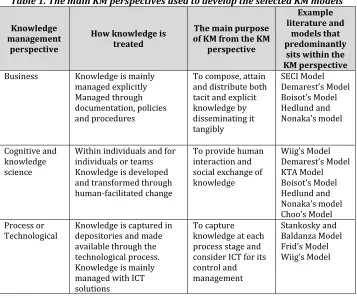
The area of KM has been described as multifaceted and characterized by several studies focusing on a variety of perspectives which have resulted with an incremental number of definitions and models (Dalkir, 2013). Generally speaking, from their origins there are three main perspectives where KM focuses, business, cognitive or knowledge science and as a process particularly on technology. These three main perspectives are illustrated in table 1.
Table 1. The main KM perspectives used to develop the selected KM models
Knowledge management
perspective
How knowledge is treated
The main purpose of KM from the KM
perspective
Example literature and
models that predominantly
sits within the KM perspective Business Knowledge is mainly
managed explicitly Managed through documentation, policies and procedures
To compose, attain and distribute both tacit and explicit knowledge by disseminating it tangibly SECI Model Demarest’s Model Boisot’s Model Hedlund and Nonaka’s model Cognitive and knowledge science
Within individuals and for individuals or teams Knowledge is developed and transformed through human-facilitated change
To provide human interaction and social exchange of knowledge Wiig’s Model Demarest’s Model KTA Model Boisot’s Model Hedlund and Nonaka’s model Choo’s Model Process or
Technological Knowledge is captured in depositories and made available through the technological process. Knowledge is mainly managed with ICT solutions
To capture knowledge at each process stage and consider ICT for its control and management Stankosky and Baldanza Model Frid’s Model Wiig’s Model
intellectual capacities. As a result, scholars argue, KM is a combined and cooperated technique towards the composition; attaining and distribution of knowledge types (Dalkir, 2013; Massingham & Massingham, 2014).
However, from a different perspective such as knowledge, or cognitive science, knowledge is the essential supply that permits individuals to understand, express and practice the know-how that they possess (Barão, de Vasconcelos, Rocha, & Pereira, 2017). Bratianu (2016, 2018) and Barley, Treem, and Kuhn (2018) argue that through time, knowledge is developed and transformed as a result of social changes where humans have the main role as initiators, facilitators, and receivers. Consequently, knowledge is promoted as the fundamental source of progressing social life and its effectiveness is detected by practices implemented. Recently, Bratianu (2018) develops this cognitive aspect and discusses KM in respect to organizational dynamics from a humanistic perspective and explains that organizational knowledge is of multifold nature formulated as a result of rational knowledge, emotional knowledge, and spiritual knowledge. Making use of metaphors Bratianu (2018, p.14) explains that the energy metaphor “does not transfer the conservation law of energy because knowledge can be created and destroyed”. Bratianu (2018) argues that each of these fields may vary in different organizations in terms of time and space.
Alternatively, from a process and/or technological perspective, knowledge is made available in an understandable and applicable format for the interested people (Dayan, Heisig, & Matos, 2017). As a result, the collective knowledge is utilized to enhance receptiveness and innovation in an organizational context (Barão et al., 2017; Barley et al., 2018; Bratianu, 2016; Dayan et al., 2017). Consequently, forming channels for managing the information required on regular basis to provide knowledge for decision making and achieving the desired developments.
Review of knowledge management models
Tacit
knowledge
Explicit
knowledge
Tacit
knowledge
Explicit
knowledge
Socialization
Externalization
Internalization
Combination
Empathizing
Embodying
Articulating
Connecting
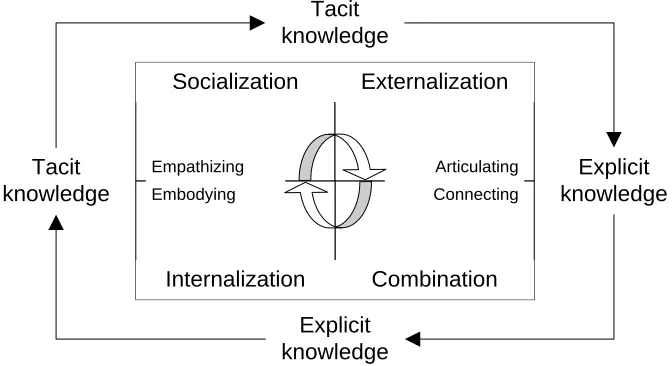
Figure 1. SECI Model (Nonaka & Takeuchi, 1995)
Even though in academic collegiums and industry, the model has been widely promoted for its importance, several shortcomings have been highlighted in regards to validity and reliability of the framework. First and foremost, the study conducted by Nonaka and Takeuchi (1995) involved only Japanese companies and the outcome were internationally generalized and ignoring other countries and organizational socio-cultural values and beliefs.
Second, Gourlay (2006) noted that the percentage of variances attained through confirmatory factor analysis met satisfactory levels for the transforming stages such as socialization and combination but not for externalization and internalization. Thus the survey conducted was capable of validating only two components of the model indicating that the model was potentially flawed.
Third, the methodology used in creating the model was of a case study qualitative approach and as such, it investigated social phenomena of the attributes and factors, which knowledge involves. Particularly, implementation of a case study strategy facilitates the understanding of a complex issue in an organizational context. Hence, a case study expert Yin (2010) suggests generalizability, quantifiability, external validity, and internal reliability are compromised.
The knowledge-to-action process framework
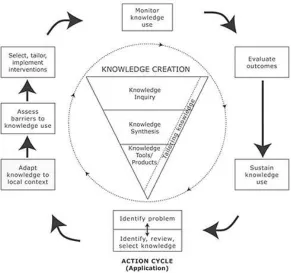
Graham et al. (2006) introduced a conceptual model named knowledge to action (KTA) based on two mechanisms which have been labeled as knowledge creation and implementation through the action cycle, each exemplified by different components.
Figure 2. KTA Model (Graham et al., 2006)
Graham et al. (2006) argued that the effectiveness of the application of the model in improving knowledge management is highly depended on the knowledge creation phase.
The authors of the model (Graham et al., 2006; Graham & Logan, 2004) argue that such models are provided as a guide to implementation and can be and should be adapted to suit individual organizational contexts and maturity. However, the authors are not clear on defining the types of change that might be required, factors influencing any possible changes and if the changes will have an impact on the knowledge creation or action cycle.
Skeptics of this approach say this is perilous as; depending on the need, experience, expertise, and environment settings; the effectiveness of the model might be compromised (Grant, 1996; McAdam & McCreedy, 1999). Additionally, Dalkir (2013) and Evans and Ali (2013) highlight that by not following a standardized flow of the model the individuals in charge might take subjective actions based on their understanding, values, and beliefs which are against several points discussed in the model such as knowledge synthesis.
The Bosiot Space model
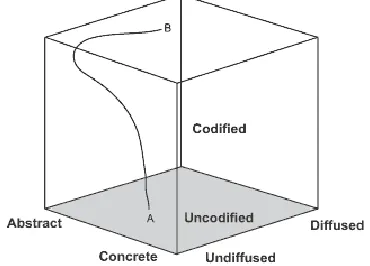
This model, represented in figure 3, classifies knowledge as codified when it can be expressed in a clear written form and is easy to transmit and un-codified, when difficult to dispense and is attained through individual’s experience. Additionally, Boisot (1998) classifies knowledge as diffused and un-diffused depending on the context of knowledge and if it can be distributed.
Personal knowledge is explained as a process that is based on codified and un-diffused expressed through people experiences that might be differently perceived even in the same scenarios. Property knowledge appears to be codified and un-diffused which is commonly categorized as intellectual property and is seen among consultants or categorized by patenting a certain product or service which will be codified and un-diffused.
The model defines the public knowledge is codified and diffused, which is observed in the usage of books, libraries or conferences. This is followed by common sense knowledge which is un-codified but diffused and it is applied through externalization and specialization processes introduced by Nonaka (Choo & Alvarenga Neto, 2010; Hislop, 2013).
Figure 3. Boisot I- Space model (Boisot, 1998)
circumstances and what is the application flow of the model. Furthermore, it is not considered easily accessible and is not widely implemented (Dalkir, 2013).
Hedlund and Nonaka’s Knowledge Management and Transfer model
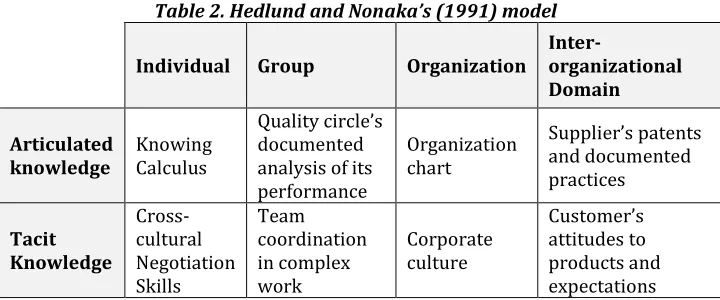
This model, represented in table 2, is established in two distinctive pillars such as types of knowledge being considered and factors that contribute to the process of knowledge transformation.
Table 2. Hedlund and Nonaka’s (1991) model
Individual Group Organization Inter-organizational Domain
Articulated
knowledge Knowing Calculus
Quality circle’s documented analysis of its performance
Organization chart
Supplier’s patents and documented practices
Tacit Knowledge
Cross-cultural Negotiation Skills
Team coordination in complex work
Corporate culture
Customer’s attitudes to products and expectations
The fundamental structure of this model is an endeavor to combine and illuminate aspects of knowledge in several contexts. Authors promote communication among different actors and types of knowledge which might occur at the same time or sequentially.
Furthermore, it can be noted that this model also considers knowledge management and transfer at the outer environment which relates with suppliers, customers and other business partners (Edvardsson & Durst, 2014). Such a model has been appreciated for the academic contribution it has given, however, some criticism has been addressed in regards to the clarity of the model when it comes to application. Critiques of this model value the wider aspects this model represents in terms of involving several factors and discussing knowledge development and distribution but they argue that the core elements of the model are deriving from Nonaka’s model which receives similar critique (Massaro, Dumay, & Garlatti, 2015; Massaro, Pitts, Zanin, & Bardy, 2014; McAdam & McCreedy, 1999; Nafei, 2014).
Knowledge Chaotic
Knowledge Centric
Knowwldge Managed
Knowledge Focused
Knowledge Aware
Understand and implement objectives, vision and other KM indices
Advocating and adopting departmental KM vision and goals
Focus on new activities
Implant KM in business strategy through performance reviews and business plans
Institutionalise initiatives and evaluate intellectual assets
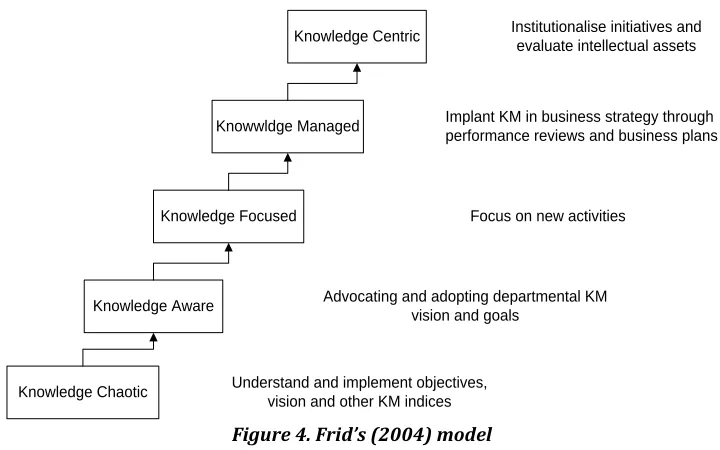
Figure 4. Frid’s (2004) model
‘Knowledge chaotic’ is stage 1 of the model, at this stage the company is considering the implementation of the KM model by encompassing a mixture of vision, objectives and other KM indices. It is vitally important to introduce and collect departmental knowledge which will later be used in more details.
Following the initial step, stage 2 is ‘knowledge aware’ stage where management at this stage need to compose a KM plan which would facilitate the collaboration amid different departments and individuals among organization by increasing and embedding KM vision and goals.
The ‘knowledge focus’ stage according to Frid (2004), is when organizations have already drawn the vision and established KM plan and now need to act technically within the organization. In other words, the KM is initiated by creating the appropriate infrastructure, providing training, evaluate the implementation and offer guidance for new adapters’, consider adjustment and include KM in company’s financial budgets
Step 4, ‘knowledge managed’ stage occurs when KM vision and understanding amid organization is strengthening and embedded within the different department and is utilized by management in order to minimize the risk of the message being transmitted through diverse types of knowledge.
Frid’s 5 Step Process model
being incorporated with the business strategy even though adjustment might be applied.
The highest level of knowledge management application maturity according to Frid is the final stage of ‘knowledge centric.’ This step demonstrates that the company is very KM oriented, has already institutionalized its initiatives and evaluates intellectual assets (Frid, 2004).
This research study argues that Frid’s (2004) model is highly focused on the implementation and measuring the maturity of knowledge thus potentially disregarding the elements required to introduce and maintain a KM strategy through an effective measurement and feedback loop.
Stankosky and Baldanza Enabling Factors and Disciplines model
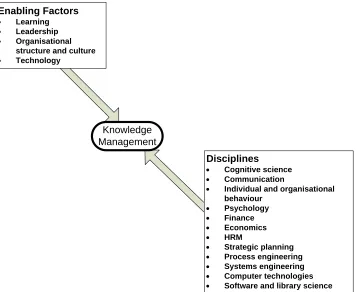
This model was established on the grounds of factors that enable KM and a successful implementation by highlighting the importance of learning, leadership, organization, structure, culture, and technology. Due to the very large scope of KM field, Stankosky and Baldanza (2001) have centered their theory on crucial organizational elements related to leadership, organization’s structure, technology, and learning.
Enabling Factors
· Learning · Leadership · Organisational
structure and culture · Technology
Disciplines
· Cognitive science · Communication
· Individual and organisational behaviour
· Psychology · Finance · Economics · HRM
· Strategic planning · Process engineering · Systems engineering · Computer technologies · Software and library science Knowledge
Management
Serenko et al. (2010) and Parent, MacDonald, and Goulet (2014) recognize the beneficial aspects of this model in understanding what components and resources are required to apply KM in an organization. However, Stankosky and Baldanza (2001) do not discuss issues on knowledge creation, capturing and distributing channels. Accordingly, critiques of this model, Ragab, and Arisha, (2013) noted that this model contributes in creating a roadmap for a KM model but the cycle of knowledge movement within the organization is not explained therefore rising doubts how knowledge will be managed following implantation of KM practices.
Kogut and Zandler Competitive Advantage model
The approach of this model is based on the groundwork of knowledge-based theory which treats knowledge as a source of competitive advantage.
Knowledge Creation
Efficient Firms Competitive Advantage
Individual “Unsocial Sociality” Knowledge Capabilities
Knowledge Transfer
Process & Transformation
of Knowledge
Kogut and Zandler (1992) consider organizations as social communities where know-how is not maintained only tacitly but also explicitly through documentation, procedures, and internal processes. Consequently, organizations are classified as a repository of capabilities because of the social interaction among and with employees which fosters the embedment of knowledge. This is completed through organizing principles which the model creators define as;
“...the organizing knowledge that establishes the context of discourse and coordination among individuals with disparate expertise and that replicates the organization over time in correspondence to the changing expectations and identity of its members”
(Kogut & Zandler, 1992, p.388).
Critiques that have supported the Kogut and Zandler (1992) model have acknowledged the usefulness in the multinational enterprise but have not mentioned the efficacy of such in smaller and more local organizations, thus this may put some doubt into the generalizability of the model particularly for SMEs’.
Choo’s Sense-Making model
The Choo (1998) model focuses on the significance of information and how it can be utilized for sense-making, knowledge creation, and decision making. A continuous combination of these three principles forms the basis for a strategic knowledge management vision for the organization Choo (1998) argues.
Information and
External Knowledge Next Knowledge Cycle
Streams of
Experience Sense Definition
Shared Meanings
Knowledge Creation
Decision
New Knowledge New Capabilities
Shared M
eaning s
Figure 7. Sense-making model (Choo, 1998)
organizations through the stages of implementation of knowledge management systems and practices.
Wiig Model of Knowledge Levels and Knowledge Types
This model as illustrated in table 3 and table 4 promotes a social approach which involves human participation in building and using knowledge depending on the purpose and its context. Within the model, Wiig (1993) proposes four approaches of knowledge such as completeness, connectedness, congruency, and perspective and purpose. Therefore, and foremost, the model discusses knowledge from an internalization viewpoint through different levels which Wiig (1993) has categorized from a novice to a master as in the following table:
Table 3. Degrees of internalization in Wiig (1997) model
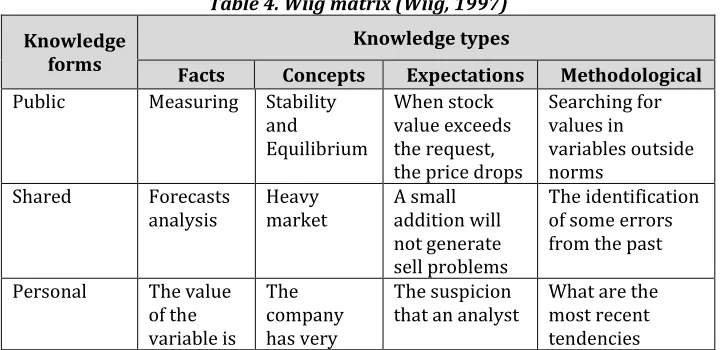
The Wiig matrix, table 4 shows the four knowledge types and how they manifest as public, shared and personal knowledge forms.
Table 4. Wiig matrix (Wiig, 1997) Knowledge
forms
Knowledge types
Facts Concepts Expectations Methodological Public Measuring Stability
and
Equilibrium
When stock value exceeds the request, the price drops
Searching for values in
variables outside norms
Shared Forecasts
analysis Heavy market A small addition will not generate sell problems
The identification of some errors from the past
Personal The value of the variable is
The company has very
The suspicion
that an analyst What are the most recent tendencies
Level Category Explanation
1 Novice Unacquainted of the existing knowledge and the purpose to use it for
2 Beginner Aware of the existing knowledge and what to use it for, however is not involved with it
3 Competent Conscious of the exiting knowledge and its usage internally and externally through documents and socialization 4 Expert High authority of knowing and storing the knowledge in
person, comprehending areas of usage and its purpose 5 Master Has a deep understanding and applies a full integration of
the most
used good references made a mistake
The Wiig KM model can be regarded as very realistic approach and be combined or tested with other models or perspectives. Such a framework contributes to the academics and practitioners by allowing a deeper view than simply tacit or explicit knowledge. However, a limitation of this model may be the lack of applications of the model in industry and consequently appears to be little or no detailed feedback about the experiences of the use or application of the model.
Demarest’s Knowledge Construction and Utilization model
This Demarest (1997) model is created with a particular focus on the construction of knowledge and sees management of knowledge as a social approach rather than a scientific contribution. Demarest (1997) suggested accordingly that created knowledge is embedded in an organization, not only through knowledge expressed explicitly, but through promoting a social interaction among staff and departments (McAdam & McCreedy, 1999). The arrows in figure 8 illustrate that KM is not considered as a sequential process but it can be utilized in different patterns as depending on the type of knowledge, owner and the need for it (Choo, 2006; Davenport, De Long, & Beer,1998; McAdam & McCreedy, 1999).
Scientific Paradigm
Knowledge Embodiment
Employee Emancipation Business Benefits
Social Paradigm
Knowledge Dissemination
Knowledge Management Utilise
Knowledge Construction
Figure 8. Demarest model (McAdam & McCreedy, 1999)
Although Demarest (1997) discusses embodiment of knowledge management, the focus of the Demarest (1997) model is on the creation and construction of a knowledge management system and Demarest (1997) does not present much in the way of directing implementation and suggesting detailed methods of embedment of successful KM.
Discussing the proposed guiding framework for KM model building
Having said this, the ten models discussed above do not individually present a thorough consideration of KM components and principles. Authors have named the models as KM models; however, they emphasize on certain categories such as knowledge creation, knowledge transfer or sharing and knowledge implementation rather than all aspects of knowledge management. If claiming to produce a holistic KM model all aspects should be covered and investigated for further integration. The effectiveness of a KM model is in doubt unless all the above concepts are covered and synergized accompanied by appropriate guidance for adequate utilization. Table 5 illustrates the focal point of each model critiqued in this research study. Also, table 5 explains the context in which each model has been created. There is a need for academics to reframe the meaning of KM and/or clearly state at what stage of KM field their model emphasizes. Otherwise, the generation of models within this area will cause confusion and mislead scholars and practitioners for further development.
Table 5. The scope and context of KM models investigated Model Management Knowledge
Emphasis Contextualization
SECI (Nonaka & Takeuchi, 1995)
Knowledge creation
Focused on the transition and transformation of knowledge through socialization, externalization, combination, and internalization. Developed from knowledge of the Japanese automotive industry.
KTA (Graham et al., 2006)
Knowledge creation and implementation
Synergizing the inquiries, tools, and products for the knowledge creation combining with knowledge implementation form the basis of a successful KM strategy. Created with a healthcare framework practice perspective in Canada.
Boisot (1998) Knowledge classification Considers the states of knowledge as codified and un-codified and its transferability as diffusible or un-diffusible. Considering knowledge as an asset.
Hedlund and Nonaka’s model (1991) Inter-relation of articulated and tacit knowledge
The emphasis is to combine different aspects of knowledge with actors involved in organizational management and this might occur at the same time or sequentially. Comparison of West and Japanese case studies.
Frid’s (2004) Knowledge maturity
Provides a 5 step model to apply KM and evaluate the maturity of it as the implementation process progresses. Developed with reference to the Canadian Government. Stankosky and Baldanza (2001) Knowledge enablers
Recommend the applicability of KM through leadership, organizational structure, technology, and learning. The model developed from an engineering perspective. Kogut and Zandler (1992) Knowledge for competitive advantage
Choo’s (1998) Knowledge for sensemaking
Highlights the significance of information as an initial step leading towards knowledge creation and decision making which overall form the grounds for implementing KM within the organization. Using the concepts of Nonaka assessed literature of practical experiences of organizations.
Wiig (1997) Knowledge embedment and accessibility
It analyses the internalization of knowledge and categorizes it in three different forms and four different types allowing knowledge to be studied from different angles depending on the scenario given. Focused on the internalization of knowledge and its management.
Demarest
(1997) Knowledge construction
This model treats knowledge as a social attribute that is effectively constructed through a stable social coordination of individuals, procedures, and processes.
Authors of KM models within their clarification of constructs claim to provide a holistic KM model but when referring back to the central meaning of knowledge and management concepts they do not generate a thorough coverage of the required characteristics and components. Considering the epistemology and ontology of the theories presented in the models as shown in table 5 they can be classified as mechanistic and/or social approaches. This is reflected in the nature of models being promoted where one school of thought treats knowledge mechanistically, framing it as an asset, and other theorists discussed it from a social perspective emphasizing the creation and transferring of knowledge based on scenarios, individuals’ needs and willingness.
Considering the differences between these schools, it can be understood that knowledge is created through a social interaction, however, a more mechanistic approach is required to embed, materialize and distribute it among the organization departments. As a result, a model that would combine these concepts is believed to provide a wider coverage of the KM field and generate a realistic model that can be validated in a commercial enterprise.
This research study proposes a framework where certain components are included for a significant consideration in composing a KM model for individual purposes. As observed, the majority of models discussed take under analysis sequential parts of KM such as knowledge creation, transferring, application or embedment, which contribute to a KM system overall, however not all models complete the whole picture of managing knowledge. Therefore, for the use by organizational researchers, knowledge management practitioners and business analysts this research study proposes the following guiding framework as a pre-requisite in assuring a well-developed individualized KM model depending entirely on organizational context.
Table 7. The proposed guiding framework for KM model building Identify and embed both KM approaches Establish Processes for each Knowledge Processing Stage Recognize all Knowledge Forms & Types Identify and Implement Necessary Resources Ensure the Management of KM Facilitating Factors Social Constructivism and Mechanistic/ Materialistic Identify needs & Initiate creation
Explicit Individuals / teams / departmental staff Align Leadership and Organization’s Objectives
Establish-Form-Adapt Implicit / Tacit Procedural Documents and Controls
Utilize Cultural traits
Test-Validate-Classify Personal Hardware Tools / equipment Support Socio-organizational processes
Apply- Embed Procedural
Know-How KM Expertise Embed Incentive and Rewarding Mechanisms
Share and
Transfer Records of Review and Funds for
The Focus of Managing Knowledge in the Models
Creation and
construction Managing the Types, Forms, and Transfer Embedment or Implementation · SECI (Nonaka &
Takeuchi, 1995) · Choo (1998) · Demarest (1997) · KTA (Graham et al.,
2006)
· Boisot (1998) · Wiig (1997)
· Hedlund and Nonaka (1991) · Kogut and Zandler (1992)
· Frid (2004)
· Stankosky and Baldanza (2001)
Monitoring
Meetings KM focused Facilities Management Evaluate and
Improve Process and Activity Records
IT Platforms and Databases hardware / software
Continual Assess and Improve IT Systems
Firstly, the left-hand column of Table 7 suggests the creation of a KM model should be based on a clear and justifiable theory which might be of one or a combination of philosophical, social, mechanistic or intellectual approaches. Secondly, the next column calls for analysis, establishment, and improvement of each stage of knowledge processing which starts by identifying the need for knowledge till it has been embedded and is ready to share or transfer to the interested participants or parties. Thirdly, supporting knowledge transfer stages there should be a clarification of the forms and type of knowledge required and produced from each of the knowledge processing stages. Fourthly, there is a need to identify the resources required for supporting the process of managing knowledge which might require the involvement of all components simultaneously or a combination of individual elements. Fifth, represented by the right-hand column of table 7, any model composed ought to emphasize the applicability of the model and its enablers or facilitators by considering different aspects such as leadership organizational structure and culture. This proposed framework which is generated as a consequence of this critical review will be the subject of further studies in attempting to develop a KM model.
The review shows that only Graham et al. (2006) explicitly promotes the evaluation of knowledge management practices following the implementation and embedment of those practices. Nevertheless, other models such as Hedland and Nonaka (1991) examine analysis of team performance and Frid (2004) discusses the institutionalization and evaluation stage while Demarest (1997) includes business benefit these do not extensively consider the evaluation of knowledge management implementation. This research study proposes that an explicit emphasis is placed on evaluation of knowledge management hence review and monitoring, evaluation and improvement are shown in the framework for KM model building, table 7.
Discussing the findings
expanding on previous concepts presented to propose a knowledge multifield construct. Bratianu presents that model with three fields of Rational Knowledge, Spiritual Knowledge, and Emotional Knowledge. Other modern perspectives of KM also exist such as Cerroni (2018) discusses knowledge within a construct of society, ending up with a typology encompassing three knowledge families (intellectual, practical and objectified) and three ways of access (direct personal knowing, indirect social acquaintance, externally recognized and personally interjected knowledge). More models are likely to emerge that transcendent current thinking of KM beyond Bratianu’s (2018) thought-provoking multifield model and further stretching Cerroni’s (2018) societal viewpoint.
Despite the widespread and evolving availability of literature on knowledge management modeling, the conduct of this investigation provides the following contributions to the understanding of knowledge management models and knowledge management modeling:
1- The need for practitioners to individualize a KM model
Several scholars (Boisot, 1998; Choo, 1998; Demarest, 1997; Frid, 2004; Nonaka & Takeuchi, 1995) have been studying and providing perspectives on developing knowledge and revolve it into organization’s benefit. However, the models being introduced and selected for the purpose of this research study do not clearly provide a completed view of KM. As it can be seen from table 6 the selected models treat knowledge from different angles, such as knowledge creation, codification, application, transfer, hence define it as KM. This work considers KM as a synergy of all of the above scopes and proposes a categorization of components (see table 7) required for building an individualized KM model. When building a KM model for a particular context KM element should be considered for the composition depending upon the scenario or the reasons for modeling.
2- The Validity, Applicability, and Generalizability
The majority of the KM models have been limited in terms of testing and validating. For instance, the SECI model receives criticism as a result of being generated from Japanese companies which have a different managerial philosophy when compared with western enterprises. Also, the model its self is very simplistic when discussing knowledge creation and its transfer. On the other hand, the KTA model appears to be very realistic in comparison with several models as it involves both aspects of creation and application, however, this model was generated from the health sector and more testing and application should be completed for further analysis. The proposition of the new framework as table 7 for KM model building allows model creators or assessors of KM to construct according to their own context.
3- Defining the criteria required for building a KM model
a certain criterion that creation of a KM model should include. The table 7 framework overcomes problems seen in the literature which appears to be very diverse and some models are considered ambiguous due to the validity, simplicity or have not been tested sufficiently for unarguable results. In addition, there is a vague depiction of how these models capture, process and distribute and at what extent the generated knowledge will be useful to the interested audience or party.
4- Contribution to the science of KM
The proposed guiding framework for KM model building has shown that two scientific perspectives are needed to provide a holistic view of knowledge when modeling. The two perspectives are shown in figure 7 as needed to be the embedded approaches of (i) Social Constructivism and (ii) Mechanistic/ Materialistic. Having a purely mechanistic approach will provide a predominantly synthetic model, while having a purely social constructivist approach may provide a more empathetic approach but not necessarily resulting in the infrastructures required for institutional knowledge processing. This paper argues the premise that one approach without the other will not provide a holistic model of KM.
Implications and recommendations for policy, practice, and research
The assessment of the efficacy of the conceptual KM models presented in this research study has led to the development of table 7 which is a proposed framework for knowledge management model building. The proposed framework is a guide for practitioners and researchers alike and it is highly recommended that policymakers within organizations utilize the framework too. The way in which the framework is envisaged as having value is fourfold as:
1. A tool for the organizational self-assessment of maturity of knowledge management within an organization, in a manner, that other self-assessment tools such as the European Foundation for Quality Management (EFQM) are used. Similarly, this is an audit tool which can be used to assess knowledge management and identify opportunities for improvement of knowledge transfer.
2. A guide to knowledge management professionals in understanding the requirements necessary for a holistic model of an organizations’ knowledge management system. This allows users of the framework to model their own organization's knowledge management systems.
3. A benchmarking tool in which policymakers, practitioners, industry observers, and researchers can critically examine interrelated and interconnected parts of an organizations management of knowledge. Benchmarking KM could be an organizations way of comparing and contrasting intergroup or across sector knowledge management in order to improve competitive advantage through better practices of knowledge management.
Notwithstanding the aforementioned fourfold immediate possibilities of use of the new framework for KM model building this research study does not claim to be flawless in its approach to understanding existing KM models. On the contrary, as with all conceptual papers limitations of the research do exist in abundance as described next.
Limitations of the research and recommendations for further research
This research study has looked extensively at ten conceptual KM models and consequently has provided a better understanding of knowledge management its implementation, adaption and adoption by organizations. While the sample provides a reasonable number of models under investigation, that number is by no means exhaustive and not all available KM models have been investigated, the findings have merit for policymakers, practitioners and researchers presented in the implications and recommendations above. There is no doubt, that an opportunity exists to assess the generalizability of findings by using the newly developed framework for KM model building in the fourfold manner expressed above. Nevertheless, the careful choice of the ten KM models is arguably representative of the current understanding of knowledge management. Future studies, however, might want to add to this research study by considering input responses from elite respondents that have evidenced their senior role involvement in knowledge management within organizations, those studies may want to further challenge the framework presented and thus clarify, adapt or even considerably alter the framework.
The main analysis being a conceptual review of KM models is not an empirical investigation and even though this research study presents a conceptual framework for KM model building, it does consider the shortfalls discovered during the analysis. While there were clear conceptual reasons for comparing and contrasting the ten conceptual models of KM it is recognized that the essence of this review lies in summarizing, synthesizing, discussing, criticizing and, showing research gaps but has not gathered empirical or quantitative data for analysis. Thus, future research might further open up the understanding of KM with observational studies, longitudinal studies or more appropriately ethnographical studies were researchers with a deep understanding of KM can be directly involved in KM activities and gather empirical data using the developed framework as a conceptual research guide. The emerging model recently presented by Bratianu (2018) explains knowledge dynamics in an organizational context and further research may assess implications of this thought-provoking multifield knowledge model towards enhancing particular issues related to KM and organizational performance.
References
Alavi, M., and Leidner, D.E. (2001). Review: Knowledge management and knowledge management systems: Conceptual foundations and research issues, MIS Quarterly, 25(1), 107-136.
Barão, A., de Vasconcelos, J.B., Rocha, Á., and Pereira, R. (2017). A knowledge management approach to capture organizational learning networks. International Journal of Information Management, 37(6), 735-740. Barley, W.C., Treem, J.W., and Kuhn, T. (2018). Valuing multiple trajectories of
knowledge: A critical review and agenda for knowledge management research. Academy of Management Annals, 12(1), 278-317.
Boisot, M. (1998). Knowledge assets, Oxford: Oxford University Press. Booker, L.D., Bontis, N., and Serenko, A. (2008). The relevance of knowledge
management and intellectual capital research. Knowledge and Process Management, 15(4), 235-246.
Bratianu, C. (2013). The triple helix of the organizational knowledge. Management Dynamics in the Knowledge Economy, 1(2), 207-220.
Bratianu, C. (2016). Knowledge dynamics. Management Dynamics in the Knowledge Economy, 4(3), 323-337.
Bratianu, C. (2018). A holistic view of the organizational knowledge dynamics. Holistica Journal of Business and Public Administration, 9(2), 7-22.
Cerroni, A. (2018). Steps towards a theory of the knowledge-society. Social Science Information, 57(2), 322-343.
Choo, C.W. (1998). The knowing organization. Oxford: Oxford University Press. Choo, C.W. (2006). The knowing organization: How organizations use information to
construct meaning, create knowledge, and make decisions. Oxford: Oxford University Press.
Choo, C.W., and Alvarenga Neto, R. (2010). Beyond the BA: managing enabling contexts in knowledge organizations, Journal of Knowledge Management, 14(4), 592-610.
Choo, C.W., and Bontin, N. (2002). The Strategic Management of Intellectual Capital and Organizational Knowledge. Oxford: Oxford University Press.
Dalkir, K. (2013). Knowledge management in theory and practice. London: Routledge.
Davenport, T., De Long, D., and Beer, M.C. (1998). Successful knowledge management projects. Sloan Management Review, 39(2), 43-57.
Davenport, T.H., and Prusak, L. (2000). Working Knowledge: How Organizations Manage What They Know. Boston: Harvard Business School Press.
Dayan, R., Heisig, P., and Matos, F. (2017). Knowledge management as a factor for the formulation and implementation of organization strategy. Journal of Knowledge Management, 21(2), 308-329.
Demarest, M. (1997). Understanding knowledge management, Long range planning, 30(3), 321-384.
Edvardsson, I.R., and Durst, S. (2014). Outsourcing of knowledge processes: a literature review. Journal of Knowledge Management, 18(4), 795-811. Evans, M.M., and Ali, N. (2013). Bridging knowledge management life cycle theory
Intellectual Capital, Knowledge Management and Organisational Learning (pp.156-165). Reading: ACPI.
Frid, R.J. (2004). Frid framework for enterprise knowledge management, A common KM framework for the Government of Canada. Lincoln, NE: iUniverse. Frost, A. (2014). A Synthesis of Knowledge Management Failure Factors. Retrieved
on April1, 2014 from www.knowledge-management
tools.net/A_Synthesis_of_Knowledge_Management_Failure_Factors.pdf. Gourlay, S. (2006). Conceptualizing knowledge creation: a critique of Nonaka’s
theory. Journal of Management Studies, 43(7), 1415-1436.
Graham, I.D., and Logan, J. (2004). Innovations in knowledge transfer and continuity of care. Canadian Journal of Nursing Research, 36(2), 89-103. Graham, I.D., Logan, J., Harrison, M.B., Straus, S.E., Tetroe, J., and Caswell, W. (2006).
Lost in knowledge translation: Time for a map?, The Journal of Continuing Education in the Health Professions, 26(1), 13-24.
Graham, K., and Logan, J. (2004). Using the Ottawa Model of Research Use to implement a skin care program. Journal of Nursing Care Quality, 19(1), 18-24. Grant, R.M. (1996). Toward a knowledge-based theory of the firm. Strategic
Management Journal, 17(S2), 109-122.
Hedlund, G., and Nonaka, I. (1991). Models of knowledge management in the West and Japan. In Lorange, P., Chakravarthy, B., and Roos, J. (Eds.), Implementing Strategic Process: Change, Learning and Cooperation (pp.117-144). Oxford: Basil Blackwell.
Hislop, D. (2013). Knowledge management in organizations: A critical introduction. Oxford: Oxford University Press.
Kogut, B., and Zander, U. (1992). Knowledge of the firm, combinative capabilities, and the replication of technology. Organization Science, 3(2), 383-397. Kogut, B., and Zander, U. (1996). What firms do? Coordination, identity, and
learning. Organization Science, 7(5), 502-518.
Massaro, M., Dumay, J., and Garlatti, A. (2015). Public sector knowledge management: A structured literature review. Journal of Knowledge Management, 19(3), 530-558.
Massaro, M., Pitts, M., Zanin, F., and Bardy, R. (2014). Knowledge Sharing, Control Mechanisms and Intellectual Liabilities in knowledge-intensive firms, Electronic Journal of Knowledge Management, 12(2), 117-127. Massingham, P., and Massingham, R. (2014). An evaluation of knowledge
management tools part 1: managing knowledge resources. Journal of Knowledge Management, 18(5), 1075-1100.
McAdam, R., and McCreedy, S. (1999). A critical review of knowledge management models. The learning organization, 6(3), 91-101.
Nafei, W. (2014). Knowledge Management and Organizational Learning from the Employee Perspectives: A Study from Saudi Arabia Context. Journal of Management and Strategy, 5(1), 73-87.
Nonaka, I., and Takeuchi, H. (1995). The knowledge-creating company: how Japanese companies create the dynamics of innovation. Oxford: Oxford University Press. Parent, M.M., MacDonald, D., and Goulet, G. (2014). The theory and practice of
Ragab, M.A.F., and Arisha, A. (2013). Knowledge management and measurement: a critical review. Journal of Knowledge Management, 17(6), 873-901.
Riege, A. (2005). Three-dozen knowledge-sharing barriers managers must consider. Journal of Knowledge Management, 9(3), 18-35.
Serenko, A., Bontis, N., Booker, L., Sadeddin, K., and Hardie, T. (2010). A
scientometric analysis of knowledge management and intellectual capital academic literature (1994-2008). Journal of Knowledge Management, 14(1), 3-23.
Smallbone, D., Welter, F., Isakova, N., and Slonimski, A. (2001). The Contribution of
Small and Medium Enterprises to Economic Development in Ukraine and Belarus: Some Policy Perspectives.Economic Policy in Transitional
Economies Journal, 11(3), 253-273.
Stankosky, M.A., and Baldanza, C. (2001). A systems approach to engineering: a
knowledge management system. In Barquin, R.C., Bennet, A., and Remez,
S.G. (Eds.), Knowledge Management: The Catalyst of Electronic Government
(pp.263-282). Virginia: Management Concept.
Suorsa, A.R. (2015). Knowledge creation and play - a phenomenological
approach. Journal of Documentation, 71(3), 503-525.
Wiig, K.M. (1993). Knowledge management foundations: thinking about thinking.
How people and organizations create, represent and use knowledge.
Arlington: Schema Press.
Wiig, K.M. (1997). Knowledge management: where did it come from and where
will it go?. Expert Systems with Applications, 13(1), 1-14.
Yin, R.K. (2010). Qualitative research from start to finish. New York: Guilford
Press.