5.1 VISUALIZING THE CONCEPT: Membranes
are fluid mosaics of lipids and proteins with
many functions
• Biologists use the fluid mosaic model to describe a membrane’s structure, a patchwork of diverse
protein molecules embedded in a phospholipid bilayer.
• The plasma membrane exhibits selective permeability.
• The proteins embedded in a membrane’s
5.3 Passive transport is diffusion across a
membrane with no energy investment
• Diffusion is the tendency of particles to spread out
evenly in an available space.
• Particles move from an area of more concentrated particles to an area where they are less
concentrated.
• This means that particles diffuse down their
concentration gradient.
• Eventually, the particles reach dynamic equilibrium, where there is no net change in concentration on either side of the membrane.
Figure 5.3a
Molecules of dye
Pores
Membrane
© 2015 Pearson Education, Inc.
Figure 5.3b
Net diffusion Net diffusion Equilibrium
5.3 Passive transport is diffusion across a
membrane with no energy investment
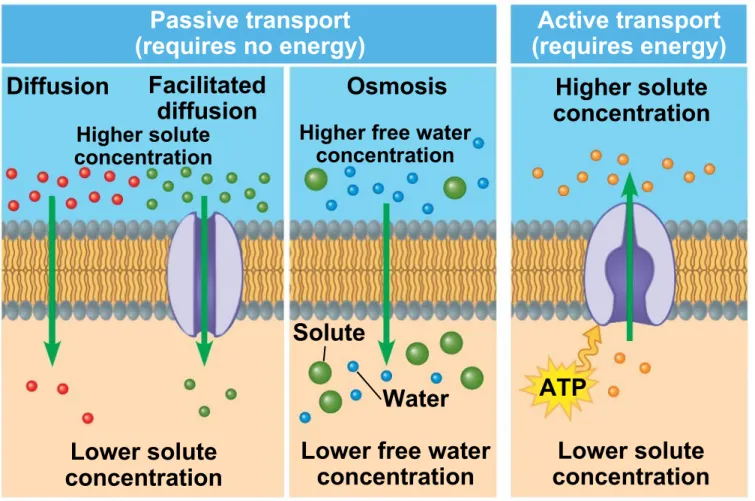
• Diffusion across a cell membrane does not require energy, so it is called passive transport.
• Diffusion down concentration gradients is the sole means by which oxygen enters your cells and
Animation: Diffusion
5.4 Osmosis is the diffusion of water across a
membrane
• One of the most important substances that crosses membranes by passive transport is water.
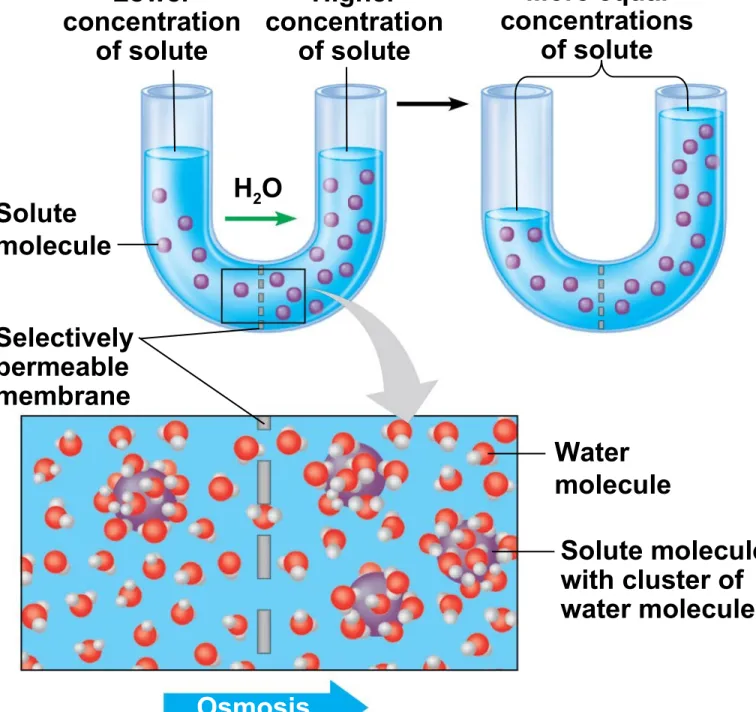
• The diffusion of water across a selectively permeable membrane is called osmosis.
5.4 Osmosis is the diffusion of water across a
membrane
• If a membrane, permeable to water but not to a solute, separates two solutions with different
concentrations of solute, water will cross the
membrane, moving down its own concentration gradient, until the solute concentration on both sides is equal.
Figure 5.4 Solute molecule Selectively permeable membrane Water molecule Solute molecule with cluster of water molecules
Osmosis
5.5 Water balance between cells and their
surroundings is crucial to organisms
• Tonicity is a term that describes the ability of a
surrounding solution to cause a cell to gain or lose water.
• The tonicity of a solution mainly depends on its
concentration of solutes relative to the concentration of solutes inside the cell.
5.5 Water balance between cells and their
surroundings is crucial to organisms
• How will animal cells be affected when placed into solutions of various tonicities?
• In an isotonic solution, the concentration of solute is the same on both sides of a membrane, and the cell volume will not change.
• In a hypotonic solution, the solute concentration is lower outside the cell, water molecules move into the cell, and the cell will expand and may burst.
• In a hypertonic solution, the solute concentration is
© 2015 Pearson Education, Inc. Figure 5.5 Animal cell Plant cell Hypotonic solution
(lower solute levels) (equal solute levels)Isotonic solution (higher solute levels)Hypertonic solution
H2O
Lysed Normal Shriveled
Turgid (normal) Flaccid
Plasma membrane
Shriveled (plasmolyzed)
H2O H2O H
2O
H2O H2O
5.5 Water balance between cells and their
surroundings is crucial to organisms
• For an animal cell to survive in a hypotonic or hypertonic environment, it must engage in
5.5 Water balance between cells and their
surroundings is crucial to organisms
• The cell walls of plant cells, prokaryotes, and fungi make water balance issues somewhat different.
• The cell wall of a plant cell exerts pressure that
prevents the cell from taking in too much water and bursting when placed in a hypotonic environment.
• But in a hypertonic environment, plant and animal cells both shrivel.
5.6 Transport proteins can facilitate diffusion
across membranes
• Hydrophobic substances easily diffuse across a cell membrane.
• However, polar or charged substances do not easily cross cell membranes and, instead, move across membranes with the help of specific
transport proteins in a process called facilitated
diffusion, which
• does not require energy and
© 2015 Pearson Education, Inc.
Figure 5.6
Solute molecule
5.6 Transport proteins can facilitate diffusion
across membranes
• Some proteins function by becoming a hydrophilic tunnel for passage of ions or other molecules.
• Other proteins bind their passenger, change
shape, and release their passenger on the other side.
5.6 Transport proteins can facilitate diffusion
across membranes
• Because water is polar, its diffusion through a
membrane’s hydrophobic interior is relatively slow.
• The very rapid diffusion of water into and out of
certain cells is made possible by a protein channel called an aquaporin.
5.8 Cells expend energy in the active
transport of a solute
• In active transport, a cell must expend energy to move a solute against its concentration gradient.
• The energy molecule ATP supplies the energy for most active transport.
Animation: Active Transport
Figure 5.8-3 Transport protein Solute ATP Solute binds to transport protein. ATP provides energy for change in protein shape.
Protein returns to original shape and more solute can bind.
5.9 Exocytosis and endocytosis transport
large molecules across membranes
• A cell uses two mechanisms to move large molecules across membranes.
1. Exocytosis is used to export bulky molecules,
such as proteins or polysaccharides.
2. Endocytosis is used to take in large molecules.
• In both cases, material to be transported is packaged within a vesicle that fuses with the membrane.
5.9 Exocytosis and endocytosis transport
large molecules across membranes
• There are two kinds of endocytosis.
1. Phagocytosis is the engulfment of a particle by
the cell wrapping cell membrane around it, forming a vacuole.
2. Receptor-mediated endocytosis uses
membrane receptors for specific solutes. The region of the membrane with receptors pinches inward to form a vesicle.
Animation: Exocytosis and Endocytosis
Introduction
Animation: Pinocytosis
Animation: Receptor-Mediated Endocytosis
© 2015 Pearson Education, Inc.
Figure 5.UN01
Passive transport
(requires no energy) (requires energy)Active transport
Diffusion Facilitated diffusion Higher solute concentration Lower solute concentration Osmosis
Higher free water concentration
Solute
Water