(www.rdmodernresearch.com) Volume I, Issue II, 2016
1
PRIME LABELING FOR SOME SUNLET
RELATED GRAPHS
V. Ganesan* & Dr. K. Balamurugan**
* Assistant Professor of Mathematics, T.K Government Arts College, Vriddhachalam, Tamilnadu
** Associate Professor of Mathematics, Government Arts College, Thiruvannamalai, Tamilnadu
Abstract:
A graph 𝐺 with vertex set 𝑉 is said to have a prime labeling if its vertices are labeled with distinct integers 1, 2, 3, … . 𝑉 such that for each 𝑥𝑦 the labels assigned to 𝑥 and 𝑦 are relatively prime.A graph which admits prime labeling is called a prime graph. In this paper, we investigate prime labeling for some sunlet related graphs. We also discuss prime labeling in the context of some graph operations namely fusion, duplication, switching and path union.
Key Words: Prime Labeling, Fusion, Duplication, Switching & Path Union
1. Introduction:
In this paper, we consider only finite simple undirected graph. The graph G has vertex set 𝑉 = 𝑉(𝐺) and the edge set 𝐸 = 𝐸(𝐺). The set of vertices adjacent to a vertex
𝑢 of 𝐺 is denoted by 𝑁(𝑢). For notations and terminology we refer to J. A. Bondy and
U.S.R. Murthy [1]. In the present work 𝑆𝑛 denotes sunlet graph with 2𝑛 vertices. We give brief summary of definitions which are useful for the present investigation. Enough literatures available in printed as well as electronics form on different types of graph labeling and more than 1000 research papers have been published so far in past four decades. A current survey of various graphs labeling problem can be found in [4] (J. Gallian, 2009)
Following are the common features of any graph Labeling problem. A set of numbers from which vertex labels are assigned.
A rule that assigns value to each edge. A condition that these values must satisfy.
The notion of prime labeling was introduced by Roger Entringer and was discussed in a paper by A. Tout (1982 P 365-368) [7]. Many researches have studied prime graph for example in H.C. Fu(1994 P 181-186) [3] have proved that path 𝑃𝑛 on 𝑛 vertices is a prime graph.
T.O. Dertsky (1991 P 359-369) [2] have proved that the Cn on 𝑛 vertices is a prime graph. S.M. Lee (1998 P 59 -67) [5] have proved that wheel Wn is a prime graph
iff 𝑛 is even. Around 1980 Roger Entringer conjectured that all tress have prime
labeling, which is not settled till today. The prime labeling for planner grid is investigated by M. Sundaram (2006, P205-209) [6]. In [8] S.K. Vaidhya and K. K. Kanmani) have proved that the prime labeling for some cycle related graphs.
Definition 1.1: If the vertices of the graph are assigned values subject to certain
conditions then it is known as (vertex) graph labeling.
Definition 1.2: Let 𝐺 = 𝑉 𝐺 , 𝐸 𝐺 be a graph with 𝑛 vertices. A bijection
𝑓 ∶ 𝑉 𝐺 → 1, 2, … 𝑛 is called a Prime labeling if for each edge 𝑒 = 𝑢𝑣,
𝑔𝑐𝑑 𝑓 𝑢 , 𝑓 𝑣 = 1. A graph which admits prime labeling is called a prime graph.
Definition 1.3: An independent set of vertices in a graph 𝐺 is a set of mutually
(www.rdmodernresearch.com) Volume I, Issue II, 2016
2
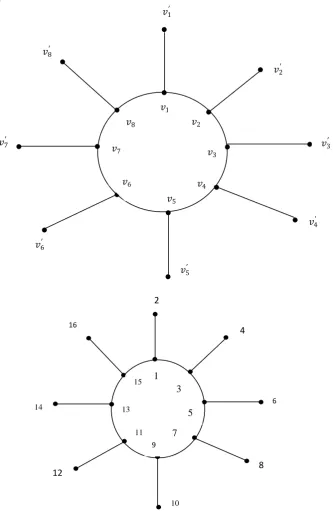
Definition 1.4: The sunlet graph 𝑆𝑛 is the graph obtained from a cycle 𝐶𝑛 attaching a
pendant edge at each vertex of the 𝑛-cycle. Example:
Figure1: A Sunlet graph 𝑆𝑛
Definition1.5: Let 𝑢 and 𝑣 be two distinct vertices of a graph G. A new graph 𝐺1 is
constructed by fusing (identifying) two vertices 𝑢 and 𝑣 by a single vertex 𝑥in𝐺1 such that every edge which was incident with either 𝑢 (or) 𝑣in 𝐺 now incident with 𝑥 in 𝐺1.
Definition 1.6: Duplication of a vertex 𝑣𝑘 of a graph 𝐺 produces a new graph 𝐺1by
adding a vertex 𝑣𝑘′ with 𝑁 𝑣
𝑘′ = 𝑁(𝑣𝑘). In other words, a vertex 𝑣𝑘′ is said to be a duplication of𝑣𝑘 if all the vertices which are adjacent to 𝑣𝑘 are now adjacent to 𝑣𝑘′.
Definition 1.7: A vertex switching 𝐺𝑣 of a graph 𝐺is obtained by taking a vertex 𝑣 of 𝐺,
removing the entire edges incident with 𝑣 and adding edges joining 𝑣 to every vertex which are not adjacent to 𝑣 in 𝐺.
Definition 1.8: Let 𝐺1,𝐺2, 𝐺3, … 𝐺𝑛, 𝑛 ≥ 2 be𝑛 copies of a fixed graph 𝐺. The graph
obtained by adding an edge between 𝐺𝑖 and𝐺𝑖+1for 𝑖 = 1, 2, … 𝑛 − 1 is called the path union of 𝐺.
2. Main Results: Proposition 2.1:
The sunlet graph 𝑆𝑛 is a prime graph. Proof:
Let 𝑆𝑛be a sunlet graph with 2𝑛 vertices and 𝑉 𝑆𝑛 = 𝑣1,𝑣2, … . . 𝑣𝑛, 𝑣1′, 𝑣2′, … . 𝑣𝑛′
𝐸 𝑆𝑛 = 𝑣𝑖𝑣𝑖′/ 1 ≤ 𝑖 ≤ 𝑛 ∪ 𝑣𝑖𝑣𝑖+1 /1 ≤ 𝑖 ≤ 𝑛 − 1 ∪ 𝑣1𝑣𝑛 Here 𝑉(𝑆𝑛) = 2𝑛 when 𝑛is even and odd.
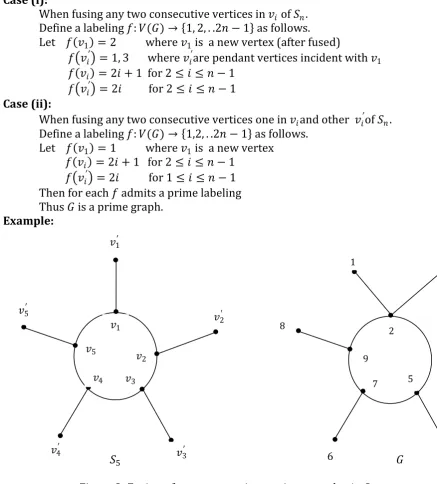
Let 𝑓 𝑣𝑖 = 2𝑖 + 1 for 0 ≤ 𝑖 ≤ 𝑛 − 1 and 𝑓 𝑣𝑖′ = 2𝑖 for 1 ≤ 𝑖 ≤ 𝑛
Since each edge 𝑒 = 𝑣𝑖𝑣𝑖+1 ∈ 𝐺, gcd 𝑓 𝑣𝑖 , 𝑓 𝑣𝑖+1 = 1 And 𝑒 = 𝑣𝑖𝑣𝑖′ ∈ 𝐺, gcd 𝑓 𝑣𝑖 , 𝑓 𝑣𝑖′ = 1 ∴ 𝑓 admits a prime labeling,
Thus 𝑆𝑛 is a prime graph.
𝑣1′
𝑣2′
𝑣3′
𝑣4′ 𝑣𝑛−1′
𝑣𝑛′
𝑣1
𝑣2
𝑣3 𝑣4
(www.rdmodernresearch.com) Volume I, Issue II, 2016
3
Example:
Figure 2: Prime labeling of sunlet graph 𝑆8 Proposition 2.2:
The graph obtained by fusing any two consecutive vertices in a sunlet graph 𝑆𝑛is a prime graph.
Proof:
Let, 𝑉 𝑆𝑛 = 𝑣1,𝑣2, … . . 𝑣𝑛, 𝑣1′, 𝑣2′, … . 𝑣𝑛′
𝐸 𝑆𝑛 = 𝑣𝑖𝑣𝑖′/ 1 ≤ 𝑖 ≤ 𝑛 ∪ 𝑣𝑖𝑣𝑖+1 /1 ≤ 𝑖 ≤ 𝑛 − 1 ∪ 𝑣1𝑣𝑛 Here, 𝑉 𝑆𝑛 = 2𝑛
Let 𝐺 be the graph obtained after fusion of two vertices. ∴ 𝑉 𝐺 = 2𝑛 − 1
1 3
5
7
6 2
4
8
13
11
9
14
16
10
12 𝑣8′
𝑣2′
𝑣5′ 𝑣6′
𝑣7′
𝑣1′
𝑣2 𝑣1
𝑣3 𝑣7
𝑣5 𝑣8
𝑣4 𝑣6
𝑣3′
𝑣4′
(www.rdmodernresearch.com) Volume I, Issue II, 2016
4
Case (i):
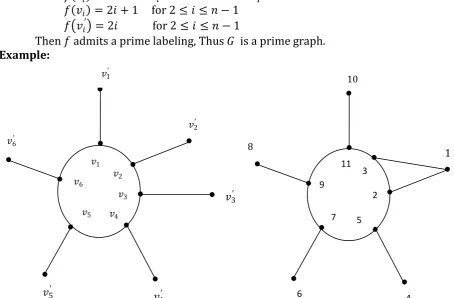
When fusing any two consecutive vertices in 𝑣𝑖 of 𝑆𝑛. Define a labeling 𝑓: 𝑉(𝐺) → 1, 2, . .2𝑛 − 1 as follows. Let 𝑓 𝑣1 = 2 where 𝑣1 is a new vertex (after fused) 𝑓 𝑣𝑖′ = 1, 3 where 𝑣
𝑖′are pendant vertices incident with 𝑣1 𝑓 𝑣𝑖 = 2𝑖 + 1 for 2 ≤ 𝑖 ≤ 𝑛 − 1
𝑓 𝑣𝑖′ = 2𝑖 for 2 ≤ 𝑖 ≤ 𝑛 − 1
Case (ii):
When fusing any two consecutive vertices one in 𝑣𝑖and other 𝑣𝑖′of 𝑆𝑛. Define a labeling 𝑓: 𝑉(𝐺) → 1,2, . .2𝑛 − 1 as follows.
Let 𝑓 𝑣1 = 1 where 𝑣1 is a new vertex 𝑓 𝑣𝑖 = 2𝑖 + 1 for 2 ≤ 𝑖 ≤ 𝑛 − 1
𝑓 𝑣𝑖′ = 2𝑖 for 1 ≤ 𝑖 ≤ 𝑛 − 1
Then for each 𝑓 admits a prime labeling Thus 𝐺 is a prime graph.
Example:
𝑆5 𝐺
Figure 3:Fusion of two consecutive vertices 𝑣1and 𝑣2in 𝑆5. Proposition 2.3:
The graph obtained by fusing any two non-consecutive vertices in a sunlet graph 𝑆𝑛 is a prime graph.
Proof:
Let 𝑆𝑛 be a sunlet graph with 2𝑛 vertices and let 𝑉 𝑆𝑛 = 𝑣1,𝑣2, … . . 𝑣𝑛, 𝑣1′, 𝑣2′, … . 𝑣𝑛′ ,
𝐸 𝑆𝑛 = 𝑣𝑖𝑣𝑖′/ 1 ≤ 𝑖 ≤ 𝑛 ∪ 𝑣
𝑖𝑣𝑖+1 /1 ≤ 𝑖 ≤ 𝑛 − 1 ∪ 𝑣1𝑣𝑛 Here, 𝑉 𝑆𝑛 = 2𝑛
Let 𝐺be the graph obtained after fusion of two non-consecutive vertices in 𝑆𝑛. 𝑉 𝐺 = 2𝑛 − 1
Case (i):
When fusing any two non-consecutive vertices in 𝑣𝑖′ of 𝑆
𝑛. 𝑣5
𝑣1
𝑣2
𝑣4 𝑣3 𝑣1′
𝑣2′
𝑣3′ 𝑣4′
𝑣5′
2
9
7 5
3 1
8
(www.rdmodernresearch.com) Volume I, Issue II, 2016
5
Define a labeling 𝑓: 𝑉(𝐺) → 1,2, . .2𝑛 − 1 as follows. Let 𝑓 𝑣1′ = 1 where 𝑣
1 is a new vertex.
𝑓 𝑣𝑖 = 2, 3 where 𝑣𝑖′ are the vertices incident with 𝑣𝑖′ 𝑓 𝑣𝑖 = 2𝑖 + 1 for 2 ≤ 𝑖 ≤ 𝑛 − 1
𝑓 𝑣𝑖′ = 2𝑖 for 2 ≤ 𝑖 ≤ 𝑛 − 1 Case (ii):
When fusing any two non –consecutive vertices in 𝑣𝑖 of 𝑆𝑛. Define a labeling 𝑓: 𝑉(𝐺) → 1,2, … … … . .2𝑛 − 1 as follows. Let 𝑓 𝑣1 = 1 where 𝑣1 is a new vertex.
𝑓 𝑣𝑖 = 2, 3 where 𝑣𝑖is incident with 𝑣1 𝑓 𝑣𝑖 = 2𝑖 + 1 for 2 ≤ 𝑖 ≤ 𝑛 − 1
𝑓 𝑣𝑖′ = 2𝑖 for 2 ≤ 𝑖 ≤ 𝑛 − 1 Case (iii):
When fusing any two non-consecutive vertices in one in 𝑣𝑖 and other in 𝑣𝑖′ of𝑆
𝑛. Define a labeling 𝑓: 𝑉 𝐺 → 1,2, . .2𝑛 − 1 as follows.
Let 𝑓 𝑣1 = 1 where 𝑣1 is a new vertex 𝑓 𝑣𝑖′ = 2 𝑣
𝑖′ incident with 𝑣1 𝑓 𝑣𝑖 = 3 𝑣𝑖 is incident with 𝑣1 𝑓 𝑣𝑖 = 2𝑖 + 1 for 2 ≤ 𝑖 ≤ 𝑛 − 1 𝑓 𝑣𝑖′ = 2𝑖 for 2 ≤ 𝑖 ≤ 𝑛 − 1
Then 𝑓 admits a prime labeling, Thus 𝐺 is a prime graph. Example:
Figure 4:Fusion of two non-consecutive vertices 𝑣1′of𝑣
2′ sunlet graph is a prime graph. Proposition 2.4:
The graph obtained by duplicating a vertex𝑣𝑘 in the rim of Sunlet graph 𝑆𝑛 is a prime graph.
Proof:
Let, 𝑆𝑛be a sunlet graph with 2𝑛 vertices and 𝑉 𝑆𝑛 = 𝑣1,𝑣2, … . . 𝑣𝑛, 𝑣1′, 𝑣2′, … . 𝑣𝑛′
𝑣3′ 𝑣2′
𝑣1′
𝑣6′
𝑣1 𝑣2
𝑣3 𝑣4 𝑣5 𝑣6
10
1 8
11 3
2
5 7 9
𝑣4′ 𝑣5′
(www.rdmodernresearch.com) Volume I, Issue II, 2016
6
𝐸 𝑆𝑛 = 𝑣𝑖𝑣𝑖′/ 1 ≤ 𝑖 ≤ 𝑛 ∪ 𝑣𝑖𝑣𝑖+1 /1 ≤ 𝑖 ≤ 𝑛 − 1 ∪ 𝑣1𝑣𝑛
Let 𝐺𝑘 be the graph obtained by duplicating the vertex 𝑣𝑘 in 𝑆𝑛 and 𝑣𝑘∗ be the new vertex. Then 𝑉(𝐺𝑘) = 2𝑛 + 1.
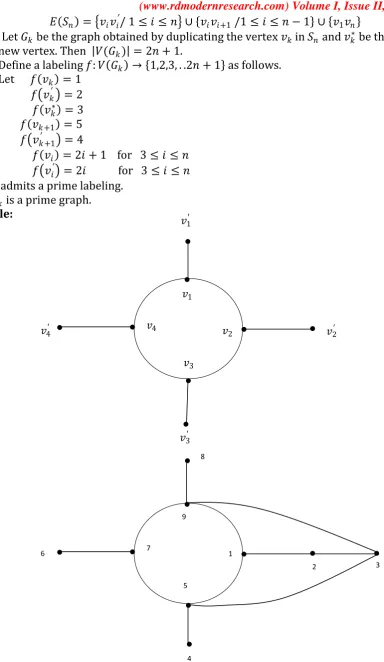
Define a labeling 𝑓: 𝑉 𝐺𝑘 → 1,2,3, . .2𝑛 + 1 as follows. Let 𝑓 𝑣𝑘 = 1
𝑓 𝑣𝑘′ = 2
𝑓 𝑣𝑘∗ = 3 𝑓 𝑣𝑘+1 = 5 𝑓 𝑣𝑘+1′ = 4
𝑓 𝑣𝑖 = 2𝑖 + 1 for 3 ≤ 𝑖 ≤ 𝑛 𝑓 𝑣𝑖′ = 2𝑖 for 3 ≤ 𝑖 ≤ 𝑛
Then 𝑓 admits a prime labeling. Thus 𝐺𝑘 is a prime graph. Example:
Figure 5:Duplication of 𝑣2 in 𝑆4
𝑣2′
𝑣3′ 𝑣1′
𝑣4′
𝑣1
𝑣3
𝑣4 𝑣
2
2
4 8
6
9
5 7
1
(www.rdmodernresearch.com) Volume I, Issue II, 2016
7
Proposition 2.5:
The graph obtained by duplicating a pendant vertex 𝑣𝑘′ of Sunlet graph 𝑆
𝑛is a prime graph.
Proof:
Let 𝑆𝑛 be the sunlet graph with 2𝑛 vertices Let 𝑉 𝑆𝑛 = 𝑣1,𝑣2, … . . 𝑣𝑛, 𝑣1′, 𝑣
2′, … . 𝑣𝑛′
𝐸 𝑆𝑛 = 𝑣𝑖𝑣𝑖′/ 1 ≤ 𝑖 ≤ 𝑛 ∪ 𝑣𝑖𝑣𝑖+1 /1 ≤ 𝑖 ≤ 𝑛 − 1 ∪ 𝑣1𝑣𝑛
Let 𝐺𝑘 be the graph obtained by duplicating any pendent the vertex 𝑣𝑘′in𝑆𝑛. Here 𝑉(𝐺𝑘) = 2𝑛 + 1
Let the new vertex be 𝑣𝑘∗
Define a labeling𝑓: 𝑉 𝐺𝑘 → 1,2,3, . .2𝑛 + 1 as follows. Let 𝑓 𝑣𝑘 = 1
𝑓 𝑣𝑘∗ = 2 𝑓 𝑣𝑘′ = 3
𝑓 𝑣𝑖 = 2𝑖 + 1 for 2 ≤ 𝑖 ≤ 𝑛 𝑓 𝑣𝑖′ = 2𝑖 for 2 ≤ 𝑖 ≤ 𝑛 Then 𝑓 admits a prime labeling .
Thus 𝐺𝑘is a prime graph. Example:
Figure 6:Duplication of a pendant𝑣1′ vertex of sunlet graph 𝑆
8 Proposition 2.6:
Let 𝐺𝑘 be the graph obtained by switching any vertex 𝑣𝑘 in 𝑆𝑛then 𝐺𝑘is a prime graph.
Proof:
Let 𝑆𝑛 be a sunlet graph with 𝑉(𝑆𝑛) = 2𝑛 and 𝑉 𝑆𝑛 = 𝑣1,𝑣2, … . . 𝑣𝑛, 𝑣1′, 𝑣2′, … . 𝑣𝑛′
𝐸 𝑆𝑛 = 𝑣𝑖𝑣𝑖′/ 1 ≤ 𝑖 ≤ 𝑛 ∪ 𝑣𝑖𝑣𝑖+1 /1 ≤ 𝑖 ≤ 𝑛 − 1 ∪ 𝑣1𝑣𝑛 Let 𝐺𝑘 be the graph obtained by switching the vertex 𝑣𝑘 in 𝑆𝑛
Then 𝑉(𝐺𝑘) = 2n 𝑣1′
𝑣2′
𝑣3′
𝑣4′
𝑣5′ 𝑣6′
𝑣7′ 𝑣8′
𝑣2 𝑣1 𝑣8 𝑣7
𝑣6 𝑣5
𝑣4 𝑣3
17
1 5
7
9 11
13 15
14 16
2
3
4
6
8
(www.rdmodernresearch.com) Volume I, Issue II, 2016
8
Define a labeling 𝑓: 𝑉 𝐺𝑘 → 1, 2, 3, . .2𝑛 as follows Let 𝑓 𝑣𝑘 = 1
𝑓 𝑣𝑘′ = 2
𝑓 𝑣𝑘+𝑖 = 2𝑖 + 1 for 1≤ 𝑖 ≤ 𝑛 − 𝑘 𝑓 𝑣𝑘+𝑖′ = 2𝑖 for 2≤ 𝑖 ≤ 𝑛 − 𝑘
𝑓 𝑣𝑖 = 2 𝑛 − 𝑘 + 2𝑖 + 1 for 1≤ 𝑖 ≤ 𝑘 − 1
𝑓 𝑣𝑖′ = 2 𝑛 − 𝑘 + 2𝑖 for 1 ≤ 𝑖 ≤ 𝑘 − 1
Then for any edge 𝑒 = 𝑣𝑖𝑣𝑗 ∈ 𝐺, gcd 𝑓 𝑣𝑖 , 𝑓 𝑣𝑗 = 1 For edge 𝑒 = 𝑣𝑖𝑣𝑖′ ∈ 𝐺, gcd 𝑓 𝑣
𝑖 , 𝑓 𝑣𝑖′ = 1 Then 𝑓 admits prime labeling
Thus 𝐺𝑘 is a prime graph. Example:
𝑣8′ 𝑣2′
𝑣5′ 𝑣6′
𝑣7′
𝑣1′
𝑣2 𝑣1
𝑣3 𝑣7
𝑣5 𝑣8
𝑣4 𝑣6
𝑣3′
𝑣4′
1
13 11
9
7 5
15
2 12
14
16
4
6 8
10
1
(www.rdmodernresearch.com) Volume I, Issue II, 2016
9
Figure 7: Switching of a vertex 𝑣3 in 𝑆8 Proposition 2.7:
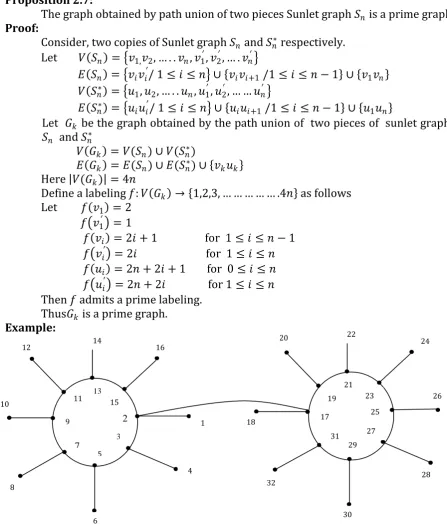
The graph obtained by path union of two pieces Sunlet graph 𝑆𝑛 is a prime graph. Proof:
Consider, two copies of Sunlet graph 𝑆𝑛 and 𝑆𝑛∗ respectively. Let 𝑉 𝑆𝑛 = 𝑣1,𝑣2, … . . 𝑣𝑛, 𝑣1′, 𝑣2′, … . 𝑣𝑛′
𝐸 𝑆𝑛 = 𝑣𝑖𝑣𝑖′/ 1 ≤ 𝑖 ≤ 𝑛 ∪ 𝑣𝑖𝑣𝑖+1 /1 ≤ 𝑖 ≤ 𝑛 − 1 ∪ 𝑣1𝑣𝑛 𝑉 𝑆𝑛∗ = 𝑢1, 𝑢2, … . . 𝑢𝑛, 𝑢1′, 𝑢2′, … … 𝑢𝑛′
𝐸 𝑆𝑛∗ = 𝑢
𝑖𝑢𝑖′/ 1 ≤ 𝑖 ≤ 𝑛 ∪ 𝑢𝑖𝑢𝑖+1 /1 ≤ 𝑖 ≤ 𝑛 − 1 ∪ 𝑢1𝑢𝑛
Let 𝐺𝑘 be the graph obtained by the path union of two pieces of sunlet graphs 𝑆𝑛 and 𝑆𝑛∗
𝑉 𝐺𝑘 = 𝑉(𝑆𝑛) ∪ 𝑉(𝑆𝑛∗) 𝐸 𝐺𝑘 = 𝐸(𝑆𝑛) ∪ 𝐸(𝑆𝑛∗) ∪ 𝑣
𝑘𝑢𝑘 Here 𝑉(𝐺𝑘) = 4𝑛
Define a labeling 𝑓: 𝑉 𝐺𝑘 → 1,2,3, … … … .4𝑛 as follows Let 𝑓 𝑣1 = 2
𝑓 𝑣1′ = 1
𝑓 𝑣𝑖 = 2𝑖 + 1 for 1 ≤ 𝑖 ≤ 𝑛 − 1 𝑓 𝑣𝑖′ = 2𝑖 for 1 ≤ 𝑖 ≤ 𝑛
𝑓 𝑢𝑖 = 2𝑛 + 2𝑖 + 1 for 0 ≤ 𝑖 ≤ 𝑛 𝑓 𝑢𝑖′ = 2𝑛 + 2𝑖 for 1 ≤ 𝑖 ≤ 𝑛
Then 𝑓 admits a prime labeling. Thus𝐺𝑘 is a prime graph.
Example:
Figure 8:Path union of sunlet graph on 8 vertices and prime labeling 3. Conclusion:
As not every graph admit prime labeling it is very interesting to investigate graph (or) graph families which admit prime graph. In the present paper we investigated a sunlet graph is a prime graph and operation on sunlet graph admits prime labeling and also proved seven new results in this context.
4. References:
1. J. A. Bondy and U.S.R. Murthy, “Graph Theory and Applications”, (North-Holland). New York (1976).
13 2 3 5 7 10 12 14 18 28 26 21 27 16 14 12
10 15
8
4
6 11
9
20 22 24
(www.rdmodernresearch.com) Volume I, Issue II, 2016
10
2. T.O. Dretskyetal, “On vertex prime labeling of graphs in graph theory”, Combinatories and applications, Vol. 1, J.Alari (Wiley. N.Y.1991) 299-359.
3. H.C. Fu and K.C. Huany, “On prime labeling Discrete Math”, 127, (1994) 181-186. 4. J.A. Gallian, “A dynamic survey of graph labeling”, The Electronic Journal of
Combinations 16 #DS6 (2009).
5. S.M. Lee, L. Wui, and J. Yen, “On the amalgamation of prime graphs”, Bull. Malaysian Math. Soc. (Second Series) 11, (1988) 59-67.
6. Sundaram M. Ponraj & S. Somasundaram (2006), “On prime labeling conjecture”, Ars Combinatoria 79 205-209.
7. A. Tout, A.N. Dabboucy and K. Howalla,“Prime labeling of graphs”, Nat. Acad. Sci. Letters, 11 (1982) 365-368.