Bahare Shokrani1* , Parisa Sadat Seyed Mousavi1 , Mansoure Sadat Sadeghi1
1. Family Research Institute, Shahid Beheshti University, Tehran, Iran.
* Corresponding Author: Bahare Shokrani, PhD.
Address: Family Research Institute, Shahid Beheshti University, Tehran, Iran.
Phone: +98 (919) 6265861
E-mail: [email protected]
Research Paper:
Intergenerational Study of
Commit-ment in Married Couples Living in Tehran City, Iran
Background:Attitudes toward commitment and standards of an intimate relationship can change from one generation to another. In the present study, we aimed to investigate intergenerational differences in commitment between two generations of Iranian married couples.
Methods:This study is descriptive cross-sectional research. A total of 240 individuals were recruited out of married men and women and their parents using a convenience sampling method in Tehran City, Iran, in 2015. To collect the study data, we employed the marital commitment questionnaire and the pros and cons of commitment measures to estimate the commitment types and emotions, respectively. Multivariate analysis of variance was used to investigate the differences in commitment types and emotions of commitment between the two generations. Results: The results show that the younger generation had higher scores in positive emotions of commitment, but no difference was observed in negative and constraining emotions. Furthermore, the younger generation had higher scores in personal commitment than the older generation, but not in the moral and structural commitment.
Conclusion: This study reveals intergenerational differences in commitment types and emotions in Iranian couples. Further studies should use longitudinal designs in the intergenerational studies of commitment in Iranian couples. Using an indicator of marital satisfaction in future research is recommended.
A B S T R A C T
Keywords:
Married persons, Commitment, Pros and cons of commitment, Intergenerational study
Citation Shokrani B, Seyed Mousavi PS, Sadeghi MS. Intergenerational Study of Commitment in Married Couples Living in Tehran City, Iran. Journal of Research & Health. 2020; 10(2):79-84. http://dx.doi.org/10.32598/JRH.10.2.3
: http://dx.doi.org/10.32598/JRH.10.2.3
Use your device to scan and read the article online
Article info: Received: 27 Oct 2019 Accepted: 17 Jan 2020 Publish: 01 Mar 2020
Introduction
sychological research studies always pay lots of attention to marital commitment as the cornerstone of marriage. Commitment to a close relationship has been defined in various ways, such as willingness to
con-tinue a relationship [1], conceptions of partners for the future of their relationship, attachment to a relationship, intention to maintain it [2], partner’s judgments regard-ing the likely relationship permanence [3], personal ded-ication to the relationship, constraints against leaving it
[4], and partners’ beliefs over the possible continuation of their relationship over a long period [5].
Johnson provided one of the widely-accepted defini-tions of commitment to a close reladefini-tionship [1]. He de-fines commitment as the decision to continue a relation-ship andscategorizes three types of marital commitmeng: personal, moral, and structurat. Personal and moral com-mitments are value-normative aspects of commitment, while structural commitment refers to the barriers that prevent leaving the relationship.
Marital commitment haseboth negative and positive aspects [6]. On the one hand, individuals need commit-ment in an intimate relationship as a prominent source of pleasure and satisfaction in life, and on the other hand, committed relationship can be a potential source of conflict and hopelessness and accordingly a threat to individuals’ well-being and health [7]. By increasing theestrength of commitment, people invest more in their relationship, and if they do not receive alproper response orflose the relationship, theyomay experience a trauma
[8]. American married couples experiencd commitment with distinct features of promise (or pledge), dedication (devotion), and attachment or bond [9].
Attitudes toward commitment and standards of an intimate relationship can vary across generations [10]. One study showedsan intergenerational difference re-garding attitudes toward commitment in romantic rela-tionships [11]. Another research found an intergenera-tional difference regarding relaintergenera-tional standards across three generations of Iranian’s married couples [12]. Previous studies have also reported gender differences in commitment construct [6, 11,13], anddsome report-ed gender differences in emotional experiences of com-mitment [6]. They found that women experience more positive emotions, and men experience more constrain-ing emotions in a relationship.
Another study reported that traditional women tend to be committed morally to their marriage, but it is not the case for the women who believe in gender equality [11]. Moreover, the finding of other research studies showed that men, more than women, tend to overcome negative and constraining emotions of commitment [13].
To our knowledge, no study has investigated intergen-erational differences in commitment among Iranian mar-ried couples. In the present paper, we aimed to inspect intergenerational differences of types and emotions of commitment in Iranian married couples. Accordingly, this researchstries to answer the following questions: .Are there any intergenerational differences in types and emotions of commitment among two generations of Ira-nian married couples? Are there any gender differences
in types and emotions of commitment among Iranian married couples?
Methods
The present study is a descriptive and cross-sectional study. The statistical population of the studyecomprised two generations of married men and women aged 20 to 35 years and their parents living if Tehran City, Iran, in 201 s. A totalrof 240 individuals were recruited using a convenience sampling metho5. Each generationscon-sisted of 60 men and 60 women. The younger generatios comprisedfmarried men and women aged 20 to 35 years, which at least six months passedsfrom their marriage. The Participants voluntarily participated in the research, ande-their information has kept confidential.sThey alsoesigne-dyan informed consent formobeforenthehstudy. Firstly, the younger generation that met the inclusion criteria en-tered the research, and afterwards they were asked to fill the questionnaire and give another questionnaire to their parents with the same sex. .Men gave the questionnaires to their fathers and women to their mothers. Table 1 presents The descriptive statistics of the participant.
A marital commitment questionnaire was used to in-spect types of commitment. Adams and Jones (1999) designed this questionnaire that assesses three types of marital commitment [14]: Personal commitment, which shows that spouses are committed to each other because the other spouse is attractive; moral commitment, which shows that spouses are morally committed to each other; and structural commitment, which shows that spouses have to be committed to each other because of barriers of breaking a relationship. The questionnaire comprised 44 questions, and the respondent answered each question on a 5-point Likert-type scale.
The pros and cons of commitment measures were used to assess feelings and emotions of commitment. This measure has been designed by Weige and Davis
[7] and measures three aspects of the commitment of positive emotions (such as pleasure or kindness), nega-tive emotions (such as anxiety or disappointment), and constraining emotions (such as pressure or dependency). Respondents answer to each question on a 7-point Lik-ert-type scale. The questionnaire has 45 itemg: 15 items for positive emotions, 15 items for negative emotions, and 15 items for constraining emotions. The total scors of the scale ranges from 45 to 315. The psychometric properties of this measure have approved for the original version. In the present study, the Cronbacs alpha was 0.94 for the whole scale and 0.91, 0.94, 0.93 for posi-tive, negaposi-tive, and constraining aspects of marital com-mitment, respectively.
Correlation analysis has applied to inspect the rela-tionship between emotions of commitment and types of commitments. MANOVA was used to investigate
the differences in commitment types and emotions of commitment between the two generations. Similarly, MANOVA was used to examine gender differences in commitment types and emotions of commitment. SPSS V. 22 was used for data analysis.
Results
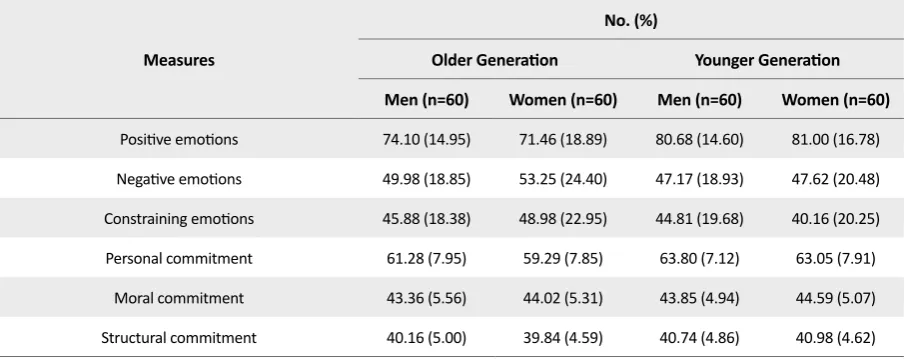
Table 2 presents the mean scores of the marital
com-mitment questionnaire and the pros and cons of commit-ment measure. Table 3 presents the results of the correla-tion between emocorrela-tions of commitment and commitment types for both generations.
MANOVA was used to inspect the differences in com-mitment types and emotions of comcom-mitment between men and women. Firstly, we investigated the assump-tions of using MANOVA. No univariate and multivariate outliers were detected. The results of the Kolmogorov-Smirnov test proved the normality of distribution in all variables (P<0.05). Box’s M test was not statistically
Table 1. Demographic of the participants (N=240)
Variable
No. (%)
Younger Generation Older Generation Men (n=60) Women (n=60) Men (n=60) Women (n=60) Age (y) 32.75 (6.38) 29.66 (6.43) 58.54 (8.34) 56.23 (8.96)
Education
Primary or secondary school 4 (6.8) 4 (7.1) 31 (52.5) 34 (60.7)
High school 28 (39.3) 22 (39.3) 21 (35.6) 20 (35.7)
University 30 (50.0) 30 (50.0) 7 (11.9) 2 (3.6)
Table 2. Mean scores of marital commitment questionnaire and the pros and cons of commitment
Measures
No. (%)
Older Generation Younger Generation Men (n=60) Women (n=60) Men (n=60) Women (n=60) Positive emotions 74.10 (14.95) 71.46 (18.89) 80.68 (14.60) 81.00 (16.78)
Negative emotions 49.98 (18.85) 53.25 (24.40) 47.17 (18.93) 47.62 (20.48)
Constraining emotions 45.88 (18.38) 48.98 (22.95) 44.81 (19.68) 40.16 (20.25)
Personal commitment 61.28 (7.95) 59.29 (7.85) 63.80 (7.12) 63.05 (7.91)
Moral commitment 43.36 (5.56) 44.02 (5.31) 43.85 (4.94) 44.59 (5.07)
significant (P>0.05), which showed covariance matrices are equal. Levene’s test was not significant in all vari-ables (P>0.05), which showed that error variances are identical in all variables.
Table 4 presents the results of MANOVA for intergen-erational differences, which showed significant differ-ences between both generations in commitment types
and emotions of commitment. The younger generation attained higher scores in positive emotions of commit-ment (P<0.0001), but no difference was observed in negative and constraining emotions between the groups (P>0.05). Furthermore, the younger generation had higher scores in personal commitment compared to the
Table 3. The correlation between emotions of commitment and commitment types for both generations
Measures 1 2 3 4 5 6
Positive emotions
Negative emotions -0.379*
Constraining emotions -0.340* -0.893*
Personal commitment -0.464* -0.87* -0.331*
Moral commitment -0.132** -0.161** -0.130** 0.620*
Structural commitment -0.317* -0.256* -0.212* 0.709* 0.662*
*P<0.01, ** P<0.05
Table 4. Results of MANOVA for intergenerational differences in commitment (n=120)
Measures Mean±SD P Cohen’s d
Older Generation Younger Generation
Positive emotions 73.13±17.13 80.63±15.55 0.0001 0.45
Negative emotions 51.54±21.68 47.81±19.68 0.127 0.18
Constraining emotions 47.22±20.75 42.50±20.17 0.072 0.23
Personal commitment 60.35±7.95 63.30±7.57 0.002 0.38
Moral commitment 43.78±5.51 43.96±4.86 0.441 0.03
Structural commitment 40.00±4.84 40.74±4.68 0.175 0.15
Table 5. Results of MANOVA for gender differences in commitment (n: 240; men: 120; Women: 120)
Measures Mean±SD P Cohen’s d
Men Women
Positive emotions 77.58±15.24 76.19±18.20 0.60 0.08
Negative emotions 48.48±18.77 50.89±22.60 0.49 0.11
Constraining emotions 45.01±18.97 44.68±22.15 0.08 0.01
Personal commitment 62.58±7.66 61.07±80.08 0.18 0.02
Moral commitment 43.52±5.22 44.22±5.13 0.30 0.13
older generation (P<0.01), but differences were not sig-nificant in moral and structural commitment (P>0.05).
Table 5 presents the results of MANOVA for the gen-der differences in commitment. No gengen-der differences were observed in commitment types and emotions of commitment (P>0.05).
Discussion
The present study demonstrated intergenerational differ-ences in commitment types and emotions of commitment in Iranian married couples. The older generation experienced lower positive emotions of commitment, but no differences were found in negative and constraining emotions of com-mitment. The older generation also reported lower scores of personal commitment compared to the younger generation, but no differences were observed in moral commitment and structural commitment. To our knowledge, previous studies did not focus on intergenerational differences of commit-ment in Iranian married couples. Prior studies found inter-generational differences in different cultures. Our study was consistent with a previous study that found an intergenera-tional difference in relationship standards among Iranian couples [12]. The finding is also in line with prior studies that found intergenerational differences of commitment in other cultures [10,11].
One study showed that people compare their standards with their experiences of commitment. Thus, the inconsis-tency in this comparison results in negative emotions, but consistency leads to positive experiences of emotion [16]. Therefore, intergenerational changes in standards result in changes in emotions of commitment.
These differences in commitment types may also be be-cause of different stages of the lifecycles between the two generations. In other words, the older generation was in the middle age in which physical attractiveness declines. Furthermore, previous studies showed that the duration of the marriage is related to marital satisfaction, and marital satisfaction is higher in the early years of marriage [18]. Therefore, another explanation for the difference in posi-tive emotions of commitment is that the younger generation was in the early years of marriage and had higher amounts of marital satisfaction and reported more positive emotions regarding commitment.
We also observed no gender differences in commitment types and emotions of commitment. These results are in-consistent with previous studies that found gender differ-ences in commitment types [6, 11, 13]. One study showed that men and women are different in experiencing
com-mitment-related emotions [7]. They reported that women experience more positive emotions, but men experience more constraining emotions regarding commitment. An-other one found that traditional women tend to be commit-ted morally to their marriage, but the modern women who believe in gender equality are different from traditional women in this aspect [11]. Research also found that men tended more to overcome negative and constraining emo-tions of commitment than women [13].
One potential explanation for this inconsistency is that previous studies mostly estimated the degree of commit-ments, but this study assessed gender differences in types and emotions of commitment. Another explanation for this inconsistency is cultural differences. Prior studies have shown cultural differences in commitment and mari-tal relationships. One study found a cultural difference in American subcultures in commitment types [9]. It seems that contrary to western cultures, in Iranian culture, both men and women do not differ in their experiences of com-mitment types and emotions of comcom-mitment.
The findings pointed out that commitment types are as-sociated with emotions of commitment. Our results were in line with the prior study, which found that commitment types are related to emotions of commitment [7]. Positive emotions had a weak correlation with personal commit-ment and structural commitcommit-ment, negative emotions had a weak correlation with personal commitment, and con-straining emotions had a weak correlation with personal commitment, which highlights the role of emotions in per-sons who reported having a personal commitment.
One limitation of the present research was the cross-sec-tional design of the study. Another limitation was a lack of control over other factors related to commitment, such as family life cycle and religiosity. Another limitation was that we just included married couples while ignored different types of relationship, such as cohabiting couples. Another limitation was the exclusion of divorced couples from the research. Despite these limitations, our findings raise the level of understanding the intergenerational differences of commitment and assessed intergenerational differences of commitment in Iranian married couples for the first time. Future studies must use longitudinal designs in the inter-generational studies of commitment in Iranian couples. Us-ing an indicator of marital satisfaction in future research is recommended.
Conclusion
com-mitment in Iranian married couples. The younger gen-eration experienced more positive emotions regarding commitment, but the two groups did not differ in nega-tive and constraining emotions. The younger generation also reported higher scores in personal commitment but no differences in moral and structural commitment. We also found no gender differences in commitment types and emotions of commitment. Furthermore, this paper showed that types of commitment are associated with emotions of commitment.
Ethical Considerations
Compliance with ethical guidelines
The study was Ethically approved (License No./S/850/106) and registered on February, 2020.
Funding
This research did not receive any specific grant from funding agencies in the public, commercial, or not-for-profit sectors.
Authors' contributions
Study design: Bahare Shokrani, Parisa Sadat Seyed Mousavi; Data collection and analysis: Bahare Shokrani; Manuscript preparation: Bahare Shokrani, Parisa Sadat Seyed Mousavi.
Conflict of interest
The authors declared no conflict of interest.
References
[1] Wieselquist, J., Rusbult, C. E., Foster, C. A., & Agnew, C. R. Commitment, pro-relationship behavior, and trust in close relationships. J Pers Soc Psychol. 1999; 77(5):942-66.
[DOI:10.1037/0022-3514.77.5.942] [PMID]
[2] Rusbult CE. A longitudinal test of the investment model: The development (and deterioration) of satisfaction and com-mitment in heterosexual involvements. J Pers Soc Psychol. 1983; 45(1):101-17. [DOI:10.1037/0022-3514.45.1.101]
[3] Lund M. The development of investment and commitment scales for predicting continuity of personal relationships. J Soc Pers Relatsh. 1985; 2(1):3-23. [DOI:10.1177/0265407585021001]
[4] Stanley SM, Markman HJ. Assessing commitment in per-sonal relationships. J Marriage Fam 1992; 54(3):595-608.
[DOI:10.2307/353245]
[5] Surra CA, Hughes DK, Jacquet SE. The development of commitment to marriage. Handbook of interpersonal com-mitment and relationship stability. New York: Springer; 1999.
[DOI:10.1007/978-1-4615-4773-0_7]
[6] Weigel DJ, Davis BA, Woodard KC. A two-sided coin: Mapping perceptions of the pros and cons of relation-ship commitment. J Soc Pers Relatsh. 2014; 32(3):344-67.
[DOI:10.1177/0265407514533765]
[7] Agnew CR, Dove N. Relationship commitment and percep-tions of harm to self. Basic Appl Soc Psych. 2011; 33(4):322-32.
[DOI:10.1080/01973533.2011.614134]
[8] Caryl E. The investment model of commitment processes. Handbook of theories of social psychology: Volume Two. Thousand Oaks: SAGE Publications Ltd; 2011.
[9] Quinn N. “commitment” in American marriage: a cul-tural analysis. Am Ethnol. 1982; 9(4):775-98. [DOI:10.1525/ ae.1982.9.4.02a00100]
[10] Stark MD, Kirk AM, Bruhn R. Generational differences as a determinant of women’s perspectives on commit-ment. Adult Span J. 2012; 11(2):112-22. [DOI:10.1002/j.2161-0029.2012.00010.x]
[11] Pinkham L. An autobiographical analysis of early attach-ment and adult intimacy in four cohorts of university stu-dents. [PhD. thesis]. USA: Long Island University; 1997.
[12] Malek Asgar S, Motabi F, Mazaheri MA. [Comparing re-lationship standards, attributions and marital satisfaction across three recent generations in Tehran (Persian)]. J Fam Res. 2014; 10(2): 137-57.
[13] Thornton A, Young‐DeMarco L. Four decades of trends in attitudes toward family issues in the United States: The 1960s through the 1990s. J Marriage Fam. 2001; 63(4):1009-37.
[DOI:10.1111/j.1741-3737.2001.01009.x]
[14] Adams JM, Jones WH. Handbook of interpersonal commit-ment and relationship stability. New York: Springer Science & Business Media; 1999. [DOI:10.1111/j.1741-3737.2001.01009.x]
[15] Shahsiah M, Bahrami F, Etemadi O, Mohebi S. [Effect of sex education on improving couples marital satisfaction in Isfa-han (Persian)]. Health Syst Res. 2010; 6(4):690-7.
[16] Simpson JA, Fletcher GJ, Campbell L. The structure and function of ideal standards in close relationships. In: Fletcher GJO, Clark MS. Blackwell Handbook Of Social Psychology: Interpersonal Processes. Hoboken: Wiley Online Library; 2008. [DOI:10.1002/9780470998557.ch4]
[17] Whyte MK. Dating, mating, and marriage. Abingdon: Routledge; 2018.