Security Schemes against Attack in Digital image Watermarking
Based DCT and EIPT
Kanhaiya Kumar1, Prof. Dharmendra Kumar singh2
Department of EC, SVCST, Bhopal, India
1[email protected], 2[email protected]
Abstract- Security schemes against attack in digital image watermarking based existing method and new effect image protect technology based on transform domain. A secure image watermarking against different attack and digital watermarking is weak to various attacks in spatial domain, thus in most of the watermarking technique’s transform domain is used. Applications in many areas like, copy right protection digital Image Watermarking is that the strategy .the owner of a copyright holder in an exceedingly digital image watermarking works for copyright protection. Digital image watermarking quality is impact of DCT. Discrete cosine transforms based totally image watermarking technique, classification and analysis of distinct cosine transform based watermarking techniques. A secure image watermarking technique has proposed a bit replacements technique based on the method of watermark embedding and extraction is also given host image. It’s not visible watermark .Digital watermarking will be used to protect digital info from illegal and it's additionally good robust in digital image.
Keywords—Watermarking, Visibility, Frequency domain, Robustness, Discrete cosine Transform, Reversible data hiding,PSNR.
I. INTRODUCTION
The digital communication technology, like internet technology confronts various troubles related to the privacy and security of the data. Security techniques are needed due to illegitimate access of information while not permission. Therefore, it's necessary to shield knowledge within the web technology. For providing the safety of digital information numerous techniques are used like cryptography, decryption, cryptography, Steganography and digital watermarking. In this paper discusses about the digital watermarking. The digital watermarking is an application of the digital image processing. The digital watermarking is a process of information hiding. There are various techniques for hiding the information in the form of digital contents like image, text, audio and video. . primarily digital watermarking may be a methodology for embedding some secret data and extra data within the cover image which might later be extracted or detected for numerous functions like authentication, owner identification, content protection and copyright protection, etc. typically the scaling issue is additionally used for embedding the watermark within the cover image. The digital watermarking is employed for the safety of the digital content and to guard information from
outlawed users and provides the possession right for the digital data. A crucial characteristic of digital watermarking is Hardiness and physical property against numerous varieties of attacks or common image manipulation like rotation, filtering, scaling, cropping and compression. The potency of digital watermarking algorithms is completely supported the hardiness of the embedded watermark against numerous varieties of attacks. Digital watermarking may be a methodology won’t to improve the possession over image by commutation low level signal directly into image. Digital watermarking methodology is additionally used for the tamper proofing and authentication [1].
Process of Digital image Watermarking
A watermarking system is typically divided into 3 distinct steps, embedding, attack and detection. In embedding, a formula accepts the host and therefore the knowledge to be embedded and produces a watermarked signal. The watermarked signal is then transmitted or holds on, typically transmitted to a unique person. If this person makes a modification, this is often stated as an attack. There are many accomplishable attacks. Detection is a formula that is applied to the attacked signal to aim to extract the watermark from it. If the signal wasn't changed throughout transmission, then the watermark remains gift and it are often extracted. If the signal is derived, then the knowledge is additionally carried within the copy. The embedding takes place by manipulating the content of the digital knowledge, which suggests the information isn't embedded within the frame round the data, it's carried with the signal itself [2].
Figure 1 Diagram of Watermarking Methodologies
Requirements
of
Digital
image
Watermarking
The major necessities for digital watermarking are:
numerous attacks, unintentional (cropping, compression, scaling) and intentional attacks that are aimed toward destroying the watermark. So, the embedded watermark ought to be specified it's invariant to vary such attacks [3].
2. Information Load: This amount describes the utmost quantity of information which will be embedded into the image to confirm correct retrieval of the watermark throughout extraction.
3 Reliability: Watermark ought to be able to give complete & reliable info for proving possession of copyright merchandise. The watermarking technique ought to be giving the reliable of recovery of watermark. The strength of the watermarking technique relies upon however firmly and showing intelligence the watermark is embedded into the host signal with none noticeable amendment. Strength of the algorithmic rule to attacks and quality of the watermarked image are connected properties that are indispensable. All applications presupposing protection and use in verification of the watermarking systems need this kind of marking so as to survive any reasonably alterations or intentional removal introduced by customary or malicious process and attacks [4].
4. Sensory activity Transparency: the most demand of watermarking is sensory activity transparency. The watermark that has embedded because the owner’s data mustn't degrade the standard of the host signal. The watermark can't be seen by human eye. It will be detected by special process or dedicated algorithms[5].
Applications of Watermarking
1. Authentication: Watermark is employed to produce authentication. Providing associate incorrect watermarked image will either destroy the watermark or ends up in incorrect watermark once extraction.
2. Digital Signatures: Watermarks could also be accustomed establish the owner of the content. By having this data the user might contact the owner for deed the legal rights to repeat or exploitation the content [6].
3. Copy Control: Watermark might contain data needed by the content owner that determined the policy of repetition the digital content. The data contained by the watermark might specify content might not be copied or only one copy. Later on, the devices used for repetition the content could also be needed by law to contain watermark detector that follows directives given by the content owner [7].
4. Broadcast Monitoring: Automatic identification of householders of knowledge could also be needed to be done and utilized in systems accountable for observance the broadcasts. This might facilitate choose the royalty payments. It conjointly helps in guaranteeing that commercials of a specific publicist
are competing at right time and for a right length.
Attacks on Watermarked Image
There are varied potential malicious intentional or unintentional attacks that a watermarked object is probably going to subject to. The supply of big selection of image process soft ware’s created it potential to perform attacks on the hardiness of the watermarking systems. The aim of those attacks is forestall the watermark from activity its meant purpose. A quick introduction to numerous styles of watermarking attacks is as beneath.
1. Geometric Attacks: All manipulations that have an
effect on the pure mathematics of the image like flipping, rotation, cropping, etc. ought to be detectable. A cropping attack from the right-hand aspect and also the bottom of the image is AN example of this attack.
Geometric attacks embrace basic geometric
transformations in a picture. These embrace geometrical distortions like rotation, scaling, translation, cropping, row-column blanking, distortion etc. Geometric attacks conceive to destroy synchronization of detection so creating the detection method troublesome and even not possible.
2.Noise Attack: during this attack, add noise to the watermark image were 0.002, 0.01, 0.08, 0.1, 0.005, 0.4, and 0.3. The extracted watermarks are affected Confuses the mark detector.
3. Smoothing Attack: Smoothing filters tend to blur a
picture, as a result of element intensity values that are considerably higher or less than the encircling neighborhood would "smear" across the world[8].
Limitations of DCT
1. DCT is main a Block impact 2 .Effect of image cropping
3. the most issues and therefore the analysis of the DCT is that the block impact. In DCT pictures are broken into blocks 8x8 or 16x16. The matter with these blocks is that once the image is reduced to higher compression ratios, these blocks appear. This has been termed because the block impact [9].
II. LITERATURE SURVEY
Bartolini F et al. [10]. Have developed an improved wavelet-based watermarking through pixel-wise masking. It’s supported masking watermark in keeping with characteristics of HVS. The watermark is adaptively more to the most important detail bands. The watermark deliberation perform is calculated as an easy product of information extracted from HVS model. The watermark is detected by correlation.
embedded into the sub-band constant worth victimization division technique. Fourthly, the inverse DFRNT and inverse DWT is performed and in conclusion watermark JPEG image is obtained. The projected algorithmic program has smart physical property and extraction performance, and ensures hardiness.
Guzman Meana et al. [12]. Have developed a rule that depends upon additional image watermarking in high resolution sub-bands of DWT. weight operate is that the product expression of knowledge extracted from the HVS model.
K.R. Rao et al. [13]. Developed a wavelet based image adaptive watermarking scheme. Embedding is performed in the higher level sub-bands of wavelet transform, even though this can clearly change the image fidelity. In order to avoid perceptual degradation of image, the watermark insertion is carefully performed while using HVS.
Ching-Chin Tsai et al. [14]. Proposed Digital Image Watermarking Using Discrete Wavelet Transform and Singular Value Decomposition. A hybrid image-watermarking technique supported DWT and SVD has been given, wherever the watermark is embedded on the singular values of the cover image’s DWT sub band. The most objective of developing this system is to satisfy each physical property and hardiness.
Li Na et al. [15]. Have proposed a DWT based method in which watermark was embedded in middle frequency coefficient using α as flexing factor with α =β |m|, where m is mean value of all coefficients watermarking embedded. But this method doesn’t provide enough security.
Amitav Mahapatra et al. [16]. described a survey on digital watermarking techniques, the idea behind this survey is to study different kind of watermarking techniques and present a robust watermark data using DWT and introduce fragile and semi-fragile watermarking techniques.
Ali Al-Haj et al. [17]. Combined DWT-DCT Digital Image Watermarking during this paper, Watermarking is completed by embedding the watermark within the 1st and second level DWT sub-bands of the host image, followed by the appliance of DCT on the chosen DWT sub-bands. The combination of the two transforms improves the watermarking performance considerably when it is compared to the DWT-Only watermarking approach.
D. Vinita Gupta et al. [18]. Robust and Secured Image Watermarking using DWT and cryptography with QR Codes [4]. During this Paper, algorithmic rule for embedding watermarking is conferred by using DWT and encrypted with QR codes. Here cowl image is chosen and DWT is applied thereon. A key K is chosen to come up with the QR code as secret key. QR code and
watermark image is encrypted by using XOR operation. Then the encrypted watermark is embedded into the duvet image and inverse DWT is applied on the embedded watermark image. For extraction, merely apply the DWT on the duvet image. This algorithmic rule is sort of easy owing to the utilization of straightforward X-OR operation for cryptography. This algorithmic rule is appropriate on completely different quite attacks on watermarked pictures like JPEG Compression, Poisson Noise Attack, Salt & Pepper Noise and Gaussian Noise.
Kim et al. [19]. Planned a watermarking technique using the human sensory system supported wave transform. The quantity of watermark components is proportional to the energy contained in every wave transform bands. To estimate the characteristic of the image, the dynamic rate of a curved pattern per subtended visual angle in cycles per degree is calculated. The result's used because the visual weight of watermarks in every wave remodel band.
III. SIMULATION AND RESULTS ANALYSIS
Simulation Tool
The
Performance analysis of MATLAB setup tool version 14 i.e. used for this thesis Implementation of data mining provides processor optimized libraries for fast execution and computation and performed on input cancer dataset. It uses its JIT (just in time) compilation technology to provide execution speeds that rival traditional programming languages. It can also further advantage of multi core and multiprocessor computers, setup tool provide many multi threaded linear algebra and numerical function. These functions automatically execute on multiple computational thread in a single setup tool, to execute faster on multicourse computers. In this thesis, all enhanced efficient data retrieve results were performed in MATLAB setup tool to get output.Environment of MATLAB
mat lab 7.8.0 and for this work we use Intel 1.4 GHz Machine. It is a HL high-level technical compute language and interactive environment for algorithm development, data visualization, records analysis, and numeric computation Mat lab is a software program that allows you to do data manipulation and visualization, calculations, math and programming. It can be used to do very simple as well as very sophisticated tasks. Database, analysis, visualization, and algorithm development, you can perform efficient data retrieve enhancement. Many functions in the toolbox are multithreaded to take benefit of multicourse and multiprocessor computers. An additional package, Simulink, natural network The key features of MATLAB; a high level language has Mathematical function for statistics, filtering, numerical analysis and solving the equations.Development tools for improving code quality and maximizing performance.
Results Analysis
Digital
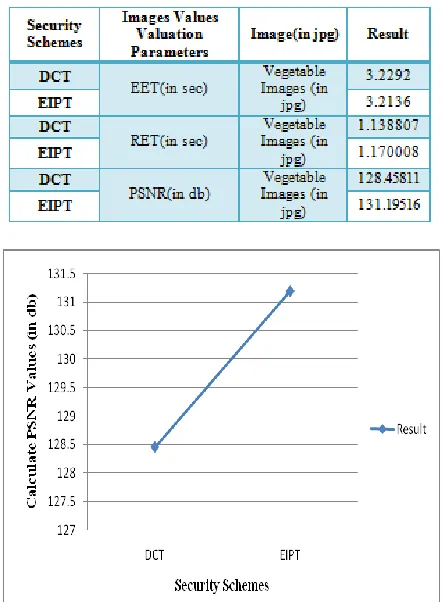
watermarking method provides a reliable digital image. It is providing good protected digital image. It is good robustness and ownership. It is providing secures in data hiding in digital image. Table 1 Vegetables grayscale Images Values Valuation Analysis DCT and EIPT algorithm PSNR values of image is more but existing algorithm PSNR values of image is minimum.Figure 2 PSNR Based Analysis among Proposed Algorithm and Existing Algorithm
Our proposed Different attack on watermarked image and calculate execution time and PSNR value of images. This process applies existing method and Proposed
Algorithm. Both is process compare PSNR of image, in case of PSNR value is high in Proposed Algorithm but existing method PSNR value is minimum
IV. CONCLUSION
Existing algorithm is being applied in the digital image becomes low robustness and the watermarked image quality is also normal but proposed algorithm applied in the digital image becomes more robustness and computing time minimum. Shows results proved that and another word more PSNR vales determine in proposed algorithm, Digital watermarking like indication, framework, techniques, applications, challenges and limitations. In search focuses on data hiding and this paper focuses on digital image in frequency domain and digital watermarking techniques like DCT, DWT their advantages, disadvantages and applications. Both embedding and extraction of watermark is being done using the techniques. For checking the robustness of these methods various attacks on watermarked images are performed Noise, Rotation, noise and unsharping watermark embedded. Hence we have concluded that if genetic algorithm is being applied in the digital watermarking, the image becomes low robust and the watermarked quality is also improved. DCT-DWT shows better results among these methods compared in terms of PSNR after attack on watermarked image. The present work will be extends in future based on color image encryption and audio encryption
REFERENCE
[1]. N. Tiwari, M. k. Ramaiya and Monika Sharma, “Digital watermarking using DWT and DES”, IEEE 2013.
[2]. Sasmita Mishra, Amitav Mahapatra, Pranati Mishra, “A Survey on Digital Watermarking Techniques”, International Journal of Computer Science and Information Technologies, Vol. 4 (3), 451-456, 2013.
[3]. T.H. Chen, D.S. Tsai, Owner–customer right protection mechanism using a watermarking scheme and a watermarking protocol, Pattern Recognition 39 (8) 1530–1541, 2006.
[4]. P. Loo, N. Kingsbury, Watermark detection based on the properties of error control codes, IEE Proc. Vis. Image Signal Process. 150 (2) 115–121, 2003. [5]. P.W. Wong, N. Memon, Secret and public key image
watermarking schemes for image authentication and ownership verification, IEEE Trans. Image Process. 10 (10) 1593–1601, 2001.
[6]. Tribhuwan Kumar Tewari, Vikas Saxena, Prof. J P Gupta “Audio Watermarking: Current State of Art and Future Objectives” IJCTA, Volume 5, Number 7, July 2011.
[7]. I. Cox, M. Miller, et al. “Digital watermarking and Steganography”, Morgan Kaufmann, 2008.
[9]. Anu Bajaj, “Robust And Reversible Digital Image Watermarking Technique Based On RDWT-DCT-SVD”, IEEE International Conference on Advances in Engineering & Technology Research (ICAETR), 2014.
[10]. Barni M, Bartolini F, Piva, “An Improved Wavelet Based Watermarking Through Pixel wise Masking”, IEEE transactions on image processing, Vol. 10, pp.783-791, 2001.
[11]. M. Kim, D. Li, and S. Hong, A Robust and Invisible Digital Watermarking Algorithm based on Multiple Transform Method for Image Contents‖ :Proceedings of the World Congress on Engineering and Computer Science 2013 Vol I WCECS 2013, 23-25 October, San Francisco, USA, 2013.
[12]. Victor V., Guzman, Meana, “Analysis of a Wavelet-based Watermarking Algorithm”, IEEE Proceedings of the International Conference on Electronics, Communications and Computer, pp. 283-287, 2004.
[13]. N. Kaewkamnerd and K.R. Rao, “Wavelet Based Image Adaptive Watermarking Scheme”, IEEE Electronic Letters, Vol. 36, pp.312-313, Feb. 2000. [14]. Chih-Chin Lai, Cheng-Chih Tsai, “Digital Image
Watermarking Using Discrete Wavelet Transform and Singular Value Decomposition”, IEEE Transaction on Instrumentation and Measurement”, vol. 59, no. 11, November 2010. [15]. Wang Hongjun, Li Na,” An algorithm of digital
image watermark based on multi resolution wavelet analysis”, International Workshop on VLSI Design and Video Technology, Proceedings, pp: 272- 275, 28-30 May 2005.
[16]. Sasmita Mishra, Amitav Mahapatra, Pranati Mishra, “A Survey on Digital Watermarking Techniques”, International Journal of Computer Science and Information Technologies, Vol. 4(3), 451-456, 2013.
[17]. Ali Al-Haj,”Combined DWT-DCT Digital Image Watermarking”, Journal of Computer Science 3 (9): 740-746, 2007.
[18]. Vinita Gupta, Atul Barve, “Robust and Secured Image Watermarking using DWT and Encryption with QR Codes‖, International Journal of Computer Applications (0975 – 8887)Volume 100 – No.14, August 2014.
[19]. Kim, Y.S., Kwon, O.-H., and Park, R.-H., “Wavelet Based Watermarking Method for Digital Images Using the Human Visual System,” IEE Electronics Letters, Vol. 35, No. 6, pp. 466-468, 1999.
[20]. K. A. Navas, M. C. Ajay, M. Lekshmi, T. S. Archana, and M. Sasikumar, “DWT-DCT-SVD based watermarking,” in Communication Systems Software and Middleware and Workshops, 2008. COMSWARE 2008. 3rd International Conference on, 2008, pp.271–274.
[21]. Hae-Yeoun Lee, Hyungshin Kim, Heung-Kyu Lee “Robust image watermarking using local invariant Features”, Optical Engineering, 2006.
[22]. H. Inoue, A. Miyazaki and T. Katsura, “An Image Watermarking Method Based on the Wavelet
Transform”, IEEE Conf. on Image Processing, Vol. 1, pp. 296-300, 1999. [23] A. Mansouri, A. M. Aznaveh, and F. T. Azar, “SVD-based digital image watermarking using complex wavelet transform,” Sadhana, vol. 34, no. 3, pp. 393–406, 2009.
[23]. J. Xiao and Y. Wang, “A robust digital watermarking algorithm based on multiple-level discrete cosine transform,” Chinese Journal of Computers, vol. 32, no. 5, pp. 1055 1061, May 2009. (in Chinese) [24]. C.-C. Chang, P. Tsai, and C.-C. Lin, “SVD-based