Algorithms for Sentiment Analysis
[1]Anirudh Ganesh,
[2]Manthan Gandhi,
[3]Balasubramanian V
[1] [2] [3]
VIT University Vellore, India
[1]
[email protected],
[2][email protected],
[3][email protected]
Abstract
:
With the advent of internet, there has been an exponential increase in user created content like customer reviews, comments and opinions. The primary cause for this sudden increase is the rapid adoption of social networks. These websites act as a medium to quickly and effortlessly share content across a wide array of domains such as products, events, people etc. This wealth of user knowledge if processed properly could be very beneficial to various businesses, governments and individuals. But the one crucial step that prevents the use of such data is that most modern techniques that do so are extremely time-consuming. This lead to a desire to develop a system that can automatically and intelligently mine such huge amounts of data and classify according to the positivity or negativity expressed within. Natural Language Processing (NLP), a branch of computer science that deals with the fruitful interpretation of human languages by computers, has given rise to a set of algorithms that perform the automated mining of attitudes, opinions and emotions from text, speech and various other sources, called Sentiment Analysis. Objective of this paper is to compare and contrast the effect of various optimizers on the efficiencies of these algorithms.Keywords:LSTM; NLP; Neural Networks; Sentiment Analysis; SVM; RMSprop; Adagrad; Stochastic Gradient Descent; Comparitive Analysis
I. INTRODUCTION
II. DATASET USED
The dataset consists of 50,000 reviews from the Internet Movie Database (IMDB), with a maximum of 30 reviews per movie [2]. The dataset also comprises of a near even distribution of positive and negative reviews, i.e. random guessing will yield only 50% accuracy. The reviews included are also highly polarized in nature. Based on the work cited in [2], we know that a review of < 4 as negative and a review of > 7 as positive. Neutral reviews are not included for sake of simplicity. This dataset has been tested and proven to be a good sample dataset to benchmark the effectiveness of existing algorithms.
The dataset was divided evenly into training and test sets. We use 25,000 reviews for training and 25,000 reviews for testing. We have chosen this in-order to minimize the effect of variance (overfitting) that might arise. This can be verified by an increase of 25 reviews which should yield around 0.1% increase in accuracy.
III. TECHNIQUES USED
Machine Learning refers to a set of techniques and algorithms employed, for a variety of tasks like classification, prediction, regression or even feature recognition. Machine Learning is often, in itself, categorized into two categories, supervised learning and unsupervised learning. Since we are only focusing on Supervised Learning methods, we will instead differentiate our techniques through the inherent architectural differences of the methods.
Firstly, we have a linear classifier which uses a Bag of Words model along with SVM, and secondly we use a neural network model, the Long Short Term Memory (LSTM). We will not focus on the inherent models themselves instead, we will focus on the effect of optimization algorithms on the accuracies of these algorithms.
A. Bag of Words (BoW) with SVM using fastText
fastText is a bag of words based model introduced in 2016 by Joulin, Armand and Grave, Edouard and Bojanowski, Piotr and Mikolov, Tomas under facebook research [3]. Unlike the neural network based approaches for NLP, this technique is a linear classifier. Although, neural network based approach are gaining widespread popularity due to their relative simplicity [4] they are relatively slow and cannot be scaled to large datasets. Though linear classifiers are extremely fast [5] and they can handle large datasets [6], right features are needed to extract the full potential in these techniques. fastText algorithm, improves the problems faced by other linear classifiers by improving their generalization through sharing parameters across features and classes through an architectural change in the word representation model.
B. Long Short Term Memory Networks (LSTMs)
LSTMs is a specialized form of Recurrent Neural Network (RNN), with the added benefit of being able to assimilate long- term dependencies during the learning process. Introduced originally by [7]. The architecture of an LSTM is such that they tend to store information for a long time, hence during implementation, we try to mitigate this long term dependency. All RNNs are composed of recurrent modules with simple structure, an LSTM on the other hand is composed of a relatively complex nodes.
IV. OPTIMIZERS USED
At the heart of every machine learning algorithm is a measure of the quality of current configuration, this is given by what is known as a “loss function”. The loss function tells us how close the given parameters are to mimicking the data that the algorithm is being trained on. It is therefore, imperative to ensure that we minimize this function in order to get the best possible set of parameters in order to get the best performance out of our algorithm. Optimization is the process of finding these best parameters.
A. Stochastic Gradient Descent (SGD)
B. RMSProp
RMSprop aims to optimize by reducing the gradient via an average of its recent magnitude. By moving an average of squared gradient, it improves the learning. The better optimization is obtained through root-mean square (RMS) of the weights ‘w’ and ‘t’ [8]. It works similar to Adagrad, but a tweaked parameter update which reduces the monotonic learning rate decay. The decay rate is a hyper-parameter, which controls the learning rate akin to Adagrad based on its gradients and the lack of large decay ensures a more balanced update in each step.
C. Adagrad
V. GRAPHICAL ANALYSIS
VI. RESULTS
TABLE I. TEST ACCURACIES
Algorith m Used
Optimization Method SG
D
RMSprop Adagrad
LSTM 57.62% 95.29% 97.78%
SVM
(fastText) 51.84% 93.08% 89.94%
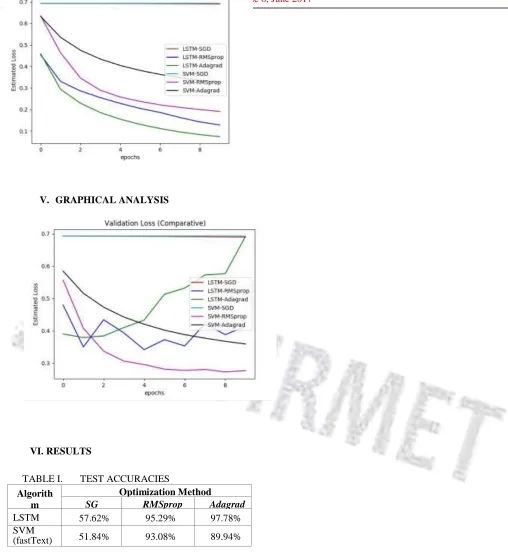
Fig. 1. Test accuracies of the various techniques using the given optimization methods.
TABLE II. VALIDATION ACCURACIES
Fig. 2. Validation accuracies of the various techniques using the given optimization methods.
In Table 2, we can see that for both algorithms, RMSprop seems to yield the best result for testing, it can thus be inferred that the steady learning rate given by RMSprop leads to better generalization than the infrequent features that the Adagrad seems to prioritize.
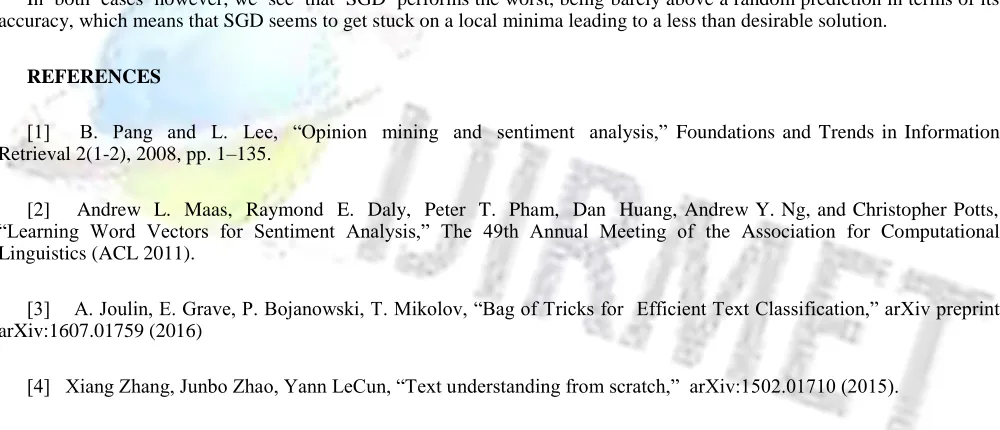
In both cases however, we see that SGD performs the worst, being barely above a random prediction in terms of its accuracy, which means that SGD seems to get stuck on a local minima leading to a less than desirable solution.
REFERENCES
[1] B. Pang and L. Lee, “Opinion mining and sentiment analysis,” Foundations and Trends in Information Retrieval 2(1-2), 2008, pp. 1–135.
[2] Andrew L. Maas, Raymond E. Daly, Peter T. Pham, Dan Huang, Andrew Y. Ng, and Christopher Potts, “Learning Word Vectors for Sentiment Analysis,” The 49th Annual Meeting of the Association for Computational Linguistics (ACL 2011).
[3] A. Joulin, E. Grave, P. Bojanowski, T. Mikolov, “Bag of Tricks for Efficient Text Classification,” arXiv preprint arXiv:1607.01759 (2016)
[4] Xiang Zhang, Junbo Zhao, Yann LeCun, “Text understanding from scratch,” arXiv:1502.01710 (2015).
[5] Sida Wang and Christopher D. Manning, “Baselines and Bigrams: Simple, Good Sentiment and Topic Classification,” ACL Web (2012).
[6] Alekh Agarwal, Olivier Chapelle, Miroslav Dud´ık, and John Langford, “A Reliable Effective Terascale Linear Learning System,” Journal of Machine Learning Research 15 (2014) 1111-1133.
[7] Sepp Hochreiter and Jürgen Schmidhuber, “Long Short-Term Memory,” Neural Comput. 9, 8 (November 1997), 1735-1780.
[8] Geoffrey Hinton, “Neural Networks for Machine Learning: Lecture 6a Overview of mini-batch gradient descent,” http://www.cs.toronto.edu/~tijmen/csc321/slides/lecture_slides_lec6.pdf
[9] John Duchi, Elad Hazan, and Yoram Singer, “Adaptive Subgradient Methods for Online Learning and Stochastic Optimization,” Journal of Machine Learning Research 12 (2011) 2121-2159
Algorith m Used
Optimization Method SG
D
RMSprop Adagrad
LSTM 56.37% 84.58% 81.71%
SVM (fastText )