ISSN: 2372-4978 (Print), 2372-4986 (Online) Copyright © The Author(s). All Rights Reserved. Published by American Research Institute for Policy Development DOI: 10.15640/ijat.v6n1a6 URL: https://doi.org/10.15640/ijat.v6n1a6
The Credit Quality and the Market- Based Performance of Banks: A Comparative Study
Dr. Salah Ahmed ORABY
1Abstract
This research aims at measuring the relationship between the credit quality measured by both non-performing loans % (NPL) and provisions for loan losses%(PLL) as independent variables and the market performance of banks measured by share prices.The sample study includes 11 Saudi listed banks in Saudi stock exchange and 15 banks listed in Jordanian stock from 2011 to 2016. This study used regression analysis and correlation analysis to analyze the quarterly data to test research hypotheses.Results of the Saudi case indicated that neither NPL% nor PLL has a statistically significant relationship with share prices and that can be interpret that investor in Saudi Arabia ignore both NPL and PLL when pricing shares of banks. On the other hand, results of the Jordanian case indicated that only PLLhave a statistically positive impact on share prices of banks.so it can be said that investors in Jordanian capital market look at part of provisions for PLL as a source of potential profit in future because they believe that PLL contain discretionary component used to manage earnings and used as signalingtool to shareholderson future expected cash flows. Also results indicated that both NPL and PLL are alternative measures should not be used together in the same model as predictors and PLL is better than NPL because PLL reflects both specific and general risk.
Key words: Credit Quality, Share Prices, Non-Performing Loans, Provisions for Loan Losses, Jordanian Banks, Saudi Banks
1. Research Question:
It has been found in previous studies that both non-performing loans and provisions for loan losses are key determinants of bank performance andwere used as accounting measures for credit qualitybecause the non-performing loans ratioinclude substandard debts, doubtful debts and bad debts that don not produce interest income from the date of classification as non-performing loans until writing off them or reclassified them as standard loans,on the other hand,Banks maintain a contra-asset account (provisions for loan losses) to cover possible loan defaults deducted from interest income during past years and will be used to write off loans in the future or returning back as income in upcoming periods.
Some previous studies examined the use of PLL as a signaling tool to investors on future expected cash flows. These studies analyzed provisions for loan losses into discretionary and nondiscretionary components. Results of most studies showed that stock prices were inverselyassociated to normal provisions for loan losses and positively associated to abnormal provisions for loan losses (Liu, Ryan and Wahlen, 1997; Beaver and Engel, 1996; Liu and Ryan, 1995; Hatfield and, Lancaster, (2000).But Ahmed et al. (1999) provided adverse evidence. Beatty and Lioa (2009) defined PLL as a policy to charge estimated loan losses as reserves from income to face any expected loans losses that helpsafeguard banks‟ earnings and equity. Previous studies indicated that the main purposes of PLL are to givespecific information about the bank's future safety; decrease taxes by earnings managing (Kanagaretnam & Lobo, 2010), and management of capital determined by regulatory bodies (Bouchekoua et al., 2012); managing the volatility of net income; and reduce changesthat occur in risk-weighted assets (Norden & Stoian, 2013).
There are abundant previous studies examined the relationship between non-performing loans and provisions for loan losses as a measure of credit quality and accounting performance of banks whereasresults of these studies found that an inverse relationship between the two measures and bank performance measures by accounting based financial ratios, for example return on assets and return on capital and some other ratios, examples for these studies areCaporale et al. (2015); Fernando and Ekanay,ake (2015);Funso. K.., et. al (2012)Dong, X.& Liu J. (2012;kargi.H.(2011);Epure and Lafuente (2012;Kithinji, A. (2010). on the other hand, other studies used non-performing loans as a measure for assets quality when using CAMEL system. forexample,Abdulazeez Y (2017);Vijaya, et. al (2015).
Although the mentioned abundant previous studies, unfortunately there are no previous studies investigated the relationship between the two accounting measures for credit quality with share prices of banks to determine market‟s reaction to measures of credit risk or credit quality. Therefore, this study aims at filling up this gap in the current literature.
The main question of this study can be stated as follows:
1-Do investors in capital market react to non-performing loan and provisions for loan losses as measures of credit qualitywhen they make decisions on share prices of banks?
2-Which of provisions for loan losses and non-performing is a better measure for credit quality or credit risk and whether they are complementary or competing measures for credit quality?
2. Objectives
This paper aims to conduct an exploratory and quantitative study to investigate whether the accounting measures for credit quality impact market -based performance of banks operating in both Saudi Arabia and Jordan.
3. Literature Review
Abdulazeez Y. (2017) conducted a research to analyze the earnings of Saudi banks measured by ROA, ROE and NIM as dependent variables with using the parameters of the Capital Adequacy ratio as per Basel accord, Non-performing loan/total loan, Operational efficiency, Earning Ability and Liquidity framework from 2000 to 2014 using ordinary least square and fixed effect regression models .The sample of this study covers 20 of the 24 listed and unlisted banks in Saudi stock exchange, including foreign-owned banks and local banks. Four banks were excluded due to non-availability of required data. Overall results indicated that domestic banks are more profitable than foreign banks and both foreign and domestic banks with higher capital ratios are more profitable.Results alsofound that Banks with a higher non-performing loan ratio (higher credit risk or lower assets quality) are less profitable, foreign banks are more credit risk in their portfolio. Results on efficiency in using financial resources measured by operating expenses to total income ratio found that foreign banks are negativelyassociated with profitability indicating that cost inefficiency inversely affect the profitability of banks.
Alhadab and Alsahawneh, (2016) investigated the impact of provisions for loan losses on the earnings of Jordanian commercial banks. The study sample consisted of 13 listed banks on Amman Stock Exchange over the period 2004-2014. Results indicated that provisions for loan loss have a negative impact on the earnings of Jordanian commercial banks measured by Return on assets and return on equity used as a proxy for theearnings.
Caporale, et al. (2015) examined the drivers of PLL for 400 banks in Italiafrom 2001 to 2012.Results indicated that the main determinants of PLL are non-discretionary components but non-discretionary components have no role as a driver for PLL.
Caporale, et al. (2015)found that there is aninverse relationship between the collateralized loans which reduce credit risk and future losses.
Fernando and Ekanayake (2015) examined whether banks operating in Sri Lankan use PLL to manage earningsfrom 2003 to 2012. They found a positive association betweenprovisions for loan losses and profits of banks and public banks did not use PLL to manage earnings.
Kayode,et.al (2015) investigated the impact of credit quality on banks‟ performance in Nigeria. The random effect model was used with a sample of six banks from 2000 to 2013.Findings showed that credit risk is inversely and statistically significantassociated with bank performance expressed by return on investment. Results proposethat an increase credit risk or a decrease in assets quality reduces bank earnings.
Tahir et al. (2014) examined the impact of PLL on Bank earnings in Pakistan using return on assets and return on equity as a proxy of profitability. The study found a negative association betweenprovisions for loan losses and profitability. Soincreases in provisions for loanlosses resulted in decreases in the earnings of the Pakistan banks, and the increases in provisions for loan losses resulted in decreases in earnings
Khalil et .al, (2013)investigated the effectiveness of credit risk managements as dependent variable at Saudi Banks. A descriptive method was used with 5determinants of CAMEL approach as predictors. The study found that liquidity has a positive impact on effectiveness of credit risk management, while the remaining determinants of CAMEL, capitaladequacy, asset quality, management soundness and earning have no any statistically impact on effectiveness of credit risk management.
Dong, X.& Liu J. (2012) investigated the relationship between provisions for loanlosses and earnings and capital management by anempirical study. A sample of 14 selected domestic commercial banks from 2001 to 2009. The study divided the provisions for loan losses into discretionary andnondiscretionary part. An empirical study investigated the association betweenthe discretionary part and earnings before taxes and total provisions and capital adequacy ratio. Resultsshowed that there is a statistically significant positive associationbetween the discretionary part and earnings before taxes and provisions.on the other hand, thereis a statisticallysignificant negative association between the discretionary part and capital adequacy ratio.
Funso. K.., et. al (2012)conducted an empirical study to measure effects of credit quality on the performance of commercial banks operating in Nigeria from to 2000-2010. The sample included 5commercial banks. Earnings are measured by Return on Asset as a dependent variable and ratio of Non-performing loan as a percentage of total loan, ratio of Total loan & Advances to Total deposit and the ratio of provisions for loan losses to classified loans as proxies for credit risk as independent variables. Results showed that an increase in non-performing loan by one unit decreases the return by 6.2 %. on the other hand, an increase in provisions for loan lossesdecreases profitability by6.5% while an increase in total loan and advances pushes earnings by 9.6 %
Epure and Lafuente (2012)examined the relationship between bank performance measured by efficiency and return on assets in banks operating in Costa-Rican banking from 1998 to 2007. Results showed that non-performing loans has a negative impact on bothefficiency and return on assets while the capital adequacy ratio has a positive impact on net interest margin.
ul Mustafa et al. (2012) examined the impact of provisions for loan losses on the performance of Pakistan banks during the period from 2001 to 2009 using a sample of 15 bank.They founda negativeassociation between provisions for loan losses and earnings.
Kithinji, A. (2010) investigated the impact of credit risk on the earnings of commercial banks operating in Kenya from 2004 to 2008.Findings revealed that both of the amount of credit and non-performing loans did not impact the performance of banks in Kenya and therefore,the study proposed that there wereother variables impacting the performance of banks in Kenya.
Ahmed, et.al, (1998) found that provisions for loanlosses have a statically significant positive influence on non-performing loans. Therefore, this can be interpreted that an increase in provisions for loan lossesresults in an increase in credit risk or a depreciation in the loans quality and in turn adversely impactingperformance of banks.
Espinoza, et. al (2010) investigated the impact of non-performing Loans in the GCC Banking System on Macroeconomic Effects.Results found that the non-performing loans ratios have been worsened from 7% to 15% from 1995-to 2008 and as a result the macroeconomic of GCC countries deteriorated
Bouvatier and Lepetit (2008)divided provisions for loan losses into two components.provisions for loan losses to cover expected future loan losses and provisions for loan lossesto manageearnings. Results revealed that the discretionarycomponent did not have a significant effect on performance.
4. Study Hypotheses
To achieve objectives of the study the following hypotheses are developed:
1-There is no a statistically significant relationship between non-performing loans as a measure for credit quality and share prices of banks.
2-There is no a statistically significant relationship between provisions for loan losses as a measure for credit quality and share prices of banks.
3- There is no statistical relationship between non-performing loans as predictor and provisions for loan losses as dependent variable.
5. Research Methodology
This exploratory study applied both regression analysis and Pearson correlation analysis to analyze the study data and test the hypotheses using panel data methodology and the conductive method in interpreting results.
6. Models Specification and Data Collection
This study used quarterly secondary data that is collected from the financial statements regarding independent variables and share prices information available on banks websites on stock markets website. The samples of study include all listed banks in stock market that have the data required to conduct this study that covers the period from 2012 to 2016. The sample of Saudi case includes 11 banks out of 12 banks listed in Saudi stock market, whereas only one bank is excluded due to unavailability of data,while the Jordanian case includes all 15 banks listed in Amman stock market. To test research hypotheses and achieve research objectives as well as answer research questions, three regression models are developed as follows:
SP it =α0 +β NPL it %+£it i = 1 . . . N, t = 1 . . . T ……… (1). SP it =α0 +β PLL it %+£iti = 1 . . . N, t = 1 T ………. ….. (2). PLL =α0 +β NPL it %+£it i = 1 . . . N, t = 1 T ………. ….. (3).
whereas:SP refers to share prices 3 months after dates of preparing quarterly financial statements to allow accounting information impact share prices because the delay of disclosure of financial statements, NPL% refers to non-performing loans as a percentage of loan portfolio, PLL refers to provisions for loan losses as a percentage of loans portfolio, i refers to cross section(banks), t refers to time period, £ refers to error term or residual.β refers to regression slope,α refers to intercept.
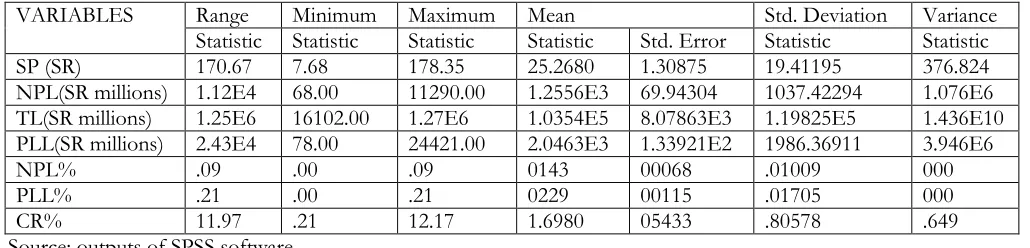
DisruptiveAnalysis (TABLE 1)
VARIABLES Range Minimum Maximum Mean Std. Deviation Variance
Statistic Statistic Statistic Statistic Std. Error Statistic Statistic
SP (SR) 170.67 7.68 178.35 25.2680 1.30875 19.41195 376.824
NPL(SR millions) 1.12E4 68.00 11290.00 1.2556E3 69.94304 1037.42294 1.076E6 TL(SR millions) 1.25E6 16102.00 1.27E6 1.0354E5 8.07863E3 1.19825E5 1.436E10 PLL(SR millions) 2.43E4 78.00 24421.00 2.0463E3 1.33921E2 1986.36911 3.946E6
NPL% .09 .00 .09 0143 00068 .01009 000
PLL% .21 .00 .21 0229 00115 .01705 000
CR% 11.97 .21 12.17 1.6980 05433 .80578 .649
Source: outputs of SPSS software
Whereas: SP indicates to share prices, NPL indicates to non-performing loans in Saudi Riyal, TL indicates to total loan portfolio Saudi Riyal, PLL indicates to Provisions for Loan Losses in Saudi riyal, NPL% indicates to non-performing loans as percentage of total loans, PLL% indicates to provisions for loan losses as a percentage of total loans, CR% indicates to provisions to non-performing loan ratio.
Non-performing loans in the euro area amounts to 5.1% in December2016.Measuring against this benchmark, the average credit quality ratio forthe period under study amounted to.0143 indicating an increase in credit quality, on the other hand thelower standard deviation of 0.01009during the period of study indicated that no greater deviation between observations and their mean and this may cause this variable statistically insignificant. High provisions for loan losses ratio also is indicative of lower credit quality, whereas the average credit quality ratio for the period under study amounted to 0.0229 with lower standard deviation 0 .01705 indicating an increase in credit quality during the period of study. The average of coverage ratio amounted to 1.6980 indicating that non-performing loans are fully covered by provisions in addition to higher capital ratio according Basel iii. All these indictors refer tostrength and the soundness of banking industry in Saudi Arabia. Tables 2indicated that the regression model 1 that uses NPL % as independent variable is statistically insignificant signaling that no impact on share prices.
Statistical l Results of Model 1 and 2(Table 2)
Model Adjusted R Square F Sig. Beta t Sig Correlation coefficient Sig
Model1 -.003 .426 .515 -84.922 -.652 0.515 -.044 0.515
Model 2 -.004 0.223 0.637 -36.400 0.472 0.63 -.032 0.63
Dependent variable sp.Source Out puts of SPSS
TABLE 2 supported regressing model 1 results whereas no statistically relationship between NPL% and share prices. Tables 6,7 and 8 indicated that the regression model 2 that uses PLL % as independent variable is statistically insignificant signaling that no impact on or relationship with share prices
7.2 The Jordanian Case
Descriptive Statistics (Table 3)
Variables Range Minimum Maximum Mean Std. Deviation Variance
Statistic Statistic Statistic Statistic Std. Error Statistic Statistic
SP (JD) 22.33 .81 23.14 2.7048 15133 2.62114 6.870
NPL(JD millions) 1869.00 6.00 1875.00 1.7968E2 20.55825 356.07941 1.268E5 TL(JD millions) 2.44E4 9.00 24416.00 2.4374E3 2.99125E2 5180.99093 2.684E7 PLL(JD millions) 1940.00 3.00 1943.00 1.3995E2 19.85200 343.84665 1.182E5
NPL% .59 00 .60 0822 .00281 .04863 .002
PLL% .09 00 . 90 .0479 .00108 .01875 .000
CR% 2.20 08 2.28 6373 .01313 .22736. .052
Source: outputs of SPSS software
a percentage of total loans, CR indicates to provisions to non-performing loan ratio. Non-performing loans in the euro area amounts to 5.1% in December2016. Measuring against this benchmark, the average credit quality ratio for the period under study amounted to 0.0822 with standard deviation of .04863 indicating a decrease in credit quality or increase in credit risk during the study period. High provisions for loan losses ratio also is indicative of lower credit quality whereas the average credit quality ratio for the period under study amounted to .0479 with standard deviation of. 01875..The average of coverage ratio amounted to .6373 indicating that non-performing loans are partially covered by provisions beside capital ratio according to Basel accord. Tables 4 indicated that the regression model that uses NPL % as independent variable is statistically insignificant signaling that no impact on or relationship with share prices.
Statistical l Results of Model 1 and 2(Table 4)
Model Adjusted R Square F Sig. Beta t Sig Correlation coefficient Sig
Model1 .000 0.807 0.370 -2.801 -.898 0.370 -.052 0.370
1mode2 .067 22.623 .000a 37.136 4.756 0.000 0.26 0.000
Dependent variable sp. Source :Out puts of SPSS
TABL4 supported regressing model 1 results whereas no statistically relationship between NPL% and share prices. These results can be interpreted that investors in Jordanian stock market ignore don not react to NPL when making their decision in capital market and therefore this ratio as measure of credit quality is not of value relevance because their possible effects on share prices have been included in accounting earnings. Tables 4 indicated that the regression model 2 that uses PLL % as independent variable is statistically significant andpositive impact on share and explained about 7% of variability in share prices.
TABLE 4supported regressing model 2 results whereas there is a statistically positive relationship between PLL % and share prices meaning an increase in provisions for loan losses (low credit quality or increase in credit risk) results in an increase in share prices and that result can be interpreted that investors in Jordanian stock market look at PLL losses as a source of future profit because they believe that it may contain discretionary part should be taken in consideration when making their decision in capital market .These results agree with the study of hatfield and lancaster, (2000) whereas the reaction to an increase in provisions for loan losses is negative and statistically significant before the declaration ; however, it becomes positive and statistically significant for several days after announcement. Results indicate also that null hypothesis 1 is accepted but null hypothesis 2 is rejected.
7.3 Empirical Results of Model 3
Statistical l Results of Model 3(Table 5)
case Adjusted
R Square F Sig. Beta t Sig Correlation coefficient Sig
Saudi case .307 98.225 000 .557 9.911 000 .557** 000
Jordanian case .280 117.130 000 .531 10.823 000 .531 000
Dependent variable sp. Source :Out puts of SPSS
8. Final Conclusions:
The main question of this study is whether investors in capital markets react to both measures for credit quality when making their decisions on share prices. This paper conducted an empirical and exploratory study to investigate whether the accounting measures for credit quality impact market based performance of banks operating in both Saudi Arabia and Jordan. This exploratory study applies both regression analysis and Pearson correlation analysis to analyze the study data and test the hypotheses using panel data methodology and the conductive method in interpreting results. This study uses quarterly secondary data that is collected from the financial statements regarding independent variables and share prices information available on banks websites on stock markets website. The samples of study include all listed banks in stock market that have the data required to conduct this study that covers the period from 2012 to 2016. The sample of Saudi case includes 11 banks out of 12 banks listed in Saudi stock market while the Jordanian case includes all 15 banks listed in Amman stock market. Results of the Saudi case indicated that the regression models that uses both NPL % and PLL as independent variables are statistically insignificant signaling that no impact on or relationship with share prices of Saudi banks. Final results can be interpreted that investors in Saudi stock market ignore or do not react to both NPL% and PLL% when making their decision in capital previous studies. Results of the Jordanian case indicated that the regression model 1 that uses NPL % as independent variable is statistically insignificant signaling that no impact on or relationship with share prices of Jordanian Banks These results can be interpreted that investors in Jordanian stock market ignore or do not react to NPL when making their decision in capital market. Regarding resultsof the regression model 2 that uses PLL % as independent variable indicated that there is a statistically significant and positive relationship with share prices and the model explains about 7% of variability in share prices. These results can be interpreted that investors in Jordanian stock market look at PLL losses as a source of future profit should be taken in consideration when making their decision in capital market. To answer the question regarding Which of provisions for loan losses and non-performing is a better measure for credit quality or credit risk and whether they are complementary or competing measures for credit quality? Results indicated that they are alternative measures should not be used together in the same model as predictors and PLL is better than NPL because PLL reflect both specific and general risk.
References
AbdulazeezY. H.; Saif-Alyousfi; AsishSaha; RohaniMd-Rus, (2017)‟ Profitability of Saudi Commercial Banks: A Comparative Evaluation between Domestic and Foreign Banks using Capital Adequacy, Asset Quality, Management Quality, Earning Ability and Liquidity Parameters‟ Journal of Economics and Financial Issues, International Journal of Economics and Financial Issues, 2017, 7(2), 477-484.
Ahmed, A.S., C. Takeda, and S. Thomas, 1999, Bank loan loss provisions: A reexamination of capital management, earnings management and signaling effects, Journal of Accounting and Economics 28, 1-25.
Ahmed, A.S., Takeda, C. And Shawn, T. (1998). Bank Loan Loss Provision: A Reexamination of Capital Management and Signaling Effects, Working Paper, Department of Accounting, Syracuse University, 1-37
Alhadab ,M.& Alsahawneh1.S.(2016, “Loan Loss Provision and the Profitability of Commercial Banks: Evidence from Jordan “International Journal of Business and Management; Vol. 11, No. 12; 2016 Published by Canadian Center of Science and Education
APO, K.: Kolade, R.: OKE, R; Ojo M., (2012) “CREDIT RISK AND COMMERCIAL BANKS‟: PERFORMANCE IN NIGERIA: A PANEL MODEL APPROACH”
Beatty, A., & Liao, S. (2009). Regulatory capital ratios, loan loss provisioning and procyclicality. Columbus, working paper.
Beaver, W., and E. Engel, (1996). Discretionary behavior with respect to allowances for loan losses and the behavior of security prices. Journal of Accounting & Economics 22 (1-3), 177- 206.
Bouchekoua, A., Matoussi, H., &Trabelsi, S. (2010). Monolithic versus Differential Impacts of Sox Regulation on Market Valuation of Banks‟ Loan Loss Provision. CAAA Annual Conference 2012. http://dx.doi.org/10.2139/ssrn.1762810 .
Bouvatier, V., &Lepetit, L. (2008). Banks‟ procyclical behavior: Does provisioning matter? Journal of-- Journal of International Financial Markets, --- Institutions and Money, Elsevier, 2008, 18, pp.513 – 526.
Caporale, G. M., Alessi, M., Di Colli, S., & Lopez, J. S. (2015). Loan Loss Provision: Some Empirical Evidence”, journal of entrepreneurial and organizational diversity, vol.3 issue 1, pp111-129
Dong, X.& Liu J. (2012 “Research on the Relationship of Commercial Bank‟s Loan Loss Provision and Earning Management and Capital Management” Journal of Service Science and Management, 2012, 5, 171-179
Epure, M. And Lafuente, I. (2012). Monitoring Bank Performance in the Presence of Risk, Barcelona GSE Working Paper Series No.61
Espinoza, Raphael and PrassadAnanthakrishnan (2010) Nonperforming Loans in the GCC POL
Espinoza,R.; Prasad,A.(2010) “Nonperforming Loans in the GCC Banking System and their Macroeconomic Effects” 2010 International Monetary Fund, WP/10/224
Felix, A.T and Claudine, T.N (2008). Bank Performance and Credit Risk Management, Unpublished Masters Dissertation in Finance, University of Skovde.
Fernando, W. D., &Ekanayake, E. M. (2015). Do Commercial Banks Use Loan Loss Provisions to Smooth Their Income? Empirical Evidence from Sri Lankan Commercial Banks. Journal of Finance, 3(1), 167-179.
Funso,T. Kolade,A. . Ojo,O.(2012)” CREDIT RISK AND COMMERCIAL BANKS‟ PERFORMANCE IN NIGERIA: A PANEL MODEL APPROAC” Australian Journal of Business and Management Research Vol.2 No.02 [31-38] | May-2012
Hakim, Sam &Neaime, Simon (2002) Performance &Credit Risk in [16] Banking: A Comparison Study for Egypt and Lebanon. Economic [17] Research Forum (www.erf.org.eg) [
Hatfield, Lancaster, C. (2000) “THE SIGNALLING EFFECTS OF BANK LOAN-LOSS RESERVE
ADDITIONS “Journal of Financial and Strategic Decisions Volume 13 Number 1 Spring 2000 57
Kanagaretnam, K., & Lobo, G. (2010).” An empirical analysis of auditor independence in the banking industry”. The accounting review, vol.85, issue 6.
Kayode,F. Obamuyi T., JOwoputi,J. Adeyefa, A.(2015), “Credit Risk and Bank Performance in Nigeria” Journal of Economics and Finance, Volume 6, Issue 2. Ver II (Mar.-Apr. 2015), PP 21-28
Khalil Elian Abdel Rahim, (2013) „Effectiveness of Credit Risk Management of Saudi Banks in the Light of Global Financial Crisis: A Qualitative Study‟ Asian Transactions on Basic and Applied Sciences (ATBAS ISSN: 2221-4291) Volume 03 Issue 02
Kithinji, A.M. (2010). Credit Risk Management and Profitability of Commercial Banks in Kenya, School of Business, University of Nairobi, Nairobi
Kwan, Simon &Eisenbeis Robert (1997) Bank Risk, Capitalization and Operating Efficiency. Journal of Financial Services Research no.12, Kluwer Academic Publishers.pp:117-131.
Liu, C., and S. Ryan, 1995, The effect of bank loan portfolio composition on the market reaction to and anticipation of loan loss provisions, Journal of Accounting Research 33(1), 77-94
Liu, C., S. Ryan, and J. Wahlen, 1997, Differential valuation implications of loan loss provisions across banks and fiscal agents, The Accounting Review 72(1), 133-146.
Miller S., and A. Noulas, 1997, “Portfolio Mix and Large-Bank Profitability in the USA”, Applied Economics, 29, 505-512.
Mustafa, A.; Ansari, R.; Younis ,M.(2012)” DOES THE LOAN LOSS PROVISION AFFECT THE BANKING PROFITABILITY IN CASE OF PAKISTAN?” Asian Economic and Financial Review 2(7):772-783
Norden, L., & Stoian, A. (2013). Bank earnings management through loan loss provisions. A double-edged On Market Valuation of Banks‟ Loan Loss Provision. CAAA Annual Conference 2012.
ORABY. S. (2017) „IFRS and Accounting Information Relevance: The Case of Saudi Arabia‟ Journal of Business & Economic Policy Vol. 4, No. 1; March 2017
Ramlall, I. (2009). Bank-Specific, Industry-Specific and Macroeconomic Determinants of Profitability in Taiwanese Banking System: Under Panel Data Estimation. International Research Journal of Finance and Economics (34), 160-167 Research Journal of Social Science & Management, 3(12).
Tahir S., Ahmad, F., & Aziz, B. (2014). Impact of Loan Loss Provision on Bank Profitability in Pakistan. TIJ's Research Journal of Social Science & Management, 3(12).
Ul Mustafa, A. R., Ansari, R. H., &Younis, M. U. (2012). Does the Loan Loss Provision Affect the Banking United States: Ohio State University, Mimeographed document.