Face Recognition & Detection Techniques with
Moving Objects
Parveen Kumar Daulat Sihag
M. Tech Scholar Assistant Professor
Department of Computer Science & Engineering Department of Computer Science & Engineering JCDMCOE Sirsa (Haryana), 125055, India JCDMCOE Sirsa (Haryana), 125055, India
Abstract
Face recognition has been the most widely used application of image analysis. Its popularity is due to wide range of commercial and law enforcement applications and presence of latest techniques. It also has several applications in areas such as content-based image retrieval, video coding, video conferencing, crowd surveillance, and intelligent human–computer interfaces. But current systems are having laggings, which still needed to be worked upon like illumination and pose variations. This paper is a study of various techniques being used for face recognition. A face recognition system includes three steps face detection, feature extraction and face recognition. This paper includes various recognition techniques and descriptions of representative methods. The majority of face recognition methods have been developed by scientists with a very technical background such as biometry, pattern recognition and computer vision. The concepts and practical issues relating to the application of each step of a face recognition system and their various strategies are given, without going into technical details. The goal of this paper is to evaluate various face detection and recognition methods, provide complete solution for image based face detection and recognition with higher accuracy, better response rate as an initial step for video surveillance. Solution is proposed based on performed tests on various face rich databases in terms of subjects, pose, emotions, race and light.
Keywords: Face Recognition, Face Recognition, Moving Objects, Face Identification
_______________________________________________________________________________________________________
I. INTRODUCTION
Over the last few decade lots of work is been done in face detection and recognition. Human’s face is a prominent feature in machine learning and computer vision system. A face conveys various information including gender, age, ethnicity etc. Face information is applicable in many sectors like biometric authentication and intelligent human-computer interface. Over the time lots of methods are introduced for detection and recognition which are considered because as it’s a best way for person identification [1] and doesn’t require human cooperation for identifying or verifying. [2].
There are basically two approaches for the face recognition: geometrics (feature based) and photometric (view based). In the geometrics we need to select only some distinctive features like nose, eyes, mouth and measure the geometric relationship among these facial points. . Face recognition is made possible by extracting the features of the face from the image. This can be done only when the face is detected. So face detection can be considered as the preliminary step in face recognition. What makes face detection different from normal object detection? Normal objects are rigid bodies with the same structure always. But in face detection, the object face is not perfectly rigid. It changes with changes in expressions of the face, appearance of the face etc. This makes the face detection a challenging task. The pictures shown below represent the output of face detection and face recognition system respectively [3]. For a machine all the images are nothing but a two dimensional array of integer values (0 to 255 for 8-bit gray-scale image). So a machine cannot differentiate objects in an image as we humans do. So it is up to us to develop a method to identify the faces from these integer values [4].Face recognition steps: The face recognition is mainly done by performing the following process:
1) Image acquisition: This is the very first step for the face recognition in this required to acquisition of any image either by camera or by any other source.
2) Image Preprocessing: Some preprocessing is required to perform before using the acquired image for the recognition. 3) Face detection: After doing the preprocessing now it required to detect the face from the given image. Since for
performing the face recognition we basically need a face of any person. So the face detection is done before performing the face recognition.
4) Feature extraction: The next step after face detection is extracting the important features of the face which can be used for comparing with the image database of individuals.
Face recognition techniques
1) Traditional: There are some algorithms which extract the facial features or landmarks from an image for example the position of nose, eyes, jaw and cheekbones. After extracting these features, then it is used for the matching the similar features in the image database.
2) 3-dimensional recognition: Now days the 3-dimensional recognition technique is very popular and mostly used for the face recognition. Other techniques are not that much more accurate in the different lighting and in non-frontal view, but in 3-D recognition there is no effect of changes in lighting. In this technique, it required a 3-D sensor for getting the information about the face surface. Then this information is used for identifying or verification of any person.
3) Skin texture analysis: The visual details of the skin are used in this technique which are captured in standards digital image or scanned image. This skin texture analysis improves the performance on the recognizing the face [5]. Face recognition method in which they have used the principal component analysis for the dimension reduction and for the feature extraction. In this the two dimensional facial images express into the large one dimensional vector form and main idea of this is to express this one dimensional vector into a compact principal component of feature space[6].
One area of application is biometrics. But there are already some established methods like iris scan, fingerprint recognition and speech recognition. One advantage of the face recognition with respect to these methods is that, it doesn't require user consent. The effect of various parameters(maximum angle and maximum deviation)on the classifiers for face detection. It was found that the best performance for a classifier is achieved at moderate values of the maximum angle and maximum deviation [7]. Our objective is to make a system which can recognize an input image and can detect the face from the images and also from the video.
II. RELATED WORK
Face Recognition, as the most successful applications of image analysis and understanding, has recently received significant attention. Recognition implies the tasks of identification or authentication. Identification involves a one-to-many comparison to fetch unknown identity from a set of known possibilities. Object detection and tracking are important in many computer vision applications including activity recognition, automotive safety, and surveillance. In fig 3.1 shows, we have developed a simple face tracking system by dividing the tracking problem into three separate problems:
1) Detect a face to track
2) Identify facial features to track 3) Track the face
Step 1: Detect a Face To Track
Before we begin tracking a face, we need to first detect it. we have used vision. Cascade Object Detector to detect the location of a face in a video frame. The cascade object detector uses the Viola-Jones detection algorithm and a trained classification model for detection. By default, the detector is configured to detect faces, but it can be configured for other object types as well. Following mechanism is followed in this regard:-
1) To create a cascade detector object 2) To Read a video frame and run the detector.
3) To Draw the returned bounding box around the detected face.
We can use the cascade object detector to track a face across successive video frames. However, when the face tilts or the person turns their head, we may lose tracking. This limitation is due to the type of trained classification model used for detection. To avoid this issue, and because performing face detection for every video frame is computationally intensive, we have used a simple facial feature for tracking.
Step 2: Identify Facial Features To Track
Once the face is located in the video, the next step is to identify a feature that will help us track the face. For example, we can use the shape, texture, or color. We need to Choose a feature that is unique to the object and remains invariant even when the object moves.
2) The nose bounding box is defined relative to the cropped face image. 3) Adjust the nose bounding box so that it is relative to the original video frame. 4) To Create a tracker object.
5) To initialize the tracker histogram using the Hue channel pixels from the nose. 6) To Create a video player object for displaying video frames.
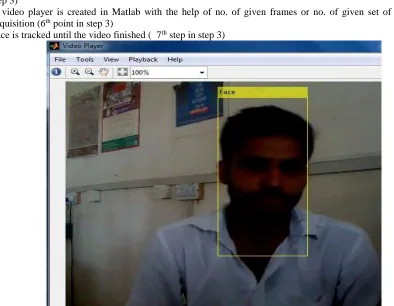
7) To Track the face over successive video frames until the video is finished.
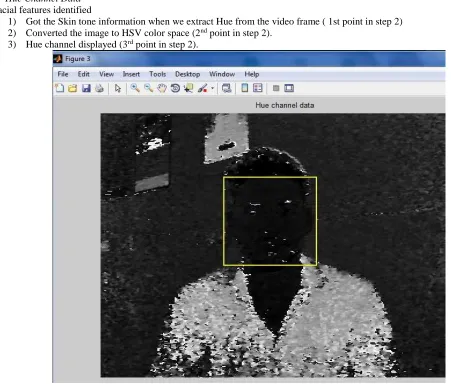
Hue Channel Data
Facial features identified
1) Got the Skin tone information when we extract Hue from the video frame ( 1st point in step 2) 2) Converted the image to HSV color space (2nd point in step 2).
3) Hue channel displayed (3rd point in step 2).
Fig. 3.1: Hue Channel Data
Face Detection Result
Face to be traced is detected
1) Here a cascade detector object is created (1st point in step 1)
Fig. 3.3: Detected Face
Face Tracking Result:
1) Nose is detected (1st point in step 3)
2) With the help of nose cropped face image is detected ( 2nd point in step 3)
3) Nose bounding box is adjusted with respect to the image and video frame (given) (3rd point in step 3) 4) 4. A tracker object is created with no. of frames and trigger the image (4th point in step 3)
5) Hue channel pixels that taken from the given image’s nose is created and tracker histogram is initialized ( 5th point in step 3)
6) A video player is created in Matlab with the help of no. of given frames or no. of given set of images and set the acquisition (6th point in step 3)
III. CONCLUSION
In current work we developed the system to evaluate the face detection and recognition methods which are considered to be a bench mark. After study of various methods and steps of a face recognition system, it is concluded that image-based approaches is best among others because face images belong to face class. Geometric changes can be overcome by local appearance based approaches, 3D enhanced approaches, and hybrid approaches. When we are taking the face image which are already in the database for the testing as an input image the accuracy is high as compare to a unknown image for the tracking the face.
The main drawback of using this technique is it is not able to give a more accurate result when there is change in the illumination. So we can improve it by using the geometric (feature based) approach in which we need to select only some distinctive feature like nose, eyes, and mouth and measure the geometric relationship between these facial points. So by this we can improve the accuracy rate in the future.
REFERENCES
[1] W. Zhao, R. chellappa, P. J. Phillips, Face recognition: A literature survey, “ACM Computing Surveys (CSUR)”, December 2003.
[2] B.Rashida, Dr. M Munir Ahamed Rabbani, 3d Image Based Face Recognition SystemPatil A.M., Kolhe S.R.and Patil P.M, 2D Face Recognition
Techniques: A Survey, International Journal of Machine Intelligence, ISSN: 0975–2927, Volume 2, Issue 1, 2010’
[3] Face recognition wikipedia. http://en.wikipedia.org/wiki/Facial_recognition_system.
[4] Indian face database. http://vis-www.cs.umass.edu/~vidit/AI/dbase.html
[5] John D. Woodward, Jr., Christopher Horn, Julius Gatune, Aryn Thomas, “Biometrics, A Look at Facial Recognition,” RAND,2003.
[6] Kyungnam Kim. Face recognition using principle component analysis. In International Conference on Computer Vision and Pattern Recognition, pages
586–591, 1996.
[7] Xiaofei He, Shuicheng Yan, Yuxiao Hu, ParthaNiyogi, and Hong-Jiang Zhang. Face recognition using laplacianfaces. Pattern Analysis and Machine