R E S E A R C H
Open Access
Increased sensitivity of Au-Pd nanolayer on
tapered optical fiber sensor for detecting
aqueous Ethanol
Ahmad Shukri Muhammad Noor
1,2*, Ali Talah
1, Mohd Anwarul Arif Rosli
1, Punithavathi Thirunavakkarasu
3and Nizam Tamchek
4Abstract
Background:Optical fiber sensors gains popularity as an alternative and a better solution compared to its electronics counterpart. Especially in detecting hazardous materials, optical fiber sensors prove to have many advantages such as miniaturization, remote yet real-time sensing and immune to electromagnetics interference.
Methods:In this paper, we used a 40um tapered standard multi-mode fiber coated with gold (Au), palladium (Pd)
and mixtures of Au-Pd nano-composites to detect hazardous ethanol in its various concentration in aqueous environment. Interrogation were made possible using UV-VIS light source, and changes in absorbance and intensity were recorded via spectrometer.
Results and Conclusion:Ethanol ranging from 20% till 100% were investigated. It was found that the composition
of nanomaterial coating on the developed sensors strongly affected the sensing performance. From the experiments carried out, the sensor with a gold palladium nanocomposite layer with a 2: 1 ratio of gold to
palladium produced the highest sensitivity, which is 0.74/vol% concentration of Ethanol. The fabricated fiber sensor also exhibits fast response and recovery time of 13 s and 6 s respectively.
Keywords:Nanoparticles, Optical sensors, Ethanol concentration, Gold, Palladium
Background
Recently, optical fiber sensors have been in the limelight since they are being utilized in various fields such as en-vironmental monitoring, medical imaging and diagnos-tics, forensics, aviation and even in the military [1, 2]. Optical fiber sensors earn this accolade due to their many advantages such as miniaturization, flexibility, fast response and capability for real time and in-situ sensing deployment as well as capability of remote sensing [3, 4]. This increases the desirability of optical fiber sensors as compared to electrical based transducers [5, 6], espe-cially when it comes to chemical detection [7, 8], humid-ity [9, 10], and also vibration sensing [11, 12].
Tapered fiber optic sensors are particularly popular due to their high sensitivity towards their surroundings [13, 14]. It is not only the enhancement of sensitivity of the tapered fibers sensors that makes them a preferable choice for optical fiber based sensors, their ease of fabri-cation makes them even more desirable as they are eas-ily reproducible and reliable [15, 16]. The tapering causes a huge reduction in the size of the core and that leads to penetration of light signal into the cladding which in turn enables the interaction of the light with the surrounding medium which allow the tapered fiber to be employed as a sensor [17, 18].
Ethanol is a commonly utilized chemical in various in-dustries such as medical, food processing, beverages and even as a replacement fuel in automotives [19, 20]. Etha-nol has a high volatility and flammability that can be dangerous for humans and living organisms, thus mak-ing the sensmak-ing of Ethanol crucial and important [21].
Mostly, commercial Ethanol sensors available are
* Correspondence:[email protected]
1Wireless and Photonics Network Research Centre of Excellence, Faculty of
Engineering, Universiti Putra Malaysia, 43400 UPM Serdang, Selangor, Malaysia
2Department of Computer and Communication Systems Engineering, Faculty
of Engineering, Universiti Putra Malaysia, 43400 UPM Serdang, Selangor, Malaysia
Full list of author information is available at the end of the article
Journal of the European Optical
Society-Rapid Publications
© The Author(s). 2017Open AccessThis article is distributed under the terms of the Creative Commons Attribution 4.0 International License (http://creativecommons.org/licenses/by/4.0/), which permits unrestricted use, distribution, and reproduction in any medium, provided you give appropriate credit to the original author(s) and the source, provide a link to the Creative Commons license, and indicate if changes were made.
Nooret al. Journal of the European Optical Society-Rapid Publications
(2017) 13:28
electrical based transducers which rely on resistance and voltage readings for detection [22, 23]. Safety features are required when electrical based sensors are used due to Ethanol’s flammability that might cause it to ignite when sparks are formed or heat is transferred. This makes the monitoring of Ethanol concentrations risky because of the fire hazards associated with Ethanol.
Researchers are now looking to optical fiber sensors as an alternative for detecting Ethanol. According to previous research conducted, a fiber optic surface Plasmon resonance (SPR) sensor coated with a layer of gold was used to detect Ethanol in an aqueous solu-tion [24]. This sensing was based on refractive index changes of the solution as the ethanol concentration increased caused changes to the SPR wavelength. Other research include tapered fiber optic tip coated with graphene oxide layer and used as a reflectance based sensor to detect Ethanol concentrations [13]. A sensitivity of 0.0086/vol% units of Ethanol in water was obtained. In this paper we propose a tapered multimode fiber optic coated with Au and Pd nano-composite layer in order to obtain a highly sensitive response towards ethanol detection.
Methods
A standard multi-mode fibre with core and cladding, diameter of 60.2 μm and 124μm respectively, was used to fabricate the tapered fiber optic sensor. The fiber optic was tapered using the Vytran Glass Processing Workstation. The up and down taper transition length was set to 3 mm and the waist length was set for 5 mm. The waist diameter was set to 40μm as illustrated in the Fig. 1.
All nanomaterials used in this experiment were pur-chased from (Hangzho Company China). Four configu-rations of fiber sensors were set up for detect Ethanol as shown in Table 1.
Fig. 1Illustration of a tapered fiber dimensions
Table 1Sensor configuration
Sensor Coating
Sensor 1 Au
Sensor 2 Pd
Sensor 3 Au:Pd (2: 0.7)
All the nanomaterial layers were deposited on the ta-pered fiber region using the drop casting technique and following that the sensors were placed in a 70°C oven for the annealing process [13, 25].
Figure 2 shows the experimental setup for the tapered optical fiber sensor. The input of the sensor is connected to a halogen white light source (HL 2000) from Ocean Optics which has a wavelength range of 360 nm to
2400 nm. A spectrometer (USB 4000) from Ocean Optics was then connected to the output of the sensor with a detection range of 360 nm to 1100 nm. The out-put from the spectrometer was connected to a comout-puter with spectra suite software for processing. The tapered fiber optic sensor was then immersed in different con-centrations of Ethanol starting from 20% up to 100%.
Results and discussion
The morphology of the nanocomposite is investigated using scanning electron microscopy (SEM). Figure 3a-c shows the SEM images for the palladium, gold and palladium-gold nanocomposite layer respectively, with a magnification of 50um. In the magnified figure of the sensor shown in Fig. 3a, the gold layer is seen to cover the tapered region with an average thickness of 3.31um. In Fig. 3b, the tapered region has a palladium layer with an average thickness of 2.60um. In Fig. 3c, it can be ob-served that the nanocomposite layer of palladium and gold has an average thickness is 5.34um. All figures show that the nanomaterial has covered the tapered re-gion of the fiber completely.
Figure 4 shows the SEM image of the gold and palla-dium nanocomposite layer made a magnification of 10,000 on a glasses substrate to show the morphology of the nanocomposite coating on the substrate. From the SEM image it can be observed that the nanocomposite has coated glass substrate completely with no obvious clumping of the nanomaterials.
The absorbance and intensity spectrums of the gold nanoparticles coated sensor are presented in Fig. 5a and b respectively. All the spectrums in this research were normalized to air. The results show that the absorbance levels increase as the concentration of Ethanol increases. This result is confirmed by the intensity results which show a corresponding decrease as the Ethanol concen-tration increases.
Fig. 3aSEM image to show the thickness of the gold layer, (b) SEM image to show the thickness of the palladium layer, (c) SEM image
to show the thickness of the mixture of gold and palladium Fig. 4SEM image for the drop casting the mixture of the Pd-Au
The sensor’s dynamic response is obtained by integrat-ing the absorbance levels of the sensor from 600 to 700 nm for each concentration of ethanol. This is performed using the time response feature of the spec-trasuite software. First 20 ml of Ethanol solution is inserted into the chamber using syringe. Once the re-sponse stabilized, the Ethanol is removed using syringe again. The sensor is allowed to recover to a stable base line. Following the recovery of the sensor, the next
concentration of the Ethanol is inserted. These steps are repeated until all the concentrations are completed.
when Ethanol is removed. The dynamic response of the Au coated tapered MMF fiber optic is shown in Fig. 5c.
Next, the response of the palladium coated fiber sen-sor was investigated. The resultant absen-sorbance and
in-tensity spectrums are shown in Fig. 6a and b
respectively. As shown in Fig. 6a, the absorbance levels increase as the sensor is exposed to increasing Ethanol concentrations. There is a strong correlation between the ethanol concentrations and the absorbance levels.
A corresponding decrease is intensity levels can be ob-served in the intensity spectrums as expected. The
dy-namic response of the 40 μm diameter MMF coated
with Pd is shown in Fig. 6c. The sensor shows fast re-sponse and recovery time of approximately 17 and 12 s respectively for all of the five concentrations of Ethanol.
The absorbance, intensity and sensor response time of the MMF fiber optic sensor with gold and palladium nanocomposite with ratio of 2: 0.7 (Au to Pd) are shown in Fig. 7a-c below while Fig. 7d-f show the result ob-tained from the fourth sensor, coated with gold and pal-ladium nanocomposite with ratio 2: 1 (Au to Pd). As observed in Fig. 7a-f, the responses of the sensors strongly correspond to the ethanol concentrations. The dynamic responses of the sensors also show fast Fig. 6aAbsorbance spectrum of coating fiber sensor with 1.0 mg/mol palladium towards Ethanol concentrations, (b) Intensity spectrum of tapered fiber sensor towards Ethanol concentrations, (c) Dynamic response of Pd coated MMF sensor towards different concentration of Ethanol
Fig. 7aAbsorbance spectrum of coating fiber sensor with 70 /mol Pd mixture with Au towards Ethanol concentrations.bIntensity spectrum of tapered fiber sensor towards Ethanol concentrations.cDynamic response.dAbsorbance spectrum of coating fiber sensor with 100 /mol Pd mixture with 200/ mol Au towards Ethanol concentrations.eIntensity spectrum of tapered fiber sensor towards Ethanol concentrations.fDynamic response
response and recovery and demonstrate stable response as they recover to a steady baseline each time the sample is removed from the liquid chamber.
Figure 8 plots the the absorbance levels against Ethanol concentrations for each of the four sensors in this research. It can be observed that all the sensors show a linear relationship between the absorbance values and the concentration of ethanol.
These results are due to the properties of gold and palladium when they are exposed to Ethanol. Gener-ally, the optical properties of metallic complexes change when VOCs are present. These changes nor-mally happen in refractive index and color. In return, these changes cause a corresponding change to the absorbance spectrum of the tapered fiber sensor. This is similar with the other reported work on fiber optic based Ethanol sensors [20, 26].
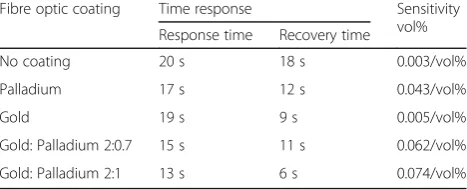
The performances of all four sensors are summarized in Table 2. The response and recovery time of the sen-sors and the sensitivity are compared. The sensitivity is calculated using eq. 1.
Sn¼Δ%CΔ%A ð1Þ
Where: Sn= sensitivity, A = absorbance and
C = concentration.
All the four sensors developed in this research show strong responses towards Ethanol concentrations. The response and recovery time for all 4 sensors are below 20 s. The fastest response is observed with the sensor coated with a gold palladium ratio of 2 to 1, which are 13 s for response and 6 s for recovery. This sensor also demonstrated the highest sensitivity towards ethanol concentrations which is 0.074/vol%.
This due to the fact that the Au, Pd combination causes a unique interaction between the light signal to the sensor surface. The gold nanoparticle enhanced the optical signal in the fiber causing a strong evanes-cent wave to be present to the surface of the sensor. This will allow the sensor interaction between the light and the surrounding media. The palladium nanoparticles show a strong affinity towards ethanol
molecules [26]. Therefore, the combination of the gold and palladium gives a strong response toward Ethanol detection.
Conclusions
A tapered multimode fiber sensor coated with gold, pal-ladium and gold palpal-ladium nanocomposite with ratios 1:1 and 2:1 has been successfully developed to detect ethanol concentration in water. The sensor was interro-gated in the visible region using a broadband white light source and a spectrometer to detect the output. The de-veloped sensors demonstrated high sensitivity towards ethanol concentrations, with the best results obtained from the sensor with the gold palladium coating with a 2:1 ratio, where a sensitivity of 0.074/vol% is reported. This sensor also gave the fastest dynamic response to-wards ethanol. This study presents improvement to the sensitivity of fiber optic based ethanol sensor using a lar-ger taper waist diameter. This will contribute towards ta-pered fiber optic sensors that are more robust and easier to handle.
Funding
The work reported in this paper has partly supported by the Universiti Putra Malaysia’s Research University Grant Schemes (RUGS) (Ref: 05–01-12-1626RU and 05–02-12-2015RU) and Ministry of Higher Education, Malaysia’s Fundamental Research Grant Scheme (FRGS) (Ref: 03–04-10-795FR). Both RUGS were used to partly fund the student scholarship throughout his study, whereas FRGS were used to buy all the components and consumable items used in the experiments.
Authors’contributions
AT: Sensing experiments and Material characterization. MR: Material Characterization. PT, NT and AM: Data analysis. All authors read and approved the final manuscript.
Competing interests
The authors declare that they have no competing interests.
Publisher’s Note
Springer Nature remains neutral with regard to jurisdictional claims in published maps and institutional affiliations.
Author details
1Wireless and Photonics Network Research Centre of Excellence, Faculty of
Engineering, Universiti Putra Malaysia, 43400 UPM Serdang, Selangor, Malaysia.
2Department of Computer and Communication Systems Engineering, Faculty
of Engineering, Universiti Putra Malaysia, 43400 UPM Serdang, Selangor, Malaysia.3Communication Technology Section, Universiti Kuala Lumpur-British
Malaysia Institute, 53100 GOMBAK, Kuala Lumpur, Malaysia.4Department of Physics, Faculty of Science, University Putra Malaysia, 43400 UPM Serdang, Selangor, Malaysia.
Received: 30 May 2017 Accepted: 5 October 2017
References
1. Roh, S., Chung, T., Lee, B.: Overview of the characteristics of micro-and nano-structured surface plasmon resonance sensors. Sensors.
11(2), 1565–1588 (2011)
2. Homola, J., Yee, S.S., Gauglitz, G.: Surface plasmon resonance sensors: review. Sensors Actuators B Chem.54(1–2), 3–15 (1999)
Table 2Performance comparison of developed sensors
Fibre optic coating Time response Sensitivity vol% Response time Recovery time
No coating 20 s 18 s 0.003/vol%
Palladium 17 s 12 s 0.043/vol%
Gold 19 s 9 s 0.005/vol%
Gold: Palladium 2:0.7 15 s 11 s 0.062/vol%
Gold: Palladium 2:1 13 s 6 s 0.074/vol%
3. Verma, R., Gupta, B.D.: Detection of heavy metal ions in contaminated water by surface plasmon resonance based optical fibre sensor using conducting polymer and chitosan. Food Chem.166, 568–575 (2015)
4. Sivacoumar, R., Vinoth, M., Alex, Z.C.: Tapered optical fiber bio-sensor for testosterone detection. In: The 14th International Meeting on Chemical Sensors, pp. 821–825 (2012)
5. Hendi, A.A., Alorainy, R.H.: New fabrication of zinc oxide nanostructure thin film gas sensors. Superlattice. Microst.66, 23–32 (2014)
6. Pandya, H.J., Chandra, S., Vyas, A.L.: Integration of ZnO nanostructures with MEMS for ethanol sensor. Sensors Actuators B Chem.161(1), 923–928 (2012) 7. Wang, X.-D., Wolfbeis, O.S.: Fiber-optic chemical sensors and biosensors
(2008-2012). Anal. Chem.85(2), 487–508 (2013)
8. Chen, Y., Li, X., Li, X., Wang, J., Tang, Z.: Sensors and actuators B : chemical UV activated hollow ZnO microspheres for selective ethanol sensors at low temperatures. Sensors Actuators B Chem.232, 158–164 (2016)
9. Lim, W.H., Yap, Y.K., Chong, W.Y., Ahmad, H.: All-optical Graphene oxide humidity sensors. Sensors (Basel).14(12), 24329–24337 (2014)
10. Corres, J.M., Arregui, F.J., Matías, I.R.: Sensitivity optimization of tapered optical fiber humidity sensors by means of tuning the thickness of nanostructured sensitive coatings. Sensors Actuators B Chem.122(2), 442–449 (2007) 11. An, J., Liu, T., Jin, Y.: Fiber optic vibration sensor based on the tilted fiber
Bragg grating. Adv. Mater. Sci. Eng.2013, 1–4 (2013)
12. Sun, Q., Liu, D., Wang, J., Liu, H.: Distributed fiber-optic vibration sensor using a ring mach-Zehnder interferometer. Opt. Commun.281(6), 1538–1544 (2008) 13. Shabaneh, A.A., Girei, S.H., Arasu, P.T., Rahman, W.B., Bakar, A.A., Sadek, A.Z.,
Lim, H.N., Huang, N.M., Yaacob, M.H.: Reflectance response of tapered optical fiber coated with graphene oxide nanostructured thin film for aqueous ethanol sensing. Opt. Commun.331, 320–324 (2014) 14. Aziz, A., Lim, H.N., Girei, S.H., Yaacob, M.H., Mahdi, M.A., Huang, N.M.,
Pandikumar, A.: Chemical silver / graphene nanocomposite-modified optical fiber sensor platform for ethanol detection in water medium. Sensors Actuators B Chem.206, 119–125 (2015)
15. Rosli, M.A.A., Arasu, P.T., Noor, A.S.M., Lim, H.N., Huang, N.M.: Reduced Graphene oxide nano-composites layer on fiber optic tip sensor reflectance response for sensing of aqueous ethanol. J. Eur. Opt. Soc. Publ.12(1), 1 (2016)
16. Lokman, A., Arof, H., Harun, S.W.: Tapered fiber coated with hydroxyethyl cellulose/polyvinylidene fluoride composite for relative humidity sensor. Sensors Actuators A Phys.225, 128–132 (2015)
17. Bora, T., Fallah, H., Chaudhari, M., Apiwattanadej, T., Harun, S.W., Mohammed, W.S., Dutta, J.: Controlled side coupling of light to cladding mode of ZnO nanorod coated optical fibers and its implications for chemical vapor sensing. Sensors Actuators B Chem.
202, 543–550 (2014)
18. Girei, S.H., Shabaneh, A.A., Arasu, P.T., Yaacob, M.H.: Tapered multimode fiber sensor for ethanol sensing application. In: International Conference on Photonics, vol. 2, pp. 2–4 (2014)
19. Zhang, C., Lin, N., Chai, X., Barnes, D.G.: A rapid method for simultaneously determining ethanol and methanol content in wines by full evaporation headspace gas chromatography. Food Chem.183, 169–172 (2015) 20. Arasu, P., Noor, A.S.M., Shabaneh, A.A.: Absorbance properties of gold
coated fiber Bragg grating sensor for aqueous ethanol. J. Eur. Opt. Soc.
9, 14018 (2014)
21. Shaws Infrastructure and Environmental Group,“Large Volume Ethanol Spills-Environmental Impacts and Response Options,”MassDEP, no. July, 2011 22. Periasamy, A.P., Umasankar, Y., Chen, S.M.: Toluidine blue adsorbed on
alcohol dehydrogenase modified glassy carbon electrode for voltammetric determination of ethanol. Talanta.83(3), 930–936 (2011)
23. Mirzaei, A., Janghorban, K., Hashemi, B., Bonyani, M., Leonardi, S.G., Neri, G.: Highly stable and selective ethanol sensor based onα-Fe 2 O 3 nanoparticles prepared by Pechini sol–gel method. Ceram. Int.42(5), 6136–6144 (2016) 24. Arasu, P.T., Noor, A.S.M., Shabaneh, A.A., Yaacob, M.H., Lim, H.N., Mahdi, M.A.:
Fiber Bragg grating assisted surface plasmon resonance sensor with graphene oxide sensing layer. Opt. Commun.380, 260–266 (2016) 25. Rosli, M.A.A., Arasu, P.T., Lim, H.N., Noor, A.S.M.: Dynamic response of tapered
optical fiber coated with Graphene oxide for detecting aqueous ethanol. In: IEEE 6th International Conference on Photonics, pp. 16–18 (2016) 26. Liewhiran, C., Phanichphant, S.: Effects of palladium loading on the response