VOLUME 36, ARTICLE 22, PAGES 659
−
690
PUBLISHED 21 FEBRUARY 2017
http://www.demographic-research.org/Volumes/Vol36/22/ DOI: 10.4054/DemRes.2017.36.22
Research Article
Orphan status, school attendance, and their
relationship to household head in Nigeria
Aramide Kazeem
Leif Jensen
© 2017 Aramide Kazeem & Leif Jensen.
This open-access work is published under the terms of the Creative Commons Attribution NonCommercial License 2.0 Germany, which permits use, reproduction & distribution in any medium for non-commercial purposes, provided the original author(s) and source are given credit.
1 Introduction 660
2 Orphanhood and fosterage 662
3 Theoretical background 663
4 Prior research 664
5 Data and analytic approach 666
6 Model estimation technique 669
7 Results 670
8 Discussion 679
9 Conclusion and policy implications 680
10 Acknowledgements 681
References 682
Orphan status, school attendance, and their relationship to
household head in Nigeria
Aramide Kazeem1 Leif Jensen2
Abstract
BACKGROUND
This study addresses the important issue of whether extended family networks can meet the educational needs of orphans in Nigeria. The theory behind this paper is based on Hamilton’s rule, which holds that individuals are less altruistic toward those with whom they have distant kinship ties.
OBJECTIVE
Our objective is to determine whether orphans experience an educational advantage if they reside in households headed by blood relatives rather than non-relatives, paying attention to age and household income differences.
METHODS
We use logistic regression to estimate models of children’s school attendance based on data from the 2010 Nigeria Education Data Survey (NEDS). The analyses examine the associations of paternal (father died) and maternal/double orphans (mother or both parents died) and child’s relation to the household head with school attendance. It also investigates how the pattern of relationships differs by age of children and household income.
RESULTS
The results indicate that paternal and maternal/double orphans who are distantly related to their household heads have lower chances of attending school than those who have close biological ties, specifically when they reside in poor households. This finding is consistent with Hamilton’s rule.
CONCLUSIONS
Our analysis suggests that orphanhood is problematic for those more distantly related to their guardians and in poor households. Since the disadvantages of orphanhood carry on
1
Western Kentucky University, USA. E-Mail:[email protected]
into later life, ameliorative policies and programs need to be attentive to the double disadvantages faced by children in such circumstances.
CONTRIBUTION
This study contributes to the literature by showing that while close kinship ties to household head produce educational advantage for orphans, the willingness of household heads to display altruism regardless of degree of kinship is highly dependent on their economic resources.
1. Introduction
In sub-Saharan Africa 48.3 million children3 have been orphaned because of the HIV/AIDS epidemic, war, famine, and other causes (UNICEF 2006). Research has focused on the educational needs of orphans and, in particular, the implications of living arrangements for the protection of orphans’ educational opportunities (Foster and Williamson 2000; Nyambedha et al 2003; Nyamukapa and Gregson 2005). A key dimension is the nature of the relationship between orphans and their guardians, and scholars have examined whether orphans have better educational outcomes if they reside in households headed by blood relatives as compared to non-relatives (Ainsworth and Filmer 2002; Yamano et al. 2006; Evans and Miguel 2007).
In sub-Saharan Africa there is a cultural belief that, in addition to their biological parents, children belong to and should be raised by extended family members (Nyambedha et al 2003; Nyamukapa and Gregson 2005). Thus, there are expectations that in cases of parental death, those with whom orphans have genetic relations will pool resources to provide for the orphans’ educational and other material needs (Nyamukapa and Gregson 2005). However, these expectations often go unfulfilled. Relatives do not always fulfill their responsibilities because of monetary constraints, Western influence and ideas, reluctance to render assistance, and priority given to the relatives’ own children over orphans in the allocation of resources (Dahl 2009; Hunter 1990; Madhaven 2004; Nyamukapa and Gregson 2005; Borgerhoff Mulder 2007; Yamano et al 2006).
The expectation that close relatives will rally to help out in times of need finds a theoretical home in the idea of Hamilton’s rule (Hamilton 1963), which holds that the level of altruism that individuals show to others is influenced by their genetic proximity to them. Individuals will be more altruistic toward those with whom they have close
3
kinship (and therefore genetic) ties than those more distantly related (Hamilton 1963; Daly and Wilson 1987; West et al. 2001; Case et al. 2004; Anderson 2005; Borgerhoff Mulder 2007). When it comes to the allocation of resources, such as paying for education, parents will privilege their own children first, and otherwise favor those dependent children with closer blood ties (e.g., grandchildren, nieces/nephews, siblings) (Hamilton 1963; Daly and Wilson 1987; West et al. 2002; Anderson 2005; Case et al. 2004).
In line with prior research that employs Hamilton’s rule to study the education of orphans in other sub-Saharan Africa countries (e.g., Case et al. 2004; Kobiane et al. 2005; Thomas 2010), our research examines whether Hamilton’s rule is applicable to the schooling of orphans in Nigeria. Specifically, we investigate whether orphans who have a close genetic relationship with the household head, such as grandchildren, siblings, and nieces/nephews, experience a schooling advantage over those who have a more distant relationship or none at all. We answer the following questions. Are maternal/double (mother or both parents died) or paternal (father died) orphans4 who have close biological/genetic ties with their household heads more likely to attend school than those with more distant relationships? If so, does this relationship differ by age and/or between poor and non-poor households?
This research expands the current knowledge base in the following ways. First, we document the educational experience of orphans in the West African country of Nigeria, a country with an estimated 7.3 million orphaned children, whose educational experiences are not fully understood (UNAIDS 2014). Thus, our work complements more ample research on this topic in eastern and southern Africa (Benell 2005; Nyamukapa and Gregson 2005; Yamano and Jayne 2005; Yamano et al. 2006). Second, although research has studied the implications for education of a child’s relationship to the household head, orphans have not been studied as a separate group. We do so here. The focus on orphans only affords the opportunity to identify which particular orphanhood type in conjunction with relationship to household head poses an educational disadvantage. This provides the opportunity to examine whether the traditional extended family network is meeting the educational needs of orphans. Third, we provide a contemporary appraisal by analyzing relatively recent data from the 2010 Nigeria Education Data Survey (NEDS). Fourth, we broaden the empirical focus beyond the typical restriction to primary-school-aged children aged 5–11 years5 (Lloyd and Blanc 1996; Ainsworth and Filmer 2002; Yamano and Jayne 2005; Evans and Miguel 2007; Funkquist et al. 2007; Parker and Short 2009) to children aged 4 to 16, and thus at both primary or secondary school levels. In so doing, we acknowledge both
4
As suggested by the literature, we combine maternal and double orphans in one category because these two orphan groups have the loss of mother in common.
the value children and their guardians place on schooling beyond the primary school level (Yamano et al. 2006) and the reality that the death of a parent can occur at any point during a child’s schooling trajectory. Finally, we empirically evaluate the theory of Hamilton’s rule. This theory does not consider how economic crisis or poverty interferes with the ability to be selfless. We seek to advance these ideas by exploring the nexus of relatedness, financial resources, and school attendance. Regardless of the closeness of the relationship between child and household head, the willingness to educate children diminishes when financial resources are limited.
2. Orphanhood and fosterage
This research is strictly concerned with orphans, as opposed to children who have been out-fostered. Orphanhood is the state where a child has lost one or both of his or her parents. Fosterage, on the other hand, has both social and economic benefits and does not necessarily presume the death of a parent: it is a traditional practice in West African countries, where parents send their children to live with relatives or nonrelatives for lengthy periods of time in order to obtain formal, religious, vocational, or other opportunities (Isiugo-Abanihe 1984; Oni 1995; Eloundou-Enyegue and Stokes 2002, Madhavan 2004). It involves an impermanent, partial, and informal transfer of children to kin and non-kin, where the costs are shared between biological parents and foster household and the arrangement is voluntary (Eloundou-Enyegue and Stokes 2002; Madhavan 2004). When fosterage is the result of economic difficulty, marital dissolution, or the death of a parent it is termed ‘crisis-led’ (Isiugo-Abanihe 1984; Madhavan 2004). Fosterage can occur after the death of a parent(s) when relatives assume primary responsibility for the orphans’ care by allowing them to reside in their household. Orphanhood is distinct from fosterage because it strictly entails the state of a child losing a parent who is responsible for their primary care.
3. Theoretical background
Our interest here is the relationship between orphans and the head of the household in which they reside, and studies have tended to rely theoretically on Hamilton’s rule. The theory emerges from evolutionary biology and applies to all species. It does not account for social relationships that develop among people who lack genetic kinship yet still show altruism (Anderson 2005; Brown 2009). While scholars recognize the importance of genetic kinship in producing altruism, they acknowledge that altruism also occurs among people who have little or no biological relatedness (Gurven 2004; Anderson 2005). In fact, scholars have found cases in developing societies where social relationships produce greater altruism than genetic ones (Alvard 2003; Anderson 2005). Traditionally, in sub-Saharan African societies, cultural norms stipulate that the care of orphans6 is the responsibility of extended family members, with little or no involvement of the state (Eke 2004; Abebe and Aase 2007). However, this duty is being neglected because of the steady rise in the number of orphans as a result of the HIV/AIDS pandemic, mainly in East and Southern Africa, magnified by endemic poverty in the region as a whole, which together have deeply strained the ability of extended family networks to provide assistance. This is the argument of the ‘social rupture’ thesis (Eloundou-Enyegue and Stokes 2002; Nyambedha et al. 2003; Eke 2004; Tawanda and Gordon 2004; Abebe and Aase 2007; Ombuya et al. 2012). Research by Eloundou-Enyegue and Stokes (2002), Madhavan (2004), and Gage (2005) resonates with the social rupture thesis by contending that in many African countries, political instability and economic crisis increase the direct costs of schooling imposed on parents. Unemployment and reduced government spending on education and other social services may explain the failure of extended families to meet the educational and economic needs of orphaned and other vulnerable children. While the social rupture thesis proposes that extended family members are stretched to the limit in their capacity to provide for orphans, a more optimistic perspective states that the traditional extended family system can meet the needs of orphans despite the threat of AIDS, as long as culturally appropriate interventions are in place to mitigate the threat of AIDS and other hardships (Chirwa 2002; Abebe and Aase 2007).
Cultural norms hold that the extended family system should provide for young children and orphans (Eke 2004). In turn, children are expected to return that social and economic support when their parents or guardians are old (Caldwell 1982; Eke 2004). Nevertheless, extended family members are sometimes reluctant to support orphans by
6 In Nigeria, children are believed to belong to both their parents and extended family members (Eke 2004).
investing in their education due to uncertainty that old-age security will materialize when the time comes (Oke 1986; Lloyd and Blanc 1996; Nyambedha et al. 2003; Eke 2004).
In line with the poverty explanation, consumer demand theory states that the ability of households to educate their children depends on the cost of education, which includes school fees, uniforms, supplies, transportation, and the lost opportunity of child labor (Lloyd and Blanc 1996; Nyambedha et al. 2003; Case et al. 2004; Asiamah, Kraybill, and Thompson 2005; Abebe and Aase 2007; Ombuya et al. 2012; Tanga 2013). The theory proposes that formal education is a normal good and its demand rises as household income or wealth increases (Asiamah, Kraybill, and Thompson 2005). The households in which orphans live may have depleted their monetary resources and have little left to cover educational expenses (Anarfi 1992; Abebe and Aase 2007; Nyambedha et al. 2003). It also holds that household preferences will affect the demand for goods and services, including that for children’s education (Asiamah, Kraybill, and Thompson 2005). The preference (demand) for children’s education will in turn be affected by the educational levels of household decision-makers and the income (resources) available for that investment (Asiamah, Kraybill, and Thompson 2005). This demand may further depend on the biological relationship between household head and children in the household (Asiamah, Kraybill, and Thompson 2005). For non-biological children, the household head may have to consider the nature of the biological relationship as opposed to cultural norms regarding support for children who are not direct offspring (Asiamah, Kraybill, and Thompson 2005).
Besides financial constraints, the greater involvement of orphans than non-orphans in domestic work may explain their lower educational attainment (Eke 2004; Ombuya et al. 2012). Orphans have been found to be working on family farms or migrating to urban areas in search of employment to support themselves and their younger siblings (Tawanda and Gordon 2004; Abebe and Aase 2007; Ombuya et al. 2012). The involvement of orphans in extensive domestic work may leave little or no time for studying and may decrease their ability to attend or remain in school (Nyambedha et al. 2003; Tawanda and Gordon 2004; Ombuya et al. 2012). In some cases, caregivers may take in orphans under the pretense of philanthropy when their main intention is to use them as domestic helpers or maids, with little or no opportunity to attend school (Nyambedha et al. 2003; Eke 2004; Ombuya et al. 2012).
4. Prior research
associations vary by the measure of schooling used and by country. Some studies find that there is no difference between the school attendance of orphans and non-orphans (Yamano et al. 2006; Parikh et al. 2007). Orphanhood either depresses or increases schooling depending on the country7 (Ainsworth and Filmer 2002; Bennell 2005; Guo et al. 2012).
Being behind in school is another important indicator of educational performance. Using DHS and other survey data for Ghana, Kenya, Malawi, Niger, Tanzania, and Zimbabwe, earlier research shows that orphans are a grade level behind non-orphans (Bicego et al. 2003; Guo et al. 2012; Kidman et al. 2012). Net of household wealth, the risk of being behind is greater for paternal and double orphans than maternal orphans and non-orphans (Bicego et al. 2003; Case et al. 2004; Bennell 2005; Parikh et al. 2007). An exception is Botswana, where maternal orphans are most likely to be behind (Bennell 2005).
Maternal, paternal, and double orphanhood has different consequences for educational outcomes (Guo et al. 2012; Kidman et al. 2012). Maternal orphans may have difficulty accessing education or completing school because their fathers neglect to pay their school fees and/or their stepmothers (if present) favor their own biological children (if any) (Nyambedha et al. 2003; Nyamukapa and Gregson, 2005; Kidman et al. 2012). Paternal orphans may experience deterioration in schooling because in many sub-Saharan African countries the father is responsible for paying school fees (Nyambedha et al. 2003; Guo et al. 2012). However, mothers may take on low-wage work or petty agricultural activities in order to ensure that their fatherless children have access to education, perhaps in pursuit of security in old age (Nyamukapa and Gregson 2005; Guo et al. 2012). Grandmothers, aunts, and sisters often provide the necessary means to meet the educational needs of double orphans (Nyamukapa and Gregson 2005). Research in sub-Saharan Africa on the association between a child’s relation to the household head and their education has produced mixed results; however, it does suggest that children with more distant relationships are disadvantaged (Ainsworth et al. 2005; Case et al. 2004; Yamano and Jayne 2005).
Other important factors in understanding children’s educational outcomes include child’s gender, urban-rural residence, ethnicity, child’s current age, parental education, household income and wealth, distance to primary and secondary schools, sibling composition, presence of children aged 5 or younger in the household, whether a mother or father live in the household, gender of the household head, parental attitude to gender equality in education and child labor, and the region of the country in which the child resides (Fuller et al. 1995; Lloyd and Blanc 1996; Buchman 2000; Ainsworth
7
and Filmer 2002; Bicego et al. 2003; Case et al. 2004; Monasch and Boerma 2004; Ainsworth et al. 2005; Nyamukapa and Gregson 2005; Yamano and Jayne 2005; Yamano et al. 2006; Evans and Miguel, 2007). All of these variables will be controlled for in the ensuing multivariate analyses.
5. Data and analytic approach
This research analyzes the 2010 Nigeria Education Data Survey (2010 NEDS), a nationally representative sample survey, and links it to the 2008 Nigeria Demographic and Health Survey Data (2008 NDHS) in order to access the birth history of children’s mothers, which does not exist in the 2010 NEDS dataset.8 The mother’s birthing history provides information about the birth order of her children.
The sample design for the 2008 NDHS, from which the 2010 NEDS is drawn, uses a stratified two-stage cluster design, which consists of 888 clusters with 286 and 602 in urban and rural areas, respectively. The 2008 NDHS survey selected a representative sample of 36,800 households nationally, with the stipulation that 950 households must be interviewed in each state of Nigeria. In the second stage of the sample design, 41 households were selected from each cluster using equal probability systematic sampling.
The 2010 NEDS aimed to interview 30,000 households from the 2008 NDHS survey, which had 34,070 households. However, only 20,823 households9 met the 2010 NEDS requirement of having at least one child between the ages of 2 and 14. To bring the number of eligible children in the 2010 NEDS to the required level, an additional 7,300 new households were randomly selected from the clusters of the 2008 NDHS, with the stipulation that 1,700 children must be randomly selected from each state and Federal Capital Territory (FCT). These newly selected households were not administered the NDHS survey. First, to be selected from the 2008 NDHS clusters, the 7,300 newly chosen households had to have at least one child between the ages of 2 and 14 in their households. Second, to attain the target number of households with completed interviews the final number of households for the 2010 NEDS was increased to accommodate expected attrition factors such as relocation, failure to respond, refusal to participate, and no longer meeting the 2010 NEDS eligibility requirements. In total, the 2010 NEDS had 27,512 households, of which 26,934 were successfully
8
The data includes unique sampling cluster numbers (qhclust) and household identification numbers (qhnumber) that allow for the unambiguous matching of records in the NEDS to the corresponding households in the NDHS. Since the NEDS is a subset of the NDHS, virtually no households go unmatched. A data/statistical analyst provided assistance with the merging of the data, and the lead author worked closely with the analyst to ensure that the process was successful.
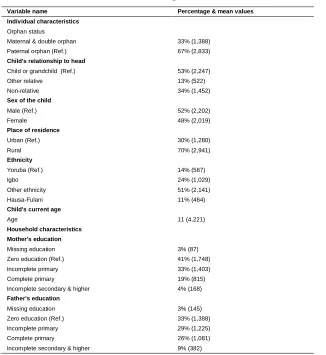
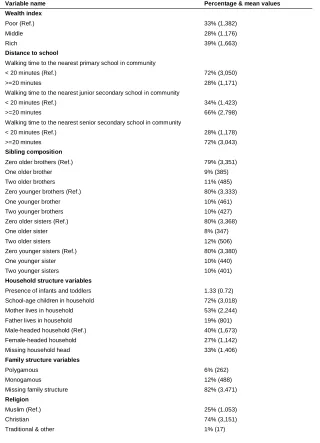
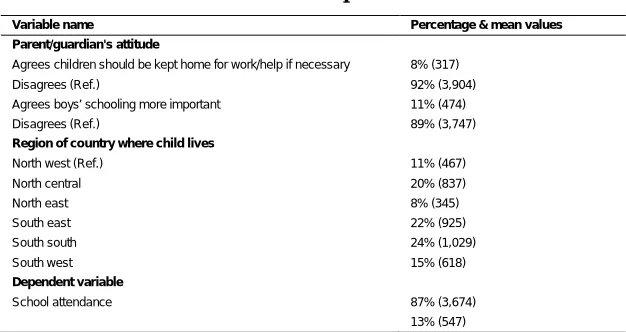
interviewed. In the interviewed households the parents/guardians of 71,567 children eligible for the 2010 NEDS answered survey questions. The response rate for the 2010 NEDS was 98%.10 The descriptive statistics of the all variables used in the analyses are presented in Table 1, and variable descriptions are shown in the Appendix.
Table 1: Variable names and descriptive statistics
Variable name Percentage & mean values
Individual characteristics
Orphan status
Maternal & double orphan 33% (1,388) Paternal orphan (Ref.) 67% (2,833)
Child's relationship to head
Child or grandchild (Ref.) 53% (2,247) Other relative 13% (522) Non-relative 34% (1,452)
Sex of the child
Male (Ref.) 52% (2,202) Female 48% (2,019)
Place of residence
Urban (Ref.) 30% (1,280) Rural 70% (2,941)
Ethnicity
Yoruba (Ref.) 14% (587)
Igbo 24% (1,029)
Other ethnicity 51% (2,141) Hausa-Fulani 11% (464)
Child's current age
Age 11 (4,221)
Household characteristics
Mother's education
Missing education 3% (87) Zero education (Ref.) 41% (1,748) Incomplete primary 33% (1,403) Complete primary 19% (815) Incomplete secondary & higher 4% (168)
Father's education
Missing education 3% (145) Zero education (Ref.) 33% (1,388) Incomplete primary 29% (1,225) Complete primary 26% (1,081) Incomplete secondary & higher 9% (382)
10
Table 1: (Continued)
Variable name Percentage & mean values
Wealth index
Poor (Ref.) 33% (1,382)
Middle 28% (1,176)
Rich 39% (1,663)
Distance to school
Walking time to the nearest primary school in community
< 20 minutes (Ref.) 72% (3,050) >=20 minutes 28% (1,171) Walking time to the nearest junior secondary school in community
< 20 minutes (Ref.) 34% (1,423) >=20 minutes 66% (2,798) Walking time to the nearest senior secondary school in community
< 20 minutes (Ref.) 28% (1,178) >=20 minutes 72% (3,043)
Sibling composition
Zero older brothers (Ref.) 79% (3,351) One older brother 9% (385) Two older brothers 11% (485) Zero younger brothers (Ref.) 80% (3,333) One younger brother 10% (461) Two younger brothers 10% (427) Zero older sisters (Ref.) 80% (3,368) One older sister 8% (347) Two older sisters 12% (506) Zero younger sisters (Ref.) 80% (3,380) One younger sister 10% (440) Two younger sisters 10% (401)
Household structure variables
Presence of infants and toddlers 1.33 (0.72) School-age children in household 72% (3,018) Mother lives in household 53% (2,244) Father lives in household 19% (801) Male-headed household (Ref.) 40% (1,673) Female-headed household 27% (1,142) Missing household head 33% (1,406)
Family structure variables
Polygamous 6% (262) Monogamous 12% (488) Missing family structure 82% (3,471)
Religion
Table 1: Variable names and descriptive statistics
Variable name Percentage & mean values
Parent/guardian's attitude
Agrees children should be kept home for work/help if necessary 8% (317) Disagrees (Ref.) 92% (3,904) Agrees boys’ schooling more important 11% (474) Disagrees (Ref.) 89% (3,747)
Region of country where child lives
North west (Ref.) 11% (467) North central 20% (837) North east 8% (345) South east 22% (925) South south 24% (1,029) South west 15% (618)
Dependent variable
School attendance 87% (3,674) 13% (547)
Source:Nigeria DHS EdData Survey 2010. (NDES 2010). Sample contains 4,221 orphan children.
6. Model estimation technique
A series of logistic regressions for school attendance are estimated of the general form:
ln 1 − = + ∗ + ∗ + ⋯+ ∗
where p is the probability that a child is currently attending school, the non-linear transformation of which (Ln [p/1-p] or ‘logit’) is estimated as the linear function of an intercept (α) and set of independent variables (X) and their corresponding parameter estimates (β) (Menard 1995). The Xs include child, head, household, and locational characteristics (including interaction terms between indicators for orphan status and child’s relationship to household head) as listed in Tables 2a, 3a, and 4a. Tables 2b to 4b present the corresponding predicted probability from each of the logistic regressions presented in Tables 2a to 4a.
Tables 3a and 4a show models with this same interaction, but conditional on child’s age and household income, respectively.
7. Results
7.1 Interaction model results
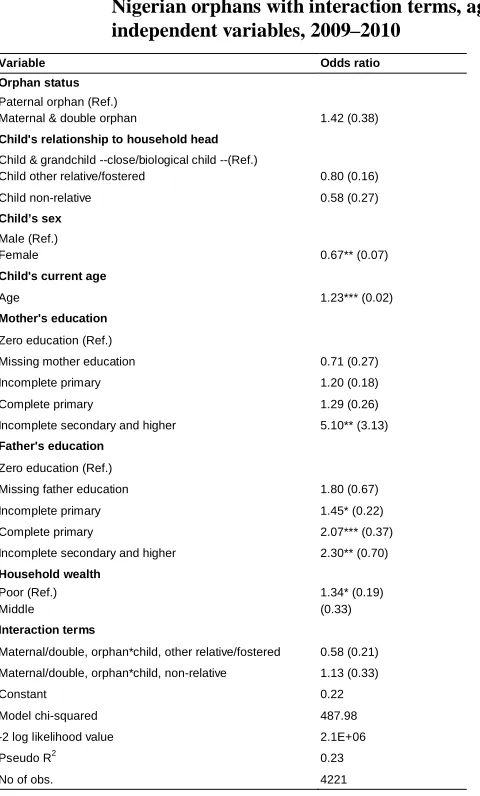
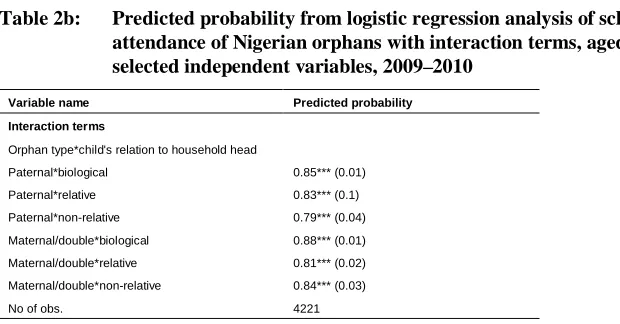
In Table 2a we examine whether maternal/double versus paternal orphans who have close biological ties with their household heads are more likely to attend school than those with more distant relationships. As shown in Table 2b,11 the corresponding predicted probabilities indicate that among paternal orphans, biological or close relatives of the household head are educationally advantaged, as Hamilton’s rule would predict. Paternal orphans without kinship ties to the household head have the lowest probability of attending school. For maternal/double orphans we find that those who are children or grandchildren (categorized as biological children) of their household heads are educationally advantaged. Maternal/double orphans without kinship ties appear to be favored by the household head compared to children who are related to them. With respect to maternal/double orphans, there is partial support for Hamilton’s rule that biological children experience an educational advantage over children who are relatives or non-relatives. But in the same group, non-relative children have an educational advantage over children who are relatives. In sum, Table 2a shows that paternal and maternal/double orphans who are children or grandchildren of their household heads have the highest probability of attending school. However, the probability of attending school is slightly higher for maternal/double orphans who are categorized as biological children than for paternal orphans with similar classification.
11 Using the technique discussed in Norton et al. (2004), the predicted probability models estimated and
Table 2a: Odds ratios from logistic regression analysis of school attendance of Nigerian orphans with interaction terms, aged 4–16 on selected independent variables, 2009–2010
Variable Odds ratio
Orphan status
Paternal orphan (Ref.)
Maternal & double orphan 1.42 (0.38)
Child's relationship to household head
Child & grandchild --close/biological child --(Ref.)
Child other relative/fostered 0.80 (0.16) Child non-relative 0.58 (0.27)
Child’s sex
Male (Ref.)
Female 0.67** (0.07)
Child's current age
Age 1.23*** (0.02)
Mother's education
Zero education (Ref.)
Missing mother education 0.71 (0.27) Incomplete primary 1.20 (0.18) Complete primary 1.29 (0.26) Incomplete secondary and higher 5.10** (3.13)
Father's education
Zero education (Ref.)
Missing father education 1.80 (0.67) Incomplete primary 1.45* (0.22) Complete primary 2.07*** (0.37) Incomplete secondary and higher 2.30** (0.70)
Household wealth
Poor (Ref.) Middle
1.34* (0.19) (0.33)
Interaction terms
Maternal/double, orphan*child, other relative/fostered 0.58 (0.21) Maternal/double, orphan*child, non-relative 1.13 (0.33)
Constant 0.22
Model chi-squared 487.98 -2 log likelihood value 2.1E+06 Pseudo R2 0.23
No of obs. 4221
Source: Nigeria DHS EdData Survey 2010. (NDES 2010).
Table 2b: Predicted probability from logistic regression analysis of school attendance of Nigerian orphans with interaction terms, aged 4–16 on selected independent variables, 2009–2010
Variable name Predicted probability
Interaction terms
Orphan type*child's relation to household head
Paternal*biological 0.85*** (0.01) Paternal*relative 0.83*** (0.1) Paternal*non-relative 0.79*** (0.04) Maternal/double*biological 0.88*** (0.01) Maternal/double*relative 0.81*** (0.02) Maternal/double*non-relative 0.84*** (0.03) No of obs. 4221
Note:The following variables were controlled for in the presented interaction model: urban-rural residence, ethnicity, distance to primary and secondary schools, sibship size, mother and father lives in the household, number of school age children in the household, presence of children under 5 in household, sex of household head, family structure. In addition, religion, parental attitude towards child labor and gender bias, and region were also included as controls. Delta-method standard errors are in parentheses. Significance stars mean p-value associated with the predicted probability is statistically significant at the .001 alpha level.
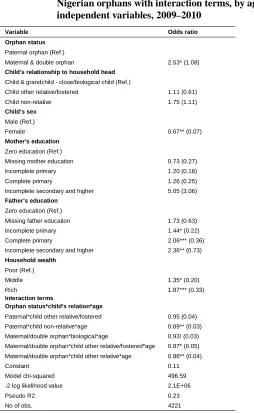
Table 3a: Odds ratios from logistic regression analysis of school attendance of Nigerian orphans with interaction terms, by age, on selected independent variables, 2009–2010
Variable Odds ratio
Orphan status
Paternal orphan (Ref.)
Maternal & double orphan 2.53* (1.08)
Child's relationship to household head
Child & grandchild - close/biological child (Ref.)
Child other relative/fostered 1.11 (0.61) Child non-relative 1.75 (1.11)
Child’s sex
Male (Ref.)
Female 0.67** (0.07)
Mother's education
Zero education (Ref.)
Missing mother education 0.73 (0.27) Incomplete primary 1.20 (0.18) Complete primary 1.26 (0.25) Incomplete secondary and higher 5.05 (3.06)
Father's education
Zero education (Ref.)
Missing father education 1.73 (0.63) Incomplete primary 1.44* (0.22) Complete primary 2.06*** (0.36) Incomplete secondary and higher 2.36** (0.73)
Household wealth
Poor (Ref.)
Middle 1.35* (0.20) Rich 1.87*** (0.33)
Interaction terms
Orphan status*child's relation*age
Paternal*child other relative/fostered 0.95 (0.04) Paternal*child non-relative*age 0.89** (0.03) Maternal/double orphan*biological*age 0.93! (0.03) Maternal/double orphan*child other relative/fostered*age 0.87* (0.05) Maternal/double orphan*child other relative*age 0.86** (0.04)
Constant 0.11
Model chi-squared 496.59 -2 log likelihood value 2.1E+06
Pseudo R2 0.23
No of obs. 4221
Source: Nigeria DHS EdData Survey 2010. (NDES 2010).
Table 3b: Predicted probability from logistic regression analysis of school attendance of Nigerian orphans with interaction terms, by age, on selected independent variables, 2009–2010
Variable name Predicted probability
Interaction terms
Orphan status*child's relation*age
Table 3b: (Continued)
Variable name Predicted probability
Interaction terms
Orphan status*child's relation*age
At age 16*maternal/double*biological 0.94*** (0.01) At age 16*maternal/double*relative 0.88*** (0.02) At age 16*maternal/double*non-relative 0.90*** (0.03)
No of obs. 4221
Source: Nigeria DHS EdData Survey 2010. (NDES 2010).
Note: The following variables were controlled for in the presented interaction model: urban-rural residence, ethnicity, distance to primary and secondary schools, sibship size, mother and father lives in the household, number of school-age children in the household, presence of children under 5 in household, sex of household head, family structure. In addition, religion, parental attitude towards child labor and gender bias, and region were also included as controls. Delta-method standard errors are in parentheses. Significance stars mean p-value associated with the predicted probability is statistically significant at the .001 alpha level.
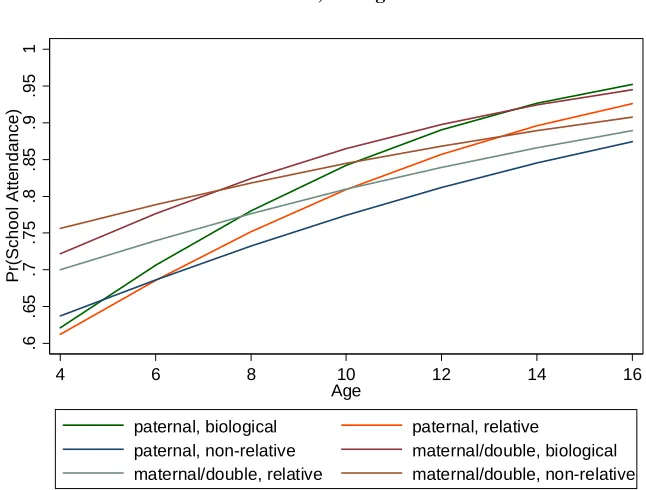
Figure 1: Predicted probabilities of school attendance by orphan status, child’s relation to household head, and age
We also examined whether the relationships vary by household income (poor versus non-poor). The corresponding predicted probabilities associated with the regression in Table 4a are shown in Figure 2. Most of the variation in the predicted
.6 .6 5 .7 .7 5 .8 .8 5 .9 .9 5 1 P r( S c h o o l A tt e n d a n c e )
4 6 8 10 12 14 16
Age
paternal, biological paternal, relative
paternal, non-relative maternal/double, biological
probability of school attendance is for the maternal/double orphans. The figure shows that maternal/double orphans who are relatives of the household head and who reside in middle-income households have the lowest predicted probability of attending school. Among maternal/double orphans the most advantaged are biological children in both middle-income and rich households, and non-relatives who live in rich households. The predicted probabilities of attending school are relatively high for the other categories for maternal/double orphans. The figure shows that poor paternal non-relatives have the lowest predicted probability of attending school. The range of the predicted probability for the rest of the paternal orphans is minimal (ranging from 0.83–0.86). The figure shows that biological paternal orphans who live in rich households have the highest predicted probability of attending school, suggesting that the altruism of those who control household resources towards orphans of any type is dependent on their economic status. School attendance is uniformly low among orphans in poor or low-income households, regardless of the closeness of their relationship to the household head. Being able to show any altruism is a function of having the resources necessary to do so: resources cannot be distributed inequitably if there are no resources to distribute in the first place. In line with consumer demand theory, the social rupture thesis, and arguments of Eloundou-Enyegue and Stokes (2002) and Gage (2005), the ability of extended families to educate orphans is highly dependent on the economic resources in their households. In fact, in the presence of economic crisis and high unemployment in the region, the extended family may not be able to afford the cost of educating orphans. Income is positively related to the willingness of guardians to educate orphans of any type, especially if they are closely related to their household head. This suggests that the education of orphans is a normal good that is sensitive to scarcity in household income.
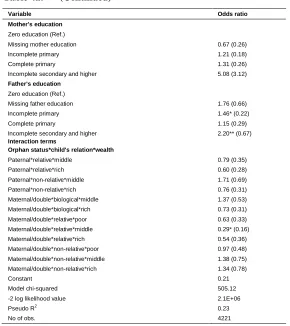
Table 4a: Odds ratios from logistic regression analysis of school attendance of Nigerian orphans with interaction terms, by wealth, on selected independent variables, 2009–2010
Variable Odds ratio
Orphan status
Paternal orphan (Ref.)
Maternal & double orphan 1.42 (0.42)
Child's relationship to household head
Child or grandchild - close/biological child (Ref.)
Child other relative - fostered 0.97 (0.29) Child non-relative 0.53 (0.28)
Child’s sex
Male (Ref.)
Female 0.68** (0.07)
Child's current age
Table 4a: (Continued)
Variable Odds ratio
Mother's education
Zero education (Ref.)
Missing mother education 0.67 (0.26) Incomplete primary 1.21 (0.18) Complete primary 1.31 (0.26) Incomplete secondary and higher 5.08 (3.12)
Father's education
Zero education (Ref.)
Missing father education 1.76 (0.66) Incomplete primary 1.46* (0.22) Complete primary 1.15 (0.29) Incomplete secondary and higher 2.20** (0.67)
Interaction terms
Orphan status*child's relation*wealth
Paternal*relative*middle 0.79 (0.35) Paternal*relative*rich 0.60 (0.28) Paternal*non-relative*middle 1.71 (0.69) Paternal*non-relative*rich 0.76 (0.31) Maternal/double*biological*middle 1.37 (0.53) Maternal/double*biological*rich 0.73 (0.31) Maternal/double*relative*poor 0.63 (0.33) Maternal/double*relative*middle 0.29* (0.16) Maternal/double*relative*rich 0.54 (0.36) Maternal/double*non-relative*poor 0.97 (0.48) Maternal/double*non-relative*middle 1.38 (0.75) Maternal/double*non-relative*rich 1.34 (0.78)
Constant 0.21
Model chi-squared 505.12 -2 log likelihood value 2.1E+06
Pseudo R2 0.23
No of obs. 4221
Source: Nigeria DHS EdData Survey 2010. (NDES 2010).
Table 4b: Predicted probability from logistic regression analysis of school attendance of Nigerian orphans with interaction terms, by wealth, on selected independent variables, 2009–2010
Variable name Predicted probability Interaction terms
Orphan status*child's relation*wealth
Paternal*biological*poor 0.82*** (0.02) Paternal*biological*middle 0.84*** (0.02) Paternal*biological*rich 0.90*** (0.01) Paternal*relative*poor 0.82*** (0.03) Paternal*relative*middle 0.82*** (0.03) Paternal*relative*rich 0.85*** (0.02) Paternal*non-relative*poor 0.74*** (0.05) Paternal*non-relative*middle 0.83*** (0.04) Paternal*non-relative*rich 0.82*** (0.04) Maternal/double*biological*poor 0.86*** (0.01) Maternal/double*biological*middle 0.90*** (0.02) Maternal/double*biological*rich 0.90***(0.02) Maternal/double*relative*poor 0.81*** (0.04) Maternal/double*relative*middle 0.74*** (0.04) Maternal/double*relative*rich 0.88*** (0.04) Maternal/double*non-relative*poor 0.79*** (0.06) Maternal/double*non-relative*middle 0.85*** (0.04) Maternal/double*non-relative*rich 0.90*** (0.03) No of obs. 4221
Source: Nigeria DHS EdData Survey 2010. (NDES 2010).
Figure 2: Predicted probabilities of school attendance by orphan status, child’s relation to household head, and household wealth
8. Discussion
This study examines the applicability of Hamilton’s rule to the education of orphans in Nigeria. It investigates three research questions.12 First, are paternal or maternal/double orphans who have close genetic ties with their household heads more likely to attend school than those with more distant ties? The results indicate that paternal and maternal/double orphans who are biological children of their household heads are the most likely to attend school. The results further show that it is paternal orphans who are non-relatives and maternal orphans who are relatives of their household heads who have the lowest chances of attending school. This finding supports that part of Hamilton’s
12
Another important issue in the discussion of orphans’ schooling in sub-Saharan Africa concerns the interactions between orphanhood and gender, and orphanhood and household income. These are subjects that are researched and addressed in a complementary manuscript.
.6 .6 5 .7 .7 5 .8 .8 5 .9 .9 5 1 P r( S c h o o l A tt e n d a n c e ) paternal maternal/double Orphan Status
biological, poor biological, middle
biological, rich relative, poor
relative, middle relative, rich
non-relative, poor non-relative, middle
rule which predicts that biological distance from the individual who controls resources leads to lower investment in schooling (Hamilton 1963).
Second, among orphans, does having close genetic ties with the household head lead to a schooling advantage, and how does age factor into this? Among maternal/double and paternal orphans the results are consistent with Hamilton’s rule, showing educational advantages to biological ties, especially after age 10. These findings are consistent with those reported elsewhere, that among orphans a closer biological relationship to the head leads to a schooling advantage (Case et al. 2004; Nyamukapa and Gregson 2005; Parker and Short 2009; Guo et al. 2012). Moreover, at younger ages, paternal orphans have lower school attendance, regardless of their relationship to the household head. However, as age increases that disadvantage reverses. Among maternal/double orphans, relatives of the household head have the lowest probability of attending school, while among paternal orphans, non-relatives have the lowest chance.
Third, among orphans, does having close genetic ties rather than distant ties with the household head lead to a schooling advantage, and how does household income factor in? The findings show that biological paternal orphans who live in better-off households possess an educational advantage, and paternal non-relatives in poor households have an educational disadvantage. The results also show that maternal/double orphans who are relatives of the household head and are in middle-income households have the lowest chance of attending school, followed by maternal/double orphans who are non-relatives and relatives of the household head in poor households.
9. Conclusion and policy implications
This research contributes to our understanding of orphans’ education and whether their relation to the household head influences school attendance in Nigeria. Specifically, we find that paternal and maternal/double orphans who have close biological ties with their household head possess an educational advantage over those with more distant relations. This finding supports the expectation from Hamilton’s rule that individuals are more altruistic toward those with whom they have close kinship (and therefore genetic) ties than those more distantly related. While this is certainly true, perhaps Hamilton’s rule might be adjusted to take into account the negative effect of poverty and economic hardship on the ability to be altruistic at all.
care of orphans stems from their unwillingness to assume the financial burden (Eke 2004). The arguments in consumer demand theory, and poverty, are pertinent to understanding why orphans with distant relations are not provided for educationally in sub-Saharan Africa. This theory states that the ability of a household to educate children depends on cost and affordability. Although African cultural norms stipulate that the extended family should provide for orphans’ needs, with little or no involvement of the state, financial instability often prevents this from happening. To address the educational needs of orphans, poverty alleviation programs should be implemented. Programs such as conditional cash transfers, child sponsorship, and food allocation to both the household and schools would incentivize household heads to allow orphans, especially those with distant ties, to go to school (Eke 2004; UNICEF 2009; Guo et al. 2012).
10. Acknowledgements
References
Abebe, T. and Aase, A. (2007). Children, AIDS and the politics of orphan care in Ethiopia: The extended family revisited. Social Science and Medicine 64(10): 2058–2069.
Ainsworth, M. and Filmer, D. (2002). Poverty, AIDS and children’s schooling: A targeting dilemma. Washington, D.C: World Bank (Policy research working paper 2885).
Ainsworth, M., Beegle, K., and Koda, G. (2005). The impact of adult mortality and parental deaths on primary schooling in north-Western Tanzania. Journal of
Development Studies 41(3): 412–439.doi:10.1080/0022038042000313318.
Alber, E. (2003). Denying biological parenthood: Fosterage in northern Benin.Ethnos 68(4): 487–506.doi:10.1080/0014184032000160532.
Alvard, M.S. (2003). Kinship, lineage, and evolutionary perspective on cooperative hunting groups in Indonesia. Human Nature 14(2): 129–163. doi:10.1007/ s12110-003-1001-5.
Anarfi, J.K. (1992). Report on a pilot study on the coping strategies of households with Aids sufferers. Legon: University of Ghana.
Anderson, K.G. (2005). Relatedness and investment in children in South Africa.Human
Nature16(1): 1–31.doi:10.1007/s12110-005-1005-4.
Asiamah, S, Kraybill, D., and Thompson, S. (2005).Does orphan status affect primary school attendance? An analysis of household survey data from Uganda. Paper presented at the American Agricultural Economics Association Annual Meeting, July 24‒27, Providence, RI
Bennell, P. (2005). The impact of the AIDS epidemic on the schooling of orphans and other directly affected children in sub-Saharan Africa. Journal of Development
Studies41(3): 467–488.doi:10.1080/0022038042000313336.
Bicego, G., Rutstein, S., and Johnson, K. (2003). Dimensions of the emerging orphan crisis in sub-Saharan Africa.Social Science and Medicine 56(6): 1235–1247.
Borgerhoff Mulder, M. (2007). Hamilton’s rule and kin competition: The Kipsigis case.
Evolution and Human Behavior 28(5): 299–312. doi:10.1016/j.evolhumbehav.
2007.05.009.
Buchmann, C. (2000). Family structure, parental perceptions, and child labor in Kenya: What factors determine who is enrolled in school?Social Forces 78(4): 1349– 1378.doi:10.2307/3006177.
Caldwell, J.C. (1982).Theory of fertility decline. New York: Academic Press.
Case, A., Paxson, C., and Ableidinger, J. (2004). Orphans in Africa: Parental death, poverty, and school enrollment.Demography41(3): 483–508.doi:10.1353/dem. 2004.0019.
Chirwa, W.C. (2002). Social exclusion and inclusion: Challenges to orphans care in Malawi.Nordic Journal of African Studies 11(2): 93–103.
Dahl, B. (2009). The ‘failures of culture’: Christianity, kinship, and moral discourses about orphans during Botswana’s AIDS crisis. Africa Today 56(1): 23–43.
doi:10.2979/AFT.2009.56.1.22.
Daly, M. and Wilson, M. (1987). The Darwinian psychology of discriminative parental solicitude. In: Leger, D. (ed.). Nebraska Symposium on Motivation. Nebraska: University of Nebraska Press: 91–144.
Eke, B. (2004). Intergenerational impact of the AIDS pandemic in Nigeria. Journal of
Intergenerational Relationships2(3–4): 39–52.doi:10.1300/J194v02n0304.
Ekong, S.C. (1986). Industrialization and kinship: A comparative study of some Nigerian ethnic group.Kinship and Development 17(2): 197‒206.
Eloundou-Enyegue, P.M and Stokes, C.S. (2002). Will economic crises in Africa weaken rural-urban ties? Insights from child fosterage trends in Cameroon.
Rural Sociology 67(2): 278–298.doi:10.1111/j.1549-0831.2002.tb00104.x.
Evans, K.E. and Miguel, E. (2007). Orphans and schooling in Africa: A longitudinal analysis.Demography 44(1): 35–57.doi:10.1353/dem.2007.0002.
Foster, G. and Williamson, J. (2000). A review of current literature of the impact of HIV/AIDS on children in sub-Saharan Africa.AIDS 14(suppl.3): S275–S284.
Fuller, B., Singer, J.D., and Keiley, M. (1995). Why do daughters leave school in Southern Africa? Family economy and mothers commitments.Social Forces 74 (2): 657–681.doi:10.2307/2580496.
Gage, A. (2005). The interrelationship between fosterage, schooling and children’s labor force participation in Ghana. Population Research and Policy Review 24(5): 431–466.doi:10.1007/s11113-005-4290-z.
Gurven, M. (2004). To give or not to give: An evolutionary ecology of human food transfers.Behavioral and Brain Sciences27(4): 543–583.
Guo, Y., Xiaoming, L., and Sherr, L. (2012). The impact of HIV/AIDS on children’s educational outcome: A critical review of global literature. AIDS Care:
Psychological and Socio-Medical Aspects of AIDS/HIV 24(8): 993–1012.
doi:10.1080/09540121.2012.668170.
Hamilton, W.D. (1963). The evolution of altruistic behavior. American Naturalist 97(896): 354–356.doi:10.1086/497114.
Huber, U. and Gould, B. (2002).Primary school attendance in Tanzania: How far is it affected by orphanhood? Paper presented at the Annual Conference of the British Society for Population Studies, University of Newcastle, 9‒11 September.
Hunter, S.S. (1990). Orphans as a window on the AIDS epidemic in sub-Saharan Africa: Initial results and implications of a study in Uganda. Social Science &
Medicine 31(6): 681–690.doi:10.1016/0277-9536(90)90250-V.
Isiugo-Abanihe, U.C. (1984). Prevalence and determinants of child fosterage in West Africa: Relevance to demography. Pennsylvania: Population Studies Center (African Demography Working Paper Series. WP-1984-012).
Karaca-Mandi, P., Norton, E.C., and Dowd, B. (2012). Interaction terms in nonlinear models. Health Services Research 47(1): 255–273. doi:10.1111/j.1475-6773. 2011.01314.x.
Kidman, R., Hanley, J.A., Foster G., Subramanian, S.V., and Heyman, J. (2012). Educational disparities in AIDS-affected communities: Does orphanhood confer unique vulnerability? Journal of Development Studies 48(4): 531–548.
doi:10.1080/00220388.2011.604412.
Kobiane, J.F., Calves, A., and Marcoux, R. (2005). Parental death and children’s schooling in Burkina Faso.Comparative Education Review 49(4): 468–489.
Madhaven, S. (2004). Fosterage patterns in the age of AIDS: Continuity and change. Social Science & Medicine 58(7): 1443–1454.
Monasch, R. and Boerma, J.T. (2004). Orphanhood and childcare patterns in sub-Saharan Africa: An analysis of national surveys from 40 Countries.AIDS 18(2): S55–S64.doi:10.1097/00002030-200406002-00007.
Menard, S.W. (1995).Applied Logistic Regression Analysis. Thousand Oaks: Sage.
Norton, E.C., Wang, H., and Ai, C. (2004). Computing interaction effects and standard errors in logit and probit models.Stata Journal 4(2): 154–167.
Nyambedha, E.O., Wandibba, S., and Aagaard-Hansen, J. (2003). Changing patterns of orphan care due to the HIV epidemic in western Kenya. Social Science & Medicine 57(2): 301–311.
Nyamukapa, C. and Gregson, S. (2005). Extended family’s and women’s roles in safeguarding orphans’ education in AIDS-afflicted rural Zimbabwe. Social Science & Medicine 60(10): 2155–2167.
Oke, E.A. (1986). Kinship interaction in Nigeria in relation to societal modernization: A pragmatic approach.Journal of Comparative Family Studies 17(2): 185–196.
Ombuya, B.D., Yambo, J.M., and Mboya, O.T. (2012). Effects of orphanhood on girl-child’s access and retention in secondary school education: A case of Rongo District, Kenya. International Journal of Academic Research in Progressive Education and Development 1(4): 114–133.
Oni, J.B. (1995). Fostered children’s perception of their health care and illness treatment in Ekiti Yoruba households, Nigeria. Health Transition Review 5(1): 21‒34.
Parker, E.M. and Short, S.E. (2009). Grandmother coresidence, maternal orphans, and school enrollment in sub-Saharan Africa. Journal of Family Issues 30(6): 813– 836.
Parikh, A., DeSilva, M.B., Cakwe, M., Quinlan, T., Simon, J.L., Skalicky, A., and Zhuwau, T. (2007). Exploring the Cinderella myth: Intrahousehold differences in child wellbeing between orphans and non-orphans in Amajuba District, South Africa.AIDS 21(7): S95–S103.doi:10.1097/01.aids.0000300540.12849.86.
Scelza, B.A. and Silk, J.B. (2014). Fosterage as a system of dispersed cooperative breeding: Evidence from the Himba. Human Nature 25(4): 448–464.
doi:10.1007/s12110-014-9211-6.
Tanga, P.T. (2013). The impact of the declining extended family support system on the education of orphans in Lesotho.African Journal of AIDS Research 12(3): 173– 183.doi:10.2989/16085906.2013.863217.
Thomas, K.J.A. (2010). Family contexts and schooling disruption among orphans in post-genocide Rwanda.Population Research and Policy Review 29(6): 819–842. doi:10.1007/s11113-009-9167-0.
Treiman, D.J. (2009). Quantitative data analysis: Doing social research to test ideas. San Francisco: Jossey-Bass.
UNAIDS (2014). Federal Republic of Nigeria. Global AIDS response. Country progress report. Nigeria: UNAIDS.
UNICEF (2009). Promoting quality education for orphans and vulnerable children: A sourcebook of programmer experiences in Eastern and Southern Africa. New York: UNICEF.
UNICEF (2006). Africa’s orphaned and vulnerable generations: Children affected by AIDS. New York: UNICEF.
West, A.S., Pen, I., and Griffin, S.A. (2002). Cooperation and competition between relatives.Science 296(5565): 72–75. doi:10.1126/science.1065507.
West, A.S., Murray, G.M., Machado, A.C., Griffin, A.A., and Edward, A.H. (2001). Testing Hamilton’s Rule with competition between relatives.Nature 409(6819): 510–512. doi:10.1038/35054057.
Yamano, T., Shimamura, Y., and Sserunuuma, D. (2006). Living arrangement and schooling of orphaned children and adolescents in Uganda. Economic
Development and Cultural Change 54(4): 833–856.doi10.1086/503586.
Appendix
Sampling procedure
The 2010 NEDS provides information on factors that influence primary and secondary education outcomes among children aged 4 to 16. The data contains variables on reasons why children miss school, never attend, or drop out. These reasons include physical or mental disability, ill health, work, inability to pay for the costs of schooling, and feeling unsafe to travel. Anthropometric information, mainly height and weight variables, were collected on children aged 4 to 10 years old. Literacy/numeracy data on children in the age category of 5 to 16 years also exist in the dataset.
Four questionnaires were utilized for the 2010 Nigeria Education Data Survey (NEDS): the household, parent/guardian, eligible child, and independent child questionnaires. This research used the dataset that was generated by the eligible child questionnaire. The United States Agency for International Development (USAID) and the UK Department for International Development (DFID) funded the survey instrument development, sampling, and data collection effort.
The definition of genetic relation to the household head and its applicability in the African context has been questioned (Anderson 2005). In sub-Saharan Africa a household does not only include the nuclear family: it can also include extended family members and others who may not have genetic ties to the household head. In the West, on the other hand, family households usually consist of one or two parents and their biological offspring only (Anderson 2005). Given this understanding, the measure for a child’s genetic relation to the household head in the dataset is defined by the Western perspective of what a household should be (Anderson 2005). The measure does not take into consideration the multigenerational household model that is common in sub-Saharan Africa (Anderson 2005). Nonetheless, we retained this variable in the multivariate analyses. Appropriate sample weights were applied in the analysis. This procedure yields robust standard errors for each of the regressions presented. Statistical analyses were conducted using STATA 13.1.
Data merging and matching
the dataset during the merge of the two datasets. The total number of children with missing information on their mothers’ birthing history in the 2010 NEDS after it was merged with the 2008 NDHS was 30,000. It was during the data analyses stage that the 30,000 cases were omitted.
Statistical knowledge on case-wise deletion notes that if data is missing completely at random by design,13 then the main cost is reduction in sample size (Treiman 2009). This omission of missing cases may raise the issue of possible selection bias (see p.12 footnote 7). Regardless of whether children have information on their mothers’ birthing history, the households from which they were drawn through the 2008 NDHS clusters were randomly selected. The children who were retained in our analyses were those with information on the mother’s birthing history. This means that our results are reflective of children whose mothers’ birthing histories exist.
Description of variables
The description of each variable as prescribed in the codebook is presented as follows. The dependent variable ‘school attendance’ is constructed from the following question: “Has (name) attended a formal school at any point during the current school year [2009-2010]?” The variable is coded 1 to indicate attendance, and 0 otherwise. The orphan indicator is derived from the following yes/no questions: “Is [Name’s] natural mother alive?” and “Is [Name’s] natural father alive?” Maternal and double orphan is defined as l if a child has lost a mother but father is still alive or if a child has lost both parents, and 0 otherwise. Paternal orphan is coded 1 if a child has lost a father but mother is alive, and 0 otherwise. The ‘child’s relationship to head’ variable is generated from the question, “What is [Name]’s relationship to head of household?” The variable was categorized into the following distinct groups: children, grandchildren, siblings, nieces/nephews, sons-/daughters-in-law, adopted/fostered, stepchildren, other distant relatives, non-relative, or relation unknown. A child or grandchild is defined as a child who is either a biological son/daughter or grandchild of the household head. The other categories of relatives denoted as children are brother/sister, niece/nephew, son or
13 ‘Missing completely at random by design’ means that the missing responses in a specific variable are
daughter in-law, adopted/fostered or stepchildren, and distant relative of household head, while the non-relative group comprises children who are either non-relatives or their relation to the household head is unknown or missing.
The sex of the child is defined as either male (reference group) or female. Place of residence is defined as urban (reference category) or rural. The child’s ethnicity variable is categorized into Yoruba (reference category), Igbo, Hausa-Fulani, and Other Ethnicities (reference category). Child’ current age is in continuous form. The mother’s and father’s education are categorized as missing (unknown), none (reference category), incomplete primary, complete primary, and incomplete secondary (some secondary and higher). A household wealth index was constructed by the NDES based on ownership of a radio, television, paraffin lamp, bicycle, motorcycle/scooter, and car/truck, as well as items about lighting, water and fuel sources, sanitation facilities, and floor material. These items are combined into an asset score that we divided into quintiles of economic status. The variable is trichotomized as poor (this reference group consists of the first and second quintiles), middle (includes the third quintile), and rich (comprises the fourth and fifth quintiles).