
VOLUME 37, ARTICLE 21, PAGES 669−708
PUBLISHED 13 SEPTEMBER 2017
http://www.demographic-research.org/Volumes/Vol37/21/ DOI: 10.4054/DemRes.2017.37.21
Research Article
Women’s education, infant and child mortality,
and fertility decline in urban and rural
sub-Saharan Africa
David Shapiro
Michel Tenikue
© 2017 David Shapiro & Michel Tenikue.
This open-access work is published under the terms of the Creative Commons Attribution NonCommercial License 2.0 Germany, which permits use, reproduction, and distribution in any medium for noncommercial purposes, provided the original author(s) and source are given credit.
1 Introduction 670
2 Theoretical framework 671
3 Overview of changes in fertility, education, mortality, and mean
age of women 673
4 Decomposition method and data 684
4.1 Decomposing changes in fertility over time 684 4.2 Changes in mean values of the variables 686
4.3 Regression results 687
5 Decomposition analysis 689
6 Conclusion 693
7 Acknowledgements 693
References 695
Women’s education, infant and child mortality, and fertility decline
in urban and rural sub-Saharan Africa
David Shapiro1 Michel Tenikue2
Abstract
BACKGROUND
This paper provides estimates of the contributions of increased women’s education and reduced infant and child mortality to fertility declines in urban and rural areas of countries in Sub-Saharan Africa, using individual-level data.
OBJECTIVE
The principal question that the paper addresses is: How much have increased women’s schooling and reduced mortality contributed to fertility declines in urban and rural places in each of 30 countries in sub-Saharan Africa? A secondary question is: What have been the changes in women’s schooling and mortality in urban and rural areas in these countries?
METHODS
Data from the first and last Demographic and Health Surveys for each country is used, along with a decomposition technique that allows us to quantify how much of the observed fertility decline is attributable to increased education and how much is due to reduced mortality.
RESULTS
In urban places, on average, increased women’s schooling accounts for 54% of observed fertility decline while reduced mortality contributes 30%. In rural areas with fertility decline, increased women’s education accounts for an average of 30% of the decline while reduced mortality accounts for an average of 35%. Results vary substantially by country and place of residence.
CONCLUSIONS
CONTRIBUTION
The paper uses individual-level data to provide quantitative estimates of the importance of increased women’s schooling and reduced mortality in contributing to fertility decline in sub-Saharan Africa.
1. Introduction
What are the roles of increasing women’s educational attainment and declining infant and child mortality in contributing to fertility decline in sub-Saharan Africa? Sub-Saharan Africa was the last major world region to experience the fertility decline that all industrialized countries have gone through and that much of the developing world has experienced. It has uniquely high fertility: for the period 2015–2020 the United Nations (2015) estimates (medium variant) the total fertility rate (TFR) at 4.75 for sub-Saharan Africa, compared to 2.15 for Asia and 2.05 for Latin America and the Caribbean. The ongoing fertility transition in sub-Saharan Africa has been comparatively slow and subject to stalling (Bongaarts 2008; Bongaarts and Casterline 2013; Shapiro and Gebreselassie 2008; Shapiro et al. 2013). As a consequence of the late onset of fertility transition, the prevalence of stalling of fertility decline, and the slow pace of decline (Bongaarts and Casterline 2013; Shapiro et al. 2013), sub-Saharan Africa has an overall level of fertility that is well over twice the levels in Asia and Latin America.
As we discuss in more detail in the theoretical framework section that follows, there are various pathways by which increased women’s education contributes to lower fertility. Likewise, there is evidence that reductions in infant and child mortality also contribute to fertility decline in the region.
Similarly, infant and child mortality is higher in sub-Saharan Africa than in Asia and Latin America (United Nations 2015). In most countries there have been declines in infant and child mortality, which, based on analysis of aggregate data, have contributed to the fertility decline in sub-Saharan Africa (Shapiro and Gebreselassie 2008; Shapiro 2012).
We use individual-level micro data and a decomposition technique for analyzing differences or changes to quantify the importance of increased women’s education and reduced infant and child mortality in contributing to the declines in fertility. Data is from the Demographic and Health Surveys, and comes from urban and rural places in all 31 countries that have had at least two surveys. These countries account for 86% of the population of sub-Saharan Africa.
The method entails decomposing observed changes in fertility to identify the magnitudes of those changes that are attributable to changes in different factors, most notably women’s education and infant and child mortality. The decompositions control not only for changes in these two variables, but also for changes in the age composition of the population of women. We examine overall changes between the first and the last surveys, beginning in the mid–1980s and up to the present. We provide separate estimates for urban and rural places: Garenne and Joseph (2002) show that the fertility transition in the region began first in urban areas, with a lag prior to the onset of fertility decline in rural places, and Shapiro and Tambashe (2002) emphasize that urban and rural areas in the region differ in terms of both the timing of the onset of fertility decline and the pace of that decline as the fertility transition unfolds.
We first provide a theoretical framework, and then review changes in fertility, education, mortality, and mean age of women in urban and rural sub-Saharan Africa (section 3). We describe the decomposition method and the data in section 4, and proceed to the decomposition analysis in section 5. The conclusion is presented in section 6.
2. Theoretical framework
regulation is used will depend in part on the strength of the motivation for fertility regulation, and in part on the costs of fertility regulation. The proximate determinants of fertility, such as exposure to the risk of conception and use of contraception, will in turn be influenced by the ‘basic determinants’ of fertility, such as education and infant and child mortality.
In her classic work, Fertility and education: What do we really know? (1979), Susan Hill Cochrane explores the various pathways by which education influences fertility, from the perspective of the Easterlin approach. Women’s education is associated with demand for fewer numbers of better-educated children (e.g., see Shapiro and Tambashe 2003), reflecting the quality-quantity tradeoff, reduced exposure to the risk of pregnancy through delays in marriage associated with increased schooling (Shapiro and Gebreselassie 2014), greater use of more efficient contraception (Rosenzweig and Schultz 1989; Shapiro and Tambashe 1994), and lower infant and child mortality (Hobcraft 1993; Rutstein 2000).
Reduced infant and child mortality, from the perspective of the Easterlin framework, raises the supply of children and hence, other things being equal, increases the demand for fertility control and thus contributes to declining fertility. In addition, in high-mortality environments the desired number of births may exceed the ideal number of children, which can stem from either a replacement effect following an infant death or an insurance effect in anticipation of such deaths, or both (Bongaarts and Casterline 2013). As noted in the introduction, reduced infant and child mortality contributes to declining fertility in sub-Saharan Africa (Shapiro and Gebreselassie 2008; Shapiro 2012) and elsewhere in the developing world (Shapiro et al. 2013).
As will be seen below, changes in education and mortality on average account for the majority but not the totality of observed fertility changes in the 30 countries with available data to carry out the decompositions, and in some countries these changes contribute relatively little to fertility decline. This implicitly raises the question, what other external factors might contribute to fertility decline? (Proximate determinants like marriage and contraception, which are pathways for education’s impact on fertility, are not discussed here but will be addressed below in the discussion of the decompositions.)
hardship as a contributor to fertility decline has also been emphasized by Eloundou-Enyegue, Stokes, and Cornwell (2000), Antoine (2006), and Gurmu and Mace (2008). In addition, there is some evidence that very high population density, as in Rwanda and Burundi, contributes to a lower ideal number of children and lower fertility (Lutz, Testa, and Penn 2006; Shapiro 2017). Finally, changes in preferences for children (i.e., ideal number of children) that cut across educational groups could be an independent source of fertility decline.
3. Overview of changes in fertility, education, mortality, and mean
age of women
Before we examine data for urban and rural places separately, we provide a brief overview of data at the national level, to facilitate comparisons with earlier research. The 31 countries present considerable variation in the pace of decline in fertility (Shapiro and Tenikue 2015). For all of the countries taken together, the average TFR in the first survey (measuring fertility during the three years prior to the survey) was 6.0, while the average TFR in the last survey was 5.2. Thus, over a span that on average was a little more than 16 years, the TFR has declined on average by a little less than 0.05 per year.
This pace is in line with the recent decline in sub-Saharan Africa. Shapiro et al. (2013) find that the average decline in sub-Saharan Africa between the two most recent Demographic and Health Surveys was 0.05 children per year. Going back over a longer time period, Bongaarts (2008) reports an average annual decline in the TFR of 0.07 from about 1992 to 1998 and a lower value (average decline of 0.02 per year) from 1998 to 2004. Using data from 31 sub-Saharan African countries, Garenne (2008) reports that the onset of fertility decline in most of the countries took place between 1960 and 2000 and that the average speed of fertility decline was approximately 0.1 children per woman per year.
Table 1: Fertility and fertility changes between the first and last Demographic and Health Survey, urban and rural places
Country First demographic and health survey
Last demographic and health survey
Absolute change in total fertility rate
year total fertility rate year total fertility rate total per year
urban rural urban rural urban rural urban rural
Benin 1996 4.9 6.7 2011–2012 4.3 5.4 –0.6 –1.3 –0.039 –0.084
Burkina Faso 1993 4.6 7.0 2010 3.9 6.7 –0.7 –0.3 –0.041 –0.018
Burundi 1987 5.1 7.0 2010 4.8 6.6 –0.3 –0.4 –0.013 –0.017
Cameroon 1991 5.2 6.3 2011 4.0 6.4 –1.2 0.1 –0.060 0.005
Chad 1996–1997 5.9 6.5 2004 5.7 6.5 –0.2 0.0 –0.027 0.000
Comoros 1996 3.8 5.0 2012 3.5 4.8 –0.3 –0.2 –0.019 –0.013
Congo 2005 3.8 6.1 2011–2012 4.5 6.5 0.7 0.4 0.108 0.062
Ivory Coast 1994 4.4 6.0 2011–2012 3.7 6.3 –0.7 0.3 –0.040 0.017
DRC 2007 5.4 7.0 2013–2014 5.4 7.3 0.0 0.3 0.000 0.046
Eritrea 1995 4.2 7.0 2002 3.5 5.7 –0.7 –1.3 –0.100 –0.186
Ethiopia 2000 3.0 6.0 2011 2.6 5.5 –0.4 –0.5 –0.036 –0.045
Gabon 2000 3.8 6.0 2012 3.9 6.1 0.1 0.1 0.008 0.008
Ghana 1988 5.3 7.0 2008 3.1 4.9 –2.2 –2.1 –0.110 –0.105
Guinea 1999 4.4 6.1 2012 3.8 5.8 –0.6 –0.3 –0.046 –0.023
Kenya 1989 4.5 7.1 2008–2009 2.9 5.2 –1.6 –1.9 –0.082 –0.097
Lesotho 2004 1.9 4.1 2009 2.1 4.0 0.2 –0.1 0.040 –0.020
Liberia 1986 6.0 7.1 2013 3.8 6.1 –2.2 –1.0 –0.081 –0.037
Madagascar 1992 3.8 6.7 2008–2009 2.9 5.2 –0.9 –1.5 –0.055 –0.091
Malawi 1992 5.5 6.9 2010 4.0 6.1 –1.5 –0.8 –0.083 –0.044
Mali 1987 6.3 7.4 2012–2013 5.0 6.5 –1.3 –0.9 –0.051 –0.035
Mozambique 1997 4.6 5.3 2011 4.5 6.6 –0.1 1.3 –0.007 0.093
Namibia 1992 4.0 6.3 2006–2007 2.8 4.3 –1.2 –2.0 –0.083 –0.138
Niger 1992 6.4 7.1 2012 5.6 8.1 –0.8 1.0 –0.04 0.050
Nigeria 1990 5.0 6.3 2013 4.7 6.2 –0.3 –0.1 –0.013 –0.004
Rwanda 1992 4.5 6.3 2010 3.4 4.8 –1.1 –1.5 –0.061 –0.083
Senegal 1986 5.4 7.1 2010–2011 3.9 6.0 –1.5 –1.1 –0.061 –0.045
Tanzania 1991–1992 5.1 6.6 2010 3.7 6.1 –1.4 –0.5 –0.076 –0.027
Togo 1988 4.9 7.3 1998 3.2 6.3 –1.7 –1.0 –0.170 –0.100
Uganda 1988–1989 5.7 7.6 2011 3.8 6.8 –1.9 –0.8 –0.084 –0.036
Zambia 1992 5.8 7.1 2007 4.3 7.5 –1.5 0.4 –0.100 0.027
Zimbabwe 1988 3.8 6.2 2010–2011 3.1 4.8 –0.7 –1.4 –0.031 –0.062
Averages 1993.4 4.7 6.5 2009.7 3.9 6.0. –0.9 –0.6 –0.053 –0.034
While the average pace of decline is slow in sub-Saharan Africa there is considerable variation across countries, in both urban and rural areas. Only 19 of the 31 countries have had declines in both urban and rural fertility. Of these countries, 11 have experienced more rapid declines in urban areas, while in the other eight the fertility decline has been more rapid in rural places. As mentioned above, the rapid fertility decline in Eritrea, especially in the countryside, may result in part from a border conflict with Ethiopia during the late 1990s (Blanc 2004; Woldemicael 2008).
Six countries experienced declines in urban fertility but not in rural fertility: Cameroon, Chad, Ivory Coast, Mozambique, Niger, and Zambia. The Congo Republic and Gabon had increased fertility in both urban and rural places, while the Democratic Republic of the Congo had stable urban fertility and increasing rural fertility. Finally, Lesotho, a low-fertility country, had increased urban fertility and reduced rural fertility.
The most common outcome is for fertility to decline in both urban and rural places, but in nearly 40% of the countries this is not the case. Fertility decline has been more prevalent in urban areas, being present in 28 countries as compared to the 23 countries that experienced rural fertility decline.
Map 1 shows the annual pace of decline in urban areas, and Map 2 does the same for rural places. The greater number of countries with an absence of fertility decline in rural areas is apparent. Rapid fertility decline is evident in both urban and rural places in Western, Eastern, and Southern Africa, while Middle Africa is least likely to have experienced fertility decline (regions are defined following the United Nations 2015 definitions).
Map 1: Average annual pace of decline in the total fertility rate between the first and last Demographic and Health Survey, urban areas
Map 2: Average annual pace of decline in the total fertility rate between the first and last Demographic and Health Survey, rural areas
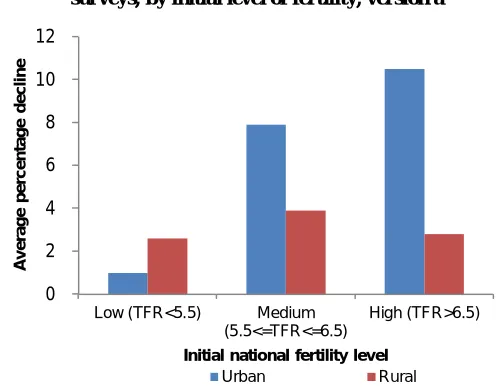
Figure 1a: Average relative declines in urban and rural TFRs between pairs of surveys, by initial level of fertility, version a
Figure 1b: Average relative declines in urban and rural TFRs between pairs of surveys, by initial level of fertility, version b
0 2 4 6 8 10 12
Low (TFR<5.5) Medium (5.5<=TFR<=6.5) High (TFR>6.5) A v e ra g e p e rc e n ta g e d e c li n e
Initial national fertility level
Urban Rural -4 -2 0 2 4 6 8 10
Low (TFR<=5) Medium (5<TFR<6) High (TFR>=6)
A v e ra g e p e rc e n ta g e d e c li n e
Initial national fertility level
In both cases the pace of urban fertility decline remains higher than that of rural fertility decline, but the gap between the two has narrowed. Figures 1a and 1b differ by the cutoffs for distinguishing the three fertility groups, this differentiation serving as a sensitivity analysis. In the low-fertility group, in Figure 1a urban fertility decline has fallen further, to below the pace of rural fertility decline, while in Figure 1b average urban fertility decline is negative – i.e., urban fertility has stalled and increased, while the pace of rural fertility decline has slowed but exceeds that of urban areas. We believe that this is evidence of increasing numbers of African cities having actual fertility close to ideal fertility. In a study of a smaller number of sub-Saharan countries, Shapiro and Tambashe (2002) find a similar pattern of fertility decline being initially more rapid in urban places but eventually reaching a stage where rural fertility decline is faster than that in urban places.
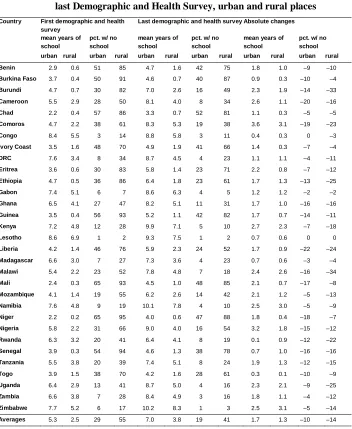
Table 2 shows the mean years of schooling of women of reproductive age, and the percentage who have never been to school. Between the first and last survey, mean years of schooling increased in both urban and rural places in every country. Similarly, the percentage of women with no schooling declined almost everywhere except for urban and rural Lesotho and urban Congo, where the very low percentages with no schooling (1–3%) remained stable.
Table 2: Levels and changes in educational attainment between the first and last Demographic and Health Survey, urban and rural places
Country First demographic and health survey
Last demographic and health survey Absolute changes
mean years of school
pct. w/ no school
mean years of school
pct. w/ no school
mean years of school
pct. w/ no school urban rural urban rural urban rural urban rural urban rural urban rural
Benin 2.9 0.6 51 85 4.7 1.6 42 75 1.8 1.0 –9 –10
Burkina Faso 3.7 0.4 50 91 4.6 0.7 40 87 0.9 0.3 –10 –4
Burundi 4.7 0.7 30 82 7.0 2.6 16 49 2.3 1.9 –14 –33
Cameroon 5.5 2.9 28 50 8.1 4.0 8 34 2.6 1.1 –20 –16
Chad 2.2 0.4 57 86 3.3 0.7 52 81 1.1 0.3 –5 –5
Comoros 4.7 2.2 38 61 8.3 5.3 19 38 3.6 3.1 –19 –23
Congo 8.4 5.5 3 14 8.8 5.8 3 11 0.4 0.3 0 –3
Ivory Coast 3.5 1.6 48 70 4.9 1.9 41 66 1.4 0.3 –7 –4
DRC 7.6 3.4 8 34 8.7 4.5 4 23 1.1 1.1 –4 –11
Eritrea 3.6 0.6 30 83 5.8 1.4 23 71 2.2 0.8 –7 –12
Ethiopia 4.7 0.5 36 86 6.4 1.8 23 61 1.7 1.3 –13 –25
Gabon 7.4 5.1 6 7 8.6 6.3 4 5 1.2 1.2 –2 –2
Ghana 6.5 4.1 27 47 8.2 5.1 11 31 1.7 1.0 –16 –16
Guinea 3.5 0.4 56 93 5.2 1.1 42 82 1.7 0.7 –14 –11
Kenya 7.2 4.8 12 28 9.9 7.1 5 10 2.7 2.3 –7 –18
Lesotho 8.6 6.9 1 2 9.3 7.5 1 2 0.7 0.6 0 0
Liberia 4.2 1.4 46 76 5.9 2.3 24 52 1.7 0.9 –22 –24
Madagascar 6.6 3.0 7 27 7.3 3.6 4 23 0.7 0.6 –3 –4
Malawi 5.4 2.2 23 52 7.8 4.8 7 18 2.4 2.6 –16 –34
Mali 2.4 0.3 65 93 4.5 1.0 48 85 2.1 0.7 –17 –8
Mozambique 4.1 1.4 19 55 6.2 2.6 14 42 2.1 1.2 –5 –13
Namibia 7.6 4.8 9 19 10.1 7.8 4 10 2.5 3.0 –5 –9
Niger 2.2 0.2 65 95 4.0 0.6 47 88 1.8 0.4 –18 –7
Nigeria 5.8 2.2 31 66 9.0 4.0 16 54 3.2 1.8 –15 –12
Rwanda 6.3 3.2 20 41 6.4 4.1 8 19 0.1 0.9 –12 –22
Senegal 3.9 0.3 54 94 4.6 1.3 38 78 0.7 1.0 –16 –16
Tanzania 5.5 3.8 20 39 7.4 5.1 8 24 1.9 1.3 –12 –15
Togo 3.9 1.5 38 70 4.2 1.6 28 61 0.3 0.1 –10 –9
Uganda 6.4 2.9 13 41 8.7 5.0 4 16 2.3 2.1 –9 –25
Zambia 6.6 3.8 7 28 8.4 4.9 3 16 1.8 1.1 –4 –12
Zimbabwe 7.7 5.2 6 17 10.2 8.3 1 3 2.5 3.1 –5 –14
Averages 5.3 2.5 29 55 7.0 3.8 19 41 1.7 1.3 –10 –14
Table 3 shows 5q0, the infant and child mortality rate, calculated over the past 10
years prior to the survey. As with increased educational attainment, reduced infant and child mortality between the first and last survey in both urban and rural places is close to universal. Only rural Chad, urban and rural Lesotho, and urban Zimbabwe did not show declining mortality, and, except for Zimbabwe, the increases in mortality were trivial. In every country except for Tanzania, mortality is higher in rural areas, but in some cases the urban-rural difference in mortality is modest (for example, Gabon, Kenya, Namibia) while in others it is substantial (for example, Burkina Faso, Cameroon, Guinea, and Niger).
Among urban women the average rate of infant and child mortality fell by 38% between the first and last survey. Among rural women, 5q0declined by 36%. Mortality
is higher in rural areas by a little more than 30% on average. There is considerable diversity of experience across countries. Reflecting the larger average absolute declines in rural mortality, in 19 of the countries the decline in the rural mortality rate exceeded the decline in the urban mortality rate. However, in 11 countries the decline in the mortality rate was greater in urban places.
In the decompositions that we carry out, the age composition of women of reproductive age is an important control variable. This is because the dependent variable is children ever born, and the value of this variable increases with age, other things being equal. Here we examine the mean age of these women and how it changes between the first and last survey. Since we know from stable population theory that given the level of mortality, higher-fertility populations are younger than lower-fertility populations, in places experiencing fertility decline the population of women of reproductive age will tend to get older over time. This phenomenon will presumably be more common in urban places than in rural ones, given the lower urban fertility. At the same time, the age pattern of female rural-urban migration will also influence age distributions in both locations.
Table 3: Mortality and mortality changes between first and last Demographic and Health Survey, urban and rural places
Country First demographic and health survey
Last demographic and health survey
Absolute change in 5q0
year 5q0 year 5q0 total per year
urban rural urban rural urban rural urban rural
Benin 1996 150 200 2011–2012 62 83 –88 –117 –5.7 –7.5
Burkina Faso 1993 148 214 2010 104 156 –44 –58 –2.6 –3.4
Burundi 1987 163 186 2010 79 131 –84 –55 –3.7 –2.4
Cameroon 1991 120 159 2011 93 153 –27 –6 –1.4 –0.3
Chad 1996–1997 190 204 2004 179 208 –11 4 –1.5 0.5
Comoros 1996 81 123 2012 28 58 –53 –65 –3.3 –4.0
Congo 2005 108 136 2011–2012 77 88 –31 –48 –4.8 –7.4
Ivory Coast 1994 120 165 2011–2012 100 125 –20 –40 –1.2 –2.3
DRC 2007 122 177 2013–2014 96 118 –26 –59 –4.0 –9.1
Eritrea 1995 129 160 2002 86 117 –43 –43 –6.1 –6.1
Ethiopia 2000 149 193 2011 83 114 –66 –79 –6.0 –7.1
Gabon 2000 88 100 2012 61 77 –27 –23 –2.3 –1.9
Ghana 1988 131 163 2008 75 90 –56 –73 –2.8 –3.6
Guinea 1999 149 211 2012 87 148 –62 –63 –4.7 –4.8
Kenya 1989 89 91 2008–2009 74 86 –15 –5 –0.8 –0.3
Lesotho 2004 87 105 2009 89 110 2 5 0.4 1.0
Liberia 1986 216 239 2013 106 120 –110 –119 –4.1 –4.4
Madagascar 1992 142 183 2008–2009 63 84 –79 –99 –4.8 –6.0
Malawi 1992 205 244 2010 113 130 –92 –114 –5.1 –6.3
Mali 1987 203 303 2012–2013 64 113 –139 –190 –5.5 –7.5
Mozambique 1997 150 237 2011 100 111 –50 –126 –3.6 –9.0
Namibia 1992 86 94 2006–2007 60 76 –26 –18 –1.8 –1.3
Niger 1992 210 347 2012 83 163 –127 –184 –6.4 –9.2
Nigeria 1990 130 208 2013 100 167 –30 –41 –1.3 –1.8
Rwanda 1992 155 163 2010 81 105 –74 –58 –4.1 –3.2
Senegal 1986 135 250 2010–2011 62 102 –73 –148 –3.0 –6.0
Tanzania 1991–1991 159 152 2010 94 92 –65 –60 –3.5 –3.3
Togo 1988 131 169 1998 101 157 –30 –11 –3.0 –1.1
Uganda 1988–1989 164 191 2011 77 111 –87 –80 –3.9 –3.5
Zambia 1992 151 201 2007 132 139 –19 –62 –1.3 –4.1
Zimbabwe 1988 55 99 2010–2011 77 78 22 –21 1.0 –0.9
Averages 1993.4 139 183 2009.7 87 116 –53 –66 –3.2 –4.1
Table 4 shows that in urban areas, consistent with the observed declines in fertility, 25 of the countries experienced increasing mean age of women. In rural places, mean age of women of reproductive age increased in 20 countries. The general pattern, then, is increased mean age, but somewhat more so for urban women.
Table 4: Total fertility rate and mean age of women, first and last Demographic and Health Survey, urban and rural places
Country First demographic and health survey Last demographic and health survey Absolute changes in mean age
year mean age TFR year mean age TFR total per year
urban rural urban rural urban rural urban rural urban rural urban rural
Benin 1996 27.8 29.8 4.9 6.7 2011–2012 28.5 29.2 4.3 5.4 0.7 –0.6 0.045 –0.039
Burkina Faso 1993 26.7 28.5 4.6 7.0 2010 27.3 29.3 3.9 6.7 0.6 0.8 0.035 0.047
Burundi 1987 27.9 28.5 5.1 7.0 2010 26.5 27.9 4.8 6.6 –1.4 –0.6 –0.06 –0.026
Cameroon 1991 27.0 28.2 5.2 6.3 2011 27.4 28.5 4 6.4 0.4 0.3 0.020 0.015
Chad 1996–1997 27.5 28.0 5.9 6.5 2004 27.5 28.5 5.7 6.5 0.0 0.5 0.000 0.067
Comoros 1996 26.9 27.4 3.8 5.0 2012 28.0 27.5 3.5 4.8 1.1 0.1 0.069 0.006
Congo 2005 27.6 28.2 3.8 6.1 2011–2012 28.0 29.9 4.5 6.5 0.4 1.7 0.062 0.262
Ivory Coast 1994 26.5 28.3 4.4 6.0 2011–2012 27.4 29.5 3.7 6.3 0.9 1.2 0.051 0.069 DRC 2007 27.6 28.9 5.4 7.0 2013–2014 27.5 28.5 5.4 7.3 –0.1 –0.4 –0.02 –0.062
Eritrea 1995 NA NA 4.2 7.0 2002 NA NA 3.5 5.7 NA NA NA NA
Ethiopia 2000 26.5 28.5 3.0 6.0 2011 26.5 28.1 2.6 5.5 0.0 –0.4 0.000 –0.036
Gabon 2000 27.0 28.6 3.8 6.0 2012 28.2 30.2 3.9 6.1 1.2 1.6 0.100 0.133
Ghana 1988 28.3 28.8 5.3 7.0 2008 28.6 29.3 3.1 4.9 0.3 0.5 0.015 0.025
Guinea 1999 27.6 29.8 4.4 6.1 2012 27.1 29.2 3.8 5.8 –0.5 –0.6 –0.04 –0.046
Kenya 1989 26.2 28.9 4.5 7.1 2008–2009 27.9 28.7 2.9 5.2 1.7 –0.2 0.087 –0.010
Lesotho 2004 28.5 28.3 1.9 4.1 2009 28.6 28.0 2.1 4.0 0.1 –0.3 0.020 –0.060
Liberia 1986 26.6 28.9 6.0 7.1 2013 27.7 29.9 3.8 6.1 1.1 1.0 0.041 0.037
Madagascar 1992 27.8 27.9 3.8 6.7 2008–2009 28.7 29.0 2.9 5.2 0.9 1.1 0.055 0.067
Malawi 1992 27.3 28.7 5.5 6.9 2010 27.2 28.2 4.0 6.1 –0.1 –0.5 –0.01 –0.028
Mali 1987 28.7 30.1 6.3 7.4 2012–2013 27.5 29.0 5.0 6.5 –1.2 –1.1 –0.05 –0.043
Mozambique 1997 27.3 28.9 4.6 5.3 2011 27.8 29.0 4.5 6.6 0.5 0.1 0.036 0.007
Namibia 1992 28.5 27.7 4.0 6.3 2006–2007 28.6 28.1 2.8 4.3 0.1 0.4 0.007 0.028
Niger 1992 27.2 27.9 6.4 7.1 2012 28.3 28.9 5.6 8.1 1.1 1.0 0.055 0.050
Nigeria 1990 27.4 28.6 5.0 6.3 2013 28.9 28.7 4.7 6.2 1.5 0.1 0.065 0.004
Rwanda 1992 27.0 28.4 4.5 6.3 2010 27.6 28.6 3.4 4.8 0.6 0.2 0.033 0.011
Senegal 1986 27.0 28.2 5.4 7.1 2010–2011 27.9 27.9 3.9 6 0.9 –0.3 0.037 –0.012
Tanzania 1991–1991 26.9 28.1 5.1 6.6 2010 27.5 29.0 3.7 6.1 0.6 0.9 0.032 0.049
Togo 1988 26.8 28.8 4.9 7.3 1998 27.6 29.2 3.2 6.3 0.8 0.4 0.080 0.040
Uganda 1988–1989 25.5 27.6 5.7 7.6 2011 26.6 28.3 3.8 6.8 1.1 0.7 0.049 0.031
Zambia 1992 26.2 27.6 5.8 7.1 2007 27.3 28.6 4.3 7.5 1.1 1.0 0.073 0.067
Zimbabwe 1988 27.2 28.1 3.8 6.2 2010–2011 27.8 28.4 3.1 4.8 0.6 0.3 0.027 0.013
We have used the TFR as our measure of fertility to this point. However, the TFR is a measure based on aggregated data, and for this study we use micro data for our decomposition analyses. For each individual, then, our measure of fertility is the number of children ever born, or cumulative fertility, and mean number of children ever born is a key variable in the analyses. The mean number of children ever born is sensitive to even small changes in the average age of women of reproductive age.
It is useful to compare the levels of the TFR and the mean number of children ever born. In urban areas the levels of these two measures are very highly correlated, with the correlation being about +0.9 for both the first and last surveys. In rural areas the correlation coefficient is about +0.7 for the first survey and +0.8 for the last survey. Given these high correlations, the analyses below of changes in the determinants of fertility and their consequences for fertility behavior, using children ever born as the measure of fertility, are useful for understanding the ongoing fertility transition in sub-Saharan Africa.
4. Decomposition method and data
4.1 Decomposing changes in fertility over time
Oaxaca (1973) introduced a procedure for analyzing differences in wages between two groups. Consider wages as a consequence of earnings functions that reflect both endowments of factors that influence wages and the payoffs to those factors. From this perspective, two groups may have different wages as a consequence of different endowments of wage-relevant factors (such as schooling and work experience) and/or different payoffs to given factors (as might occur with labor market discrimination). The Oaxaca decomposition procedure allows the assessment of the importance of different endowments of relevant factors in accounting for the observed difference in wages between two groups.
The procedure developed by Oaxaca (1973) and subsequently refined (Oaxaca and Ransom 1994) has been used in many studies of wage differences between groups. However, it may also be applied to analysis of differences in fertility (Bundervoet 2014). Here we are interested in changes in fertility over time, and in the importance of changes in the educational attainment of women and in mortality in accounting for the fertility changes.
The number of children ever born to a woman in period i, Yi (i=1,2), is considered as a linear function of a set of women’s characteristics Xi (i=1,2), a vector of
Yi=Xiβi+ei
The average number of children ever born to a woman in the sample is on the regression line and can be written as
Yi=Xi βi
where Xi is the vector of average values of Xi and βi is the vector of estimated values of βi.
For any arbitrary vector β* we have that
Y-Y= (X -X )β∗ + X (β -β∗) +X (β∗− β ) (1) Equation 1 is a decomposition equation of the linear regression model. It expresses the change in the means of the dependent variable over two periods as a function of changes in means of the set of women’s characteristics (first term on the right-hand side) and changes in the regression coefficients (two last terms on the right-hand side). We can then compute the contribution of each of these factors (as well as the contributions of changes in other characteristics that influence fertility) to overall fertility decline. The literature has considered various values for β* and some of them display some weaknesses (Oaxaca and Ransom 1994; Sinning, Hahan, and Bauer 2008). Following Oaxaca and Ransom (1994), this paper sets β* to be parameters estimated on the pooled sample. It reflects the set of parameters that should prevail irrespective of the time period.
We first estimate the effects of educational attainment, mortality, and age on cumulative fertility (children ever born), using data from the first and last Demographic and Health Surveys for each country. We estimated the β1coefficients using the first survey for each country, the β2coefficients using the last survey, and the β* coefficients using the pooled data. The estimated coefficients from the pooled data are then used in conjunction with changes in the means of the explanatory variables to identify the consequences for fertility of the changes in age, mortality, and education between the first and last survey.
previous research (Shapiro and Tambashe 2003; Shapiro 2012) shows that these three secondary-school groups have distinctly different fertility.
Infant and child mortality is proxied by the percentage of children born to women in the respondent’s sample cluster who have died. This is a measure of mortality that pertains to the small area in which each woman resides. It is not a measure of the infant and child mortality rate, but since most of the deaths it counts are likely to be of infants and children under five, our mortality measure should be highly correlated with the local area’s infant and child mortality rate. The correlation between levels of our measure of mortality and the reported infant and child mortality rate exceeds +0.96 in both urban and rural places as of the first survey, and exceeds +0.92 in both places of residence as of the last survey. Our measure should thus be a good indicator of women’s perceptions of the level of mortality.
4.2 Changes in mean values of the variables
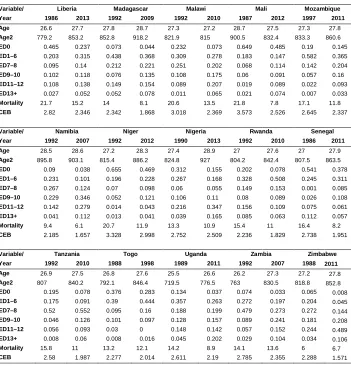
Appendix Table A-1 shows the detailed results for individual countries with respect to changes in the mean values of the variables between the first and last surveys, for the variables used in the regressions. Micro data is not available for Eritrea, so the Appendix tables cover 30 countries.
Consider first the education dummy variables. In nearly every country the proportion of women with no schooling declined between the first and last survey in both urban and rural places. On average, the decline was about 35% in urban areas and 25% in rural areas. The pace of decline varied substantially across countries and was considerably slower in relative terms among the countries that had particularly low educational attainment at the outset.
For example, of the seven countries with more than 50% of urban women of reproductive age with no schooling as of the first survey, the average decline in this percentage as of the last survey was 13 percentage points, a 23% decline; while among the 23 countries with fewer than 50% of urban women with no schooling at the first survey, the average decline was 10 percentage points, more than 45% of the initial level. Among rural women, when 50% or more had no schooling at the first survey, there was a 15-point decline in that percentage at the last survey, or nearly a 20% decline, while in rural places with fewer than 50% with no schooling at the outset, the average decline was 11 points, almost 45%.
broadly, these changes in educational attainment reflect the increased access to both primary and (especially in urban places) secondary schooling that women have experienced during the past 20–30 years.
Declines in mortality, based on our measure reflecting mortality of children in each cluster of residence in urban and rural places, were universal within this group of countries, with one exception: urban Zimbabwe, which had the lowest mortality of all countries as of the first survey and, despite a slight increase, the fifth-lowest level as of the last survey. In some cases these declines were substantial and in others quite modest. The correlations between infant and child mortality rates reported in Table 3 and the mortality measures reported in Table A-1 are greater than +0.9 in both urban and rural areas and for both first and last surveys.
Changes in mean age of women aged 15–49 were mostly increases, but sometimes there were decreases. In some cases the changes were modest and in others more substantial. All of these changes influence the decompositions.
4.3 Regression results
The first step in the decomposition procedure is to estimate regressions with the dependent variable, the number of children ever born to each woman, regressed on variables indicating her educational attainment, the extent of mortality locally, and the woman’s age. The data from the first and last Demographic and Health Survey is pooled, regressions are estimated using weighted data, and the resulting coefficients indicate the effects of each variable on the number of children ever born. The samples for each of these regressions consist of all urban women and all rural women aged 15– 49, respectively.
Regression results for each country are in Appendix Table A-2. The estimated coefficients differ across countries, and the vast majority of these coefficients are highly significant. There are some consistent similarities in the results for the different countries. Consider the coefficients for the education dummy variables. Compared to women with 1–6 years of schooling (the reference group), women with no schooling tend to have significantly higher fertility, a little more so in urban places than in rural areas. Women with higher levels of schooling tend to have significantly lower numbers of children ever born, and typically the negative impact of schooling gets larger in absolute value as schooling level increases, in urban and especially in rural places.
Controlling for a woman’s age and the level of mortality of children in her cluster of residence, on average urban women with no schooling have had nearly a third of a child more than women with 1–6 years of schooling; among rural women the corresponding differential is only half as large. Both urban and rural women with 7–8 years of schooling have lower fertility than their counterparts with 1–6 years of education, other things being equal, by close to 0.3 children, on average. As educational attainment increases beyond this level the magnitudes of the negative coefficients for the schooling groups rise in absolute value and at an increasing rate, especially among rural residents. Similar evidence of increasingly stronger negative effects of schooling on fertility as schooling increases is reported in Shapiro (2012).
Table 5: Mean values of regression coefficients, children-ever-born regressions, urban and rural places
Variable Average values
urban rural
Age 0.292 0.438
Age2 –0.0017 –0.0034
ED0 0.318 0.156
ED1–6 – –
ED7–8 –0.29 –0.279
ED9–10 –0.567 –0.676
ED11–12 –1.041 –1.295
ED13+ –1.642 –2.06
Mortality 0.023 0.018
Notes:ED0=dummy variable=1 if years of schooling=0; otherwise =0. ED1–6=dummy variable=1 if 1<=years of schooling<=6; otherwise=0. ED7–8=dummy variable=1 if 7<=years of schooling<=8; otherwise=0. ED9–10=dummy variable=1 if 9<=years of schooling<=10; otherwise=0. ED11–12=dummy variable=1 if 11<=years of schooling<12; otherwise=0. ED13+=dummy variable=1 if years of schooling>=13.
Mortality=percentage of children born to women in respondent’s cluster who have died.
5. Decomposition analysis
Appendix Table A-3 provides results of the decompositions that assess the contributions of different variables to the changes in fertility (children ever born) between the first and last Demographic and Health Surveys. Effects of the changes in means of the different education dummy variables, evaluated using the individual regression coefficients, are aggregated so that we see the consequences of changes in the group of education variables. The effects of changes in age and age squared are reported as the effect of the change in age.
Consider some examples to illustrate the interpretation of the numbers in the table. The increased educational attainment in urban Benin accounts for just over a third of the decline in the average number of children ever born between 1996 and 2012. By contrast, the reduction in mortality experienced in urban Benin implies a decline in the number of children ever born equivalent to more than 80% of the actual decline of 0.47 children. The increase in the mean age of urban women aged 15–49 of 0.7 years, by itself, would have increased fertility by almost 30% of the observed decline, and hence has a negative value. The three variables, taken together, account for 91% of the change in the number of children ever born between the first and last survey.
In urban Cameroon, increased education accounts for almost two-thirds of the fertility decline between 1991 and 2011 of more than 0.6 children in the average number of children ever born. The decline in mortality in Cameroon accounts for only 11% of the reduction in fertility. Finally, the slight increase in mean age of women of reproductive age between 1991 and 2011, since it would imply an increase in the number of children ever born, gets a minus sign for its influence, given that fertility declined.
In rural Namibia, increased schooling accounted for almost 90% of the decline in fertility, while reduced mortality had only a very small impact on fertility. By contrast, in rural Senegal more than two-thirds of the fertility decline reflected declining mortality, and increased education only contributed modestly to the decline in fertility.
These different examples illustrate that in some countries increased women’s schooling accounts for the lion’s share of changes in urban and rural fertility, while in other countries it is reductions in mortality that are predominant in accounting for declines in fertility. Before going into detail on this point, however, consider some peculiarities of the table.
(Chad, the DRC, and Lesotho) and in rural areas of six countries there was a decline in the mean number of children ever born, but the decline was quite small. Since that decline is the denominator in the decomposition calculations, the result of having small values of the denominator is inordinately high values for the impact of individual variables. The table thus includes decompositions only for those places that experienced a decline in the mean number of children ever born between the first and last survey of at least 0.10. This constituted 26 of the 30 urban areas, but, reflecting the slower pace of rural fertility decline, only 15 of the 30 rural areas showed reduced fertility of at least 0.10.
For the 26 countries whose urban areas experienced a decline in mean number of children ever born of at least 0.1, the unweighted mean contribution of increased women’s schooling accounts for 54% of the fertility decline, while the corresponding figure for improvements in mortality is 30%. In 17 of those countries, education plays a more important role than mortality in contributing to reduced urban fertility, while in seven other countries mortality is more important for urban fertility, and in two countries they have about the same impact.
Among the 15 countries with a rural fertility decline of at least 0.1 children, the mean contribution of increased education represented 30% of the fertility decline, while reduced mortality accounted for 35% of the decline. Mortality had a greater impact than education on reducing rural fertility in eight countries, while the reverse was true in six countries, and in rural Rwanda the two factors had equal weight. Rwanda is a country in which education and mortality only contribute modestly to fertility decline, as is also the case for neighboring Burundi. These two countries have the highest population density by far in the region, and this high density appears to contribute to preferences for low fertility (Lutz, Testa, and Penn 2006; Shapiro 2017).
MDGs being pursued between 2000 and 2015, it is plausible to suggest (as did one of the reviewers) that countries with all surveys in the period 2000 or later might have benefited in terms of fertility decline, presumably from more rapid education increases and mortality declines.
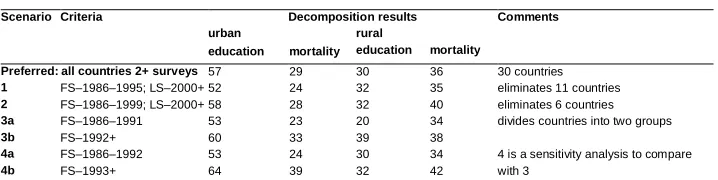
To test for period effects, we compared our preferred decomposition results, for all countries taken together, to results from alternative scenarios. These comparisons are reported in Table 6.
Table 6: Decomposition results with alternative sample selection scenarios
Scenario Criteria Decomposition results Comments
urban rural
education mortality education mortality
Preferred: all countries 2+ surveys 57 29 30 36 30 countries
1 FS–1986–1995; LS–2000+ 52 24 32 35 eliminates 11 countries 2 FS–1986–1999; LS–2000+ 58 28 32 40 eliminates 6 countries 3a FS–1986–1991 53 23 20 34 divides countries into two groups
3b FS–1992+ 60 33 39 38
4a FS–1986–1992 53 24 30 34 4 is a sensitivity analysis to compare with 3
4b FS–1993+ 64 39 32 42
Notes:N.B. FS=First Survey; LS=Last Survey. Figures in the table show the average percentage of fertility decline attributable to increased education and reduced mortality, by place of residence.
To avoid an MDG effect, the first scenario, proposed by a reviewer, limited the sample to countries with a first survey no later than the mid-1990s and a last survey in 2000 or later. This removed 11 countries from the decompositions, and the average contributions of education and mortality to fertility decline in urban places were reduced somewhat. This indicates, consistent with an MDG effect, that the contributions among the late-starting countries were greater. In rural areas the results were essentially unchanged. Scenario 2 extends the first-survey limit to 1999, resulting in 6 countries being removed. Results for urban places are essentially the same as those for all 30 countries; the contribution of mortality is a little greater in rural places.
Scenarios 3 and 4 each divide the full sample into two groups differentiated by the year of the first survey, with 1991–1992 and 1992–1993 being the respective dividing lines (these close dividing lines represent a sensitivity analysis, and move six countries from the late to the early group). It is clear in each case that the later-starting countries show a greater impact of education and mortality on urban fertility decline, and while results for rural areas are somewhat variable there is evidence of greater impact on rural fertility decline as well.
factor, while in rural areas mortality decline is slightly more likely to be more important for fertility decline. Over all, on average these two factors account for almost 85% of urban fertility decline and nearly two-thirds of the slower rural fertility decline.
Two important proximate determinants of fertility, age at first union and contraceptive use, have not been included in the analyses. There are two major problems with using these variables. First, endogeneity with respect to education: these variables are related to education, so including them would reduce the estimated impact of education by attributing its consequences (later marriage, more and better contraception) to these other variables. The analysis here is essentially very close to a reduced form. Even here, there is an endogenous component to mortality: better-educated women experience lower infant and child mortality. If we omit mortality from the regressions, the impact of women’s education in contributing to explaining fertility decline increases in all countries and locations where mortality had previously had some relevance. The increases are small, presumably because there is also a substantial exogenous component to mortality decline reflecting improvements in medical technology and in the delivery of health care services, but omitting mortality shows that including a partially endogenous variable reduces the estimated contribution of women’s education.
Having noted our preferred analytical strategy, we also estimated regression equations for children ever born, including age at first union and modern contraceptive use. More specifically, to avoid endogeneity we used the average age at first marriage in the respondent’s cluster of residence, and current use of modern contraception in the cluster. As anticipated, explicitly controlling for these proximate determinants reduces the estimated contribution of education per se. At the same time, it highlights the roles of these two pathways.
6. Conclusion
Analyses of changes in urban and rural fertility in 31 countries in sub-Saharan Africa, in many cases going back to the mid- or late-1980s, show that the changes are typically but not exclusively declines, and vary substantially in magnitude and pace. Using individual-level data, we decompose the fertility changes into portions due to increasing women’s schooling and declining infant and child mortality, while controlling for changes in the mean age of women of reproductive age as an additional factor influencing changes in our measure of fertility, children ever born.
The analyses document that fertility decline is more rapid in urban areas than in rural places. While both increased women’s schooling and reduced mortality contribute to fertility decline, in urban areas the importance of women’s education tends more frequently to be greater, while in rural places reduced mortality tends, on average, to play a modestly more important role than increased schooling in contributing to fertility decline. We note that the increases in educational attainment tend to be greater in urban places, while the declines in infant and child mortality are greater in rural areas.
We estimate the impact of educational attainment and mortality on cumulative fertility using a six-category scheme to represent educational attainment rather than the trichotomy (none/primary/secondary+) that is often used to characterize schooling. This more detailed representation of education shows that as educational attainment increases through the secondary level and beyond, fertility differences by education tend to widen. This suggests that as educational attainment rises to the secondary level and beyond for many women, the pace of fertility decline may well accelerate.
Fertility transition in sub-Saharan Africa, late in getting started relative to elsewhere in the developing world, has been comparatively slow and subject to stalling. As continued high fertility in the region is an obstacle to efforts to promote socioeconomic development and economic growth, policies seeking to encourage lower fertility constitute efforts to facilitate growth and development. The analyses here suggest that continued and augmented efforts to increase women’s schooling and reduce infant and child mortality will generate more rapid fertility decline. We believe that such fertility decline will contribute to more rapid socioeconomic development.
7. Acknowledgments
References
Antoine, P. (2006). Analyse biographique de la transformation des modèles matrimoniaux dans quatre capitales africaines: Antananarivo, Dakar, Lomé et Yaoundé. Cahiers québecois de démographie 35(2): 5–38. doi:10.7202/0185 91ar.
Barro, R.J. and Lee, J.W. (2013). A new data set of educational attainment in the world, 1950–2010. Journal of Development Economics 104: 184–198. doi:10.1016/j. jdeveco.2012.10.001.
Blanc, A. (2004). The role of conflict in the rapid fertility decline in Eritrea and prospects for the future. Studies in Family Planning 35(4): 236–245.
doi:10.1111/j.0039-3665.2004.00028.x.
Bongaarts, J. (2008). Fertility transitions in developing countries: Progress or stagnation? Studies in Family Planning 39(2): 105–110.
doi:10.1111/j.1728-4465.2008.00157.x.
Bongaarts, J. and Casterline, J. (2013). Fertility transition: Is sub-Saharan Africa different? Population and Development Review 38 (Supplement 1): 153–168.
doi:10.1111/j.1728-4457.2013.00557.x.
Bundervoet, T. (2014). What explains Rwanda’s drop in fertility between 2005 and 2010? Washington, D.C.: World Bank Group (Policy Research working paper WPS 6741.).doi:10.1596/1813-9450-6741.
Cochrane, S.H. (1979). Fertility and education: What do we really know? Baltimore: Johns Hopkins University Press.
Easterlin, R.A. (1975). An economic framework for fertility analysis.Studies in Family
Planning 6(1): 54–63.doi:10.2307/1964934.
Easterlin, R.A. and Crimmins, E.M. (1985).The fertility revolution: A supply–demand
analysis.Chicago: University of Chicago Press.
Eloundou-Enyegue, P., Stokes, C.S., and Cornwell, G. (2000). Are there crisis-led fertility declines? Evidence from central Cameroon. Population Research and
Policy Review 19(1): 47–72.doi:10.1023/A:1006423527473.
Garenne, M. and Joseph, V. (2002). The timing of the fertility transition in sub-Saharan Africa. World Development 30(10): 1835–1843. doi:10.1016/S0305-750X(02) 00069-4.
Gurmu, E. and Mace, R. (2008). Fertility decline driven by poverty: The case of Addis Ababa, Ethiopia. Journal of Biosocial Science 40(3): 339–358. doi:10.1017/
S002193200700260X.
Hobcraft, J. (1993). Women’s education, child welfare, and child survival: A review of the evidence.Health Transition Review 3(2): 159–175.
Lutz, W., Testa, M.R., and Penn, D.J. (2006). Population density is a key factor in declining human fertility.Population and Environment 28(2): 69–81.
Oaxaca, R. (1973). Male–female wage differentials in urban labor markets.
International Economic Review14(3): 693–709.doi:10.2307/2525981.
Oaxaca, R. and Ransom, M. (1994). On discrimination and the decomposition of wage differentials. Journal of Econometrics 61(1): 5–21. doi:10.1016/0304-4076(94) 90074-4.
Romaniuk, A. (2011). Persistence of high fertility in tropical Africa: The case of the Democratic Republic of the Congo. Population and Development Review 37(1): 1–28.doi:10.1111/j.1728-4457.2011.00388.x.
Rosenzweig, M. and Schultz, T.P. (1989). Schooling, information, and nonmarket productivity: Contraceptive use and its effectiveness. International Economic
Review 30(2): 457–477.doi:10.2307/2526657.
Rutstein, S. (2000). Factors associated with trends in infant and child mortality in developing countries during the 1990s. Bulletin of the World Health
Organization 78(10): 1256–1270.doi:10.1590/S0042-96862000001000011.
Schultz, T.P. (1993). Investments in the schooling and health of women and men: Quantities and returns. Journal of Human Resources 28(4): 694–734.
doi:10.2307/146291.
Shapiro, D. (2012). Women’s education and fertility transition in sub-Saharan Africa.
Vienna Yearbook of Population Research 10: 9–30. doi:10.1553/population
yearbook2012s9.
Shapiro, D. (2015). Enduring economic hardship, women’s education, marriage, and fertility transition in Kinshasa. Journal of Biosocial Science 47(2): 258–274.
Shapiro, D. (2017). Emerging preferences for low fertility in sub-Saharan Africa: An exploratory study. Revised version of paper presented at the 2016 Annual Meeting of the Population Association of America, Washington, D.C., March 31 – April 02, 2016.
Shapiro, D. and Gebreselassie, T. (2008). Fertility transition in sub-Saharan Africa: Falling and stalling.African Population Studies 23(1): 3–23.
Shapiro, D. and Gebreselassie, T. (2014). Marriage in sub-Saharan Africa: Trends, determinants, and consequences.Population Research and Policy Review 33(2): 229–255.doi:10.1007/s11113-013-9287-4.
Shapiro, D., Kreider, A., Varner, C., and Sinha, M. (2013). Stalling of fertility transitions and socioeconomic change in the developing world: Evidence from the Demographic and Health Surveys. In: Tabutin, D. and Masquelier, B. (eds.). Ralentissements, résistances et ruptures dans les transitions démographiques, Actes de la Chaire Quetelet 2010. Louvain-la-Neuve: Presse de l’Université de Louvain: 47–64.
Shapiro, D. and Tambashe, B.O. (1994). The impact of women’s employment and education on contraceptive use and abortion in Kinshasa, Zaire. Studies in
Family Planning 25(2): 96–110.doi:10.2307/2138087.
Shapiro, D. and Tambashe, B.O. (2002). Fertility transition in urban and rural sub-Saharan Africa: Preliminary evidence of a three-stage process. Journal of
African Policy Studies8(2 and 3): 103–127.
Shapiro, D. and Tambashe, B.O. (2003). Kinshasa in transition: Women’s education, employment, and fertility. Chicago: University of Chicago Press.
Shapiro, D. and Tenikue, M. (2015). Women’s education, infant and child mortality, and fertility decline in sub-Saharan Africa: A quantitative assessment. Paper presented at the Annual Meeting of the Population Association of America, San Diego, California, April 30 – May 02, 2015.doi:10.2139/ssrn.2717490.
Sinning, M., Hahan, M., and Bauer T.K. (2008). The Blinder–Oaxaca decomposition for nonlinear regression models.The Stata Journal 8(4):480–493.
United Nations (2010). The world’s women 2010: Trends and statistics. New York: Department of Economic and Social Affairs, Population Division.
http://unstats.un.org/unsd/demographic/products/Worldswomen/
United Nations (2015). World population prospects: The 2015 revision,DVD edition. New York: Department of Economic and Social Affairs, Population Division. Woldemicael, G. (2008). Recent fertility decline in Eritrea: Is it a conflict-led
Appendix
Table A-1 a: Mean values of the variables used in the regressions, first and last surveys, by country, urban places
Variable/ Benin Burkina Faso Burundi Cameroon Chad
Year 1996 2012 1993 2010 1987 2010 1991 2011 1997 2004
Age 27.8 28.5 26.7 27.3 27.9 26.5 27 27.4 27.5 27.5
Age2 860.4 895.4 792.9 830.9 861.2 781.5 801.8 838.6 840.7 845.5 ED0 0.508 0.419 0.501 0.403 0.305 0.161 0.277 0.082 0.569 0.521
ED1–6 0.301 0.229 0.248 0.249 0.413 0.388 0.301 0.288 0.311 0.265
ED7–8 0.074 0.08 0.071 0.098 0.112 0.099 0.14 0.135 0.05 0.064
ED9–10 0.069 0.126 0.103 0.139 0.081 0.094 0.167 0.221 0.038 0.065
ED11–12 0.032 0.061 0.037 0.058 0.041 0.102 0.084 0.145 0.022 0.047
ED13+ 0.016 0.085 0.04 0.053 0.048 0.156 0.031 0.129 0.01 0.038
Mortality 16.3 6.4 15.8 12.1 14.9 9.3 13.5 10 20.6 18.6
CEB 2.695 2.227 2.632 2.05 2.821 1.913 2.788 2.147 3.286 3.219
Variable/ Comoros Congo Ivory Coast Democratic Republic
of the Congo Ethiopia
Year 1996 2012 2005 2011 1994 2012 2007 2013 2000 2011
Age 26.9 28 27.6 28 26.5 27.4 27.6 27.5 26.5 26.5
Age2 808.6 871.4 843.5 866 780.4 829.3 844.3 839.3 787.7 775.3 ED0 0.381 0.192 0.03 0.034 0.483 0.411 0.075 0.039 0.364 0.233
ED1–6 0.246 0.144 0.205 0.174 0.293 0.247 0.292 0.225 0.229 0.249
ED7–8 0.134 0.107 0.232 0.206 0.078 0.058 0.207 0.191 0.182 0.167
ED9–10 0.131 0.159 0.328 0.321 0.09 0.125 0.189 0.212 0.093 0.149
ED11–12 0.059 0.143 0.112 0.126 0.035 0.059 0.187 0.248 0.109 0.068
ED13+ 0.049 0.255 0.093 0.14 0.021 0.1 0.05 0.085 0.023 0.134
Mortality 8.9 4.4 10.1 8.2 13.6 10.8 13 10.3 16.8 9.8
CEB 2.161 1.872 1.965 2.095 2.472 1.947 2.554 2.494 1.934 1.643
Variable/ Gabon Ghana Guinea Kenya Lesotho
Year 2000 2012 1988 2008 1999 2012 1989 2009 2004 2009
Age 27 28.2 28.3 28.6 27.6 27.1 26.2 27.9 28.5 28.6
Age2 813.7 881 889.9 906.8 850.5 815.5 750.1 850.2 899.1 903.6 ED0 0.062 0.045 0.267 0.111 0.555 0.418 0.123 0.047 0.008 0.007
ED1–6 0.349 0.214 0.15 0.165 0.211 0.19 0.186 0.091 0.17 0.124
ED7–8 0.232 0.229 0.095 0.118 0.067 0.09 0.302 0.283 0.31 0.286
ED9–10 0.19 0.265 0.385 0.344 0.061 0.102 0.143 0.094 0.289 0.266
ED11–12 0.094 0.103 0.053 0.172 0.037 0.082 0.211 0.308 0.195 0.205
ED13+ 0.073 0.144 0.05 0.09 0.069 0.118 0.035 0.177 0.028 0.112
Mortality 9.9 7.2 14.5 8.9 17.2 10.4 8.7 6.4 8.9 8.3
Table A-1 a: (Continued)
Variable/ Liberia Madagascar Malawi Mali Mozambique
Year 1986 2013 1992 2009 1992 2010 1987 2012 1997 2011
Age 26.6 27.7 27.8 28.7 27.3 27.2 28.7 27.5 27.3 27.8
Age2 779.2 853.2 852.8 918.2 821.9 815 900.5 832.4 833.3 860.6
ED0 0.465 0.237 0.073 0.044 0.232 0.073 0.649 0.485 0.19 0.145
ED1–6 0.203 0.315 0.438 0.368 0.309 0.278 0.183 0.147 0.582 0.365
ED7–8 0.095 0.14 0.212 0.221 0.251 0.202 0.068 0.114 0.142 0.204
ED9–10 0.102 0.118 0.076 0.135 0.108 0.175 0.06 0.091 0.057 0.16
ED11–12 0.108 0.138 0.149 0.154 0.089 0.207 0.019 0.089 0.022 0.093
ED13+ 0.027 0.052 0.052 0.078 0.011 0.065 0.021 0.074 0.007 0.033
Mortality 21.7 15.2 14 8.1 20.6 13.5 21.8 7.8 17.1 11.8
CEB 2.82 2.346 2.342 1.868 3.018 2.369 3.573 2.526 2.645 2.337
Variable/ Namibia Niger Nigeria Rwanda Senegal
Year 1992 2007 1992 2012 1990 2013 1992 2010 1986 2011
Age 28.5 28.6 27.2 28.3 27.4 28.9 27 27.6 27 27.9
Age2 895.8 903.1 815.4 886.2 824.8 927 804.2 842.4 807.5 863.5
ED0 0.09 0.038 0.655 0.469 0.312 0.155 0.202 0.078 0.541 0.378
ED1–6 0.231 0.101 0.196 0.228 0.267 0.168 0.328 0.508 0.245 0.311
ED7–8 0.267 0.124 0.07 0.098 0.06 0.055 0.149 0.153 0.001 0.085
ED9–10 0.229 0.346 0.052 0.121 0.106 0.11 0.08 0.089 0.026 0.108
ED11–12 0.142 0.279 0.014 0.043 0.216 0.347 0.156 0.109 0.075 0.061
ED13+ 0.041 0.112 0.013 0.041 0.039 0.165 0.085 0.063 0.112 0.057
Mortality 9.4 6.1 20.7 11.9 13.3 10.9 15.4 11 16.4 8.2
CEB 2.185 1.657 3.328 2.998 2.752 2.509 2.236 1.829 2.738 1.951
Variable/ Tanzania Togo Uganda Zambia Zimbabwe
Year 1992 2010 1988 1998 1989 2011 1992 2007 1988 2011
Age 26.9 27.5 26.8 27.6 25.5 26.6 26.2 27.3 27.2 27.8
Age2 807 840.2 792.1 846.4 719.5 776.5 763 830.5 818.8 852.8
ED0 0.195 0.078 0.376 0.283 0.134 0.037 0.074 0.033 0.065 0.008
ED1–6 0.175 0.091 0.39 0.444 0.357 0.263 0.272 0.197 0.204 0.045
ED7–8 0.52 0.552 0.095 0.16 0.188 0.199 0.479 0.273 0.272 0.144
ED9–10 0.046 0.126 0.101 0.097 0.128 0.157 0.089 0.241 0.181 0.208
ED11–12 0.056 0.093 0.03 0 0.148 0.142 0.057 0.152 0.244 0.489
ED13+ 0.008 0.06 0.008 0.016 0.045 0.202 0.029 0.104 0.034 0.106
Mortality 15.8 11 13.2 12.1 14.2 8.9 14.1 13.6 6 6.7
CEB 2.58 1.987 2.277 2.014 2.611 2.19 2.785 2.355 2.288 1.571
Notes: ED0=dummy variable=1 if years of schooling=0; otherwise =0. ED1–6=dummy variable=1 if 1<=years of schooling<=6; otherwise=0. ED7–8=dummy variable=1 if 7<=years of schooling<=8; otherwise=0. ED9–10=dummy variable=1 if 9<=years of schooling<=10; otherwise=0. ED11–12=dummy variable=1 if 11<=years of schooling<12; otherwise=0. ED13+=dummy variable=1 if years of schooling>=13.
Table A-1 b: Mean values of the variables used in the regressions, first and last surveys, by country, rural places
Variable/ Benin Burkina Faso Burundi Cameroon Chad
Year 1996 2012 1993 2010 1987 2010 1991 2011 1997 2004
Age 29.8 29.2 28.5 29.3 28.5 27.9 28.2 28.5 28 28.5
Age2 980.4 934 898.7 949.2 893.3 870.8 891.6 904.8 871.9 906.8
ED0 0.852 0.75 0.915 0.866 0.824 0.488 0.5 0.344 0.859 0.812
ED1–6 0.127 0.134 0.07 0.096 0.167 0.439 0.33 0.434 0.135 0.172
ED7–8 0.014 0.045 0.006 0.021 0.004 0.037 0.098 0.09 0.005 0.013
ED9–10 0.004 0.055 0.007 0.013 0.003 0.02 0.052 0.095 0.001 0.002
ED11–12 0.002 0.01 0.001 0.003 0.002 0.012 0.013 0.025 0 0.001
ED13+ 0.001 0.006 0.001 0.001 0 0.004 0.007 0.012 0 0
Mortality 22.9 9 24 17.3 19.5 16.2 19.3 15.8 22 21.8
CEB 3.926 3.179 3.715 3.76 3.03 2.807 3.484 3.408 3.571 3.84
Variable/ Comoros Congo Ivory Coast Democratic Republic
of the Congo Ethiopia
Year 1996 2012 2005 2011 1994 2012 2007 2013 2000 2011
Age 27.4 27.5 28.2 29.9 28.3 29.5 28.9 28.5 28.5 28.1
Age2 846.7 837.7 882 987.2 890.8 956.6 930.1 897.3 907.3 879.7
ED0 0.607 0.376 0.135 0.115 0.7 0.663 0.335 0.232 0.855 0.614
ED1–6 0.278 0.221 0.462 0.449 0.238 0.266 0.477 0.484 0.124 0.294
ED7–8 0.048 0.109 0.204 0.226 0.032 0.024 0.094 0.151 0.014 0.056
ED9–10 0.048 0.112 0.154 0.164 0.021 0.031 0.056 0.079 0.003 0.024
ED11–12 0.014 0.073 0.034 0.03 0.007 0.007 0.037 0.052 0.002 0.002
ED13+ 0.005 0.109 0.011 0.017 0.002 0.009 0.001 0.002 0.002 0.01
Mortality 15.1 6.6 14.1 10.4 18.2 14.1 18.2 13.9 22.9 16.3
CEB 2.779 2.322 2.926 3.324 3.539 3.46 3.332 3.402 3.348 3.271
Variable/ Gabon Ghana Guinea Kenya Lesotho
Year 2000 2012 1988 2008 1999 2012 1989 2009 2004 2009
Age 28.6 30.2 28.8 29.3 29.8 29.2 28.9 28.7 28.3 28
Age2 914.5 1016.1 911.3 956 979.2 945.9 922.5 919.3 901.5 882.1 ED0 0.067 0.049 0.465 0.313 0.927 0.816 0.279 0.104 0.025 0.017
ED1–6 0.703 0.523 0.169 0.249 0.053 0.115 0.296 0.219 0.355 0.293
ED7–8 0.136 0.202 0.102 0.137 0.01 0.03 0.284 0.412 0.373 0.375
ED9–10 0.068 0.156 0.237 0.234 0.005 0.025 0.07 0.096 0.175 0.204
ED11–12 0.019 0.043 0.018 0.052 0.002 0.008 0.064 0.13 0.064 0.087
ED13+ 0.007 0.027 0.009 0.015 0.003 0.006 0.007 0.039 0.008 0.024
Mortality 11.5 8.4 17.5 11.3 24.5 17.3 10.2 9.3 10.9 10.2
Table A-1 b: (Continued)
Variable/ Liberia Madagascar Malawi Mali Mozambique
Year 1986 2013 1992 2009 1992 2010 1987 2012 1997 2011
Age 28.9 29.9 27.9 29 28.7 28.2 30.1 29 28.9 29
Age2 921.4 995.2 865.3 935.1 919.2 881.3 992.3 920.5 929.1 937.5 ED0 0.757 0.524 0.268 0.23 0.517 0.181 0.927 0.851 0.553 0.418
ED1–6 0.163 0.357 0.61 0.589 0.368 0.483 0.065 0.08 0.425 0.468
ED7–8 0.037 0.069 0.079 0.104 0.095 0.203 0.007 0.036 0.016 0.068
ED9–10 0.023 0.027 0.02 0.037 0.013 0.08 0.001 0.017 0.006 0.037
ED11–12 0.018 0.019 0.021 0.031 0.007 0.047 0 0.012 0 0.008
ED13+ 0.002 0.004 0.002 0.009 0 0.006 0 0.004 0 0.001
Mortality 25.3 17.6 19.1 10.4 27.1 16.3 33.7 11.8 23.3 15.3
CEB 3.347 3.732 3.415 3.063 3.546 3.231 4.101 3.552 3.176 3.204
Variable/ Namibia Niger Nigeria Rwanda Senegal
Year 1992 2007 1992 2012 1990 2013 1992 2010 1986 2011
Age 27.7 28.1 27.9 28.9 28.6 28.7 28.4 28.6 28.2 27.9
Age2 860.8 887.7 863.9 914.8 903 917.4 892.8 909.3 877 863.2
ED0 0.189 0.095 0.948 0.88 0.659 0.541 0.407 0.189 0.937 0.779
ED1–6 0.477 0.241 0.049 0.096 0.229 0.181 0.405 0.644 0.056 0.149
ED7–8 0.194 0.211 0.002 0.014 0.029 0.046 0.128 0.105 0 0.036
ED9–10 0.103 0.307 0.001 0.007 0.032 0.067 0.019 0.031 0.002 0.027
ED11–12 0.032 0.107 0 0.002 0.043 0.131 0.034 0.025 0.002 0.006
ED13+ 0.005 0.039 0 0.001 0.008 0.034 0.007 0.006 0.003 0.003
Mortality 10.1 8.2 32.8 20.7 21.4 17.6 19.6 15 27.4 12.6
CEB 2.592 2.152 3.961 4.461 3.499 3.466 3.125 2.521 3.625 3.052
Variable/ Tanzania Togo Uganda Zambia Zimbabwe
Year 1992 2010 1988 1998 1989 2011 1992 2007 1988 2011
Age 28.1 29 28.8 29.2 27.6 28.3 27.6 28.6 28.1 28.4
Age2 882.4 933.3 918.8 941.7 848.7 896.4 852.6 905.2 885.8 896.1
ED0 0.386 0.24 0.702 0.61 0.41 0.162 0.282 0.16 0.173 0.035
ED1–6 0.205 0.163 0.239 0.335 0.448 0.526 0.442 0.464 0.41 0.157
ED7–8 0.387 0.522 0.028 0.04 0.099 0.172 0.247 0.258 0.259 0.303
ED9–10 0.009 0.046 0.027 0.015 0.029 0.073 0.016 0.09 0.088 0.224
ED11–12 0.012 0.02 0.004 0 0.013 0.036 0.008 0.02 0.066 0.249
ED13+ 0.001 0.009 0 0 0.001 0.031 0.005 0.008 0.004 0.032
Mortality 16.9 12.3 19.5 17.5 19.2 13.7 19.5 15.2 10.7 7.9
CEB 3.279 3.236 3.718 2.483 3.607 3.726 3.443 3.525 3.288 2.433
Notes:ED0=dummy variable=1 if years of schooling=0; otherwise =0. ED1–6=dummy variable=1 if 1<=years of schooling<=6; otherwise=0. ED7–8=dummy variable=1 if 7<=years of schooling<=8; otherwise=0. ED9–10=dummy variable=1 if 9<=years of schooling<=10; otherwise=0. ED11–12=dummy variable=1 if 11<=years of schooling<12; otherwise=0. ED13+=dummy variable=1 if years of schooling>=13.





![Tetrakis(diethylenetriammonium) tris[hexacyanoferrate(II)] octahydrate](data:image/gif;base64,R0lGODlhAQABAIAAAP///wAAACH5BAEAAAAALAAAAAABAAEAAAICRAEAOw==)