R E S E A R C H
Open Access
What interdependence can tell us about
collaborative learning: a statistical and
psychological perspective
Lenka Schnaubert
*and Daniel Bodemer
* Correspondence:lenka. [email protected]
University of Duisburg-Essen, Lotharstrasse 65, 47057 Duisburg, Germany
Abstract
When learning collaboratively, learners interact and communicate transactively. Interventions to foster collaborative learning frequently target such interactive processes and thus may drastically change how learners engage with and thus influence each other. One statistical phenomenon related to collaborative learning is the interdependence of data gained from learners collaborating. Often viewed as a mere statistical phenomenon, on a conceptual level, statistical interdependence is a similarity between learners mainly resulting from the mutual influence learners have on each other while collaborating and is thus closely related to collaborative practices. In this paper, we report data of an exemplary study (N= 82) to illustrate how information on interdependence and within- and between-dyad variance may add to data interpretation. The study examined how providing metacognitive group awareness information during collaboration affects individual learning outcomes. We found indications that the information fosters knowledge gain, but not confidence. Surprisingly, the data revealed different levels of interdependence between conditions, which led us to assume interdependence to be part of the treatment effect resulting from differential collaboration processes. We discuss reasons and implications of varying levels of statistical interdependence and their impact on inferential and descriptive statistics.
Keywords:Interdependence, Intra-class correlation, Collaborative learning, Experimental study, Group awareness, Metacognition
Introduction
Collaborative learning (CL) yields a lot of potential to foster knowledge construction. When learning collaboratively, learners interact and communicate transactively. They exchange and commonly build knowledge and/or skills. Interventions to foster collab-orative learning frequently target such interactive processes and thus may drastically change how the learners engage with and thus influence each other. However, research on collaborative learning comes with a number of additional challenges. One import-ant issue is that collaboration is an interactive activity of learners that is thought to foster not only group performance but also individual learning (Hesse2007). Thus, the data collected is frequently on different levels (individual and group) and/or heavily intertwined (like in turn-taking during discussion) (cf. Strijbos and Fischer2007). This poses a great challenge for quantitative research, because traditional analyses (like
ANOVAS) require independent data and are not designed to handle statistical inter-dependence (cf. Janssen et al.2011).
While there have been promising developments like multi-level approaches to deal with hierarchical data, these approaches are often limited especially when working with dyadic data and/or require high standards like large sample sizes (Janssen et al. 2011; Nezlek et al.2006). Thus, dealing with hierarchical data usually comprises of testing for interdependence using for example the intra-class correlation (ICC) before deciding on an appropriate strategy. If the ICC indicates practically relevant levels of interdepend-ence, the data is analyzed accordingly by accounting for the non-independence (Cress 2008). There are different ways to handle interdependence (cf. Janssen et al.2011). For example, data is sometimes analyzed on group level loosing information about individ-ual data; however, this approach may have downsides (e.g., increasing the risk of type 2 errors by losing statistical power due to reduced sample size). Recently, more and more researchers use multi-level approaches to account for interdependence. However, dyadic data provides a special challenge for the later, since the usual regression-based approaches are not appropriate (Kenny and Kashy 2011). If the data shows no signs of interdependence, statistically, the dyads do not have to be taken into consideration and independence may be assumed. While this often solves analytical problems, theoretic-ally, this may be a short-sighted perspective. To get to the bottom of this, we first need to take a closer look at what statistical interdependence means statistically, but also conceptually.
Statistically, interdependence means that data (for example of specific subjects within a sample) is correlated; in CL research, this is usually measured with the intra-class cor-relation coefficient (ICC) (Griffin and Gonzalez 1995; Kenny et al. 2006; Shrout and Fleiss 1979). The ICC measures the percentage of variance due to belonging to the same group or dyad. One interpretation is thus, how much of the variance between subjects may be explained by the (random) dyad factor (Gonzalez and Griffin 2012; Griffin and Gonzalez 1995; Kenny et al. 2006). Thus, the more similar members of a dyad are (in comparison to members of the whole sample), the higher the value. Con-ceptually, positive statistical interdependence resulting from collaboration describes a similarity between learners that had been in the same group or dyad during collaboration.
However, interdependence is not only a phenomenon observed within collaborative learning processes but also within individual learning outcomes that rely on collabor-ation processes. Depending on the outcomes measured, results of collaborative efforts may be heavily interdependent between learners in a group or dyad due to mutual in-fluence caused by interactive processes. While these processes do not have to cause statistical interdependence that is visible in the data a researcher is interested in, con-ceptually, interrelations should be expected for variables directly related to collabora-tive practices. Especially learning outcomes like knowledge are expected to be highly impacted by knowledge exchange and mutual knowledge building processes as they highly depend on interactive processes.
For example, imagine a scenario with all learners having unique prior knowledge on a subject and being brought together in dyads in an environment designed to share their knowledge and build a common knowledge base. The learning partners then start exchanging their knowledge by externalizing internal cognitive information for the group’s benefit and by perceiving observable group level activities. Ideally, they each share (i.e., externalize) all relevant content information they possess on the subject, while processing, comprehending, and elaborating on the information (Buder 2017). Further, they might detect misconceptions and correct them together. In this scenario, the content of their knowledge after collaboration would be rather similar due to con-vergence (Weinberger et al. 2007). Additionally, their levels of knowledge would be interdependent since the amount of shared information contributes to the amount of knowledge they have on the subject. Moreover, if we assume reciprocal processes, col-laboration should benefit both learners similarly, albeit not identically. For example, high-quality collaboration should benefit both learners, while poor strategic decisions should hamper learning for both. Of course, going beyond knowledge exchange and to-ward collaborative knowledge building activities, the relation between the collaborative activities and interdependence of outcomes are even more pronounced, since these processes rely on transactivity (cf. Teasley 1997). Obviously, there are other scenarios in which learning processes are not balanced, but for example complementary or uni-lateral. In these scenarios where the collaborative processes lack reciprocity, learners may profit very differently. However, even within less reciprocal settings, learners may influence each other in a unique way that fosters interdependence: a weak learner might for example profit from a more knowledgeable partner not only by internalizing the information given by the partner but also by adopting the other one’s thought pro-cesses. In such a scenario, learning outcomes may be highly interdependent even though learner partners profit from collaboration very differently.
cause of statistical interdependence—is desired within CL (Cress2008), a lack of statis-tical interdependence in the data after collaboration is seldom commented on within CL research, let alone discussed in detail.
Altogether, this means that interdependence is indicative for collaborative processes (which does not mean that the absence likewise is inevitably and indicator of the lack of such) and should thus be celebrated rather than bemoaned. It also means that the collaborative processes taking place strongly influence the level of interdependence be-tween learners within a dyad or group. This is important, since interventions targeting these processes may not only have an impact on these collaborative learning processes and individual learning outcomes but also on the relatedness/interdependence of these outcomes. Every time interventions targeting collaboration processes are believed to affect individual learning outcomes, they may affect the level of interdependence of these outcomes as well, especially if they are specifically designed to foster individual knowledge construction via such mechanisms. Thus, statistical interdependence of data of learners within dyads may not always be similar between experimental conditions within an experimental setup.
If we connect information about the nature of psychological research and treatment effects on interdependence with statistical practices, it is surprising that while statisti-cally straightforward, in practice, interdependence is usually measured on the whole sample. Apart from ignoring possible differences in interdependencies between experi-mental conditions, this additionally conflates treatment variance with variance due to dyad (interdependence of learners within a dyad will be inflated in cases of between-dyad variations of treatments, especially when effects are large, and deflated for within-dyad variations). While one can correct for this effect by factoring out treat-ment variance (and only use dyad and residual variance to estimate interdependence), this is seldom explicitly reported. And even if the treatment effect is adjusted for, such a procedure still assumes that the variance due to belonging to the same dyad is com-parable between experimental conditions. Conceptually, this is a bold and even flawed assumption considering that interventions varied within an experiment often target interactive processes within the collaborative situation.
outcomes in a dyadic setting. Due to the methodological focus of this paper, we will only briefly sketch the theoretical background, research questions, and methods of this exemplary study. We will then describe the results of statistical analyses by comparing individual and dyadic data in detail and discuss the results with a specific focus on the value of information on interdependence.
Interdependence in CSCL: an example from group awareness research
In many studies within computer-supported collaborative learning research (CSCL), in-terventions are thought to foster collaboration processes that—in turn—foster individ-ual processes (often cognitive in nature) leading to better knowledge acquisition or skill development. Progress in ICT makes it possible to support these collaborative learning processes in various ways. One typical example is group awareness tools. Group aware-ness tools are specifically designed to inform learners about cognitive, social, and/or be-havioral aspects of group members or the group as a whole in order to implicitly guide their learning processes to ultimately benefit individual learning (Bodemer et al. 2018). By providing relevant information without giving an explicit structure or instructions, this approach builds heavily on individual skills and therefore enables diverse ap-proaches to learning. While tools providing (cognitive) group awareness information can support relevant learning processes (cf. Janssen and Bodemer 2013), empirical re-search uses a great variety of target concepts, some of which may well be framed within a metacognitive context (e.g., Dehler et al. 2011). However, the field lacks a thorough investigation of the role of metacognitive awareness information in collaborative learn-ing. Thus, in our experimental study, we aim to investigate whether metacognitive in-formation has an added bonus to mere cognitive content inin-formation for both cognitive and metacognitive learning outcomes, drawing on group awareness research on collaborative learning and metacognitive research on individual self-regulation. While analyzing the data, we will look in detail at interdependencies between learners and compare individual and dyadic approaches to data analyzes.
Metacognitive group awareness information: research questions and hypotheses
However, there is a multitude of tools providing very different kinds of information assessed in very different ways (for an overview on social and cognitive group aware-ness tools, see Janssen and Bodemer 2013). For example, some tools provide informa-tion about the content of other learners’ cognitions, fostering awareness about conflicting assumptions within the group (e.g., Bodemer 2011), while others provide more contextual information (cf. Engelmann et al. 2009). From a metacognitive per-spective, the latter tools may provide information on learners’ metacognitive self-evaluations rather than cognitions (e.g., Dehler et al. 2011). Subjective evaluations of knowledge have an inherent stand-alone value (Efklides 2008) exploited by group awareness research: they indicate subjective needs by pointing out uncertainties or lacks of knowledge (Engelmann et al. 2009). Utilizing such metacognitive information is part of the causal chain for successfully self-regulating learning (Nelson et al. 1994). Additionally, metacognitions may validate cognitive information by giving a subjective value to objectively evaluable assumptions. For example, confidence in response ratings (usually seen as basic metacognitive judgments, cf. Dunlosky and Metcalfe 2009) may be seen as giving value to otherwise meaningless responses or assumptions: without a high degree of subjective certainty attached to assumptions, these may not be viewed as knowledge and may not guide real-life decisions and behavior (cf. Hunt2003). While information on contents of knowledge can foster awareness about socio-cognitive con-flicts and thus coordination efforts of the learning process, additional confidence infor-mation might change how such conflicts are handled (Schnaubert and Bodemer 2016). Ultimately, metacognitive confidence information may provide social context informa-tion that may help learners interpret their partners’ knowledge and their communica-tion efforts.
Through the above described mechanisms, confidence information may lead to better aligned communication and help learners to better ascertain knowledge distributions and control/adapt knowledge exchange processes. While this should foster knowledge gain, knowledge about learning partners’confidence in assumptions may also enable to interpret the assumptions themselves in terms of conflict perception and may thus help resolve these conflicts more efficiently. We already established that fostering knowledge exchange processes through intervention may also impact knowledge interdependence. It follows, then, that higher knowledge interdependence with metacognitive confidence information could be expected.
emerge on group level, they should apply similarly to members of the same dyad, but not members of different dyads, thus fostering interdependence.
In sum, metacognitive information may support learners in identifying aspects of the learning material that need further attention. Additionally, they may foster grounding processes enabling learners to tail their conversation and learning process better to the needs of the individuals and thus should foster knowledge gain. Consequently, we as-sume that learners provided with metacognitive group awareness information in the form of confidence regarding specific assumptions gain more knowledge during collab-oration than learners without this information (hypothesis 1) due to improved collabor-ation processes. However, we acknowledge the possibility that additional informcollabor-ation might also put an extra strain on the learners’cognitive system, already charged by the collaborative situation (Dillenbourg and Bétrancourt 2006). On the other hand, meta-cognitive confidence information may also directly affect learners’ confidence levels, since insecurities signaling an individual need for clarification can easily be identified and thus addressed during collaboration—leading to a higher clear-up rate. For ex-ample, Dehler et al. (2011) found that providing information on self-assessed levels of understanding led learners to tailor their communication to these aspects. Thus, we further hypothesize that learners receiving information on metacognitive confidence re-garding specific assumptions gain more confidence during collaboration than learners without this information (hypothesis 2). In terms of interdependence, we expect en-hanced knowledge exchange and conflict resolution processes to increase interdepend-ence between learners within the same dyad.
Methods
data set provides a typical example of research on collaborative learning in which a treatment is implemented on dyad level to foster beneficial collaboration of learning partners interacting in a dyadic setting, and individual outcome measures are measured pre and post collaboration.
Procedure
All experiments were conducted in our research lab with learners working individually on a computer and in dyads on a multi-touch tabletop. Again, this is quite common in CSCL studies, where typically individual and collaborative parts of the experiment alternate. After welcoming the participants, two learners were simultaneously placed in front of a computer screen each and started the experiment individually. After filling out question-naires, e.g., about demographics, each learner received a text on diabetes mellitus and blood-sugar regulation and had up to 15 min to study the text. In order to foster within-dyad knowledge interdependence and support interactive engagement in the task (cf. Deiglmayr and Schalk 2015), each learner in a dyad received different text versions, that shared basic information on blood-sugar regulation available to both learners, but had a different focus especially on diabetes mellitus. They then each individually answered 18 binary true-false questions about the content of both texts and provided binary confi-dence ratings on each item. Answers given with conficonfi-dence were visualized green, uncon-fident answers were visualized hatched white-green (cf. Fig.1).
When both learners had finished this part, the experimenter asked them to the multi-touch tabletop and loaded the experimental setting. This consisted of a visualization of the binary questions and the answers provided by both participants (A and B, cf. Fig. 2) and the instruction to discuss the items for up to 20 min. They had the opportunity to access additional information on each item selected from the texts by pressing a blue button next to each item and were able to change the answers to the items. Additionally, in one experimental condition, dyads had information on the confi-dence ratings available during learning (MC+), the other one did not (MC−). After col-laboration, learners were placed again in front of individual computers and individually answered the learning tasks again from scratch, including confidence ratings.
Independent and dependent variables
Dyads were randomly assigned to one of two conditions at the beginning of the experiment: dyads receiving metacognitive confidence information during collaboration and dyads not receiving this information (between-dyad factor: MC+ vs. MC−). Additionally, we assessed our dependent variables twice within the experiment: before and after collaboration
(within-subject factor: pre vs. post). Consequently, our design was a 2 × 2 factorial design with repeated measures on one factor—a common design in research on collaborative learning. Our dependent variables were the number of learning tasks correctly solved by each individual pre and post collaboration to assess knowledge gain (performance) and the number of learning tasks confidently solved by each individual pre and post collaboration to assess changes in confidence levels (confidence). Thus, while the treatment was imple-mented on dyad level, outcome measures were assessed for each individual separately.
Methodological approach
Since we worked with potentially dependent data (individuals were nested within dyads), we assessed statistical interdependence between subjects within dyads with re-gard to our learning outcomes by computing intra-class correlation coefficients (ICC; Shrout and Fleiss 1979) for each experimental condition and each dependent variable. ICC estimates and their 95% confident intervals were calculated using SPSS statistical package version 24 based on a single-rating, absolute-agreement, one-way random-effects model (the ICC estimates are thus based on ANOVA models). While it is a common practice to calculate the ICC over the whole sample, this practice falls short for different reasons: because we assigned whole dyads to experimental condi-tions (between-dyad independent variable), we expect within-group variances within each condition to be lower than between-group variances (cf. hypotheses 1–2) and thus ICCs over the whole sample may partially reflect treatment effects rather than within-dyad dependencies. However, while we could partial out the treatment effect (Kenny et al. 2006), this procedure ignores possible differences in dependencies be-tween research conditions. For example, some treatments may foster collaboration and thus interdependence between learners while others might not (cf. introduction). Since the dependencies differed between the experimental groups in our study (cf. Table 3), we decided to calculate effects based on data for each individual and repeat the analyses using dyads as units of measurement (dyad values = means over individuals within a dyad). By comparing these analyses, we get a closer look into the relationship between local dependencies and inferential as well as descriptive data, which we will describe in the results section. We added multi-level analyses for reference (cf. Table 1). We also conducted variance decompositions for the dependent variables pre and post collabor-ation using ANOVA models (cf. Table4).
Results
To test our hypotheses on learning outcomes (hypotheses 1 and 2), we conducted a two-factorial MANOVA with repeated measures on one factor. Our independent vari-ables were experimental condition (MC+ vs. MC−) and time (pre vs. post collabor-ation). Our dependent variables were performance and confidence level in the learning tasks. The MANOVA was conducted once with the individual and once with the dyad as the unit of measurement. Apart from some violations of the normality assumptions for the individual data and the interdependence of the data we focus on in this paper, prerequisites were met. Since two-factorial analyses were pertinent for this design and there are no fully satisfying non-parametric alternatives, we decided to use the para-metric test despite the violations. Thus, the results of the inferential statistics should be treated with caution. Level of significance was set atα= .05.
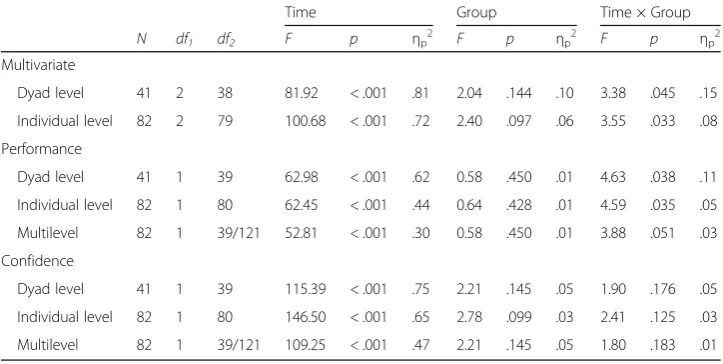
The results of the MANOVA can be viewed in Table1. As we can see, there is a multi-variate main effect of time (but not of group) and an interaction effect visible for both units of measurement. Univariate ANOVAs confirm main effects of time on both vari-ables with performance and confidence levels rising significantly from pre to post. They also show a significant interaction effect on performance with learners in MC+ showing a steeper increase from pre to post than learners in MC−(cf. Table2). To account for the dyadic structure, we additionally analyzed the data via a dyadic multi-level model using linear mixed modeling with restricted maximum likelihood estimation (REML) taking into account the dependencies between learners within dyads (analogous to Kenny et al. 2006), that has been used in similar studies before (e.g., Lam and Muldner2017). While the results were similar to the other analyses, effect sizes were overall somewhat smaller and the interaction effect between time and group just missed statistical significance.
Relationship between local dependencies and inferential and descriptive statistics We used two different units of measurement and contrasted the results due to the non-independence of the individual subjects within our sample. By violating the inde-pendency assumption due to the local dependencies within dyads, we overestimate stat-istical significance for individual units of measurement (by underestimating pvalues), Table 1Inferential statistics of the MANOVA for dyads and individuals and multilevel analyses
Time Group Time × Group
N df1 df2 F p ηp 2
F p ηp
2
F p ηp
2
Multivariate
Dyad level 41 2 38 81.92 < .001 .81 2.04 .144 .10 3.38 .045 .15
Individual level 82 2 79 100.68 < .001 .72 2.40 .097 .06 3.55 .033 .08
Performance
Dyad level 41 1 39 62.98 < .001 .62 0.58 .450 .01 4.63 .038 .11
Individual level 82 1 80 62.45 < .001 .44 0.64 .428 .01 4.59 .035 .05
Multilevel 82 1 39/121 52.81 < .001 .30 0.58 .450 .01 3.88 .051 .03
Confidence
Dyad level 41 1 39 115.39 < .001 .75 2.21 .145 .05 1.90 .176 .05
Individual level 82 1 80 146.50 < .001 .65 2.78 .099 .03 2.41 .125 .03
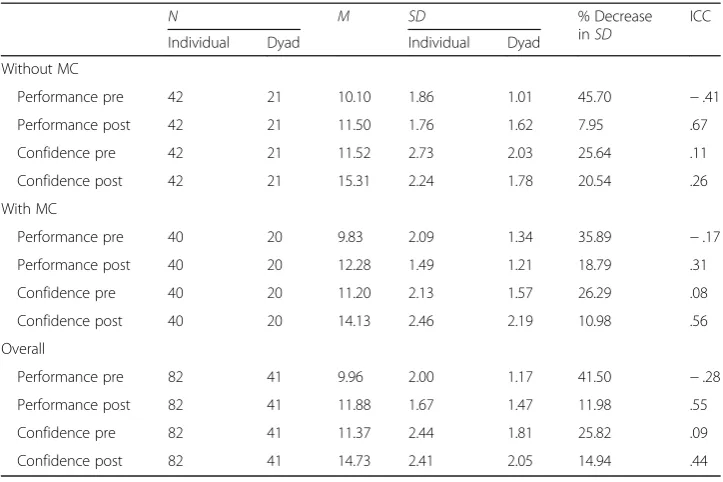
since we assume learners within a dyad to be more similar rather than more different from random pairs. When we look at the inferential statistics for both units of meas-urement, we can see thatpvalues increase from individual to dyad level analyses (as to be expected, sinceNis halved and is directly related top). However, our effect size also increases from individual to dyad level. This is due to the elimination of within-dyad variance (by computing within-dyad means) and thus a deduction of residual variance: for individual data, we underestimate the within-group variance in comparison to between-group variance because of local dependence within the dyads, therebyover esti-mating the effect of the between group treatment (cf. Bliese and Hanges 2004). Re-placing within-dyad variance by calculation mean scores further adds to this effect, completely evening out individual differences within dyads in the process. Thus, this procedure comes at a price: by eliminating the within-dyad variance to get rid of over-estimation effects of statistical significance, we keep information about mean scores, but lose information on residual variance (cf. Table 2). Accounting for this effect by conducting a multi-level approach confirms the mostly lower effect sizes and higher p values.
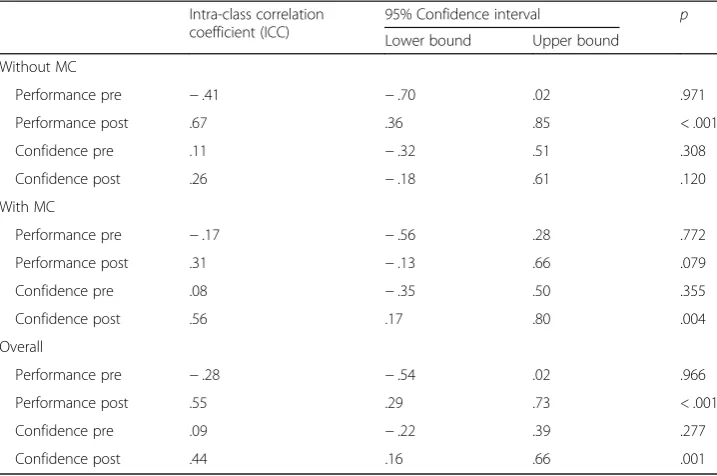
The changes in the standard deviation due to the elimination of within-dyad variance from individual to group are presented in the %-decrease column. We also added infor-mation on ICC values andp(cf. Table3). While these measures may be somewhat un-stable (confidence intervals are quite large) due to the smallNespecially when looking at each experimental condition individually (Kenny et al. 1998 recommend at least 36 dyads for 80% power in detecting consequential non-independence), they still give a rough indication on within-dyad dependence. As we can see, higher ICC values are as-sociated with a decrease in the variance lost from individual to group level. This is be-cause learners that are more closely related do vary less between them (within dyad) than unrelated learners. Table 4 shows the decomposition of variance for each condi-tion and outcome variable. As expected, ICC values are low for the pre-test scores, Table 2Descriptive statistics of the results for dyad and individual data (including ICC)
N M SD % Decrease
inSD
ICC
Individual Dyad Individual Dyad
Without MC
Performance pre 42 21 10.10 1.86 1.01 45.70 −.41
Performance post 42 21 11.50 1.76 1.62 7.95 .67
Confidence pre 42 21 11.52 2.73 2.03 25.64 .11
Confidence post 42 21 15.31 2.24 1.78 20.54 .26
With MC
Performance pre 40 20 9.83 2.09 1.34 35.89 −.17
Performance post 40 20 12.28 1.49 1.21 18.79 .31
Confidence pre 40 20 11.20 2.13 1.57 26.29 .08
Confidence post 40 20 14.13 2.46 2.19 10.98 .56
Overall
Performance pre 82 41 9.96 2.00 1.17 41.50 −.28
Performance post 82 41 11.88 1.67 1.47 11.98 .55
Confidence pre 82 41 11.37 2.44 1.81 25.82 .09
which is to be expected since the learners within each dyad did not collaborate yet in any way (please note that learners within a dyad received different versions of the learn-ing text, leadlearn-ing to negative ICC values for performance pre collaboration—since nega-tive values violate the ICCs model assumption, associated p values may not be interpreted). Variance decomposition shows that dyads do not account for much of the variance pre collaboration and error variance is quite high. Thus, computing a mean dyad score of largely unrelated learners eliminates large amounts of variance in pre-test. However, as dependencies (and thereby ICC values) increase in post-test due to collaboration and a large amount of the variance can be explained by dyads, the loss in variance decreases. Meanwhile, the means stay identical since the dyad value was computed as a mean between dyad members. It is interesting to notice that within the MC− condition, learners’ performance scores are more closely related to each other than in the MC+ condition (cf. ICC in Table3), and thus, losses in variance (and infor-mation) are greater for the latter condition, if we combine the data to get dyad level data (cf. Table2).
If we look more closely at the actual variance, we can see that in the MC−condition, variance for individual performance data is more or less equal in pre and post (slight decrease), whereas on dyad level, variance noticeably increases (cf. Table 2). Factoring Table 3Intra-class correlation coefficients per group and outcome variable
Intra-class correlation coefficient (ICC)
95% Confidence interval p
Lower bound Upper bound
Without MC
Performance pre −.41 −.70 .02 .971
Performance post .67 .36 .85 < .001
Confidence pre .11 −.32 .51 .308
Confidence post .26 −.18 .61 .120
With MC
Performance pre −.17 −.56 .28 .772
Performance post .31 −.13 .66 .079
Confidence pre .08 −.35 .50 .355
Confidence post .56 .17 .80 .004
Overall
Performance pre −.28 −.54 .02 .966
Performance post .55 .29 .73 < .001
Confidence pre .09 −.22 .39 .277
Confidence post .44 .16 .66 .001
Table 4Variance decomposition (ANOVA) for performance and confidence pre and post collaboration
Var(dyad) Var(error) Var(overall) Var(dyad) Var(error) Var(overall)
Performance pre Performance post
Without MC −1.39 4.81 3.45 2.11 1.02 3.09
With MC −0.74 5.08 4.35 0.70 1.53 2.20
Confidence pre Confidence post
Without MC 0.83 6.62 7.43 1.29 3.74 5.00
in the high interdependence in post-test for this group, the data suggests that while learners within dyads may be more similar post collaboration, the dyads themselves seem to grow apart. This is especially interesting since we do not see the same effect for MC+: here, the variance on the individual level decreases visibly from pre to post, while the decrease on dyad level is negligible. Table4shows that while error variance is roughly similar between the conditions for performance post, the variance explained by the dyad is three times higher for learners without metacognitive information (MC−). For confidence, we get a different picture: although there are no overall effects of the treatment (cf. Table 1), the ICC after collaboration is much higher for learners within MC+ (cf. Table 3). Thus, while the loss in variance from individual to dyad level is ra-ther similar pre collaboration, the losses are visibly smaller post collaboration within MC+ (cf. Table2). Table4supports this notion: we can see that while unexplained vari-ance for confidence post collaboration is smaller in MC+, the varivari-ance explained by the dyad is more than twice the size as in the MC−condition. From pre to post however, overall variance decreases in the MC− condition and increases in the MC+ condition (both units of measurement). With a larger percentage of variance in post being due to between dyad variance for MC+ than for MC−, on a dyad level, the difference between the groups is more obvious than on an individual level.
Discussion
assign to low confidence assumptions. Confidence cues are used to judge the know-ledge of others, but also the validity of assumptions (e.g., Price and Stone 2004), and confidence in assumptions is also seen as a prerequisite for experiencing cognitive con-flict (Lee et al.2003). If confidence information is visualized and thus more salient, in cases of low confidence this might reduce the learners’need to align their understand-ing and reach consensus about the content. As discussed before, while aligned perform-ance levels do not necessarily come with conversion of assumptions, differences in basic assumptions could explain some of the differences and may explain why dyads do not explain a lot of the variance within the condition with metacognitive information. Alternatively, providing metacognitive confidence information may also have made learners assume different roles within the process according to their respective confi-dence levels (e.g., more confident student mainly explaining and providing informa-tion), which may have led to less reciprocal yet still effective learning processes. In such a scenario, the dyad itself might still explain some variance, but less, and the variance within dyads (error variance) should be comparably high. While confirming any of these interpretations would of course require further research, the different levels of local dependencies cast doubt about the assumption that metacognitive information simply enhanced and guided reciprocal knowledge exchange processes. On a descrip-tive level, the variances for dyad level data on performance show that dyads without metacognitive information become more diverse from pre to post while dyads with the information rather become more similar, so that most of the variance is due to individ-ual error. One plausible explanation would be that dyads with metacognitive informa-tion use the provided informainforma-tion in a similar fashion resulting in similar mean performance, while dyads without such information apply slightly more diverse ap-proaches. While this may explain the differences in variance due to dyad, it does not explain what strategies may lead to higher within-dyad variance (error variance) and lower between-dyad variance, except for more individualistic approaches and less collaboration.
In our study, learners may have established an agreement on how overly confident they were about the learning material, especially when confidence information was provided. While negotiating agreement is a collaborative act, this explanation focuses more on the common exposure aspect of interdependence, because such alignment processes may well happen without the learners interacting or explicitly discussing confidence if metacognitive information is provided. Finally, it is important to point out that unex-plained (error) variances in confidence levels were quite different between the condi-tions pre collaboration and thus, some effects might be due to random differences between the learners rather than experimental treatment.
Of course, our descriptive analyses of changes and differences in variances are not suitable to draw definite conclusions. Rather, they provide clues into possible mecha-nisms of collaboration that may be used to generate hypotheses to be tested in further studies. Similarly, while the ICC values post collaboration seem very different descrip-tively, confidence intervals are quite large due to the small samples and considerably overlap, so jumping to conclusions may be premature. However, they still provide however-fragile evidence that suggests that collaboration processes might have been af-fected by the treatment in an unexpected way and should thus be further examined.
Overall, comparing dyadic and individual level data showed that both approaches produced similar outcomes for our data. Multi-level analyses reached similar conclu-sions, although the effect sizes were smaller and the interaction effect on performance was not statistically significant. Since the advantages of multi-level approaches to analyze data within collaborative learning settings have been repeatedly illustrated else-where (for detailed examples contrasting results drawn from individual, dyadic, and multi-level analyses, see, e.g., Janssen et al. 2011), we did not compare multi-level re-sults with dyadic and individual data in detail. Rather, we argue that looking into the ICCs and variances allowed us to gain some insight into the collaboration processes. Using this additional information, we conclude that providing confidence information may have led learners to focus on different aspects of the collaboration—aligning confi-dence rather than performance levels. While this may lead to higher performance gains, the mechanisms need to be further investigated. To achieve this, methodological one-track approaches are insufficient. Causal models require a sound description of generative mechanisms able to explain variations within the data and quantitative methods are limited to testing for differences and co-variations. Thus, analyses of vari-ance have limited capacity to help us understand the underlying processes of the ob-served phenomena as they reduce social reality to a fixed set of linear relationships largely disregarding social-contextual complexity and dynamics (cf. Abbott 1988). A meaningful integration of theoretical and statistical models thus requires a combination of in-depth analyses of collaborative and transactive processes to explain observed vari-ances within the data by providing a rationale of causal relationships (e.g., via qualita-tive analyses of the interaction and communication processes) and inferential statistics to secure these findings on a larger scale.
Conclusion
scenarios often explicitly target such processes of learners exchanging information, co-constructing knowledge, or in other ways interacting while influencing the learning partners’cognitive processes (Dillenbourg 1999). Hence, the focus of our study was to exemplarily show how interdependencies (i.e., ICCs) may be used to gain more insight into the mechanisms of collaboration. Comparing results of statistical analyses between different units of measurement (individual vs. dyad) and decomposing variance may further provide valuable information easily lost when compensating for these effects ra-ther than interpreting them. While none of the statistical aspects of local dependence discussed in this paper are genuinely new, the results described demonstrate the effect this has on specific dyadic data drawn from a study typical for quantitatively assessing the effect of a treatment to foster collaboration on individual learning outcomes. We argue that this valid information should not be viewed as hampering our statistical de-sign, but as enriching our analyses by providing valuable information. As stated before, interdependence is not a mere statistical phenomenon, but needs to be interpreted psy-chologically as the result of collaborative processes or shared experiences (Cress2008). Thus, it has theoretical value and should be critically analyzed, especially if the research conducted targets the aforementioned collaboration processes as frequently done in CL research. Interventions designed to support collaborative learning processes affect the interaction processes between learners. These processes are pivotal to collaborative learning, where peers interact while pursuing a learning goal (Dillenbourg et al. 2009; Suthers 2012) and thus, it is reasonable to assume that such interventions affect the interdependence between learners. While in cooperative settings this might be some-what different (when learners split their work and focus on very different aspects of a task), we argue that when considering collaboration within CL, our underlying theoret-ical assumptions about collaborative processes should often lead us to expect inter-dependencies and their absence might be a reason to rethink these assumptions. Apart from adjusting statistical models to the characteristics of our specific data, using quan-titative and qualitative methods to take a closer look at the fit between our model as-sumptions about collaborative processes taking place in a specific educational scenario and the outcome data retrieved is a great opportunity to adjust our assumptions about educational practices and ultimately build better models.
Abbreviations
CL:Collaborative learning; CSCL: Computer-supported collaborative learning; ICC: Intra-class correlation coefficient; MC: Metacognitive confidence information; MC−: Research condition without information on the learners’ metacognitive confidence; MC+ : Research condition with information on the learners’metacognitive confidence
Acknowledgements
Many thanks to Rebecca Streidt, M.Sc., for collecting the data in the course of her Masters’Thesis. Some of the arguments presented in this manuscript were published as a two-page summary in the ICLS 2018 proceedings (Schnaubert L. and Bodemer D. (2018). Interdependence as a treatment effect: An example from group awareness research. In J. Kay and R. Luckin (Eds.),Rethinking Learning in the Digital Age: Making the Learning Sciences Count, 13th International Conference of the Learning Sciences (ICLS) 2018, Vol. 3(pp. 1457–1458). London, UK: International Society of the Learning Sciences.). The manuscript in its current form has not been published. It differs substantially in content and wording from the previous publication and contains further analyses and details on the background, methods, data and results, as well as elaborated content and additional conclusions.
Availability of data and materials
The dataset supporting the conclusions of this article is available in the Open Science Framework (OSF) repository underhttps://osf.io/a972m/. Further data including raw data and materials used in the experiment are available on request. To access this or additional information, please contact the corresponding author.
Authors’contributions
Competing interests
The authors declare that they have no competing interests.
Publisher’s Note
Springer Nature remains neutral with regard to jurisdictional claims in published maps and institutional affiliations.
Received: 30 May 2018 Accepted: 4 October 2018
References
Abbott, A. (1988). Transcending general linear reality.Sociological Theory, 6(2), 169–186.https://doi.org/10.2307/202114. Bliese, P. D., & Hanges, P. J. (2004). Being both too liberal and too conservative: the perils of treating grouped data as though
they were independent.Organizational Research Methods, 7(4), 400–417.https://doi.org/10.1177/1094428104268542. Bodemer, D. (2011). Tacit guidance for collaborative multimedia learning.Computers in Human Behavior, 27(3), 1079–1086.
https://doi.org/10.1016/j.chb.2010.05.016.
Bodemer, D., & Dehler, J. (2011). Group awareness in CSCL environments.Computers in Human Behavior, 27(3), 1043–1045. https://doi.org/10.1016/j.chb.2010.07.014.
Bodemer, D., Janssen, J., & Schnaubert, L. (2018). Group awareness tools for computer-supported collaborative learning. In F. Fischer, C. E. Hmelo-Silver, S. R. Goldman, & P. Reimann (Eds.),International handbook of the learning sciences(pp. 351– 358). New York, NY: Routledge/Taylor & Francis.
Bonito, J. A. (2002). The analysis of participation in small groups: methodological and conceptual issues related to interdependence.Small Group Research, 33(4), 412–438.https://doi.org/10.1177/104649640203300402.
Buder, J. (2017). A conceptual framework of knowledge exchange. In S. Schwan & U. Cress (Eds.),The psychology of digital learning(pp. 105–122). Cham: Springer International Publishing.https://doi.org/10.1007/978-3-319-49077-9_6. Clark, H. H., & Brennan, S. E. (1991). Grounding in communication. In L. B. Resnick, J. M. Levine, & S. D. Teasley (Eds.),
Perspectives on socially shared cognition(pp. 127–149). Washington, DC: American Psychological Association.
Clark, H. H., & Murphy, G. L. (1982). Audience design in meaning and reference. In J.-F. Le Ny & W. Kintsch (Eds.),Advances in Psychology(Vol. 9, pp. 287–299). Amsterdam: North-Holland.https://doi.org/10.1016/S0166-4115(09)60059-5.
Cress, U. (2008). The need for considering multilevel analysis in CSCL research—an appeal for the use of more advanced statistical methods.International Journal of Computer-Supported Collaborative Learning, 3(1), 69–84.https://doi.org/10. 1007/s11412-007-9032-2.
Dehler, J., Bodemer, D., Buder, J., & Hesse, F. W. (2011). Guiding knowledge communication in CSCL via group knowledge awareness.Computers in Human Behavior, 27(3), 1068–1078.https://doi.org/10.1016/j.chb.2010.05.018.
Deiglmayr, A., & Schalk, L. (2015). Weak versus strong knowledge interdependence: a comparison of two rationales for distributing information among learners in collaborative learning settings.Learning and Instruction, 40, 69–78.https://doi. org/10.1016/j.learninstruc.2015.08.003.
Dillenbourg, P. (1999). What do you mean by“collaborative learning”? In P. Dillenbourg (Ed.),Collaborative-learning: cognitive and computational approaches(pp. 1–19). Oxford: Elsevier.
Dillenbourg, P., & Bétrancourt, M. (2006). Collaboration load. In J. Elen & R. E. Clark (Eds.),Handling complexity in learning environments: research and theory(pp. 142–163). Amsterdam: Elsevier.
Dillenbourg, P., Järvelä, S., & Fischer, F. (2009). The evolution of research on computer-supported collaborative learning. In D. N. Balacheff, D. S. Ludvigsen, D. T. de Jong, D. A. Lazonder, & D. S. Barnes (Eds.),Technology-enhanced learning(pp. 3–19). Dordrecht: Springer.
Dunlosky, J., & Metcalfe, J. (2009).Metacognition. Los Angeles: Sage Publications.
Efklides, A. (2008). Metacognition: defining its facets and levels of functioning in relation to self-regulation and co-regulation.
European Psychologist, 13(4), 277–287.https://doi.org/10.1027/1016-9040.13.4.277.
Engelmann, T., Dehler, J., Bodemer, D., & Buder, J. (2009). Knowledge awareness in CSCL: a psychological perspective.
Computers in Human Behavior, 25(4), 949–960.https://doi.org/10.1016/j.chb.2009.04.004.
Fraundorf, S. H., & Benjamin, A. S. (2016). Conflict and metacognitive control: the mismatch-monitoring hypothesis of how others’knowledge states affect recall.Memory, 24(8), 1108–1122.https://doi.org/10.1080/09658211.2015.1069853. Gonzalez, R., & Griffin, D. (2012). Dyadic data analysis. In H. Cooper, P. M. Camic, D. L. Long, A. T. Panter, D. Rindskopf, & K. J.
Sher (Eds.),APA handbook of research methods in psychology, Vol 3: data analysis and research publication(pp. 439–450). Washington, DC: American Psychological Association.https://doi.org/10.1037/13621-022.
Griffin, D., & Gonzalez, R. (1995). Correlational analysis of dyad-level data in the exchangeable case.Psychological Bulletin, 118(3), 430–439.https://doi.org/10.1037/0033-2909.118.3.430.
Hesse, F. (2007). Being told to do something or just being aware of something? An alternative approach to scripting in CSCL. In F. Fischer, I. Kollar, H. Mandl, & J. Haake (Eds.),Scripting computer-supported communication of knowledge—cognitive, computational and educational perspectives(pp. 91–98). New York: Springer.
Hunt, D. P. (2003). The concept of knowledge and how to measure it.Journal of Intellectual Capital, 4(1), 100–113.https://doi. org/10.1108/14691930310455414.
Janssen, J., & Bodemer, D. (2013). Coordinated computer-supported collaborative learning: awareness and awareness tools.
Educational Psychologist, 48(1), 40–55.https://doi.org/10.1080/00461520.2012.749153.
Janssen, J., Erkens, G., Kirschner, P. A., & Kanselaar, G. (2011). Multilevel analysis in CSCL research. In S. Puntambekar, G. Erkens, & C. Hmelo-Silver (Eds.),Analyzing interactions in CSCL(pp. 187–205). Springer US). https://doi.org/10.1007/978-1-4419-7710-6_9.
Karabenick, S. A. (1996). Social influences on metacognition: effects of colearner questioning on comprehension monitoring.
Journal of Educational Psychology, 88(4), 689–703.https://doi.org/10.1037/0022-0663.88.4.689.
Kenny, D. A., Kashy, D. A., & Bolger, N. (1998). Data analysis in social psychology. In D. Gilbert, S. Fiske, & G. Lindzey (Eds.),
Handbook of social psychology(Vol. 1, 4th ed., pp. 233–265). Boston: McGraw-Hill. Kenny, D. A., Kashy, D. A., & Cook, W. L. (2006).Dyadic data analysis. New York: Guilford Press.
Lam, R., & Muldner, K. (2017). Manipulating cognitive engagement in preparation-to-collaborate tasks and the effects on learning.Learning and Instruction, 52, 90–101.https://doi.org/10.1016/j.learninstruc.2017.05.002.
Lee, G., Kwon, J., Park, S.-S., Kim, J.-W., Kwon, H.-G., & Park, H.-K. (2003). Development of an instrument for measuring cognitive conflict in secondary-level science classes.Journal of Research in Science Teaching, 40(6), 585–603.https://doi.org/10.1002/ tea.10099.
Luus, C. A. E., & Wells, G. L. (1994). The malleability of eyewitness confidence: co-witness and perseverance effects.Journal of Applied Psychology, 79(5), 714–723.https://doi.org/10.1037/0021-9010.79.5.714.
Nelson, T. O., Dunlosky, J., Graf, A., & Narens, L. (1994). Utilization of metacognitive judgments in the allocation of study during multitrial learning.Psychological Science, 5(4), 207–213.https://doi.org/10.1111/j.1467-9280.1994.tb00502.x. Nezlek, J. B., Schröder-Abé, M., & Schütz, A. (2006). Mehrebenenanalysen in der psychologischen Forschung (multilevel
analyses in psychological research).Psychologische Rundschau, 57(4), 213–223.https://doi.org/10.1026/0033-3042.57.4.213. Price, P. C., & Stone, E. R. (2004). Intuitive evaluation of likelihood judgment producers: evidence for a confidence heuristic.
Journal of Behavioral Decision Making, 17(1), 39–57.https://doi.org/10.1002/bdm.460.
Sangin, M., Molinari, G., Nüssli, M.-A., & Dillenbourg, P. (2011). Facilitating peer knowledge modeling: effects of a knowledge awareness tool on collaborative learning outcomes and processes.Computers in Human Behavior, 27(3), 1059–1067. https://doi.org/10.1016/j.chb.2010.05.032.
Schnaubert, L., & Bodemer, D. (2016). How socio-cognitive information affects individual study decisions. In C.-K. Looi, J. Polman, U. Cress, & P. Reimann (Eds.),Transforming learning, empowering learners: the international conference of the learning sciences (ICLS) 2016(pp. 274–281). Singapore: International Society of the Learning Sciences.
Shrout, P. E., & Fleiss, J. L. (1979). Intraclass correlations: uses in assessing rater reliability.Psychological Bulletin, 86(2), 420–428. https://doi.org/10.1037/0033-2909.86.2.420.
Strijbos, J.-W., & Fischer, F. (2007). Methodological challenges for collaborative learning research.Learning and Instruction, 17(4), 389–393.https://doi.org/10.1016/j.learninstruc.2007.03.004.
Suthers, D. D. (2012). Computer-supported collaborative learning. In N. M. Seel (Ed.),Encyclopedia of the sciences of learning
(pp. 719–722). New York: Springer.https://doi.org/10.1007/978-1-4419-1428-6_389.
Teasley, S. D. (1997). Talking about reasoning: how important is the peer in peer collaboration? In L. B. Resnick, R. Säljö, C. Pontecorvo, & B. Burge (Eds.),Discourse, tools and reasoning(pp. 361–384). Berlin: Springer. https://doi.org/10.1007/978-3-662-03362-3_16.
Weinberger, A., & Fischer, F. (2006). A framework to analyze argumentative knowledge construction in computer-supported collaborative learning.Computers & Education, 46(1), 71–95.https://doi.org/10.1016/j.compedu.2005.04.003.
Weinberger, A., Stegmann, K., & Fischer, F. (2007). Knowledge convergence in collaborative learning: concepts and assessment.Learning and Instruction, 17(4), 416–426.https://doi.org/10.1016/j.learninstruc.2007.03.007.