A Novel Two-Split Capacitor Array with
Linearity Analysis for High-Resolution SAR
ADCs
Yingxin Zheng, Zongmin Wang, Song Yang, Qizhang Li, and Li Xiang
Beijing Microelectronics Tech. Institution (BMTI), Beijing, ChinaEmail: [email protected]
Abstract—A novel two-split capacitor (T-SC) array structure for Successive Approximation Register (SAR) analog-to-digital converter (ADC) is proposed. When used as digital –to-analog converter (DAC), this circuit reduced the chip area by 27.7% in comparing with the conventional Split Capacitor (SC) at resolution=14. The area reduction effect can be more significant with the increasing resolution of ADC. The capacitor mismatch and parasitic effects of this proposed structure are analyzed in theory. Behavioral simulations were performed to demonstrate the effectiveness of this proposed structure. This simulation was only performed for capacitor mismatch. Simulation results show that T-SC array could achieve good binary-weighted performance and the standard deviation of its DNL was 0.51LSB when the standard deviation of capacitor was 0.025%. Furthermore, the analysis in this paper is provided for designers to make a tradeoff among resolution, CMOS process, circuit structure and capacitor size in their design of SAR ADC.
Index Terms—capacitor DAC, capacitor mismatch, nonlinearity, SAR ADC, small area
I. INTRODUCTION
Recently, the Successive Approximation Register (SAR) analog-to-digital converter (ADC) has attracted more attentions again for that it features low power and area consumption due to its simple structure and least usage of analog circuit. Thus, it is used widely in today’s System-on-Chip (SOC) solutions [1], [2], where requires low power, low cost, high speed and high density. As we all know, capacitor array DAC (CDAC) is used popularly in SAR ADC. For a binary-weighted capacitor array, as the resolution increases, a problem comes up: the total number of capacitors in CDAC will has an exponential increase. This will lead to increasing chip area, power dissipation as well as reducing speed due to a large charging time-constant. Obviously, it does not match case of SOC’s requirements. To mitigate this problem, split capacitor array is used, which can reduce total number of capacitors. However, when the resolution is higher, this problem still exists and cannot be ignored.
This paper presents a novel two-split capacitor (T-SC) array structure based on conventional SC array. When
Manuscript received April 25, 2014; revised June 27, 2014.
used as digital-to-analog converter (DAC), this circuit reduced the chip area by 27.7% in comparing with the conventional Split Capacitor (SC) at resolution=14. Notably, the high speed performance advantage did not go away. The area reduction effect can be more significant with the increasing resolution of ADC. Thus, it can be used widely in high-speed and medium-to-high resolution SAR ADC. Because the data of the capacitor mismatch are usually available in statistical data, such as standard deviation [3], it is more practical to clarify the relationship between the standard deviation of the capacitor mismatch and the achievable ADC accuracy. In this paper, a statistical analysis has been made on the effect of capacitor mismatch on the SAR ADC resolution for these two capacitor array structure. Also, the roughly analysis of parasitic effect is included in this paper.
II. OVERVIEW OF SARADCOPERATION
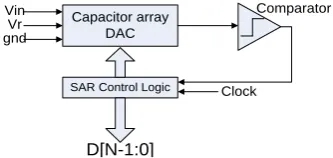
The architecture of a SAR ADC is shown in Fig. 1, consisting of a series of a CDAC, a comparator and successive approximation (SA) control logic. The SA control logic includes shift registers and switch drivers which control the DAC operation by performing the binary-scaled feedback during the successive approximation. The CDAC is the basic structure of the SAR ADC and it serves both to sample the input signal and as a DAC for creating and subtracting the reference voltage.
Capacitor array DAC
SAR Control Logic
Vin Vr gnd
Clock
Comparator
D[N-1:0]
Figure 1. Simplified block diagram of a SAR ADC architecture
III. CAPACITOR ARRAY STRUCTURE AND ANALYSIS
A. Structure
1) Conventional SC array
structure was implemented to save the chip area and consequently mitigate the large power dissipation and low speed issue. Fig. 2 shows a SC array structure with N=h+m resolution, which utilizes an attenuation capacitor Ca to split the capacitor array into h bits ‘H-segment’ and m bit ‘M-‘H-segment’. To improve matching performance, we choose integral multiples of unit capacitor Cu as Ca.
... ...
2h-1
kCu 2h-2
kCu 2kCu kCu Cd1 2 m-1
Cu 2m-2Cu 2Cu Cu Cd2 Ca
Vout H-segment: h bits M-segment: m bits
Dm+h-1 Dm+h-2 Dm+1 Dm Dm-1 Dm-2 D1 D0
Vin
Vr
gnd
Figure 2. Conventional SC array
To satisfy binary-weighted requirements, we should assure
1
2
m m
dV
dV
(1)where dVm, dVm-1 is the variation of Vout when Dm, Dm-1
equals 1, respectively. (That Dm, Dm-1 equals 1 means
their corresponding capacitor connects to the reference voltage Vr).
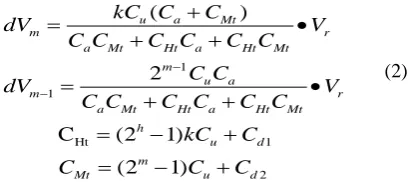
Easily, we can calculate dVm, dVm-1 as
1 1 Ht 1 2 ( ) 2
C (2 1)
(2 1)
u a Mt
m r
a Mt Ht a Ht Mt m
u a
m r
a Mt Ht a Ht Mt h
u d
m
Mt u d
kC C C
dV V
C C C C C C
C C
dV V
C C C C C C
kC C
C C C
(2)
where CHt, CMt represent the total number of capacitors in H-segment and M-segment, respectively. Then we could get the following equation, which ensures good performance of binary weight along with Ca equaling integral multiples of Cu.
2 2 2 1 m m d a u u
C kC
C k C
(3)
From (3), we can conclude that the performance of binary weight has nothing to do with the value of Cd1 and
h. That is to say, to achieve good linearity performance of CDAC, we just ensure that the value of Cd2/Cu, k, Ca/Cu, m is integer.
Meanwhile, to reduce the number of input capacitor, we can choose Cd1=kCu as sample capacitor instead of all capacitor in M-segment, which can cause only a gain error and no influence on linearity performance.
... ...
C13=64CuC12=32CuC8=2Cu C7=Cu
Cd1=Cu
C6=64CuC5=32Cu C1=2CuC0=Cu
Ca=Cu
Vout H-segment: h=7 M-segment: m=7
D13 D12 D8 D7 D6 D5 D1 D0
Vin Vr gnd
Figure 3. An example of 14-bit SC array DAC
2) Novel T-SC array
Although SC array can reduce area of capacitor array, the area of capacitor array is still large when the resolution of CDAC is high. To achieve smaller total number of capacitors, we can modify the conventional SC array to a new T-SC array.
Design Highlights: The new design adds another array of capacitors by borrowing the capacitors from Cd2.
With the resolution of N=h+m+l, the T-SC array is
(H-segment, M-segment and L-segment) and two attenuation capacitors (Ca1, Ca2). The parameters of k1, k2
represent the ratio of smallest capacitor in adjacent segment.
Figure 4. The T-SC array DAC
To ensure the value of Ca1/Cu, Ca2/Cu is integer, we
can design H-segment and M-segment first based on (3). The equation is as follows.
2 1 1
2 1 2
2 2 1 m m d a u u
C k C
k C k k C
(4)
Then we can borrow xCu from Cd2, where x is an
uncertain integer and design M-segment and L-segment by use of (3) again.
3 2
2
3 2
3 1 2
1 (2 1) (2 1) 2 2 1 l
d u a
u d
l
d u a
l
l
d a
u u
C C C
xC C
C C C
C k C
C k C
(5)To make clear the following formulas, we define that Ca1/Cu=a, Cd2/Cu=b, Ca2/Cu=p, and Cd3/Cu=q. After simplifying formulas (4), (5), we can get formulas as follows, when we choose p=2l.
(6)
-illustrated in Fig. 4. It consists of three segments (H-An example of 14-bit SC array DAC is shown in Fig. 3. To achieve the smallest total number of capacitor, we choose h=m=7, k=1, Cd1=Cu, Cd2=0, Ca=Cu based on
(3).
where the condition is 0<x≤b, and the value of q, x,bis integer. Note that b is the value of Cd2/Cu before borrowing. After we borrowing x from b, Cd2/Cu equals (b-x).
choose h=6, m=5, l=3, Cd1=Cu, k1=k2=1, a=2, b=
p=8 and q=49 based on (6).
...
C7=16Cu
C6=8Cu
C3=Cu
Cd2=24Cu
C2=4Cu
C1=2Cu
C0=Cu
Cd3=49Cu
Ca2=8Cu
Vout
M-segment: m=5 L-segment:l=3
Vin Vr gnd
...
C13=32Cu
C12=16Cu
C8=Cu
Cd1=Cu
Ca1=2Cu
H-segment: h=6
D13 D12 D8 D7 D6 D3 D2 D1 D0
Figure 5. An example of 14-bit T-SC array DAC
where Ct is the total number of capacitors in CDAC.
TABLE I. OTHER DIVISION METHODS AT N=14
N=14
h m l k1 k2 a b-x p q Ct/Cu
6 5 3 1 1 2 24 8 49 185
7 5 2 1 1 2 28 4 9 205
6 6 2 1 1 2 60 4 9 205
7 4 3 1 1 2 8 8 49 217
6 5 3 1 1 3 55 8 49 217
There are many others not listing.
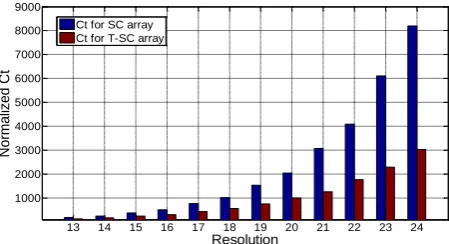
3) Comparation of total capacitors in two CDAC In Fig. 3 and Fig. 5, the T-SC array can get Ct=185Cu,
with area reduction of 27.7% in comparing with Ct=256Cu in conventional SC array. The available
smallest total capacitors Ct normalized by the unit capacitor versus the resolution of CDAC is plotted in Fig. 6. As we can see in Fig. 6, it is obvious that with the increasing resolution of CDAC, the area reduction effect can be more significant in theory.
13 14 15 16 17 18 19 20 21 22 23 24
1000 2000 3000 4000 5000 6000 7000 8000 9000
Resolution
No
rm
a
lize
d
Ct
Ct for SC array Ct for T-SC array
Figure 6. Normalized Ct versus the resolution of CDAC
B. Linearity Analysis
1) Mismatch nonlinearity effect
The analysis of capacitor mismatch has been made in recent years [4], [5]. Since the effect of the capacitor mismatch in the L-segment is reduced to about 1/2m+hand 1/2hfor T-SC and SC array respectively, the one in the H-segment dominates [5]. Therefore, as shown in Fig. 7, the following analysis only focuses on H-segment in 14-bit CDAC. For simplicity, it is assumed that all capacitors except in H-segment are connected to the ground and the initial charge is zero. The maximum error of Voutcaused
by mismatch occurs during the code transition from ‘011…1’ to ‘100…0’ at the midpoint where the number of capacitors that change their state is maximal. To meet
the ADC accuracy, this error must be smaller than a half least significant bit (LSB)(Vr/214+1).
Figure 7. Simplified block focusing on H-segment
Then we can get the relation between capacitor mismatch requirement and resolution.
T-SC array: _ 1 2
1
1 2 1
(2 1) 1 1
2 / 2 2
h DNL STD
h N
r a u u
V k k C
LSB
V k k C C C
(7)
SC array: _
1
(2 1) 1 1
2 / 2 2
m DNL STD
m N
r a u u
V k C
LSB
V k C C C
(8)
where ∆Cis the standard deviation of the unit capacitor and VDNL_STDis the standard deviation of VDNL.
Based on (3), (6), (7), (8), the required capacitor matching versus resolution plot for these two CDAC can be seen in Fig. 8. Curve 1 and curve 2 shows ∆C/Cuat
smallest Ct in a conventional SC and T-SC array, respectively; and curve 3 shows the optimum ∆C /Cu of
T-SC array when Ct of T-SC array is smaller than that of SC array.
Figure 8. Required capacitor matching versus resolution for these two CDAC
As shown in Fig. 8, if reasonable values of h, k1, k2 and Ca1 are selected, T-SC array can achieve much
smaller area than that of SC array, without the increase of mismatch requirement.
Also, compared with curve 3, curve 2 means smaller area, but stricter matching requirements. To relax the required capacitor matching, a segmented capacitor array [5] or capacitor calibration techniques [6] can be used.
2) Parasitic nonlinearity effect
Lots of efforts have been made on parasitic nonlinearity effect in SC array [4], [7], as is illustrated in Fig. 9(a).
The results in [4], [7] show that, the parasitic capacitance Cp2degrades the linearity of the SAR ADC,
while Cp1can cause only a gain error and have no effect
thus the nonlinearity effect can be alleviated. But this will enlarge the capacitor spread in H-segment.
As we all know, bottom-plate parasitic capacitance of a capacitor is bigger than that of top-plate. Thus, using results in [4], [7], capacitors in T-SC array can be distributed in Fig. 9(b), which can reduce the parasitic effect. To alleviate the parasitic effect further, the number of bits in the L-segment and M-segment should be chosen carefully with other parameters.
Cp2 CMt
Vout M-segment
Cp1
Ca
H-segment
CHt
CLt
Vout
CMt
CHt
Ca2
Ca1
(a)
(b)
Figure 9. Analysis of parasitic nonlinearity effect in SC and T-SC array
IV. SIMULATION RESULTS
A. Binary-Weighted Performance
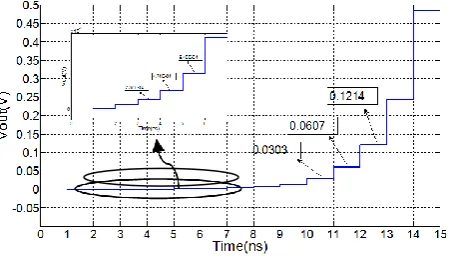
To verify binary-weighted performance of T-SC array, the example in Fig. 5 is simulated at Vr=1V from D=‘00…01’, ‘00…10’ to ‘10…00’. As shown in Fig. 10, the results match the theoretical analysis perfectly.
Figure10. Binary-weighted performance
B. Behavioral Simulation For Capacitor Mismatch In Fig. 5, to ensure VDNL_STD is smaller than 1/2LSB,
the theoretical value of capacitor mismatch is ∆C /Cu <0.025% for T-SC array.
Behavioral simulation of T-SC array in Fig. 5 is performed to verify the previous analysis. In simulation, it is assumed that the unit capacitor has a Gaussian distribution with standard deviation of 0.025% (∆C /Cu <0.025%). Fig. 11 shows the result of 3000-time Monte Carlo runs, where the standard deviation of DNL and INL is plotted versus input code of CDAC. As expected, the maximum value of DNL is 0.51LSB, a little bigger than 1/2LSB.
Figure 11. The standard deviation of DNL, INL versus input code of CDAC
V. CONCLUSION
A novel two-split capacitor array has been proposed which can achieve area reduction effect in comparison with SC array. Theoretical analysis of the linearity performance was verified by comparing with the Monte-Carlo simulation results. Furthermore, the analysis in this paper is provided for designers to make a tradeoff among resolution, CMOS process, and capacitor area in their design of SAR ADC.
REFERENCES
[1] M. D. Scott, B. E. Boser, and K. S. J. Pister, “An ultralow_energy ADC for smart dust,” IEEE J. Solid-State Circuits, vol. 38, pp. 1123-1129, 2003.
[2] T.-C. Huang, P.-T. Huang, S.-L. Wu, et al., “Area-Power-Efficient 11-bit SAR ADC with delay-line enhanced tuning for neural sensing applications,” in Proc. IEEE Biomedical Circuits and
Systems Conference, 2013, pp. 238-241.
[3] A. Verma and B. Razavi, “Frequency-Based measurements of mismatches between small capacitors,” in Proc. CICC, 2006, pp. 481-484.
[4] Y. Zhu, U. Chio, H.-G. Wei, et al., “Linearity analysis on a
series-split capacitor array for high-speed SAR ADCs,” in Proc.
International Midwest Symposium on Circuits and Systems, 2008,
pp. 922-925.
[5] T. Wakimoto, H. Li, and K. Murase, “Statistical analysis on the effect of capacitance mismatch in a high-resolution successive-approximation ADC,”IEEJ Trans. Electr. Electron. Eng., vol. 6, pp. S89-S93, 2011.
[6] H. Neubauer, T. Desel, and H. Hauer, “A successive approximation A/D converter with 16bit 200kS/s in 0.6um CMOS using selfcalibration and low power techniques,” in Proc. 8th
IEEE Int. Conf. Electronics, Circuits and Systems, 2001, pp.
859-862.
[7] S. Lei, D. Qin yuan, L. Chuangchuan, and Q. Gaoshuai, “Analysis on capacitor mismatch and parasitic capacitors effect of improved segmented-capacitor array in SAR ADC,” in Proc. IITA, 2009, pp. 280-283.
Yingxin Zhengwas born in 1990, China. He is currently pursuing the
M.S. in Microelectronics Engineering at Beijing Microelectronics Tech Institution. His research focus is in High-speed/High-resolution Analog to Digital converter design, and he is talented in the development of chip area reduction techniques.
Zongmin Wang was born in 1973, China. He received the M.S. degree in Electrical Engineering from the Harbin Institute of Technology. He is dedicated to the research of ADC and DAC, and currently serves as a student advisor. Many of his work are highly praised.
Song Yang was born in 1973, China. He received his PhD degree from
the Science Academy of China, Yunnan Branch, 2008’, in automation modernization. He joined this A/D converter research group in 2008. Upon his coming, he brought along industry insight and an upper level system view.
Qizhang Li was born in 1986, China. He received the M.S. in Analog
Signal Circuits Design from Beijing Jiaotong University 12’. He joined this High-Speed/High-Resolution A/D converter research group in 2012. He is dedicated to the research of Analog to Digital converter design.
Li Xiang was born in 1989, China. He received his M.S.E. in Systems