Realization of Different Multiplexers by Using
COG Reversible Gate
S. Mamataj
ECE Department, Murshidabad College of Engineering and Technology, Berhampore, WB, India Email: [email protected]
B. Das
CSE Department, Murshidabad College of Engineering and Technology, Berhampore, WB, India Email: [email protected]
A. Rahaman
AEIE Department, Future Institute of Engineering and Technology, Sonarpur, WB, India Email: [email protected]
Abstract—Reversible logic is one of the most essential issues at present time due to its power reduction capability in circuit designing. It finds application in various fields including quantum computing, optical computing, nanotechnology, computer graphic, cryptography, digital signal processing and many more. Dissipation of a significant amount of energy is achieved in the conventional digital circuits because bits of information are erased during the logic operations. Thus, if logic gates are designed in such a way that the information bits are not destroyed, then it is possible to reduce the power consumption dramatically. The information bits are not lost in case of a reversible computation. This has led to the development of reversible gates. The reversible circuits do not lose information and can generate unique outputs from the specified inputs and vice versa.The main purposes of designing reversible logic are to decrease quantum cost, depth of the circuits and the number of garbage outputs. This paper represents the realization of different multiplexers by using COG reversible gate and a comparison of cost metrics of different multiplexers. Also the COG gate and multiplexer by this COG gate have been simulated by XILINX and implemented in the SPARTAN-FPGA Kit.
Index Terms—basic reversible gates, reversible multiplexer, irreversible multiplexer, garbage output, constant input, technology, select lines
I. INTRODUCTION
Modern digital circuits offer a great deal of computation. As technology evolves and many more transistors can fit in a given area, the concern for power dissipation as heat arises. Reversible logic was first related to energy when in 1973. It was Landauer states that information loss due to function irreversibility leads to energy dissipation in 1961 who stated that there is small amount of heat dissipation the circuit due to loss of
Manuscript received February11, 2014; revised October 22, 2014.
where ‘k’ is Boltzmann constant and T is the absolute temperature [1]. This principle is further supported by Bennett that zero energy dissipation can be achieved only when the circuit contains reversible gates. Bennett showed that the energy would not be dissipating from the circuit if inputs can be extracted from outputs and it would be possible if and only if reversible gates are used in the circuits [2]. According to Moore’s law the numbers of transistors will double every 18 months. Thus energy conservative devices are the prime need at the end of the day. The amount of energy dissipated in a system bears a direct relationship to the number of bits erased during computation. Reversible circuits are those circuits that do not lose information. A circuit will be reversible if input vectors can be explicitly retrieved from output vectors and one to one correspondence are there between inputs and outputs [3]. Younis and Knight [4] showed that some reversible circuits can be made asymptotically energy-lossless if their delay is allowed to be arbitrarily large. A reversible logic circuit should have the following features [5], use of minimum number of reversible gates, use of minimum number of garbage outputs and use of minimum constant inputs.
II. REVERSIBLE LOGIC A. Definitions
Some of the basic definitions [6] pertaining to Reversible Logic are
Definition 1
:
Reversible logic functionA reversible logic function is a function which maps each input vector to a unique output vector. A function is said reversible if, from its given output, it is always possible to determine back its input, because there is a one-to-one relationship between input and output states.
Definition 2: Reversible logic gate
has N inputs, then to perform one to one mapping, the number of outputs should also be N. Then this device may be called an NxN reversible logic gate whose inputs are denoted by I1 I2 I3…IN and the outputs are denoted by
O1O2 O3…ON.
Definition 3: Garbage output
These are the outputs that are not used in the synthesis of a function. These may appear to be redundant but are very essential to preserve the reversibility of a gate. It is denoted by GO.
Definition 4: Constant inputs
These are the inputs that have to be maintained at either a constant 0 or at constant 1 in order to generate a given logical expression by using the reversible logic gates. It is abbreviated as CI.
Definition 5: Quantum cost
This refers to the cost of the circuit in terms of the cost of a primitive gate. It is computed knowing the number of primitive reversible logic gates (1×1 or 2×2) required to realize the circuit. It is denoted as QC.
Definition 6: Gate count
This refers to the number of gates that are required to implement a reversible logic circuit. It is denoted by GC. Another parameter that can be defined in relation to the gate count is the flexibility, which can be defined as the ability of a reversible logic gate in realizing more functions. Higher the flexibility of a gate, lesser is the number of gates that are needed to implement a given function.
Definition 7: Hardware complexity
The hardware complexity [7] is measured by counting the number of EX-OR operations, number of AND operations and number of NOT operations. Let
α = No. of EX-OR operations β = No. of AND operations δ = No. of NOT operations
Then the total hardware complexity is given as sum of EX-OR, AND and NOT operations.
Figure 1. Basic reversible gates.
B. Reversible Logic Gates
The important basic reversible logic gate is Feynman gate [8] which is the only 2×2 reversible gate and it is
used most popularly by the designers for fan-out purposes. There is also a double Feynman gate [9], Fredkin gate [10] and Toffoli gate [11], New Gate [12], Peres gate [13], all of which can be used to realize important combinational functions and all are 3×3 reversible gates. Some basic reversible gates are shown in Fig. 1.
C. COG Reversible Logic Gates
A 3×3 reversible gate COG (Controlled Operation Gate) already had been proposed [14] shown in Fig. 2. The Truth table for the corresponding gate is shown in Table I also. The closer looking at the truth table reveals that the input pattern corresponding to a specific output pattern can be uniquely determined and thereby maintaining that there is a one-to-one correspondence between the input vectors and the output vectors. In this
III. CONVENTIONAL MULTIPLEXER
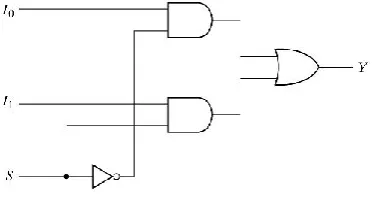
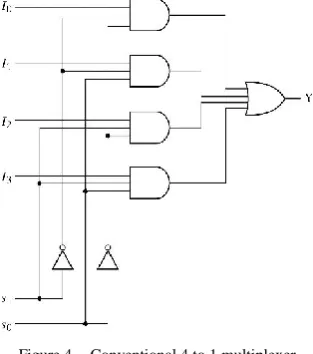
Multiplexer is a combinational circuit that selects binary information from one of the input lines and directs it to a single output line. Usually there are 2n input lines and n selection lines whose bit combinations determine which input line is to be selected. It is also called a data selector. For example for 2-to-1 multiplexer if selection S is zero then I0 has the path to output and if S is one I1 has
the path to output. A 2 to 1 multiplexer is shown in Fig. 3.
Figure 3. Conventional 2 to 1 multiplexer TABLE I. TRUTH TABLE OF COG GATE
Inputs Outputs
A B C P Q R
0 0 0 0 1 0
0 0 1 0 0 0
0 1 0 0 0 1
0 1 1 0 1 1
1 0 0 1 1 0
1 0 1 1 0 1
1 1 0 1 0 0
1 1 1 1 1 1
gate the input vector is given by IV= (A, B, C) and the
corresponding output vector is OV= (P, Q, R).
Figure 4. Conventional 4 to 1 multiplexer
Larger multiplexers can be constructed by using smaller multiplexers by chaining them together. For example, an 8-to-1 multiplexer can be made with two 4-to-1 and one 2-4-to-1 multiplexers. The two 4-4-to-1 multiplexer outputs are fed into the 2-to-1 with the
selector pins on the 4-to-1's put in parallel giving a total number of selector inputs to 3, which is equivalent to an 8-to-1. An 8 to 1 multiplexer of basic gate is shown in Fig. 5.
Figure 5. Conventional 8 to 1 multiplexer
IV. REALIZATION OF MULTIPLEXER BY COGGATE Different types of multiplexer have been realized in this paper by using COG reversible gates.
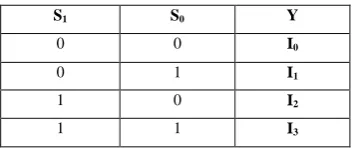
Using the reversible COG gate, 4:1 multiplexer can also be designed as shown in Fig. 7. This design requires three COG gates such that producing four garbage outputs. The Table III describes the truth table of 4:1 reversible multiplexer, the garbage outputs are discarded as it doesn’t play a vital role in the multiplexing operation.
Figure 7. Reversible 4 to 1 multiplexer A 2-to-1 multiplexer has a Boolean equation
Y=S’I0+SI1, where I0 and I1 are the two inputs, S is the
selector input, and Y is the output which can be expressed as a truth table shown in Table II.
TABLE II. TRUTH TABLE OF 2TO1 MULTIPLEXER
S I0 I1 Y
0
1 1 1
0 1
0 1 0
0 0
1 1
1 1
0 0
0 1 1
0 0
This truth table shows that when S=0 then Y=I0 but
whenS=1 thenY=I1. A straightforward realization of this
2-to-1 multiplexer would need 2 AND gates, an OR gate, and a NOT gate.
Larger multiplexers are also common and, as stated above, require log2 (n) selector pins for n inputs. Other
common sizes are 4-to-1, 8-to-1, and 16-to-1. Since digital logic uses binary values, powers of 2 are used (4, 8, and 16) to maximally control a number of inputs for the given number of selector inputs.
The Boolean equation for a 4-to-1 multiplexer is
Y=I0S0’S1’+I1S0S1’+I2S0’S1+I3S0S1, where I0, I1, I2 and I3
are the two inputs, S is the selector input, and Y is the output A 4 to 1 multiplexer is shown in Fig. 4.
A. Design of 2:1 Reversible Multiplexer Using COG Gate
The 3×3 reversible COG gate is used in order to act as the 2:1 reversible multiplexer producing two garbage bits shown in Fig. 6. The inputs are S0, I0and I1. Based on the
selection input S0, the corresponding message bits are
passed on to the output Y.
Figure 6. Reversible 2 to 1 multiplexer
TABLE III. TRUTH TABLE OF 4 TO 1MULTIPLEXER
S1 S0 Y
0 0 I0
0 1 I1
1 0 I2
1 1 I3
The above truth table depicts there is no change in the functionality of 4:1 reversible multiplexer with respect to the irreversible multiplexer functionality. The equation for the output Y is given as follows,
Figure 8. Reversible 8 to 1 multiplexer
Figure 9. Reversible 16 to 1 multiplexer
C. Design of 8:1 and 16:1Reversible Multiplexer Using Reversible COG Gate
Using the same proposed COG gate again 8:1 and 16:1 reversible multiplexer also can be designed as shown in Fig. 8 and Fig. 9. These designs use seven and fifteen COG gates producing 10 and 19 garbage outputs respectively. In genera designing of 2n:1 reversible multiplexer can be possible where n is 1, 2, 3…n. For
2n:1 reversible multiplexer (2n-1) COG gates are required producing (2n+n-1) number of garbage outputs
V. COMPARISON
TABLE IV. COMPARISON OF COST METRICS OF DIFFERENT
MULTIPLEXERS
[Proposed]
MUX GC GO T
2:1
1 2 2 α+2ß+2δ
4:1
3 5 6 α+6ß+6δ
8:1 7 10 14 α+14ß+14δ
16:1 15 19 30 α+30ß+30δ
2n:1 (2n-1) (2n+n-1) (2n-1) (2 α+2ß+2δ)
TABLE V. COMPARISON OF DIFFERENT CONVENTIONAL AND
REVERSIBLE MULTIPLEXERS
MUX
No of gates Reversible MUX
[proposed]
Irreversible MUX 2:1
1 4
4:1
3 7
8:1 7 12
16:1 15 21
2n:1 (2n-1) (2n+n+1)
TABLE VI. COMPARISON OF DIFFERENT 4:1REVERSIBLE
MULTIPLEXERS
Name of the circuit
No of gates
Garbage output
Constant Input
hardware Complexity
4:1 MUX [15]
6 10 4 11α+10ß+2δ
4:1 MUX [16]
3 6 0 6α+8ß+3δ
4:1 MUX [17]
3 5 0 6α+12β+6δ
4:1 MUX [proposed]
3 5 0 6 α+6ß+6δ
VI. SIMULATION RESULTS
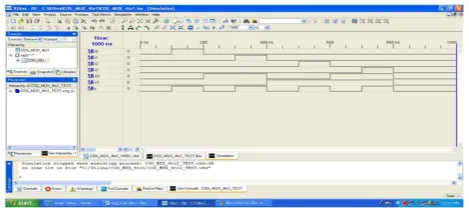
This work also includes the simulation of the COG gate and multiplexer using this proposed gate. The simulated snapshot input, output waveforms and RTL schematics of the proposed circuits are shown from Fig. 10 to Fig. 21. The simulation has been done by XILINX ISE 8.2 and also the implementation in the SPARTAN-3 FPGA kit has been achieved.
The VHDL program for COG gate
--- entity COG_gate_vhdl is
Port (A: in STD_LOGIC; B: in STD_LOGIC; C: in STD_LOGIC; P: out STD_LOGIC; Q: out STD_LOGIC; R: out STD_LOGIC);
end COG_gate_vhdl;
architecture Behavioral of COG_gate_vhdl is begin
P <= A;
Q <= ((A and C) or ((not A) and B)); R <= (not (B or C));
end Behavioral;
---
Figure 10. Simulation result for COG input
Figure 11. Simulation result for COG output
Figure 12. RTL block for COG input
Figure 13. RTL schematic for COG input
The program for proposed COG gate as a 2:1 MUX --- entity COG_MUX_VHDL is
Port (I0: in STD_LOGIC; I1: in STD_LOGIC; S0: in STD_LOGIC; Y: out STD_LOGIC); end COG_MUX_VHDL;
architecture Behavioral of COG_MUX_VHDL is begin
Y <= ((not S0) and I0) or (S0 and I1); end Behavioral;
---
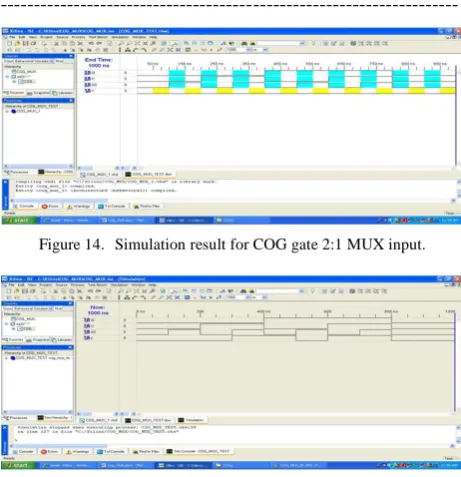
Figure 14. Simulation result for COG gate 2:1 MUX input.
Figure 15. Simulation result for COG gate 2:1 MUX output.
Figure 16. RTL block for COG gate 2:1 MUX input.
Figure 17. RTL schematic for COG gate 2:1 MUX input.
The program for proposed COG gate as a 4:1 MUX --- entity MUF _MUX_VHDL is
Port (S0: in STD_LOGIC; S1: in STD_LOGIC; I0: in STD_LOGIC; I1: in STD_LOGIC; I2: in STD_LOGIC; I3: in STD_LOGIC; Y: out STD_LOGIC); end COG_MUX_VHDL;
begin
Y <= ((not S1) and (((not S0) and I0) or (S0 and I1))) or (S1 and (((not S0) and I2) or (S0 and I3)));
end Behavioral;
---
Figure 18. Simulation result for COG gate 4:1 MUX input.
Figure 19. Simulation result for COG gate 4:1 MUX output.
Figure 20. RTL block for COG gate 4:1 MUX input.
Figure 21. RTL schematic for COG gate 4:1 MUX input.
VII. CONCLUSION
In this paper, the reversible multiplexer using COG gate is proposed and described. One of the major constraints in reversible logic is to minimize the number of reversible gates used, garbage outputs produced and usage of number of constant inputs. A comparison is made between different proposed reversible multiplexers by COG gates in terms of gate count, garbage output and
hardware complexity in Table IV. It can be concluded that 2n:1 reversible multiplexer requires (2n-1) COG gate s producing (2n+n-1) number of garbage outputs, where n is 1, 2, 3…n and having hardware complexity of (2n-1) (2 α+2ß+2δ). Another comparison is drawn between the conventional multiplexers and proposed multiplexers in terms of number of gates in Table V. The proposed 2n:1 reversible multiplexer requires (2n-1) number of COG gates whereas conventional multiplexers require (2n+n+1) number of basic gates. Comparison is also made by various parameters like garbage output, number of gates, constant input and hardware complexity for various 4:1 multiplexer to our proposed one in Table VI. It can be found that the proposed multiplexer is much more efficient with respect to the existing one. Thus for future research, efficient design schemes for design of logic function generator and for design of parity preserving function generator by using multiplexer is an interesting area to investigate. Alternate optimization methods are under investigation as a future work.
ACKNOWLEDGMENT
The authors wish to thank ECE Department and CSE Department of Murshidabad College of Engineering and Technology, Berhampore for supporting this work.
REFERENCES
[1] R. Landauer, “Irreversibility and heat generation in the computational process,” IBM Journal of Research and Development, vol. 5, pp. 183-191, 1961.
[2] C. H. Bennett, “Logical reversibility of computation,” IBM J. Research and Development, vol. 17, no. 6, pp. 525-532, Nov. 1973.
[3] P. Singla and N. K. Malik, “A cost effective design of reversible programmable logic array,” IJCA, vol. 41, no. 15, Mar. 2012. [4] S. Younis and T. Knight, “Asymptotically zero energy split level
charge recovery logic,” in Proc. Workshop on Low Power Design, Jun. 1994.
[5] M. Perkowski and P. Kerntopf, “Reversible logic. Invited tutorial,” in Proc. EURO-MICRO, Warsaw, Poland, Sep. 2001. [6] R. Saligram and T. R. Rakshith, “Novel code converter employing
reversible logic,” IJCA, vol. 52, no. 18, Aug. 2012.
[15] S. Gugnani and A. Kumar, “Synthesis of reversible multiplexers”, International Journal of Scientific and Engineering Research, vol. 4, no. 7, pp. 1859-1863, Jul. 2013.
[7] M. S. Islam,et al., “Synthesis of fault tolerant reversible logic,” in Proc. IEEE Circuits and Systems International Conference on Testing and Diagnosis, 2009.
[8] R. Feynman, “Quantum mechanical computers,” Optical News, vol. 11, no. 2, pp. 11-20, 1985.
[9] B. Parhami, “Fault tolerant reversible circuits,” in Proc. 40th
Asilomar Conference on Signals, Systems and Computers, Pacific Grove, CA, Oct. 2006.
[10] E. Fredkin and T. Toffoli, “Conservative logic,” International Journal of Theor. Physics, vol. 21, pp. 219-253, 1982.
[11] T. Toffoli,Reversible Computing - Tech Memo MIT/LCS/TM-151, MIT Lab for Computer Science, 1980.
[12] M. M. H. A. Khan, “Design of full-adder with reversible gates,” in Proc. International Conference on Computer and Information Technology, Dhaka, Bangladesh, 2002, pp. 515-519.
[13] A. Peres, “Reversible logic and quantum computers,” Physical Review, vol. 32, no. 6, pp. 3266-3276, 1985.
[16] Praveen. B and Vinay Kumar S. B, “2n:1 reversible multiplexer and its transistor implementation,” International Journal of Computational Engineering Research, vol. 2, no. 1, pp. 182-189, 2012.
[17] R. Saligram, S. S. Hegde, S. A. Kulkarni, H. R. Bhagyalakshmi, and M. K. Venkatesha, “Design of fault tolerant reversible multiplexer based multi-boolean function generator using parity preserving gates,” International Journal of Computer Applications, vol. 66, no. 19, pp. 20-24, Mar. 2013.
Mrs. Shefali Mamataj received B.Tech in Electronics and Communication Engineering from University of Kalyani, West Bengal, India in 2003 and also received M.Tech in Optics and Optoelectronics from University of Calcutta, Kolkata, India in 2006. Her teaching experience is approximately nine years and presently she is working as an Assistant Professor, Department of Electronics and Communication Engineering, MCET,
Berhampore. Her present research of interests includes Reversible Logic, DNA Computing. She has authored 10 international journal papers, 2 international conference paper papers, one national conference paper and another two accepted international conference papers in the areas of the Reversible Logic.