ISSN 0975-928X
Research Note
Genetic variability, correlation and path coefficient analysis studies in rice
(
Oryza sativa
L.) under alkaline soil condition
Abdul Fiyaz, R 1*, Ramya K.T2, Chikkalingaiah1, Ajay B.C3, Gireesh C2 and R. S. Kulkarni1
1
Department of Genetics and Plant Breeding, University of Agricultural Sciences, Bangalore, India.
2
Division of Genetics, Indian Agricultural Research Institute, Pusa campus, New Delhi, India.
3
Crop Improvement Unit, Directorate of Groundnut Research, Junagadh, Gujarat, India.
1
Division of Plant Breeding, ICAR Research Complex for NEH Region, Umiam, Umroi Road, Meghalaya 793103, India. *Email: [email protected]
(Received: 16 Aug 2011; Accepted: 15 Oct 2011)
Abstract:
Rice occupies a pivotal place in the Indian agriculture and has been grown under diverse ecological conditions and gets exposed to different environmental stresses like salinity, alkalinity, drought, cold etc. The experiment was conducted to study the response of rice genotypes and their quantitative traits under alkaline soil condition to examine the nature and magnitude of variability, heritability and genetic advance. Variability studies revealed significant differences among the genotypes for the traits studied. High values of heritability and genetic advance were observed for total spikelet per panicle, thousand grain weight and total biomass. Number of productive tillers, total spikelet per panicle, total biomass, days to 50 per cent flowering and plant height were the traits which exhibited significant positive association with grain yield. Path analysis revealed that their direct effects on grain yield through total biomass and harvest index were also very high. Thus these traits which contribute to the grain yield under alkaline soil condition could be exploited for further breeding programme.
Keywords: Rice, correlation, path coefficient analysis, soil alkalinity, grain yield
Rice (Oryza sativa L.) occupies a pivotal place in the Indian agriculture. Rice is also called as the “Grain of Life”, because it is not only the staple food for more than 70 per cent of the Indians but also a source of livelihood for about 120-150 million rural households. At the current rate of population growth accelerating at 1.8 per cent, rice requirement by the year 2020 would be around 140 million tones (Anon., 2004). Rice has been grown under diverse ecological conditions and gets exposed to different environmental stresses like salinity, alkalinity, drought, cold etc. Soil alkalinity and salinity are widespread problems in a number of rice growing countries, particularly in Asian continent. Among the South Asian countries, India has the largest area of about 13.3 million ha, followed by Bangladesh and Sri Lanka. In India alone, 6.7 million ha is characterized by coastal salinity, and inland alkaline and saline soils cover an area of about 6.6 million ha
(2.64 million ha saline and 3.96 million ha saline-alkaline) (Anon., 2003). Alkalisoils are characterized by a relatively less (EC < 4 dS/m at 25°C) salt concentration and/or high (> 8.2) pH and Exchangeable sodium percentage of >15 (Abrol et al., 1988).
ISSN 0975-928X
recommended for reclamation (Qadir et al., 1996). Rice varieties are known to exhibit wide variation in their tolerance to salinity and alkalinity (IRRI, 2006; Pathak et al., 2005). In this regard identification and evaluation of alkaline tolerant genotypes of rice along with proper management of soil was taken in Zonal Agricultural Research Station, Mandya, Karnataka, with the following objectives. Studying the genetic variability of rice genotypes under alkaline soil condition, studying relationship of different plant traits with grain yield through correlation and path analysis which would help in selection and further improvement and in identification of rice genotypes which are tolerant to alkaline condition which would be economical to the farmers in increasing their production.
The material for the present study consisted of 33 genotypes of rice collected from AICRP (Rice), Mandya, University of Agricultural Sciences, Bangalore and International Rice Research Institute, Philippines. Field experiment was conducted at Zonal Agricultural Research Station, Mandya, Karnataka. The experiment was laid out in Randomized Complete Block Design (RCBD) with three replications. All cultural practices are followed as per the package of practices adopted for irrigated rice. Soil samples from all the three replications were collected and they were analyzed for parameters such as pH, electrical conductivity, organic carbon, available nitrogen, phosphorus and potassium using standard procedures.
Observations were recorded on five randomly selected plants in each replication for plant height, days to 50 per cent flowering, productive tillers per plant, panicle length, spikelets per panicle, spikelet fertility, total biomass, thousand grain weight, harvest index and grain yield per plant. Data for the above traits were subjected to statistical analysis viz., Analysis of variance (ANOVA), mean, range, genetic variability components such as phenotypic coefficient of variation (PCV), genotypic coefficient of variation (GCV), heritability (h2) and genetic advance as percent t mean (GAM). Correlation analysis was computed as per Karl Pearson (1932) and path coefficient analysis was carried out as suggested by Wright (1921).
Genetic variability in any crop is pre-requisite for selection of superior genotypes over the existing cultivars. Variance analysis for all the characters revealed significant variation among the genotypes studied (Table 1). Data from the soil analysis revealed that particular experimental soils are characterized by a relatively less EC < 4 dS/m (1.2),
high pH > 8.2 (9.6) and Exchangeable sodium percentage is more than 15 (alkali soils). The phenotypic coefficient of variation (PCV) in general was higher than genotypic coefficient of variation (GCV) for all the characters studied indicated the influence of environment on the manifestation of these characters. However, the difference between PCV and GCV was less for the characters, total spikelet per panicle, thousand grain weight and days to 50 per cent flowering which indicated low environmental influence and predominance of genetic factors controlling variability in these traits.
The amount of genetic variation considered alone will not be of much use to the breeder unless supplemented with the information on heritability estimate, which gives a measure of the heritable portion of the total variation. It has been suggested by Burton and Devane (1953) that the GCV along with heritability estimate could provide a better picture of the amount of advance to be expected by phenotypic selection. Since genetic advance is dependent on phenotypic variability and heritability in addition to selection intensity, the heritability estimates in conjunction with genetic advance will be more effective and reliable in predicting the response to selection (Johnson et al., 1955). Heritability in broad sense includes both additive and non-additive gene effects (Hanson et al., 1956). While, narrow sense heritability includes only additive components (Johnson et al., 1955). In the present study, heritability in broad sense was estimated. Highest broad sense heritability was recorded in the case of total spikelet per panicle, thousand grain weight, days to 50 per cent flowering and total biomass. However, low heritability estimates were observed in the case of number of productive tillers and plant height. The expected genetic advance over mean of the characters was found to be highest for total spikelet per panicle followed by total biomass, grain yield per plant and thousand grain weight. The study clearly showed that there is ample scope to improve total spikelet per panicle, total biomass, grain yield per plant and thousand grain weight through selection.
ISSN 0975-928X
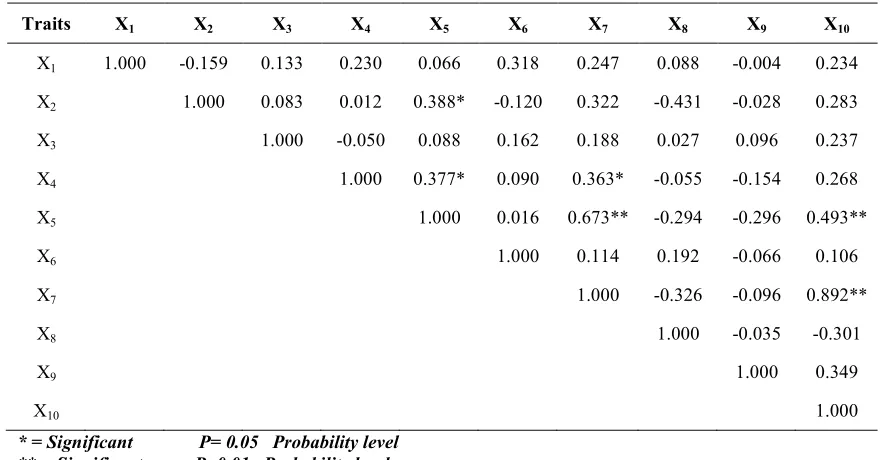
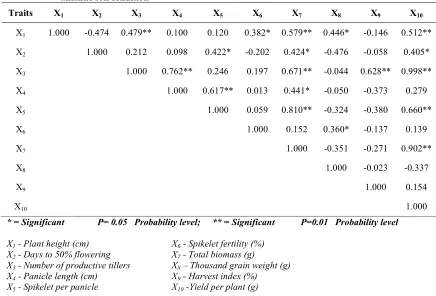
heritable part of the observed variation, enable the assessment of the pattern of inherent relationship that existed between various traits. The inter character correlation at phenotypic and genotypic levels among ten characters studied are presented in Table (2 and 3). High significant and positive correlation of grain yield per plant with plant height, days to 50 per cent flowering, number of productive tillers at genotypic level. Total spikelets per panicle and total biomass were significant and positively correlated with grain yield per plant both at phenotypic and genotypic levels.
The magnitude of genotypic correlation with grain yield per plant was highest in the case of number of productive tillers per plant followed by total biomass, total spikelets per panicle, plant height and days to 50 per cent flowering. Other yield components viz., plant height, days to 50 per cent flowering, number of productive tillers, panicle length, spikelet fertility and harvest index showed non-significant positive association with grain yield at phenotypic level. Similar findings were earlier reported by Nadarajan and Kumarvelu (1994) for panicle length and grains per panicle, by Balan et al., (1999) for days to 50 per cent flowering, and Janardhanam et al., 2001 for number of grains per panicle.
Path coefficient analysis: Path coefficient analysis was carried out both at phenotypic and genotypic levels considering the grain yield as dependent character and yield attributes as independent characters. Each component has two-path action viz.,
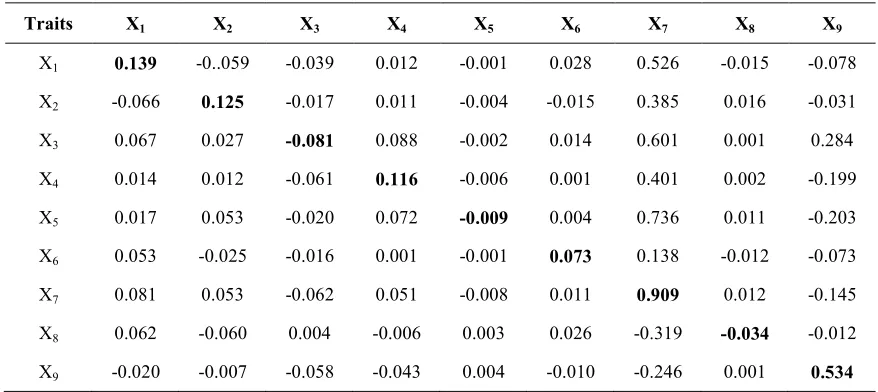
direct effect on yield and indirect effects through component characters, which were not revealed by correlation studies. The phenotypic and genotypic correlations were partitioned into direct and indirect effects on grain yield per plant and the data is presented in Table (4 and 5). Among the characters studied at phenotypic level, total biomass had highest direct positive effect on grain yield per plant followed by harvest index, spikelet fertility, thousand grain weight, number of productive tillers and days to 50 per cent flowering. The highest direct negative contribution to the grain yield was recorded by total spikelet per panicle followed by plant height and panicle length.
At genotypic level, with respect to positive direct effect, the contribution to grain yield per plant by total biomass was the highest followed by harvest index, plant height, days to 50 per cent flowering, panicle length and spikelet fertility. The direct negative effect of total spikelet per panicle was highest followed by thousand grain weight and number of productive tillers.
Among the different traits studied, total biomass and total spikelets per panicle showed the maximum direct effects on grain yield per plant at phenotypic level. While at genotypic level, total biomass, plant height and days to 50 per cent flowering showed maximum direct effects on yield. Thus, it is understood that biomass, plant height and days to 50 per cent flowering decide the yield, this is also in line with the physiological basis of the concept of developing “super rice” having the capacity to produce more biomass. These results are also in accordance with the previous studies (Deosarkar and Nerkar, 1994; Sarawagi et al., 1997; Bagali et al., (1999). It is also understood that the increased grain yield through the direct effect of biomass is through the indirect effect of plant height and days to 50 per cent flowering followed by moderate to low indirect effects of thousand grain weight, spikelet fertility and harvest index. These findings were in confirmation with earlier findings (Yolanda and Das, 1995; Sarawagi et al., 1997). Thus, total biomass appears to be important trait on which emphasis can be laid as a selection criteria for tolerance to alkalinity in Cauvery command area.
Reference
Abrol, I. P., Yadav, J. S. P. and Massoud, F. I. 1988. Salt-Affected Soils and their Management. Food and Agriculture Organization of the United Nations, Rome, Italy.
Anonymous. 2003. Lowland: Problem soils, salinity.
Proceedings of the working group meeting of Consortium for Unfavourable Rice Environments (CURE) held at New Delhi, India on 23-24 March 2003. Los Banos, Philippines: International Rice Research Institute.
Anonymous. 2004. Progress report: Towards achieving food security, Directorate of Rice Research. (ICAR), Hyderabad, India, pp.1-5.
Bagali, P.G., Hittalmani, S. and Shashidhar, H.E. 1999. Character association and path coefficient analysis in Indica x Japonica doubled haploid population of rice. Oryza, 36 (1): 10-12.
Balan, A., Muthiah, A.R. and Ramachandra Boopathi, S.N.M. 1999. Genetic variability, correlation and path coefficient analysis in upland early rice genotypes. Madras Agric. J., 86 (1-3): 7-9. Burton, G.W. and Devane. 1953. Estimating heritability in
tall fescue (Festula arundnacea L.) from replicated clonal material. Agron.J., 45: 478-481.
Deosarkar, D.B. and Nerkar, Y.S. 1994. Correlation and path analysis for grain quality characters in indica rice. J. Maharashtra Agric.Univ., 19: 175-177. Falconer, D.S. 1964. Introduction to quantitative genetics.
Oliver and Boyd, London, p.365.
ISSN 0975-928X
Hanson, C.H., Robinson, H.F. and Comstock, R.K. 1956. Biometrical studies on yield in segregating population of Korean Lasphadezia. Agron.J., 48: 314-318.
IRRI. 2006. Standard Evaluation System for Rice. Los Banos, Laguna, Philippines: International Rice Research Institute.
Janardhanam, V., Nadarajan, N. and Jebaraj, S. 2001. Correlation and Path analysis in rice. (Oryza sativa
L.) Madras Agric. J.,88(10-12): 719-720.
Johnson, H.W., Robinson, H.F. and Comstock, R.E. 1955. Estimates of genetic and environmental variability in soybeans. Agron.J., 47: 314-318.
Karl Pearson. 1932. Tables for statisticians and biometricians, Stat .J. Biometrics.
Nadarajan, N. and Kumaravelu, S. 1994. Character association and components analysis in rice under drought stress. Oryza, 31: 309-311.
Pathak, M.D., Singh, U.S., Kumar, T., Pandey, S., Singh, D., Singh, A.N. and R.P. Mishra. 2005. Tolerance to soil alkalinity and other constraints in aromatic rices. In: Scented Rices of Uttar Pradesh and Uttaranchal eds. R.K. Singh and U.S. Singh. New Delhi, Kalyani Publishers. pp 42-56.
Qadir, M., Quereshi, R., Ahmad, N. and Ilyas, M. 1996. Salt-tolerant forage cultivation on a saline-sodic field for biomass production and soil reclamation. Land Degrad. Dev., 7: 11- 18.
Sarawagi, A.K., Rastogi, N.K. and Soni, D.K. 1997. Studies on some quality parameters of indigenous rice in Madya Pradesh. Aun. Agric. Res., 21: 258-261.
Wright, S. 1921. Correlation and causation. J. Agric. Res., 20: 557-585.
ISSN 0975-928X
Table 1. Genetic variability parameters for ten yield components in 33 rice genotypes under alkaline soil condition
Character Mean Range GCV% PVC% Heritability
(%) GAM
Min. Max.
Plant height (cm) 57.37 42.00 78.33 8.90 21.13 17.7 7.72
Days to 50% flowering 108.37 85.00 127.33 9.73 10.51 85.9 18.57
Number of productive
tillers 6.101 4.00 8.33 5.41 24.93 04.7 2.45
Panicle length (cm) 18.05 13.60 20.67 6.84 10.97 38.9 8.80
Spikelet per panicle 77.14 26.00 122.00 32.55 33.09 96.8 65.9
Spikelet fertility (%) 83.78 59.53 92.07 6.26 10.90 33.0 7.40
Total biomass (g) 63.90 37.37 133.3 26.77 31.88 70.6 46.33
Thousand grain weight (g) 22.11 16.00 34.00 17.38 18.57 87.6 33.51
Harvest index (%) 42.46 26.01 49.60 10.22 14.15 52.1 15.19
Yield per plant (g) 5.40 2.80 9.60 24.53 31.75 59.7 39.07
Table 2. Phenotypic correlation coefficients among ten yield components in 33 rice genotypes under alkaline soil condition
Traits X1 X2 X3 X4 X5 X6 X7 X8 X9 X10
X1 1.000 -0.159 0.133 0.230 0.066 0.318 0.247 0.088 -0.004 0.234
X2 1.000 0.083 0.012 0.388* -0.120 0.322 -0.431 -0.028 0.283
X3 1.000 -0.050 0.088 0.162 0.188 0.027 0.096 0.237
X4 1.000 0.377* 0.090 0.363* -0.055 -0.154 0.268
X5 1.000 0.016 0.673** -0.294 -0.296 0.493**
X6 1.000 0.114 0.192 -0.066 0.106
X7 1.000 -0.326 -0.096 0.892**
X8 1.000 -0.035 -0.301
X9 1.000 0.349
X10 1.000
* = Significant P= 0.05 Probability level ** = Significant P=0.01 Probability level
X1 - Plant height (cm)
X2 - Days to 50% flowering
X3 - Number of productive tillers
X4 - Panicle length (cm)
X5 - Spikelet per panicle
X6 - Spikelet fertility (%)
X7 - Total biomass (g)
X8 - Thousand grain weight (g)
X9 - Harvest index (%)
ISSN 0975-928X
Table 3. Genotypic correlation coefficients among ten yield components in 33 rice genotypes under alkaline soil condition
Traits X1 X2 X3 X4 X5 X6 X7 X8 X9 X10
X1 1.000 -0.474 0.479** 0.100 0.120 0.382* 0.579** 0.446* -0.146 0.512**
X2 1.000 0.212 0.098 0.422* -0.202 0.424* -0.476 -0.058 0.405*
X3 1.000 0.762** 0.246 0.197 0.671** -0.044 0.628** 0.998**
X4 1.000 0.617** 0.013 0.441* -0.050 -0.373 0.279
X5 1.000 0.059 0.810** -0.324 -0.380 0.660**
X6 1.000 0.152 0.360* -0.137 0.139
X7 1.000 -0.351 -0.271 0.902**
X8 1.000 -0.023 -0.337
X9 1.000 0.154
X10 1.000
* = Significant P= 0.05 Probability level; ** = Significant P=0.01 Probability level
X1 - Plant height (cm)
X2 - Days to 50% flowering
X3 - Number of productive tillers
X4 - Panicle length (cm)
X5 - Spikelet per panicle
X6 - Spikelet fertility (%)
X7 - Total biomass (g)
X8 – Thousand grain weight (g)
X9 - Harvest index (%)
X10 -Yield per plant (g)
Table 4. Phenotypic Path analysis of ten yield components influencing yield in 33 rice genotypes under alkaline soil condition
Traits X1 X2 X3 X4 X5 X6 X7 X8 X9
X1 -0.005 -0.001 0.002 -0.001 0.000 0.008 0.231 0.001 -0.002
X2 0.001 0.003 0.001 0.000 -0.002 -0.003 0.302 -0.007 -0.012
X3 -0.001 0.000 0.015 0.000 -0.001 0.004 0.176 0.000 0.042
X4 -0.001 0.000 -0.001 -0.002 -0.002 0.002 0.340 -0.001 -0.067
X5 0.000 0.001 0.001 -0.001 -0.006 0.000 0.0631 -0.005 -0.130
X6 -0.002 0.000 0.002 0.000 0.000 0.024 0.107 0.003 -0.029
X7 -0.001 0.001 0.003 -0.001 -0.004 0.003 0.938 -0.005 -0.042
X8 0.000 -0.001 0.000 0.000 0.002 0.005 -0.306 0.016 -0.015
X9 0.000 0.000 0.001 0.000 0.002 -0.002 -0.090 -0.001 0.438
Residual = 0.0126
X1 - Plant height (cm)
X2 - Days to 50% flowering
X3 - Number of productive tillers
X4 - Panicle length (cm)
X5 - Spikelet per panicle
X6 - Spikelet fertility (%)
X7 - Total biomass (g)
X8 - Thousand grain weight (g)
ISSN 0975-928X
Table 5. Genotypic Path analysis of ten yield components influencing yield in 33 rice genotypes under alkaline soil condition
Traits X1 X2 X3 X4 X5 X6 X7 X8 X9
X1 0.139 -0..059 -0.039 0.012 -0.001 0.028 0.526 -0.015 -0.078
X2 -0.066 0.125 -0.017 0.011 -0.004 -0.015 0.385 0.016 -0.031
X3 0.067 0.027 -0.081 0.088 -0.002 0.014 0.601 0.001 0.284
X4 0.014 0.012 -0.061 0.116 -0.006 0.001 0.401 0.002 -0.199
X5 0.017 0.053 -0.020 0.072 -0.009 0.004 0.736 0.011 -0.203
X6 0.053 -0.025 -0.016 0.001 -0.001 0.073 0.138 -0.012 -0.073
X7 0.081 0.053 -0.062 0.051 -0.008 0.011 0.909 0.012 -0.145
X8 0.062 -0.060 0.004 -0.006 0.003 0.026 -0.319 -0.034 -0.012
X9 -0.020 -0.007 -0.058 -0.043 0.004 -0.010 -0.246 0.001 0.534
Residual = 0.0243
X1 - Plant height (cm)
X2 - Days to 50% flowering
X3 - Number of productive tillers
X4 - Panicle length (cm)
X5 - Spikelet per panicle
X6 - Spikelet fertility (%)
X7 - Total biomass (g)
X8 - Thousand grain weight (g)