PRISCILLA L. SOUTHWELL is Professor of Political Science at University of Oregon. MATHEW MANWELLER is Assistant Professor of Political Science at Central Washington University.
The American Review of Politics, Vol. 24, Winter, 2003: 361-374 ©2003 The American Review of Politics
Different Rules for Different Folks: The Effect of Primary Type
on the 2000 Presidential Nomination Process
Priscilla L. Southwell and Mathew Manweller
This research examines both aggregate and individual-level data from the 2000 presidential primaries in order to test: (1) the effect of primary type on the distribution of votes across candidates and the eventual outcome of the state’s primary race; and (2) the extent of strategic voting in more open types of primaries. Multivariate analysis of aggregate primary results suggests that John McCain fared better in states with open or semi-closed primaries. A similar pattern is revealed in California’s “beauty contest” primary. Using ANES data, we also project various primary outcomes under open, semi-closed, and closed scenarios. In both “sincere” and “strategic” models, McCain, but not Bradley, gained in semi-closed and open primaries, but Bush was still the projected Republi-can winner in all types of primaries. Our analysis of general election behavior shows that indepen-dents were the most likely group to switch parties when their preferred primary candidate did not gain the nomination.
The competitive nature of the presidential nomination process in 2000 has re-ignited the debate over the effect of primary type on candidate for-tunes. This controversy was fostered, in part, by the exit polls in open pri-mary states which showed a high number of crossover voters in Republican primaries. For example, McCain’s unexpected win in Michigan was the result of an open Republican primary that included more than 40 percent crossover voters (as compared to the normal 30 percent), a majority of whom voted for McCain (Bradsher 2000). Several observers saw Senator John McCain as having had an “open primary strategy” for winning the Republican presidential nomination (Cain and Mullin 2002),1 and his candi-dacy has raised the issue of whether favorable nomination rules can boost the prospects of certain candidates in future contests.2
As such, this topic falls into the broader discussion of the strategic en-vironment of the presidential nomination process—how the “rules of the game” can have a direct impact in determining the winners and losers in this process. Much of the literature on the effect of nomination rules has centered on the reform of the selection of nomination delegates, especially in the post-1968 years,3 but this research centers instead on the state-by-state parti-cipatory rules regarding primaries.
We center on the various types of presidential primaries in the 2000 election in order to determine if primary type affected the strength of presi-dential contenders in both major parties, and also assesses whether strategic voting occurred among crossover voters. The competitive race within the Republican Party developed early in the nomination process in 2000, and therefore offers a suitable opportunity to examine the impact of primary type on the outcome of these primary contests.
Debate Over Participation Rules in Primaries
Much of the controversy over primary type4 centers on the question of the proper role of the nominating process (Ranney 1972). Should primaries and caucuses produce the candidate who is most likely to win in the general election, or it is preferable to choose a person who best reflects the party’s ideology and platform? Ideally, a nominee emerges with both these qualities, but many party leaders argue that this latter goal is best attained in closed primaries where participation is confined to party members.
Another argument against open primaries is the prospect of strategic voting. If one loosely defines a “crossover” voter as one who votes for a candidate outside of his party, then such a voter can vote for the candidate he likes best within that party, even if he actually prefers a candidate in another party. This voter is merely “hedging” his bets in the general election—he does not vote in his own party due to incumbency or a sure winner but in-stead opts for his favored candidate in the more competitive race (Alvarez and Nagler 2002). However, he could also engage in “raiding,” where an opposition party member selects the “weakest” candidate in order to help his own party’s choice in the general election. Although Riker argues that this complicated strategy has “never been used by enough voters to make a diffeence” (1982, 145), party leaders are wary of any primary rules that would permit such behavior.
Even semi-closed primaries are relatively unpopular with those party adherents who wish to enhance rather than minimize the role of party regu-lars in the nomination process (Hedlund and Watts 1986). Similar to the debate over the use of “ex officio” delegates at the national convention, party elites have successfully pushed for more control over the nomination process by enhancing the role of experienced leaders who are, in their view, more likely to choose an electable leader who reflects the party’s philosophy and outlook.
primaries to nominate highly electable candidates, an argument can be made for allowing independents and partisans from the opposition’s party to par-ticipate in primaries” (1986, 1020). Or, as one of this article’s authors pon-dered “. . . why ‘shoot the messenger’ when the results of open primaries may merely indicate a competitive race for the nomination, as well as the nature of the support for various candidates” (Southwell 1988, 293).
These opposing arguments assume that the results of a primary are altered by allowing non-party members to participate in this election. Pre-sumably, independents and opposition party members will vote in a different manner than party regulars, and therefore their votes will affect the outcome of each state’s primary. Previous research on this topic has generally found the effects of such primary rules to have a more limited impact.
Research on Voting in Primaries
A number of studies have assessed the degree of crossover voting in presidential primaries (Adamany 1976; Cohen and Sides 1998; Geer 1986; Gimbel, Hoffman, and Kaufman 2000; Hedlund, Watts, and Hedge 1982; Hedlund and Watts 1986; Lengle 1981; Ranney 1972; Southwell 1988; Wekkin 1988). In general, they have concluded that crossover voters do make up a considerable portion of the electorate in open and semi-closed primaries, but that these voters have rarely affected the outcome of the race in each state. However, Wekkin (1988) argues that an underestimation of crossover voting has led previous researchers into minimizing the extent and impact of such behavior.
More recent research on the motivation behind such crossover voting has found little evidence of strategic voting, of either the hedging or raiding type. Southwell’s (1991) work concludes that the level of strategic voting is nearly identical across primary types. Similarly, Wekkin (1991), and Abram-owitz, McGlennon and Rapoport (1981), found little evidence of hedging or raiding in primary elections. Cohen and Sides (1998) examined subnational primary contests—state senate races in the State of Washington—and con-cluded that crossover voting was extensive (one-third to one-half of all votes). However, they also found that such voting consisted of a more posi-tive type of “hedging” for a preferred candidate in the most exciting contest rather than a “raiding” type of voting behavior.
contests. Alverez and Nagler (2002) studied five races for the California’s General Assembly in 1998, and found that in only one of these races did crossover voting have an impact on the outcome of either party’s primary nomination. Salvanto and Wattenberg (2002) analyzed absentee ballots from Los Angeles County in the 1998 primary, and concluded that split-ticket voting, as allowed only with a blanket primary, was extensive but found no evidence of deliberate strategic raiding. Kousser (2002) examined the “stick-iness” of crossover voters, that is, how many of these voters actually voted for the same party in the general election as in the primary. He concluded that hedging is quite common, and the stickiness factor low, in a blanket primary where the race is close in one party or one party is overwhelmingly strong.
The 2000 Presidential Primaries
As such, this body of research suggests that a close race in a particular party, or the existence of an incumbent President, are two factors that can intensify the impact of crossover voting in open or semi-closed primaries. This research is an expansion of one of Paolino and Shaw’s (2001) explana-tions of the McCain phenomenon—that the structure of the initial contests in 2000 helped the McCain campaign. We also examine the nature of the Bradley-Gore contest as well as some hypothetical primary scenarios.
Table 1 provides an overview of the 2000 presidential primaries, as categorized by primary type. Al Gore appears to have fared better in open primary states than did fellow Democrat, Bill Bradley. This result may have occurred because of the perception that Bradley was the more liberal of these two men, with less appeal to more moderate independents or Republi-cans who were eligible to vote in the Democratic primary in these states. George Bush did equally well in closed and open primary states, while McCain fared best in states with semi-closed primaries.
Multivariate Analysis of Primary Results
Table 1. Summary of Percentage of Primary Vote and Type of Primary*
Year Closed Semi-Closed Open
Bush 68.1% 55.9% 64.4%
McCain 25.4 34.9 29.5
Gore 68.0 59.4 78.6
Bradley 26.9 26.1 19.3
*Excludes those later primaries where John McCain and Bill Bradley were not on the ballot: Ala-bama, Arkansas, Idaho, Montana, New Jersey, and Oregon.
Source: Federal Election Commission, www.fec.gov/votregis/primaryvoting.htm; www.fec.gov/ pubrec/fe2000/2000presprim.htm.
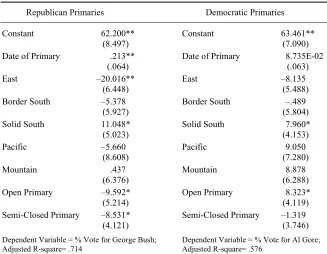
Table 2. Regression Analysis of Percentage of Vote for Bush and Gore in the 2000 Primaries*
Republican Primaries Democratic Primaries
Constant 62.200** Constant 63.461**
(8.497) (7.090)
Date of Primary .213** Date of Primary 8.735E-02
(.064) (.063)
East –20.016** East –8.135
(6.448) (5.488)
Border South –5.378 Border South –.489
(5.927) (5.804)
Solid South 11.048* Solid South 7.960*
(5.023) (4.153)
Pacific –5.660 Pacific 9.050
(8.608) (7.280)
Mountain .437 Mountain 8.878
(6.376) (6.288)
Open Primary –9.592* Open Primary 8.323*
(5.214) (4.119)
Semi-Closed Primary –8.531* Semi-Closed Primary –1.319
(4.121) (3.746)
Dependent Variable = % Vote for George Bush; Dependent Variable = % Vote for Al Gore; Adjusted R-square= .714 Adjusted R-square= .576
*p<.05; **p<.01
*Excludes those later primaries where John McCain and Bill Bradley were not on the ballot: Ala-bama, Arkansas, Idaho, Montana, New Jersey, and Oregon.
primaries, and in the Solid South, and less well in states in the Northeast.6 He received a smaller percentage of the votes than McCain in open and semi-closed primary states. This is consistent with Paolino and Shaw’s (2001) analysis of the 2000 primaries.
The model for the Democrats has less explanatory power, as the date of the primary was not significant, and Gore had only a modest advantage over Bradley in Southern states. Gore, however, did do better in open primary states than Bradley, confirming the bivariate results of Table 1. These results suggest that the appeal of various presidential candidates in 2000 was affected by the type of primary electorate that was created by each state’s participatory rules. McCain was able to capitalize on a broader appeal to independents and Democrats in more open primary states. In contrast, Brad-ley’s more liberal image did not serve him well in states where more centrist voters were allowed to vote in the primary.
California’s Closed Primary and “Beauty Contest”
Table 3. A Comparison of Candidate Preferences among Voter Types in California’s Presidential Primary (Percent of the Vote)
Party Non-Party
Members Members All Votersab
Bush 60.6% 34.0% 52.2%
(1,725,162) (443,304) (2,168,466)
McCain 34.7% 60.6% 42.9%
(988,706) (791,864) (1,780,570)
Gore 81.2% 73.6% 79.8%
(2,155,321) (454,629) (2,609,950)
Bradley 18.2% 25.9% 19.6%
(482,882) (159,772) (642,654)
Note: Cells are column percentages and Ns.
aTotal Votes Cast in Republican Primary = 4,153,702 bTotal Votes Cast in Democratic Primary = 3,272,029
Source: Federal Election Commission, http://www.fec.gov/ pubrec/fe2000/2000presprim.htm.
A Hypothetical Look at Voting in Primaries
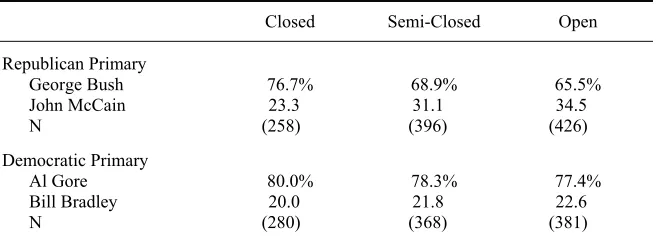
Table 4. “Sincere” Voting Model of Projected 2000 Primary Vote Across Primary Type (Percent of the Vote)
Closed Semi-Closed Open
Republican Primary
George Bush 76.7% 68.9% 65.5%
John McCain 23.3 31.1 34.5
N (258) (396) (426)
Democratic Primary
Al Gore 80.0% 78.3% 77.4%
Bill Bradley 20.0 21.8 22.6
N (280) (368) (381)
Source: American National Election Pre- and Post-Election Survey, University of Michigan, 2000.
McCain did much better among independents and Democrats, but George Bush still received a strong majority of the “votes” under the each primary scenario. Bradley gained only a very modest amount of support under the semi-closed and open primary scenarios. Clearly, these projections reflect the halo effect of the thermometer scale ratings done during the fall follow-ing the successful party nominations of Gore and Bush, but these results suggest that the impact of differing primary types does not alter the outcome drastically.
As indicated in our literature review, the degree and direction of cross-over voting is affected by the immediate context of the race for the nomina-tion, and it may be inappropriate to assume sincere voting would prevailed throughout the 2000 race, particularly within the Republican Party. Early in the primary season, it was clear that John McCain had been successful in appealing to independents and moderate Democrats, and that this ability would help him in open and closed primary states. As Cain and Mullin state, “McCain’s candidacy was assisted by nomination rules that lowered the opportunity costs for independents and Democrats to participate in the Re-publican nomination process” (2002, 325-326). As such, the desire to hedge one’s vote in the 2000 primary election was more apparent than in other election years, especially as the Gore nomination became more certain.
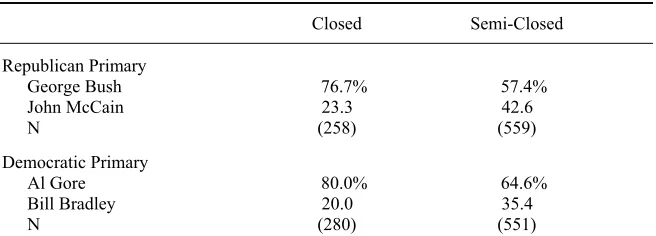
Table 5. Strategic Voting Model of Projected 2000 Primary Vote (Percent of the Vote) and Type of Primary
Closed Semi-Closed
Republican Primary
George Bush 76.7% 57.4%
John McCain 23.3 42.6
N (258) (559)
Democratic Primary
Al Gore 80.0% 64.6%
Bill Bradley 20.0 35.4
N (280) (551)
Source: American National Election Pre- and Post-Election Survey, University of Michigan, 2000.
votes under a closed primary (these figures are identical to those in Table 4) with a semi-closed primary in which all independents are assumed to be voting in the Democratic or Republican Party, because one primary is the most exciting or competitive race. This scenario is extremely unlikely, espe-cially for the Democrats. However, the results do not change dramatically, as shown below. Bush, and Gore’s support declines in the semi-closed pri-mary scenario, but they still lead their opponents by a considerable margin.
General Election Voting Behavior
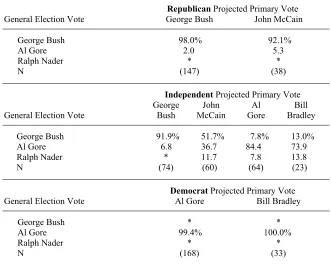
Table 6. Comparison of General Election Voting Behavior and Projected Primary Votes (Percent of the Vote)
Republican Projected Primary Vote
General Election Vote George Bush John McCain
George Bush 98.0% 92.1%
Al Gore 2.0 5.3
Ralph Nader * *
N (147) (38)
Independent Projected Primary Vote
George John Al Bill
General Election Vote Bush McCain Gore Bradley
George Bush 91.9% 51.7% 7.8% 13.0%
Al Gore 6.8 36.7 84.4 73.9
Ralph Nader * 11.7 7.8 13.8
N (74) (60) (64) (23)
Democrat Projected Primary Vote
General Election Vote Al Gore Bill Bradley
George Bush * *
Al Gore 99.4% 100.0%
Ralph Nader * *
N (168) (33)
*Less than 2%.
Source: American National Election Pre- and Post-Election Survey, University of Michigan, 2000.
One must be cautious that these projected votes are not simply the result of “sour grapes”—the disgruntled feelings of a backer of a losing candidate, but clearly they do indicate that the attachments of independents to the McCain candidacy during the primaries had a long-lasting impact on the campaign.
Conclusion
In general, these analyses suggest that the primary rules did have an impact on the candidate fortunes of the various candidates in the 2000 elec-tion. John McCain did better in states which held open or semi-closed pri-maries. It also appears that such voting behavior was reflective of the sincere preferences of independents and Democrats for his candidacy, although independent voters may have hedged their votes. For those independents who backed McCain in the primary, approximately a third of them bolted to the Democratic candidate in the general election. Indeed, it appears that a competitive nomination race may have less effect among party regulars than it does among independents that back a nomination loser. Open and semi-closed primaries allow a competitive race for the nomination to become more visible and apparent, perhaps undesirably so given the previous re-search on the effect of divisive primaries on defection (see Atkeson 1998; Bernstein 1977; Born 1981; Hernson and Gimbel 1995; Kenney and Rice 1984; Lengle 1995; McCann, Partin, Rapaport, and Stone 1996; McNitt 1978, 1981; Stone 1984).
Our results suggest that the candidate preferences of independents and opposition party members do differ considerably from that of party regis-trants, and could potentially affect the outcome of the nomination process in future contests. To party leaders, this finding would probably confirm their worst fears about more open types of primaries. Perhaps closed primaries serve the parties best by enhancing the nomination of an insider candidate who is firmly reflective of the party’s philosophy. By opting for this type of primary, however, the parties must then be prepared to develop a winning electoral strategy in the November election, even after excluding the voice of nonpartisans in the primaries—not an easy task.
NOTES
1Bush may also have adjusted his strategy after McCain’s initial successes in open
and semi-closed primary states. He launched a massive media campaign in the state of Washington five weeks before its blanket primary on February 29 (see Mapes2000).
2As one example, Senator John McCain attempted, unsuccessfully, to overturn the
ballot rules for the New York State Republican primary as an unconstitutional burden on voting rights (Samuels 2000).
3See Cavala 1974; Lengle and Shafer 1976; Lengle 1981; Polsby and Wildavsky
1971; Wekkin 1984.
4Geer (1986) describes primary type as a continuum, and we expand on his
either party; (3) the “declare polls” primary—any registered voter can vote, provided he declares his partisanship at the polling place; (4) the “semi-closed” primary—registered independents may vote in either party’s primary, but voters registered with one of the parties are limited to their own party’s contest; (5) the “closed” primary—only voters registered as members of a party can participate in that party’s primary.
5California Democratic Party v. Jones (99-401) 169 F.3d 646, reversed.
6Regions were coded as follows: East: Connecticut, Delaware, Maine,
Massachu-setts, New Hampshire, New York, Pennsylvania, Rhode Island, Vermont; Midwest: Illinois, Indiana, Michigan, Missouri, Nebraska, Ohio, South Dakota, Wisconsin; Border
South: Kentucky, Maryland, Virginia, West Virginia; South: Georgia, Mississippi,
Louisiana, North Carolina, Oklahoma, South Carolina, Tennessee, Texas; Mountain: Arizona, Colorado, New Mexico, Utah; Pacific: Washington, California.
7Otherwise the state would have been in violation of the national Democratic and
Republican party rules that prohibit the seating of delegates chosen under a blanket pri-mary system.
8The original collector of the data, ICPSR, and the relevant funding agency bear no
responsibility for uses of this collection or for interpretations or inferences based upon such uses.
9In each of these scales, the respondent is asked to indicate how “warm” or “cold”
he or she feels toward a particular candidate, using the range 0 to 100.
REFERENCES
Abramowitz, Alan, John McGlennon, and Ronald Rapoport. 1981. A Note on Strategic Voting in a Primary Election. Journal of Politics 43:899-904.
Adamany, David. 1976. Crossover Voting and Democratic Party’s Reform Rules. Ameri-can Political Science Review 70:536-541.
Aldrich, John. H. 1980. Before the Convention: Strategies and Choices in Presidential Nomination Campaigns. Chicago: University of Chicago Press.
Alvarez, R. Michael, and Jonathan Nagler. 2002. Should I Stay or Should I Go? Sincere and Strategic Crossover Voting in California Assembly Races. In Voting at the Political Fault Line: California’s Experiment with the Blanket Primary, eds. Bruce Cain and Elisabeth Gerber. Berkeley: University of California Press.
Atkeson, Lonna. 1998. Divisive Primaries and General Election Outcomes: Another Look at Presidential Campaigns. American Journal of Political Science 42:256-272.
Bernstein. Robert A. 1977. Divisive Primaries Do Hurt: U.S. Senate Races, 1956-1972.
American Political Science Review 71:540-545.
Born, Richard. 1981. The Influence of House Primary Election Divisiveness on General Election Margins, 1962-1976. Journal of Politics 47:640-661.
Brasher, Keith. 2000. The 2000 Campaign: Michigan: Loss by Bush Forces Debate on Open Primaries. The New York Times, February 27, p. 33.
Cain, Bruce, and Megan Mullin. 2002. Strategies and Rules: Lessons from the 2000 Pres-idential Primary. In Voting at the Political Fault Line: California’s Experiment with the Blanket Primary, eds. Bruce Cain and Elisabeth Gerber. Berkeley: Univer-sity of California Press.
Cavala, William. 1974. Changing the Rules Changes the Game: Party Reform and the 1972 California Delegation to the Democratic National Convention. American Political Science Review 68:27-42.
Cohen, Jonathan, and Jon Sides. 1998. The Incidence and Importance of Crossover Vot-ing in a Blanket Primary: WashVot-ington State Senate Elections, 1986-1996. Institute for Governmental Studies, Working Paper 98-6.
Galderisi, Peter F. 1982. Primary Reform as Participatory Incentive: Party Renewal in a Changing American Political Universe. S.I.: s.n.
Geer, John G. 1986. Rules Governing Presidential Primaries. Journal of Politics 48:1006-1025.
Gerber, Elisabeth R., and Rebecca B. Morton. 1998. Primary Election Systems and Representation. Journal of Law, Economic, and Organization 14:304-324.
Gerber, Elisabeth R. 2002. Strategic Voting and Candidate Policy Positions. In Bruce Cain and Elisabeth Gerber, eds., Voting at the Political Fault Line: California’s Experiment with the Blanket Primary. Berkeley: University of California Press. Gimbel, James G., Adam Hoffman, and Karen M. Kaufman. 2000. Open Primaries and
Representation. Paper presented at the Annual Meeting of the American Political Science Association, San Francisco, CA.
Gurian, Paul-Henri. 1993. Candidate Behavior in Presidential Nomination Campaigns: A Dynamic Model. Journal of Politics 55:115-139.
Hedlund, Ronald D. 1977-78. Crossover Voting in a 1976 Open Presidential Primary.
Public Opinion Quarterly 41:498-514.
Hedlund, Ronald D. and Meredith W. Watts. 1986. The Wisconsin Open Primary, 1968-1984. American Politics Quarterly 14:55-73.
Hedlund, Ronald D., Meredith W. Watts, and David M. Hedge. 1982. Voting in an Open Primary. American Politics Quarterly 10:197-218.
Hernson, Paul S., and James G. Gimbel. 1995. District Conditions and Primary Divisive-ness in Congressional Elections. Political Research Quarterly 48:117-129.
Haskell John. 1996. Fundamental & Flawed: Understanding and Reforming Presidential Primaries. Lanham, MD: Rowman & Littlefield.
Kousser, Thad. 2002. Crossing Over When It Counts: How the Motives of Voters in Blanket Primaries are Revealed by Their Actions in General Elections. In Voting at the Political Fault Line: California’s Experiment with the Blanket Primary, eds. Bruce Cain and Elisabeth Gerber, eds. Berkeley: University of California Press. Kenney, Patrick, and Tom Rice. 1984. The Effect of Primary Divisiveness and in
Guber-natorial and SeGuber-natorial Elections. Journal of Politics 46:904-915.
Lengle, James I. 1995. Divisive Nomination Mechanisms and Democratic Electoral Pros-pects. Journal of Politics 57:370-384.
Lengle, James I. 1981. Representation and Presidential Primaries: The Democratic Party in the Post-reform Era. Westport, CT: Greenwood Press.
Mapes, Jeff. 2000. Bush Forges Win Treading Basic Path. The Oregonian, March 2, p. D7.
McCann, James A., Randali W. Partin, Ronald B. Rapaport, and Walter J. Stone. 1996. Presidential Nomination Campaigns and Party Mobilization: An Assessment of Spillover Effects. American Journal of Political Science 40:756-768.
McNitt, Andrew D. 1978, 1981. An Examination of Intra-party Competition: Guberna-torial and SenaGuberna-torial Nominations in the United States. Ann Arbor, MI: University Microfilms International.
Polsby, Nelson W., and Aaron B. Wildavsky. 1971. Presidential Elections, 3rd ed. New York: Scribner’s.
Ranney, Austin. 1972. Turnout and Representation in Presidential Primary Elections.
American Political Science Review 66:21-37.
Riker, William H. 1982. Liberalism against Populism. San Francisco, CA: W.H. Free-man.
Salvanto, Anthony M. and Martin P. Wattenberg. 2002. Peeking Under the Blanket: A Direct Look at Crossover Voting in the 1998 Primary. In Voting at the Political Fault Line: California’s Experiment with the Blanket Primary, eds. Bruce Cain and Elisabeth Gerber, eds. Berkeley: University of California Press.
Samuels, Dorothy J. 2000. The Fight for an Open Presidential Primary. The New York Times, January 28, p. 22.
Sides, John, Jonathan Cohen, and Jack Citrin. 2002. The Causes and Consequences of Crossover Voting in the 1998 California Elections. In Voting at the Political Fault Line: California’s Experiment with the Blanket Primary, eds. Bruce Cain and Elisa-beth Gerber, eds. Berkeley: University of California Press.
Southwell, Priscilla L. 1988. Open Versus Closed Primaries and Candidate Fortunes, 1972-1984. American Politics Quarterly 16:280-295.
Southwell, Priscilla L. 1991. Open Versus Closed Primaries: The Effect on Strategic Voting and Candidate Fortunes. Social Science Quarterly 44:789-796.
Stone, Walter J. 1984. Prenomination Candidate Choice and General Election Behavior: Iowa Presidential Activists in 1980. American Journal of Political Science 28:361-378.
Wekkin, Gary D. 1984. Democrat versus Democrat. Columbia: University of Missouri Press.
Wekkin, Gary D. 1988. The Conceptualization and Measurement of Crossover Voting.
Western Political Quarterly 41:105-114.