Research Journal
Volume 10, No. 30, June 2016, pages 38–50
DOI: 10.12913/22998624/62746 Review Article
RESOURCE SCHEDULING IN CLOUD ENVIRONMET: A SURVEY
Neeraj Mangla1, Manpreet Singh1, Sanjeev Kumar Rana1
1 Computer Engineering Department, Engineering College, Maharishi Markandeshwar University Mullana,
133207 Ambala, India, e-mail: [email protected]
ABSTRACT
Cloud Computing offers the avant-garde services at a stretch that are too attractive for any cloud user to ignore. With its growing application and popularization, IT compa-nies are rapidly deploying distributed data centers globally, posing numerous chal-lenges in terms of scheduling of resources under different administrative domains. This perspective brings out certain vital factors for efficient scheduling of resources providing a wide genre of characteristics, diversity in context of level of service agree-ments and that too with user-contingent elasticity. In this paper, a comprehensive sur-vey of research related to various aspects of cloud resource scheduling is provided. A comparative analysis of various resource scheduling techniques focusing on key performance parameters like Energy efficiency, Virtual Machine allocation and migra-tion, Cost-effectiveness and Service-Level Agreement is also presented.
Keywords: resource scheduling, energy conservation, cloud computing, virtualiza-tion, service-level agreement.
INTRODUCTION
Cloud computing is the new cost-efficient computing standard that delivers on-demand ac-cess to services on pay-per-usage basis [1, 2]. The unwavering services offered by cloud com-puting are realized through its innovative global data centers that are firmed on virtualized com-pute and storage technologies [3]. It is intended for the cloud users to multifold the prospects by accessing leased infrastructure and software ap-plications ubiquitously and unrestrictive in time [4]. The ideology is firmed on the grounds of ‘re-usability of IT capabilities’. The traditional com-puting archetypes become outmoded by cloud computing due to its expansive horizons across organizational boundaries [5].
The cloud computing paradigm offers numer-ous benefits to both cloud customers and service providers. The aim of service provider is to maxi-mize the profit by efficient usage of its datacen-ter resources through virtualization technology [6] and effective scheduling within the constraint
of Service-Level Agreement [7] with cloud us-ers and limited power budget [8, 9]. From the perspective of cloud’s user, the focus is on ap-plication performance, availability of services, cost-effectiveness [10, 11] and adaptability to the changing requirements.
The resource scheduling in cloud environment is always a complicated task due to geographical distribution of resources having varying load con-ditions, different user’s requirements and price models [12]. A lot of research work dealing with the cloud resource scheduling problem has been carved by many researchers [13, 14, 35, 36, 58, 59, 71, 72]. This paper provides a detailed survey of the prevailing resource scheduling techniques focusing on the promising features and challeng-es of cloud computing.
LITERATURE SELECTION PROCESS
In order to select the relevant papers, the following keywords were used on a number of
search databases (IEEE, ACM, Elsevier, Spring-er, and Google Scholar):
• Virtual machine allocation,
• Virtual machine migration,
• Virtualization,
• Cloud resource scheduling,
• SLA-aware resource scheduling,
• Profit maximization,
• Cost-effective scheduling,
• Energy-aware scheduling.
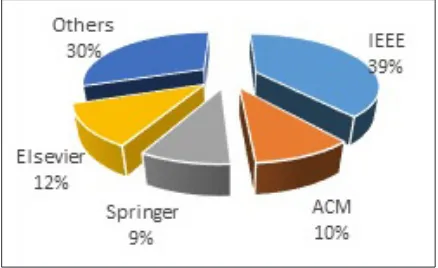
In total, 278 potential papers along with ab-stracts published within the period from 2007 to 2016 were collected. Finally, 93 full length most relevant papers for this literature survey was se-lected and analyzed. The year-wise and publish-er-wise bifurcation of selected papers is presented in Figure 1 and Figure 2.
Fig. 1. The year-wise bifurcation of selected papers
Fig. 2. The publisher-wise bifurcation of selected papers
LITERATURE REVIEW
Efficient resource provisioning with focus on satisfying user service requirements by taking into account both the economic and environmen-tal viability, lays the foundation for the success of commercial competition [22, 47, 65, 78]. In
the subsequent sections, a classification of the re-source scheduling problem in cloud environment as shown in Figure 3 and its existing on hand so-lutions have been reviewed in brief.
Fig. 3. Classification of the resource scheduling problem in cloud environment
Scheduling based on energy conservation With the ever-increasing needs of Cloud infra-structure, the energy consumption of datacenters has increased dramatically raising the apprehen-sion for both government and service providers to consume energy effectively [47, 51]. Assessment of literature is indicative of the fact that servers in many datacenters usually operate at 30% of their full capacity [57]. Incorporating energy reduction activities during the phases of low utilization is a centre of attraction and thus is the target of most of the research related to energy saving in cloud.
Table 1. Comparison of various energy conservation based resource scheduling techniques
Technique Performance metrics Environment Results red work
Refer-Energy based Efficient Re
-source Scheduling Algorithm Energy efficiency - CloudSim Proposed algorithm (23.39%) reduces more energy than EEUR (18.71%) [55] during
migra-tions. [36]
VM consolidation based on utilization, network topolo-gies and thermal state of servers
Energy effi
-ciency CloudSim
Proposed heuristic reduces energy by 83% and 66% as compared to a non-power aware system and a system based on DVFS technique. [38]
Energy aware scheduling al-gorithm based on processor and disk workloads
Energy
efficiency,
Execution time
Simulation
(MATLAB) Proposed algorithm shows 24.9% power savings and 1.2% performance degradation in compari-son with other scheduling approaches. [40] Thermal aware resource
allocation technique Energy effi -ciency, Cost
Simulation (Environment not mentioned)
17% improvement in terms of maximizing reward and 9% reduction in power consumption is
reported in proposed technique. [41] Heuristic based on
per-formance-per-watt for VM placement
Energy effi
-ciency CloudSim
35 % of total energy saving in proposed heuristic in comparison with the traditional allocation
heuristics. [42]
Power-aware VM allocation
heuristic Energy effi
-ciency CloudSim
Proposed heuristics results in energy saving of 22.4% and 16.0% when simulated with
power--aware best-fit decreasing and vector bin-packing
norm-based greedy algorithms.
[43]
Reinforcement Learning--based VM Consolidation
method CloudSim
Energy saving of 12.5%,19.4%, 22.6% and 28.5% can be attained in comparison with LR, MAD, THR and IQR [56] in the real workload. SLA violation rate is less in proposed solution than other techniques.
[44]
Scheduling strategy capable of providing virtual clusters that reactively focus on energy optimization to per-form consolidation
Energy
efficiency, SLA
violation rate
Simulation (Environment not mentioned)
Energy saving in proposed algorithm over OBFIT is 23.6%, 16.9% and 72.4% for the average task length ratios of 0.01, 0.1 and 1, respectively.
The working efficiency of proposed algorithm
is improved over OBFIT as 26.2%, 20.3% and 219.7% for the average task length ratios of 0.01, 0.1 and 1, respectively.
[45]
A PSO based energy-aware
VM allocation algorithm Energy efficiency,
Resource utilization
CloudSim
Energy savings and utilization of datacenter
resources in proposed algorithm are significant at
the same time. [46]
A novel heuristic based on multi-criteria decision ma-king method for determining the lightly loaded nodes and nodes for VM consolidation
Energy
efficiency, SLA
violation rate, Number of VM migration.
CloudSim
The proposed approach shows upto 46%, 99%, and 95% reduction in energy used, deadline violations, and VM migrations respectively as
compared with similar heuristics. [48]
VM management architec-ture for Snooze (a private cloud)
Energy effi
-ciency Snooze
Result confirmed the effectiveness of proposed
solution as energy conservation of upto 67% is
achieved on a realistic workload. [49] An improved PSO for
opti-mal VM placement Energy efficiency - Java based simulator Proposed approach significantly reduces energy by 13–23% as compared to other heuristic
approaches [50]
In [52], a predictive design which aims to combine the machine learning clustering and stochastic theory to estimate both the number of VM requests and the amount of cloud resources associated with each request is formulated. An amalgamated resource conditioning framework depending upon this method has been used by the authors to make suitable energy-aware resource supervised decisions which is further evaluated using real Google traces collected over a 29-day period from a Google cluster containing over 12,500 PMs. Comparison of various energy
con-servation based resource scheduling techniques is presented in Table 1.
Scheduling based on virtualization
re-ducing the energy consumption and capital cost associated with the cloud datacenter [79,85]. Vir-tual Machine allocation and migration in cloud environment is a challenging task. The concept behind VM allocation is the mapping between VM and PM with an objective to maximize ap-plication performance, energy saving, or augment the provider’s revenue [80].
In [86], authors presented a Virtual Com-puting Laboratory framework model using the concept of private cloud by extending the open source IaaS solution Eucalyptus. A mapping al-gorithm for VMs based on rules and the princi-ples of set theoretic is also presented. The algo-rithmic design is projected towards being able to autonomic plotting between VMs and datacenter resources. A system based on virtualization for the allocation of data center resources dynami-cally on the basis of demands of the application is presented [87]. In parallel, the optimized number of servers henceforth supports the green comput-ing. The concept of “skewness” is put forward to determine the non-proportionality in the multi-dimensional resource utilization of a server. It is also shown that different types of workloads can be combined efficiently and overall utilization of server resources is improved upon minimiza-tion of skewness. A group of heuristics is also developed that is able to effectively save the en-ergy while avoiding the system overloading. Ef-ficiency of this algorithm was adjudged through the trace driven simulation and henceforth the results of experiments. In [88], a combination of ant colony optimization (ACO) and VM dynamic forecast scheduling (VM_DFS) to perform VM scheduling is presented. In this algorithm through analysis of historical memory consumption in each PM, future memory consumption forecast of VMs and their allocation on the cloud resources is performed. This methodology is experimented in MATLAB for both homogeneous and heteroge-neous mode and results indicate that the proposed algorithm produces lower resource wastage than other traditional approaches and better load bal-ancing among PMs.
Virtual Machine migration is of utmost im-portance in implementing resource management strategies for the optimization of performance metrics such as consumption of energy, utilization of resource and QoS. The primer challenge for VM migration in terms of service downtime and high network utilization is discussed [84]. In [81], the authors put forward a novel model for
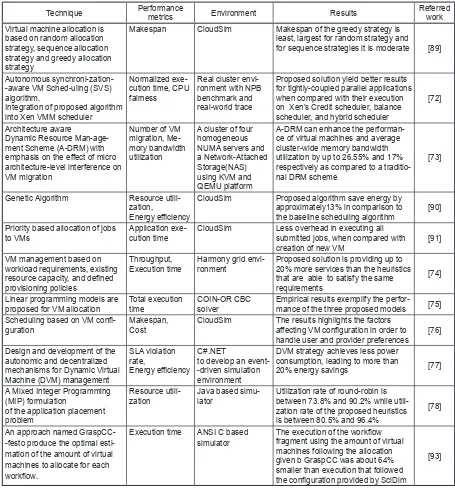
optimi-zation which laid its basis on linear programming along with an automatic approach for VM migra-tion in self-managing virtualized environments. The experimentation yielded the applicability of this approach to effectively determine which vir-tual machines should be migrated and on which physical machines to host them while minimizing operational and migration costs. In [82], authors proposed a Linear Programming formulation and heuristics to control VM migration that gives pri-ority to the virtual machines with steady capacity. In order to draw comparison between this migra-tion-control approaches with the well-established eager-migration-based solutions, the simulations are implemented using TU-Berlin and Google data center workloads. The results confirmed the reduction in the number of migrations with minimal penalty in the number of physical serv-ers, if the migration of VMs with steady capacity is avoided. Basic outline for cloud brokering and multi-cloud VM administration is proposed [83]. Descriptive algorithms were also proposed by the authors that paved way for the efficient placement of applications in multi-cloud environments. In-corporation of price and performance along with constraints such as hardware configuration, load balancing is also incorporated in the placement model. In contrast to single-cloud deployment, the proposed multi-cloud placement algorithms yielded improvement in performance with lower costs during an evaluation against commercial clouds. An attempt to decide the appropriate time for VM migration has been made by the authors [84] in which they have articulated an applica-tion-oriented live migration model exploring the application level information, in conjunction to the state-of-art system level metric. The experi-ment was conducted on three real applications with due consideration to the application specific to catalyze the VM live migration. It depicted a significant drop in the network overhead up to 42% and decrease in live migration time up to 63%. Table 2 elucidates a comparative study of various virtualization based resource scheduling techniques.
Table 2. Comparative study of various virtualization based resource scheduling techniques
Technique Performance metrics Environment Results Referred work Virtual machine allocation is
based on random allocation strategy, sequence allocation strategy and greedy allocation strategy
Makespan CloudSim Makespan of the greedy strategy is least, largest for random strategy and for sequence strategies it is moderate [89]
Autonomous synchroni-zation--aware VM Sched-uling (SVS) algorithm.
Integration of proposed algorithm into Xen VMM scheduler
Normalized exe-cution time, CPU fairness
Real cluster envi-ronment with NPB benchmark and real-world trace
Proposed solution yield better results for tightly-coupled parallel applications when compared with their execution on Xen’s Credit scheduler, balance scheduler, and hybrid scheduler
[72]
Architecture aware
Dynamic Resource Man-age-ment Scheme (A-DRM) with
emphasis on the effect of micro
architecture-level interference on VM migration
Number of VM migration, Me-mory bandwidth utilization
A cluster of four homogeneous NUMA servers and a Network-Attached Storage(NAS) using KVM and QEMU platform
A-DRM can enhance the performan-ce of virtual machines and average cluster-wide memory bandwidth utilization by up to 26.55% and 17% respectively as compared to a traditio-nal DRM scheme
[73]
Genetic Algorithm Resource utili-zation,
Energy efficiency
CloudSim Proposed algorithm save energy by approximately13% in comparison to
the baseline scheduling algorithm [90] Priority based allocation of jobs
to VMs Application exe-cution time CloudSim Less overhead in executing all submitted jobs, when compared with
creation of new VM [91] VM management based on
workload requirements, existing
resource capacity, and defined
provisioning policies
Throughput,
Execution time Harmony grid envi-ronment Proposed solution is providing up to 20% more services than the heuristics that are able to satisfy the same requirements
[74]
Linear programming models are
proposed for VM allocation Total execution time COIN-OR CBC solver Empirical results exemplify the perfor-mance of the three proposed models [75]
Scheduling based on VM confi
-guration Makespan,Cost CloudSim The results highlights the factors affecting VM configuration in order to
handle user and provider preferences [76] Design and development of the
autonomic and decentralized mechanisms for Dynamic Virtual Machine (DVM) management
SLA violation rate,
Energy efficiency
C#.NET
to develop an event--driven simulation environment
DVM strategy achieves less power consumption, leading to more than
20% energy savings [77]
A Mixed Integer Programming (MIP) formulation
of the application placement problem
Resource
utili-zation Java based simu-lator Utilization rate of round-robin is between 73.8% and 90.2% while utili-zation rate of the proposed heuristics is between 80.5% and 96.4%
[78]
An approach named GraspCC--festo produce the optimal esti-mation of the amount of virtual machines to allocate for each
workflow.
Execution time ANSI C based simulator
The execution of the workflow
fragment using the amount of virtual machines following the allocation given b GraspCC was about 64% smaller than execution that followed
the configuration provided by SciDim
[93]
tends to make customers malcontent and eventu-ally their level of satisfaction declines.
In [2], authors proposed the following to re-duce the deadline miss rate: (1) design and mod-eling of the Analytics as a Service (AaaS) plat-form; (2) formulation of the resource scheduling problem on the basis of mixed Integer Linear Programming (ILP) model; (3) an algorithm to ensure admission control and resource schedul-ing. In [68], author’s contribution is: (1) a novel domain specific language that is able to illustrate the QoS-oriented SLA associated with cloud ser-vices; (2) a general control-theoretic approach
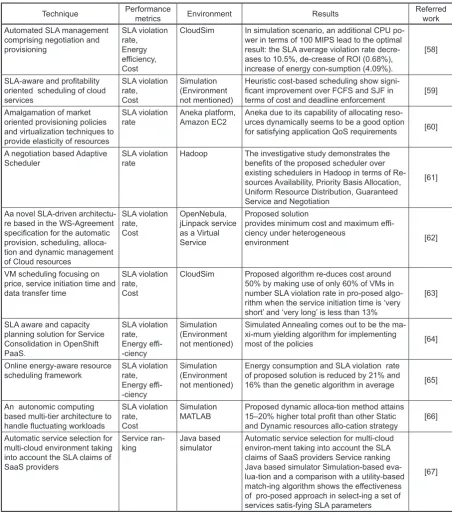
are also instilled. An OpenStack version of the Generic SLA Manager, besides its methodical approaches for VM selection and allocation dur-ing live migration of VMs is presented [70].A use case is simulated, where IaaS (OpenStack-SLAM) and PaaS (OpenShift) are coalesced to evaluate the performance and effectiveness of the proposed VM placement strategies, in case of multi-domain SLA pricing & penalty mod-el. Comparison of various SLA based resource scheduling techniques is presented in Table 3.
Scheduling based on cost-effectiveness
In cloud, service providers want to minimize resource rental costs while still meeting workload demands and cloud users look forward to the low-est possible prices for the resources they lease. It is worthwhile to mention that optimized VM placement [76], reducing application makespan [16], dynamic resource renting schemes [26] can satisfy the monetary requirements of both provid-ers and usprovid-ers.
Table 3. Comparison of various SLA based resource scheduling techniques
Technique Performance metrics Environment Results Referred work Automated SLA management
comprising negotiation and provisioning
SLA violation rate, Energy
efficiency,
Cost
CloudSim In simulation scenario, an additional CPU po-wer in terms of 100 MIPS lead to the optimal result: the SLA average violation rate decre-ases to 10.5%, de-crease of ROI (0.68%), increase of energy con-sumption (4.09%).
[58]
SLA-aware and profitability
oriented scheduling of cloud services
SLA violation rate, Cost
Simulation (Environment not mentioned)
Heuristic cost-based scheduling show
signi-ficant improvement over FCFS and SJF in
terms of cost and deadline enforcement [59] Amalgamation of market
oriented provisioning policies and virtualization techniques to provide elasticity of resources
SLA violation
rate Aneka platform,Amazon EC2 Aneka due to its capability of allocating reso-urces dynamically seems to be a good option for satisfying application QoS requirements [60]
A negotiation based Adaptive
Scheduler SLA violation rate Hadoop The investigative study demonstrates the benefits of the proposed scheduler over
existing schedulers in Hadoop in terms of Re-sources Availability, Priority Basis Allocation, Uniform Resource Distribution, Guaranteed Service and Negotiation
[61]
Aa novel SLA-driven architectu-re based in the WS-Agarchitectu-reement
specification for the automatic
provision, scheduling, alloca-tion and dynamic management of Cloud resources
SLA violation rate, Cost
OpenNebula, jLinpack service as a Virtual Service
Proposed solution
provides minimum cost and maximum effi -ciency under heterogeneous
environment [62]
VM scheduling focusing on price, service initiation time and data transfer time
SLA violation rate, Cost
CloudSim Proposed algorithm re-duces cost around 50% by making use of only 60% of VMs in number SLA violation rate in pro-posed algo-rithm when the service initiation time is ‘very short’ and ‘very long’ is less than 13%
[63]
SLA aware and capacity planning solution for Service Consolidation in OpenShift PaaS.
SLA violation rate,
Energy effi --ciency
Simulation (Environment not mentioned)
Simulated Annealing comes out to be the ma-xi-mum yielding algorithm for implementing
most of the policies [64]
Online energy-aware resource
scheduling framework SLA violation rate,
Energy effi --ciency
Simulation (Environment not mentioned)
Energy consumption and SLA violation rate of proposed solution is reduced by 21% and
16% than the genetic algorithm in average [65]
An autonomic computing based multi-tier architecture to
handle fluctuating workloads
SLA violation rate, Cost
Simulation
MATLAB Proposed dynamic alloca-tion method attains 15–20% higher total profit than other Static
and Dynamic resources allo-cation strategy [66] Automatic service selection for
multi-cloud environment taking into account the SLA claims of SaaS providers
Service
ran-king Java based simulator Automatic service selection for multi-cloud environ-ment taking into account the SLA claims of SaaS providers Service ranking Java based simulator Simulation-based eva-lua-tion and a comparison with a utility-based
match-ing algorithm shows the effectiveness
of pro-posed approach in select-ing a set of services satis-fying SLA parameters
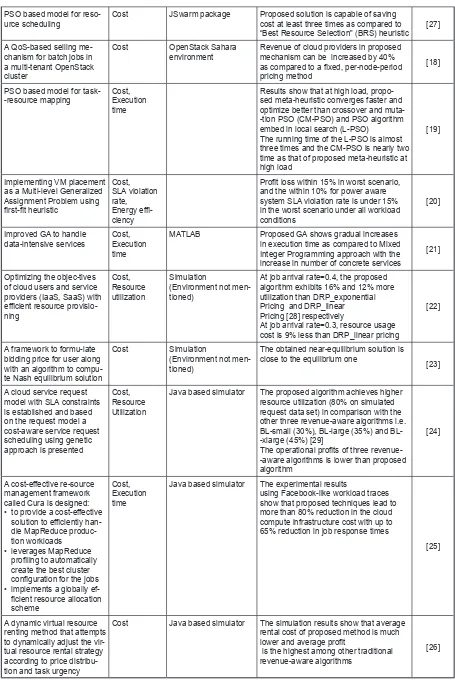
A cost-aware runtime strategy to store the da-tasets of the generated application in the cloud as a decision support system by making an estimate of the trade-off between computation, storage and bandwidth is proposed [30]. In [31], authors for-malized an optimization framework for MapRe-duce over multi-cloud including virtual machine and data transfer costs. In addition, a decentral-ized resource management middleware that con-siders multi-optimization is designed. In [32], authors proposed an innovative methodology to manage virtualized data centers according to mul-tiple facets (energy efficiency, virtualization over-heads, and SLA violation penalties) when placing VMs in data center nodes and maximizing the provider’s profit. The experiments demonstrated that the proposed model is capable of increasing the provider’s revenue by 30% and can handle certain issues including resource heterogeneity. The outline of scheduling prioritized workflow ensembles under budget and deadline constraints is discussed [33]. The authors developed a genre of dynamic and static algorithms to schedule tasks and resource provisioning that depends upon the workflow structure information and estimates of task runtimes. The proposed algorithms are then
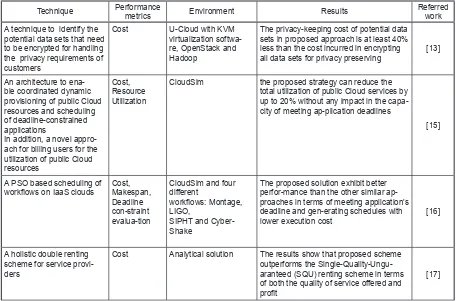
simulated using a simulator built on top of Cloud-Sim, which designs the infrastructure and the ap-plication, keeping under consideration the uncer-tainties in task runtime estimates, provisioning de-lays and failures. In [34], authors devised the fol-lowing approaches in order to minimize the rental costs while meeting users’ computing needs: (1) an online algorithm called Online Cost-efficient Scheduling (OCS) that makes use of a priority function to determine the urgency of requests, where the value of the priority function is based on the expected VM speed to complete a request, and assigns faster VM instances to requests with higher priorities; (2) an algorithm called Dynamic Resource Planning (DRP) to terminate unneeded VM instances before the next billing cycle starts based on prediction of daily patterns of resource usage from interactive services using queuing analysis; (3) an algorithm called Cost-conscious Scheduling algorithm (CCS) to dispatch batch jobs. The core of CCS is workload partitioning, which splits batch jobs across a large number of time slots according to the remaining resource ca-pacity and spot instance pricing. Comparison of various Cost-effective cloud resource scheduling techniques is presented in Table 4.
Table 4. Comparison of various Cost-effective cloud resource scheduling techniques
Technique Performance metrics Environment Results Referred work A technique to identify the
potential data sets that need to be encrypted for handling the privacy requirements of customers
Cost U-Cloud with KVM virtualization softwa-re, OpenStack and Hadoop
The privacy-keeping cost of potential data sets in proposed approach is at least 40% less than the cost incurred in encrypting
all data sets for privacy preserving [13]
An architecture to ena-ble coordinated dynamic provisioning of public Cloud resources and scheduling of deadline-constrained applications
In addition, a novel appro-ach for billing users for the utilization of public Cloud resources
Cost, Resource Utilization
CloudSim the proposed strategy can reduce the total utilization of public Cloud services by up to 20% without any impact in the capa-city of meeting ap-plication deadlines
[15]
A PSO based scheduling of
workflows on IaaS clouds Cost,Makespan, Deadline con-straint evalua-tion
CloudSim and four
different
workflows: Montage,
LIGO,
SIPHT and Cyber-Shake
The proposed solution exhibit better perfor-mance than the other similar ap-proaches in terms of meeting application’s deadline and gen-erating schedules with
lower execution cost [16]
A holistic double renting scheme for service provi-ders
Cost Analytical solution The results show that proposed scheme outperforms the Single-Quality-Ungu-aranteed (SQU) renting scheme in terms
of both the quality of service offered and profit
Table 4. Continued
PSO based model for
reso-urce scheduling Cost JSwarm package Proposed solution is capable of saving cost at least three times as compared to
“Best Resource Selection” (BRS) heuristic [27] A QoS-based selling
me-chanism for batch jobs in a multi-tenant OpenStack cluster
Cost OpenStack Sahara
environment Revenue of cloud providers in proposed mechanism can be increased by 40%
as compared to a fixed, per-node-period
pricing method
[18]
PSO based model for
task--resource mapping Cost,Execution time
Results show that at high load, propo-sed meta-heuristic converges faster and optimize better than crossover and muta--tion PSO (CM-PSO) and PSO algorithm embed in local search (L-PSO)
The running time of the L-PSO is almost three times and the CM-PSO is nearly two time as that of proposed meta-heuristic at high load
[19]
Implementing VM placement as a Multi-level Generalized Assignment Problem using
first-fit heuristic
Cost, SLA violation rate,
Energy effi -ciency
Profit loss within 15% in worst scenario,
and the within 10% for power aware system SLA violation rate is under 15% in the worst scenario under all workload conditions
[20]
Improved GA to handle
data-intensive services Cost,Execution time
MATLAB Proposed GA shows gradual increases in execution time as compared to Mixed Integer Programming approach with the increase in number of concrete services
[21]
Optimizing the objec-tives of cloud users and service providers (IaaS, SaaS) with
efficient resource provisio -ning
Cost, Resource utilization
Simulation
(Environment not men-tioned)
At job arrival rate=0.4, the proposed algorithm exhibits 16% and 12% more utilization than DRP_exponential Pricing and DRP_linear Pricing [28] respectively
At job arrival rate=0.3, resource usage cost is 9% less than DRP_linear pricing
[22]
A framework to formu-late bidding price for user along with an algorithm to compu-te Nash equilibrium solution
Cost Simulation
(Environment not men-tioned)
The obtained near-equilibrium solution is
close to the equilibrium one [23]
A cloud service request model with SLA constraints is established and based on the request model a cost-aware service request scheduling using genetic approach is presented
Cost, Resource Utilization
Java based simulator The proposed algorithm achieves higher resource utilization (80% on simulated request data set) in comparison with the other three revenue-aware algorithms i.e. small (30%), large (35%) and BL--xlarge (45%) [29]
The operational profits of three revenue --aware algorithms is lower than proposed algorithm
[24]
A cost-effective re-source
management framework called Cura is designed:
• to provide a cost-effective solution to efficiently han -dle MapReduce produc-tion workloads
• leverages MapReduce profiling to automatically
create the best cluster
configuration for the jobs • implements a globally ef
-ficient resource allocation
scheme
Cost, Execution time
Java based simulator The experimental results
using Facebook-like workload traces show that proposed techniques lead to more than 80% reduction in the cloud compute infrastructure cost with up to 65% reduction in job response times
[25]
A dynamic virtual resource renting method that attempts to dynamically adjust the vir-tual resource rental strategy according to price distribu-tion and task urgency
Cost Java based simulator The simulation results show that average rental cost of proposed method is much
lower and average profit
is the highest among other traditional revenue-aware algorithms
CONCLUSION
Resource scheduling always remained an ac-tive area of research due to world-wide uncon-trolled growth of datacenters to cope up with the growing demands of cloud infrastructure. Based on the literature survey, the challenges posed by the cloud environment itself in terms of high power energy consumption of data centers, cus-tomer satisfaction, provider profitability etc. are identified. Furthermore, a critical evaluation of the existing on-hand cloud resource scheduling techniques on the basis of selected parameters from the literature is carried out. With a belief, that an up-to-date review of the resource schedul-ing literature presented in this paper will surely help the researchers and developers in selecting the most appropriate techniques to manage re-sources in cloud environment under the given constraints.
REFERENCES
1. Demchenko, Y., Van der Ham, J., Yakovenko, V., De Laat, C., Ghijsen, M., & Cristea, M. On-demand provisioning of cloud and grid based in-frastructure services for collaborative projects and groups. In: Collaboration Technologies and Sys-tems (CTS), International Conference, IEEE, May 2011, 134–142.
2. Buyya, R., Yeo, C. S., Venugopal, S., Broberg, J., & Brandic, I. Cloud computing and emerging IT platforms: Vision, hype, and reality for delivering computing as the 5th utility. Future Generation computer systems, 25 (6), 2009, 599–616.
3. Shawish, A., & Salama, M. Cloud computing: par-adigms and technologies. In Inter-cooperative Col-lective Intelligence: Techniques and Applications (pp. 39-67). Springer Berlin Heidelberg 2014. 4. Whaiduzzaman, M., Gani, A., Anuar, N.B., Shiraz,
M., Haque, M.N., & Haque, I.T. Cloud service se-lection using multicriteria decision analysis. The Scientific World Journal, 2014.
5. Foster, I., Zhao, Y., Raicu, I., & Lu, S. Cloud com-puting and grid comcom-puting 360-degree compared. In: Grid Computing Environments Workshop, IEEE. 2008, November, 1–10.
6. Huang, J., Liu, Y., & Duan, Q. Service provision-ing in virtualization-based Cloud computprovision-ing: Mod-eling and optimization. In Global Communications Conference (GLOBECOM), IEEE. 2012, Decem-ber, 1710–1715.
7. Mohamadi, A., & Barani, S. A review on approach-es in service level agreement in cloud computing
environment. In Fuzzy and Intelligent Systems (CFIS), 4th Iranian Joint Congress, IEEE. 2015, September, 1–4.
8. Okada, T. K., De La Fuente Vigliotti, A., Macedo Batista, D., & Goldman vel Lejbman, A. Consoli-dation of VMs to improve energy efficiency in cloud computing environments. In Computer Net-works and Distributed Systems (SBRC), XXXIII Brazilian Symposium, IEEE. 2015, May, 150–158. 9. Hou, R., Jiang, T., Zhang, L., Qi, P., Dong, J., Wang, H., & Zhang, S. Cost effective data center servers. In High Performance Computer Architec-ture (HPCA2013), 19th International Symposium, IEEE. 2013, February, 179–187.
10. Gupta, A., & Kalé, L. V. Towards efficient map-ping, scheduling, and execution of HPC applica-tions on platforms in cloud. In Parallel and Dis-tributed Processing Symposium Workshops & PhD Forum (IPDPSW), 27th International, IEEE. 2013, May, 2294–2297.
11. Han, R., Ghanem, M. M., Guo, L., Guo, Y., & Os-mond, M. Enabling cost-aware and adaptive elas-ticity of multi-tier cloud applications. Future Gen-eration Computer Systems, 32, 2014, 82–98. 12. Weingärtner, R., Bräscher, G. B., & Westphall, C.
B. Cloud resource management: A survey on fore-casting and profiling models. Journal of Network and Computer Applications, 47, 2015, 99–106. 13. Zhang, X., Liu, C., Nepal, S., Pandey, S., & Chen,
J. A privacy leakage upper bound constraint-based approach for cost-effective privacy preserving of intermediate data sets in cloud. Parallel and Dis-tributed Systems, IEEE Transactions, 24 (6), 2013, 1192–1202.
14. Verma, A., & Kaushal, S. Deadline and budget dis-tribution based cost-time optimization workflow scheduling algorithm for cloud. In IJCA Proceed-ings on international conference on recent ad-vances and future trends in information technology (iRAFIT 2012, April).
15. Calheiros, R. N., & Buyya, R. Cost-effective pro-visioning and scheduling of deadline-constrained applications in hybrid clouds. In Web Information Systems Engineering-WISE. Springer Berlin Hei-delberg 2012.
16. Rodriguez, M. A., & Buyya, R. Deadline based re-source provisioning and scheduling algorithm for scientific workflows on clouds. Cloud Computing, IEEE Transactions on, 2 (2), 2014, 222–235. 17. Mei, J., Li, K., Ouyang, A., & Li, K. A profit
maxi-mization scheme with guaranteed quality of ser-vice in cloud computing. Computers, IEEE Trans-actions, 64 (11), 2015, 3064–3078.
pre-print arXiv:1504.07283.
19. Guo, L., Zhao, S., Shen, S., & Jiang, C. Task scheduling optimization in cloud computing based on heuristic algorithm. Journal of Networks, 7 (3), 2012, 547–553.
20. Shi, W., & Hong, B. Towards profitable virtual ma-chine placement in the data center. In Utility and Cloud Computing (UCC), Fourth IEEE Interna-tional Conference, 2011, December, 138–145. 21. Wang, L., Shen, J., Luo, J., & Dong, F. An improved
genetic algorithm for cost-effective data-intensive service composition. In Semantics, Knowledge and Grids (SKG), Ninth International Conference, IEEE. 2013, October, 105–112.
22. Li, C., & Li, L. Efficient resource allocation for op-timizing objectives of cloud users, IaaS provider and SaaS provider in cloud environment. The Jour-nal of Supercomputing, 65 (2), 2013, 866–885. 23. Li, K., Liu, C., Li, K., & Zomaya, A. A Framework
of Price Bidding Configurations for Resource Us-age in Cloud Computing, 2015.
24. Liu, Z., Wang, S., Sun, Q., Zou, H., & Yang, F. Cost-aware cloud service request scheduling for SaaS providers. The Computer Journal 2013, bxt009.
25. Palanisamy, B., Singh, A., & Liu, L. Cost-effective resource provisioning for mapreduce in a cloud. Parallel and Distributed Systems, IEEE Transac-tions, 26 (5), 2015, 1265–1279.
26. Zhou, A., Wang, S., Sun, Q., Zou, H., & Yang, F. Dynamic Virtual Resource Renting Method for Maximizing the Profits of a Cloud Service Pro-vider in a Dynamic Pricing Model. In Parallel and Distributed Systems (ICPADS), International Con-ference, IEEE. 2013, December, 118–125. 27. Pandey, S., Wu, L., Guru, S.M., & Buyya, R.A
particle swarm optimization-based heuristic for scheduling workflow applications in cloud com-puting environments. In Advanced information networking and applications (AINA), 24th IEEE international conference, 2010, April, 400–407. 28. Zhu, Q., & Agrawal, G. Resource provisioning
with budget constraints for adaptive applications in cloud environments. In Proceedings of the 19th ACM International Symposium on High Perfor-mance Distributed Computing, ACM. 2010, June, 304–307.
29. Chen, J., Wang, C., Zhou, B. B., Sun, L., Lee, Y. C., & Zomaya, A. Y. Tradeoffs between profit and customer satisfaction for service provisioning in the cloud. In Proceedings of the 20th international symposium on High performance distributed com-puting, ACM. 2011, June, 229–238.
30. Yuan, D., Cui, L., Liu, X., Fu, E., & Yang, Y. A Cost-Effective Strategy for Storing Scientific
Data-sets with Multiple Service Providers in the Cloud, 2016. arXiv preprint arXiv:1601.07028.
31. Imai, S., Patterson, S., & Varela, C. A. Cost-Efficient High-Performance Internet-Scale Data Analytics over Multi-Cloud Environments. In Cluster, Cloud and Grid Computing (CCGrid), 15th IEEE/ACM International Symposium, 2015, May, 793–796.
32. Goiri, Í., Berral, J. L., Fitó, J. O., Julià, F., Nou, R., Guitart, J., Torres, J. Energy-efficient and multifac-eted resource management for profit-driven virtu-alized data centers. Future Generation Computer Systems, 28 (5), 2012, 718–731.
33. Li, J., Su, S., Cheng, X., Song, M., Ma, L., & Wang, J. Cost-efficient coordinated scheduling for leasing cloud resources on hybrid workloads. Par-allel Computing, 44, 2015, 1–17.
34. Malawski, M., Juve, G., Deelman, E., & Nabrzys-ki, J. Algorithms for cost-and deadline-constrained provisioning for scientific workflow ensembles in IaaS clouds. Future Generation Computer Sys-tems, 48, 2015, 1–18.
35. Videv, S., & Haas, H. Energy-efficient scheduling and bandwidth-energy efficiency trade-off with low load. In Communications (ICC), IEEE Inter-national Conference, 2011, June, 1–5.
36. Singh, S., & Chana, I. Energy based efficient re-source scheduling: a step towards green comput-ing. Int J Energy Inf Commun, 5 (2), 2014, 35–52. 37. Liu, D., & Han, N. An Energy-efficient Task
Scheduler in Virtualized Cloud Platforms. Interna-tional Journal of Grid and Distributed Computing, 7 (3), 2014, 123–134.
38. Beloglazov, A., & Buyya, R. Energy efficient re-source management in virtualized cloud data cen-ters. In Proceedings of the 10th IEEE/ACM in-ternational conference on cluster, cloud and grid computing, 2010, May, 826–831.
39. Buyya, R., Beloglazov, A., & Abawajy, J. Energy-efficient management of data center resources for cloud computing: a vision, architectural elements, and open challenges, 2010. arXiv preprint arX-iv:1006.0308.
40. Sharifi M, Salimi H, Najafzadeh M. Power-effi-cient distributed scheduling of virtual machines us-ing workload-aware consolidation techniques. The Journal of Supercomputing, Springer 2012. 41. Al-Qawasmeh, A.M., Pasricha, S., Maciejewski,
A.A., & Siegel, H.J. Power and thermal-aware work-load allocation in heterogeneous data centers. Com-puters, IEEE Transactions, 64 (2), 2015, 477–491. 42. Quang-Hung, N., Thoai, N., & Son, N. T. EPOBF:
Knowledge-Cen-tered Systems XVI, 2014, 71–86.
43. Quang-Hung, N., Le, D. K., Thoai, N., & Son, N. T. Heuristics for energy-aware vm allocation in hpc clouds. In: Future Data and Security Engi-neering, Springer International Publishing 2014, 248–261.
44. Farahnakian, F., Liljeberg, P., & Plosila, J. Energy-efficient virtual machines consolidation in cloud data centers using reinforcement learning. In: Par-allel, Distributed and Network-Based Processing (PDP), 2014 22nd Euromicro International Confer-ence, IEEE. 2014, February, 500–507.
45. Sampaio, A. M., & Barbosa, J. G. Towards high-available and energy-efficient virtual computing environments in the cloud. Future Generation Computer Systems, 40, 2014, 30–43.
46. Xiong, A. P., & Xu, C. X. Energy efficient mul-tiresource allocation of virtual machine based on PSO in cloud data center. Mathematical Problems in Engineering, 2014.
47. Dong, D., & Herbert, J. Energy efficient vm placement supported by data analytic service. In Cluster, Cloud and Grid Computing (CCGrid), 13th IEEE/ACM International Symposium, 2013, May, 648–655.
48. Arianyan, E., Taheri, H., & Sharifian, S. Novel energy and SLA efficient resource management heuristics for consolidation of virtual machines in cloud data centers. Computers & Electrical Engi-neering, 47, 2015, 222–240.
49. Feller, E., Rohr, C., Margery, D., & Morin, C. Energy management in IaaS clouds: a holistic ap-proach. In Cloud Computing (CLOUD), IEEE 5th International Conference, 2012, June, 204–212. 50. Wang, S., Liu, Z., Zheng, Z., Sun, Q., & Yang, F.
Particle swarm optimization for energy-aware vir-tual machine placement optimization in virvir-tualized data centers. In Parallel and Distributed Systems (ICPADS), International Conference, IEEE. 2013, December, 102–109.
51. Uddin, M., Darabidarabkhani, Y., Shah, A., & Memon, J. Evaluating power efficient algorithms for efficiency and carbon emissions in cloud data centers: A review. Renewable and Sustainable En-ergy Reviews, 51, 2015, 1553–1563.
52. Dabbagh, M., Hamdaoui, B., Guizani, M., & Rayes, A. Energy-efficient resource allocation and provisioning framework for cloud data centers. Network and Service Management, IEEE Transac-tions, 12 (3), 2015, 377–391.
53. Chen, H., Zhu, X., Guo, H., Zhu, J., Qin, X., & Wu, J. Towards energy-efficient scheduling for real-time tasks under uncertain cloud computing environment. Journal of Systems and Software, 99, 2015, 20–35.
54. Zhang, Z., Hsu, C. C., & Chang, M. Cool Cloud: A Practical Dynamic Virtual Machine Placement Framework for Energy Aware Data Centers. In Cloud Computing (CLOUD), IEEE 8th Interna-tional Conference, 2015, June, 758–765.
55. Lee, Y.C., & Zomaya, A.Y. Energy efficient utiliza-tion of resources in cloud computing systems. The Journal of Supercomputing, 60 (2), 2012, 268–280. 56. Beloglazov, A., & Buyya, R. Optimal online de-terministic algorithms and adaptive heuristics for energy and performance efficient dynamic consoli-dation of virtual machines in cloud data centers. Concurrency and Computation: Practice and Expe-rience, 24 (13), 2012, 1397–1420.
57. Barroso, L.A., & Hölzle, U. The case for energy-proportional computing. Computer 12, 2007, 33–37. 58. Lu, K., Yahyapour, R., Wieder, P., Yaqub, E.,
Abdullah, M., Schloer, B., & Kotsokalis, C. Fault-tolerant Service Level Agreement lifecycle man-agement in clouds using actor system. Future Gen-eration Computer Systems, 54, 2016, 247–259. 59. Moon, H. J., Chi, Y., & Hacigumus, H. SLA-aware
profit optimization in cloud services via resource scheduling. In Services (SERVICES-1), 6th World Congress, IEEE. 2010, July, 152–153.
60. Buyya, R., Garg, S. K., & Calheiros, R. N. SLA-oriented resource provisioning for cloud comput-ing: Challenges, architecture, and solutions. In Cloud and Service Computing (CSC), Internation-al Conference, IEEE. 2011, December, 1–10. 61. Nayak, D., Martha, V. S., Threm, D., Ramaswamy,
S., Prince, S., & Fatimberger, G. Adaptive sched-uling in the cloud—SLA for Hadoop job schedul-ing. In Science and Information Conference (SAI), IEEE. 2015, July, 832–837.
62. García, A. G., Espert, I. B., & García, V. H. SLA-driven dynamic cloud resource management. Future Generation Computer Systems, 31, 2014, 1–11. 63. Wu, L., Garg, S. K., & Buyya, R. SLA-based
re-source allocation for software as a service provider (SaaS) in cloud computing environments. In Clus-ter, Cloud and Grid Computing (CCGrid), 11th IEEE/ACM International Symposium, 2011, May, 195–204.
64. Yaqub, E., Yahyapour, R., Wieder, P., Jehangiri, A. I., Lu, K., & Kotsokalis, C. Metaheuristics-based planning and optimization for sla-aware resource management in paas clouds. In Proceedings of the IEEE/ACM 7th International Conference on Utility and Cloud Computing, 2014, December, 288–297. 65. Rajabi, A., Faragardi, H. R., & Yazdani, N.
66. Bi, J., Yuan, H., Tie, M., & Tan, W. SLA-based optimisation of virtualised resource for multi-tier web applications in cloud data centres. Enterprise Information Systems, 9 (7), 2015, 743–767. 67. Farokhi, S., Jrad, F., Brandic, I., & Streit, A.
HS4MC–Hierarchical SLA-based Service Selec-tion for Multi-Cloud Environments. In: CLOSER 2014, 722–734.
68. Serrano D, Bouchenak S, Kouki Y, de Oliveira Jr FA, Ledoux T, Lejeune J, Sopena J, Arantes L, Sens P. SLA guarantees for cloud services, In Future Generation Computer Systems. In: Future Generation Computer Systems, 2016, 233–246. 69. Morshedlou, H., & Meybodi, M. R. Decreasing
impact of sla violations: a proactive resource al-location approach for cloud computing environ-ments. Cloud Computing, IEEE Transactions, 2 (2), 2014, 156–167.
70. Lu, K., Yahyapour, R., Wieder, P., Kotsokalis, C., Yaqub, E., & Jehangiri, A. I. Qos-aware vm place-ment in multi-domain service level agreeplace-ments scenarios. In IEEE Sixth International Conference on Cloud Computing, 2013, June, 661–668. 71. Selvi, S. T., SathiaBham, P. R., Architha, S.,
Kaa-runya, T., & Vinothini, K. Scheduling In Virtual-ized Grid Environment Using Hybrid Approach. International Journal of Grid Computing & Appli-cations (IJGCA), 2010, Vol, 1.
72. Wu, S., Chen, H., Di, S., Zhou, B., Xie, Z., Jin, H., & Shi, X. Synchronization-Aware Scheduling for Virtual Clusters in Cloud. Parallel and Distributed Systems, IEEE Transactions on, 26 (10), 2015, 2890–2902.
73. Wang, H., Isci, C., Subramanian, L., Choi, J., Qian, D., & Mutlu, O. A-DRM: Architecture-aware dis-tributed resource management of virtualized clus-ters. In Proceedings of the 11th ACM SIGPLAN/ SIGOPS International Conference on Virtual Exe-cution Environments, 2015, March, 93–106. ACM. 74. Garbacki, P., & Naik, V. K. Efficient resource virtu-alization and sharing strategies for heterogeneous grid environments. In Integrated Network Manage-ment, IM’07. 10th IFIP/IEEE International Sym-posium, 2007, May, 40–49.
75. Nguyen, Q.T., Quang–Hung, N., Tuong, N.H., Tran, V.H., & Thoai, N. Virtual machine allocation in cloud computing for minimizing total execution time on each machine. In Computing, Management and Telecommunications (ComManTel), Interna-tional Conference, IEEE. 2013, January, 241–245. 76. Sahal, R., & Omara, F. A. Effective virtual machine
configuration for cloud environment. In Informat-ics and Systems (INFOS), 9th International Con-ference, IEEE. 2014, December, PDC-15. 77. Wang, X., Liu, X., Fan, L., & Jia, X. A
decentral-ized virtual machine migration approach of data
centers for cloud computing. Mathematical Prob-lems in Engineering, 2013.
78. Aral, A., & Ovatman, T. Improving Resource Uti-lization in Cloud Environments using Application Placement Heuristics. In: CLOSER, 2014, 527–534. 79. Li, K., Wu, J., & Blaisse, A. Elasticity-aware vir-tual machine placement for cloud datacenters. In Cloud Networking (CloudNet), IEEE 2nd Interna-tional Conference, 2013, November, 99–107. 80. Li, W., Tordsson, J., & Elmroth, E. Virtual machine
placement for predictable and time-constrained peak loads. In Economics of Grids, Clouds, Sys-tems, and Services, 2011, 120–134.
81. Park, J. G., Kim, J. M., Choi, H., & Woo, Y. C. Virtual machine migration in self-managing vir-tualized server environments. In Advanced Com-munication Technology, ICACT 2009. 11th Inter-national Conference, IEEE. 2009, February, Vol. 3, 2077–2083.
82. Ferreto, T. C., Netto, M. A., Calheiros, R. N., & De Rose, C. A. Server consolidation with migration control for virtualized data centers. Future Genera-tion Computer Systems, 27 (8), 2011, 1027–1034. 83. Tordsson, J., Montero, R. S., Moreno-Vozmediano,
R., & Llorente, I. M. Cloud brokering mechanisms for optimized placement of virtual machines across multiple providers. Future Generation Computer Systems, 28 (2), 2012, 358–367.
84. Baruchi, A., Toshimi Midorikawa, E., & Netto, M. A. Improving Virtual Machine live migration via application-level workload analysis. In Network and Service Management (CNSM), 10th Interna-tional Conference, IEEE. 2014, Nov. 163–168. 85. Hieu, N. T., Di Francesco, M., & Yla-Jaaski, A.
Virtual Machine Consolidation with Usage Predic-tion for Energy-Efficient Cloud Data Centers. In Cloud Computing (CLOUD), IEEE 8th Interna-tional Conference, 2015, June, 750–757.
86. Ezugwu, A. E., Buhari, S. M., & Junaidu, S. B. Virtual machine allocation in cloud computing en-vironment. International Journal of Cloud Applica-tions and Computing (IJCAC), 3 (2), 2013, 47–60. 87. Z. Xiao, W. Song and Q. Chen. Dynamic Resource
Allocation Using Virtual Machines for Cloud Computing Environment. In IEEE Transactions on Parallel and Distributed Systems, 24, 6, June 2013, 1107–1117.
88. M. Seddigh, H. Taheri and S. Sharifian. Dynamic prediction scheduling for virtual machine place-ment via ant colony optimization. Signal Process-ing and Intelligent Systems Conference (SPIS), Tehran, Iran, 2015 , 104–108.
Information Security, 2012, 113–120.
90. Quang-Hung, N., Nien, P. D., Nam, N. H., Tuong, N. H., & Thoai, N. A genetic algorithm for power-aware virtual machine allocation in private cloud. In Information and Communication Technology 2013, 183–191.
91. Saraswathi, A. T., Kalaashri, Y. R. A., & Padma-vathi, S. Dynamic resource allocation scheme in cloud computing. Procedia Computer Science, 47, 2015, 30–36.
92. Coutinho, R. D. C., Drummond, L. M., Frota, Y., & de Oliveira, D. Optimizing virtual machine alloca-tion for parallel scientific workflows in federated clouds. Future Generation Computer Systems, 46, 2015, 51–68.