International Doctorate School in Information and Communication Technologies
DISI - University of Trento
Tape Mbo’e: A Service Oriented Method
Ilse Mar´ıa Grau Yegros
Tutors Prof. Luca Cernuzzi Prof. Adolfo Villafiorita
Abstract
In developing countries, normally, different e-government applications do not exchange data each other, affecting the quality of service provided to citizens and the transparency. This situation has motived us to focus on the development of applications in such domain and, more specifically, on the interoperability among these applications. The interoperability has been implemented in e-government context of multiple countries through the Service-Oriented Computing (SOC). In addition to the in-teroperability, SOC provides considerable benefits. However, developing a service-based e-government application (SBeA) is a complex challenge and requires a software engineering method to manage its development process. The potential method should take into account not only design, construc-tion, and maintenance of SBeA, but also it should consider the context in which it will be used (i.e, developing countries). In fact, in these countries, the scarcity of economic resources and qualified professionals can impose constraints to carry out e-government projects. Thus, the adopted meth-ods have to maintain the costs low and to consider aspects related to long-term sustainability of the applications from the beginning. These issues suggest the adoption of Agile Methods (AMs) that have been proved to offer benefits in different projects in developing countries. However, they do not include SOC characteristics. Therefore, we have proposed Tape Mbo’e (TME)1, that is an extension of the agile method “OpenUP” to support the construction and the maintenance of SBeA in devel-oping countries. TME has been used in five case studies, which embraced both academia and public organizations in Paraguay. It is important to remark that it was the first application of this type of evaluation in the public sector in Paraguay. A full validation of TME requires a long-term study, including its applications in a consistent number of e-government projects. This is out of the scope, and the possibility, of the current thesis. Nevertheless, the initial results of the different case studies indicate the feasibility and simplicity of TME when it is applied in this context.
Keywords
Service-oriented computing, interoperability, developing countries, agile methods, service-oriented methods, evaluation, case studies
1Tape Mbo’e means: “method” in Guarani Language
Contents
1 Introduction y Motivation 8
1.1 Challenges of development methods for e-government: The case of Paraguay . . . 9
1.2 Objectives of our research . . . 9
1.3 The proposal . . . 9
1.4 Structure of the Thesis . . . 10
2 State of the Art 11 2.1 Evaluation Planning . . . 11
2.1.1 Definition of Research Questions . . . 11
2.1.2 Definition of Goals to Evaluate . . . 12
2.1.3 Definition of Measures . . . 14
2.1.4 Measurement of Goals . . . 15
2.1.5 Analysis of the methods . . . 15
2.2 Agile Methods . . . 15
2.2.1 Scrum . . . 18
2.2.2 Extreme Programming . . . 19
2.2.3 Open Unified Process . . . 19
2.2.4 Feature Driven Development . . . 20
2.2.5 Dynamic Systems Development Method . . . 20
2.2.6 Analysis of the Agile Methods . . . 20
2.2.7 Overview of the Agile Methods . . . 27
2.3 Service Oriented Methods . . . 27
2.3.1 Service Oriented Modelling and Architecture . . . 33
2.3.2 Service Oriented Architecture Framework . . . 33
2.3.3 Service-Oriented Design and Development Methodology . . . 33
2.3.4 Demchak et al. . . 33
2.3.5 Lamparter et al. . . 34
2.3.6 Quasar Enterprise Method . . . 34
2.3.7 Analysis of the Service Oriented Methods . . . 34
2.3.8 Overview of the Service Oriented Methods . . . 42
2.4 Concluding remarks on the State of the Art . . . 43
3 Tape Mbo’e: A Service Oriented Method 45 3.1 Life Cycle . . . 45
3.1.1 Inception Phase . . . 46
3.1.2 Elaboration Phase . . . 47
3.1.3 Construction Phase . . . 47
3.1.4 Transition Phase . . . 47
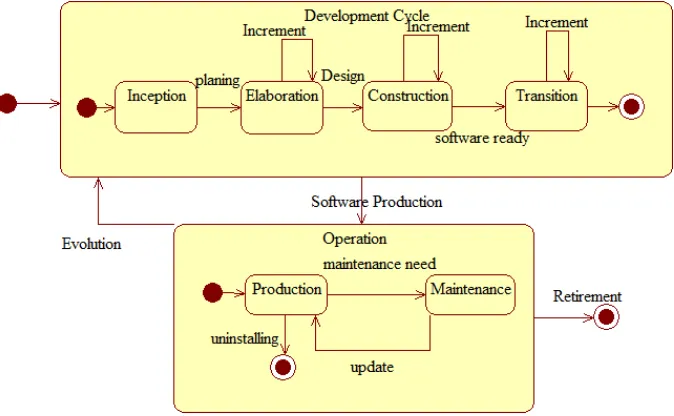
3.1.5 Operation Phase . . . 47
3.2 Roles . . . 48
3.2.1 Basic Roles . . . 48
3.2.2 Deployment Roles . . . 49
3.2.3 Environment Roles . . . 50
3.2.4 External Roles . . . 50
3.3 Disciplines . . . 50
3.3.1 Project Management . . . 51
3.3.2 Quality Assurance . . . 52
3.3.3 Requirements . . . 52
3.3.4 Architecture . . . 53
3.3.5 Development . . . 54
3.3.6 Deployment . . . 55
3.4 Disciplines over the Life Cycle . . . 55
3.4.1 Inception . . . 57
3.4.2 Elaboration . . . 58
3.4.3 Construction . . . 61
3.4.4 Transition . . . 62
3.4.5 Operation . . . 63
3.5 TME and OpenUP: extensions and differences . . . 64
3.6 Chapter Summary . . . 66
4 Experimental Evaluation 68 4.1 Outline of the Evaluation Process . . . 68
4.1.1 Planning Phase . . . 69
4.1.2 Execution Phase . . . 73
4.1.3 Analysis Phase . . . 75
4.2 Execution Phase . . . 76
4.2.1 Case Study 1: Academic Request System . . . 76
4.2.2 Case Study 2: Face Recognition System . . . 80
4.2.3 Case Study 3: Information Exchange System . . . 83
4.2.4 Case Study 4: Financial System . . . 88
4.2.5 Case Study 5: Healthcare System . . . 91
4.3 Analysis Phase . . . 94
4.4 Chapter summary . . . 95
5 Contributions, Conclusions and Future Research 98 5.1 Contributions . . . 98
5.2 Conclusion . . . 99
5.3 Future Research . . . 100
A Questions associated to the Tree of Goals 110 B Surveys in the Public Sector of Paraguayan Government 127 B.1 Survey about Software Development . . . 127
B.1.1 ICT Team Composition . . . 127
B.1.2 ICT Communication Management . . . 128
B.1.3 Methodology of Development and Maintenance . . . 128
B.2 ICT Staff Skill . . . 131
B.2.1 Which modelling language do you know? . . . 131
B.2.2 Which diagrams do you know? . . . 131
B.2.4 Do developers receive documents describing functionalities to program? . . . . 131 B.2.5 Do you think that is easy to understand the functionality to develop if you have
List of Figures
2.1 Measure Description . . . 15
2.2 OpenUP life cycle . . . 19
2.3 Comparison among the dimensions of the Agile Methods . . . 25
2.4 Template used to filter . . . 31
2.5 Percentage of references in related works . . . 39
2.6 SOMs Comparison . . . 40
3.1 Life Cycle of in House Development . . . 46
3.2 Life Cycle of Outsource Development . . . 46
3.3 Dependency among the roles . . . 48
3.4 Dependency among the roles . . . 49
3.5 TME Disciplines . . . 50
3.6 Domain Meta-model . . . 54
3.7 Service Model [1] . . . 54
3.8 Life Cycle and Disciplines . . . 55
3.9 Example of Standard Data Format . . . 58
3.10 Example of Business Model . . . 60
3.11 Example of Domain Model . . . 60
4.1 Evaluation Phases . . . 68
4.2 Questionnaire Example . . . 74
4.3 Template of Measurement Example . . . 75
4.4 Comparison among CU C,E1,E2,E2 and EARS . . . 80
4.5 Comparison among CU C,E4,E5,E6 and EF RS . . . 82
4.6 Comparison among CIES,E7,E8, andEIES . . . 85
4.7 Comparison among CSF and EF IS . . . 90
4.8 Comparison among CSF and EHCS . . . 93
4.9 Comparison among the case studies . . . 97
B.1 Meetings Pattern . . . 129
List of Tables
2.1 Tree of Goals . . . 13
2.2 Measures Description . . . 15
2.3 Scale Description . . . 16
2.4 Summary of Agile Methods . . . 16
2.5 Assessment of Agile Methods . . . 26
2.6 Attributes for SOMs Analysis . . . 28
2.7 Common Attributes . . . 29
2.8 References . . . 29
2.9 Lane and Richardson References . . . 32
2.10 Relation among the phases of SOMs . . . 36
2.11 Assessment of Service-Oriented Methods . . . 41
2.12 Global Results . . . 43
3.1 Summary of Tape Mbo’e . . . 56
3.2 Differences between TME and OpenUP . . . 65
3.3 Work Products of TME and OpenUP . . . 67
4.1 Tree of Goals . . . 70
4.2 Description of the Metrics . . . 72
4.3 The Scales of the Frequency Metric . . . 72
4.4 The Scales of the Aggregation of Frequency Metric . . . 72
4.5 The Scales of the Aggregation of Sample Metric . . . 73
4.6 Possible responses to one question . . . 74
4.7 Tree of Goals for the university’ case studies . . . 77
4.8 Tree of goals for the Control Groups of UC . . . 78
4.9 Tree of goals for the Academic Request System . . . 79
4.10 Upshot for Control Groups . . . 79
4.11 Upshot for the Academic Request System . . . 79
4.12 Upshot of Goals and Sub-Goals of the Face Recognition System . . . 82
4.13 Upshot of Dimensions of the Face Recognition System . . . 82
4.14 Tree of Goals . . . 84
4.15 The tree of goals with the results of the three questionnaires . . . 86
4.16 Upshot of Dimensions . . . 86
4.17 Tree of Goals for the software factory . . . 89
4.18 Upshot of Goals and Sub-Goals of the Financial System . . . 89
4.19 Upshot of Dimensions of the Financial System . . . 90
4.20 Upshot of Goals and Sub-Goals of the Healthcare System . . . 92
4.21 Upshot of Dimensions of the Healthcare System . . . 92
4.22 Interpretation of Effect Size . . . 94
4.23 Case Studies . . . 94
4.24 Meta-Analysis of Case Studies . . . 95
4.25 Questionnaires Description . . . 96
4.26 Summary of the Case Studies . . . 97
Introduction y Motivation
The Information and Communication Technologies (ICT) is not generally spread out across all public agencies in developing countries. This situation has entailed many pitfalls such as inconsistency and duplication of data, dishonest practices, bureaucratic procedures, and overpopulation of public employees. Thus, various governments, such as Egypt [2], Chile [3], Mozambique [4], and Paraguay [5], have implemented an interoperability framework to overcome the isolation of their agencies.
The interoperability has normally been implemented with the adoption of the service-oriented computing (SOC) technology which is a growing trend for modelling a huge class of heterogeneous applications which can belong to different agencies to provide value services to citizens. This is not always straightforward due to the constituent legacy systems have generally been developed in an independent fashion, and they could use incompatible technology. These issues can do unmanageable the development processes, unless they have a software engineering method which defines what to do, how to do, and when to do.
In these countries, the political and economical conditions impose constraints in the execution of projects. The political changes can occur suddenly retarding or cancelling projects execution, and they can also affect the staff assigned to the projects [6]. Moreover, the projects are normally financed by international donors, but a risk is their abandonment when the help finishes [7, 8]. Another constraint is the lack of either qualified or trained staff in government [9]. All these constraints affect software sustainability that is the capability of bankrolling of the software operation in long-term [8]. For these reasons, the software have to deliver fast, maintain their costs low, and consider from the beginning, aspects related to long-term sustainability. These issues seem to suggest the adoption of Agile Methods (AMs) convenient, owing they can rapidly adapt in changing environments, provide fast delivery, and focus on user satisfaction [10, 6]. However, they offer little or no documentation making software maintenance difficult, if their developers leave the organization or the development has been outsourced [11, 12]. As a result, the software become non sustainable [8]. In addition to this, they do not encompass the technical aspects of SOC which can facilitate to face the interoperability issues. For this reason, it seems convenient to take into account the Service-Oriented Methods (SOMs).
Besides, the e-government projects can involve stakeholders and staff of different agencies, and also they can be demanded by donors to fulfil quality standards. Thus, they have to deal with manage human resources, scope, costs, time, quality, etc., which are usually considered under the umbrella of project management and quality assurance. Both knowledge areas are poorly defined in AMs, being less considered in SOMs.
As a result, this thesis proposes the extension of the AM “Open Unified Process (OpenUP)1” to manage the development and the maintenance of service-based e-government applications. The proposal also include the project management and the quality assurance.
1http://epf.eclipse.org/wikis/openup/
1.1
Challenges of development methods for e-government: The case
of Paraguay
We tackle the pitfall of a method to develop interoperable and sustainable e-government systems in developing countries. The interoperability is implemented through SOC, but the methods available for this technology seem to be no enough mature in the project management; they do not take into account the user satisfaction; and only a few of them has been applied in real cases [16, 17, 18, 19, 20, 21].
The major risk in these countries is that the software projects are abandoned after a first success which is a failure of sustainability [8]. The failure is caused by many factors, among them, we mention withdrawing of benefactors fund, lack of political will, scarcity of both economic resources, and qualified professionals [7, 9, 8].
We illustrate this situation using as example Paraguay where the software projects are typically supported by benefactors whose help can encompass economic resource and technicians. The legacy systems of public agencies do not share information each other, and only a few public services are available in web-sites [9]. Consequently, there are inconsistency and duplication of data that have promoted dishonest practices. Additional to this, citizens have to follow bureaucratic procedures that might involve distant agencies to access to the majority of the public services. Moreover, a survey carried out in 11 public agencies (among them are 6 ministries) revealed that the development is normally outsourced by the agencies (see Appendix B). The ICT staff of the agencies can comprehend from 5 to more than 50 people, and a software project can involve various teams located in different places. The interviewees reported that there had not defined a development method in the agencies, as a consequence, the development was managed informally, and without documentation, hindering the software sustainability.
Therefore, this situation has boosted us to find a method to develop and maintain sustainable service-based e-government applications, and our proposal is described in the next chapters.
1.2
Objectives of our research
The major goal of this thesis is the proposal of a method for the development and the maintenance of e-government applications, based on the service-oriented paradigm, in developing countries. This goal tackles various secondary goals which are the following:
• Our approach should describe the software architecture, should propose strategies to maintain the development cost low, and should be easy to apply.
• Our approach should encompass the whole life cycle of the software and should consider the quality of the development process.
• Our approach should manage development, human resources, communication, and procurement.
• Finally, it should include the service description, the service implementation, and exchange standards.
1.3
The proposal
The proposal is to extend the OpenUP to include mainly the SOC features and the operation and retirement of the software. Thus, our approach is called Tape Mbo’e (TME)2.
TME encompasses the major characteristics of SOC, and includes the quality assurance; both are out OpenUP’s scope. It has also redefined the project management discipline of OpenUP according to
2
the standard of project management [22]. These changes have affected the definition of the disciplines, the roles, and the work-products included by OpenUP.
Moreover, TME have enlarged the life cycle of OpenUP, in order to overcome the gap between software delivery and its maintenance.
As a result, TME is a service-oriented method that includes the whole life cycle of software, from its conception until its retirement.
We are aware that the changes proposed by TME reduce its agility. However, they support the sustainability, which is more valuable for the type of projects that we are interested in, such as the government projects.
1.4
Structure of the Thesis
The remainder of the thesis is structured as follows:
• Chapter 2summarizes theState of the Artrelated to our work which are the software engi-neering methods. Among the methods, we are interested in Agile Methods and Service-Oriented Methods which are examined according to a set of goals. The goals involve four dimensions which are Service Oriented, Life Cycle Coverage, Project Management, and Sustainability.
• Chapter 3 outlines the proposal of TME which is an extension of the agile method OpenUP to include the service-oriented paradigm benefits and others complementary dimensions. The description involves the life cycle, the roles, the disciplines and how the disciplines are performed during the life cycle. Moreover, the comparison between OpenUP and TME is provided.
• Chapter 4 depicts the evaluation process that involves the phases of planning, execution, and analysis. The planning describes the evaluation goals, the metrics, and the measurement process. The execution encompasses the case studies description, their measuring, and their evaluation. Finally, in the analysis compares the outcomes of the case studies, and it discusses the main findings.
State of the Art
As mentioned in the Introduction, service-oriented approaches have been adopted in different countries for the design and development of e-government (as well as others domain applications) with interesting results. The agile methods (AMs) also seem very convenient. In effect, they have the ability to adapt fast in changing environments, and to focus on customer satisfaction, as well as to provide value deliveries to stakeholders from early stages of development For this reason, we are interested in finding methods that include the characteristics of service-oriented computing and maintain to some extent agile approach. In addition to this, considering the constraints of developing countries, the potential approaches should also take into account aspects of project management and involve the maintenance of software. As a result, the analysis embraces four dimensions which are Service Oriented, Life Cycle Coverage, Project Management, and Sustainability. The dimensions of Service Oriented and Sustainability have determined the types of methods which will be reviewed.
Thus, we have inspected the Agile Methods and the Service-Oriented Methods, and our assessment is organized as follows. Section 2.1 depicts how the assessment is carried out. Section 2.2 presents a briefly description of some Agile Methods, and then evaluates them. Section 2.3 describes some Service-Oriented Methods which are also evaluated. Finally, conclusion is provided.
2.1
Evaluation Planning
To examine the methods we have adapted an evaluation framework which was previously used to evaluate Agent Oriented Methodologies [23]. This framework is flexible to evaluate any type of methods through the change of its goals (attributes).
Our assessment focuses on answering four research questions which guide our analysis. Each re-search question is associated to one dimension which is a set of characteristics related to one knowledge area. The dimensions comprehend a set of goals to be measured in order to quantify their achieve-ment. We defined four dimensions: Service Oriented, Life Cycle Coverage, Project Management, and Sustainability. The Service Oriented and the Life Cycle Coverage dimensions are related with technical-methodological aspects. Complementary, the project management and the sustainability take into account the needs of the software development in developing countries.
2.1.1 Definition of Research Questions
We propose the following research questions:
Q.1 Does the methods include the service-oriented computing characteristics (services description, composition, identification, and service level agreement (SLA))? .
Q.2 Does the method cover the whole life cycle of service-based applications (SBAs) (requirement, analysis and design, development, and maintenance)? .
Q.3 Does the method address activities for project management?.
Q.4 Does the method support the sustainability of the software?.
2.1.2 Definition of Goals to Evaluate
The definition of goals is performed applying Goal-Question-Metric (GQM) [24]. GQM separates the goals in sub-goals hierarchically as a tree of goals where the goals-leaves measure the goals’ achievement. The tree is organized in the next way: dimensions and goals, as it is shown in Table 4.1. Thus, each node of the tree is described as follows.
SO Service Oriented
This dimension focuses on the intrinsic characteristics of service-oriented computing, and it is com-posed of the following goals:
SO.1 Service Description. Finds out if the methods describe the services messages, interfaces, flows, roles, etc.
SO.2 Service Level Agreement. Ascertains if the methods comprehend the Service Level Agreement (SLA).
SLA depicts service, terms, guarantees, and responsibilities into contract among a service provider and their consumers [17].
SO.3 Service Identification. Examines if the methods propose techniques to find the functionalities to be deployed as services.
SO.4 Service Composition. Looks into if the methods encompass the service composition.
The service composition is to cluster various services to achieve a goal. There are four type of composition models: choreography, orchestration, coordination, and assembly [17].
LC Life Cycle Coverage
This dimension is in charge of finding out which phases of the life cycle are covered by the methods. The life cycle encompasses the following phases:
LC.1 Requirement. Specifies what the software has to do and how it is supposed to work [17].
LC.2 Analysis and Design. Examines how the architecture of the software is designed and documented. [20].
LC.3 Construction. Ascertains how the construction of the software is carried out [17].
LC.4 Deployment and Provisioning. Looks into if the methods include the activities of deployment and publication of services.
LC.5 Operation and Management. Ascertains how maintenance (corrective, perfective, and adaptive) and adaptation of the software is carried out.
Table 2.1: Tree of Goals
SO Service Oriented
SO.1 Service Description
SO.2 Service Level Agreements
SO.3 Service Identification
SO.4 Service Composition
LC Life cycle coverage
LC.1 Requirement
LC.2 Analysis and Design
LC.3 Construction
LC.4 Deployment and Provisioning
LC.5 Operation and Management
PM Project Management
PM.1 Integration management
PM.2 Scope Management
PM.3 Time Management
PM.4 Cost Management
PM.5 Quality Management
PM.6 Human Resource Management
PM.7 Communication Management
PM.8 Risk Management
PM.9 Procurement management
SU Sustainability
SU.1 Accessibility
SU.2 Validity
SU.3 Vendor Independence
SU.4 Degree of Prescription
PM Project Management
Involves the fundamental activities to manage software process. It considers the goals proposed by project management standard [22] which are the following:
PM.1 Integration management. Inquires about planning, developing, and controlling of the develop-ment.
PM.3 Time Management. Ascertains if the methods estimate and control the activities duration.
PM.4 Cost Management. Appraises if the methods estimate costs, elaborate budget, and control the costs.
PM.5 Quality Management. Examines if the quality is considered and controlled. Moreover, it inquires about the verification and validation of the software.
PM.6 Human Resource Management. Finds out if the methods include the definition of staff’ roles and their responsibilities.
PM.7 Communication Management. Ascertains how the methods address the communication among the stakeholders.
PM.8 Risk Management. Examines if the methods consider the identification of risks, and if it plans how to respond to and to recover from them.
PM.9 Procurement Management. Finds out if the methods consider purchases and outsourcing.
SU Sustainability
This dimension concentrates on the aspects that can affect the sustainability of the SOMs. It is composed of the following goals:
SU.1 Accessibility. Looks into if the methods are described with guides, examples, and case studies. Moreover, it examines if these information can be obtained without additional cost [18], [21].
The major pitfall of proprietary approaches is that their information can be unreachable.
SU.2 Validity. Ascertains if there have been reported some implementation of the methods in real projects or case studies. It is important for demonstrating the practical applicability of the methods.
SU.3 Vendor Independence. Examines if the methods are proprietary approach.
SU.4 Degree of Prescription. Examines if the methods provide guidelines or processes to develop software.
2.1.3 Definition of Measures
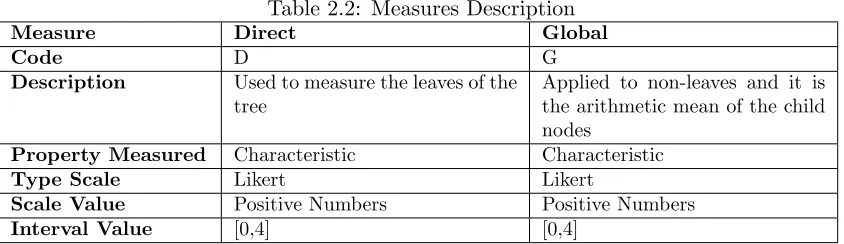
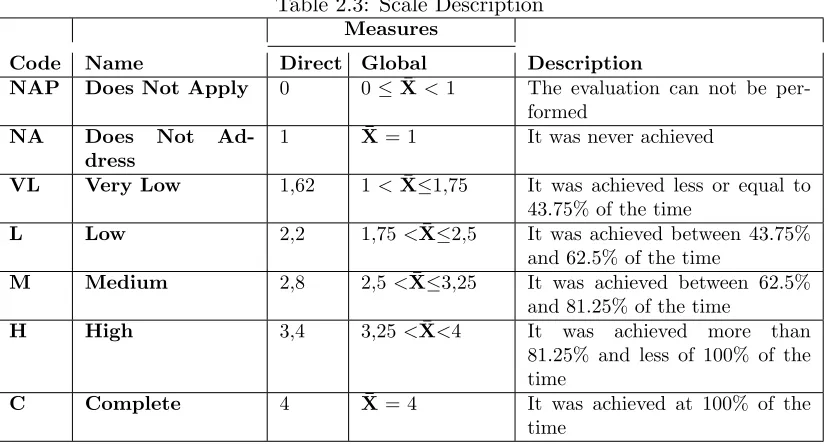
Two types of measurements are performed: direct (D) and indirect (I). The former is applied for leaves while the latter for non-leaves of the tree of goals. For each type were established the following measures: Direct and Global. They are described in Table 4.2. The Global Measure encompasses a range of values whose interpretation is the degree of satisfaction of the goals achievement. The scales of the measures are given in Table 2.3. The relations among measure, scale, and values are shown in Figure 2.1.
The value for a non-leaf is the arithmetic mean calculated from its child nodes, and it is in the Global scale. The arithmetic mean ( ¯X) is obtained with Formula 4.1.
¯
X=
n
X
k=0
ai
n (2.1)
¯
X: Arithmetic mean a: Child node
Figure 2.1: Measure Description
Table 2.2: Measures Description
Measure Direct Global
Code D G
Description Used to measure the leaves of the tree
Applied to non-leaves and it is the arithmetic mean of the child nodes
Property Measured Characteristic Characteristic
Type Scale Likert Likert
Scale Value Positive Numbers Positive Numbers
Interval Value [0,4] [0,4]
2.1.4 Measurement of Goals
The tree is measured starting from the leaves until the root. Thus, first of all it is assigned a value in the direct Scale to the leaves (see Table 2.3). Then, the values of the non-leaves are calculated through the arithmetic mean of their child nodes. The arithmetic mean is computed with Formula 4.1, and is in the Global scale.
2.1.5 Analysis of the methods
The analysis is addressed from two perspectives: by individual goals; and by dimensions.
2.2
Agile Methods
The Agile Methods (AMs) propose a set of practices to develop software which are in accordance with the Agile Manifesto [25, 26]. The Agile Manifesto promulgates a set of practices which give value to individuals and interaction instead of processes and tools; working software instead of comprehensive documentation; customer collaboration instead of contract negotiation; and responding to changes instead of following a plan [26].
Table 2.3: Scale Description Measures
Code Name Direct Global Description
NAP Does Not Apply 0 0 ≤X¯ <1 The evaluation can not be per-formed
NA Does Not
Ad-dress
1 X¯ = 1 It was never achieved
VL Very Low 1,62 1 <X¯≤1,75 It was achieved less or equal to 43.75% of the time
L Low 2,2 1,75<X¯≤2,5 It was achieved between 43.75% and 62.5% of the time
M Medium 2,8 2,5<X¯≤3,25 It was achieved between 62.5% and 81.25% of the time
H High 3,4 3,25<X¯<4 It was achieved more than 81.25% and less of 100% of the time
C Complete 4 X¯ = 4 It was achieved at 100% of the
time
constant testing, and local teams. Additional to this, the review determined fifteen agile practices which are coding standards, collective code ownership, continuous integration, metaphor, on-site cus-tomer, planning game, product backlog, project visibility, re-factoring, simple design, short releases, daily meetings, and sustainable pace. This review involves the general characteristics of AMs, but not describes them.
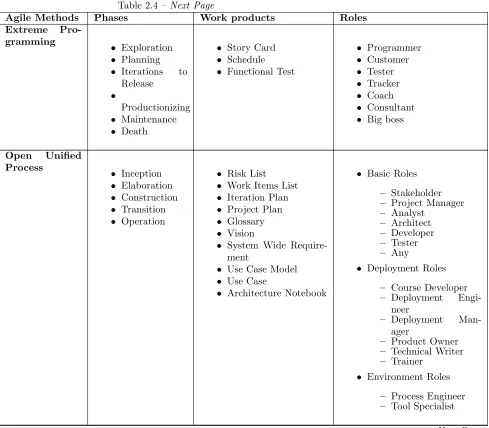
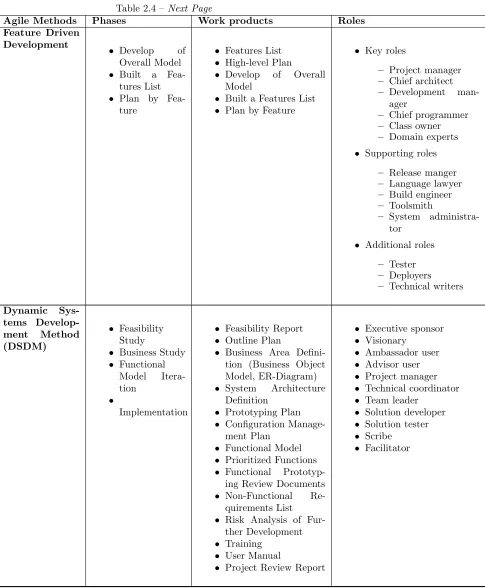
For this reason, we have examined various well known AMs which are Scrum [28, 29], Extreme Programming (XP)[30, 31], Open Unified Process (OpenUP)1, Feature Driven Development (FDD) [32], and Dynamic Systems Development Method (DSDM) [32]. The characteristics of these AMs are summarized in Table 2.4, and they are briefly described in the next sub-sections.
Table 2.4: Summary of Agile Methods
Agile Methods Phases Work products Roles
Scrum
• Pre-game
• Development
• Product Backlog List
• Sprint Backlog List
• Burn Down Chart
• Core roles
– Product owner – Team
– Scrum master
• Range of ancillary roles – Stakeholders – Managers
Next Page
Table 2.4 –Next Page
Agile Methods Phases Work products Roles
Extreme Pro-gramming
• Exploration
• Planning
• Iterations to Release
•
Productionizing
• Maintenance
• Death
• Story Card
• Schedule
• Functional Test
• Programmer • Customer • Tester • Tracker • Coach • Consultant
• Big boss
Open Unified Process • Inception • Elaboration • Construction • Transition • Operation
• Risk List
• Work Items List
• Iteration Plan
• Project Plan
• Glossary
• Vision
• System Wide Require-ment
• Use Case Model
• Use Case
• Architecture Notebook
• Basic Roles – Stakeholder – Project Manager – Analyst
– Architect – Developer – Tester – Any
• Deployment Roles – Course Developer – Deployment
Engi-neer
– Deployment Man-ager
– Product Owner – Technical Writer – Trainer
• Environment Roles – Process Engineer – Tool Specialist
Table 2.4 –Next Page
Agile Methods Phases Work products Roles
Feature Driven Development
• Develop of Overall Model
• Built a Fea-tures List
• Plan by Fea-ture
• Features List
• High-level Plan
• Develop of Overall Model
• Built a Features List
• Plan by Feature
• Key roles
– Project manager – Chief architect – Development
man-ager
– Chief programmer – Class owner – Domain experts
• Supporting roles – Release manger – Language lawyer – Build engineer – Toolsmith
– System administra-tor
• Additional roles – Tester – Deployers – Technical writers Dynamic Sys-tems Develop-ment Method (DSDM) • Feasibility Study
• Business Study
• Functional Model Itera-tion
•
Implementation
• Feasibility Report
• Outline Plan
• Business Area Defini-tion (Business Object Model, ER-Diagram)
• System Architecture Definition
• Prototyping Plan
• Configuration Manage-ment Plan
• Functional Model
• Prioritized Functions
• Functional Prototyp-ing Review Documents
• Non-Functional Re-quirements List
• Risk Analysis of Fur-ther Development
• Training
• User Manual
• Project Review Report
• Executive sponsor
• Visionary
• Ambassador user
• Advisor user
• Project manager
• Technical coordinator
• Team leader
• Solution developer
• Solution tester
• Scribe
• Facilitator
2.2.1 Scrum
Scrum is iterative and incremental method which is composed of three phases: pre-game, development, and post-game [28, 29].
Scrum suggests the team have to arrange a meeting every day which lasts as maximal 15 minutes to update to the staff about work progress [25]. its team is composed of not more than 10 developers, and it involves two types of roles: core and ancillary roles. The core roles are product owner, team, and scrum master while the ancillary role are stakeholders and managers (see Table 2.4).
2.2.2 Extreme Programming
Extreme Programming (XP) defines a life cycle composed of the phases of Exploration, Planning, Iterations to Release, Productionizing, Maintenance, and Death [30, 31].
Over the Exploration Phase, the users describe in a story-card the requirement which has to be included in the first release. The sequences in which the requirements will be built are planned in the Planning Phase. The Iterations to Release Phase embraces various iterations before the first release. The Productionizing Phase verifies and validates the software before its release to users. The Maintenance Phase is to keep running the software while parts of it are built. TheDeath phase involves the final release of the software.
XP involves technical practices which are Incremental Planning, Small Releases, Simple Design, Test-first Development, Re-factoring, Pair Programming, Collective Ownership, Continuous Integra-tion, Sustainable Pace, On-Site Customer, Uniform Coding Standard, and System Metaphor. They are based in the values of communication, simplicity, feedback, and courage.
XP’s team involves the roles of programmer, customer, tester, tracker, coach, consultant, and big boss (see Table 2.4). The team’s size must not be more than 12 people.
XP can fail in distributed teams, and when the work place is noisy [31, 33].
2.2.3 Open Unified Process
Open Unified Process (OpenUP) (version: June 1, 2012)2 is a light version of Rational Unified Process (RUP), a well organized method that has been widely used in the industry. OpenUP encompasses various characteristics of RUP such as life cycle, iterative, and incremental process; it is use case driven, architecture centric, and risk focused. However, its iterations last generally a few weeks, and it describes only essential content either informal or formal way. Moreover, OpenUP likes RUP is organized in two dimensions: life cycle and disciplines. The life cycle is composed of four phases: Inception, Elaboration, Construction, and Transition (see Figure 2.2). The Inception Phase covers
Figure 2.2: OpenUP life cycle
main functionalities identification, project plan elaboration, and requirements acquisition. The Elab-oration Phaseencompasses problem understanding, and architecture building. The Construction Phaseembraces system constructing and testing. Finally, theTransition Phaseinvolves the system delivery and deployment.
Besides, the disciplines are Requirements, Architecture, Development, Deployment, Environment and Project Management which produce work-products (see Table 2.4).
The Requirements Discipline focuses on understanding the problem to be solved, and the stakeholders needs. Its work-products are use cases and scenarios representing the requirements.
The Architecture Disciplinedescribes the architecture through simple diagrams or list of deci-sions, and its work-product is the architecture notebook.
The Development Discipline builds the software incrementally according to the requirements, and it checks if the software accomplishes the specifications.
The Deployment Discipline plans the release deployment.
The Environment Disciplineconfigures process and tools to be used in the development. TheTest Disciplineverifies software in isolated and integrated manner to get early and frequent feedback in order to ensure the software achieves the requirements.
The Project Management Discipline focuses on addressing the project activities including management project staff, enhancing the relationships with external teams and resources, risk man-agement, estimate scheduling and planning, managing the iteration.
OpenUP defines three type of roles which are Basic, Deployment, and Environment. The Basic roles is composed of analyst, architect, developer, any role, tester, stakeholder, and project manager. The Deployment roles includes course developer, deployment engineer, deployment manager, prod-uct owner, technical writer, and trainer. The Environment roles involves process engineer and tool specialist (see Table 2.4).
2.2.4 Feature Driven Development
Feature Driven Development (FDD) proposes five sequential processes which focus on designing and building software. The processes are Develop and Overall Model, Build a features List Plan by Feature, Design by Feature, and Build by Feature [32].
The Design by Feature and the Build by Feature are iterative processes which support the agile development.
FDD concentrates in quality aspects of the processes; and it monitors the project progress. FDD defines three categories of roles: key roles, supporting roles, and additional roles. The key roles are: project manager, chief architect, development manager, chief programmer, class owner and domain experts. The supporting roles comprehend release manger, language lawyer, build engineer, toolsmith and system administrator. The additional roles include tester, deployers and technical writers (see Table 2.4).
2.2.5 Dynamic Systems Development Method
Dynamic Systems Development Method (DSDM) comprises five phases: Feasibility Study, Business Study, Functional Model Iteration, Design and Build Iteration, and Implementation.
The phases of Functional Model Iteration, Design and Build Iteration, and Implementation are iterative and incremental while the others are executed only once. Each phase produces work-products which are lodged in Table 2.4 [32].
DSDM is suggested for teams composed of not more than 6 developers. However, it can be used to develop large systems, with the condition of the systems have to be separated in parts that are in charge of small teams.
DSDM defines the roles of executive sponsor, visionary, ambassador user, advisor user, project manager, technical coordinator, team leader, solution developer, solution tester, scribe, and facilitator.
2.2.6 Analysis of the Agile Methods
Due to these AMs are not under the umbrella of Service-oriented computing, our evaluation does not include the service oriented dimension.
The direct and indirect measurement are presented in the next sub-sections.
Analysis of the Goals: Direct Measurement
This analysis inspects how each Agile Method (AM) fulfils the goals settled.
LC Life Cycle Coverage
This dimension is measured through the following goals:
LC.1 Requirement
The AMs normally focus on gathering requirements from users. The users choose the requirement that will be developed over short period of time. Consequently, these AMs fulfil the “Requirement goal”.
Method SCR
UM
XP Op
enUP
FDD DSDM SCRUM XP OpenUP FDD DSDM
Grades 4 4 4 4 4 Complete Complete Complete Complete Complete
LC.2 Analysis and Design
Scrum and XP do not specify any description of architecture, as a result they obtained “Does Not Address”.
FDD outlines the architecture at high level then its score “Low”.
OpenUP and DSDM delineate partially in narrative way the architecture; thus, they achieved “Medium”.
Method SCR
UM
XP Op
enUP
FDD DSDM SCRUM XP OpenUP FDD DSDM
Grades 1 1 2,8 2,2 2,8 Does Not Address
Does Not Address
Medium Low Medium
LC.3 Construction
The AMs focus on building software, and they aim at producing high quality of code. Thus, they achieve completely this sub-goal.
Method SCR
UM
XP Op
enUP
FDD DSDM SCRUM XP OpenUP FDD DSDM
Grades 4 4 4 4 4 Complete Complete Complete Complete Complete
LC.4 Deployment and Provisioning
The responsibility of these AMs is until delivery and installation of the software.
The publication of services is out of the scope of them owing they are not under the umbrella of service-oriented computing.
Method SCR
UM
XP Op
enUP
FDD DSDM SCRUM XP OpenUP FDD DSDM
Grades 3,4 3,4 3,4 3,4 3,4 High High High High High
LC.5 Operation and Management
After delivering the software, the AMs do not consider its correction, improvement, or adaptation (i.e its maintenance), as well as its abandonment. Therefore, all of them have “Does Not Address” as grade in this sub-goal.
Despite of the fact that XP involves the phases of Maintenance and Death, they do not concerned to the maintenance as it is defined above. The Maintenance Phase lasts until the software is completely finished, and the Death Phase refers at the final delivery.
Method SCR
UM
XP Op
enUP
FDD DSDM SCRUM XP OpenUP FDD DSDM
Grades 1 1 1 1 1 Does Not
Address
Does Not Address
Does Not Address
Does Not Address
Does Not Address
PM Project Management
This dimension tackles the goals related with project management.
PM.1 Integration Management
At the beginning of the development, the AMs gather the requirement to be developed.
Scrum describes the project in high level in its product backlog including requirements and pri-orities. The sprint backlog plans the spring, and burn down reports about the project progress (see Table 2.4).
XP set the order in which the requirements will be built in over its Planing Phase.
OpenUP arranges the project and the iterations, as a result it elaborates the project and iteration plan.
FDD and DSDM outline the project plan. Moreover, DSDM elaborates the plans of prototyping and configuration management.
Method SCR
UM
XP Op
enUP
FDD DSDM SCRUM XP OpenUP FDD DSDM
Grades 2,2 1,62 2,8 1,62 3,4 Low Very Low Medium Very Low High
PM.2 Scope Management
The baseline of these methods is the requirements which can be considered as the project scope, but the requirements can change continuously, and these changes are not formally controlled. On one side, SCRUM, XP, FDD, and DSDM do not create WBS, then they achieved the grade “Medium”.
Method SCR
UM
XP Op
enUP
FDD DSDM SCRUM XP OpenUP FDD DSDM
Grades 2,8 2,8 3,4 2,8 2,8 Medium Medium High Medium Medium
PM.3 Time Management
All these methods determine the duration of tasks, and they control the accomplishment of the time settled.
Method SCR
UM
XP Op
enUP
FDD DSDM SCRUM XP OpenUP FDD DSDM
Grades 4 4 4 4 4 Complete Complete Complete Complete Complete
PM.4 Cost Management
The estimation and control of the costs, as well as the creation of budget are not taken into account by these methods.
Method SCR
UM
XP Op
enUP
FDD DSDM SCRUM XP OpenUP FDD DSDM
Grades 1 1 1 1 1 Does Not
Address
Does Not Address
Does Not Address
Does Not Address
Does Not Address
PM.5 Quality Management
All these AMs emphasis on the quality of code as well as the verification and validation of the software. However, SCRUM, XP, FDD give scarce documentation, and they obtain the grade “Low”.
OpenUp and DSDM produce documents that not only boost the probability of accomplishing the quality norms, but also they are a memory aid to support the maintenance. Moreover, the development and test tasks of OpenUp are better defined and documented than in DSDM.
Method SCR
UM
XP Op
enUP
FDD DSDM SCRUM XP OpenUP FDD DSDM
Grades 2,2 2,2 3,4 2,2 2,8 Low Low High Low Medium
PM.6 Human Resource Management
The roles and responsibilities are well defined in all these methods, but recruitment, task assignation, and control are informal.
Method SCR
UM
XP Op
enUP
FDD DSDM SCRUM XP OpenUP FDD DSDM
Grades 2,2 2,2 2,2 2,2 2,2 Low Low Low Low Low
PM.7 Communication Management
Method SCR
UM
XP Op
enUP
FDD DSDM SCRUM XP OpenUP FDD DSDM
Grades 3,4 3,4 3,4 3,4 3,4 High High High High High
PM.8 Risk Management
The risks are managed by SCRUM, OpenUP, FDD and DSDM, but not by XP that has the grade “Does Not Address”. OpenUP and DSDM include work-products to describe the risks, for this reason they have the grade “Complete” in this goal (see Table 2.4).
Besides SCRUM and FDD achieved the grade “High”.
Method SCR
UM
XP Op
enUP
FDD DSDM SCRUM XP OpenUP FDD DSDM
Grades 3,4 1 4 3,4 4 High Does Not
Address
Complete High Complete
PM.9 Procurement Management
Neither these of AMs deal with “Procurement Management”, as a result, they have grades “Does Not Address”.
Method SCR
UM
XP Op
enUP
FDD DSDM SCRUM XP OpenUP FDD DSDM
Grades 1 1 1 1 1 Does Not
Address
Does Not Address
Does Not Address
Does Not Address
Does Not Address
SU Sustainability
This dimension encompasses the attributes related with sustainability.
SU.1 Accessibility
The AMs have gained the interest not only in the academia, but also in the industry. Thus, we can find a lot of information about them in Internet, and they also have their own website which are Scrum 3, XP4, OpenUP5, FDD6, and DSDM7. Consequently, they all fulfil this goal.
Method SCR
UM
XP Op
enUP
FDD DSDM SCRUM XP OpenUP FDD DSDM
Grades 4 4 4 4 4 Complete Complete Complete Complete Complete
SU.2 Validity
These methods have widely been validated not only in the academia, but also in the industry.
3https://www.scrum.org/ 4
http://www.extremeprogramming.org/
5http://epf.eclipse.org/wikis/openup/ 6
http://www.featuredrivendevelopment.com/
Method SCR
UM
XP Op
enUP
FDD DSDM SCRUM XP OpenUP FDD DSDM
Grades 4 4 4 4 4 Complete Complete Complete Complete Complete
SU.3 Vendor Independence
All these methods are open source, then they have the grade “Complete”.
Method SCR
UM
XP Op
enUP
FDD DSDM SCRUM XP OpenUP FDD DSDM
Grades 4 4 4 4 4 Complete Complete Complete Complete Complete
SU.4 Degree of Prescription
OpenUP provides more work-products than the other methods, then it has the grade “Complete” (see Table 2.4). It is followed by DSDM and FDD; DSDM has the grade “Hight” and FDD has the grade “Low”.
Besides, the less number of work-products is provided by Scrum and XP, and then they have “Very Low”.
Method SCR
UM
XP Op
enUP
FDD DSDM SCRUM XP OpenUP FDD DSDM
Grades 1,62 1,62 4 1,62 2,8 Very Low Very Low Complete Low Hight
Analysis of the Dimensions: Indirect Measurement
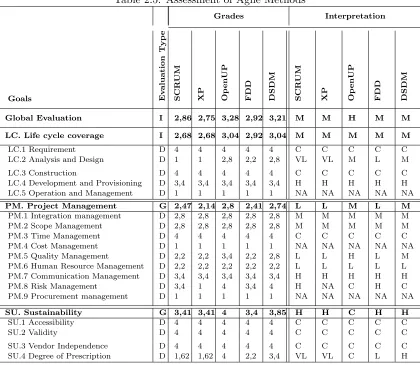
The dimensions are measured indirectly through the application of the Formula 4.1. As a result, the best grade was obtained by OpenUP, and it is in the range of “Medium”. However, Scrum, XP, FDD, and DSDM only obtained “Low”.
These results are shown in Table 2.5 and Figure 2.3.
Figure 2.3: Comparison among the dimensions of the Agile Methods
Table 2.5: Assessment of Agile Methods
Grades Interpretation
Goals Ev
aluation
T
yp
e
SCR
UM
XP Op
enUP
FDD DSDM SCR
UM
XP Op
enUP
FDD DSDM
Global Evaluation I 2,86 2,75 3,28 2,92 3,21 M M H M M
LC. Life cycle coverage I 2,68 2,68 3,04 2,92 3,04 M M M M M
LC.1 Requirement D 4 4 4 4 4 C C C C C LC.2 Analysis and Design D 1 1 2,8 2,2 2,8 VL VL M L M LC.3 Construction D 4 4 4 4 4 C C C C C LC.4 Development and Provisioning D 3,4 3,4 3,4 3,4 3,4 H H H H H LC.5 Operation and Management D 1 1 1 1 1 NA NA NA NA NA PM. Project Management G 2,47 2,14 2,8 2,41 2,74 L L M L M
PM.1 Integration management D 2,8 2,8 2,8 2,8 2,8 M M M M M PM.2 Scope Management D 2,8 2,8 2,8 2,8 2,8 M M M M M PM.3 Time Management D 4 4 4 4 4 C C C C C PM.4 Cost Management D 1 1 1 1 1 NA NA NA NA NA PM.5 Quality Management D 2,2 2,2 3,4 2,2 2,8 L L H L M PM.6 Human Resource Management D 2,2 2,2 2,2 2,2 2,2 L L L L L PM.7 Communication Management D 3,4 3,4 3,4 3,4 3,4 H H H H H PM.8 Risk Management D 3,4 1 4 3,4 4 H NA C H C PM.9 Procurement management D 1 1 1 1 1 NA NA NA NA NA
SU. Sustainability G 3,41 3,41 4 3,4 3,85 H H C H H SU.1 Accessibility D 4 4 4 4 4 C C C C C
SU.2 Validity D 4 4 4 4 4 C C C C C
Life Cycle Coverage Dimension
The major pitfall of these methods are that they do not encompass the scarce of documentation, and they do not encompass the Operation and Management phase. Moreover, they do not embrace the service publication, and Scrum and XP do not comprise the Analysis and Design Phase.
The best grade in this dimension has been reached by OpenUP.
Project Management Dimension
The project management is generally applied in short iterations that may be documented or not in these AMs. In addition, the activities of tracking, and controlling projects can be informal [34, 35].
The goals of “Cost Management” and “Procurement Management” are not addressed by neither of these methods. Moreover, the “Time Management” is the most achieved goal for all these methods.
The most highest score in this dimension has been reached by OpenUP.
Sustainability Dimension
OpenUP has completely fulfilled the goals of this dimension. The next best grade is (i.e “High”) was reached by DSDM.
The goal of “Documentation” is the weakness of the Scrum and XP, then, they has achieved “Very Low”. Moreover, FDD has achieved “Low” in this goal.
2.2.7 Overview of the Agile Methods
The insufficient documentation is a problem with AMs which focus on code instead of producing documentation. Thus, they could not meet the requirements of quality standard such as ISO certifi-cate, and Capability Maturity Model and Integration CMMI [36]. Moreover, the knowledge gets lost when either the developers leave the organization or system development has been outsourced. The large and/or complex systems maintenance, and the new members team training can be difficult or impossible without documentation [35, 11].
The analysis phase is not included by XP and SCRUM. In addition to this, neither of the AMs involves the maintenance phase.
AMs normally organizes the project activities in short iterations, but may not be documented. The project monitoring and control is not always be well-organized. Additional to this, other areas do not covered by AM are quality assurance, and configuration management [34]. The weakness in the quality control mechanisms is critical in software development where software failures can injure human or cause economic damage [35].
Besides, AMs require customers side-to-side with developers who should participate in daily meet-ing to be updated about the project progress. This practice requires some level of IT maturity that should be hard to find n developing countries. Moreover, it can not be applied by distributed teams, which are the common situations for e-government applications.
2.3
Service Oriented Methods
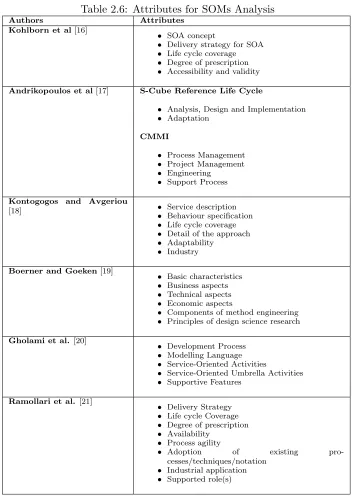
Various researches have focused on the service oriented methods (SOMs) such as Kohlborn et al [16], Andrikopoulos et al [17], Kontogogos and Avgeriou [18], Boerner and Goeken [19], Gholami et al [20], and Ramollari et al. [21].
Table 2.6: Attributes for SOMs Analysis
Authors Attributes
Kohlborn et al[16]
• SOA concept
• Delivery strategy for SOA
• Life cycle coverage
• Degree of prescription
• Accessibility and validity
Andrikopoulos et al[17] S-Cube Reference Life Cycle
• Analysis, Design and Implementation
• Adaptation
CMMI
• Process Management
• Project Management
• Engineering
• Support Process
Kontogogos and Avgeriou
[18] • Service description
• Behaviour specification
• Life cycle coverage
• Detail of the approach
• Adaptability
• Industry
Boerner and Goeken[19]
• Basic characteristics
• Business aspects
• Technical aspects
• Economic aspects
• Components of method engineering
• Principles of design science research
Gholami et al.[20]
• Development Process
• Modelling Language
• Service-Oriented Activities
• Service-Oriented Umbrella Activities
• Supportive Features
Ramollari et al. [21]
• Delivery Strategy
• Life cycle Coverage
• Degree of prescription
• Availability
• Process agility
• Adoption of existing pro-cesses/techniques/notation
• Industrial application
• Supported role(s)
All these related works examined SOMs under perspective of a set of attributes which are shown in Table 2.6.
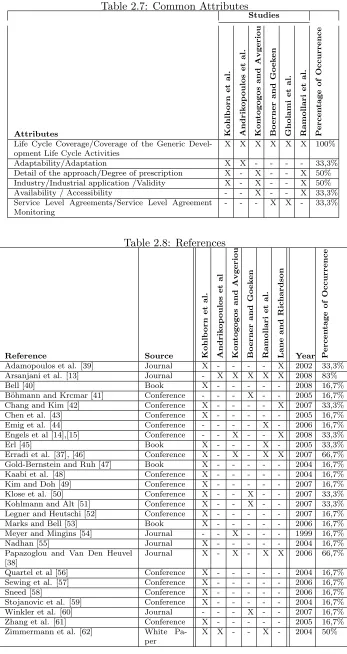
There are common attributes among the studies, despite they may have different denomination. The similarities are listed in Table 2.7 which shows that the attribute “Life Cycle Coverage” was the only one attribute included by all the studies.
Table 2.7: Common Attributes Studies Attributes Kohlb orn et al . Andrik op oulos et al. Kon togogos and Avgeriou Bo erner and Go ek en Gholami et al. Ramollari et al. P ercen tage of Occurrence
Life Cycle Coverage/Coverage of the Generic Devel-opment Life Cycle Activities
X X X X X X 100%
Adaptability/Adaptation X X - - - - 33,3% Detail of the approach/Degree of prescription X - X - - X 50% Industry/Industrial application /Validity X - X - - X 50% Availability / Accessibility - - X - - X 33,3% Service Level Agreements/Service Level Agreement
Monitoring
- - - X X - 33,3%
Table 2.8: References
Reference Source Kohlb
orn et al . Andrik op oulos et al Kon togogos and Avgeriou Bo erner and Go ek en Ramollari et al. Lane and Ri c h ardson
Year Percen
tage
of
Occurrence
Adamopoulos et al. [39] Journal X - - - - X 2002 33,3% Arsanjani et al. [13] Journal - X X X X X 2008 83% Bell [40] Book X - - - 2008 16,7% B¨ohmann and Krcmar [41] Conference - - - X - - 2005 16,7% Chang and Kim [42] Conference X - - - - X 2007 33,3% Chen et al. [43] Conference X - - - 2005 16,7% Emig et al. [44] Conference - - - - X - 2006 16,7% Engels et al [14],[15] Conference - - X - - X 2008 33,3% Erl [45] Book X - - - X - 2005 33,3% Erradi et al. [37], [46] Conference X - X - X X 2007 66,7% Gold-Bernstein and Ruh [47] Book X - - - 2004 16,7% Kaabi et al. [48] Conference X - - - 2004 16,7% Kim and Doh [49] Conference X - - - 2007 16,7% Klose et al. [50] Conference X - - X - - 2007 33,3% Kohlmann and Alt [51] Conference X - - X - - 2007 33,3% Legner and Heutschi [52] Conference X - - - 2007 16,7% Marks and Bell [53] Book X - - - 2006 16,7% Meyer and Mingins [54] Journal - - X - - - 1999 16,7% Nadhan [55] Journal X - - - 2004 16,7% Papazoglou and Van Den Heuvel
[38]
Journal X - X - X X 2006 66,7%
Quartel et al [56] Conference X - - - 2004 16,7% Sewing et al. [57] Conference X - - - 2006 16,7% Sneed [58] Conference X - - - 2006 16,7% Stojanovic et al. [59] Conference X - - - 2004 16,7% Winkler et al. [60] Journal - - - X - - 2007 16,7% Zhang et al. [61] Conference X - - - 2005 16,7% Zimmermann et al. [62] White
Pa-per
Our analysis differs from the previous works in three main aspects. First, we selected the SOMs to be analysed through the application of a set of criteria over the upshot of a systematic literature review proposed by Lane and Richardson [63]. The systematic literature review defined research questions, a search process, and both inclusion and exclusion criteria of methods. It obtained 57 SOMs and some of them were also mentioned in the related works (see Table 2.9). A brief description of the systematic literature review is presented in the next section.
Second, our analysis was addressed according to an evaluation framework that involves a measure-ment process, measures, scales, and formula [23, 5]. Finally, we proposed a set of attributes, including the common attributes of the related works, not just related with the technical–methodological di-mension but also with project management and sustainability. Moreover, we separated into phases the common attribute of “Life Cycle Coverage” in order to get a deeper analysis.
The first step towards the analysis is the collection and the selection of SOMs which require being performed in rigorous way. We adopted a systematic literature review (SLR). For this reason, our work is based on the SLR conducted by Lane and Richardson [63]. The protocol of this SLR is composed of the following topics:
a) Research question. One primary question was defined, and it is “What software processes models8 are proposed for developing SBAs (service-based applications)?”. This question aims to identify the processes (methods) for developing SBAs, in which we are also interested. Thus, it retrieved the methods published until October 2009.
b) Data source. The papers were got from the following electronic databases:
• IEEE Explore
• ACM Digital Library
• ISI Web of Knowledge
• SpringerLink
• ScienceDirect
• Wiley InterScience
c) Search string. The primary question was separated into list of terms to carry out the search in the electronic databases. The logical operator “OR” was used to include synonyms for each term, and the operator “AND” to link together each set of synonyms. The string was applied to the abstracts contained in the databases, and it is the following:
(“software process” or “software engineering process” or “engineering process” or “engineering methodology” or “sose framework” or soad or soma or “architecture framework” or “architecture
frameworks” or “engineering methodology” or “development technique” or “development approach” or “development methodology” or “development process” or “development processes” or “development lifecycle” or “development life cycle” or “process model” or “process framework”
or “development model” or “development framework” or sdlc or cmm or cmmi or 15504 or spice or 12207 or 15288) and ( sba or sose or soa or based” or “service based” or “service-oriented” or “service “service-oriented” or “service-centric” or “service centric” or “service computing”
or “service engineering”) [63].
d) Study selection. The search retrieved 722 papers. Then the title and abstracts of the papers retrieved were read in order to filter them according to inclusion and exclusion criteria. Thus, the papers were reduced to 77 which were read completely, and then from these papers 20 were excluded again. Finally, the outcomes of SLR were 57 papers.
e) Data extraction. The data extraction was supported by MS Access9. The papers gathered are 57, and they were published between the years 2004 and 2009. Table 2.9 shows the retrieved papers.
f) Data synthesis. SRL has addressed the two research questions.
We take the studies and the information given about them by the SRL to include them in Microsoft EXCEL template. Figure 2.4 shows the EXCEL template in which we can note that the first 6 columns were given in SRL’s Table 5. This template was used to filter the studies again according to the following criteria:
Figure 2.4: Template used to filter
C.1 We assumed that the more relevant studies appear in journal or conference. Thus, we only included the studies from those sources. Consequently, we kept out 11 studies.
C.2 We included only those methods whose origin were the service oriented computing (SOC) or business-driven-development (BDD); being both areas closely related, and considering the indi-cation of some studies which reported the SOC methods were bit mature [63, 21, 20]. Thus, we excluded those methods which are extensions of other paradigms such as the agent oriented devel-opment (AOD), aspect oriented (AO), and model driven develdevel-opment (MDD). MDD approaches comprehend collaborative modelling (CM) [91], semantic modelling (SM) [101], context aware (CA) [107], and web based (WbB) [64]. Thus, 29 approaches were left.
C.3 The methods for SOC found in the literature can focus on the construction of service, service-based applications (SBAs), or both [63]. This study encompasses those to develop SBAs which must cover at least the requirement engineering, analysis and design, and construction . Therefore, 16 studies were quit.
Table 2.9 provides a classification of all the studies in accord with these criteria.
Finally, we obtained six SOMs whose papers were read completely for analysis. These SOMs are the Service Oriented Modelling and Architecture (SOMA) [13], the Service Oriented Architecture Framework (SOAF) [37], the Service-Oriented Design and Development Methodology (SODM) [38], the Quasar Enterprise Method (QEM) [14], [15], the proposals of Demchak et al. (DEM) [78], and Lamparter et al. (LAM) [96].
These SOMs are summarized in the next subsections.
9
Table 2.9: Lane and Richardson References
Reference Source Origin Coverage Criteria Selected Adamopoulos et al. [39] Conference SOC Service C.5 N Anaby-Tavor et al. [64] Conference WbB Service C.2 N Arsanjani et al. [13] Journal SOC SBA - Y Arsanjani and Allam [65] Conference SOC Service C.3 N Autili et al [66] Conference MDD Service C.2 N Bahler et al. [67] Conference MDD SBA C.2 N Bercovici et al. [68] Conference MDD Service C.2 N Bicer et al. [69] Symposium SOC Service C.1 N Bocchi et al. [70] Workshop SOC Service C.1 N Boukadi et al. [71] Conference MDD Service C.2 N Chang and Kim [72] Conference SOC Service C.3 N Chang and Kim [42] Conference SOC Service C.4 N Chengjun [73] Conference MDD Service C.2 N Christou et al. [74] Journal SOC Service C.3 N Colombo et al. [75] Conference SOC Service C.3 N De Castro et al. [76] Journal MDD Service C.2 N Delessy et al. [77] Conference MDD Service C.2 N Demarchk et al. [78] Conference SOC SBA - Y Deubler et al. [79] Conference MDD Service C.2 N Deubler et al. [80] Conference MDD Service C.2 N Dori [81] Workshop MDD Service C.1 N Engels et al [15], [14] Conference SOC BDD - Y Erradi et al. [37] Conference SOC BDD - Y Fernandez et al. [82] Workshop SOC Service C.1 N Hong-Mei [83] Journal SM SBA C.2 N Howard and Kerscgverg
[84]
Journal SM SBA C.2 N
Huigui et al. [85] Conference SOC Service C.3 N Ivanyukonich et al. [86] Journal SOC Service C.5 N Johnson et al. [87] Conference MDD Service C.2 N Kambhampaty [88] Conference SOC Service C.3 N Karam et al. [89] Journal SOC Service C.3 N Karhunen et al. [90] Conference SOC Service C.3 N Karle and Oberweis [91] Conference CM SBA C.2 N Kenzi et al. [92] Conference MDD Service C.2 N Koehler et al. [93] Workshop BDD SBAs C.1 N Kruger and Mathew [94] Conference AO Service C.3 N K¨urger [95] Workshop MDD Service C.1 N Lamparter and Sure [96] Conference SBA SOC - Y Lu and Chabra [49] Workshop AOD Service C.1 N Lopez et al. [97] Workshop MDD Service C.1 N Meisinger and Kruger [98] Conference SOC Service C.3 N Mittal [99] Thesis MDD Service C.2 N Nguyen et al. [42] Journal SOC Service C.2 N Orriens et al [100] Conference MDD SBA C.2 N Pahl [101] Journal SM Service C.2 N Papazoglou and Heuvel
[38]
Journal SOC SBA - Y
2.3.1 Service Oriented Modelling and Architecture
Service Oriented Modelling and Architecture (SOMA) provides guidances, techniques, and best prac-tices to support the development of service-based applications (SBAs) [13]. It has a fractal life cycle which is composed by seven not lineal phases: Business Modelling and transformation, Identifica-tion, SpecificaIdentifica-tion, RealizaIdentifica-tion, Solution Management, ImplementaIdentifica-tion, Deployment, Monitoring and Management.
Its major activities are Service Identification, Specification, and Realization. TheService Identi-ficationfocuses on identifying a list of candidate services to support the development of requirements. The identification is carried out using techniques such as Goal-Service Modelling, Domain Decompo-sition, and Existing Asset Analysis.
TheService Specificationselects the services to be developed from the list of candidate services, and then it describes them. The description encompasses dependencies, flows, services composition, events, rules and policies, operations, messages, non-functional requirements, and state management decisions.
The Realization builds prototypes and carries out feasibility exploration to verify the decisions. Moreover, it chooses pattern categories including information service patterns, enterprise service bus (ESB), and rule patterns.
SOMA is proprietary of IBM, and it has been applied in this company’ projects [13].
2.3.2 Service Oriented Architecture Framework
Service Oriented Architecture Framework (SOAF) is a framework for defining, designing, and realizing Service Oriented Architecture. It provides a set of activities which are carried out during five phases. The phases are Information Elicitation, Service Identification, Service Definition, Service Realization, and Roadmap and Planning [37].
SOAF includes techniques and guidelines for identifying services, deciding service granularity, and specifying services.
Besides, SOAF embraces Service Level Agreement (SLA) and Business Level Agreement (BLA).
2.3.3 Service-Oriented Design and Development Methodology
Service-Oriented Design and Development Methodology (SODM) is an iterative and incremental meth-ods, and it is composed of the phases of Planning, Analysis and Design, Construction, Testing, Pro-visioning, Deployment, Execution, and Monitoring [38].
SODM focuses on provisioning, deploying, executing, and monitoring services. It tackles various realization scenarios for business processes, and Web services.
Moreover, it depicts the details of Service Level Agreement (SLA).
2.3.4 Demchak et al.
Demchak et al. (DEM) proposes an iterative process composed of three phases: Service Elicitation, Rich Services Architecture, and System Architecture Definition [78].
The Service Elicitation Phase encompasses the requirements collection which are represented using use cases. From the use cases is built the domain model that includes logical entities, data structures, roles, and other knowledge representations.
The Rich Services Architecture Phase obtains a hierarchic set of Rich Services from the domain model.
2.3.5 Lamparter et al.
Lamparter et al. (LAM) encompasses the phases of Requirements Gathering, Design and Realization, and Evaluation [96].
The Requirements Gathering examines legacy systems and the domain of the application to be developed.
TheDesign and Realizationinvolve the conceptualization of both the market and the ontology. The upshot of this phase are the formal model and ontology formalization.
The Evaluationconsists on testing the application and validating against the requirements.
2.3.6 Quasar Enterprise Method
Quasar Enterprise Method (QEM) is a business driven process for designing and realizing services. It is composed of four processes which are Modelling business services, Designing domains, Designing components, Designing interfaces and operations [14, 15].
The Modelling business services aims at identifying top-level business services, identifying services actions, refining business services, and specifying business services.
The Designing domainsstructures IT architecture according to business services. It defines the activities of apply core business services, apply business dimensions, apply business objects, apply management and support service, and finalize.
The Designing components comprehends the activities of assigning services to domains, cate-gorizing services, refining components, and verifying coverage of components.
The Designing interfaces and operations builds the interfaces and operation of the compo-nents. Besides, it validates the operations completeness.
QEM has been applied in industrial projects [15].
2.3.7 Analysis of the Service Oriented Methods
The measurement has been performed according to the settled evaluation process described in Section 2.1.
We have addressed the analysis from two perspectives: by individual goals; and by dimensions. Both are presented in the next sections.
Analysis of the Goals: Direct Measurement
The grades of the goals leaves are given in direct scale (see Table 2.3). This means that each grade is assigned according to the level of goal accomplishment.
The evaluation for all the goals are presented in the next sub-sections.
SO Service Oriented
This dimension focuses on the goals related with service oriented computing. The outcomes are the presented in the next subsections.
SO.1 Service Description
SOMA describes the services including flows, messages, operation, and non-functional requirements in the Service Specification activity.
SOAF depicts the services with their flows, messages, and operations.
LAM specifies the services with messages, flows, and dependencies.
QEM identifies, and describes service in the step of Analysis of Business Architecture.
Methods SOMA SO
AF
SODM DEM LAM QEM SOMA SOAF SODM DEM LAM QEM Grades 4 4 4 4 4 4 Complete Complete Complete Complete Complete Complete
SO.2 Service Level Agreement
SOMA, DEM, QEM, and LAM do not involve SLAs.
SODM and SOAF gather non-functional requirements, and they monitor and compel their accom-plishment through SLAs [38]. Moreover, SOAF includes the Business Level Agreements (BLA).
Methods SOMA SO
AF
SODM DEM LAM QEM SOMA SOAF SODM DEM LAM QEM Grades 1 4 4 1 1 1 Does Not
Address
Complete Complete Does Not Address
Does Not Address
Does Not Address
SO.3 Service Identification
SOMA proposes three techniques for identifying services: Goal-Service Modelling, Domain Decompo-sition, and Existing Asset Analysis.
SOAF combines top-down domain decomposition along with bottom-up application portfolio anal-ysis to identify services.
SODM identifies and specifies service during its Analysis phase. QEM and LAM deal with service identification as well.
DEM does not involve service discovery.
Methods SOMA SO
AF
SODM DEM LAM QEM SOMA SOAF SODM DEM LAM QEM Grades 4 4 4 1 4 4 Complete Complete Complete Does Not
Address
Complete Complete
SO.4 Service Composition
SOMA composes service using choreography.
SOAF, SODM, and QEM describes service composition with orchestration. LAM and DEM do not involve the service composition.
Methods SOMA SO
AF
SODM DEM LAM QEM SOMA SOAF SODM DEM LAM QEM Grades 4 4 4 1 1 4 Complete Complete Complete Does Not
Address
Does Not Address
Complete
LC. Life Cycle Coverage
We have matched the life cycle of each process with the life cycle proposed by S-Cube [17]. Thus, the results is shown in Table 2.10.
LC.1 Requirement
SOMA encompasses the requirement phase with its Identification phase that embraces activities related with Analysis Phase as well.
Table 2.10: Relation among the phases of SOMs Processes Requirement Analysis and Design Construction Deployment
and Provi-sioning Operation and Manage-ment SOMA [13]
Identification Business Modelling and Transformation; Identification;
Specification; Realiza-tion; Solution Manage-ment Implementation Deployment, Monitoring, and Manage-ment —
SOAF[37] Information Elicitation
Service Identification; Service Definition
Service Realization — —
SODM [38]
Planing Analysis and Design Construction; Testing; Provisioning; Deployment
Monitoring
DEM[78] Service Elicita-tion
Rich Service Ar