Generation of database for development of a control system for
precision seed drill
Prabhat Kumar Guru
1*, Prem Shanker Tiwari
2, Kunj Bihari Tiwari
3,
Atul Shrivastava
4, Rajesh Kumar Naik
5, Brajesh Nare
6(1. Scientist, Central Rice Research Institute, Cuttack, India;
2. Principal Scientist & Head, Agricultural Mechanization Division, Central Institute Agricultural Engineering, Bhopal, India; 3. Assistant Professor, College of Agricultural Engineering, Jawaharlal Nehru Krishi Vishwavidyalaya, Jabalpur, India; 4. Professor & Head, Farm Machinery & Power, College of Agricultural Engineering, Jawaharlal Nehru Krishi Vishwavidyalaya,
Jabalpur, India;
5. Assistant Professor, Swami Vivekanand, College of Agricultural Engineering & Technology, Indiara Gandhi Krishi Vishwavidyalaya, Raipur, India;
6. Scientist on Probation, National Academy of Agricultural Research Management, Hyderabad, India.)
Abstract: The site specific application of seed to maintain crop growth is an essential part of precision agriculture and is
required to minimize the cost of production. In this study the database of selected seeds was generated for the development of precision seed drill to enable variable-rate application with a significant reduced error compared to current seed applicators. The laboratory setup was designed and fabricated and was equipped with a fluted helical roller and a variable speed DC motor with controller. The experiment was conducted for three different exposures, two crops, six varieties, and three different seed sizes. The effect of different hopper filling, exposure length of fluted roller on seed delivery rate was measured and the speed ratio between motor gear to feed shaft for different seed rate of wheat and soybean were recommended. It was found that the seed delivery per revolution of feed shaft for small seed size varieties has more seed delivery rate as compared to medium and bold seed varieties. The database will help in designing a precision seed applicator in future.
Keywords: precision seed drill, helical fluted roller, exposure length of metering system, physical properties of seeds, seed
drill experimental setup
Citation: Guru, P. K., P. S. Tiwari, K. B. Tiwari, A. Shrivastava, R. K. Naik, and B. Nare. 2015. Generation of database
for development of a control system for precision seed drill. Agric Eng Int: CIGR Journal, 17(3): 242-247.
1 Introduction
1In India, the technology of precision agriculture, such
as the variable-rate seed application aims to develop the
capability of site-specific crop management. Seeds
(Wheat & Soybean) are one of the most expensive inputs,
therefore it is important for growers to plant the right
amount of seed to minimize input costs and increase
profitability. Wheat sown at low seed rate of 125 kg
ha-1 had better growth, yield, nutrient uptake and low
Received date: 2015-05-03 Accepted date: 2015-08-04
*Corresponding author: Prabhat Kumar Guru, Scientist,
Central Rice Research Institute, Cuttack, India Email: [email protected].
lodging tendency. Maximum tillers, spike length, grains
spike-1, grain weight spike-1, seed index, biological yield,
grain yield, harvest index, dry matter, crop growth rate and
low lodging were found with seed rate of 125 kg ha-1
(Laghari, 2011). Parish et al. (1972) cited the need
expressed by some soybean growers for a soybean seeder
that combines the narrow row capability and relatively low
cost of a grain drill with a precision spacing of a row crop
seeder. The seed drill includes seed metering unit which
is driven from a ground wheel for metering seed at a rate
proportional to the forward speed of the implement. For
changing the seeding rate either the transmission ratio
between the ground wheel and the drive shaft connected to
September, 2015 Generation of database for development of a control system for precision seed drill Vol. 17, No. 3 243
wheels is shifted the drive shaft transversely within the
meter housing to adjust the effective metering area of the
wheels. Therefore it has been very difficult for the
operator to calculate the exact seeding rate and to precisely
adjust the seeding rate when moving to a new field or
when changing seed varieties and it has been practically
impossible to change the seeding rate on the go for
varying conditions. Sohn (2004) performed studies on
physical properties of granular fertilizer and design factors
of the controller for variable-rate application. He
suggested a motor control method in order to improve the
performance of the controller. The researchers
constructed and tested a prototype soybean metering unit
using the seed bed principle. Karayel and Ozmerzi (2002)
stated that the best sowing uniformity, the most uniform
sowing depth and maximum emergence percentage
occurred when a precision seeders was used after
preparing the soil with a mouldboard plough, disc harrow,
and roller. One of the solutions to overcome of this
major cause of variation in application rate of seeds would
be provided power to the metering unit shafts through a
constant torque variable speed motor powered by tractor
battery. Zhuang and Komatsu (1996) developed a feed
control device in which the feed shaft speed of a seeder or
a fertilizer applicator can be controlled according to the
running speed signals from a ground wheel. The speed
of motor could be synchronized with the speed of
operation either by ideally rotating toed wheel or by using
a ground speed sensor. For designing the precision seed
applicator, it is necessary to know the amount of seed
delivered per revolution of fluted feed roller, so we
developed a laboratory setup of seed drill to measure the
effect of operation speed and metering unit exposure
length on seed delivery rate and recommend the optimum
exposure length for desired seed rate. The database
generated will be useful for designing a precision seed
drill for soybean and wheat crop.
2 Material and methods
The study was conducted in Farm Mechanization
division, Central Institute of Agricultural Engineering,
Bhopal, India. Three popular wheat varieties HI 8498, HI
306, and HI 8627 and three popular soybean varieties JS
9560, JS 9305, and JS 335 were selected for the study.
The impurities of seeds were removed manually and each
variety of seed was graded in three grade sizes. The
physical properties of seeds were determined before the
start of the experiment.
2.1 Design development and fabrication of laboratory
setup of seed drill
Auto-cad design and drawing were used for the
fabrication of the setup. The base join with the main
frame was fabricated by joining the two Mild Steel
L-angle of size 100×20×10 mm. The total height of
main frame was 400 mm, a supporting frame joint with the
main frame at 300 mm height. Another lower supporting
L-angle is added for more strength and tightness of frame.
The seed box was made up of 2 mm mild steel sheet.
The seed box having three sections were made as per
designed. A rectangular opening was providing in a
lower part of hopper for connecting the housing of
metering unit. The metering unit with housing was
connected with the hopper by 3 mm bolts. The seed
delivery tube was connected with the housing.
The shafts of seed metering device having 15 mm
diameter and 350 mm length cold rolled round section
steel shaft was taken. Two smooth holes were provided
for shaft at both ends. The metering device, helical roller
(Figure 1) was made up of 15 mm thick white nylon with
30 mm exposure length. The numbers of helix on roller
are 12 and the depths of helix were 8 mm. The cover of
helical roller was made with the aluminum and it
completely covered the helical roller so that the seed were
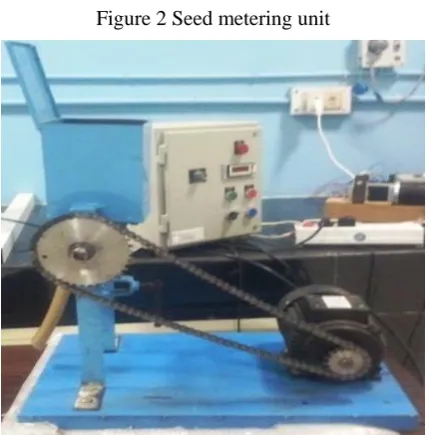
smoothly going through seed delivery tube (Figure 2).
The DC motor was attached in base at 140 mm from the
front side. The small sprocket of motor and big sprocket
of feed shaft were attached through the chain drive. The
centre-to-centre distance of two sprockets was 350 mm.
motor and placed near the setup (Figure 3). The
experimental setup was placed at suitable height of
operation so that the hopper filling was easily done.
Figure 1 Fluted roller with helical grooves
Figure 2 Seed metering unit
Figure3 View of experimental setup
2.2 Test procedure
2.2.1 Seed damage percentage
1 kg sample of soybean and wheat were randomly
selected and passed through the metering device and seed
tubes, the number of seeds that were damaged
mechanically including any significant bruising, skin
removal or crushing were counted.
2.2.2 Effect of hopper filling on seed delivery rate
An experiment was conducted for measurement of
effect of hopper filling on seed delivery rate. Three
different levels of hopper filling were used for test; first
for 1/3rd hopper filling, half hopper filling and full hopper
filling. The setup was run for one minute and the
amount of seed delivered in one minute is measured.
2.2.3 Effect of different exposures on seed delivery
The test conducted for three different exposure
lengths of fluted roller. At full exposure, 3/4th exposure
and half exposure and the exposure length was 30 mm,
22.5 mm and 15 mm, respectively. For more accuracy
of the experiment, three replications of each reading were
taken and averages of these readings are taken for final
database.
2.2.4 Calculation of speed ratio
The ratio between ground wheels of tractor (motor
gear) to the feed shaft was measured to feed the speed
ratio in DSS. The process of calculating speed ratio:
Seed Rate =Q kg/ha
Row spacing= R cm
Speed = S km/h
Quantity drops in one revolution of fluted roller= Qr
(g)
𝐷𝑖𝑎𝑚𝑒𝑡𝑒𝑟 𝑜𝑓 𝑚𝑜𝑡𝑜𝑟 𝑔𝑒𝑎𝑟 = 𝐷𝑤 (𝑚)
𝑆𝑝𝑒𝑒𝑑 𝑅𝑎𝑡𝑖𝑜 =𝑁𝑓 𝑁𝑤
𝑅𝑃𝑀 𝑜𝑓 ℎ𝑒𝑙𝑖𝑐𝑎𝑙 𝑟𝑜𝑙𝑙𝑒𝑟 𝑁𝑓 =𝑄 × 𝑅 × 𝑆 60 × 𝑄𝑟
September, 2015 Generation of database for development of a control system for precision seed drill Vol. 17, No. 3 245
3 Result and discussion
3.1 Effect of different exposures on seed delivery
The experiment conducted for three different
exposures, two crops, six varieties, and their different
seed sizes (Figure 4, Figure 5 and Figure 6). The result
found that the different exposure, crop, variety and size
are significantly different at 1 % level of significance
(Table 1). The seed size affected the seed delivered per
revolution of feed shaft at all three selected exposure
lengths.
Figure 4 Seed deliverd per revolution (g) of feed shaft for soybean and wheat at full exposure
Figure 5 Seed deliverd per revolution (g) of feed shaft for soybean and wheat at 3/4th exposure
Figure 6 Seed deliverd per revolution (g) of feed shaft for soybean and wheat at half exposure
Table 1 ANOVA for effect on seed delivery rate for different exposures, crops, varieties, and seed sizes
Source DF SS MSS F -Value Pr> F tab
Exposure (E) 2 321.24 160.62 7419.22 <0.0001
Crop (C) 1 10.41 10.41 480.86 <0.0001
Variety (V) 4 36.87 9.21 425.83 <0.0001
Size (S) 6 9.65 1.60 74.29 <0.0001
E x C 2 0.72 0.36 16.69 0.0003
E x V 8 1.11 0.14 6.42 0.0023
E x S 12 0.33 0.027 1.29 0.3331
V x S 6 0.88 0.15 6.78 0.0025
0 5 10 15 20 ˃ 5.6 5.5 -5.6 ˂ 5.5 ˃ 5.6 5.5 -5.6 ˂ 5.5 ˃ 4.75 3.2 -4.7 5 ˂ 3.2
JS 9560 JS 9305 JS 335
Soybean Se e d d e liv e re d ,g 0 5 10 15 20 ˃ 3.2 2.8 -3.2 ˂ 2.8 ˃ 3.2 2.8 -3.2 ˂ 2.8 ˃ 3.2 2.8 -3.2 ˂ 2.8
HI 8498 HI 306 HI 8627
Wheat Se e d d e liv e re d ,g 0 5 10 15 20 ˃ 5.6 5.5 -5.6 ˂ 5.5 ˃ 5.6 5.5 -5.6 ˂ 5.5 ˃ 4.75 3.2 -4.7 5 ˂ 3.2
JS 9560 JS 9305 JS 335
Soybean Se e d d e liv e re d ,g 0 5 10 15 20 ˃ 3.2 2.8 -3.2 ˂ 2.8 ˃ 3.2 2.8 -3.2 ˂ 2.8 ˃ 3.2 2.8 -3.2 ˂ 2.8
HI 8498 HI 306 HI 8627
Wheat Se e d d e liv e re d ,g 0 5 10 15 20 ˃ 5.6 5.5 -5.6 ˂ 5.5 ˃ 5.6 5.5 -5.6 ˂ 5.5 ˃ 4.75 3.2 -4.7 5 ˂ 3.2
JS 9560 JS 9305 JS 335
Soybean Se e d d e liv e re d ,g 0 5 10 15 20 ˃ 3.2 2.8 -3.2 ˂ 2.8 ˃ 3.2 2.8 -3.2 ˂ 2.8 ˃ 3.2 2.8 -3.2 ˂ 2.8
HI 8498 HI 306 HI 8627
3.2 Recommendation of exposure length
Recommendation of exposure length is made
according to the actual amount of seed delivery per meter
length and the required amount of seed per meter length.
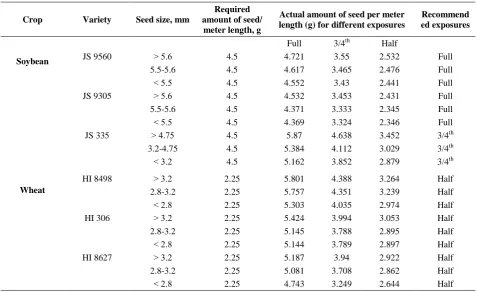
Table 2 shows the recommendation of different exposures
for 100 kg/ha seed rate and 45 cm row spacing of
soybean and 22.5 cm row spacing of wheat.
3.3 Speed ratio for different exposure length of fluted
roller
Figure 7 shows the speed ratio at different exposure
lengths. The speed ratio shows in the figure is
calculated for 100 kg/ha seed rate with row spacing of 45
cm for soybean and 22.5 cm for wheat.
4 Conclusions
The seed delivery per revolution of feed shaft for
small seed size varieties has more seed delivery rate as
compared to medium and bold seed varieties. For
soybean JS 335 variety the seed delivery rate is more as
compared to the JS 9560 and JS 9305. The seed
delivery rate of wheat seed HI 8498 is more than the
other two varieties HI 306 and HI 8627. The
Table 2 Recommendation of fluted roller exposure for different seed rate
Crop Variety Seed size, mm
Required amount of seed/
meter length, g
Actual amount of seed per meter length (g) for different exposures
Recommend ed exposures
Soybean
Full 3/4th Half
JS 9560 ˃ 5.6 4.5 4.721 3.55 2.532 Full
5.5-5.6 4.5 4.617 3.465 2.476 Full
˂ 5.5 4.5 4.552 3.43 2.441 Full
JS 9305 ˃ 5.6 4.5 4.532 3.453 2.431 Full
5.5-5.6 4.5 4.371 3.333 2.345 Full
˂ 5.5 4.5 4.369 3.324 2.346 Full
JS 335 ˃ 4.75 4.5 5.87 4.638 3.452 3/4th
3.2-4.75 4.5 5.384 4.112 3.029 3/4th
˂ 3.2 4.5 5.162 3.852 2.879 3/4th
Wheat
HI 8498 ˃ 3.2 2.25 5.801 4.388 3.264 Half
2.8-3.2 2.25 5.757 4.351 3.239 Half
˂ 2.8 2.25 5.303 4.035 2.974 Half
HI 306 ˃ 3.2 2.25 5.424 3.994 3.053 Half
2.8-3.2 2.25 5.145 3.788 2.895 Half
˂ 2.8 2.25 5.144 3.789 2.897 Half
HI 8627 ˃ 3.2 2.25 5.187 3.94 2.922 Half
2.8-3.2 2.25 5.081 3.708 2.862 Half
˂ 2.8 2.25 4.743 3.249 2.644 Half
September, 2015 Generation of database for development of a control system for precision seed drill Vol. 17, No. 3 247
recommended exposure length of fluted roller for wheat
is low (15 mm). The recommended exposure length of
fluted roller for soybean variety JS 335 is 22.5 mm and
soybean variety JS 9560 and JS 9305 are 30 mm. The
speed ratio for bolder varieties of soybean and wheat are
more as compared to smaller seeds. The speed ratio for
soybean JS 335 is less and for wheat variety HI 8627 is
less as compared with HI 8498 and HI 306.
References
Laghari, G.M., F.C. Oad, S. Tunio, Q. Chachar, A.W. Ghandahi, M.H. Siddiqui, S.W. Hassan and A. Ali.(2010). Growth and yield attributes of wheat at different seed rates. Sarhad Journal of Agriculture. 27(2): 177-183.
Parish, R. L. 1972. Development of narrow row vertical planter. Transaction of American Society of Agricultural Engineering, 15(A):636-637.
Sohn. S. Y. 2004. Development of a control system for variable-rate application of granular fertilizers. Unpublished master’s thesis.Agricultural Machinery Engineering Dept. Seoul National University. Seoul. Korea. Karayel, D., and A. Ozmerzi. (2002). Effect of tillage methods
on sowing uniformity of maize. Canadian Biosystems Engineering, 44(1): 2.23-2.26.