Concentration of Control Rights in Leveraged Loan Syndicates*
Mitchell Berlin, Greg Nini, and Edison G. Yu**
First Draft: April 1, 2016
Printed: April 29, 2017
Abstract
Corporate loan contracts frequently concentrate control rights with a subset of lenders. In a large fraction of leveraged loans, which typically include a revolving line of credit and a term loan, the revolving lenders have the exclusive right and ability to monitor and renegotiate the financial covenants in the governing credit agreements. Concentration is more common in loans that include nonbank institutional lenders and in loans originated subsequent to the financial crisis, when recognition of bargaining frictions increased. We conclude that concentrated control rights maintain the benefits of lender monitoring and minimize the costs of renegotiation associated with larger and more diverse lending syndicates.
* This is a revised version of “Learning and Contract Evolution: The Case of Leveraged Loans.” We thank Viral Acharya, Yeejin Jang (discussant), Justin Murfin, Michael Roberts, Richard Rosen (discussant), Anjan Thakor, and seminar participants from Drexel, the Drexel-Lehigh-Temple-Delaware Research Symposium, the Federal Reserve Bank of Philadelphia, George Mason, and the University of Nebraska for helpful com-ments and suggestions, although we are solely responsible for any errors. We thank Matthew Accardi and Michael Slonkosky for outstanding research assistance. The views expressed in this paper are our own, and not necessarily those of the Federal Reserve Bank of Philadelphia or the Federal Reserve System.
One striking development in the $4 trillion syndicated loan market has been the marketing of bank-originated term loans to nonbank intermediaries such as hedge funds, collateralized loan obli-gations (CLOs), and mutual funds.1 Another closely related development has been the marketing of so-called “covenant-lite” loans — loans without traditional financial covenants — first during the period of credit expansion in 2005-2007 and more recently, as the pace of commercial lending quickened in 2012-2014. Some observers have interpreted covenant-lite loans as sign of a decline in the role of banks in monitoring and renegotiating contracts.2 Moreover, the rapid growth of leveraged lending in the recent period has caught the attention of bank regulators concerned about the possibility of declining credit standards, which prompted regulators to impose restrictions on the origination of leveraged loans in 2013.3
In this paper, we empirically examine a large sample of loan contracts to understand whether the leveraged loan market has evolved to supplant the role of banks in monitoring and renegotiating loan contracts. More generally we seek to better understand the economics of lending arrangements with multiple creditors by examining how the presence of nonbank lenders in leveraged loan syndicates has affected the structure of loan contracts.
Specifically, we examine the financial covenants in a large set of credit agreements governing leveraged loans issued during the years 2005 through 2014. The typical structure of a leveraged loan deal includes multiple tranches, most commonly a term loan and a revolving line of credit. The line of credit is predominately funded by commercial banks, and the term loan is often marketed to nonbank investors.4 Although we do confirm a sharp rise in loan tranches lacking traditional financial covenants, we show that very few loan deals are issued without any financial covenants. Even if the term loan lacks financial covenants, the line of credit nearly always contains traditional financial covenants. Despite the tranches sharing similar cash flow rights, including a senior and secured position in the borrower’s capital structure, the revolving lenders are often given the
unilat-1
The league tables provided by Thomson Reuters reports $4 trillion of syndicated loan is-suance during 2016, with about one-half of the total coming from the United States. See http://share.thomsonreuters.com/general/PR/Loan 4Q 2016 E.pdf.
2For examples, see Becker and Ivashina (2016) and Billett et al. (2016). We discuss the literature below. 3
In March 2013, the Office of the Comptroller of the Currency, the Board of Governors of the Federal Reserve System, and the Federal Deposit Insurance Corporation issued “Interagency Guidance on Leveraged Lending,” which proposed “sound practices for leveraged finance activities.” The original guidance pointed to “the absence of meaning-ful maintenance covenants in loan agreements” and “the participation of unregulated investors” as factors motivating the new guidelines. See https://www.federalreserve.gov/bankinforeg/srletters/sr1303a1.pdf for details.
4
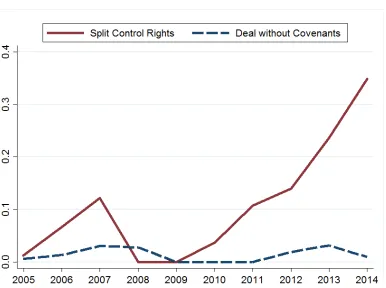
Figure 1: Covenant-Lite Tranches and Deals
Note: The figure shows the annual proportion of leveraged loan deals that contain no financial maintenance covenants in any tranche (blue, dashed line) and that contain split
control rights (red, solid line) .
eral right to waive or amend the covenants without consulting the term lenders. The consequence of this structure is to concentrate control rights with the revolving lenders, which we refer to as
split control rights.5
Figure 1 highlights the difference between deals with split control rights and deals that lack covenants entirely. Based on a sample of more than 900 leveraged loan deals that we describe in detail below, the figure shows the annual fraction of deals that contain split control rights (red, solid line), meaning that the revolving lenders have the unilateral right to waive or amend the financial covenants, and the fraction of deals that contain exclusively covenant-lite tranches (blue, dashed line). The incidence of split control rights rose sharply following the financial crisis, from zero in 2009 to about 35 percent by 2014. However, the incidence of completely covenant-lite deals barely changed in recent years and remained less than 2 percent across all deals in our sample.
We begin by looking for evidence that split control rights are associated with less monitoring,
but instead we find that borrowers with loans that have split control rights are still subject to the discipline of financial covenants. We examine the realized frequency of covenant violations and find borrowers with split control rights violate covenants at a rate similar to borrowers with financial covenants on all tranches in the deal. We conclude that split control rights is best interpreted as a concentration of control rights rather than a relaxation of monitoring by lenders, which maintains the benefits of borrower monitoring by giving the revolving lenders sole discretion following a covenant violation, including the decision whether to waive the violation, amend the terms of the agreement, or enforce additional rights granted by the event of default.
We conjecture that split control rights help minimize bargaining frictions within lending syndi-cates. We hypothesize that the presence of a large set of nonbank institutional investors increases bargaining frictions. Institutional tranches of leveraged loans have a larger and more diverse set of lenders, fewer repeated interactions to foster relationship benefits, and a secondary market that permits lenders to change during the life of the loan. We show that, indeed, the usage of split control rights is concentrated in deals that have a term loan tranche designed for funding by insti-tutional lenders. Across our whole sample, the rate of split control rights is nearly four times as large among deals with an institutional tranche.
Our primary empirical challenge is to establish whether the expected costs of renegotiation, as proxied by the presence of an institutional tranche, have a causal effect on the usage of split control rights. We begin by arguing that the sharp rise in split control rights following 2009 reflects an increase in the recognition of renegotiation costs following the experience of the financial crisis. A 2010 article from The Secured Lender highlights the difficulties faced by syndicates that included nonbank lenders:
“In 2009, the lending industry departed even further from the halcyon days when syn-dicates of lenders functioned in a unified and cooperative way. In an increasing number
of situations, some lenders have found that their most troublesome conflicts were not
with their borrower, but with other co-lenders in the facility.”6
In response to these challenges, corporate loan contacts evolved to make renegotiation easier. As prima facie evidence, the 2014 version of the Loan Syndications and Trading Association’s (LSTA)
Model Credit Agreement Provisions (MCAP), a model syndicated loan contract reflecting standard market conventions, was updated to include a provision meant to ease renegotiation of the maturity of a loan.7 We provide evidence that this provision, along with a separate provision to facilitate the renegotiation of the pricing of a loan, was nearly non-existent prior to the financial crisis but is now used in about one-half of deals. Moreover, the rise is concentrated in deals with an institutional tranche, in line with the description of these provisions in the LSTA’s Complete Credit Agreement Guide:
“[B]oth of these provisions permit a borrower to modify maturity, pricing, and other key terms on a portion of its debt without having to seek the unanimous lender consent
...Particularly in a broadly syndicated loan with many disparate lenders, meeting the
required consent threshold is difficult at best.”8
We then show that the growth in split control rights shown in Figure 1 has occurred exclusively among deals with an institutional tranche, which we attribute to the increased recognition of renegotiation costs. Indeed, split control rights is only significantly related to the presence of an institutional tranche during the 2011-2014 period. We conclude that the experience of the financial crisis accelerated the adoption of split control rights as a way to maintain the traditional benefits of bank lending — monitoring and renegotiation — while accommodating the presence of institutional lenders that provide a substantial portion of the supply of term loans.
We rule out alternative explanations for the correlation between split control rights and the presence of institutional lenders that emerges during the latter period. We find no evidence that the nature of leveraged lending borrowers has changed over time, which suggests that changes in the contract structure are not due to changes in loan demand or borrower composition. We also show that deals with institutional tranches have experienced no changes in other contract terms — interest rate, amount, or maturity — that would suggest alternative supply-side explanations for the rise in split control rights. Finally, we show that the causal interpretation of an institutional tranche on split control rights is robust to a large degree of correlation between omitted factors that could be an alternative explanation for the result.
7
The 2014 MCAP updated the previous version from 2011. We describe the contractual provisions, known collo-quially as “amend and extend,” in detail below.
Apart from our substantive findings, our paper makes a methodological contribution by carefully accounting for all of a firm’s loans, rather than looking at the term loans in isolation. Our approach adopts the view that lenders and borrowers write term loan contracts with a full understanding of the firm’s revolving lines of credit and vice versa. Our analysis is based on the credit agreements that govern a large sample of leveraged loan deals for which we manually read the credit agreements to avoid relying on standard databases for information about covenants. In the Appendix, we show that our data on financial covenants is more accurate than that provided by Dealscan and provide guidance on how to best use Dealscan data related to covenants. Furthermore, reading the loan contracts uncovers a broad set of contract terms that sheds light on the underlying economics of multicreditor lending.
In the next section, we discuss the existing literature concerning the economic purposes of financial covenants, the emerging literature on covenant-lite loans, and the broader literature on models of multi-creditor lending. Many existing multi-creditor models were conceived prior to the emergence of nonbank institutional investors and are not fully appropriate for the current institutional environment. Section II provides some background on the growth of the leveraged loan market and the contractual provisions that are the main topic of our paper. Section III describes our data and sample construction. In Section IV, we document the frequency of split control rights and show that firms with split control rights are still monitored by covenants. Section V shows that the incidence and growth of split control rights are concentrated in deals with institutional investors and attributes the change to renegotiation costs. Section VI explores some alternative explanations, and Section VII offers some conclusions and directions for further research.
I.
Literature Review
Our paper provides evidence supporting models that identify covenants and renegotiation as essen-tial features of bank lending. Following the classic paper by Smith and Warner (1979), a number of theoretical models show that covenants act as ex-ante tripwires that trigger monitoring by the lender, who can then either impose default or renegotiate the terms of the contract.9 Subsequently, a series of papers have established empirically that covenant violations occur frequently outside
of serious financial distress and that they typically trigger renegotiation.10 Furthermore, covenant violations lead to significant ex-post changes in firm behavior, evidence that actual and prospective covenant violations act as a trigger for bank monitoring.11 Consistent with a large literature that has consistently found positive abnormal positive stock returns when a firm announces a new bank loan issue, beginning with James (1987), Nini et al. (2012) has documented that bank monitor-ing through covenants benefits other firm claimants.12 More generally, Roberts (2015) has shown empirically that renegotiation of bank loans is pervasive quite apart from actual or prospective covenant violation.
The growth of the institutional loan market poses serious challenges for this well documented model of bank lending, in which monitoring and renegotiation are closely related features of bank lending. We expect a large syndicate composed of institutional investors holding small shares of the loan to have difficulties in coalescing around a common bargaining stance, much less renegotiating loan terms every nine months as documented by Roberts (2015). Consistent with anecdotal accounts from market participants of negotiating frictions during the financial crisis, Demiroglu and James (2015) and Osborn (2014) have found that bankruptcy is more likely for firms with syndicates including nonbank lenders, especially syndicates including CLOs.13
Our empirical evidence that institutional loan syndicates have evolved to concentrate control rights has some similarities with other recent research on leveraged lending and covenant-lite loans, but we view the differences as fundamental. Like Becker and Ivashina (2016), we explore the implications of bargaining frictions in loan syndicates with nonbank lenders. In their interpretation, covenant-lite loans mitigate bargaining frictions by reducing the probability of covenant violations and subsequent bargaining by banishing financial maintenance covenants entirely to turn syndicated loans into an instrument more like bonds. In contrast, our evidence supports the view that covenant-lite term loans are best interpreted as a mechanism to concentrate control rights with the revolving lenders. The main difference in our empirical approaches is that we account for all of the borrowing firm’s loans while they consider the term loans in isolation. Inconsistent with their interpretation,
10
See, for example, Beneish and Press (1995); Dichev and Skinner (2002); Roberts and Sufi (2009); Roberts (2015).
11See, for example, Chava and Roberts (2008); Nini et al. (2009); Roberts and Sufi (2009). 12
Related, Carey and Gordy (2016) find that the recovery value of nonbank debt claims in bankruptcy increases with the share of bank loans in a firm’s debt debt structure.
13
our evidence shows that covenant violations do not occur less frequently in those contracts with split control rights. That is, covenant violations are not less for firms that have a covenant-lite term loan.
Our interpretation and empirical evidence also differs from Billett et al. (2016), who view a covenant-lite contract as a mechanism to bypass the agent bank when intra-syndicate conflicts are severe. In their model, covenants are removed entirely to reduce the costs of intra-syndicate conflicts, even if the lack of covenants exacerbates borrower moral hazard. This model is inconsistent with our evidence that firms with a covenant-lite term loan universally have a revolving loan that is governed by covenants, so the agent bank maintains the covenant control rights granted in the revolving loan.
Our findings also shed light on models of multi-creditor lending. Our evidence that institu-tional loan contracts are designed to mitigate bargaining frictions when there are many creditors is generally inconsistent with the model in Bolton and Scharfstein (1996). In their model, firms with very risky cash flows borrow from multiple creditors to create intra-creditor bargaining frictions to prevent strategic default. Conversely, our results say that, in the leveraged loan market, bargaining frictions are not a positive feature of nonbank lenders but rather a cost to be minimized through contract design. Our empirical results also raise questions for multi-creditor models in which the priority of the bank’s claim over other creditor claims is key to promoting efficient monitoring and renegotiation.14 In the leveraged loan market, we find that contracts are designed to concentrate control rights with the revolving lenders despite the term loan creditors having equal priority with the revolving lenders. In fact, deals with split control rights tend to be concentrated in highly leveraged borrowers and have a very large term loan relative to the revolving loan, which dilutes the expected recovery of the revolving lenders in the event of a bankruptcy filing.
Our empirical results best support the theories of banking in which liquidity provision through lines of credit is the key feature that makes bank lending unique, notably, Kashyap et al. (2002) and Gatev and Strahan (2006). These models emphasize the complementarity between deposit taking and providing lines of credit. Since credit lines create the potential for borrower moral hazard due to the insurance provided by the fixed interest rate spread, covenants are a natural component of
14
revolving loans.15 There is a natural complementarity between the two roles of banks, the provision of liquidity and monitoring borrowers, which we confirm empirically remains true in the modern leveraged loan market. Although the growth in the institutional market suggests that nonbank intermediaries are at no disadvantage in supplying term loans, banks continue to specialize in providing liquidity by retaining the line of credit and retaining control rights that permit them to monitor efficiently.
II.
Background
A. Leveraged Loan Market
A syndicated loan is characterized by a syndicate of lenders jointly providing funding to a single borrower. A typical deal is arranged by a single or small set of lead lenders who solicits the syndicate members and structures the lending arrangement. After the original financing, a single lender will serve as the agent for the syndicate to help coordinate payments, the flow of information between the borrower and the lenders, and any renegotiation. Each lender, however, retains the authority to vote on any changes to the governing agreement during the life of the loan.
The leveraged loan market refers to those syndicated loans made to relatively risky borrowers, much as the junk bond market is the portion of the corporate bond market for relatively risky bond issuers. Although there is no universal definition of a leveraged loan, Loan Pricing Corporation (LPC) defines a leveraged loan as a syndicated loan that is rated BB+ or lower, or an unrated loan with an interest-rate spread larger than 150 basis points.16 We adopt this definition throughout the paper.
A unique feature of the leveraged loan market since the early 2000s has been the increase in participation of nonbank institutional investors such as CLOs and mutual funds.17 Figure 2 highlights this trend in two ways. The blue solid line shows that the fraction of syndicated loans held by nonbanks increased from less than 10% in 2001 to nearly 20% by 2008. This series is based on aggregate data from the Shared National Credits (SNC) program administered by U.S.
15
See Shockley and Thakor (1997) for a model that highlights the insurance provided by credit lines and Sufi (2009) for empirical evidence that covenants serve to limit access to existing credit lines. Acharya et al. (2014) argue that covenants and credit line revocations are part of the cost of the liquidity insurance provided by credit lines.
16This cutoff has been adjusted over time with market conditions. 17
Figure 2: Institutional Investors in Syndicated Loans
Note: The figure shows the annual share of commitments in the Shared National Credits review provided by nonbanks (blue, solid line) and the annual fraction of facilities in
Dealscan designated for institutional investors (red, dashed line). The SNC data is available at https://www.federalreserve.gov/supervisionreg/snc.htm.
regulatory agencies, so it reflects the experience of large syndicated loans to borrowers of all risk levels. The red dash line shows that the fraction of newly originated leveraged loan facilities intended for institutional investors increased from less than 10% in 2001 to about 25% by 2008. Although new issuance fell sharply following the financial crisis, the SNC data shows that the level of outstanding loans provided by nonbanks has remained constant at around 20% to 25% of total syndicated loans.
“term loan A.”18
As an example of a typical leveraged loan deal, consider the April 2014, $1.2 billion loan financing the spinoff of Time Inc. from Time Warner Inc. The deal was arranged by Citibank, JP Morgan, Morgan Stanley, and Wells Fargo, who each helped underwrite the deal.19 The deal included a $500 million revolver with a 5-year maturity and a $700 million institutional term loan with a 7-year maturity. Each tranche offered a floating rate of interest tied to LIBOR; the revolver paid an additional spread of 225 basis points, and the term loan offered a spread of 325 basis points. Each is a senior, secured obligation of the borrower backed by a lien on all of Time’s assets. Dealscan identifies the term loan as a tranche intended for institutional investors. For example, we confirm that CLOs owned more than $260 million of the term loan by the end of 2015.20
Figure 3 shows the quarterly time series of syndicated loan issuance from 2003 through the end of 2015. Loan issuance fell sharply around the financial crisis and subsequent recession. Leveraged loans, in particular, show two periods of sharp growth, the first from 2004 through 2007 and the second beginning in 2012 and reaching a peak in early 2014. The variation during each of the periods is driven primarily by swings in the institutional portion of the market, which grew faster during the waves and fell further during the crisis. The first wave subsided with the financial crisis, and the second wave prompted a regulatory response from the primary banking regulators. In March 2013, the Federal Reserve, Federal Deposit Insurance Corporation, and Office of the Comptroller of the Currency issued guidance on leveraged lending in response to “periods of tremendous growth in the volume of leveraged credit and in the participation of unregulated investors.”21 Our analysis sample spans the years 2005 through 2014, but much of the analysis is a comparison of contract terms between the first wave and the second wave.
B. Financial Covenants
We collect the details of the financial covenants from the credit agreements that govern a sample of leveraged syndicated loans, which we describe in Section III.A. Here we provide an overview of
18These tranches are referred to as “pro rata” since lenders typically fund the identical proportion of each tranche. 19
Citibank has served as the administrative agent for the deal.
20This is based on data from CLO-i.com. The ownership data is based on reports from October, November, and
December 2015. Roughly 100 different CLOs in the sample owned the Time term loan, but no CLO owned any of the revolver.
21
Figure 3: Issuance of Syndicated Loans
the covenants we collect from the contracts.
Covenants generally come in three forms: affirmative covenants, negative covenants, and finan-cial covenants. Affirmative covenants refer to the set of activities that the borrower must make, such as paying taxes or complying with laws. Negative covenants specify actions that the borrower can not take, such as disposal of assets or granting liens on existing assets. Financial covenants refer to accounting-based conditions that test the borrower’s financial position or recent performance. In each case, failure to comply with a covenant, including a financial covenant, leads to an event of default, which provides the lenders with additional legal rights, including the right to call the loan.22
Financial covenants can be one of two types, depending on when the firm needs to be in compliance with the test. Incurrence covenants are only triggered if some contractually specified event actually occurs. For example, a widely used incurrence covenant limits the leverage ratio of the borrower in the event that the borrower issues additional new debt above some level. Absent the occurrence of a triggering event, the incurrence-based financial covenants do not apply. Maintenance covenants, on the other hand, require that the borrower needs to maintain compliance at periodic intervals over the life of the loan, regardless of whether any events occur. Financial maintenance covenants are typically monitored quarterly but the monitoring frequency is determined by the contracting parties.23
We collect data on maintenance financial covenants, since the monitoring and renegotiation triggered by maintenance covenants distinguish bank loans from other types of debt, which typically have incurrence covenants. Indeed, our reading suggests that loan tranches without maintenance covenants do have incurrence covenants, but we leave the study of incurrence covenants to future research.
Financial covenants can refer to almost any item on a firm’s balance sheet or income state-ment, but there are a few standard covenants that appear in many contracts. The most common covenants are tied to an agreed definition of the borrower’s cash flow available for debt service, typically defined as earnings before the deduction of interest, taxes, depreciation and amortization
22
See Wight et al. (2009) for additional discussion of loan covenants and the rights granted in the event of a default.
23In some cases, the monitoring of the maintenance covenants depends on the utilization of the borrower’s line of
(EBITDA).24There are other types of financial maintenance covenants that are based on net worth, asset coverage, and various liquidity measures.
C. Split Control Rights
As we discovered in the process of reading credit agreements, the provisions of a loan contract can be different for separate tranches in the same deal. In particular, the financial covenants in a deal may apply to only a subset of the tranches in a deal. We refer to these cases assplit control rights, since the arrangement means that the financial covenant can be waived or modified by only a subset of the syndicate lenders. In the event of a covenant violation, these lenders have the unilateral right to negotiate with the borrower about how to cure the default.
Split control rights can be accomplished through two means. First, the deal can can be governed by multiple credit agreements that have different financial covenants. For example, a firm with a pre-existing line of credit may issue a new term loan that does not have any financial maintenance covenants. If the revolving loan contains financial maintenance covenants, then the revolving lenders are still protected by the existing covenants and the associated contingent control rights. Roughly two-thirds of deals with split control rights are accomplished through multiple contracts.
Second, a single credit agreement that contains financial maintenance covenants can give the lenders in a specific tranche the unilateral right to decide whether to waive or modify the financial covenant. In the credit agreement governing the Time loan described above, the borrower is bound by a maximum senior leverage ratio financial covenant, which prohibits the borrower from having a “Consolidated Secured Net Leverage Ratio as of the last day of any Test Period to be higher than 2.75 to 1.00.”25 However, the next paragraph in the credit agreement writes:
“The provisions of this Section 7.08 are for the benefit of the Revolving Credit Lenders only and the Required Class Lenders for the Revolving Credit Facility may amend, waive
or otherwise modify this Section 7.08 or the defined terms used for purposes of this
Section 7.08 (but solely for such purposes) or waive any Default resulting from a breach
of this Section 7.08 without the consent of any Lenders other than such Required Class
24
In many cases, the definition of EBITDA for the purpose of loan covenants is different than the GAAP definition.
25The complete credit agreement is available in Time Inc.’s Form 10-12B filed with the SEC on May 8, 2014 and
Lenders in accordance with the provisions of clause (iv) of the second proviso of Section
10.01(a).”
The contract makes clear that the borrower will renegotiate exclusively with the revolving lenders regarding the financial covenant.26 In the Online Appendix, we provide an additional example of split control rights accomplished within a single credit agreement. Roughly one-third of deals with split control rights are accomplished within a single contract.
In some cases, we find that the types of covenants or the level of specific covenant are different across the tranches in a deal, which happens when the tranches are governed by separate credit agreements. For example, the revolving loan may contain a fixed charge coverage ratio, and the term loan may contain a maximum leverage covenant.27 Since control is allocated differently for different covenants, we choose not to define these deals as having split control rights.28
For our sample contracts, we collect data on the existence of any financial maintenance covenant and the tranches excluded from control, if any, through split control rights. In our sample of deals with split control rights, we did not find a single case in which the revolving lenders were excluded from covenant-related decisions.29 In the subsequent analysis, reference to split control rights should be interpreted as a provision that excludes a term loan tranche from the control provided by covenants.
III.
Loan Issuance Data
This section describes the sample of loan deals that we construct, with some additional details provided in the Appendix. The ultimate goal is to generate a sample of loan financing events along with data on the contract choices settled on by the borrower and lenders.
26In cases in which split control rights is accomplished within a single agreement, the agreement typically modifies
the definition of “required lenders,” which is the number of lenders required to modify terms in the contract. Required lenders are often defined as any set of lenders holding greater than 50% of the sum of outstanding loans and unused credit commitments. In a credit agreement covering multiple tranches without split control rights, the required lenders would include lenders from all of the tranches. In a credit agreement with split control rights, only a majority of the lenders from a specific tranche are required to waive or modify a default on the financial covenants.
27
In about 2% of deals, we find that the tranches have the same covenant set at different levels. In each of these cases, the covenant is tighter for the revolving loan.
28
All of our results are qualitatively similar, and tend to be quantitatively stronger, if we define these deals as having split control rights.
29
A. Loan Contract Sample
We begin by constructing a sample of loan “deals” using LPC’s Dealscan database, where we define a deal as the set of loan facilities that are current on the same day to the same borrower.30 We use the concept of a deal under the assumption that the contracts governing these facilities are designed with mutual awareness. We examine only deals that contain at least one term loan facility and at least one facility considered a leveraged loan, as defined in Dealscan.
Our sample spans from 2005 through 2014. Because we hand-collect data from the underlying credit agreements, we limit the span of the sample to minimize data collection. However, as shown in Figure 3, issuance of institutional loans was relatively high at the beginning and end of this period.
After imposing some restrictions (described in the Appendix) to construct a sample of fairly homogeneous loans and firms, we are left with nearly 8,700 leveraged loan deals. For this sample, we attempt to collect the credit agreement that governs each of the facilities in the deal. We focus on borrowers that were likely public at the time of the loan, since SEC filings are the ultimate source of the loan contracts.31 In total, we find contracts for 966 of the deals.
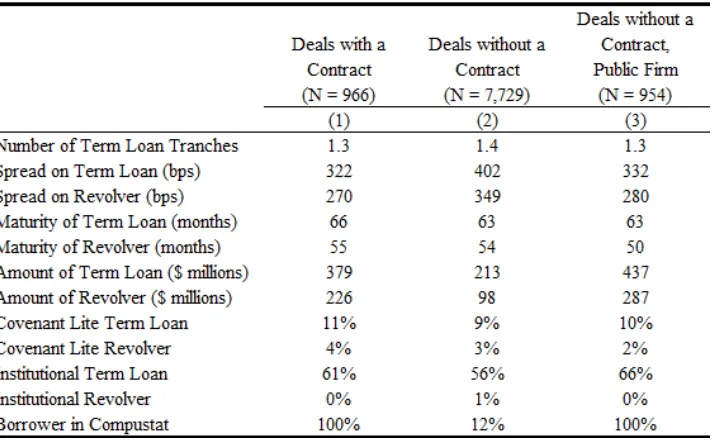
Since we have a credit agreement for about 11% of the full deal sample, Table I provides some summary statistics to assess the representativeness of our sample credit agreements, based exclusively on data from Dealscan. Column (1) provides sample means for the set of deals for which we have a contract, and column (2) provides sample means for all other deals. Based on the sample means, the deals with a contract are significantly larger and less risky, based on the differences in loan amounts and interest rate spreads. The most notable difference, however, is that deals without a contract are significantly less likely to have a borrower with data in Compustat.32 Nearly 90% of deals without a contract are for borrowers that were likely private at the time of the loan. Based on this evidence, we conclude that the predominant reason that we fail to find a loan contract is that the borrower is not a public firm so the agreement is not publicly available.
Column (3) of Table I provides sample means for the set of deals without a contract but for
30In terms of fields in Dealscan, we identify a deal using facilityStartDate and borrowerCompanyID. A deal does
not correspond perfectly to a loan package, since a borrower can have multiple packages beginning on the same date.
31We define a likely public firm as one that we can merge with data from Compustat from the year-end immediately
prior or immediately subsequent to the loan issue date.
32
Table I: Comparison of Deals With and Without a Contract
Note: This table reports summary statistics for the full set of leveraged loan deals. A
loan deal refers to all facilities issued on the same date. A Deal with a Contract is one for which we have the governing loan agreement; an issue without a contract is all other issues. A Deal without a Contract, Public Firm is the subset of deals for which we find a
Compustat observation from the year-end before or following issuance. The data are from Dealscan.
which the firm has Compustat data. Within the set of firms with Compustat data, we have a contract for about one-half of deals. Moreover, the means for loan spreads and loan amounts are quite close in columns (1) and (3), suggesting that the set of loans for which we have a contract is fairly representative of the set of loans to public borrowers. Finally, according to Dealscan’s measure of whether a loan is covenant-lite, our sample of deals with contracts has a similar fraction of covenant-lite term loans and revolvers as the sample of firms without contracts. We conclude that our results concerning the prevalence of financial covenants are not driven by the fact that we only observe contracts for a subset of firms.
B. Contract Data
issued credit agreement and code the contract as if it was issued on the same day.33 For the remaining 5% of deals, we cannot find a revolving loan contract and believe that many of these are for firms that truly do not have a line of credit.34 We exclude these from our analysis, including in column (1) of Table I. Based on the covenant-lite indicator in Dealscan, less than 5% of these term loan only deals are covenant-lite, which is less than one-half of the rate for deals that include a revolver. Based on the small fraction of deals without a revolver, and the small fraction of term loan only deals that are covenant-lite, including these deals would not change the conclusion from Figure 1 that there are very few leveraged loan borrowers that completely lack financial covenants. For each of the leveraged loan deals for which we have a contract, we manually read all of the contracts related to the deal, including any previously issued revolving loans, if needed. The final output is two unique pieces of data for each deal: (1) an indicator that the deal contains zero financial maintenance covenants, and (2) an indicator that the deal has split control rights.
The advantage of the hand-collected data is that we have more accurate data than is available in Dealscan. In the Appendix, we compare our hand-collected data with what could be constructed from Dealscan and show that Dealscan often fails to identify deals that truly do have split control rights. We also show how our empirical results could best be replicated using data exclusively from Dealscan.
C. Additional Data
We use Dealscan to provide some additional data about the facilities covered in each loan deal. Dealscan provides information on the amount, maturity, and pricing of the individual tranches. Al-most all of the loans have a floating interest rate tied to LIBOR, and Dealscan provides information on the spread over LIBOR that the borrower must pay. We collect this information for all term loan tranches and all revolving tranches separately. Dealscan also provides information on whether the term loan is marketed to institutional investors.35 Although the Dealscan definition surely does not capture perfectly which lenders are funding a tranche, it does indicate that a tranche is
33For the revolvers issued before the term loans, we also searched for intervening changes to the revolvers in Capital
IQ to make sure that we have the most up-to-date information about the revolver contract.
34The small fraction of deals without a line of credit should not be surprising. Sufi (2009) finds that roughly 85%
of public firms have a line of credit, and that this fraction is even higher for firms that have debt outstanding, as all firms in our sample do.
35
more likely to be funded by institutional investors. Moreover, we think the intended investor is the important distinction since the contract will be tailored with the intended investor in mind.
In Section V, we explore the ownership of CLOs as an example of nonbank participation in our sample deals, using data provided by CLO-i.36 CLO-i is a product of Creditflux that provides data on CLOs based on the trustee reports provided by CLOs to their investors. The trustee reports include data on the portfolio of loans owned by the CLO. We collect the holdings of each loan in our sample as of the most recent year-end period following the origination of the loan that is also at least 6 months after origination.37 Using this data, we have information on whether the loan appears in any CLO portfolio, the number of CLOs that own the loan, and the total holdings of the CLO universe. This data is only available for loans issued since 2011.
We also merge our sample of borrowers to Compustat and Capital IQ. Using Compustat and Capital IQ, we collect data on the balance sheets, income statements, and debt structures for the borrowers shortly before and after the loan was issued.
IV.
The Rise in the Split Control Rights
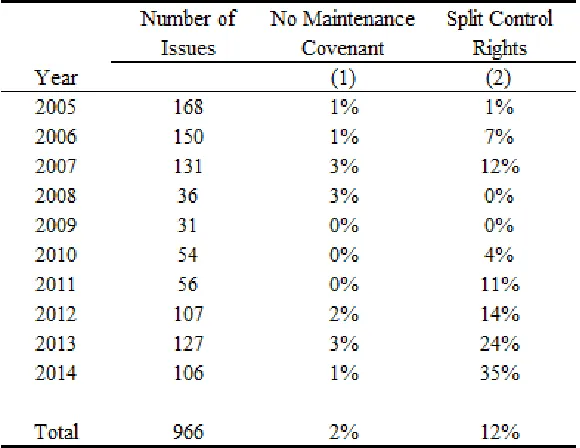
We begin by documenting the concentration of control rights through the presence of split control rights. Table II presents the annual time series of the frequency of loans with no maintenance covenants and with split control rights.38 Column (1) shows that nearly every deal contains at least one maintenance covenant, meaning that most borrowers must be in regular compliance with some financial covenant. Across the entire sample, the frequency of deals with no maintenance covenants is only 2% and has not risen in recent years. Column (2) shows, however, that the frequency of split control rights has risen sharply in recent years. Across the 10 year sample, 14% of deals have split control rights, but the incidence has been more than twice that rate during 2013 and 2014. By the end of the sample, more than one-third of leveraged loan deals have split control rights.
36
Dealscan has limited data on the participants in the syndicate at loan origination and no data on trades in the secondary market, so we do not rely on Dealscan lender data to measure the syndicate structure.
37We require the year-end period to be 6 months following origination to allow the loan some time to settle into
CLO portfolios.
Table II: Concentration of Control Rights
Note: This table reports the annual frequency of deals with no
main-tenance covenants and deals with split control rights in the sample of leveraged loan deals that include both a term loan and a revolver. Col-umn (1) reports the fraction of deals with no maintenance covenant in
any tranche in the deal, and column (2) reports the frequency deals with split control rights, meaning that the revolving lenders have the unilat-eral right to waive or amend a covenant. The data are compiled by the
A. Are Loans with Split Control Rights still Monitored?
In order to bolster our interpretation that split control rights serve to concentrate control rights rather than reduce creditor monitoring, we next examine the disclosures that firms make regarding loan covenants, including the disclosure that the borrower has violated a financial covenant. We use disclosures in 10-K filings following the issuance of the loan and use the experience of borrowers without split control rights to determine whether borrowers with loans that have split control rights seem less constrained by covenants.39
For each deal in our sample, we find in EDGAR the second10-K following the loan origination date and borrow the methodology from Nini et al. (2012) to identify each instance a firm mentions a covenant and each reported violation.40 Across the sample, we find a 10-K filing for about 90% of our sample; the mean number of covenant mentions is 3.5 per filing, and about 8% of firms report a covenant violation.41
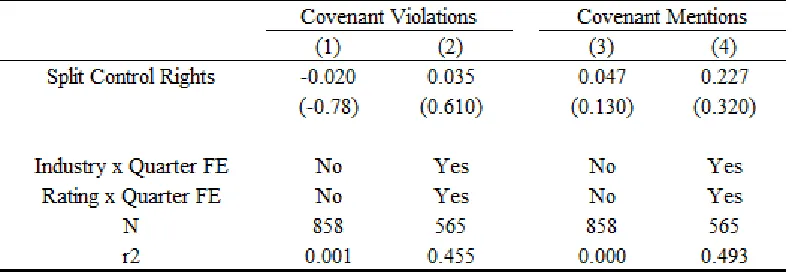
Table III reports an estimate of the correlation between split control rights and realized covenant-related disclosures, based on OLS regressions. Columns (1) and (2) report the results for covenant violations, and columns (3) and (4) report the results for covenant mentions. Specifications (2) and (4) include a full set of fixed effects for the combination of industry and quarter of issuance and for the combination of credit rating and quarter of issuance.42 We include these fixed effects to account for variation in the propensity to violate a covenant due to borrower risk and general economic conditions. The estimates in columns (1) and (2) show that there is no significant rela-tionship between split control rights and the subsequent realized frequency of covenant violations. The point estimates are close to zero, and the estimated confidence intervals comfortably surround zero.
In our sample, more than 6% of firms with split control rights report a covenant violation in the
39
We exclude firms with loans that have no maintenance covenants from this analysis.
40We use the second 10-K for two reasons. First, firms are unlikely to violate a covenant immediately following the
origination of the loan. Second, 10-K filings often discuss matters related to the entire fiscal year, so any covenant-related discussion in the immediately following 10-K might refer to a prior loan agreement. Within each 10-K, we automatically search the filing for the word “covenant” within 100 words of the the following phrases: “waiv,” “viol,” in default,” “modif,” and “not in compliance.” The requirement that “covenant” be located near the additional terms reduces the number hits that are unrelated to covenants in loan agreements. Based on the discovered mentions of a covenant, we manually read the relevant passages to confirm whether the firm violated a covenant or not. We record the number of mentions of the phrase “covenant” along with an indicator that the firm violated a covenant.
41
We lose 10% of the sample because the borrower stops filing with the SEC.
second year after issuing the loan. For instance, consider the experience of Southcross Energy Part-ners, who entered into a $650 million leveraged loan on August 4, 2014. The deal was backed by two credit agreements, one for a $200 million revolving loan and a separate agreement for a $450 mil-lion term loan. Although the term loan contract contained no financial maintenance covenants, the revolving agreement included a leverage, senior leverage, and interest coverage covenant. Roughly nine months following issuance, Southcross entered into an amendment of the revolving credit fa-cility to relax the strictness of the covenants, and in their 10-Q filing for the period ending June 30, 2015, Southcross writes “As of June 30, 2015, we determined that we will not be in compliance with the consolidated total leverage ratio for our financial covenants” and describes some of the actions taken in preparation for a violation.43 Despite the lack of maintenance covenants in the term loan, Southcross was still subject to the scrutiny of covenants and forced to renegotiate with the revolving lenders under the threat of default.
The Southcross anecdote and columns (1) and (2) of Table III show that split control rights does not mean that firms are free from the monitoring of revolving creditors. Nevertheless, covenant violations are infrequent, so it may be difficult to detect a significant difference in a relatively small sample. In order to support our inference, columns (3) and (4) report the relationship between split control rights and the number of covenant mentions. Based on the estimates, firms with split control rights do not appear to discuss covenants any less often than other firms; the point estimates, relative to an unconditional mean of 3.5, are very close to zero. This is unsurprising since firms with split control rights still face covenants in their lines of credit, which generates the need for firms to disclose information related to these covenants. As an example of the types of disclosures related to covenants, US Ecology, Inc. disclosed in their 2015 10-K that their credit agreement included a financial maintenance covenant despite the presence of split control rights, writing “The Credit Agreement also contains a financial maintenance covenant, which is a maximum Consolidated Senior Secured Leverage Ratio, as defined in the Credit Agreement, and is only applicable to the Revolving Credit Facility.”44
Based on this evidence, we conclude that the primary purpose of split control right is to allow revolving lenders to set and renegotiate financial covenants independently of the term loan lenders,
43
Southcross Energy Partners, L.P.’s 10-Q, filed on August 7, 2015, is available in EDGAR. Southcross subsequently filed for Chapter 11 bankruptcy protection on March 28, 2016.
Table III: Realized Covenant Related Disclosures
Note: This table displays coefficient estimates from OLS regressions of covenant-related disclosures
on an indicator that the prior loan deal has split control rights. “Covenant Violations” is an indicator that the firm violated a financial covenant, and “Covenant Mentions” is the frequency that the word “covenant” appears in the filing. Industry x Quarter FE refers to fixed effects for the
industry of the borrower interacted with the calendar quarter the deal was originated, and Rating x Quarter FE refers fixed effects for the credit rating of the borrower interacted with the calendar quarter the deal was originated. Standard errors are clustered by calendar quarter and robust to
arbitrary heteroskedasticity. Absolutet statistics in parentheses. * p<0.10, ** p<0.05, *** p<0.01
which serves to concentrate control rights with revolving lenders.
V.
Split Control Rights and Renegotiation Costs
In this section we examine the role of renegotiation costs in the design of a loan to have split control rights. We hypothesize that the presence of an institutional tranche creates scope for renegotiation difficulties, which split control rights can mitigate by concentrating the ability to renegotiate with revolving lenders. Moreover, we hypothesize that the recognition of renegotiation costs increased following the financial crisis, which explains the growth in split control rights documented in Table II. After showing independent support for this hypothesis, we use the combination of the presence of an institutional tranche after the financial crisis to identify the impact of expected renegotiation costs on split control rights.
A. Institutional Deals
Table IV: Institutional Deals and CLO Investors
Note: This table reports summary statistics for CLO holdings for the set of leveraged loan deals with a loan contract, split on whether the deal contains an institutional tranche. The data are compiled from CLO-i for the 2011-2014
sample.
the lending syndicate, it remains a useful measure for expected bargaining difficulties at the time the loan is originated. Indeed, Demiroglu and James (2015) and Osborn (2014) show that the presence of a CLO increases the likelihood that a distressed firm will enter Chapter 11 rather than restructure outside of bankruptcy. The institutional tranche is designed to appeal to institutional investors, with the expectation that the tranche will be widely held and traded in a secondary market. It is this expectation that drives the structure of the credit agreement at the time the loan is originated.
In order to provide some evidence for one type of institutional investor, Table IV shows that deals with an institutional tranche are much more likely to be widely held in portfolios of CLOs. Based on the sample of deals issued since 2011, nearly two-thirds of institutional deals are held by at least one CLO, and more than one-half are held by at least 25 CLOs; the comparable numbers for non-institutional deals are 25% and 9%. Conditional on a CLO owning the loan, the average number of CLOs is more than 3 times as large for institutional deals, with the average syndicate comprised of more than 150 CLOs. On average, a single CLO owns $2 million to $3 million of a loan, and CLOs collectively own a bit less than one-half of the entire deal. To the extent that lenders and borrowers expect renegotiation difficulties to increase with the presence and/or number of CLO investors, the comparison of deal terms across these groups should provide a good sense of how contracts respond to renegotiation costs.
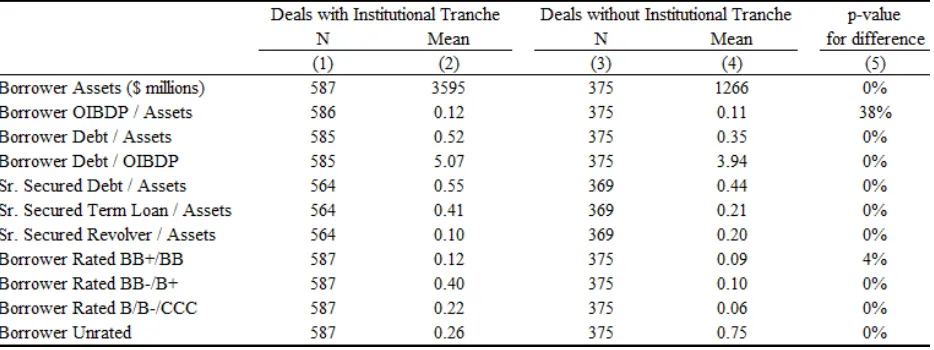
Deals with an institutional tranche may also differ along dimensions unrelated to renegotiation costs, so Table V provides some evidence on how borrowers differ across the groups.45 On average,
45
Table V: Comparison of Deals With and Without an Institutional Tranche
Note: This table reports summary statistics for set of leveraged loan deals with a loan contract, split on whether the deal contains an institutional tranche. The data are compiled from Compustat as of the fiscal year following the
loan issuance. OIBDP stands for operating income before depreciation.
deals with an institutional tranche are used by borrowers that are much larger and have higher leverage, particularly term loan debt. The average institutional borrower is about 2.8 times larger, measured by total assets, and has nearly twice as much term loan debt, relative to total assets. The borrowers with an institutional tranche are also significantly more likely to have a credit rating, and conditional on having a credit rating, institutional borrowers are more likely to have a low credit rating (B/B-/CCC) rather than a higher speculative-grade rating (BB+/BB). There is no significant difference in profitability across the groups, as measured by operating income (OIBDP). The evidence suggests that institutional deals are utilized more heavily by larger and more highly leveraged borrowers who have access to the bond market by virtue of having a credit rating. To the extent that these factors may also explain the usage of split control rights, we control for these factors in subsequent regressions.
B. The Impact of the Financial Crisis on Loan Contracts
the LSTA, which addressed several changes in contracts arising from the financial crisis, one ob-server said, “During the financial crisis, borrowers not surprisingly encountered difficulty achieving unanimous consent from lenders that would modify provisions.”46
We hypothesize that the changes in contracts following the crisis have been more pronounced in deals with an institutional tranche, since these are the deals where easing renegotiation costs is most beneficial. In order to test our hypothesis, we collect data on two additional contract provisions that facilitate renegotiation, each of which became quite common following the financial crisis. We then show that the growth in these provisions has been concentrated in deals with an institutional tranche, which provides evidence that these deals have become viewed as particularly prone to renegotiation difficulties. For each of the loan contracts in our sample, we determine if the term loan is subject to the following two provisions:
1. Amend and Extend. An amend and extend provision allows a borrower to extend the maturity of a portion of a loan without having to obtain the consent of all lenders at the time of the extension. A standard loan agreement requires unanimous consent from all lenders to change the maturity date of the loan. However, with an amend and extend provision, a subset of lenders is permitted to extend the maturity of their own portion of the loan without the requiring the consent of non-extending lenders. Without this provision, even a small minority of lenders can stop a firm from extending the maturity of any portion of the loan. This provision would allow just a portion of institutional lenders to extend the maturity of the institutional tranche. In the Online Appendix, we provide an example of the specific language in an amend and extend provision.
2. Refinancing Facility. A refinancing provision permits the borrower to add a new loan tranche using an existing credit agreement, provided that the proceeds are used to refinance a portion of the existing loan. Most syndicated loans allow the borrower to prepay a loan with little or no penalty, but a credit agreement without a refinancing facility requires that any prepayments must be made on a pro-rata basis to all existing lenders. A refinancing provision permits a borrower to refinance with a subset of lenders, usually to obtain a lower interest rate. The Online Appendix contains an example of a credit agreement that permits
a refinancing facility.
Each of these provisions reduces the hurdle for renegotiating a loan. The amend and extend provision, in particular, has been included in loan agreements as a direct response to the experience of the financial crisis. Bellucci and McCluskey (2017) describe the evolution as,
“Following the occurrence of the financial crisis, borrowers faced uncertain and illiquid loan market conditions... As a refinancing alternative, borrowers sought to extend the
maturities of their existing loans... If the amendment provisions of the applicable credit
agreement required a unanimous rather than required lender vote, as a practical matter
an amend and extend transaction would likely not be possible... Over time, new credit
agreements started to include mechanics that are referred to as amend and extend
trans-actions that permit the required amendments to be effected with the consent of only the
extending lenders...”47
We examine the pattern of these provisions to provide an indication of when, and for which loans, market participants designed contracts to facilitate renegotiation. Since the provisions are quite similar, we create a single indicator that a deal has either an amend and extend provision or permits a refinancing facility.48 Figure 4 plots the annual frequency of deals that have an amend and extend provision or a refinancing facility option. The solid, red line plots the annual frequency for deals that have an institutional tranche, and the dashed, blue line plots the annual frequency for deals without an institutional tranche. These provisions were extremely rare prior to the financial crisis in 2008; we find only a handful of contracts that permit an amend and extend. Following the crisis, however, the frequency of these provisions has risen steadily over time, particularly for deals with an institutional tranche. Although deals without an institutional tranche sometimes include these provisions, the rate of inclusion has been about twice as large for institutional deals. We conclude from this evidence that the recognition of renegotiation costs increased following the financial crisis more for institutional deals than other deals.
As an initial piece of evidence that renegotiation costs are an important factor determining split control rights, we note that the correlation between an amend and extend or refinancing provision
47
Quote taken from pages 63 and 64 of Bellucci and McCluskey (2017).
48
Figure 4: Institutional Investors and Alternative Contract Provisions
and split control rights is quite high. During the four year period at the end of our sample (2011-2014), the frequency of an amend and extend or refinancing provision is 44%. However, for deals that contain split control rights, the frequency increases to 74%. Similarly, the frequency of split control rights is only 11% for deals without an amend and extend or refinancing provision but 40% for deals with such a provision. These provisions are strongly positively correlated, which we take as evidence that they are addressing the same underlying friction.
C. Renegotiation Costs and Split Control Rights
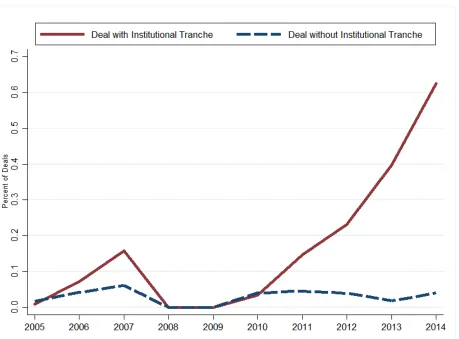
Based on the evidence in Figure 4, we use as a measure of expected renegotiation costs the combi-nation of a deal containing an institutional tranche and being issued after 2010. Figure 5 provides initial evidence that split control rights responds sharply to this measure of renegotiation costs. The figure shows the annual frequency of split control rights for the set of deals with an insti-tutional tranche (red, solid line) and those without (blue, dashed line) and highlights the sharp difference between the experience of the two groups. For deals without an institutional tranche, split control rights is very uncommon and has not become more common in recent years. For deals with an institutional tranche, however, split control rights has become much more common over time. The similarity of the time series pattern documented in Figure 4 suggests that a common factor is driving each of the provisions, which we attribute to increased recognition of renegotiation costs.
In order to better measure the relationship between institutional loans and split control rights, we estimate regressions to control for other differences between the deals. Since split control rights is a dummy variable, we estimate the following probit model:
Splitit= 1 α·Institutionalit+Xit0β+εit>0
, (1)
where Splitit is an indicator that a deal has split control rights, 1() is the indicator function that
Figure 5: Split Control Rights and Institutional Investors
panel nature of the data. We do, however, estimate the model on different sub-periods to account for the evolution documented in Figure 5. We separate the sample into three periods: 2005-2007, 2008-2010, and 2011-2014. However, due to the low incidence of split control rights during the 2008-2010 period, we use only the early and later periods.
The coefficient estimates from the probit regressions are shown in Table VI. The table reports a version of model (1) with no control variables and a version with a large set of controls chosen based on the observed differences between deals with and without an institutional tranche reported in Table V. We include the natural log of the borrowers assets to control for firm size, the borrower’s operating income scaled by assets to control for profitability, and several measures of the borrower’s credit risk, including credit rating dummy variables. In these regressions, unlike Table V, all of the control variables are measured as of the year-end prior to the loan issuance.49 The regressions with controls also include calendar quarter fixed effects and industry fixed effects based on the Fama-French 30 classification of the borrower’s SIC code.
As shown in columns (1) and (2), there is only a very weak relationship between the institu-tional tranche indicator and split control rights during the years 2005-2007. With no controls, the estimated marginal effect of the deal containing an institutional tranche is only 3.8%, and the point estimate becomes negative when including controls. Neither of the estimates is significantly differ-ent from zero. During the early period, larger borrowers and riskier borrowers were more likely to have split control rights, and since these are also the borrowers more likely to have an institutional tranche, the estimated relationship between an institutional deal and split control rights is largely driven by these observable characteristics.
During the later period, however, there is a very strong relationship between the institutional tranche indicator and split control rights. Without controls, the estimated marginal effect is a statistically significant 36.6%, and unlike the early period, adding control variables only increases the estimate to highly statistically significant 42.5%, as seen in column (4). Indeed, the included control variables have a much weaker relationship with split control rights during the latter period; the point estimates on firm size and leverage are closer to zero, and the increase in pseudo-R2 is much smaller between specifications (3) and (4) than between specifications (1) and (2). The
49
underlying motivation to include split control rights appears to have shifted somewhat between the periods, and the presence of an institutional tranche became much more important during the years following the crisis. We take the large increase in the estimated effect of an institutional tranche as evidence that recognition of renegotiation costs prompted a change in the optimal contract to more often include split control rights.
VI.
Alternative Explanations
The evidence in Table VI shows a strong relationship between split control rights and the presence of an institutional term loan tranche during the years 2011-2014 that is unaffected, or perhaps slightly strengthened, by including control variables that are correlated with the presence of an institutional tranche. In our interpretation of this evidence, split control rights are responding to the expected renegotiation costs created by institutional investors, which became clearer only after the financial crisis. However, the presence of an institutional investor is not randomly assigned to loans, and the presence of an institutional investor is only an indirect proxy for expected renegotiation costs, so there could be other interpretations of the evidence in Table VI. In this section, we address the plausibility of several alternatives.
We address two broad concerns with our interpretation. First, we ask whether unobserved factors could be responsible for the correlation between split control rights and the institutional tranche indicator. Our empirical model estimated in Table VI certainly does not account for all of the factors that influence the choice for a loan to have split control rights, so it could be that unobserved factors are simultaneously affecting the propensity for split control rights and the presence of an institutional tranche. Second, we ask whether the presence of an institutional tranche during the 2011-2014 period could be serving as a proxy for factors other than expected renegotiation costs.
A. Sample Composition
Table VI: Split Control Rights and Institutional Tranches
Note: This table displays coefficient estimates from probit regressions where the dependent variable is an indicator that a deal has split control rights. M.E. of Institutional Tranche reports the marginal effect of a discrete change in Institutional Tranche from 0 to 1, computed with control variables
at their sample means. OIBDP stands for operating income before depreciation. Year-Quarter FE refers to fixed effects for the calendar quarter the deal was originated, and Industry FE refers to Fama-French 30 industry classification based on SIC code. r2 is the pseudo-R2. Standard errors
changed differentially for institutional loans during the years 2011-2014. To do so, we estimate a series of the following difference-in-difference type regressions:
yit=α+Xit0β+δt+φInstitutionalit+γInstitutionalit·I(t >2010) (2)
whereyit is an outcome variable for dealiduring quartert,Xis a vector of control variables,δtis a
calendar-quarter fixed effect,Institutionalis an indicator that the deal has an institutional tranche, and I(t >2010) is an indicator that the deal was issued after year 2010. In this specification, the parameter φ measures the impact of a loan having an institutional tranche and γ measures the additional impact during the years 2011 - 2014. We use the estimate of γ to assess whether institutional deals seem unique during the 2011-2014 period. Based on the characteristics of firms using institutional loans documented in Table V, we examine firm size, firm leverage, and an indicator that the borrower has a credit rating.
Figure 6 plots the time series of the averages of these borrower characteristics for deals with and without an institutional tranche. The figure confirms that larger firms, more highly leveraged borrowers, and borrowers more likely to have a credit rating are significantly more likely to use an institutional tranche. However, the difference between the types shows no discernible pattern over time, other than perhaps a slight narrowing of the difference in size during recent years.
Table VII shows the coefficient estimates ofφandγ from equation (2). These regressions include industry and calendar quarter fixed effects but no other control variables. The coefficient estimates confirm that deals with an institutional tranche are significantly larger, more highly leveraged, and much less likely to be unrated. However, only firm size shows any difference during the 2011-2014 period, when the average firm with an institutional tranche fell from roughly 2.5 times larger to roughly 1.5 times larger than borrowers without an institutional tranche. We have no reason to believe that a tilting of the size distribution towards slightly smaller firms would result in a drastic increase in the use of split control rights.50 Moreover, there is no statistically significant change in the average leverage of institutional borrowers or the likelihood that an institutional borrower has a credit rating. Based on this evidence, we do not believe that changes in the characteristics of institutional borrowers could explain the rise in split control rights.
50
Figure 6: Borrower Characteristics and Institutional Deals
Note: The figure shows annual sample means for borrower characteristics. Borrower Size is defined as the natural log of total assets in 2009 dollars, Borrower Leverage is defined as the ratio of the book value of debt to total assets. The balance sheet data is from the fiscal year immediately following
Table VII: Institutional Tranche and Borrower Characteristics
Note: This table displays coefficient estimates from OLS regressions. Year-Quarter FE
refers to fixed effects for the calendar quarter the deal was originated, and Industry FE refers to Fama-French 30 industry classification based on SIC code. Standard errors are clustered by calendar quarter.
Absolutet statistics in parentheses. * p<0.10, ** p<0.05, *** p<0.01
B. Accounting for Unobservable Factors
Although the lack of significant changes in observable characteristics helps rule out some alternative explanations for the strong relationship between split control rights and an institutional tranche, it could be that unobserved factors are driving the relationship during the 2011-2014 period. We utilize the insights of Altonji et al. (2005) to assess this possibility.51
We first modify the model in (1) to account for the potential endogeneity of the decision to include an institutional tranche. The model becomes a bivariate probit:
Splitit = 1 α·Institutionalit+Xit0βS+εSit>0
(3)
Institutionalit = 1 Xit0 βI+εIit >0
εI εS ∼N
0 0 , 1 ρ ρ 1 51
where the model forSplitis unchanged from (1), andInstitutionalis modeled as a probit function of the observable factors X and a random variable εI. This model allows for the endogeneity of Institutional through the correlation ρ, which captures the extent to which there are common unobserved factors that affect both the likelihood that a deal has split control rights and an insti-tutional tranche. A large positive value ofρ would result in a positive bias on the estimate of αin model (1), which has an implicit assumption thatρ= 0.
Although α can be identified in the model (3) by placing parametric assumptions on the dis-tribution of residuals, we are hesitant to rely exclusively on the assumption that the error terms are jointly normally distributed. Instead, we use the approach of Altonji et al. (2005), who suggest treating ρ as an unidentified parameter and assess the degree of bias that might be present in our estimates of α in Table VI. The first suggestion from Altonji et al. (2005) is to estimate (3) assuming different levels of residual correlationρ and examining how our inferences might change. Table VIII reports the result from this exercise by showing the estimates ofβS,βI, andαfor three different levels of ρ: 0.2, 0.4, and 0.6.
The estimates in Table VIII show that a higher level of ρdoes indeed result in a lower estimate forαand the estimated marginal effect of an institutional tranche. However, the inference that an institutional tranche leads to a large and statistically significant increase in the probability of split control rights remains true for even a very high degree of correlation between unobserved factors. Even with a correlation of 0.6 between the unobserved factors, the estimated marginal effect remains a highly statistically significant 18.8%. The robustness of the inference reflects the statistically strong relationship between the presence of an institutional tranche and split control rights; the omitted factors would need to be very important determinants of both Splitand Institutionalto fully account for the estimate ofα.
Table VIII: Split Control Rights and Institutional Tranches, Bivariate Probit 2011-2014
Note: This table displays coefficient estimates of the bivariate probit model presented in (3) where the residual
correlation is constrained to be 0.2, 0.4, and 0.6. The dependent variables are an indicator that a deal has split control rights and an indicator that the deal contains an institutional tranche. OIBDP stands for operating income before depreciation. M.E. of Institutional Tranche reports the marginal effect of a discrete change in Institutional
Tranche from 0 to 1, computed with control variables at their sample means. Year-Quarter FE refers to fixed effects for the calendar quarter the deal was originated, and Industry FE refers to Fama-French 30 industry classification based on SIC code. The sample includes only deals issued during 2011-2014. Standard errors are clustered at calendar
quarter level.