Exploratory Models of Intersite Variability in Mid to Late Holocene Central Alaska
B.A. POTTER1
(Received 27 November 2007; accepted in revised form 10 March 2008)
ABSTRACT. Interrelated aspects of technology, site structure, and subsistence patterns in central Alaska are synthesized using a comprehensive database of radiocarbon-dated components. Microblade technology is examined with respect to broad patterns of technology, settlement, and subsistence. Striking changes in the archaeological record during the Late Holocene (~1000 cal BP), including the loss of microblades, are explored through three general models: technological and economic change within existing populations, population replacement or assimilation, and taphonomic bias. The evidence most strongly supports the first: a shift from multiseasonal large mammal hunting strategies with associated high residential mobility to exploitation of seasonally overabundant resources (caribou, fish) and increased logistical mobility and reliance on storage.
Key words: Alaska, intersite variability, microblade technology, bison extirpation, Subarctic prehistory, subsistence economy, land-use strategies, Holocene
RÉSUMÉ. Les aspects interdépendants de la technologie, de la structure des sites et des modèles de subsistance dans le centre de l’Alaska sont synthétisés en s’appuyant sur une banque de données exhaustives de composantes datées au radiocarbone. La technologie des microlames est examinée par rapport aux modèles élargis en matière de technologie, d’établissement et de subsistance. Des changements marquants sur le plan de l’enregistrement archéologique du Holocène supérieur (~1000 cal. BP), dont la perte des microlames, sont explorés à la lumière de trois modèles généraux : le changement technologique et économique au sein des populations existantes, l’assimilation ou le remplacement de la population, et l’écart taphonomique. Les éléments probants viennent surtout appuyer le premier modèle : le passage de stratégies de chasse multisaisonnière de gros mammifères accompagné d’une grande mobilité résidentielle à l’exploitation des ressources saisonnières surabondantes (le caribou, le poisson) accompagnée d’une mobilité logistique accrue et d’une dépendance du stockage.
Mots clés : Alaska, variabilité intersite, technologie des microlames, extirpation du bison, préhistoire subarctique, économie de subsistance, stratégies d’utilisation des terres, Holocène
Traduit pour la revue Arctic par Nicole Giguère.
1Department of Anthropology, University of Alaska Fairbanks, 310 Eielson Building, Fairbanks, Alaska 99775, USA; [email protected]
© The Arctic Institute of North America INTRODUCTION
Archaeological investigations in Interior Alaska have multiplied since the 1970s, resulting in the discovery of numerous sites in varying surface and subsurface contexts. Many surveyed sites remain buried in the gray literature, and little synthetic work has been attempted (but see Dixon, 1985; Sheppard et al., 1991; and Potter, 2004a). That the growth in empirical data has not been matched by a similar increase in our understanding of the prehistory in this region is particularly evident in our models of prehis-toric change in this region. Basic cultural hisprehis-torical schemes remain almost unchanged since their original proposition (Cook and McKennan, 1970; see also Bacon, 1987) and are often constrained by normative views of culture (for example, the view that archaeological variability is prima-rily constrained by culturally derived mental templates). This perspective offers limited avenues for developing and testing hypotheses about land use and cultural change through time.
broader technological systems of Holocene complexes? Is there a separate Late Denali Complex, distinct from the Late Pleistocene/Early Holocene Denali Complex (West, 1967, 1975; Dixon, 1985)?
Understanding this ambiguity is important because eth-nographic and ethnohistoric data can be brought to bear only on the latest prehistoric manifestation in central Alaska, whereas the earlier archaeological complexes ap-pear very different. Athabascan prehistory has been noto-riously difficult to reconstruct given poor organic preservation and the lack of technological continuity with earlier archaeological cultures (Shinkwin, 1977). Under-standing the transition from late prehistoric to ethnographically known groups is important for a variety of reasons: to allow linkage to more thoroughly under-stood cultural systems, and to better understand the inte-gration of material culture with social structure and ideology. This transition is thus qualitatively different from earlier transitions between prehistoric groups where we have no such linkages.
Many well-known factors can condition assemblage vari-ability beyond normative perspectives of cultural determin-ism, including seasonal variability, land use strategies, and role of storage facilities, as well as larger-scale factors like climate change and long-term changes in biodiversity (Binford, 1973, 1979; Torrence, 1983; Bamforth, 1986, 1991; Shott, 1986; Odell, 1988, 1996; Andrefsky, 1994; Kuhn, 1994). Large- and small-scale environmental vari-ables are directly mediated by human adaptive strategies, encompassing technology, subsistence, and settlement strat-egies. Explaining assemblage variability solely in terms of normative culture concepts limits our ability to explore the relationships among environmental variables and human adaptation in this region. The research presented here at-tempts to understand assemblage variability by moving beyond lithic typology and addressing patterns in technol-ogy, economy, and site structure in this region.
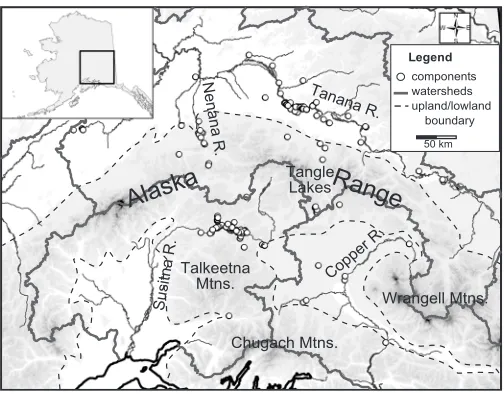
To this end, this paper provides (1) a synthesis of existing archaeological data for the best-sampled portion of Interior Alaska (the Tanana, Susitna, and Copper River watersheds) to better situate the problem of Holocene assemblage and site structural variability (Fig. 1), and (2) a number of explanatory models consistent with the ob-served patterns. Possibilities for testing these models are also discussed. The study area totals almost 93 000 square miles (240 869 km2), roughly the size of Minnesota. While
the area is large, these three watersheds share a similar history of research (related to substantial development and site discovery), similar search images, climate, current vegetation and faunal distributions, and general physiog-raphy. Furthermore, these watersheds were inhabited by various Athabascan groups using relatively similar tech-nology and subsistence/settlement systems.
Background
The disparity between mid-Holocene and Late Holocene assemblages has been widely noted (cf. Derry, 1975; Bacon, 1977; Holmes, 1977, 1986; Shinkwin, 1977, 1979; Workman, 1977; Clark, 1981). Holmes’ (1986) cultural sequence at Lake Minchumina shows a clear technological break between recent Athabascans (Spruce Gum Phase) and the earlier Minchumina Tradition (2600 – 950 cal BP). Numerous components dated to the mid-Holocene (~6000 – 1000 cal BP) contain well-developed flaked stone indus-tries, including microblades struck from prepared cores and bifacial projectile points (e.g., side-notched, stemmed, oblanceolate, and lanceolate varieties) (Bacon, 1977; Dixon, 1985). After ~1000 cal BP, microblade technology and most formal flaked stone tools (especially large bifacial forms) are rare or absent. Maschner’s (1989) summary shows clear reduction in emphasis on flaked cryptocrys-talline tools and flakes between ~800 and 100 cal BP. In the Late Prehistoric Period (sensu Workman, 1977), flaked stone wedges, end scrapers, and expedient boulder spall artifacts (commonly termed tci-thos) are common. Larger bifacial projectile points are replaced by diminutive stemmed points, termed “Kavik points,” but organic barbed and unbarbed points dominate hunting implements. Flaked stone technology was not known to Tanana ethnographic informants in the 1930s (Shinkwin, 1979).
Evidence for technological continuity through the Late Holocene is equivocal. Cook (1969, 1989) posits continu-ity at Healy Lake Village site for the last 10 000 years, but the chronological gap between Level 1 and the historic occupation and lack of convincing typological links ar-gues against this (see Shinkwin, 1979). In nearby regions, varying sequences have linked recent Athabascan groups with Late Prehistoric occupations, including a 1200-year sequence at Klo-kut (Morlan, 1973a). Others argue for general continuity between mid-Holocene cultures and Athabascans at Lake Minchumina (Holmes, 1986) and in the Southwest Yukon (Workman, 1978).
Attempts to understand any particular technology (such as microblades) as a part of overall assemblage variability are often situated within cultural historical perspectives. Briefly summarized, cultural complexes are created on the basis of shared attributes of artifact types/classes and a
fossile directeur approach, where one or two types are
sufficient to establish connections between sites. The utility of these often provisional constructs for exploring cultural change is arguably limited (see review in Bever, 2001 and Clark, 2001). Many of these complexes have been defined primarily on the presence or absence of microblade technology and bifacial point forms. Two of the most influential types, Chindadn points and notched bifaces, have considerable variability and likely reflect multiple functional types (Workman, 1978; Holmes, 2001). Binford (1983) argues that cultural historical approaches may obscure actual patterning in assemblage variability. One way to move beyond these limitations is to examine assemblage variability with respect to economic and site structural variability. Microblade technology is not lim-ited to a single period of human occupation, and it is important to understand how this technology was used with respect to other technology, settlement strategies and site structure, and subsistence.
One important implication of continuity in microblade technology lies in its long history among high-latitude populations in very different environments. This technol-ogy was widespread in northeast Asia (Siberia, Russian Far East, northern China, Tibet, Korea, and Japan) from the last glacial maximum (Slobodin, 2001; Vasil’ev, 2001). Microlithic technology may have played a role in very high residential mobility that allowed for rapid coloniza-tion of high-latitude terrain (Goebel, 1999). There is no consensus on microblade function, and there may be con-siderable functional variability within and among cultural systems. Therefore, it is important to understand microblade use in systemic contexts.
While some have argued that notched biface assem-blages are associated with populations distinct from those using microblade technology in certain areas (Anderson, 1988 for Northwest Alaska and Workman, 1978 for South-west Yukon Territory), an ever-increasing body of evi-dence indicates associations between these technologies in this region (see Cook and Gillispie, 1986). Potential relationships of this co-occurrence of multiple weapon systems (bifacial and microblade/composite points) to economy and land-use strategies must be addressed.
In addition to the new archaeological data from this region presented here, important new data have recently been published on prehistoric weapon systems from ice patch archaeology in the adjacent southwest Yukon Terri-tory. The unprecedented preservation of the organic com-ponents of these weapon systems is particularly relevant for the western Subarctic, given the general lack of organic preservation in boreal forest environments. Bow and ar-row technology completely replaces thar-rowing dart weapon systems soon after its introduction at ~1300 cal BP (Hare
et al., 2004). There is a relationship between the point material and the weapon system: 90% of dart points are bifaces (notched, stemmed, and lanceolate forms) and only two are made of antler, whereas 100% of the arrow points are either antler or bone (Hare et al., 2004). Only a single slotted antler dart point was recovered (interpreted by the authors to receive microblades, though none were found associated) (Hare et al., 2004). These numbers suggest a long-standing preference for bifacial dart tips throughout the Holocene (from ~9300 to 1300 cal BP). These patterns are integrated below into models of techno-logical change.
METHODS
Database Description
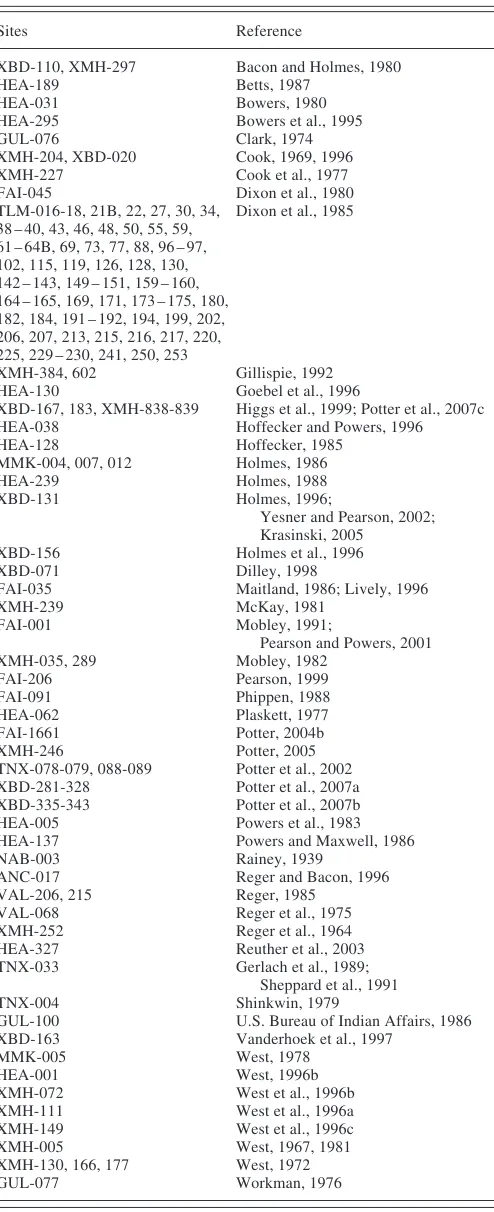
This analytical database, developed from Alaska Herit-age Resource Survey (AHRS) data, is limited to sites with published references. The empirical data used here consist of all available dated components in the region, totaling 272 components (or occupations) from 181 sites (de-scribed in Potter, 2008). All primary references for these sites are provided in the Appendix (Table A1). Component delineation and dating generally follow the original inves-tigator’s interpretation (see Appendix for exceptions). Two sets of data were defined: Database 1 (DB1), com-prising 160 components with directly associated radiocar-bon dates (on strata or cultural features); and Database 2 (DB2), comprising (a) 112 components with estimated ages (stratigraphic bracketing dates, associated tephras, etc.) and (b) all DB1 components (thus, totaling 272 components).
For DB1 components, multiple dates on single stratigraphic contexts were averaged following Ward and Wilson (1978) using the Calib 5 program (Stuiver and Reimer, 1993, Version 5) to provide a single radiometric age estimate. The estimated ages were calibrated using Calib 5 with the IntCal04 terrestrial calibration curve (Reimer et al., 2004). The median of each date range was taken, and the components were grouped into 1000 calen-dar year intervals. While the single age estimators lack precision, lumping components by broad intervals par-tially mitigates this problem.
For DB2 components with estimated ages, the midpoint of the calibrated chronological range was used as the age estimator, and components were also grouped by 1000 calendar year intervals. Syntheses based on DB1 and DB2 are distinguished below, but in all cases DB2 sample results were similar to DB1 sample results.
included here because of their role as a hallmark of the Northern Archaic tradition (Anderson, 1968; Dixon, 1985). Faunal presence/absence data from the literature were collated at three levels: (1) faunal presence vs. absence, (2) large vs. small mammal, and (3) individual taxa (identified to genus or species for mammals and class for fish and birds). The term “large mammal” refers here to ungulates: bison, wapiti, moose, caribou, sheep, and unidentified large mammals (as identified by each original investiga-tor), while “small mammal” refers to other medium to very small mammals (hare, ground squirrel, marmot, beaver, otter, porcupine).
Relatively few sites in the study area have been exca-vated (only 18 sites have more than 50 m2 excavated,
compared to 104 sites with less than 10 m2 excavated; the
overall median is 3.9 m2 excavated). Sites chosen for
excavation tend to be larger and more complex, with the possibility of palimpsests (many overlapping occupations). The larger sample size evaluated here may better reflect underlying prehistoric behavior patterns. To mitigate the effect of the generally small samples of stone tools and faunal remains per site, variables were largely confined to presence/absence, and sample size effects were evaluated.
Analytical Methods
Given the coarse-grained nature of the dataset and the broad level of synthesis attempted here, differences among variables and groups are assessed through Pearson chi-square analysis of 2 × 2 tables, which tests the hypothesis of no association (null) or association (alternate) of col-umns and rows. Cells represent components enumerated by grouping variables (e.g., presence of a particular taxon or technology). The reported chi-square value is the Yates chi-square corrected for continuity. P-values refer to the probability of non-association of the categorical variables (i.e., if p < 0.05, the variables are inferred to be associ-ated). Cramer’s V values measure the strength of the association between nominal categorical variables (rang-ing between -1 and 1). For 2 × 2 tables where any of the cells have expected frequencies of 5 or less, the Fisher Exact Test (one-tailed p-values) is used. Component com-parisons yielded baseline data on covariation of lithic, faunal, and site structural characteristics. General patterns of chronology, technology, site structure, and subsistence were identified. Various models were abductively devel-oped to explain these patterns.
Data Limitations
This research presents a conceptual framework to or-ganize and explore relationships among various forms of archaeological data and to generate and test hypotheses at various spatial and temporal scales without recourse to monolithic cultural constructs. However, some limitations are inherent in the database and analytical methods. The extent to which the total known sample of sites suitably
reflects the underlying population is currently unknown, though numerous resource management and academic projects in the region have discovered components from every period of human occupation of North America. A recent survey through the mid-Tanana basin resulted in the dating of 36 components without bias for expected age (Potter et al., 2007b); the resulting distribution matches the overall DB1 distribution, suggesting the inferences derived from these data may not be overly biased with respect to age.
Most sites have been found in overlook positions and are typically inferred as short-term camps or stations. This topographic distribution may not adequately reflect actual variation in site locations or site structure and function. In addition, Subarctic site formation and disturbance proc-esses may also affect spatial and temporal distribution of components (Ives, 1990). However, that portion of the overall settlement strategies reflected in these short-term camps/stations can be examined for changes through time. Component age estimates should be viewed as tentative given the limited number of large-scale excavations (with refit controls), multiple dates on cultural features, and other uncertainties.
Limitations in archaeological knowledge in Interior Alaska must also be acknowledged. Systemic tool use, seasonal variability in subsistence and lithic procurement strategies, settlement patterns, and basic population pa-rameters are virtually unknown. Therefore, this synthesis includes only a few basic lithic characters (microblades, notched bifaces, and projectile points) that are used as cultural diagnostics. Component comparisons are aided by similar search images, survey and testing strategies, and typological and technological nomenclature used by re-searchers since the 1970s (e.g., Morlan, 1973b; Workman, 1978; Powers et al., 1983).
By excluding all non-radiocarbon dated components, this database under-represents the most recent period (post 200 cal BP), as C14 dates may not be run when evidence exists (such as trade beads, etc.) for protohistoric or his-toric age. However, as the time period of concern extends to ~800 cal BP, when habitation and storage features typical of Athabascan cultures are established (or at least recognized), this under-representation does not affect the analysis. Given these limitations, these data provide im-portant provisional baseline data on covariation among lithics, fauna, and site structure.
RESULTS
Chronology
9000 cal BP intervals are apparent. The two periods of fewer components may reflect lower populations and lower carrying capacity related to effects of the Younger Dryas stadial and the first post-glacial spruce forest expansion in the region (Ager and Brubaker, 1985; Overpeck et al., 1989). The mid-late Holocene record, after 6000 cal BP, is characterized by increasing component abundance, per-haps related to increasing archaeological visibility (though there is a small decrease at 4000 – 3000 cal BP). The lower component abundance at the 1000 – 0 cal BP period re-flects radiocarbon sampling bias, as many sites were ad-equately dated with Euro-American trade goods (e.g., beads, iron), like Dakah Den’in (Shinkwin, 1979) and Paxson Lake (Ketz, 1983). If these protohistoric and early historic sites were added, the component population curve would increase dramatically over the 2000 – 1000 cal BP period sample.
These data are consistent with a number of demo-graphic scenarios, including population replacement at ~5800 cal BP (associated with the Northern Archaic Tra-dition), changes in size and structure of existing populations related to various adaptive economic strategies, or taphonomic factors affecting site preservation. However, at this coarse resolution, no breaks or major trends indicat-ing population decline or extirpation are evident for the last ~6000 years.
Technology
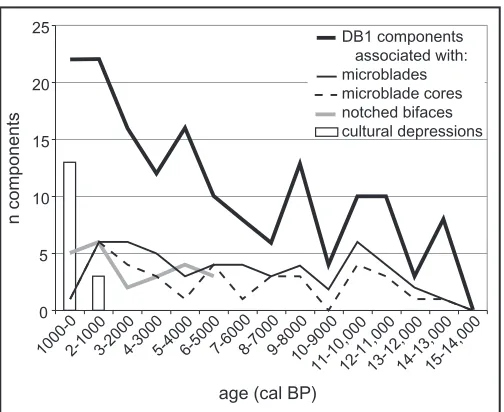
Microblade technology is ubiquitous in this region, present from the earliest known occupation (Swan Point Cultural Zone (CZ) 4, Holmes, 2001), throughout the Holocene until ~1000 cal BP, generally paralleling overall component abundance (Figs. 2 and 3). Microblade-bear-ing components comprise ~20 – 70% of DB1 components per 1000 year intervals except for the last 1000 years,
where they drop to 5% (represented at only one compo-nent, Healy Lake Village Level 1, dated to 962 – 675 cal BP). A similar pattern is evidenced with microblade cores within DB1 components (Fig. 3) and microblade technol-ogy within DB2 components. While some sites like Healy Lake and Campus may be affected by taphonomic mixing of cultural layers (Mobley, 1991; Hamilton and Goebel, 1999), data from the stratified Broken Mammoth and Swan Point sites unequivocally link microblade technol-ogy with secure Late Holocene radiocarbon dates (Holmes, 1996, 2004; Yesner and Pearson, 2002; see also data in Shinkwin, 1979; Holmes, 1986; Betts, 1987 for data on recent microblade sites). While microcore morphology in this region exhibits variability, wedge-shaped microcores are found throughout the Holocene. The data presented here demonstrate continuity of microblade technology throughout the Holocene until around 1000 cal BP.
Within this continuity there may be differences in microblade use from earlier to later Holocene. Between ~3500 and 1000 cal BP, microblades overwhelmingly co-occur with bifacial projectile points (n = 15 components vs. 3 components with microblades without bifacial points), whereas in earlier periods, these two types are more evenly split (19 vs. 14), possibly indicating different land-use strategies (Fig. 3).
Microblade recovery does seem to be affected by sam-pled area. When limiting the sample to all components with more than 50 m2 excavated (n = 51), microblades averaged
57% of all components per 1000 calibrated years BP, 57% of components from 3000 to 2000 cal BP, and 100% of components from 2000 to 1000 cal BP, dropping to 14% of components under 1000 cal BP (the single Healy Lake component). Given that microblades tend to be discarded in small discrete clusters that may be missed in sites with limited excavation (see Potter, 2005), the patterns observed here likely under-represent microblade occurrence.
Notched bifaces are represented from ~5800 to 300 cal BP. Of the 18 dated DB1 components older than 1000 cal 0
5 10 15 20 25
age (cal BP)
n components
1000-02-1000
13-12,000 12-11,000 11-10,000 10-9000 9-8000 8-7000 7-6000 6-5000 5-4000 4-3000 3-2000
14-13,00015-14,000
DB1 components associated with: microblades microblade cores notched bifaces cultural depressions
FIG. 2. Temporal distribution of DB1 components (n = 160), technology, and cultural depressions (semi-subterranean houses, cache pits).
neither technology
n = 75
bifacial proj. points alone
n = 34
microblades alone n = 22
microblades and bifacial proj. points n = 29
cal BP
0 1000 2000 3000 4000 5000 6000 7000 8000 9000 10,000 11,000 12,000 13,000 14,000
DB1 Components
BP with notched bifaces, over half (n = 10) also contain microblade technology. No temporal trend in correlation is seen, and both technologies co-occur from the earliest components with notched bifaces (Butte Lake C2 and Swan Point CZ1B) to some of the latest (Healy Lake Level 1, Lake Minchumina Level 1, Swan Point CZ1A). This pattern suggests that a single cultural tradition is repre-sented in the later Holocene components in this region.
Site function almost certainly affects tool discard be-haviour, and this effect may be evident in these data. Several sites in the region associated with primary lithic reduction tend not to have microblade technology, includ-ing Landmark Gap and Little Delta River #3 (Mobley, 1982; Higgs et al., 1999; Potter et al., 2007c). The absence of microblade technology does not reflect a “cultural adaptation” present in all toolkits or discarded at all sites, but reflects the use of composite and bifacial points for specific purposes or associated with specific activities that may not have occurred at a specific site.
The evidence for Holocene technological continuity presented here is supported by technological and typologi-cal analyses at individual sites. Many tool classes and types, such as wedge-shaped microcores, flake burins, various scraper forms, lanceolate bifaces, and boulder spall scrapers, are relatively unchanged from the Late Pleistocene to the Late Holocene (Holmes and Bacon, 1982; Holmes et al., 1996; Bowers, 1999). Of particular importance here is the co-occurrence of microblades (in-ferred to be composite point insets) and bifacial points (Fig. 3). The implications for the co-occurrence of multi-ple weapon systems are evaluated below.
Site Structure
Sites in the study area can be divided into two groups, one representing surface or buried lithic scatters with or without unlined firepits (generally interpreted to be out-door hearths) situated on positive landforms with overlook potential, and the other representing cultural depressions (semi-subterranean houses, cache pits) near lakes and clearwater streams at lower relative elevations above the surrounding terrain. There is no current evidence for semi-subterranean houses or storage features (such as caches) before ~1200 cal BP, with the possible exception of XMH-035, dated to ~5000 cal BP. There was no site report produced, and the AHRS record states: “excavation also reportedly produced evidence of an oval dwelling,” with-out explicitly identifying it as a depression. The absence of obvious habitation sites older than 1200 cal BP in this region is remarkable, even assuming increased residential mobility in the earlier Holocene (Kelly and Todd, 1988; Goebel, 1999). Few habitation sites are found in Subarctic regions of Northeastern Siberia and the Russian Far East in the Late Pleistocene/Early Holocene; a notable exception is Ushki Lake Levels 6 and 7 (Goebel and Slobodin, 1999). While few prehistoric settlement system models for central Alaska have been advanced, Guthrie (1983a)
suggested a settlement system for the Nenana valley com-posed of a central base or residential camp and outlying spike camps where game processing and tool maintenance occurred. Most pre-1200 cal BP components would be considered spike camps or work stations depending on the variable presence/absence of faunal remains and features. A residential base camp would presumably have semi-subterranean features similar to those at Ushki-1 to allow winter shelter, but none have been found before the latest Holocene. Yesner (1996) notes that this absence could be due to location of base camps along major rivers in valley bottoms, at sites subsequently destroyed through channel changes in the active floodplain. However, ethnographic data indicate Athabascan preference for habitation sites adjacent to clearwater streams and lakes, which arguably undergo less destruction than do glacially fed braided rivers. Numerous surveys have been completed in the region, and a wide variety of environments have been sampled, including numerous lake and stream edges and alluvial terrace edges above abandoned floodplain allu-vium, with no evidence for older semi-subterranean houses (see Potter et al., 2002, 2007b).
with lakeshore settings: microblades were found in 73% of lakeshore components dated earlier than 1000 cal BP, vs. only 25% of non-lakeshore components (chi-square = 14.4, p = 0.000, Cramer’s V = 0.27). This distribution echoes the results of Sheppard et al. (1991). While this association does not indicate why microblades and lakeshores are associated, it does suggest that microblades are not randomly distributed in all areas on the landscape as expected in a normative model of microblade use.
In sum, evidence for seasonally specific residential or habitation sites (e.g., winter villages, fish camps) and storage facilities (indicating seasonally abundant resources and logistical organization) is present only after about 1200 cal BP, thus making it difficult to compare lithic and faunal assemblages between the ethnographic present and earlier periods.
Subsistence
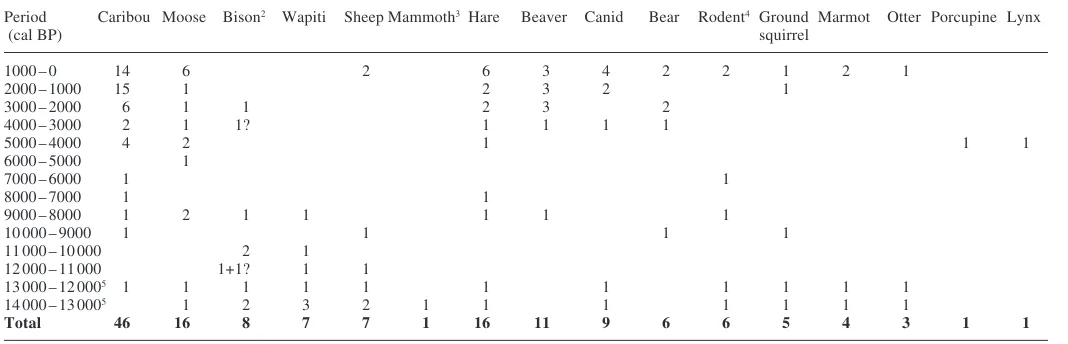
Faunal remains offer a wealth of information about site function, economy, and settlement strategies, and the record for the study area is quite robust (compared with other areas like the Brooks Range or Northwest Alaska, where preservation is more limited). Of the 272 DB2 compo-nents, a remarkable 128 (48%) contained faunal remains. Of these 128 components, 44 were described as unidenti-fied (typically composed of small calcined/burned frag-ments) or unidentified mammal (medium to large size), and thus had limited analytical potential. The remaining 84 components were analyzed further. Table 1 lists com-ponents with some level of faunal identification, and Table 2 lists components with more specific identifica-tions. While the relatively larger number of post-3000 cal BP components likely reflects a taphonomic bias against preservation, these data span the record of occupation, with 14 components older than 10 000 cal BP.
The most striking pattern is the broad spectrum of resource use throughout the record; large and small mam-mals, birds, and fish are represented from the earliest to the latest components. Fish, and to a lesser extent birds and small mammals, are present at fewer sites in the mid-Holocene; however, this result may be due to sampling. Only 11 components are known between 10 000 and 5000 cal BP, and the proportions of small mammals remain roughly the same (found at around 25 – 50% of compo-nents during this period). On the basis of these data, we may conclude that no major resource group was ignored, though small mammals and fish use may have increased after 5000 cal BP. However, large mammals still dominate the entire record (found at 93% of all components with fauna).
Caribou and moose dominate the large mammal record, though bison and wapiti are well represented in the early Holocene (Table 2). The date of the shift from bison- and wapiti-dominated components to caribou and moose is difficult to infer given potential taphonomic factors (and possible misidentification of moose and wapiti remains), but given the presence of bison in Alaska until the last few
hundred years (Stephenson et al., 2001), bison hunting may have been an important part of subsistence strategies throughout the Holocene. Additional support for late Holocene bison and wapiti predation include directly dated fauna associated with Yukon Territory ice patches: bison from ~8300 – 2900 cal BP and wapiti until ~1400 cal BP (Farnell et al., 2004).
The relationship between technology and subsistence can be directly explored through this database. Microblade-bearing components are significantly associated with faunal remains (chi-square = 4.46, p = 0.035, Cramer’s V = 0.15) (Fig. 4A). When controlling for sample size (n = 43 components dated earlier than 1000 cal BP with more than 50 m2 excavated), this relationship is even more
pro-nounced (Fisher’s Exact Test, p = 0.017, Cramer’s V = 0.38) (Fig. 4B). This pattern supports the contention that microblades were part of a hunting toolkit.
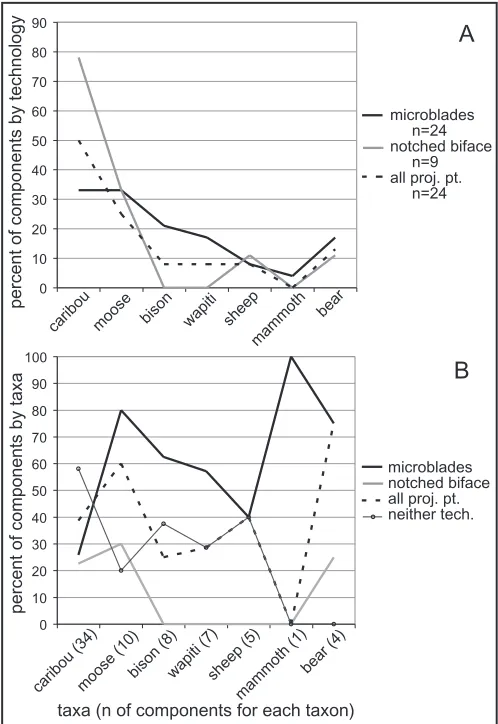
Having demonstrated the microblade-faunal associa-tion, it is important to assess associations with particular taxa. The sample sizes are small, so these associations should be viewed as provisional. Overall, microblade-bearing components are more associated with most taxa, with the notable exception of caribou, which was found at 33% of microblade components versus 62% of non-microblade components (Fig. 5). Large-bodied ungulates are differentially positively associated with microblade technology (Fisher’s Exact Test, bison, p = 0.044; moose, p = 0.000; and possibly wapiti, p = 0.089), while smaller-bodied ungulates have no such association (Fisher’s Exact Test, caribou, p = 0.920; sheep, p = 0.414). Bison (found at 21% of microblade components with faunal remains vs. 8% of non-microblade components) and moose (33% vs. 5%) may illuminate microblade/composite point function. Put another way, 63% of all components with bison con-tain microblade technology, and only 25% (2 components) contain bifacial projectile points. Both of these compo-nents also contain microblade technology (Swan Point C2 and Broken Mammoth CZ3). If bison-microblade associa-tions are present at Swan Point CZ3 and Campus, then 70% of components with bison contain microblade technology. Only 11% of components with caribou contain microblade technology, compared with 38% that contain bifacial pro-jectile points.
whereas notched bifaces (and projectile points in general) are closely associated with smaller game (particularly caribou).
MODEL DEVELOPMENT
The patterns presented in the synthesis above were used to develop the empirical generalizations summarized here. Microblade technology is present throughout the entire span of human occupation in the study area until around 1000 cal BP, when microblades disappear from the record, along with many formal flaked stone tool forms. Bow and arrow technology was likely introduced into the region ca.
1300 cal BP. Site structure and inferred settlement and storage strategies appear to have changed at around that time, with earlier components characterized by high resi-dential mobility, no formal storage features, and no appar-ent long-term habitations, and later componappar-ents characterized by increased diversity in site types, in-creased logistical mobility, storage features, and seasonal habitation sites. Subsistence data indicate bison and wapiti hunting (within generalized economies that included fish, birds, and small mammals), with increased caribou and moose hunting after ~5000 cal BP, and possibly increased small game procurement after ~4000 cal BP. To explain these patterns, I have developed three models (or explana-tive scenarios). The first two are to some extent exclusive TABLE 1. DB2 component faunal assemblage summary.
Period (cal BP) All fauna Mammals Birds Fish Large Mammals Small Mammals
1000 – 0 21 21 3 5 19 11
2000– 1000 17 17 1 4 15 4
3000 – 2000 9 9 1 2 8 4
4000 – 3000 5 5 1 5 2
5000 – 4000 7 7 1 7 3
6000 – 5000 1 1 1
7000 – 6000 2 2 1 1 2 1
8000 – 7000 3 3 2 1
9000 – 8000 2 2 1 2 1
10 000 – 9000 3 3 3 1
11 000 – 10 000 4 4 1 4 1
12 000 – 11 000 4 4 1 4
13 000 – 12 000 1 1 1 1 1
14 000 – 13 000 5 5 3 1 5 2
Total 84 84 14 14 78 32
TABLE 2. DB2 components with identifiable fauna1 from the study area.
Period Caribou Moose Bison2 Wapiti Sheep Mammoth3Hare Beaver Canid Bear Rodent4 Ground Marmot Otter Porcupine Lynx
(cal BP) squirrel
1000 – 0 14 6 2 6 3 4 2 2 1 2 1
2000 – 1000 15 1 2 3 2 1
3000 – 2000 6 1 1 2 3 2
4000 – 3000 2 1 1? 1 1 1 1
5000 – 4000 4 2 1 1 1
6000 – 5000 1
7000 – 6000 1 1
8000 – 7000 1 1
9000 – 8000 1 2 1 1 1 1 1
10 000 – 9000 1 1 1 1
11 000 – 10 000 2 1
12 000 – 11 000 1+1? 1 1
13 000 – 12 0005 1 1 1 1 1 1 1 1 1 1 1
14 000 – 13 0005 1 2 3 2 1 1 1 1 1 1 1
Total 46 16 8 7 7 1 16 11 9 6 6 5 4 3 1 1
1Scientific names: caribou (Rangifer tarandus), moose (Alces alces), bison (Bison sp.), wapiti (Cervus elaphus), sheep (Ovis dalli),
mammoth (Mammuthus sp.), hare (primarily Lepus americanus), beaver (Castor canadensis), canids (foxes, wolves, and dogs), bear (primarily Ursus americanus), ground squirrel (Spermophilus sp.), marmot (Marmota broweri), otter (Lontra canadensis), porcupine (Erithizon dorsatum), and lynx (Lynx canadensis).
2Bison remains were found at the Campus site, but may not be associated with the dated component (Mobley, 1991), and bison was
possibly identified at Swan Point CZ3 (Holmes, pers. comm. 2006).
3Mammoth dated to the occupation. 4Other (or unspecified) rodent.
and competitive, while the third may have occurred in conjunction with one of the other two, or alone.
Technological and Economic Change Model
The technological and economic change (TEC) model takes the form of several integrated changes in technology, subsistence, and settlement strategies that may have oc-curred during the period 1300–800 cal BP. This model posits that before 1300 cal BP, an ancient conservative tradition of multi-seasonal hunting for large mammals, especially bison and wapiti, involved two weapon systems: (1) bifacial projectile points set at the tips of darts thrown with atlatls, used for distance penetration, and (2) compos-ite points made from organic points and microblade side insets set at the tips of hand-held spears, used to dispatch larger, wounded animals. An alternative configuration has
these two weapon systems used within different hunting strategies: encounter or pursuit hunting with bifacial dart points and disadvantage hunting with both systems. A third alternative has two atlatl weapon systems used against different-sized prey.
After 1300 cal BP, bow and arrow technology was introduced into the region and incorporated into the al-ready existing hunting strategies, and bows and arrows rapidly replaced atlatls as long-distance weapons. Typical projectile point forms changed from larger lanceolate and notched forms to (1) unilaterally barbed antler arrow-heads, (2) smaller stemmed and tanged forms, including the Kavik type, interpreted to function as arrowheads (Workman, 1978), and (3) copper points. This efficient technology allowed for ever-increasing numbers of large game to be hunted, particularly bison. This overhunting, coupled with climate change that reduced grassland bison habitat in the Late Holocene, led to the extirpation of bison in the region.
0 20 40 60 80 100 120
0 5 10 15 20 25
n components n components
A B
microblade non-microblade
microblade non-microblade fauna
no fauna
lynx porcupine
otter marmot gr. squirrel
rodent, other bear canid
beaver hare all fish
all birds mammoth sheep
wapiti bison moose
caribou
0 10 20 30 40 50 60 70
percent of components
taxa
non-microblade components microblade components
FIG. 6. Relationship of technology and taxa. (A) Associated taxa and components (grouped by technology); (B) associated technology and components (grouped by taxon). Data consist of DB2 components dated earlier than 1000 cal BP associated with identifiable fauna. “Neither” refers to assemblages without projectile points, notched bifaces, or microblades. Percentages in B total more than 100% because of overlap in technologies and multiple species per component.
FIG. 4. Relationship of microblades and faunal remains. (A) DB2 components dated earlier than 1000 cal BP with fauna/no fauna reported (n = 223); (B) DB2 components dated earlier than 1000 cal BP and excavated area of over 50 m2, n = 43.
FIG. 5. Association of microblade-bearing components with faunal taxa (DB2 components dated earlier than 1000 cal BP with identifiable fauna, n = 63).
0 10 20 30 40 50 60 70 80 90
0 10 20 30 40 50 60 70 80 90 100
caribou moose bison wapiti sheep mammoth
percent of components by technology
percent of components by taxa
bear
caribou (34)moose (10)bison (8)wapiti (7)sheep (5)mammoth (1) bear (4)
A
B
taxa (n of components for each taxon)
microblades n=24 notched biface n=9 all proj. pt. n=24
With bison populations below a threshold that permit-ted multiseasonal hunting, populations in the region shifpermit-ted to a broader-spectrum diet, focused more on seasonally abundant resources like caribou and fish. This shift re-sulted in the need for increased storage facilities and logistical mobility geared to those seasonally overabundant resources. Increased reliance on fish especially led to a shift in settlement strategies, with longer-term habitations near rich fish streams and lakes, usually in low-lying areas, distant from high-quality tool stone. The resultant reduced residential mobility necessitated a shift in raw material use, from high-quality lithics suitable for flaking to in-creased use of locally available organic and lower-quality stone implements, and later copper (antler, bone, birch bark, ground and pecked stone, and tci-thos). Microblade technology was phased out because of (1) changes in settlement locations, mobility, and raw material procure-ment strategies and (2) extirpation of large-bodied bison. This transformation took place within a few hundred calendar years, between 1300 and 800 cal BP.
Holmes and Bacon (1982) hypothesized a link between microblades and bison, but provided little supporting data other than the late bison tibia at site XMH-297 and the continuity of microblade technology during the Holocene. This paper has added substantial data to this question. Microblades are demonstrated to be strongly associated with fauna, suggesting they form part of a hunting toolkit. Specifically, microblades are associated with bison, wapiti, moose, and mammoth, all large and arguably dangerous when wounded. While Guthrie (1983b) argues that the correspondence of microblade technology and caribou geographic distributions may reflect prey-specific use of microblades, this argument runs counter to the empirical patterns identified in this paper. First, caribou as elements in archaeological food assemblages (and ice patch sites) are more closely linked with bifacial points than with microblade/composite points. Second, a wide range of prey is associated with microblade technology, especially large ungulates (bison, moose, and wapiti). Recent recon-structions of wood bison distributions in northwestern North America demonstrate a closer fit with Holocene microblade technology, especially as neither wood bison nor microblade distributions extend much beyond Alberta to the east or south of central British Columbia (Gates et al., 2001; Stephenson et al., 2001).
The proposition that many microblades were used as side insets for weapon tips is supported by a variety of data. Many researchers hypothesize that microblades in Beringia were primarily or exclusively used as side insets into com-posite organic armatures presumed to function as projectile tips (Larsen, 1968; Guthrie, 1983b; Hare et al., 2004). Other functions, such as knives or daggers (Abramova, 1979; Giria and Pitul’ko, 1994; Derev’anko and Markin, 1998), spear points (Giria and Pitul’ko, 1994), arrow points (Ackerman, 1996; Dixon, 1999), gravers or awls (Sanger, 1968; Ackerman, 1985), and/or saws or shredders (Yi and Clark, 1985), have also been suggested. Microblade
morphology and typical retouch locations suggest suitabil-ity for cutting, slicing, or penetrating relatively soft materi-als in a motion parallel to the long axis (Potter, 2005). The shapes of slotted implements vary, but all East Beringian examples are elongate and relatively thin, efficient for multiple piercing (Potter, 2005). As noted above, ice patch data clearly demonstrate a preference for large bifacial points as dart tips throughout the Holocene, suggesting other function(s) for composite implements. One hypoth-esis is that composite points were used as thrusting spears in disadvantage-hunting strategies against large ungulates, perhaps in conjunction with bifacial point-tipped atlatl darts, whereas the latter were also used in encounter or pursuit hunting of smaller game. An alternative hypothesis, that composite points functioned as atlatl dart tips for use on specific game (large ungulates), is not supported by the data presented here (see below).
Since bifacial projectile points co-occur with microblade technology (especially from ~3500 – 1000 cal BP, see Fig. 2), there must be some difference that would necessitate two coterminous types of weapon systems, and ice patch data suggest composite points and bifacial points were not simulta-neously used as projectile point (dart) tips. One alternative hypothesis is that both systems reflect differential access to lithic raw materials or seasonality, or both. Microblades have been viewed as an efficient technique that conserves lithic raw material by maximizing the working edges produced per unit stone (Sheets and Muto, 1972; see discussion in Yesner and Pearson, 2002). To test this hypothesis, I examined microblade and non-microblade sites found within 5 km of three known lithic material sources in Interior Alaska (see Potter, 2005). The percentage of microblade sites within 5 km of lithic raw material sources is 43% for Batza Téna (Clark and Clark, 1993), 17% for Livengood (Derry, 1976), and 1% for Land-mark Gap (West, 1981). The last area has relatively few microblade sites, about 3% of the total, and reflects the relative lack of microblade components in upland areas. The overall percentage of sites with microblade technology in the present sample is 46% for DB1, and 30% for DB2, suggesting that microblade sites are not less likely to be found near lithic quarries. In addition, most microblades are unretouched waste discarded at the point of detachment, hardly indicative of tool stone conservation. While these are relatively weak tests, they do not suggest a correlation between limited access to high-quality tool stone and microblade technology that might be reflected in differential seasonal use of these technologies. I argue that differential function of bifacial and composite points (whether atlatl vs. thrusting spear tips or prey-specific weapon tips) is the most parsimonious explanation of the co-occur-rence of these technologies.
of studies have examined relationships of weapons plat-forms with prey choice and hunting techniques (Odell and Cowan, 1986; Churchill, 2002). Churchill (2002) notes from ethnographic data that hand-held spears are predomi-nantly used with disadvantage techniques to kill larger prey, arrows are used for all hunting techniques and a wide range of prey sizes, and atlatl darts are associated with ambush techniques and smaller prey, though his atlatl data were limited to Australia. These patterns support thrusting spear use for large-bodied prey and the suitability of arrows for most of the resources within the study area.
There is limited evidence of bison and to a lesser extent wapiti habitat disruption in the Late Holocene (Stephenson et al., 2001; Potter, 2005). The Early Holocene boreal forest (~9000–5500 cal BP) was likely a gallery forest dominated by white spruce and paper birch (Hu and Brubaker, 1996). Black spruce replaced white spruce as the dominant tree species by 4000 cal BP. The modern fire regime that followed after 2400 cal BP was due to the expansion of water-saturated soils that favored black spruce (Hu and Brubaker, 1996; see also Hu et al., 1993; Bigelow, 1997). It is difficult to fit grazing habitats into this record, but Stephenson et al. (2001) note that the geographic distribution of wood bison and Native oral accounts indi-cate low-elevation habitats, associated with meadows, that persisted in some areas until modern times. Extant wood bison habitats are typically in low-elevation areas within mosaics of meadows and boreal forests (Larter and Gates, 1991; see also discussion in Stephenson et al., 2001), though there is some evidence of summer use of upland areas (Farnell et al., 2004).
Are microblades differentially associated with these lowland habitats? All DB2 components dated earlier than 1000 cal BP were assigned values of “upland” at sites within the foothills of the Alaska Range (n = 128), prima-rily in the Upper Susitna, Upper Nenana, and Tangle Lakes areas, and “lowland” at other sites in the study area (n = 99), primarily in the bottomlands and lowlands of the Tanana and Copper River basins. Microblade-bearing com-ponents are more associated with lowland settings (chi-square = 3.77, p = 0.052). Notched biface sites were equally likely to be in upland or lowland settings (chi-square = 0.04, p = 0.560). However, caribou strongly associate with upland areas (chi-square = 21.63, p < 0.0001), whereas 75% of components with bison are found in lowland areas (80% if Swan Point CZ3 and Campus contain associated bison; Fisher Exact test, p = 0.061). These patterns reinforce a microblade-bison-lowlands link. The timing of bison extirpation is unclear. While the latest bison specimen dates to ~200 cal BP, Stephenson et al. (2001) note that the critical point is the time when bison populations could no longer be a stable, dependable re-source. I argue that this point occurred around 1000 cal BP. The date list from Stephenson et al. (2001) indicates 13 bison specimens from 3000 to 1000 cal BP in Alaska and Yukon Territory, while only two specimens were dated after 1000 cal BP. Stephenson et al. (2001) note reliance on
archery among ethnographically documented Athabascans to kill large mammals like moose and grizzly bears and suggest that bows and arrows were also used to kill bison in the Late Holocene. They further argue that bison habitat was fragmented into ever-diminishing and discontinuous grasslands, and this fragmentation increased their vulner-ability to overkill, possibly caused by the juxtaposition of human and bison habitats (Stephenson et al., 2001). The TEC model provides a mechanism for the transition from dispersed multiseasonal hunting in uplands and lowlands to increasingly stable settlements in lowland ecosystems near fish streams and lakes. This change destabilized the previous resilient subsistence system. The introduction of bow and arrow technology could have further accelerated the extirpation of bison in this region between 1300 and 800 cal BP.
Tentative support for this model also comes from stud-ies of salmon abundance variability over the last 2200 years at Kodiak Island, where Finney et al. (2002) showed a decline in Alaskan sockeye salmon populations from 2100 to 1200 cal BP, and an increase in abundance from 800 to 100 cal BP. This increase may have strengthened the importance of salmon fishing after bison populations were decimated.
While the TEC model is generally consistent with a wide variety of empirical data, there are some counter-indications. Microblade technology is widespread in space and time, from southern China and Tibet to British Colum-bia, from ~25,000 years ago to the recent period, and there is probably considerable variation in microblade use. Vari-ous functional considerations may include warfare vs. subsistence, ceremonial vs. functional, non-ungulate prey-specific (perhaps fishing or fowling), and so forth—far too many to test with the limited current data. Microblades seem to be associated with other taxa besides large-bodied ungulates, though this link may relate to the lowland (especially lakeshore) association mentioned above. The tool stone conservation hypothesis cannot be totally dis-counted given the limited testing described above. More productive tests would involve establishing contempora-neity among a series of sites and controlling for the presence and use of a specific raw material and the dis-tance to the source. The single known slotted dart point found at the Gladstone Ice Patch may indicate the use of microblades for dart tips as well as (or instead of) thrusting spear tips. One could argue that technological and typo-logical variability resolution is too coarse for this time period, and more research needs to be done (including refitting and use-wear studies) to test these interrelated hypotheses fully. Other counter-indications could cer-tainly be put forward.
Population Replacement Model
into the study area and its replacement or cultural assimi-lation (or both) of existing popuassimi-lations. In this model, microblades are associated with earlier populations that are replaced (or assimilated) by later, non-microblade using populations. One might argue that the cultural changes around 1000 cal BP were too profound for continuity in cultural traditions and populations, and a number of au-thors have discussed possible migration scenarios. The most influential scenario is from Workman (1972), who suggested that volcanic eruptions that spread ash across the southern Yukon Territory may have influenced Athabascan expansions. Derry (1975) describes a detailed model of partial replacement, in which Athabascans, with an associated toolkit including Kavik-type points but lack-ing microblade technology, expanded from southwest Yukon to the north and then east across the Brooks Range in response to the volcanic eruption that deposited the eastern lobe of the White River Ash (dated to 1147 cal BP, Clague et al., 1995). Derry associates this group with the proto-Gwich’in. Populations in most of the study area remained in place. In support of this model, microblade technology appears to have disappeared earlier in the southwest Yukon Territory (from ~5800 cal BP, the begin-ning of the Northern Archaic Tradition, Taye Lake Phase) (Workman, 1978), and Kavik points can be characterized as a horizon marker (widespread in space, limited in time). Holmes (1986) suggests that the discontinuity between the Minchumina Tradition and subsequent Spruce Gum Phase (Athabascan) was due to a gap in occupation or population replacement (Holmes, 1977).
Counter-indications to the PRA model include evi-dence for other volcanic events with widespread tephras that do not correlate with major technological or subsist-ence changes, such as the northern lobe of the White River Ash, deposited around 1887 cal BP (Leberkmo et al., 1975), or more limited ashfalls in the Susitna basin (e.g., Oshetna and Devil tephras, Dixon et al., 1985). Second, there is no clear break in occupations; the demographic model presented above indicates continual increase in populations (as inferred from component abundance), though this trend might be affected by taphonomic factors. Third, long cultural sequences with no major technologi-cal breaks are evident from the nearby southwest Yukon Territory (Workman, 1978) and at Healy Lake (Cook, 1969), suggesting continuity in populations. Finally, Kavik points have been found in a much wider area, including Dixthada and Healy Lake Village in the Tanana Basin.
Taphonomic Bias Model
The taphonomic bias (TB) model posits that post-depositional disturbance processes caused many of the intersite variability patterns identified above. The absence of cultural depressions before ~1000 cal BP may be due to erosional or depositional processes that have removed evidence of them (e.g., destroyed them through braided stream development) or covered them to the point that they
are no longer archaeologically visible. This model makes no predictions about technological or subsistence systems, other than that organic artifacts are under-represented for earlier time periods. Support for this model includes the presence of semi-subterranean houses at Ushki-1 and the similarity of Dyuktai Culture and Late Pleistocene/ Holocene microblade-bearing traditions (Beringian, Denali, American Paleoarctic). Since the technology, the hypercontinental climate, and the resource base and in-ferred hunting strategies were relatively similar (microblades and bifacial points associated with large terrestrial mammals), we might expect the habitation struc-tures and settlement strategies to be similar. Other support may include the similar broad-spectrum resource base that continued broadly until recent times (with the exception of bison, wapiti, and mammoth), acquired through logistical and residential mobility, which may have included storage and longer-term habitation facilities. Finally, survey in this region is still very limited (see Potter et al., 2001), and the small sample surveyed thus far may not reflect the underlying variability of site types.
Counter-indications to the TB model include the ethnographically documented preference of Athabascans in the study area for locating longer-term habitations near lakes and clearwater streams rather than on larger, more geologically active glacier-fed braided rivers in the Tanana, Copper, and Yukon basins (Rainey, 1939; Hosley, 1977). Hosley (1977:127) notes that introduction of the rifle and the European fish wheel, increasing importance of the fur trade, and location of trading posts and missions all acted to decrease the importance of hunting and increase the importance of fishing, which ultimately “contributed to centripetal clustering of Athabascans into permanent set-tlements along main rivers.” Many surveys have been conducted in areas where habitation sites may be located (e.g., along lakeshores) in areas of relatively little erosion or disturbance; however, no evidence of earlier structures has been found. Most importantly, the TB model has no bearing on explaining the transformation in lithic technol-ogy, raw material use, and advances in projectile weapons during this period.
DISCUSSION
technology, subsistence, and settlement. The TEC model, I believe, is most strongly supported by current data, but aspects of the PRA and TB models are also consistent with some of the data.
Expectations with respect to predicted associations of technology, faunal remains, and habitat/site location can clearly be derived from each of these models. The empiri-cal linkages are clearly described, in order for more pro-ductive testing with new site-based and intersite investigations. Future tests and discoveries can clearly confirm or falsify elements of each of the models. These models, and any competing scenarios, must explain ob-served associations of microblades with fauna (especially large-bodied ungulates), spatial and temporal distribution of microblade-bearing sites with respect to local ecology, co-occurrence of composite and bifacial points, major technological changes observed from ice patch data, very recent evidence of longer-term habitation and storage facilities, the loss of microblades at around ~1000 cal BP, and the reduction of flaked stone toolkits in favor of organic implements.
This study has yielded some intriguing patterns with respect to boreal forest hunter-gatherer mobility and set-tlement strategies. Two types of sites seem to be repre-sented in the earlier periods (pre ~1000 cal BP): stations and camps in overlook settings and lower-elevation sites associated with water bodies, especially lakeshores. Some aspects of interassemblage variability seem to relate to these two settings; the latter is associated with higher frequency and diversity of faunal remains and microblade technology, which may be related to resource availability and seasonality. Detailed explorations of lakeshore sites (like Healy Lake and Lake Minchumina) may provide avenues to test some expectations for sites used as residen-tial base camps.
What do these patterns mean with respect to cultural historical sequences? How far back can we “identify” Athabascan or Na-Dene ancestors? As this study does not rely on typological analysis, it has limited utility for defining typological constructs, but it can shed some illumination on the problem. The key difference between Northern Archaic and Late Denali is the presence or absence of microblades (Dixon, 1985). Since microblades are found throughout the Holocene (with a variety of core forms), it is reasonable to posit a regional variety of the Northern Archaic Tradition from ~5800 to 1000 cal BP, characterized by high residential mobility and an economy based on large ungulates, with decreasing importance of bison and increasing importance of caribou, small mam-mals, birds, and fish. The idea of a “pure” Northern Archaic, without microblades, sometimes termed Pali-sades Complex and a “mixed” Northern Archaic, with microblades, termed Tuktu Complex (Bacon, 1977; Clark, 1994; Ackerman, 2004) cannot be supported on the basis of these data. While it is possible that all components with notched bifaces and microblades are mixed, this conclu-sion hardly seems justifiable, since both technologies
co-occur in securely dated contexts in this region through-out the last 5800 years.
After ~1000 cal BP, an Athabascan Tradition character-ized by decreasing flaked stone tool use and increasing organic and copper use can be linked with logistical mobil-ity strategies and reliance on seasonally overabundant resources (caribou, salmon, other fish), as well as small mammals and birds. This subsistence strategy and sea-sonal reliance on storage facilities allowed for increased local band size and sedentism.
While there is still some ambiguity, I suspect that the recent time frame of the transition between these cultural traditions indicates a continuity of Athabascan populations from at least the beginning of the Northern Archaic Tradi-tion. This is consistent with Workman’s perspective on the Southwest Yukon Territory record, with a continuity of population from ~5800 – 5100 cal BP to the historic pe-riod, also associated with the beginning of the Northern Archaic Tradition (Taye Lake Phase) (Workman, 1978).
Speculating on ethnic or linguistic affiliation with ear-lier periods is much more difficult. The introduction or innovation of new tools (notched bifaces, tabular microblade cores, notched cobbles) at ~5800 cal BP and the continuation of existing tools (wedge-shaped microblade cores) could be explained by the migration and borrowing of new populations, by partial or total popula-tion replacement (Workman, 1978; Dumond, 1987), or by diffusion of a limited number of new artifact types and technologies within extant populations (Clark, 1994). With relatively few excavated components between 9000 and 5000 cal BP, it is difficult to test these hypotheses. Archae-ologists have yet to fully integrate the presence of microblade-bearing Swan Point CZ4 prior to Nenana Com-plex components and the association of Chindadn points and microblades at Swan Point CZ3 (Holmes, 2001), Broken Mammoth CZ3 (Krasinski, 2005), and likely at Healy Lake (Cook, 1969). The synthesis and explanative models developed here represent frameworks through which to explore cultural change over the Holocene. Their use to examine multiple lines of evidence will aid in building a firm foundation on which to situate future hypothesis testing and excavation.
ACKNOWLEDGEMENTS
APPENDIX: DATABASE REFERENCES
1Table A1 lists the sites and primary references included in this
synthesis. Site prefixes refer to USGS 250 000 scale quadrangles (ANC-Anchorage, FAI-Fairbanks, HEA-Healy, GUL-Gulkana, TABLE A1. All DB2 sites, ordered by reference.1
Sites Reference
XBD-110, XMH-297 Bacon and Holmes, 1980
HEA-189 Betts, 1987
HEA-031 Bowers, 1980
HEA-295 Bowers et al., 1995
GUL-076 Clark, 1974
XMH-204, XBD-020 Cook, 1969, 1996
XMH-227 Cook et al., 1977
FAI-045 Dixon et al., 1980
TLM-016-18, 21B, 22, 27, 30, 34, Dixon et al., 1985 38 – 40, 43, 46, 48, 50, 55, 59,
61 – 64B, 69, 73, 77, 88, 96 – 97, 102, 115, 119, 126, 128, 130, 142 – 143, 149 – 151, 159 – 160, 164 – 165, 169, 171, 173 – 175, 180, 182, 184, 191 – 192, 194, 199, 202, 206, 207, 213, 215, 216, 217, 220, 225, 229 – 230, 241, 250, 253
XMH-384, 602 Gillispie, 1992
HEA-130 Goebel et al., 1996
XBD-167, 183, XMH-838-839 Higgs et al., 1999; Potter et al., 2007c HEA-038 Hoffecker and Powers, 1996
HEA-128 Hoffecker, 1985
MMK-004, 007, 012 Holmes, 1986
HEA-239 Holmes, 1988
XBD-131 Holmes, 1996;
Yesner and Pearson, 2002; Krasinski, 2005
XBD-156 Holmes et al., 1996
XBD-071 Dilley, 1998
FAI-035 Maitland, 1986; Lively, 1996
XMH-239 McKay, 1981
FAI-001 Mobley, 1991;
Pearson and Powers, 2001
XMH-035, 289 Mobley, 1982
FAI-206 Pearson, 1999
FAI-091 Phippen, 1988
HEA-062 Plaskett, 1977
FAI-1661 Potter, 2004b
XMH-246 Potter, 2005
TNX-078-079, 088-089 Potter et al., 2002 XBD-281-328 Potter et al., 2007a XBD-335-343 Potter et al., 2007b
HEA-005 Powers et al., 1983
HEA-137 Powers and Maxwell, 1986
NAB-003 Rainey, 1939
ANC-017 Reger and Bacon, 1996
VAL-206, 215 Reger, 1985
VAL-068 Reger et al., 1975
XMH-252 Reger et al., 1964
HEA-327 Reuther et al., 2003
TNX-033 Gerlach et al., 1989; Sheppard et al., 1991
TNX-004 Shinkwin, 1979
GUL-100 U.S. Bureau of Indian Affairs, 1986 XBD-163 Vanderhoek et al., 1997
MMK-005 West, 1978
HEA-001 West, 1996b
XMH-072 West et al., 1996b
XMH-111 West et al., 1996a
XMH-149 West et al., 1996c
XMH-005 West, 1967, 1981
XMH-130, 166, 177 West, 1972
GUL-077 Workman, 1976
NAB-Nabesna, TLM-Talkeetna Mountains, VAL-Valdez, XBD-Big Delta, XMH-Mount Hayes). Component dating generally follows the original investigator, except that Healy Lake Athabascan Stage Levels 1–3 (Cook, 1969) are grouped into two components, Level 1 (962–675 cal BP) and Levels 2–3 (3342– 2952 cal BP). Late Holocene dates at Donnelly Ridge (West, 1967) and Little Panguingue Creek (Hoffecker and Powers, 1996) are tentatively accepted, given no convincing demonstration of contamination.
REFERENCES
ABRAMOVA, Z.A. 1979. Paleolit Yeniseya: Kokorevskaya kul’tura [Paleolithic of the Yenisey: The Kokorevo culture]. Novosibirsk: Nauka.
ACKERMAN, R.E. 1985. Southwestern Alaska archeological survey. National Geographic Society Research Reports 19: 67 – 94.
———. 1996. Cave 1, Lime Hills. In: West, F.H., ed. American beginnings. Chicago: University of Chicago Press. 470 – 477. ———. 2004. The Northern Archaic Tradition in southwestern
Alaska. Arctic Anthropology 41(2):153 – 162.
AGER, T.A., and BRUBAKER, L.B. 1985. Quaternary palynology and vegetational history of Alaska. In: Bryant, V.M., and Holloway, R.G., eds. Records of Late Quaternary North American sediments. Dallas: American Association of Stratigraphic Palynologists. 353 – 384.
ANDERSON, D.D. 1968. A stone age campsite at the gateway to America. Scientific American 218(6):24 – 33.
———. 1988. Onion Portage: The archaeology of a stratified site from the Kobuk River, Northwest Alaska. Anthropological Papers of the University of Alaska 22(1 – 2).
ANDREFSKY, W., Jr. 1994. Raw-material availability and the organization of technology. American Antiquity 59:21 – 34. BACON, G.H. 1977. The prehistory of Alaska: A speculative
alternative. In: Helmer, J.W., Van Dyke, S., and Kense, F.J., eds. Problems in the prehistory of the North American Subarctic: The Athapaskan question. Calgary: University of Calgary Archaeological Association. 1 – 10.
———. 1987. A cultural chronology for central Interior Alaska: A critical appraisal. Quarterly Review of Archaeology (June 1987):3 – 5.
BACON, G.H., and HOLMES, C.E. 1980. Archaeological survey and inventory of cultural resources at Fort Greely, Alaska, 1979. ALASKARCTIC. Report submitted to the U.S. Army Corps of Engineers, Alaska District, Contract No. DAC85-78-C-0045. On file at the Office of History and Archaeology, 550 West 7th Avenue, Suite 1310, Anchorage, Alaska 99501.
BAMFORTH, D.B. 1986. Technological efficiency and tool curation. American Antiquity 43(1):38 – 50.
———. 1991. Technological organization and hunter-gatherer land use: A California example. American Antiquity 56(2): 216 – 234.
Archaeology, 550 West 7th Avenue, Suite 1310, Anchorage, Alaska 99501.
BEVER, M.R. 2001. An overview of Alaskan Late Pleistocene archaeology: Historical themes and current perspectives. Journal of World Prehistory 15:125 – 191.
BIGELOW, N.H. 1997. Late Quaternary vegetation and lake level changes in central Alaska. PhD dissertation, Department of Anthropology, University of Alaska Fairbanks, Fairbanks. BINFORD, L.R. 1973. Interassemblage variability: The Mousterian
and the “functional” argument. In: Renfrew, C., ed. The explanations of culture change: Models in prehistory. London: Duckworth. 227 – 253.
———. 1979. Organization and formation processes: Looking at curated technologies. Journal of Anthropological Research 35:255 – 273.
———. 1980. Willow smoke and dogs’ tails: Hunter-gatherer settlement systems and archaeological site formation. American Antiquity 45(1):4 – 20.
———. 1983. Working at archaeology. New York: Academic Press. BOWERS, P.M. 1980. The Carlo Creek site: Geology and archaeology of an early Holocene site in the central Alaska Range. Fairbanks: Anthropology and Historic Preservation Cooperative Park Studies Unit, University of Alaska.
———. 1999. AMS dating of the Area 22 American PaleoArctic Tradition microblade component at the Lisburne Site, Arctic Alaska. Current Research in the Pleistocene 16:12 – 14. BOWERS, P.M., MASON, O.K., LUDWIG, S.L., HIGGS, A.S.,
and SMYTHE, C.W. 1995. Cultural resources inventory and assessment of the proposed Healy to Fairbanks Northern Intertie, South Route and Tanana Flats Alternatives. Report submitted to Golden Valley Electric Association, Fairbanks. NLUR Technical Report No. 30. Fairbanks: Northern Land Use Research, Inc. CARLSON, D. 1979. Hunter-gatherer mobility strategies: An
example from the Koster site in the Lower Illinois Valley. PhD dissertation, Northwestern University, Evanston, Illinois. CHURCHILL, S.E. 2002. Weapon technology, prey size selection,
and hunting methods in modern hunter-gatherers: Implications for hunting in the Palaeolithic and Mesolithic. In: Peterkin, G.L., Bricker, H.M., and Mellars, P., eds. Hunting and animal exploitation in the Later Palaeolithic and Mesolithic of Eurasia. Archeological Papers of the American Anthropological Association 4. 11 – 24.
CLAGUE, J.J., EVANS, S.G., RAMPTON, V.N., and WOODSWORTH, G.J. 1995. Improved age estimates for the White River and Bridge River tephras, western Canada. Canadian Journal of Earth Sciences 32:1172 – 1179.
CLARK, D.W. 1981. Prehistory of the Western Subarctic. In: Helm, J., ed. Handbook of North American Indians, Vol. 6, Subarctic. Washington D.C.: Smithsonian Institution Press. 107 – 129.
———. 1994. The Archaic in the extreme northwest of North America. Revista de Arqueología Americana 5:71 – 99. ———. 2001. Microblade-culture systematics in the far Interior
Northwest. Arctic Anthropology 38(2):64 – 80.
CLARK, D.W., and CLARK, A.M. 1993. Batza Tena: Trail to obsidian. Mercury Series, Archaeological Survey of Canada Paper No. 147. Hull, Quebec: Canadian Museum of Civilization.
CLARK, G.H. 1974. Archaeological survey and excavation along the southernmost portion of the Trans-Alaska Pipeline System. Final Report to the Alyeska Pipeline Service Company. Report on file at the Alaska Office of History and Archaeology, 550 West 7th Avenue, Suite 1310, Anchorage, Alaska 99501. COOK, J.P. 1969. The early prehistory of Healy Lake, Alaska. PhD
dissertation, University of Wisconsin, Madison, Wisconsin. ———. 1989. Historic archaeology and ethnohistory at Healy
Lake, Alaska. Arctic 42(2):109 – 118.
———. 1996. Healy Lake. In: West, F.H., ed. American beginnings. Chicago: University of Chicago Press. 323 – 327.
COOK, J.P., and GILLISPIE, T.E. 1986. Notched points and microblades. Paper presented at the 13th Annual Meeting of the Alaska Anthropological Association, Fairbanks, Alaska. COOK, J.P., and McKENNAN, R.A. 1970. The Athapaskan
tradition: A view from Healy Lake in the Yukon-Tanana Upland. Paper presented at the 10th Annual Meeting of the Northeastern Anthropological Association, Ottawa, Ontario.
COOK, J.P., NEWELL, R.R., and WIERSUM, W.E. 1977. Hogan’s Hill to Salcha River. In: Cook, J.P., ed. Pipeline Archeology: Final Report. Fairbanks: University of Alaska Fairbanks. 70 – 180.
DEREV’ANKO, A.P., and MARKIN, S. 1998. The Middle and Upper Paleolithic of Western and Central Siberia. In: Derev’anko, A.P., ed. The Paleolithic of Siberia: New discoveries and interpretations. Urbana: University of Illinois Press. 79 – 84. DERRY, D.E. 1975. Later Athapaskan prehistory: A migration
hypothesis. Western Canadian Journal of Anthropology 5 (3 – 4):134 – 147.
———. 1976. Archeological research in the Livengood (Alaska) area. In: Cook, J.P., ed. Analysis of Pipeline Archeology: Progress report. Report to Alyeska Pipeline Service Company. Report on file at the Alaska Office of History and Archaeology, 550 West 7th Avenue, Suite 1310, Anchorage, Alaska 99501. DIKOV, N.N. 1977. Arkheologicheskie Pamiatniki Kamchatki,
Chukotki I Verkhnei Kolmy [Archaeological sites of Kamchatka, Chukotka, and the Upper Kolyma]. Moscow: Nauka.
DILLEY, T.E. 1998. Late Quaternary loess stratigraphy, soils, and environments of the Shaw Creek Flats Paleoindian sites, Tanana Valley, Alaska. PhD dissertation, University of Arizona, Tucson, Arizona.
DIXON, E.J., Jr. 1985. Cultural chronology of central Interior Alaska. Arctic Anthropology 22(1):47 – 66.
———. 1999. Bones, boats, and bison: Archeology and the first colonization of western North America. Albuquerque: University of New Mexico Press.
DIXON, E.J., Jr., SMITH, G.S., and PLASKETT, D. 1980. Archaeological survey and inventory of cultural resources, Fort Wainwright, Alaska. Prepared for U.S. Army Corps of Engineers, Alaska District. On file at the Office of History and Archaeology, 550 West 7th Avenue, Suite 1310, Anchorage, Alaska 99501. DIXON, E.J., Jr., SMITH, G.S., ANDREFSKY, W., Jr., SALEEBY,