Http://www.ijetmr.com©International Journal of Engineering Technologies and Management Research [19]
A KINETIC STUDY ON THE OXIDATION OF MALIC ACID BY
CHLORAMINES - T IN MICELLAR SYSTEM
Smt. Manmeet Kaur Makkad *1
*1
Department of Chemistry, Government Madhav Science P.G. College, Ujjain (M.P.), India Abstract:
The oxidation of malic acid by chloramine –T with the presence of cationic surfactant e.g., cetyltrimethyl ammonium bromide (CTAB) in acetic acid medium has been studied. The reaction shows first order with respect to [CAT] and fractional order with respect to [Substrate]. The reaction rate decraeses with increase in concentration of acetic acid. The reaction has retarding effect on the addition on product (P-Toluene Sulphonamide). The activation parameters evaluation has been on the basis of temperature variations studied. A literature survey reveals that very limited information have been available on the oxidation of malic acid by CAT in micellar system1. This has prompted us to undertake a kinetic study on this reaction.
Keywords: Kinetic Study; Oxidation; Micellar System; Chloramines.
Cite This Article: Smt. Manmeet Kaur Makkad. (2017). “A KINETIC STUDY ON THE OXIDATION OF MALIC ACID BY CHLORAMINES - T IN MICELLAR SYSTEM.”
International Journal of Engineering Technologies and Management Research, 4(12:SE), 19-23. DOI: 10.29121/ijetmr.v4.i12.2017.586.
1. Introduction
1.1. Experimental
All chemicals used were of BHD or AR or equivalent grade. Acetic acid and malic acid were purified before use. The reaction was initiated by rapid addition of requisite amount of thermally pre-equilibrated (at 323k). CAT solution to a mixture containing known amount of malic acid, perchloric acid, CTAB and acetic acid at same temperature. The progress of Reaction was studied by iodometric estimation of unused CAT concentration with known, time intervals as CAT was isolated in the reaction system.
2. Result and Discussion
Http://www.ijetmr.com©International Journal of Engineering Technologies and Management Research [20] 3. Dependence of Rate on [CAT] and [Malic Acid]
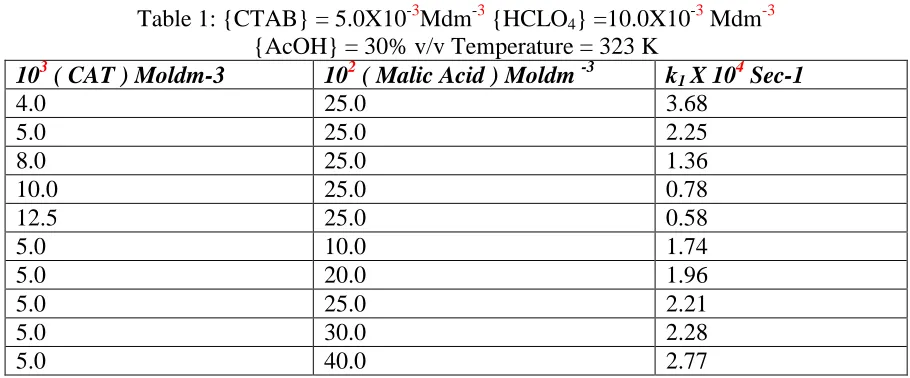
When the acid in large excess plots of log (a-x) time in found to be linear indicating first order dependence on (CAT). The pseudo first order rate constant in CAT calculated at different initiated concentration of malic acid are found to be independent. Hence, the reaction has fractional order with referred to malic acid (table-1).
4. Dependence of Rate on Surfactant Concentration
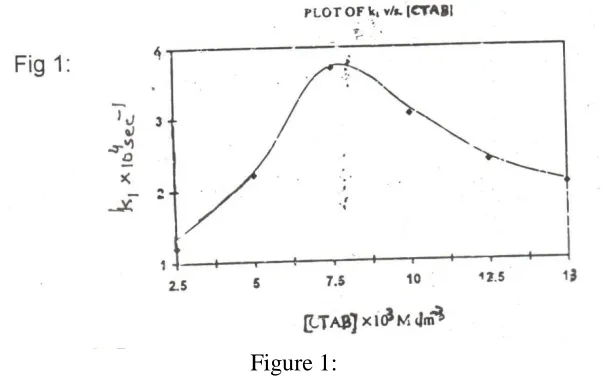
The reaction was carried out at different concentration of the surfactant (5x10⁻³ to 15.0x10⁻³m). It has been seen that the reaction rate increases initially with the increase of surfactant concentration and then decreases up to certain limit (Fig-1). This behavior is in accordance with the micellar catalysis of organic reaction of ionic neutral molecular type. As with increasing concentration of CTAB the relative concentration of organic substrates and ionic reactant with stern layer of micelle increases quit rapidly. The acceleration of rate beyond (7.5x10⁻³m CTAB) may due to the possibility of completion between reactive and uncreative ions sites in the stern layer.2
Figure 1:
5. Dependence of Rate on Solvent Concentration
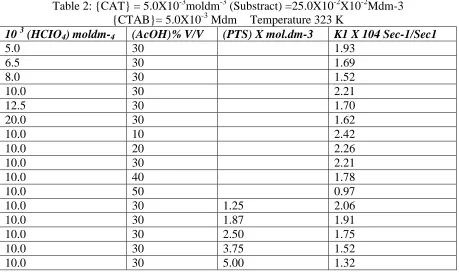
The rate of oxidation of Malic Acid in affected by varying the concentration of solvent (acetic acid). It in observed that reaction rate decreases with the increases of the solvent concentration (table-2). This may be due to the possible interaction (Amis 1960)3
6. Role of Product Addition on Reaction
Http://www.ijetmr.com©International Journal of Engineering Technologies and Management Research [21] 7. Theoretical Treatment of Micellar Data
The effect of changing the reaction medium from an aqueous to a micellar phase does not significantly affect the activity of a cationic function enhancement of its nucleophile characters due to desolvation in apparently not relevant. This is really surprising since the properties of the stern layer, in terms of dielectric constant and salvation capacity, would have suggested higher rates in the micellar than in the aqueous medium. The micellar catalysis or inhibition could be explained theoretically by making some simplification and assuming that one substrate is incorporated into a micelle and the aggregation number N of the micelle must be independent of the substrate. On the basis of general concepts, following reaction scheme is proposed.
(1)
The concentration of micelles, Dn is represented by Cd - CMC
[DN] =
N (2)
Where, Cd is the concentration of the detergent. For a system, where catalysis is observed at
detergent concentration close to CMC (Critical Micelle Concentration) the reaction schemes provides a comparision of the form.
(Kobs - Ko) = K (Cd –CMC)
(Km - Kobs) = N (3)
From the above equation the plot of (Kobs – Ko/ Km -Kobs) vs (CD - CMC) is linear in the present
case (Fig.2) and the value of building constant K/N Calculated is 1.074 X 10⁻³ M. Experience (3) shows that there is no catalysis expected below CMC however the result show catalysis below the reported CMC (8.5 X 10⁻³ M acetic Acid ) for CTAB, indicating that the substrate promotes micellisation of the cationic surfactant or there may be possibility of formation of all the small aggregation (index of positive cooperative more than one i.e.,1.01) of micelles which catalyse the oxidation process. At higher surfactant concentration, the possible molecular mechanism scheme. The counter ions also increase, there by inhibiting approaching ions of the reaction or large number of surfactants deactivate ionic reactants as a result, the velocity of reaction decreases. This can be said that ionic reactants are attracted by micellar surfaces which does not contain any substrate with consequent of dimerisation of these at the surface which ci=ontainsubstrate.
Http://www.ijetmr.com©International Journal of Engineering Technologies and Management Research [22] 8. Effect of Temperature
The reaction has been studied at different temperature and the Kinetic Parameters have been calculated temperature coefficient =1.3771
∆Ea [KJmol-1] = 28.49 Log pz = 09731 ∆s*j.k-1 mol-1 = 225.95 ∆h*kj mol-1 =25.83 ∆G*kj mol-1 = 98.80
9. The Stoichiometry of the Reaction
Several sets of. Experiments with variations of CAT over malic acid were carried out. The excess of CAT left in each set was estimated. An experiment showed that one mole of malic acid for one mole of CAT and has been found the following stoilchiometry of the reaction.
OH—CH—COOH + RSO2. NCl- - Na+ O = C – COOH
| | CH2COOH CH2COOH
Malic Acid Oxaloacetic acid +RSO2NH2 + Na+ -- Cl
-The oxidation product was oxalo acetic acid and this was identified by alkaline sodium nitrussied and alkaline m-dinilnibenxzen. This is also confirmed by spot test5 and 2:4 dinitro phenyl-hydrazine method6.
Table 1: {CTAB} = 5.0X10⁻³Mdm-3 {HCLO4} =10.0X10⁻³ Mdm-3
{AcOH} = 30% v/v Temperature = 323 K
103 ( CAT ) Moldm-3 102( Malic Acid ) Moldm -3 k1 X 104 Sec-1
4.0 25.0 3.68
5.0 25.0 2.25
8.0 25.0 1.36
10.0 25.0 0.78
12.5 25.0 0.58
5.0 10.0 1.74
5.0 20.0 1.96
5.0 25.0 2.21
5.0 30.0 2.28
Http://www.ijetmr.com©International Journal of Engineering Technologies and Management Research [23] Table 2: {CAT} = 5.0X10⁻³moldm-3 (Substract) =25.0X10-2X10-2Mdm-3
{CTAB}= 5.0X10⁻³ Mdm Temperature 323 K
10 3 (HCIO4) moldm-4 (AcOH)% V/V (PTS) X mol.dm-3 K1 X 104 Sec-1/Sec1
5.0 30 1.93
6.5 30 1.69
8.0 30 1.52
10.0 30 2.21
12.5 30 1.70
20.0 30 1.62
10.0 10 2.42
10.0 20 2.26
10.0 30 2.21
10.0 40 1.78
10.0 50 0.97
10.0 30 1.25 2.06
10.0 30 1.87 1.91
10.0 30 2.50 1.75
10.0 30 3.75 1.52
10.0 30 5.00 1.32
References
[1] Sharma.J and Mushran.S.P., Indian j.Chem 19A, 615 (1976) [2] Hartley,G.S., Quart Rev. Chemistry .Sec.Q.PP 153- 183 (1948)
[3] Amis.E.S, “Solvent effect on reaction rate and Mechanism Academic Press, New York (1960) [4] Mukherji.J and Benerji.K.K , Organic Chemistry,46,2323 (1981)
[5] Fiegi.F., Spot test in organic Analysis” Elsevier Publishing Co. Amsterdam.331(1956)
[6] Mitchell.J. (Jr), “Organic Analysis” Vol-1, Inter science Publishers, Inc, New York 279 (1953).
*Corresponding author.