www.atmos-meas-tech.net/8/1259/2015/ doi:10.5194/amt-8-1259-2015
© Author(s) 2015. CC Attribution 3.0 License.
Implementation of a GPS-RO data processing system for the
KIAPS-LETKF data assimilation system
H. Kwon1,2, J.-S. Kang1, Y. Jo1, and J. H. Kang1
1Korea Institute of Atmospheric Prediction Systems, Seoul, Korea 2Korea Polar Research Institute, Incheon, Korea
Correspondence to: J.-S. Kang ([email protected])
Received: 31 October 2014 – Published in Atmos. Meas. Tech. Discuss.: 28 November 2014 Revised: 17 February 2015 – Accepted: 17 February 2015 – Published: 16 March 2015
Abstract. The Korea Institute of Atmospheric Prediction Systems (KIAPS) has been developing a new global numer-ical weather prediction model and an advanced data assimi-lation system. As part of the KIAPS package for observation processing (KPOP) system for data assimilation, preprocess-ing, and quality control modules for bending-angle measure-ments of global positioning system radio occultation (RO) data have been implemented and examined. The GPS-RO data processing system is composed of several steps for checking observation locations, missing values, physical val-ues for Earth radius of curvature, and geoid undulation. An observation-minus-background check is implemented by use of a one-dimensional observational bending-angle operator, and tangent point drift is also considered in the quality con-trol process. We have tested GPS-RO observations utilized by the Korean Meteorological Administration (KMA) within KPOP, based on both the KMA global model and the Na-tional Center for Atmospheric Research Community Atmo-sphere Model with Spectral Element dynamical core (CAM-SE) as a model background. Background fields from the CAM-SE model are incorporated for the preparation of as-similation experiments with the KIAPS local ensemble trans-form Kalman filter (LETKF) data assimilation system, which has been successfully implemented to a cubed-sphere model with unstructured quadrilateral meshes. As a result of data processing, the bending-angle departure statistics between observation and background show significant improvement. Also, the first experiment in assimilating GPS-RO bending angle from KPOP within KIAPS-LETKF shows encourag-ing results.
1 Introduction
clouds or precipitation compared to other satellite observa-tions. Because of these benefits, many operational numeri-cal weather prediction centers, such as the Met Office of the United Kingdom, ECMWF, NCEP, Météo-France, Environ-ment Canada, and JMA, have started incorporating GPS-RO soundings into their assimilation systems with clear positive impacts on weather forecasting (e.g., Healy, 2008; Buon-tempo et al., 2008; Cucurull and Derber, 2008; Aparicio et al., 2009; Rennie, 2010). In particular, GPS-RO data assim-ilation shows strong sensitivity to upper atmosphere temper-ature structures, an area that is only weakly constrained by other observations in the analysis and that is prone to large model uncertainties (Anlauf et al., 2011).
The Korea Institute of Atmospheric Prediction Systems (KIAPS) is a government-funded, non-profit research and de-velopment institute that was established in 2011 by the Ko-rea Meteorological Administration (KMA). The goal of the KIAPS is to develop the next-generation operational global numerical weather prediction (NWP) system, which can be used for global modeling as well as local areas, particularly optimized to topographic and meteorological features of the Korean Peninsula. The KIAPS has been developing an ad-vanced data assimilation system in addition to a global model (KIAPS integrated model with spectral element dynamic core, or KIM). As one of the data assimilation systems, a local ensemble transform Kalman filter (LETKF) (Hunt et al., 2007) has been successfully implemented for the Na-tional Center for Atmospheric Research Community Atmo-sphere Model with Spectral Element dynamical core (CAM-SE) (Dennis et al., 2012), which has the same grid struc-ture on the cubed sphere as KIM. After a successful eval-uation of the KIAPS-LETKF data assimilation system with various observing system simulation experiments (OSSEs) (Kang and Park, 2013), assimilation of real observations of surface and rawinsonde data from NCEP preprocessed data has been performed (Jung et al., 2014). In preparation for GPS-RO data assimilation, preprocessing and quality control modules for bending-angle measurements of GPS-RO data are well implemented in the KIAPS Package for Observation Processing (KPOP) to provide optimal observation for the data assimilation. Finally, we have tested GPS-RO bending-angle data assimilation within the KIAPS-LETKF system to see whether our first version of the GPS-RO data assimila-tion cycle works well in a coupled system of KIAPS-LETKF and KPOP.
In this paper, we describe the GPS-RO data processing system for bending-angle data assimilation and present pre-liminary results from bending-angle data assimilation experi-ments with the KIAPS-LETKF system. In Sect. 2, we present the GPS-RO processing system in KPOP. In this section, background ingest and spatial interpolation step, observation operator for bending angle, quality control procedure, and re-sults from the quality control process for bending-angle data assimilation are introduced. In Sect. 3, description of analysis cycles within the KIAPS-LETKF system and its preliminary
result are presented. Section 4 contains a summary and plans for future work.
2 GPS-RO processing system in KPOP
2.1 Background ingests and spatial interpolation The observation needs to be compared with the model background for quality control and observation monitoring. Here, operational global model forecasts of the KMA are used as a model background. The global model is the Uni-fied Model (UM; Davies et al., 2004), which was devel-oped by the UK Met Office. It is a non-hydrostatic, grid-point model, with the Charney–Phillips grid in a vertical di-rection. The horizontal resolution is approximately 25 km (N512/∼0.352◦× ∼0.234◦) and it has 70 vertical levels,
with the model top at 80 km.
To produce the simulated observation by use of model background fields, the spatial interpolation of model vari-ables to the observation space is required. We used a bi-linear interpolation method to transform model variables into the observation space in the horizontal direction. In the vertical coordinate of the UM, model information is provided on a staggered height grid, with pressure and density onρ levels and potential temperature and humidity information on the intermediateθlevels. Therefore, the pressure on model lev-els where humidity information is stored should be known. The linear interpolation in natural log of pressure is applied for the calculation of the pressure on the intermediate vertical levels.
2.2 Observation operator
The purpose of data assimilation is to find an optimal analysis state, depending on the difference between observation and model background (i.e., innovations) and their error statis-tics. To have such innovations, one should have the observa-tion operator that maps atmospheric variables in the model grid space into the observed variables in observation space (Eyre, 1994). Therefore, the observation operator (forward model) is one of the most important components in the data assimilation system that calculates the simulated observation by use of model variables.
inflate the observation errors to partially compensate for this source of forward model error (Anlauf et al., 2011). The as-sumption of spherical symmetry enables calculation of the bending angle from a one-dimensional integration of the background refractivity lapse-rate profile located at the ver-tical level of the observation point. Recently, ECMWF has tested the two-dimensional bending-angle operator in their numerical weather prediction system and planned to imple-ment it into the next model cycle. For the same reason as most other operational centers, however, we adhere to a one-dimensional bending-angle operator that is included in the Radio Occultation Processing Package (ROPP) developed by the European Organization for the Exploitation of Meteoro-logical Satellites (EUMETSAT) Radio Occultation Meteo-rology Satellite Application Facility (ROM SAF). The one-dimensional bending-angle operator in ROPP solves Eq. (1) by use of the algorithm of Healy and Thépaut (2006). It cal-culates the integral of the bending angle (e.g., Kursinski et al., 1997), given the observed impact parametera, by use of the interpolated model fields (temperature, pressure, and hu-midity) at the horizontal location of the tangent point of the observation.
α (a)= −2a
∞
Z
a 1
√
x2−a2
d ln(n)
dx dx, (1)
where αis the total ionospheric-corrected bending angle,n
is the refractive index derived from the model, andx=nr, wherer is distance from the local center of curvature. As-suming that refractivity varies exponentially withxbetween model levels j andj+1 and
√
x2−a2≈√2a√x−a, the bending-angle calculation at a single layer is given by
1αj=10−6 p
2π akjNjexp kj xj−a (2) ×
erf
q
kj xj+1−a
−erf q
kj xj−a
,
wherekjand the error function (erf) are defined as
kj = ln(NNj
j+1)
xj+1−xj
, (3)
erf(x)=√2
π
x Z
0
e−t2dt. (4)
Ray bending above the model top is accounted for by ex-trapolating the uppermost model parameters and evaluating
1αtop=10−6 p
2π akjNjexp kj xj−a
(5)
×
1−erf
q
kj xj−a
.
The bending-angle forward model is composed of the fol-lowing steps. First, the partial water vapor pressure on each
background level is derived from the definition of specific humidity for evaluating refractivity. The refractivity (N) is then calculated on each background model level by appli-cation of the equation given by Bevis et al. (1994) and then interpolated to geopotential heights. For the radio occultation soundings, the scattering term is usually assumed to be neg-ligible, and the ionospheric effects in the equation of refrac-tivity are assumed to have been removed during the prepro-cessing. Therefore, the refractivity can be expressed (Smith and Weintraub, 1953; Bevis et al., 1994) as
N=(n−1)×106=k1
Pd
T +k2 e T2+k3
e
T, (6)
wherePdis the pressure of the dry air,T is the temperature,e is the partial water vapor pressure, andk1(77.607),k2(71.6), andk3(3.747)are the atmospheric refractivity constants. Us-ing the refractive indexn, the impact parameter correspond-ing to each background level is derived and, finally, the bend-ing angle is computed as a function of the observation impact parameter from the refractivity profile on background impact parameter levels.
2.3 Preprocessing and quality control
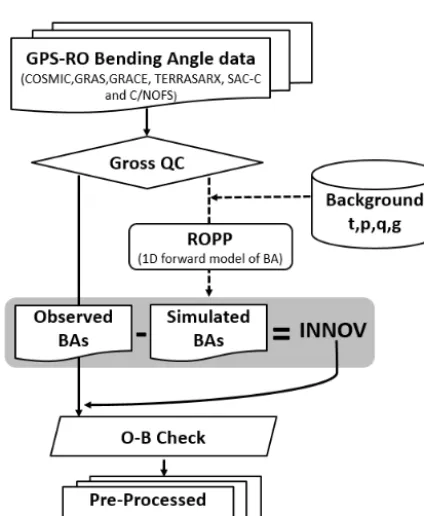
Figure 1. Schematic diagram of the GPS-RO data processing sys-tem implemented in KPOP.
The standard deviation of the error is assumed to decrease linearly from 10 % of the observed value to 1 % for impact heights from 0 to 10 km, and to stay at 1 % above 10 km, with an absolute lower limit of 3 µrad.
2.4 Processing results
We processed 30 days of bending-angle data from 1 to 30 November 2011, which were used for operational data assimilation at the KMA. The GPS-RO data provided by the KMA include measurements from the GRAS instrument on METOP (Loiselet et al., 2000), the constellation of six satel-lites launched by the Constellation Observing System for Meteorology, Ionosphere and Climate (COSMIC) program (Anthes et al., 2000), and the Communications/Navigation Outage Forecasting System (C/NOFS) Occultation Receiver for Ionospheric Sensing and Specification (CORISS) instru-ment. Figure 2 shows geographical coverage of GPS-RO pro-files over 6 h. The number of total GPS-RO events for 6 h is approximately 500, and the data are shown to be distributed globally over land and ocean.
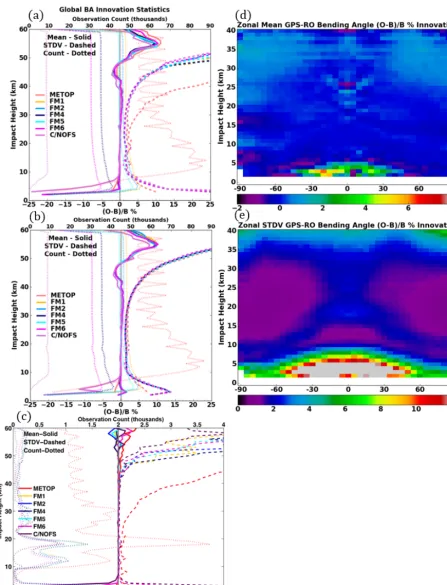
The KMA global model forecasts are used as model back-ground. The operational global forecast model used at the KMA is the UM (Davies et al., 2004), developed by the UK Met Office. The GPS-RO data were assimilated to produce the analysis with other kinds of observations in operational forecast cycle at the KMA. Figure 3 presents the global mean of departure statistics of bending angle between the observa-tion and background calculaobserva-tions for the month of
Novem-ber 2012. Figure 3a and b show the global mean and stan-dard deviation of bending-angle innovations normalized by background and the number of observations as a function of impact height before and after quality control, respectively. Also, Fig. 3c shows the difference of departure statistics be-tween Fig. 3a and b. After the quality control, the mean agreement is best over approximately 5 to 40 km altitude, be-tween−1 % and+1 %, except for the observation from the CORISS instrument. The statistics from CORISS observa-tions show large mean differences between observation and background calculations at the lower atmosphere below ap-proximately 8 km. The increased bias above∼45 km is con-sidered to be associated with a specific model temperature bias of the UM. As we mentioned above, UM forecast is uti-lized to produce the model background field for data pro-cessing. Increased bias of bending-angle innovations (O-B) above∼45 km is also addressed by Burrows et al. (2014). As a reason, they specifically noted the high-altitude temper-ature bias in the UM. The region located above 40 km altitude presents standard deviations increasing with height and this increase is partly caused by ionospheric contamination. The COSMIC satellites show the smallest global mean O-B value with impact height of other satellites (METOP and C/NOFS). Also, all COSMIC satellites show consistent bending-angle departure statistics from one another. This results from con-sistency in the data processing.
We compared our results of bending-angle departure statistics to those from the established operational quality control system of the Met Office by Burrows et al. (2014) (not shown). The period (about 1 month) of data processing and the types (satellites) of observations used by the Met Of-fice are similar to our data processing even though the year and month of observation are not exactly matched. The com-parison of results of O-B statistics in our study with those of Met Office shows a good agreement in terms of global mean and standard deviation. The results from CORISS in-struments show the large value of mean difference of O-B statistics under∼8 km in the Met Office’s data processing as well, so they do not use the GPS-RO observations under the height of∼8 km for an operational data assimilation (C. Bur-rows, personal communication, 2013).
Figure 2. Six-hour coverage of the GPS radio occultation events on 7 November 2012. The total number of profiles is 591.
standard deviation remains below 4 % except near the trop-ical tropopause. In general, the standard deviations of the bending-angle departures between observations and back-ground states are slightly larger in the southern high latitudes than in the northern high latitudes. This result is consistent with previous researches (Cucurull et al., 2007; Poli et al., 2009).
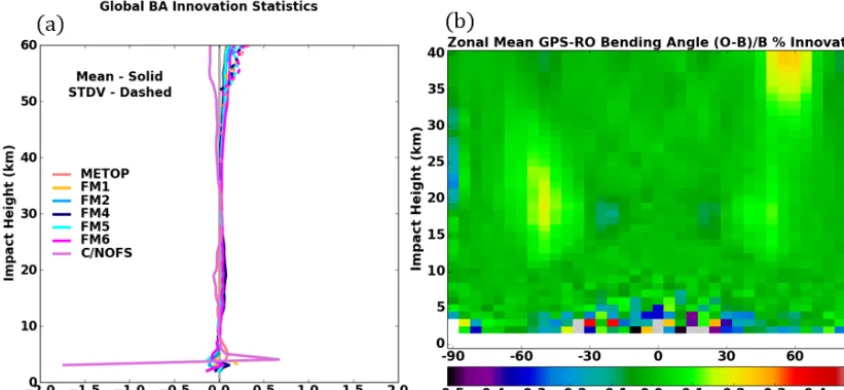
We also investigated the bending-angle departure statistics when the tangent point drift is taken into account in GPS-RO data processing. Figure 4 shows the difference of the bending-angle departure statistics between the results from data processing with and without considering the tangent point drift. In data processing, which does not consider the tangent point drift, horizontal location of each data point in a vertical profile is assumed to be fixed, with mean value of latitude and longitude extracted from the BUFR file for all vertical levels. Although no significant difference is seen be-tween the two treatments over most of the area, certain dif-ferences have been found at altitudes below 5 km over the tropics in latitude bands. Furthermore, the total number of data points remaining after quality control with tangent point drift consideration is slightly smaller than the other results with 0.08 %.
3 Assimilation of bending angle within the KIAPS-LETKF system
3.1 The KIAPS-LETKF system
Figure 4. Difference of the bending-angle departure statistics for global (a) and zonal mean (b) between the results from data processing considering (TPD) and not considering (no_TPD) the tangent point drift (TPD minus no_TPD).
background states in our experiments contain model bias, es-pecially over polar regions. This imperfection of the forecast model is embedded on purpose to see how the data assimila-tion system works with an obviously forced model bias.
For the ensemble data assimilation experiments, we had 30 ensemble members and a 6-hourly analysis cycle. Within the 6 h assimilation window, we considered background ensem-bles and GPS-RO data every hour, based on a 4D-LETKF al-gorithm (e.g., Fertig et al., 2007; Harlim and Hunt, 2007) that deals with flow-dependent background uncertainty in space as well as in time. Adaptive multiplicative inflation (Miyoshi, 2011) was implemented, which greatly helped in estimating background error covariance accurately (e.g., Miyoshi and Kunii, 2012; Kang et al., 2012). Within the 4D-LETKF data assimilation, the analysis meanxa and its perturbations Xa are determined by Eqs. (7) and (8) at every grid point. Here, Xb(and Yb) andyoto computew(l)andePa(l)are considered at every hour in the 4D-LETKF system. State vector ofxin the analysis cycle includes the variables of U(zonal wind),
V (meridional wind),T (temperature),q(specific humidity), andPs (surface pressure). Then those variables are updated by multivariate data assimilation as described below. xa(l)=xb(l)+Xb(l)w(l), (7)
Xa(l)=Xb(l)h(K−1)ePa(l) i1/2
, (8)
where xb is the ensemble mean of background states, Xb is a matrix whose column is each background ensem-ble perturbation (background state minus ensemensem-ble mean of background), w(l)=ePa(l)(Yb(l))TR−(l)1
yo
(l)−y b (l)
, Pe(l)a =
h
(Yb(l))TR−(l)1Y(l)b +(K−1)I/ρi,yois a vector of all the ob-servations,yb and Yb correspond toxb and Xb at the ob-servation space, respectively, R is the obob-servation error co-variance matrix, which is the assumed diagonal matrix here, andρis the adaptive multiplicative inflation factor (Miyoshi, 2011). Subscript (l) indicates the information within a local area centered at the analysis point. In this study, we used a Gaussian function with 500 km of a standard deviation for the horizontal localization function while setting 1800 km as the cutoff distance. For the vertical function, we have another Gaussian function with 0.2σof standard deviation and 0.73σ
of cutoff. The LETKF simultaneously assimilates all obser-vations within the distance just described in space and within the 6 h assimilation window (Hunt et al., 2007).
To assimilate GPS-RO bending-angle data within the KIAPS-LETKF system, we ran ROPP implemented in KPOP, as an observation operator, as many times as the en-semble size. Then, background enen-sembles at the GPS-RO observation space Ybwere provided for the computation of Eqs. (7) and (8).
3.2 Data processing with CAM-SE backgrounds
the bending-angle assimilation within the KIAPS-LETKF system. The background ensembles at the initial time of bending-angle data assimilation cycles are the forecasts from the analysis assimilating sonde and surface pressure station data only. Once the the data assimilation cycle with RO data (EXP_RO cycle) is initiated, the background ensembles used for the data processing are CAM-SE forecasts starting from the analysis assimilating bending angle in addition to sonde and surface pressure data.
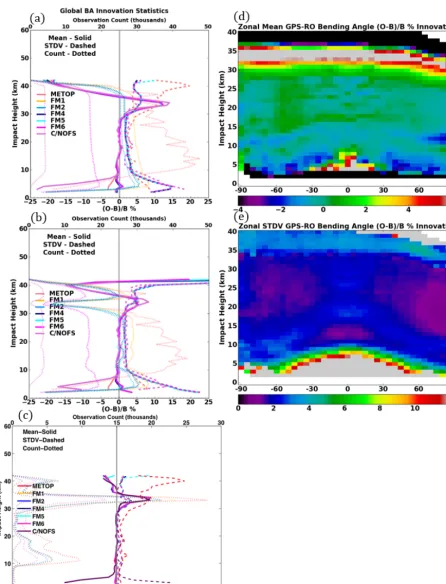
Figure 5 presents departure statistics between the obser-vation and background of the bending angle from 15 to 30 November 2012. The background of the bending-angle re-sults from an ensemble mean of 30 background states. Fig-ure 5a and b show the global mean of departFig-ure statistics nor-malized by background and the number of observations as a function of impact height before and after quality control, re-spectively. Also, Fig. 5c shows the difference of departure statistics between Fig. 5a and b. Figure 5d and e show the zonal mean and the standard deviation of bending-angle de-partures between observations and background after the pro-cessing. The data processing clearly improves the bending-angle departure statistics in terms of global mean and stan-dard deviation for the vertical range from 10 to 35 km. The global mean departure statistics show best agreement be-tween observation and background over approximately 5 to 30 km of the impact height. The zonal mean feature of de-parture statistics shows large value over the tropic regions. About 13 % of the total number of observation is rejected during the data processing. The number of rejected obser-vations widely ranges from 2.9 to 32 % in the vertical pro-file. Note that the number of observations around ∼33 km (impact height) was considerably reduced (∼75 % of the total number of observations for the vertical range of 32– 33 km) compared to other levels. This is mainly due to the large difference of bending angle between observation and background for that vertical range before the data process-ing. This could be affected by the bending-angle calculation using the one-dimensional observation operator described in Sect. 2.2 around the model top with a large vertical spacing of the CAM-SE. Another possible reason can be ascribed to a quality of the CAM-SE background for those vertical levels. CAM-SE is a climate model that may not be optimal for the purpose of NWP although we chose it for a test model due to the same grid structure as KIM. Therefore, we expect that replacing the forecast model by KIM would solve this issue. When compared with the results obtained from use of the KMA forecast as a background, as presented in Sect. 2.4, the departure statistics show a larger variability with the CAM-SE background than with the KMA background in terms of global and zonal mean features of statistics. Also, the number of observations is significantly reduced compared to results of KMA forecasts after the data processing. This again im-plies that the CAM-SE background has poorer forecasts of atmospheric conditions than the KMA background. If we re-call the lower horizontal and vertical resolution of the
CAM-SE model and some limitations of climate models for good weather prediction as mentioned in a previous section, the finding looks reasonable. Another factor is that the KMA backgrounds already include the operational data assimila-tion effects of GPS-RO and many other observaassimila-tions on the analysis, whereas our CAM-SE background is the forecast from the analysis assimilating sonde, surface pressure station data, and GPS-RO bending angle only.
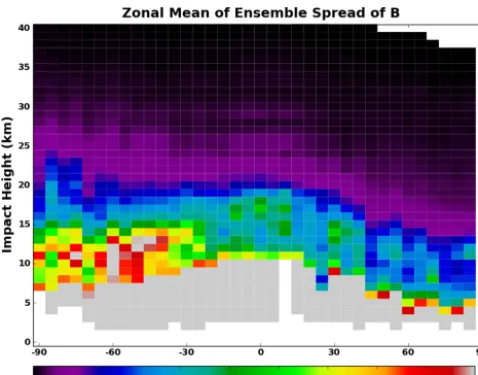
We also see the ensemble spread of background states in the observation space of bending angle in Fig. 6. Because the initial background ensembles for the RO data assimilation experiment come from background states of analyses assim-ilating only sonde and surface pressure data, the ensemble spread over the Northern Hemisphere is smaller than over the Southern Hemisphere. That is, meteorological variables are relatively well constrained by sonde data over the North-ern Hemisphere, so the ensemble spread (standard deviation of ensemble perturbations), representing background uncer-tainty, has small values there. Therefore, we expect that the impact of GPS-RO bending-angle data would be significant over the regions with large ensemble spread (e.g., Southern Hemisphere) when the observation error of bending-angle data is relatively small.
3.3 Assimilation experiments and results
We conducted two experiments: a 1-month (November 2011) data assimilation experiment that included sonde and sur-face pressure station data only (hereafter referred to as CTRL_SONDE) and a 2-week data assimilation experi-ment that starts from ensemble background after 2 weeks of CTRL_SONDE analysis (15 November 2011) but starts as-similating GPS-RO bending-angle data in addition to sonde and surface pressure station data (hereafter referred to as EXP_RO). Thus, we would like to see if EXP_RO gives rea-sonable analysis increments compared with CTRL_SONDE, for the last 2 weeks of the analysis period.
Figure 6. Zonal mean of ensemble spread in the bending-angle ob-servation space (unit: rad) at the initial time of EXP_RO at 00Z of 15 November 2011, which is from CTRL_SONDE.
Fig. 6 shows a large background spread at the observation space, which makes the analysis reflect observation effec-tively. Thus, it shows the additional correction caused by RO data, even in the lower troposphere, where the background states exhibit serious forecast bias. Furthermore, states and errors between two experiments are transferred by the en-semble forecast, so the difference can be found in the lower troposphere through repetition of forecast-analysis cycles.
Horizontal analysis increment at the level where many bending-angle data of GPS-RO are assimilated is pre-sented in Fig. 8. As expected, significant increments occur where sonde data do not sufficiently constrain the back-ground. Since the initial ensembles of EXP_RO were al-ready constrained by conventional data for 2 weeks of CN-TRL_SONDE, analysis increments look dominant where the conventional data do not exist, especially for the 2-week analysis period of EXP_RO. Recall that the spinup period usually shows significant analysis increments where obser-vations are newly assimilated. We expect that the system will show more comparable increments even in the Northern Hemisphere as the forecast-analysis cycles are repeated.
To examine a posteriori uncertainties between CTRL_SONDE and EXP_RO, we looked at the rela-tive uncertainty reduction in Fig. 9 through the following equation:
100×nqE
(xasonde−xasonde)2−q
E
(xa
ro−xaro)2 o
q
E
(xasonde−xasonde)2
, (9)
wherexasonde andxaro indicate ensemble analysis states from CTRL_SONDE and EXP_RO, respectively, and xasonde and xbro are the ensemble means ofxasonde andxaro, respectively, andE[ ] indicates ensemble mean. As a result, positive
val-ues mean that analysis uncertainty estimated in EXP_RO is smaller than that in CTRL_SONDE and vice versa. Thus, the values of Fig. 9 indicate how much reduction of the estimated analysis uncertainty has been introduced by adding GPS-RO data into the KIAPS-LETKF system.
We found significant uncertainty reduction estimated over the areas where the analysis increments are shown in Fig. 8. This illustrates that GPS-RO data are assimilated and reduce uncertainties of background and analysis over the areas with many data and relative inaccuracy of background states. Be-cause we used the adaptive multiplicative inflation method (Miyoshi, 2011), which computes inflation parameters in a way that has large inflation where and when innovation is large, to avoid underestimation of background uncertainty, background/analysis tends to have greater inflation factors than unity. In contrast, the multiplicative inflation parameter is not adaptively estimated when there is no observation (no O-B information), and a very small inflation factor (only 1 % inflation) is set. Therefore, background states in EXP_RO tend to be inflated more than those in CTRL_SONDE. De-spite greater inflation factors multiplied in EXP_RO than in CTRL_SONDE, resultant analysis of EXP_RO shows signif-icant reduction of analysis spread as a result of assimilating additional data. Before verifying our analysis, we confirmed that GPS-RO bending-angle data are assimilated effectively for the first test with the KIAPS-LETKF system in a way that reduces analysis uncertainty where the data are expected to contribute.
Finally, we compared our analysis with ERA in-terim reanalysis (Dee et al., 2011) using the equation
xasonde−ERA−
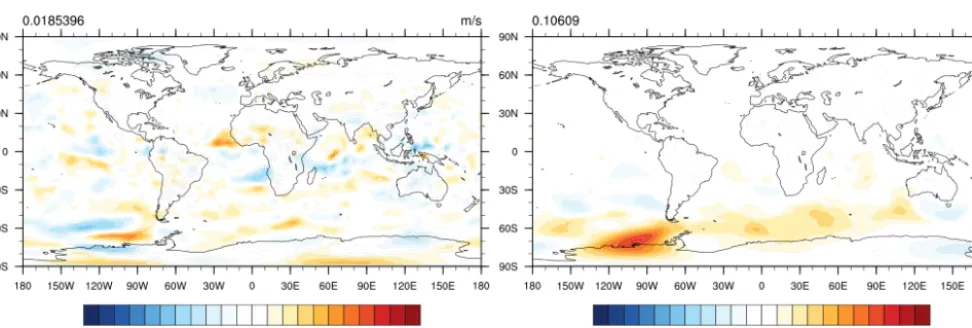
xaro−ERA in Fig. 10, which gives pos-itive values when the analysis of EXP_RO is closer to ERA interim than CTRL_SONDE and vice versa. Even though the forecast model used for this study has difficulties in making good weather prediction, as described in Sect. 3.1, we still expect a meaningful correction to be introduced by additional GPS-RO bending-angle data if our analysis method works. Thus, we have computed that equation of analysis improve-ment for the 2-week EXP_RO data assimilation period. Fig-ure 10 shows encouraging results. We have obtained positive global mean values for bothU andT, which represent the positive impact of GPS-RO data on our analysis. We found that the variable ofT has much better fit to ERA interim data than that ofUafter assimilating GPS-RO bending-angle data. This is a reasonable result because bending-angle data have been known to show stronger sensitivity to the temper-ature than wind. Based on this fact, we may be able to try the “localization of the variables” for even better analysis within the LETKF system, which allows the assimilation of GPS-RO bending-angle data to update only temperature (Kang et al., 2011).
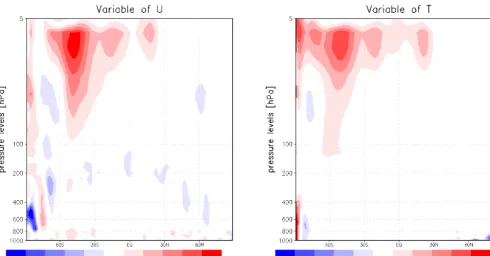
Figure 7. Difference of zonally averaged analysis increments ofU(left, unit: m s−1) andT (right, unit: K) between CTRL_SONDE and EXP_RO for a 2-week analysis from 15 November 2011.
Figure 8. Difference of horizontal analysis increment ofU(left, unit: m s−1) andT (right, unit: K) between CTRL_SONDE and EXP_RO at the level of 100 hPa for a 2-week analysis from 15 November 2011.
EXP_RO. There are considerable corrections of errors in up-per level wind and temup-perature. In addition, we could ap-parently find positive impact of RO data even in the lower troposphere, especially over the polar region where there is forecast imperfection due to the inactivated sea–ice model. Figure 12 shows much greater improvement caused by GPS-RO bending-angle data at the level of 20 hPa than the level of 100 hPa, and the global mean of error reduction looks re-markable for both variables of U andT. Those results are from the first version of GPS-RO bending-angle data assimi-lation within the KIAPS-LETKF system coupled with KPOP.
Thus, we want to prove our first achievement in this paper. In the meantime, we continue improving our current system (such as tuning parameters within LETKF, replacing the fore-cast model by a better one, etc.) so that it could give compa-rable results to those of other centers (e.g., Cucurull et al., 2007; Anlauf et al., 2011) in the near future.
4 Summary and future work
Figure 9. Relative uncertainty reduction of EXP_RO from CTRL_SONDE, computed by Eq. (9) for the variableU(left) andT (right) at the 100 hPa level for a 2-week analysis period.
Figure 10. Improvement of EXP_RO analysis from CTRL_SONDE, toward ERA interim, computed by the equationxasonde−ERA −
xaro−ERA
forU(left, unit: m s−1) andT (right, unit: K) at the level of 100 hPa. Positive values indicate analysis of EXP_RO closer to ERA interim data than CTRL_SONDE and vice versa. Global mean values are present at the top left of each figure.
KPOP system for GPS-RO bending-angle data assimilation. The preprocessing and gross quality control procedure con-sists of checks for observation locations, missing values, and physically consistent values for Earth radius of curvature and geoid undulation. An observation-minus-background check is implemented by use of a one-dimensional observa-tional bending-angle operator that is included in the ROPP software. With this GPS-RO data processing system, we have processed bending-angle observations with background states produced by both KMA and CAM-SE forecasts to in-vestigate the bending-angle departure statistics between ob-servation and background. After the data processing, the mean departure statistics show better agreement between the observation and background of the bending angle. In particu-lar, it is more apparent in the use of a CAM-SE background. Overall, the processing results show reasonable quality of de-parture statistics, which is consistent with previous studies
(Cucurull et al., 2007; Poli et al., 2009; Rennie, 2010; Bur-rows et al., 2014).
Figure 11. Vertical cross section of zonally averaged improvement of EXP_RO analysis from CTRL_SONDE, toward ERA interim, com-puted by the equationxa
sonde−ERA
−
xaro−ERA
forU (left, unit: m s−1) andT (right, unit: K). Positive values indicate analysis of EXP_RO closer to ERA interim data than CTRL_SONDE and vice versa.
Figure 12. Same as Fig. 10 except for the vertical level of 20 hPa.
have started implementing the KIAPS-LETKF system in a much more advanced forecast model, KIM, which has much finer horizontal and vertical resolution with a higher top. This change will bring major improvement to the GPS-RO bending-angle data assimilation system. We can try the “lo-calization of the variables” (Kang et al., 2011) to see if the results of bending-angle data assimilation would be im-proved. Moreover, in the coupled cycle of the KPOP and KIAPS-LETKF systems, we will try proactive quality con-trol and estimate observation error by the advanced method of Hotta (2014), which estimates short-range forecast
sensi-tivity to the observation data and to observation error within LETKF. Also, we will try to use the information from the prior ensemble statistics for the quality control of bending angle within the KPOP system. In addition, we plan to apply a two-dimensional bending-angle operator suggested (Healy et al., 2007) for advanced bending-angle preprocessing and data assimilation.
Atmospheric Prediction Systems funded by Korea Meteorological Administration. Also, this work was partly funded by Korea Polar Research Institute project (PE15010). We thank Benjamin Ruston at the U.S. Naval Research Laboratory for his support and constructive discussion in the development of the KPOP system. Finally, we thank two anonymous reviewers for their constructive comments and suggestions to improve the manuscript.
Edited by: R. Anthes
References
Anlauf, H., Pingel, D., and Rhodin, A.: Assimilation of GPS radio occultation data at DWD, Atmos. Meas. Tech., 4, 1105–1113, doi:10.5194/amt-4-1105-2011, 2011.
Anthes, R. A.: Exploring Earth’s atmosphere with radio occulta-tion: contributions to weather, climate and space weather, At-mos. Meas. Tech., 4, 1077–1103, doi:10.5194/amt-4-1077-2011, 2011.
Anthes, R. A., Rocken, C., and Kuo, Y. H.: Applications of COS-MIC to meteorology and climate, Terr. Atmos. Ocean. Sci., 11, 115–156, 2000.
Aparicio, J. M., Deblonde, G., Garand, L., and Laroche, S.: The signature of the atmospheric compressibility factor in COSMIC, CHAMP and GRACE radio occultation data, J. Geophys. Res., 114, D16144, doi:10.1029/2008JD011156, 2009.
Bevis, M., Businger, S., Chiswell, S., Herring, T. A., Anthes, R. A., Rocken, C., and Ware, R. H., GPS meteorology: Mapping zenith wet delays onto precipitable water, J. Appl. Meteor., 33, 379– 386, 1994.
Buontempo, C., Jupp, A., and Rennie, M. P.: Operational NWP as-similation of GPS radio occultation data, Atmos. Sci. Lett., 9, 129–133, 2008.
Burrows, C. P., Healy, S. B., and Culverwell, I. D.: Improving the bias characteristics of the ROPP refractivity and bending angle operators, Atmos. Meas. Tech. Discuss., 7, 4439–4480, doi:10.5194/amtd-7-4439-2014, 2014.
Cucurull, L. and Derber, J. C.: Operational implementation of COS-MIC observations into NCEP’s global data assimilation system, Weather Forecast., 23, 702–711, 2008.
Cucurull, L., Derber, J., Treadon, R., and Purser, R. J.: Assimilation of global positioning system radio occultation observations into NCEP’s global data assimilation system, Mon. Weather Rev., 135, 3174–3193, 2007.
Cucurull, L., Derber, J. C., and Purser, R. J.: A bending angle for-ward operator for global positioning system radio occultation measurements, J. Geophys. Res.-Atmos., 118, 14–28, 2013. Davies, T., Cullen, M. J. P., Malcolm, A. J., Mawson, M. H.,
Stan-iforth, A., White, A. A., and Wood, N.: A new dynamical core for the Met Office’s global and regional modelling of the atmo-sphere, Q. J. Roy. Meteorol. Soc., 131, 1759–1782, 2004. Dee, D. P., Uppala, S. M., Simmons, A. J., Berrisford, P., Poli,
P., Kobayashi, S., Andrae, U., Balmaseda, M. A., Balsamo, G., Bauer, P., Bechtold, P., Beljaars, A. C. M., van de Berg, L., Bid-lot, J., Bormann, N., Delsol, C., Dragani, R., Fuentes, M., Geer, A. J., Haimberger, L., Healy, S. B., Hersbach, H., Holm, E. V., Isaksen, L., Kallberg, P., Köhler, M., Matricardi, M., McNally, A. P., Monge-Sanz, B. M., Morcrette, J.-J., Park, B.-K., Peubey,
C., de Rosnay, P., Tavolato, C., Thépaut, J.-N., and Vitart, F.: The ERA-Interim reanalysis: configuration and performance of the data assimilation system, Q. J. Roy. Meteorol. Soc., 137, 553– 597, doi:10.1002/qj.828, 2011.
Dennis, J. M, Edwards, J., Evans, K. J., Guba, O., Lauritzen, P. H., Mirin, A. A., St-Cyr, A., Taylor, M. A., and Worley, P. H.: CAM-SE: A scalable spectral element dynamical core for the Commu-nity Atmosphere Model, Int. J. High Perform. Comput. Appl., 26, 74–89, 2012.
Eyre, J. R.: Assimilation of radio occultation measurements into a numerical weather prediction system, Technical Memo. No. 199, ECMWF, Reading, UK, 1994.
Fertig, E. J., Harlim, J., and Hunt, B. R.: A comparative study of 4D-VAR and a four-dimensional ensemble Kalman filter: perfect model simulations with lorenz-96, Tellus, 59A, 96–100, 2007. Gorbunov, M. E. and Kornblueh, L.: Principles of variational
assim-ilation of GNSS radio occultation data, Report 350, Max-Planck-Institut für Meteorologie, Hamburg, Germany, 2003.
Harlim, J. and Hunt, B. R.: Four-dimensional local ensemble trans-form Kalman filter: numerical experiments with a global circula-tion model, Tellus, 59A, 731–748, 2007.
Healy, S. B.: Assimilation of GPS radio occultation measurements at ECMWF, in: Proceedings of the GRAS SAF Workshop on Applications of GPSRO measurements, ECMWF, Reading, UK, 16–18 June 2008, 99–109, 2008.
Healy, S. B. and Thépaut, J. N.: Assimilation experiments with CHAMP GPS radio occultation measurements, Q. J. Roy. Me-teorol. Soc., 132, 605–623, 2006.
Healy, S. B., Eyre, J. R., Hamrud, M., and Thépaut, J.-N.: Assimilat-ing GPS radio occultation measurements with two-dimensional bending angle observation operators, Q. J. Roy. Meteorol. Soc., 133, 1213–1227, 2007.
Hotta, D.: Proactive quality control based on ensemble forecast sen-sitivity to observations, PhD thesis, Univ. of Md., College Park, 2014.
Hunt, B. R., Kostelich, E., and Szunyogh, I.: Efficient data assimilation for spatiotemporal chaos: A local ensem-ble transform Kalman filter, Physica D, 230, 112–126, doi:10.1016/j.physd.2006.11.008, 2007.
Jung, B.-J., Kang, J.-S., Kim, J., and Jo, Y.: Preliminary result for KIAPS-LETKF system with real observations, Collection of ab-stracts for spring meeting of Korean Meteorological Society, 11– 12, 2014.
Kang, J.-S. and Park, J.: Development of KIAPS Ensemble Data Assimilation System, KIAPS Tech. Note, 2013.
Kang, J.-S., Kalnay, E., Miyoshi, T., Liu, J., and Fung, I.: Estimation of surface carbon fluxes with an advanced data assimilation methodology, J. Geophys. Res., 117, D24101, doi:10.1029/2012JD018259, 2012.
Kursinski, E. R., Hajj, G. A., Hardy, K. R., Schofield, J. T., and Lin-field, R.: Observing Earth’s atmosphere with radio occultation measurements using the global positioning system, J. Geophys. Res., 102, 23429–23465, doi:10.1029/97JD01569, 1997. Loiselet, M., Stricker, N., Anthes, R., Chang, J., Tseng, J.-H., and
Wang, B.: Metop’s GPS-based atmospheric sounder, Bulletin 102, ESA, Darmstadt, Germany, 2000.
trans-form Kalman filter, Mon. Weather Rev., 139, 1519–1535, doi:10.1175/2010MWR3570.1, 2011.
Miyoshi, T. and Kunii, M.: The local ensemble transform Kalman filter with the Weather Research and Forecasting model: Exper-iments with real observations, Pure Appl. Geophys., 169, 321– 333, doi:10.1007/s00024-011-0373-4, 2012.
Phinney, R. A. and Anderson, D. L.: On the radio occultation method for studying planetary atmospheres, J. Geophys. Res., 73, 1819–1827, 1968.
Pingel, D. and Rhodin, A.: Assimilation of Radio Occultation Data in the Global Meteorological Model GME of the German Weather Service, in: New Horizons in Occultation Research, Studies in Atmosphere and Climate, edited by: Steiner, A., Pirscher, B., Foelsche, U., and Kirchengast, G., Springer-Verlag, Berlin, Heidelberg, 111–129, doi:10.1007/978-3-642-00321-9, 2009.
Poli, P., Moll, P., Puech, D., Rabier, F., and Healy, S.: Quality control, error analysis, and impact assessment of FORMOSAT-3/COSMIC in numerical weather prediction, Terr. Atmos. Ocean. Sci., 20, 101–113, 2009.
Rennie, M. P.: The impact of GPS radio occultation assimilation at the Met Office, Q. J. Roy. Meteorol. Soc., 136, 116–131, doi:10.1002/qj.521, 2010.