ORIGINAL RESEARCH
Association of
CD58
polymorphism
and multiple sclerosis in Malaysia: a pilot study
Yee Ming Ching
1, Shanthi Viswanathan
2, Nurhanani Mohamed Nor
1, Shuwahida Shuib
1, Balqis Kamarudin
1,
Salawati Mansor
1, Ainur Yusniza Yusof
1and Masita Arip
1,3*Abstract
Background: Multiple sclerosis is an immune mediated disease targeting the central nervous system. Association of non-human leukocyte antigen gene, CD58, with multiple sclerosis has been reported in several populations but is unclear among Southeast Asians. This pilot study was conducted to explore the association between CD58 polymor-phism and multiple sclerosis among the Malay population in Malaysia.
Methods: Blood samples were collected from 27 multiple sclerosis patients, and compared with 58 age- and gender matched healthy individuals. All patients were tested negative for anti-aquaporin 4. DNA was extracted from the blood and genotyped for 3 single nucleotide polymorphisms rs12044852, rs2300747 and rs1335532 of gene CD58 by real-time PCR.
Results: The majority of multiple sclerosis patients were female (85.2%). The general mean age of onset was 30.5 years. Genotyping results showed that frequencies of the alleles were between 40 and 50% for MS patients and healthy individuals. Association (allelic model) between multiple sclerosis and CD58 gene polymorphism alleles rs12044852 (p = 0.410), rs2300747 (p = 0.881) and rs1335532 (p = 0.407) were indistinct.
Conclusions: The impact of the CD58 gene polymorphism was not prominent in this pilot study, implying that genetic composition contributing to multiple sclerosis may be different between different populations, thus results in a heterogeneity of disease manifestation and distribution.
Keywords: Multiple sclerosis, CD58 polymorphism, Single nucleotide polymorphism
© The Author(s) 2019. This article is licensed under a Creative Commons Attribution 4.0 International License, which permits use, sharing, adaptation, distribution and reproduction in any medium or format, as long as you give appropriate credit to the original author(s) and the source, provide a link to the Creative Commons licence, and indicate if changes were made. The images or other third party material in this article are included in the article’s Creative Commons licence, unless indicated otherwise in a credit line to the material. If material is not included in the article’s Creative Commons licence and your intended use is not permitted by statutory regulation or exceeds the permitted use, you will need to obtain permission directly from the copyright holder. To view a copy of this licence, visit http://creat iveco mmons .org/licen ses/by/4.0/.
Background
Multiple Sclerosis (MS) is an immune-mediated disease characterized by inflammation and demyelination of the central nervous system (CNS). MS patients can present with a broad spectrum of neurological symptoms such as visual loss, muscle weakness, sensory loss, incoordina-tion, cognitive dysfunction and bladder problems [1]. A systemic analysis of MS has reported that age-standard-ized prevalence was greater than 120 cases per 100,000
population in North America and some northern Euro-pean countries, moderate (60–120 per 100,000) in some countries in Europe and Australasia, and lower in Africa, Asia and northern South America region (5 per 100 000) [2, 3]. In Malaysia, the prevalence of MS was estimated to range from 2 to 3 per 100,000 [4, 5].
The development of MS is commonly associated with the interaction between genetic susceptibility and envi-ronmental factors. Genetic association of MS, especially the variation in human leukocyte antigen (HLA) loca-tion on chromosome 6, has been generally considered as the highest risk for the disease development [6]. How-ever, the influence of the HLA gene alone is insufficient to fully explain the role of genetic in the pathogenesis of the disease. A genome wide association study of MS
Open Access
*Correspondence: [email protected]
3 Allergy and Immunology Research Centre, Institute for Medical Research, Block C6, National Institute of Health Complex, No. 1, Jalan Setia Murni U13/52, Seksyen U13, Bandar Setia Alam, 40170 Shah Alam, Selangor Darul Ehsan, Malaysia
patients among the United States (US) and United King-dom (UK) was performed by the International Multiple Sclerosis Genetics Consortium (IMSGC) in 2007. They found that several single nucleotide polymorphisms (SNPs) from the non-HLA region were highly asso-ciated with MS [7]. One of the MS related non-HLA genes is CD58.
The CD58 gene is located on chromosome one and it encodes a member of the T lymphocytes CD2 protein ligand, which plays an important role in signal trans-duction in T cell activation [8, 9]. Regulation of T cells is crucial in maintaining the body’s immune response and tolerance towards self and foreign antigens. Fail-ure of immune tolerance towards self-antigens results in autoimmunity. The CD58 SNPs have been studied in European ancestry [10, 11] but little is known about their association with MS in Asian, especially in Southeast Asian. Therefore, in this study, we aimed to explore and investigate the association of several CD58 SNPs and MS in the Malay population in Malaysia.
Methods
Subjects of study
Samples for this study consisted of 27 MS patients, who were recruited from the Neurology Clinic, of Hospi-tal Kuala Lumpur. This study enrolled patients of Malay ancestry and were diagnosed with Multiple Sclerosis (MS) by a neurologist based on the revised McDon-ald criteria of 2017 [12]. Clinical subtypes of the disease included relapsing–remitting MS (RRMS) and secondary progressive MS (SPMS). Demographic data and charac-teristic of patients such as duration of disease, age onset, MRI results (infratentorial lesion and juxtacortical lesion) and Expanded Disability Status Scale (EDSS) scores were collected. All samples were tested for anti-aquaporin 4 antibodies using commercially available kit (Euroimmun, Lubeck, Germany). Patients with positive anti-aquaporin 4 antibodies were excluded from the study. The control group comprised 58 biological unrelated individuals of the same ethnic background and similar age. Informed consent was obtained from all patients and control
individuals participating in this study and their anonym-ity was preserved. This study was approved by the Medi-cal Research and Ethics Committee of Malaysia Ministry of Health (NMRR-13-1029-18067).
Sample preparation and genotyping
DNA was extracted from blood samples according to the standard method using the commercial DNA extrac-tion kit (Qiagen, Germany). Three SNPs (rs12044852, rs1335532 and rs2300747) in CD58 gene were selected based on findings of genome wide association stud-ies (GWAS) and were reported to be highly associ-ated with MS [7, 11, 13]. The 3 SNPs were genotyped for all study subjects and control using Taqman assay (Applied Biosystems, USA): Taqman SNP Genotyping assay C_31433800_10 (rs12044852), C_15755405_10 (rs2300747) and C_8700717_10 (rs1335532), on the ABI 7500 Fast Real-time PCR system (Thermo Fisher Scien-tific, USA).
Statistical analysis
Statistical analysis was performed using IBM SPSS Sta-tistics version 22 for Windows (IBM Corp, USA). Allele frequencies for MS patients and healthy controls were calculated and compared to healthy controls. The asso-ciation between CD58 polymorphism and MS patients’ characteristics was analysed using Chi square or two-tailed Fisher’s exact test, odd ratios (OR) and 95% confi-dence interval (95% CI) were calculated. Value of p ≤ 0.05 was considered statistically significant.
Results
Our study population consisted of 27 Malay MS patients, predominantly female, with female to male ratio of 5.8:1. Control groups comprised 52 females and 6 males of healthy individuals. The demographic and clinical fea-tures of the study population are shown in Table 1. Majority of MS patients in this study population were diagnosed as RRMS (81.5%).
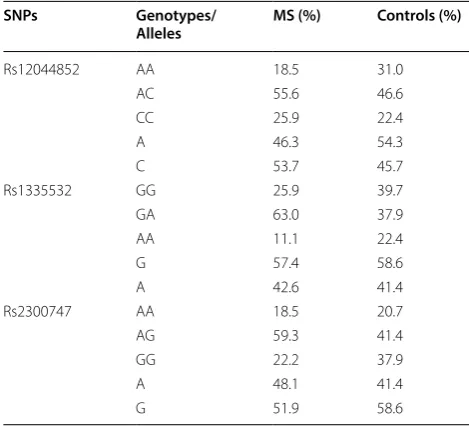
Allelic prevalence for each of the CD58 SNPs studied shows a range of 40 to 50% for each allele in both MS
Table 1 Demographic and clinical features of study subjects
Variables Controls, N (%) MS patients, N (%)
Female 52 (89.7) 23 (85.2)
Male 6 (10.3) 4 (14.8)
Age of onset, mean ± SD (range) 30.5 ± 10.3 (16–56) Age of time of analysis, mean ± SD (range) 42.3 (26–65) 36.5 ± 11.7 (20–62) Disease type
Relapsing remitting MS (RRMS) 22 (81.5)
patients and controls (Table 2). Frequencies of CD58 hap-lotypes for this study population are shown in Table 3. Table 4 shows the association analysis of the CD58 SNP alleles rs12044852 (p = 0.410), rs1335532 (p = 0.881) and rs2300747 (p = 0.407) between MS patients and controls. Analysis of the results revealed no significant association between CD58 SNPs and age of onset, MRI parameters and disease activity. CD58 SNPs were also not signifi-cantly different between types of MS.
Discussion
Single nucleotide polymorphisms (SNPs) are the most common type of DNA polymorphisms in human and their relations with autoimmune diseases such as MS are noteworthy. Association of SNPs in non-HLA genes and autoimmune diseases has been reported in various stud-ies involving the US and European population in the last decades [14, 15].
For MS, one of the candidate non-HLA genes reported to be associated with the disease is CD58 [16]. It is sug-gested that alteration of CD58 expression affects the regulation of FoxP3, a protein highly expressed in regu-latory T cells (Treg), leading to functional changes in Treg cells and influence the body’s immune response against its own cells. Dysfunction or reduction of Treg has been reported in various studies of autoimmune dis-eases including MS [17]. The expression of CD58 mRNA has been shown to be increased significantly in samples collected from MS patients during remission than those sampled during relapse [13].
The demographic characteristic of this study is in agreement with findings of other studies. Age of onset in this study population ranged from 16 to 56 years old, with mean of 30.5 ± 10.3 years which falls within the range of findings in other studies around the region: 28.6 ± 9.9 years in another study in Malaysia [18] and 32.7 ± 11.5 years in Thailand [19]. In South India, the age of onset was noted at 38.3 ± 12.8 years [20]. Out of 27 MS patients in this study, about 85.2% were females and 14.8% were males, with female to male ratio of 5.8:1. The ratio is consistent with an analysis of data from the Danish Multiple Sclerosis Registry that showed the incidence in women doubled between 1950 and 2009, while the increases among men were relatively moderate [21]. The rapid change in incidence among women might be due to environmental changes such as the rise in obesity, increased cigarette smoking, and changes in the frequency of breastfeeding infants [21, 22].
In this pilot study, we investigated the possible asso-ciation of CD58 SNPs, namely rs2300747, rs12044852 and rs1335532, with MS amongst Malay population in Malaysia. Our results showed that the frequency of rs2300747G was higher in the control group compared to the MS patients, suggesting a potential of a protec-tive value in rs2300747G, although the difference was statistically insignificant. A study done by De Jager et al. indicated that rs2300747G was a protective allele asso-ciated with MS and that East Asian cell lines expressed higher frequencies of rs2300747G compared to the cell lines of Europe ancestry, which might explain a lower
Table 2 Genotype distribution and allele frequency CD58
SNPs in MS patients and controls
SNPs Genotypes/
Alleles MS (%) Controls (%)
Rs12044852 AA 18.5 31.0 AC 55.6 46.6 CC 25.9 22.4
A 46.3 54.3
C 53.7 45.7
Rs1335532 GG 25.9 39.7 GA 63.0 37.9 AA 11.1 22.4
G 57.4 58.6
A 42.6 41.4
Rs2300747 AA 18.5 20.7 AG 59.3 41.4 GG 22.2 37.9
A 48.1 41.4
G 51.9 58.6
Table 3 Frequency of CD58 haplotypes in this study Haplotype (Ht) Rs1335532 Rs2300747 Rs12044852 Frequency
Ht1 G G A 0.511
Ht2 A A C 0.405
Ht3 G G C 0.047
Ht4 G A C 0.024
Others 0.013
Table 4 Allelic analysis of CD58 SNPs in MS patients
and control
SNPs Alleles p value OR 95% CI
frequency of MS amongst Asians [11]. This is also sup-ported by a meta-analysis done by Liu et al. [23] which reported polymorphism of rs2300747G as a protective allele against MS. However, findings of SNP rs2300747 and MS were inconsistent in different populations. Like our results, no evidence of protective allele in SNP rs2300747 was found in a study on the association of non-MHC region and MS among Indian population in India [24].
In a replication GWAS study conducted by The Aus-tralia and New Zealand Multiple Sclerosis Genetics Consortium (ANZgene) which analysed more than 1500 MS cases, it was reported that SNP rs1335532 of CD58 is one of the non-HLA SNPs that was highly associated with MS [13]. However, the same SNP has been reported to be significantly associated with neuro-myelitis optica spectrum disorders (NMOSD), another spectrum of inflammatory demyelinating disease, in a case–control study of Koreans [25, 26]. On the other hand, the other CD58 SNPs, rs12044852, has been repeatedly reported to be associated with MS [27, 28]. A case–control study involving 200 MS patients and 200 healthy controls in a subset of Iranian population reported that the rs12044852 polymorphism of CD58
has a profound effect on the onset of MS but not signif-icantly associated with patients’ gender, disease sever-ity and type of MS [29]. Our results showed that the rs12044852 polymorphism was not significantly associ-ated with MS. This is also similar to a study focused on genetic susceptibility to MS in African Americans, that showed rs12044852 and rs2300747 were not signifi-cantly associated with MS [30].
There were a number of limitations in our study which possibly restricted the analysis of the results and affected the outcome of the study. Compared with other studies on SNPs [13, 31], the number of patients and controls recruited in this study was relatively small for genetic association study and may not represent the true popula-tion. Small sample size also has less statistical power and could introduce bias to this study, leading to insignifi-cant results. Although a larger sample size could increase statistical power, it could also be costly and takes longer time frame to complete the sample collection due to the relatively low frequency of autoimmune diseases around the region. Another option that can be considered to improve this study is by increasing the sample size of the control to 1:4 case–control ratio if the assumptions of model can be fulfilled [32]. Another limitation in this study that can be improved is the location of sample col-lection. Due to location of the hospital, patients recruited in this study were mainly from the central urban region of Peninsular Malaysia. This could introduce bias as the Malay population in Malaysia can be clustered into a
few sub-ethnic groups that could be genetically different [33]. In addition to that, like other autoimmune diseases, the development of MS involves a complex interac-tion between genetic susceptibility and environmental factors. CD58 gene may play an indirect role in disease development and the differences in other genetic com-ponents of our study population may have contributed to the outcome.
In conclusion, our exploratory study did not show sig-nificant association between CD58 SNPs (rs12044852, rs1335532 and rs2300747) and MS in our study popula-tion. However, further investigations with optimal sample size, more genetic markers and correlation with environ-mental factors are necessary to help shed some light on this disease in our country.
Abbreviations
MS: Multiple sclerosis; HLA: human leukocyte antigen; SNPs: single nucleotide polymorphisms; RRMS: relapsing–remitting MS; SPMS: secondary progressive MS; EDSS: Expanded Disability Status Scale.
Acknowledgements
The authors would like to thank the Director General of Health Malaysia for his permission to publish this article.
Authors’ contributions
CYM, SV, SM, AYY and MA designed and conceptualized the study; CYM, SV, NMN, SS, BK and SM acquired and analyzed data; all authors were involved in interpretation of data; all authors were involved in drafting, revising the manu-script and approving the manumanu-script; CYM was a major contributor in writing the manuscript. All authors read and approved the final manuscript.
Funding
This study was funded by National Institute of Health Malaysia (NMRR-13-1029-18067).
Availability of data and materials
The datasets used and/or analysed during the current study are available from the corresponding author on reasonable request.
Ethics approval and consent to participate
Informed consent was obtained from all participants. Identification details were removed to maintain the anonymity. This study was approved by Medical Research and Ethics Committee of Malaysia Ministry of Health (NMRR-13-1029-18067).
Consent for publication Not applicable.
Competing interest
The authors declare that they have no competing interest.
Author details
1 Autoimmune Unit, Allergy and Immunology Research Centre, Institute for Medical Research, National Institute of Health, Selangor, Malaysia. 2 Neurol-ogy Department, Hospital Kuala Lumpur, Kuala Lumpur, Malaysia. 3 Allergy and Immunology Research Centre, Institute for Medical Research, Block C6, National Institute of Health Complex, No. 1, Jalan Setia Murni U13/52, Seksyen U13, Bandar Setia Alam, 40170 Shah Alam, Selangor Darul Ehsan, Malaysia.
•fast, convenient online submission •
thorough peer review by experienced researchers in your field • rapid publication on acceptance
• support for research data, including large and complex data types •
gold Open Access which fosters wider collaboration and increased citations maximum visibility for your research: over 100M website views per year •
At BMC, research is always in progress. Learn more biomedcentral.com/submissions
Ready to submit your research? Choose BMC and benefit from: References
1. Loma I, Heyman R. Multiple sclerosis: pathogenesis and treatment. Curr Neuropharmacol. 2011;9:409–16.
2. Chong HT. Multiple sclerosis in South East Asia and diagnostic criteria for Asians. Neurol Asia. 2008;13:145–6.
3. GBD 2016 Neurology Collaborators. Global, regional, and national burden of neurological disorders, 1990-2016: a systematic analysis for the global burden of disease study 2016. Lancet Neurol. 2019;18(5):459–80. 4. Chong HT, Tan CT. A review of multiple sclerosis with Asian perspective.
Med J Malaysia. 2008;63:356–61.
5. Tan C-T. Multiple sclerosis in Malaysia. Arch Neurol. 1988;45:624–7. 6. International multiple sclerosis genetics consortium. A high-density
screen for linkage in multiple sclerosis. Am J Hum Genet. 2005;77:454–67. 7. International multiple sclerosis genetics consortium. Risk alleles for
multiple sclerosis identified by a genomewide study. N Engl J Med. 2007;357:851–62.
8. Davis SJ, van der Merwe PA. The structure and ligand interactions of CD2: implications for T-cell function. Immunol Today. 1996;17:177–87. 9. Mestas J, Hughes CCW. Endothelial cell costimulation of T cell activation
through CD58-CD2 interactions involves lipid raft aggregation. J Immu-nol. 2001;167:4378–85.
10. Hoppenbrouwers IA, Aulchenko YS, Janssens AC, Ramagopalan SV, Broer L, Kayser M, et al. Replication of CD58 and CLEC16A as genome-wide significant risk genes for multiple sclerosis. J Hum Genet. 2009;54:676–80. 11. De Jager PL, Baecher-Allan C, Maier LM, Arthur AT, Ottoboni L,
Barcel-los L, et al. The role of the CD58 locus in multiple sclerosis. PNAS. 2009;106:5264–9.
12. Thompson AJ, Banwell BL, Barkhof F, Carroll WM, Coetzee T, Comi G, et al. Diagnosis of multiple sclerosis: 2017 revisions of the McDonald criteria. Lancet Neurol. 2018;17:162–73.
13. Bahlo M, Booth DR, Broadley SA, Brown MA, Foote SJ, Griffiths LR, et al. Genome-wide association study identifies new multiple sclerosis suscep-tibility loci on chromosomes 12 and 20. Nat Genet. 2009;41:824–8. 14. Sharma A, Liu X, Hadley D, Hagopian W, Liu E, Chen W-M, et al.
Identifica-tion of non-HLA genes associated with celiac disease and country-specific differences in a large, international pediatric cohort. PLoS ONE. 2016;11:e0152476.
15. Steck AK, Bugawan TL, Valdes AM, Emery LM, Blair A, Norris JM, et al. Asso-ciation of Non-HLA genes with Type 1 diabetes autoimmunity. Diabetes. 2005;54:2482–6.
16. Bahreini SA, Jabalameli MR, Saadatnia M, Zahednasab H. The role of non-HLA single nucleotide polymorphisms in multiple sclerosis susceptibility. J Neuroimmunol. 2010;229:5–15.
17. Viglietta V. Loss of functional suppression by CD4 + CD25 + regulatory T cells in patients with multiple sclerosis. J Exp Med. 2004;199:971–9. 18. Viswanathan S, Rose N, Masita A, Dhaliwal JS, Puvanarajah SD, Rafia
MH, et al. Multiple sclerosis in Malaysia: demographics, clinical features, and neuroimaging characteristics. Mult Scler Int. 2013. https ://doi.
org/10.1155/2013/61471 6.
19. Siritho S, Prayoonwiwat N, Pulkes T, Chankrachang S, Laptikultham S, Nidhinandana S, et al. A retrospective study of multiple sclerosis in Thai-land. Neurol Asia. 2010;15(3):253–61.
20. Pandit L, Kundapur R. Prevalence and patterns of demyelinating central nervous system disorders in urban Mangalore, South India. Mult Scler. 2014;20:1651–3.
21. Koch-Henriksen N, Thygesen LC, Stenager E, Laursen B, Magyari M. Incidence of MS has increased markedly over six decades in Denmark particularly with late onset and in women. Neurol. 2018;90:e1954–63. 22. Langer-Gould A, Smith JB, Hellwig K, Gonzales E, Haraszti S, Koebnick C,
et al. Breastfeeding, ovulatory years, and risk of multiple sclerosis. Neurol. 2017;89:563–9.
23. Liu J, Liu X, Liu Y, Deng S, Huang H, Chen Q, et al. Association of EVI5 rs11808092, CD58 rs2300747, and CIITA rs3087456 polymorphisms with multiple sclerosis risk: a meta-analysis. Meta Gene. 2016;9:97–103. 24. Pandit L, Ban M, Sawcer S, Singhal B, Nair S, Radhakrishnan K, et al.
Evalu-ation of the established non-MHC multiple sclerosis loci in an Indian population. Mult Scler J. 2011;17:139–43.
25. Kim JY, Bae JS, Kim HJ, Shin HD. CD58 polymorphisms associated with the risk of neuromyelitis optica in a Korean population. BMC Neurol. 2014;14:57.
26. Wingerchuk DM, Banwell B, Bennett JL, Cabre P, Carroll W, Chitnis T, et al. International consensus diagnostic criteria for neuromyelitis optica spec-trum disorders. Neurol. 2015;85:177–89.
27. Hecker M, Blaschke J, Blaschke P, Fitzner B, Koczan D, Thiesen H-J, et al. CD58 and multiple sclerosis: genetic association, gene expression and prognostic value (P6.156). Neurology. 2014;82:P6.156.
28. Brynedal B, Lima Bomfim I, Olsson T, Duvefelt K, Hillert J. Differential expression, and genetic association, of CD58 in Swedish multiple sclero-sis patients. PNAS. 2009;106:23.
29. Torbati S, Karami F, Ghaffarpour M, Zamani M. Association of CD58 poly-morphism with multiple sclerosis and response to interferon ß therapy in a subset of Iranian population. Cell J. 2015;16(4):506–13.
30. Johnson BA, Wang J, Taylor EM, Caillier SJ, Herbert J, Khan OA, et al. Mul-tiple sclerosis susceptibility alleles in African Americans. Genes Immun. 2010;11:343–50.
31. Baranzini SE, Wang J, Gibson RA, Galwey N, Naegelin Y, Barkhof F, et al. Genome-wide association analysis of susceptibility and clinical pheno-type in multiple sclerosis. Hum Mol Genet. 2009;18:767–78.
32. Hong EP, Park JW. Sample size and statistical power calculation in genetic association studies. Genomics Inform. 2012;10:117.
33. Hatin WI, Nur-Shafawati AR, Zahri M-K, Xu S, Jin L, Tan S-G, et al. Popula-tion genetic structure of Peninsular Malaysia malay sub-ethnic groups. PLoS ONE. 2011;6:e18312.
Publisher’s Note