Page 13 www.ijiras.com | Email: [email protected]
Ethosome: A Novel Vesicular Carrier
Kamlesh J.Wadher
Shital D.Pounikar
Sagar S.Trivedi
Milind J. Umekar
Department of Quality Assurance, SKB College of Pharmacy Kamptee, Nagpur, (MS) India
I. INTRODUCTION
The skin which provides the largest boundary between the body and the external environment, acts as a major target as well as a principle barrier for topical and transdermal drug delivery (Glenn GM & Kenney RT 2006). One of the most important functions of skin is to regulate entry and exit of material.(Kogan A & Garti N 2006, Touitou E & Godin B. 2007).The skin is significant barrier properties are due to in large part to the stratum corneum, which embodies the thin outer layer of the epidermis. In contrast to other tissues in the body, the stratum corneum consists of coenocytes that are surrounded by an extracellular milieu of lipids organized as multiple lamellar bilayers. These structural lipids block the entry of most of the topically applied drugs, as well as those that are lipid-soluble and of low molecular weight.(Sloan KB et al 2006,Kiptoo PK et al 2006, Kalia YN et al 2004).This
poses an important challenge to administering medications through the skin either for local cutaneous effects or as systemic therapy following their entry into superficial dermal capillaries. (Pikal MJ 2001, Subramony JA et al 2006).
The skin as a route of drug delivery can offer many significance over traditional drug delivery systems including lower fluctuations in plasma drug levels, avoidance of gastrointestinal disturbances and first-pass metabolism of the drugs, and high patient compliance (Scheuplein R & Blank H 1971).
Transdermal drug delivery (TDD) is designed to deliver a therapeutically effective dose of drug across a patient’s skin. It offers several unique advantages including relatively large and readily accessible surface area for absorption, improved bioavailability, painless as compare to injectables, easy application, prompt termination of therapy and reduction in side effects (Ghulaxe C & Verma C 2015). It overcomes a Abstract: Delivery across skin is more popular due to its easy accessibility and advantages. However, drug delivery across skin is still a challenge and complicated. The use of lipid vesicles in delivery systems attracted increasing attention in recent years. However, it is found that classic liposomes are of little or no value as carriers for transdermal drug delivery because they do not deeply penetrate the skin, but rather remain confined to the upper layer of the stratum corneum. Ethosomes is gaining attention in the novel drug delivery system for topical use for their excellent abilities to reach deep skin layers and system circulation. Ethosomes are uniquely designed and tailored vesicles consisting high concentration of ethanol which makes them extra malleable resulting in successful delivery of therapeutic agents deeply across the skin. Enhanced delivery of bioactive molecules through the skin and cellular membranes by means of an ethosomal carrier opens numerous challenges and opportunities for the research and future development of novel improved therapies. This review attempts to describe all aspects of ethosomes including Merits, advanced applications, research findings, obstacles, challenges and future prospects.
Keywords: Drug delivery, Ethosome, vesicular system, Liposomes, Transdermal system
Page 14 www.ijiras.com | Email: [email protected] number of limitations of oral drug delivery such as
degradation of drugs in GIT, gastrointestinal irritation and first pass metabolism. The disadvantages include, barrier properties of skin which make it difficult to penetrate and permeate drug through skin. There are various techniques to enhancing delivery of drug through skin such as, polymeric system, surfactant based and vesicular based drug delivery approaches (Guy RH & Hadgraft J 2003, Williams 2003, Prausnitz MR et al 2004, Bronaugh RL & Maibach HI 2005).
The use of lipid vesicles in delivery systems attracted increasing attention in recent years (Braun Falco O et al 1992, Touitou, E & Junginger N 1992) However, it is found that classic liposomes are of little or no value as carriers for transdermal drug delivery because they do not deeply penetrate the skin, but rather remain confined to the upper layer of the stratum corneum (Braun Falco O et al 1992).
Niosomes, microemulsion, nanoemulsions comes under surfactant based carrier systems while dendrimers, biodegradable and non biodegradable nanoparticles are examples of polymer based system. One of the novel approaches is vesicular drug delivery systems containing liposomes, deformable liposomes, and ethosomes (Elisa E & Evelyn M 2011)
A. VESICULAR SYSTEMS
First reported in 1965 by Bingham, and was given the name ―Bingham bodies‖ -Vesicles, play a major role in modeling biological membranes, and in the transport and targeting of active agents. Among the different approaches for achieving an effective topical drug delivery, Liposomes have been widely used as safe and effective vehicles, due to their proved potential in improving skin penetration and clinical efficacy of several drugs (Gregoriadis G 2000, Verma D & Fahr A 2004, Mura P et al 2007). Liposomes are vesicles in which one or more lipid bilayers entrapped an aqueous volume. Their major components are usually phospholipids with or without cholesterol. The stratum corneum lipid liposomes (SCLL) are the vesicular systems made of lipids with a composition similar to the lipids found in the outer layer of human skin. (Torchilin V 2006,Cevc G 1993).
Their delivery mechanism is accumulation of the liposomes in the stratum corneum and upper skin layers, and as a local drug reservoir. Transfersomes are ultra deformable vesicles and structurally similar to liposomes but they differ in function. Phospholipids are the major components but an additional surfactant acts as an edge activator to modify elasticity and increase deformability. (Cevc G & Richardsen H 1993,Barenholz Y & G Cevc 2000, Bertrand et al 2010,Barani H & Montazer, M 2008).
But recent finding reveals that, that traditional liposomes do not deeply penetrate skin, but rather remain confined to upper layers of the stratum corneum Therefore, new strategies have been developed in the attempt of enhancing the skin penetration ability of liposomes (Marco, B et al 2012).
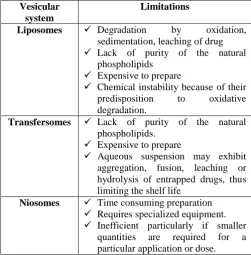
There are many limitations of Liposomes, Transfersomes, and Niosomes as depicted in table 1 (Madhulika P et al 2013)
Vesicular system
Limitations
Liposomes Degradation by oxidation,
sedimentation, leaching of drug Lack of purity of the natural
phospholipids Expensive to prepare
Chemical instability because of their predisposition to oxidative degradation.
Transfersomes Lack of purity of the natural phospholipids.
Expensive to prepare
Aqueous suspension may exhibit aggregation, fusion, leaching or hydrolysis of entrapped drugs, thus limiting the shelf life
Niosomes Time consuming preparation Requires specialized equipment. Inefficient particularly if smaller
quantities are required for a particular application or dose.
Table 1: Problems associated with liposome, transferosomes and noisome
Many research finding suggested, a novel vesicular sysrtem, ―ethosomes,‖as alternative to overcome the problems of poor skin permeability of classic liposomes by using lipid vesicles composed of phospholipids, water and ethanol in relatively high concentrations (Rahul G et al 2012)
B. ETHOSOME
One of the major advancement in vesicle research was the finding a vesicle derivative, defined as Ethosomes (Verma D & Fahr A 2004). Ethosomes are phospholipids vesicles as shown in figure 1, which include ethanol to increase elasticity, whereas niosomes comprise surfactants together with cholesterol and may include small proportions of phospholipids (Bhalaria M et al 2009).
Figure 1: Structural feature of Ethosome
Page 15 www.ijiras.com | Email: [email protected] The synergistic effects of combination of phospholipids
and high concentration of ethanol in vesicular formulations have been suggested to be responsible for deeper distribution and penetration in the skin lipid bilayers (Solanke P et al 2016, Kaisar R et al 2013). Due to non invasive properties, it is responsible for disturbing the organization of skin lipid bilayer (Christian C et al 2009). Release of drug could be result of combination of ethosomal system with skin lipids and drug release at various points along the penetration pathway (Carl S et al 2011).Delivery of drugs through ethosomes can be fabricated for enhanced skin permeation and localization of the drug at the site. They are found to entrap various hydrophilic, lipophilic or amphiphilic molecules (Kim S & Chien Y 1996, Touitou E et al 2001).
In ethosomes, on account of solubility of most of the drugs in ethanol, the high concentration of drug encorporation is possible .High concentration of ethanol makes them flexible as well as increases the penetrating power as, it increases the thermodynamic activity due to evaporation of ethanol .It also enhances penetration due to reduction in barrier property of stratum corneum (Spruance SL & Semin 1992).
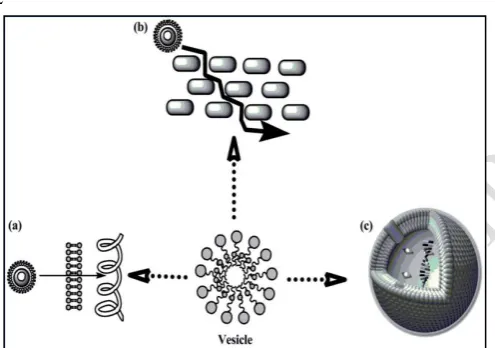
The multi functional roles of vesicle is depicted in figure 2
Figure 2: A schematic drawing showing multi functional roles of vesicle. (a) Delivering drug molecules into/across the skin, (b) penetration into stratum corneum and (c) acting as storage
compartment for drug molecules
C. MERITS OF ETHOSOMES.(ESPOSITO E ET AL 2004)
High flexibility High deformability
Greater elasticity of ethosomal membrane. Retentive and adaptability in lipid bilayer. Non invasive m
Highest transdermal flux.
Suitable for the delivery of large and diverse groups of drugs like peptides, protein molecules
More efficient at delivering a fluorescent explore (quantum dots) to the skin, in terms of quantity and depth. High patient compliance
Biodegradable
Increased permeation of drug.
II. RECENT STUDIES CITED IN LITERATURE ON ETHOSOMAL TECHNOLOGY
The field of vesicular delivery now expanding further into the chronic treatment of neurological disorders, Arthritis, Skin cancer, AIDS, etc. which has been show introduction of TDS-containing drugs such as stavudine, tetrandrine, celecoxib, Clopidogrel,etc. Many researcher worked on ethosomal formulations. Recent studies on Ethosomal technology are depicted in table 2.( Verma D & Fahr A 2004).
Author Year Research Studies Maurya et al. 2010 Formulation Development and
Evaluation of Ethosome of Stavudine.
Barupal et al. 2010 Preparation and Characterization of Ethosomes for Topical delivery
of Aceclofenac Bragagni M.et al. 2012 Comparative study of liposomes,
transfersomes and ethosomes as carriers for improving topical
delivery of celecoxib Chao Fan et al. 2013 Enhanced Topical Delivery of
Tetrandrine by Ethosomes Bhosale and
Avachat
2013 Designed and developed ethosomal transdermal drug delivery system of valsartan with
preclinical assessment in Wistar albino rats.
Sarwa et al. 2014 conducted Penetration studies of tamoxifen citrate loaded ethosomes and liposomes across human skin: a comparative study with confocal laser scanning
microscopy. Zhai et al. 2015 prepared ethosomes for skin
delivery of ropivacaine: preparation,characterization and
ex-vivo penetration properties. Shen et al 2015 Prepared ethosomes and evaluated
Compound for antimalarial ethosomal cataplasm: preparation,
evaluation, and mechanism of penetration enhancement Khan and Wong 2016 prepared Microwave-aided skin
drug penetration and retention of 5-fluorouracil-loaded ethosomes Tripti Shukla 2016 Development and
Characterization of Clopidogrel-loaded Ethosomal Transdermal
Patch
Garg et al 2016 prepared nanosized ethosomes-based hydrogel formulations of methoxsalen for enhanced topical
delivery against vitiligo: formulation optimization, in-vitro
evaluation and preclinical assessment.
Limsuwan et al., 2017 prepared and evaluated ethosomes of Phenylethyl Resorcinol as Vesicular Delivery System for
Skin Lightening Applications Yang et al 2017 investigated mechanism of
transdermal permeation promotion of lipophilic drugs by
ethosomes Shubhra Rai 2017 Transfersomes as versatile and
flexible nano-vesicular carriers in skin cancer therapy: the state of
the art
Page 16 www.ijiras.com | Email: [email protected] III. CHALLENGES AND OPPORTUNITIES
Enhancement of stability is a major issue in the formulation and development aspect. Recently many researchers worked on to improve the stability of ethosomes and to reduce aggregation of ethosomes It consist of ethanol and PEG in place of single ethanol phase. Phospholipid, mixture of ethanol and propylene glycol were used to improve ethosomes stability and skin drug delivery. Fluid properties of lipid bilayers found to be affected by reversible sedimentation because of different pharmaceutical components present in colloidal suspension(Biju SS et al 2006).The balance between drug affinity to vesicles and drug solubility in lipids of stratum corneum is necessary to maintain rate and the amount of drug release. High temperature will cause degradation of phospholipids and that will affect the gel to liquid transition of lipid bilayer ultimately causes blemish in membrane packaging(Paolino D et al 2005).Sensitizing capacity of micro ethosomes is more than that of Nanoethosomes. Research finding suggests that, fraction of phospholipid is lost in the extruder membrane during extrusion process when producing nano form ( Nirved V et al 2012) Determination of zeta potential is prognostic of storage stability of ethosomal suspension.
IV. APPLICATION OF ETHOSOMES
Ethosomes have wide applications in different categories of drugs like Antifungal, Antibiotics, Skin infections and Cosmetic field as shown in table 3.
Formulation Rationale of
ethosomal delivery
Application Route of
administrat ion 5-aminolevulinic acid Ethosome Significantly improved the delivery of ALA in the inflammatory
skin.
Anti- psoriasis Topical
Erythromycin ethosome Ethosomal erythromycin was highly efficient in eradicating S.aureus- induced intradermal infections
Anti bacterial Topical
Isoeugenol ethosome Chemicals (allergen) in vesicular carrier system can enhance the sensitizing capacity.
allergen Topical
Matrine ethosome Improves the percutaneous permeation Anti-
inflammatory Topical
Methotrexate ethosome Ethosomes showed favorable skin permeation Anti- pyretic Topical characteristics Minoxidil ethosome Enhance the penetration and accumulation of minoxidil in the skin by Pilosebaceous targeting Hair growth promoter Topical Testosterone ethosome Testosterone ethosome for enhanced transdermal delivery Steroid
hormone Topical
Trihexyphenidyl HCL ethosome Increased drug entrapment efficiency, reduced side effect and constant systemic levels Anti-
parkinsonian Topical
Acyclovir ethosome Binary combination of the lipophilic drug ACV-C16 and the
ethosomes synergistically
enhanced ACV absorption into the skin
Anti-viral Topical
Azelaic acid ethosome Release rate was higher from ethosomes than from liposomes
Anti-keratinizing Topical
Bacitracin ethosome Ethosomal enhances intracellular delivery of and reduced drug toxicity in the skin
Polypeptide
antibacterial Topical
Colchicine ethosome Enhance skin accumulation, prolong release and improve the specificity
Anti-gout Topical
Finasteride ethosome Enhanced percutaneous absorption of finasteride 5-a reductase inhibitor
Anti-Fungal Topical
Page 17 www.ijiras.com | Email: [email protected] using an ethosomal carrier Ligustrazine Ethosome patch enhances the permeation the skin Pulmonary
vasodilator Topical
Salbutamol ethosome Enhanced drug delivery through skin with ethosomes Anti- asthmatic Anntiarrythmic Topical Sotalol ethosome Enhances the systemic absorption Topical Vitamin A palmitate, Vitamin C, Vitamin E ethosome Anti-oxidation of phospholipid was increase due to the synergistic interaction of all three together as compare to individual use vitamins Topical Diclofenac Selective delivery of drug to desired side for prolong period of time
NSAID Topical
Table 3: Application of Ethosomes
Synthetic drugs have a disadvantage of adverse and toxic effects whereas herbal drugs are believed to be safe and biocompatible with no adverse effects. Herbal ethosomes is a novel concept n vesicular research for Transdermal Drug delivery System. The various applications of Herbal Ethosomes are shown in Table 4. (Paolino D et al 2005, Nirved V et al 2012, Zhou Y et al, Mathur M & Vyas,G 2013)
formulation Rationale of
ethosomal delivery
Application Route of
administration
Amonium Glycyrrhi zinate Ethosomes
Increases of in vitro Percutaneous permeation and significantly enhanced anti inflammatory activity Anti inflammatory Topical Triptolide Good percutaneous Permeability Anti inflammatory Topical Podophy Llotoxin enhance its therapeutic effect Purgative, anti rheumatic, antiviral and antitumor Topical Sesbania Ethosome Enhance Transdermal Permeation Anti-microbial Topical Sophora ethosome Enhance drug deliver and Anti endotoxic, Topical
stability anticancer, And anti inflammatory Matrine Ethosome Improve precutaneous Permeation Cardio protective, Anti inflammatory Topical
Table 4: Applications of Herbal Ethosomes
V. MARKETED FORMULATIONS BASED ON ETHOSOMAL FORMULATION
There are abundant transdermal delivery systems currently available and used in the market. In the transdermal drug delivery market, worth $12.7 billion dollars in 2005, is expected to reach $32 billion in 2015.The field of transdermal delivery now seems to be growing further into the chronic treatment of neurological disorders, which has been show cased by the introduction of TDS-containing drugs such as methylphenidate for attention-deficit hyperactivity disorder (introduced in 2006), rotigotine for Parkinson’s disease (2007) and rivastigmine for dementia (2007).
VI. TRANSDERMAL PRODUCTS CURRENTLY ON THE US MARKET
The exceptional structure with highest penetration ability and sound techniques of preparation make them ideal sformulations for commercialization of ethosomes in the market. They are suitable for incorporating different categories of drugs. The Novel Therapeutic Technology Inc, (Wilmington, Delaware, United states) is a Biopharmaceutical Company having a portfolio of pharmaceutical formulation based on ethosome technology, including formulation for the treatment of alopecia, deep skin infection, herpes, hormone deficiencies, inflammation, post operative nausea, atopic dermatitis and erectile dysfunction. The various marketed Ethosomal Formulation are shown in Table 4. (Shukla T 2016, Rai S 2017, Pawar P 2015, Li-Na et al 2014, Touitou E 1998).
Products
Description Importance
BodyShape (MaccabiCARE)
Gel Executive solidification cellulite reduction, stretching the skin flexible and based on
a technology
Deeper diffusion into the skin.
Cellulight EF (Hampden Health,
USA)
Topical cellulite cream contains a powerful combination of ingredient
to increase metabolism and breakdown fats
Deeper diffusion into the skin.
Nanominox Sinere,Germany
Composed of 4% minoxidil, adenosine,
sophora flavescens extract, creatine ethyl ester, cephranthine absorb
for 10 mins prior to washing your hair when other minoxidil solution
Pilosebaceous targeting and high penetration into deep layers
of skin
Page 18 www.ijiras.com | Email: [email protected]
(NTT, Israel) cream into the skin
Osmotics Lipoduction cellulite
cream (Osmotics, Israel)
Ethosomal cream is designed to help reduce
cellulite and burn fat when applied to the skin
Deeper penetration into the skin into the
skin.
Skin genuity (physonics,Nottingh
am,UK)
Drastically reduces those dimples. It also firms and softens your skin with natural antioxidants and
moisturizing agents to give you the peachy thighs and dimple free
derriere.
High penetration into deep layers
of the skin
Supravir cream (trima,Israel)
For the treatment of herpes virus, formulation
of acyclovir drug has a long shelf life with no stability problems, stable
for at least 3 year at 2500C Skin permeation experiments showed that
the creams retained its initial penetration enhancing properties even
after 3 yrs
Lipid perturbation.
Table 5: Marketed Formulations of Ethosomes
VII. FUTURE PROSPECTS
There is a promising future of ethosomes in production of transdermal delivery of various agents in more effective manner. Advance research in this area will allow better control over drug release in vivo, allowing physician to make the therapy more effective. Ethosomes offers a good prospective for the non-invasive delivery of small, medium and large sized drug molecules Hence, it can be concluded that ethosomal formulations possess promising future in effective dermal/transdermal delivery of bioactive agents.
VIII. CONCLUSION
There are various techniques to enhance delivery of drug through skin such as, polymeric system, surfactant based and vesicular based drug delivery approaches. Traditional liposomes do not deeply penetrate skin, but rather remain confined to upper layers of the stratum corneum Therefore; new strategies have been developed in the attempt of enhancing the skin penetration ability of liposomes. Ethosomes are phospholipids vesicles which include ethanol to increase elasticity. Ethosomes are soft, malleable vesicles tailored for enhanced delivery of active agents, which makes them a promising candidate for future transdermal drug delivery product. Enhanced delivery of bioactive molecules through the skin and cellular membranes by means of an ethosomal carrier opens numerous challenges and opportunities. Enhanced delivery of synthetic and herbal drug molecules through the skin and cellular membranes by means
of an ethosomal carrier opens tremendous opportunities for the research and future development of novel improved therapies.
REFERENCES
[1] Advances in nanoscience and nanotechnology,(2012); Nanomedicine and drug delivery. Apple Academic Press Publication, 1-16.
[2] Barani, H., Montazer, M (2008). "A review on applications of liposomes in textile processing". Journal of liposome research. 18 (3): 249–62. Delivery
[3] Barenholz, Y.,Cevc, G. (2000). Physical chemistry of biological surfaces, Chapter 7: Structure and properties of membranes. New York: Marcel Dekker. pp. 171–241. [4] Barupal.(2010).Preparation and Characterization of
Ethosomes for Topical delivery of Aceclofenac, Ind. J.Pharm. Sci, 72 (5),582-586.
[5] Bertrand, N., Bouvet, C., Moreau, P., Leroux, J., (2010). "Transmembrane pH-Gradient Liposomes to Treat Cardiovascular Drug Intoxication". ACS Nano. 4 (12): 7552–8.
[6] Bhalaria, M., Naik, S., Misra, N.(2009) Ethosomes: A novel delivery system for antifungal drugs in the treatment of topical fungal diseases. Ind. J.Exp. Bio,( 47)368‐ 375.
[7] Biju, SS., Sushama, T., Mishra, P.(2006). Vesicular systems: An overview. Ind. J. Pharm. Sci.,68(2),141-153. [8] Bragagni, M.(2012).Comparative study of liposomes,
transfersomes and ethosomes as carriers for improving topical delivery of celecoxib, Drug Delivery,19(7), 354-361.
[9] Braun Falco,O.(1992). Kortung,H.; Maibach H,; (Eds.), Gries batch Conference: Liposome Dermatics, Springer-Verlag, Berlin, Heidelberg.
[10] Bronaugh, RL., Maibach, HI.,(2005). editors. Edn. 4th. New York: Marcel Dekker. Percutaneous Absorption. [11] Carl, S., Jakob, T., Annette, G.(2011).A Study of the
enhanced sensitizing capacity of a contact allergen in lipid vesicle formulations. Toxi.App. Pharm. Elsevier Publication,(252) 221–227.
[12] Cevc, G (1993).Rational design of new product candidates: the next generation of highly deformable bilayer vesicles for noninvasive, targeted therapy. Journal of Controlled Release. 160 (2): 135–146
[13] Cevc, G., Richardsen, H.(1993). "Lipid vesicles and membrane fusion". Advanced Drug Delivery Reviews. 38 (3): 207–232.
[14] Chetty, DJ., Chien, YW.(1998).Transdermal Delivery of CaCO3- Nanoparticles Containing Insulin. Crit. Rev Therm.Drug Carrier Sys.,15, 629-670.
[15] Christian, C., Elena, T., Donato,C. (2009).Turbiscan Lab Expert analysis of the stability of ethosomes and ultradeformable liposomes containing a bilayer fluidizing agent Colloids and Surfaces B: Biointerfaces. Elsevier Publication,(72) 155–160.
Page 19 www.ijiras.com | Email: [email protected] [17] Elisa, E., Evelyn, M.(2011). Liposomes and Other
Vesicular Systems: Structural Characteristics, Methods of Preparation, and Use in Nanomedicine. Pro.Mole. Bio.Trans. Sci., 104.
[18] Esposito, E., Menegatti, E., Cortesi, R.(2004). Ethosomes and liposomes as topical vehicles for azelaic acid: a preformulation study. J.Cosma. Sci,55,253-64.
[19] Fan, C. (2013).Enhanced Topical Delivery of Tetrandrine by Ethosomes for Treatment of Arthritis, Bio Med Res. Int.,(13)1-18.
[20] Gannu, P., and Pogaku, R .(2011).Nonionic surfactant vesicular systems for effective drug delivery—an overview.Acta Pharmaceutica Sinica B. Elsevier Publication,1(4),208–219,.
[21] Ghulaxe, C. and Verma,C (2015).A review on transdermal drug delivery system,The phrama inno. J. , 4(1): 33-37.
[22] Glenn, GM., Kenney, RT. (2006). Mass vaccination: solutions in the skin. Curr Top Microbiol Immunol. 304:247–268.
[23] Gregoriadis, G. (2000).Liposome technology. II ed. Boca Raton, FL: CRC Press,367–398.
[24] Guy, RH., Hadgraft, J.,(2003). editors. New York: Marcel Dekker. Transdermal Drug Delivery.
[25] Jain, N.(2007). Melatonin loaded ethanolic liposomes: Physicochemical characterization and enhanced transdermal delivery. Euro.J.Pharm. Bio pharma.,Elsevier Publication,( 67) 398–405
[26] Kaisar, R., Bhupinder, S., Shikha, L.(2013).Nano-lipoidal carriers of tretinoin with enhanced percutaneous absorption, photostability, biocompatibility and anti-psoriatic activity. Int. J.Pharm. Elsevier Publication,(456) 65– 72.
[27] Kalia, YN., Naik, A., Garrison, J., Guy, RH.(2004). Iontophoretic drug delivery. Adv Drug Deliv Rev.56:619– 658.
[28] Kim, S., Chien,Y. (1996). Toxicity of cationic lipids and cationic polymers in gene delivery. J Cont. Rel.,40,67-76. [29] Kiptoo, PK., Hamad, MO., Crooks, PA., Stinchcomb,
AL.,(2006). Enhancement of transdermal delivery of 6-beta-naltrexol via a codrug linked to hydroxybupropion. J Control Release.113:137–145.
[30] Kogan, A., Garti, N.(2006). Microemulsions as transdermal drug delivery vehicles. Adv Colloid Interface Sci.123–126:369–385.
[31] Kumarn, G., and Rajeshwarrao, P.(2011). Nonionic surfactant vesicular systems for effective drug delivery— an overview. Acta Pharmaceutica Sinica, B1(4),208–219. [32] Li-Na, S.,Yong-TZ., Nian-PF.(2014).Enhanced in vitro
and in vivo skin deposition of apigenin delivered using ethosomes. Int. J. Pharma. Elsevier Publication,(460) 280– 288.
[33] Madhulika,P., Deependra, S., Manju, S.(2013).Novel colloidal carriers for psoriasis: Current issues, mechanistic insight and novel delivery approaches, J. Cont. Rel. Elsevier Publication, (170), 380–395.
[34] Marco, B., Natascia, F., Marzia, Cirri., Paola, Mura.(2012). Comparative study of liposomes, transfersomes and ethosomes as carriers for improving
topical delivery of celecoxib. Drug Delivery,19(7): 354– 361.
[35] Mathur, M.,Vyas, G.(2013). Role Of Nanoparticles For Production Of Smart Herbal Drug- An Overview.Ind. J.Natural Products Res.; Vol.4(4), Pp.329-338.
[36] Maurya, S.(2010). Formulation Development and Evaluation of Ethosome of Stavudine Indian J.Pharm. Edu. Res.,44(1).
[37] Mura, P., Maestrelli, F., Gonzalez-Rodriguez, M., Michelacci, I., Ghelardini, C., Rabasco, A.(2007). Development, characterization and in vivo evaluation of benzocaine-loaded liposomes. Eur J Pharm Biopharm .67:86–95.
[38] Nirved,V., Vyash, L., Mishra,G., Joshi, H.(2012). Formulation And Evaluation Of Ethosomes Of Sesbania Grandiflora Linn. Seeds. Nov. Sci. Int. J. Pharm, Sci., 1(6),274-275, Issn 2278 – 0033.
[39] Paolino, D., Lucania, G., Mardente, D., Alhaique, F., Fresta, M.(2005).Ethosomes For Skin Delivery Of Ammonium Glycyrrhizinate: In Vitro Percutaneous Permeation Through Human Skin And In Vivo Anti-Inflammatory Activity On Human Volunteers. J Cont.Rel,106, 99–110.
[40] Patel, N.(2007).Ethosomes: A promising tool for transdermal delivery of drug. Pharma Info.Net,5(3). [41] Pawar,P.(2015).Ethosomes: A Novel Tool for Herbal
Drug Delivery, Int. j. pharm. and pharm. res.,3(4), 191-202.
[42] Pikal, MJ.(2001). The role of electroosmotic flow in transdermal iontophoresis. Adv Drug Deliv Rev.46:281– 305.
[43] Prausnitz, MR., Mitragotri, S., Langer, R.(2004). Current status and future potential of transdermal drug delivery. Nat Rev Drug Discov.3:115–124.
[44] Rahul, G., Maheshwari, S., Rakesh, T. (2012).Ethosomes and ultradeformable liposomes for transdermal delivery of clotrimazole: A comparative assessment. Saudi Pharm J, Elsevier,Publication,(20), 161–170.
[45] Rai,S.(2017).Transfersomes as versatile and flexible nano-vesicular carriers in skin cancer therapy: the state of the art, nano rev exp,vol. 8, 1325708.
[46] Scheuplein, R., Blank,H.(1971). Permeability of the skin. Physiological Revised, 51, 702 – 47.
[47] Shinde, N.(2014). Recent Advances in Vesicular Drug Delivery System, Res. J. Pharm. Dosage Forms and Tech,6(2), 110-120.
[48] Shukla, T.(2016). Development and Characterization of Clopidogrel-loaded Ethosomal Transdermal Patch for Antiplatelet Effect, Asi J. Pharma, 10 (4),480.
[49] Sloan, KB., Wasdo, SC., Rautio, J.(2006). Design for optimized topical delivery: Prodrugs and a paradigm change. Pharm Res.;23:2729–2747.
[50] Solanke, P., Saboo, S., Tidke, P.(2016) Ethosomes– radical approach in transdermal drug delivery, Indo American J.Pharm Res,6(03), 4670-4677.
Page 20 www.ijiras.com | Email: [email protected] [52] Subramony, JA., Sharma, A., Phipps, JB.(2006).
Microprocessor controlled transdermal drug delivery. Int J Pharm.317:1–6.
[53] Sudhakar, K.,Narayana, C.(2012). Ethosomes as non-invasive Loom for transdermal drug delivery. Apple Academic Press Publication.
[54] Torchilin, V (2006). Multifunctional nanocarriers. Advanced Drug Delivery Reviews. 58 (14): 1532–55. [55] Touitou, E.(1996). Composition of applying active
substance to or through the skin.US Patent US patent 5, 540,934.
[56] Touitou, E.(1998) inventor. Composition of applying active substance to or through the skin.US patent 5 716 638.
[57] Touitou, E., Godin, B.(2007). Enhancement in Drug Delivery. In: Touitou E, Barry B, editors. Boca Raton, FL: CRC Press. pp. 255–278.
[58] Touitou, E., and Dayan, N.(2000). Ethosomes — novel vesicular carriers for enhanced delivery: characterization and skin penetration properties. J. Cont. Rel.,403–418,.
[59] Touitou, E.,Godin, B., Dayan, N.(2001). Intracellular delivery mediated by an ethosomal carrier. Biomater, 22,3053-3059.
[60] Touitou, E.,Junginger, N.,Weiner, M.,Mezei (1992). Liposomes as carriers for topical and transdermal delivery, J. Pharm. Sci., 9,1189–1203.
[61] Verma, D. and Fahr, A.(2004).Synergistic penetration effect of ethanol and phospholipids on the topical delivery of Cyclosporin A, J. Cont. Rel., Elsevier Publication,(97),55‐66.
[62] Verma, D., and Fahr, A.(2004). Synergistic penetration effect of ethanol and phospholipids on the topical delivery of Cyclosporin, Ana J. Cont. Rel,97:55-66.
[63] Williams, A.(2003). London: Pharmaceutical Press; 2003. Transdermal and Topical Drug Delivery.