Abstract—This paper proposes a speed load control of induction motor using immune algorithm (IA) and fuzzy phase plane controller. Fuzzy membership functions, phase plane theory and the IA are employed to design the proposed controller (FPPC) for controlling the speed of an induction motor with loading, based on the desired specifications. The proposed FPPC has merits of rapid response, simply designed fuzzy logic control and an explicitly designed phase plane theory. Simulations and experimental results reveal that the proposed FPPC is superior in optimal speed and load control to conventional PI controller.
Index Terms—Fuzzy phase plane, immune algorithm, speed load control.
I. INTRODUCTION
Conventional proportional integral (PI) dynamic controls for speed and the load have drawbacks [1]. Although fuzzy logic is commonly applied to the field oriented control of induction motors, the fuzzification, defuzzification, and decision procedures that establish a knowledge base are more complicated, difficult and time-consuming. Moreover, although some studies [2]-[6] have been performed in this area, most, if not all, are based on conventional trial-and-error techniques. However, optimal performance may not be achieved. The phase plane technique [7]-[9] is now widely used to enhance the control performance in the transient and steady states. This paper describes a new method for advancing the indirect oriented field control (IFOC) [3], [4] technique for controlling the speed load of an induction motor. The proposed controller (FPPC) speeds up the response because the defuzzification procedure and the fuzzy rules derived from expert experiences (knowledge bases) are no longer required. The block diagram of the proposed controller design has shown in Fig. 1 for controlling speed load of an induction motor.
Fig. 1. The block diagram for controlling the induction motor speed.
Manuscript received October 15, 2013
work was supported by the National Science Council, Taiwan, ROC. Under Grant No. NSC100-2632-E-252-001-MY3.
C. L. Chiang is with the Nan Kai University of Technology, Nan-Tou, Taiwan, ROC (e-mail: t129@ nkut.edu.tw).
IA [10] is inspired by immunology, immune function and principles observed in nature. IA is a very intricate biological system which accounts for resistance of a living body against harmful foreign entities. It is now interest of many researchers and has been successfully used in various areas of research [10]-[12].
Fuzzy membership functions, phase plane theory and the IA are used to design the proposed controller (FPPC) for the IFOC of an induction motor, based on the desired specifications. The proposed FPPC has rapid response, simply designed fuzzy logic control and an explicitly designed phase plane theory. The simulated and experimental results indicate that the proposed FPPC outperforms the conventional PI controllers in the optimal speed control and loading controls.
II.SYSTEM FORMULATION
By assuming a linear magnetic circuit and neglecting the iron losses, the dynamic equations for an induction motor can be expressed in a de-qe rotating two-axis coordinate frame [13] as,
* *
2
2 2
0 0
1 0
0 0
s
e
e e
qs
qs qs
e s m r m r e e
ds ds ds
r r
e e
dr dr
m r r
r r
R L
i i
R L R L R
p i i
L L L L L L
L R R
L L
(1)
where
*
/
e e e e
qs qs eL ids Lm Lr e dr
(2) *
e e e
ds ds e
L i
qs
(3)Rs, Rr= stator resistance and rotor resistance referred to the
Stator
voltages stator
axis and
e qs e ds
e e
q d
,
linkages flux
rotor axis and
currents stator
axis and
e qr e dr
e qs e ds
e e
e e
q d ,
q d
i , i
Lσ = Ls –Lm2 /Lr , total leakage inductance
Lm, Lr = mutual inductance and rotor inductance referred to the stator
Te = electromagnetic torque
ωe = synchronous rotating frame angular speed ωm = rotor mechanical speed (rad/s)
p = differential operator ( p≡d / dt )
Speed Load Control of Induction Motor Using Immune
Algorithm and Fuzzy Phase Plane Controller
Chao-Lung Chiang
By applying (1) and letting
e dr
be a constant,
e dr
can be expressed in terms of
e ds
i
as,(4) 1
e e ds m dr
r
r
i L L
s R
Once the de-axis position is determined, the magnetizing current component, or equivalently, the de-axis current component can be easily determined:
) 5 ( *
m e dr e ds
L
i
where
L
*m is the unsaturated nominal mutual inductance. After decoupling, the stator current command (*
e qs
i
) can be controlled by motor torque generation. Two command values (
*sland*
e qs
i
) are obtained from the vector controllers. The slip command (
*sl) satisfies,) 6 (
* *
e dr r
e qs *
m * r * sl
L i L R
where
R
*r represents the nominal rotor resistance. Substituting (6) into (1) enables the stator current command (i
qse*) to be written as,) 7 ( 3
4
* *
e dr * e *
m r e
qs
T
L L P i
The torque current command (
i
qse*) is generated primarily from the output of the proposed FPPC.III. THE DESIGN OF CONTROLLERS A. The Proposed Controller (FPPC)
The output signal u (t) of the proposed FPPC shown in Fig. 1 is given by,
( )
( )
u t
U n
, forndT
t
(
n
1)
dT
(8)where dT indicates the sampling period and n is an integer. The value of U (n) is determined using the following steps.
Step 1. Sample the error (E) and compute the scaled variation of error (dEscale) by,
( )
( )
(
1)
dE n
E n
E n
(9)( )
( )
scale o
dE
n
k
dE n
(10) where dE(n) is the variation of error at nth sampling time;dEscale is the scaled dE and ko is the scaling factor.
Step 2. Compute θ(n) and Ri(n), which are shown in Fig.
2.
Fig. 2. Induction motor condition on the phase plane.
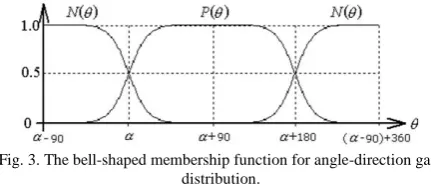
Step 3. Define the membership function, which contains sigmoid functions that determine the angle-direction gain is presented. The bell-shaped membership function of P(θ), which has a positive gain, is illustrated as,
90
36090 1
1 1
1
180) (
i
i e
e
e e
P (11)
Fig. 3 shows the corresponding waveform to (11). This figure presents N (
), which is the negation of P (
), is equal to 1-P (
). If the
<α- 90 condition occurs,
plus 360 results (11). We set ei and α to 100.0 and 135o
respectively, and expect to obtain a rapid response and simplified design.
Fig. 3. The bell-shaped membership function for angle-direction gain distribution.
Step 4. Determine the radius-direction gain function G
(Ri(n)), and is defined in (12). Where the fi is an adjustable
centripetal gain; Ri(n) is the length between the dynamic and
original points , (Ri(n) =∣(k0*dE i(n) , E i(n) )∣).
1 (12)1 2
fR(n) i
i i
e n
R G
Step 5. Compute the output of the proposed controller (U n( )), represented as,
n
G
Ri n
P
n
UMAXU ( ) 2 ( ) 1 (13) where UMAX is the maximum output of U n( ) for a practical
hardware system.
Step 6. Increase n by 1, and repeat steps 1 to 5.
M
n
M
n
k L
k kg
n error J
1 1 1
) ( min
SAEC
min (14)
where M denotes the total number of data sampled. λk is the
penalty factor associated with the constraint gk, and L is the
total number of constraints.
B. The Field-Weaken Control, the Flux Controller and Two Current Controllers
The conventional PI controller has been extensively used for controlling the speed of induction motor drives. The major feature of the PI controller is its capability to maintain a zero steady state error within a step change. The controller has the merits of simplicity and stability. However, a PI controller has some disadvantages, such as undesirable speed overshoot and oscillation, a sluggish response to a sudden change in load torque, a long settling time, and sensitivity to controller gains
kP and ki. Hence, the proposed FPPC is used as the primary
controller, which can overcome the disadvantages in the PI controller. Three PI controllers are employed as subordinate controllers [14] in the IFOC drive system design, including the flux controller and two current controllers of iqs and ids.
The determination of
edr* requires fairly complicated computations because the solution of*
e dr
is based on an eighth-order polynomial equation [15]. LetT
e* = 0; then
edr*can be approximated by,r s
s m e dr
L V L
max *
(15)
where
V
sm ax and
r are the maximum stator voltage and the electrical angular speed, respectively. To keep*
e ds
i
constant, the flux controller uses the PI control expressed as,
e
dr e dr if pf e ds
s k k
i
*
* (16)
To eliminate variant values
eqs* and
eds* in (2) and (3), two PI controllers are used in the current decoupling controllers of the deand qe axes, defined as (17) and (18).
e
qs e qs ic pc e
qs i i
s k
k
1 *
1
*
(17)
e
ds e ds ic pc e
ds i i
s k
k
2 *
2
*
(18)
Thus, the two decoupled stator voltages can be rewritten as,
edr e r m e ds e e qs decouple
qs Li L L
/ (19)
e qs e e ds decouple
ds Li
(20)
MAX
n R f
U e
e e n
U
o o
i i
1 1
2 1
2
1 1
2 )
(
315 0 . 100 135
0 . 100
) (
(21)
The parameters of the flux controller and the two current controllers (kpf, kif, kpc1, kic1, kpc2 and kic2) slightly influence the
performance of motor controls because the principal controller (FPPC) performs most of this work.
IV. THE OPTIMAL ALGORITHM
In IA [12], mimics these biological principles of clone generation, proliferation and maturation. The main steps of IA based on clonal selection principle are activation of antibodies, proliferation and differentiation on the encounter of cells with antigens, maturation by carrying out affinity maturation process, eliminating old antibodies to maintain the diversity of antibodies and to avoid premature convergence, selection of those antibodies whose affinities with the antigen are greater. In order to emulate IA in optimization, the antibodies and affinity are taken as the feasible solutions and the objective function respectively.
V. RESULTS OF THE SIMULATIONS AND EXPERIMENTS A. Setups of the Proposed Controller
The proposed controller (FPPC) was implemented using fuzzy membership functions, the phase plane theory and the IA. Fig. 1 shows the block diagram for controlling the speed of an induction motor using the IFOC. The proposed FPPC has one output (U n( ), the torqueTe*) and two input state
variables (the state E(n) and the variation of the error state dE (n)). Substituting (11) and (12) into (13) yields the output
( )
U n shown as (21).
In (21), fi is an adjustable parameter related to G (Ri (n)),
and the scaling factor ko of (10) is an adjustable parameter on
the phase plane. For optimal control, the parameters fi and ko
must be optimized. The maximum output UMAX was set to 3
for the practical hardware system. Matlab /Simulink software was employed on a P-IV 2.0GHz CPU to perform the simulations and experiments. The sampling interval was chosen as 0.1ms. Table I lists the parameters for the induction motor.
TABLEI:THE PARAMETERS OF THE INDUCTION MOTOR
Rs = 2.85Ω,Ls = 0.19667H
Rr = 2.34Ω,Lr = 0.19667H
Lm = 0.1886H
Jm = 0.002 kg·m2
Bm = 0.003 N·m/rad/s
4-pole, 220V Δ-connected,1 hp
B. Optimal Parameters of the Proposed Controller
In practice, the desired performance of a control system is specified in terms of time-domain quantities. An induction motor drive must usually meet the following specifications [5], [14], [16];
1) Delay time (td), td < 0.15s. 2) Rise time (tr), tr < 0.1s. 3)
Settling time (ts), ts < 0.2s. 4) Maximum step response
overshoot (mp), mp < 0.3%. 5) Step response steady state error
(ess), ess ~ 0.
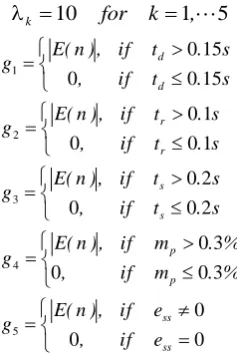
controlling speed of an induction motor. The fitness function can be calculated using (14). In light of aforementioned specifications, the penalty factors and constraints of (14) are defined as follows;
5
1
10
for
k
,
k
0 0
0 3 0 0
3 0
2 0 0
2 0
1 0 0
1 0
15 0 0
15 0
5 4 3 2 1
ss ss p p s s r r d d
e if ,
e if , ) n ( E g
% . m if ,
% . m if , ) n ( E g
s . t if ,
s . t if , ) n ( E g
s . t if ,
s . t if , ) n ( E g
s . t if ,
s . t if , ) n ( E g
C.Responses of the Proposed FPPC and Conventional PI Controllers
Fig. 4. The optimal speed control responses of the proposed FPPC and conventional PI controllers.
TABLEII:THE OPTIMAL PARAMETERS OF THE PROPOSED FPPC AND CONVENTIONAL PI CONTROLLERS,USING THE IA.
IA Controller Optimal parameters
SPEED CONTROL
(ω*
d =1000 rpm)
FPPC fi
ko
30.2618 1.2818
PI Kp2
Ki2
45.4267 0.0184
TABLEIII:THE CHARACTERISTICS OF THE TRANSIENT AND STEADY STATES FOR THE PROPOSED FPPC AND CONVENTIONAL PI CONTROLLERS
Simulation td(ms) tr
(ms) ts (ms)
mp
(%) ess (rpm)
Speed FPPC 70 109-32=77 120 0.0750 -0.00033 PI 93 141-47=94 152 0.0246 0.01430
Experiment td (ms)
tr
(ms)
ts
(ms)
mp
(%) ess (rpm)
Speed FPPC 83 130-33=97 140 0.2853 1.0387 PI 95 153-47=106 166 0.3021 2.0010
The simulated and experimental results for a step command input are given here to demonstrate the effectiveness of the proposed controller (FPPC). The IA was applied ten times,
considering the desired specifications. Table II lists the optimal parameters yielding the minimum SAEC using ten runs with the proposed FPPC and conventional PI controllers. Fig. 4 shows the simulated and experimental results using the proposed FPPC and conventional PI controllers to optimally control the speed of an induction motor. Moreover, Table III summarizes the characteristics of the transient and steady states (td, tr, ts, mp and ess), during applications using the
proposed FPPC and conventional PI controllers to control the speed of an induction motor. Fig. 4 and Table III indicate that the proposed FPPC not only has a smaller SAEC than the conventional PI controllers in speed control, but also completely satisfies the desired specifications. However, the conventional PI controllers violate most of the desired specifications.
Fig. 5 shows a three-dimensional plot using (ko*dE(n), E(n),
U(n)) as (x, y, z) variables. This figure indicates that the output of the proposed FPPC, (U(n)), is a functional designing controller on the phase plane, obtained using (22). The figure also shows that the switch line nearly cuts the phase plane into two semi-planes at 135˚ . The proposed FPPC accelerates the response because defuzzification and the knowledge base are no longer required. Therefore, the proposed FPPC has the merits of rapid response, simply designed fuzzy logic control and an explicitly designed phase plane theory.
Fig. 5. 3D phase plane diagram of the optimal speed control using the proposed FPPC.
TABLEIV:THREE CASES OF DIFFERENT PARAMETERS FOR THE FLUX CONTROLLER AND TWO CURRENT CONTROLLERS
Case A Case B Case C
Flux Controller Eq. (16)
kpf 20.0 20.0×0.7 20.0×1.3
kif 351.2 351.2×1.3 351.2×0.7
qe-Current
controller Eq.(17)
kpc1 20.0 20.0×1.3 20.0×0.7
kic1 200.0 200.0×.7 200.0×1.3
de-Current controller
Eq.(18)
kpc2 20.0 20.0×0.7 20.0×1.3
kic2 200.0 200.0×1.3 200.0×0.7
D.Parameters of the Three Subordinate Controllers
This paper used (15) to compensate for the field-weaken control of an induction motor, and employed three PI controllers as the subordinate controllers for the IFOC. Table IV lists the computational results from three cases involving different parameters for these PI controllers. This table explains that the flux controller and two current controller parameters (kpf, kif, kpc1, kic1, kpc2 and kic2) could be roughly
chosen, because this task was performed by the proposed FPPC.
E. Responses of the Load Control of the FPPC and PI Controllers
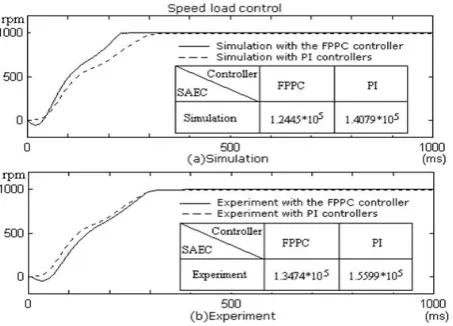
response results due to a step load torque change, (dTL=1N•
m), using the parameters in Table II to compare the load control responses of the proposed FPPC and conventional PI controllers. The comparisons demonstrate that the proposed FPPC is superior in both its smaller steady state error and quicker response than the conventional PI controllers, in controlling speed loads.
Fig. 6. The speed load control responses of the proposed FPPC and conventional PI controllers.
VI. CONCLUSIONS
The proposed controller (FPPC), was presented herein. Fuzzy membership functions, phase plane theory and the IA were employed to design the proposed FPPC to optimally control induction motor speed and load. The contribution of this paper is the methodology of the proposed controller for optimally controlling speed of an induction motor. Simulated and experimental results clearly reveal that the proposed FPPC outperforms conventional PI controllers in optimal speed and load controls.
ACKNOWLEDGMENT
Financial support given to this research by the National Science Council, Taiwan, ROC. under Grant No. NSC100-2632-E-252-001-MY3 is greatly appreciated.
REFERENCES
[1] Z. Libo, J. E. Fletcher, B. W. Williams, and H. Xiangning, “A novel direct torque control scheme for a sensorless five-phase induction motor drive,” IEEE Transactions on Industrial Electronics, vol. 58, no. 2, pp. 503-513, 2011.
[2] K. K. Shyu, J. K. Lin, V. T. Pham, M. J. Yang, and T. W. Wang, “Global minimum torque ripple design for direct torque control of induction motor drives,” IEEE Transactions on Industrial Electronics, vol. 57, no. 9, pp. 3148-3156, 2010.
[3] O. S. Ebrahim, M. F. Salem, P. K. Jain, and M. A. Badr, “Application of linear quadratic regulator theory to the stator field-oriented control of induction motors,” IET, Electric Power Applications, vol. 4, no. 8, pp. 637-646, 2010.
[4] A. M. Bazzi, A. D. Garcia, and P. T. Krein, “Markov reliability modeling for induction motor drives under field-oriented control,”
IEEE Transactions on Power Electronics, vol. 27, no. 2, pp. 534-546, 2012.
[5] C. M. Liaw and F. J. Lin, “A discrete adaptive induction position servo drive,” IEEE Trans. on Energy Conversion, vol. 8, no. 3, pp. 350-356, 1993.
[6] A. Rubaai and J. Jerry, “Hybrid fuzzy bang-bang mode controller for electric motor drives applications,” in Proc. 2011 IEEE Industry Applications Society Annual Meeting (IAS), 2011, pp. 1-8.
[7] Q. GuiLing, L. Youcai, and Y. Zongtian, “Fuzzy control with phase plane-reference-models and its application in the deep sea stepping hydraulic control system,” in Proc. 2012 2nd International Conference on Consumer Electronics, Communications and Networks
(CECNet), 2012, pp. 338-341.
[8] J. Y. Sun, W. Shi, and Z. C. Wang, “The application of the phase plane in the tuning method for fuzzy PID,” in Proc.2012 2nd International Conference on Consumer Electronics, Communications and Networks
(CECNet), 2012, pp. 1381-1385.
[9] Y. Zhou, M. S. Liu, L. S. Hu, and Z. D. Zhang, “Application of fuzzy five states control system base on phase plane in steer by wire system of loader,” in Proc.2010 Seventh International Conference on Fuzzy Systems and Knowledge Discovery (FSKD), 2010, vol. 2, pp. 649-653. [10] M. Basu, “Hybridization of artificial immune systems and sequential quadratic programming for dynamic economic dispatch,” Electric Power Components and Systems, vol. 37, pp. 1036-1045, 2009. [11] K. M. Woldemariam and G. G. Yen, “Vaccine-Enhanced artificial
immune system for multimodal function optimization,” IEEE Trans. on Man and Cybernetics- Part B: Cybernetics, vol. 40, pp. 218-228, 2010.
[12] E. John. Hunt and D. E. Cooke, “Learning using an artificial immune system,” Journal of Network and Computer Applications, vol. 19, pp. 189-212, 1996.
[13] P. C. Krause, Analysis of Electric Machinery, NY, McGraw-Hill, 1987.
[14] C. M. Liaw and F. J. Lin, “Position control with fuzzy adaptation for induction servomotor drive,” IEE Proc. Electr. Power Appl., vol. 142, no. 6, pp. 397-404, 1995.
[15] X. Xu, R. D. Doncker, and D. W. Novotny, “Stator flux orientation control of induction machines in the field weakening region,” in Proc. 1988 IEEE IAS Conf., 1988, pp. 437-443.
[16] B. C. Kuo, Automatic Control System, NY, John Wiley & Sons, 1995.