S O F T W A R E
Open Access
An ontology-driven tool for structured
data acquisition using Web forms
Rafael S. Gonçalves
*, Samson W. Tu, Csongor I. Nyulas, Michael J. Tierney and Mark A. Musen
Abstract
Background: Structured data acquisition is a common task that is widely performed in biomedicine. However, current solutions for this task are far from providing a means to structure data in such a way that it can be
automatically employed in decision making (e.g., in our example application domain of clinical functional assessment, for determining eligibility for disability benefits) based on conclusions derived from acquired data (e.g., assessment of impaired motor function). To use data in these settings, we need it structured in a way that can be exploited by automated reasoning systems, for instance, in the Web Ontology Language (OWL); thede factoontology language for the Web.
Results: We tackle the problem of generating Web-based assessment forms from OWL ontologies, and aggregating input gathered through these forms as an ontology of “semantically-enriched” form data that can be queried using an RDF query language, such as SPARQL. We developed an ontology-based structured data acquisition system, which we present through its specific application to the clinical functional assessment domain. We found that data gathered through our system is highly amenable to automatic analysis using queries.
Conclusions: We demonstrated how ontologies can be used to help structuring Web-based forms and to semantically enrich the data elements of the acquired structured data. The ontologies associated with the enriched data elements enable automated inferences and provide a rich vocabulary for performing queries.
Keywords: OWL, Ontology, Structured data, Data acquisition, Form generation
Background
Ontology-based form generation and structured data acquisition was first pioneered almost 30 years ago. In the early 1990s, Protégé-Frames used definitions of classes in an ontology to generate knowledge-acquisition forms, which could be used to acquire instances of ontology classes [1, 2]. The rise of the Web Ontology Language (OWL) [3, 4], standardized by the World Wide Web Con-sortium (W3C) in 2004, caused a paradigm shift in knowl-edge representation from frame-based to axiom-based. Because of its axiom-based nature, it is more difficult to acquire instance data based on OWL than it was based on frames. With OWL as the preferred modeling language for ontologies, class definitions are collections of description logic (DL) axioms, and can no longer be seen as templates
*Correspondence: [email protected]
Stanford Center for Biomedical Informatics Research, Stanford University, Stanford, CA, USA
for forms [5]. Unlike template-based knowledge represen-tations, where what can be said about a class is defined by the slots of the class template, axiom-based representa-tions do not have this kind of locally scoped specification, and allow any axiom describing the same class to be added to the ontology, as long as the axiom does not lead to inconsistencies. Template-based knowledge representa-tion systems use closed-world reasoning and have local constraints (e.g., cardinality of a slot for a particular class) that can be validated easily, while in an axiom-based sys-tem with the open-world assumption such local constraint checking is much more problematic. Furthermore, in our chosen application domain, assessment instruments have specific formats that do not lend themselves to be seen as representing instances of domain ontology classes. Items in the instruments have potentially complex descriptions of information to be collected, such as the severity of pain with a particular quality, and at a specific anatomical
location. The challenge is to model the assessment instru-ments and relate the assessed data to a domain ontology with which one can formulate meaningful queries.
In this paper, we describe a system that we developed for representing, acquiring, and querying assessment data that uses: (1) an information model of assessment instru-ments to drive the generation of data-acquisition Web forms, (2) domain ontologies and standard terminolo-gies to give formal descriptions of entities in our chosen domain, and (3) a data model for the acquired informa-tion that links the data to the domain ontologies and standard terminologies. Such linkage makes it possible to query and aggregate the data using the logical representa-tion of the domain concepts in the ontologies. The choice of Web forms as a method for acquiring data is due to their widespread use and simplicity for data acquisition. The form generation software we present here works with forms modeled in OWL so long as these replicate our design pattern for the form specification ontology. The paper describes requirements on the underlying ontolo-gies and information models, and the steps for configuring the software to generate forms and to acquire data using clinical functional assessment as an exemplar.
Related work
In addition to the comparison with the Protégé-Frames template-based instance acquisition method (in the Background Section), we briefly contrast our work with other systems that use ontologies in the construction of forms for acquiring structured data.
Girardi et al. [6] describe an ontology-based data-acquisition and data-analysis system where the structure of the data depends on the ontology classes, in such a way that the GUI structures (tables, headers, filter dialogs, etc.) can be created at runtime based on the ontology information. This system, like the earlier Protégé-Frames system, assumes that classes in the ontology provide data-acquisition templates that directly define user-interface features. Our system is designed to work with OWL ontologies where ontology axioms do not provide the structural templates required in the system described by Girardi et al. Instead, the structure of the data-acquisition instrument has to be defined separately.
ObTiMA, described by Stenzhorn et al. [7], is another ontology-based data-acquisition system. It is a clinical trial-management application featuring a Trial Builder module that a clinical researcher can use to build case report forms (CRFs). Items in a CRF are constructed by selecting concepts from a master ontology. A Patient Data Management System provides a graphical user inter-face that allows clinicians to fill in the CRFs relevant to the patient’s current treatment situation. The design of ObTiMA is very similar to the system we are proposing. The main differences, aside from ObTiMA’s specific focus
on clinical trial management, include (1) our use of OWL to model not only the domain concepts, but also the struc-tures of forms and data model, and (2) ObTiMA’s use of a tree view to represent concepts that can be selected to define data items. It is understandable that, from the per-spective of supporting a clinical researcher’s use of the master ontology to construct CRFs, a tree view provides a necessary simplification of the master ontology, although it nevertheless constrains what can be expressed. It is difficult to see how some of the complex concepts (e.g., ‘constant pain caused by radiculopathy in the lower left extremity’) modeled in our work can be represented as part of a tree structure.
The clinical documentation system developed by Hor-ridge et al. [8] uses a template schema to allow a technology-savvy clinician to create documentation tem-plates that include the local structure of subforms, and potentially complex clinical descriptions consisting of fea-tures and their values. The feafea-tures and values are mapped to a medical ontology, and the system automatically gen-erates ontological descriptions of the data elements based on the mappings. Constrained by our goal to replicate existing forms, we took the opposite approach where we start with ontological descriptions of the data elements, specify how they are used in assessment instruments as part of the description of instruments, and generate forms for the acquisition of data. Having the freedom to design their documentation system, Horridge et al. avoided the laborious work of manually modeling the domain concepts.
Bona et al. developed a work that is similar to ours [9]. They modeled the specifications of forms, question groups, questions, and answers as extensions of the Infor-mation Artifact Ontology (IAO),1and the answers as the result of the patient-history taking process. In their work, the questions are just strings that have associated accept-able answers, whereas we attempt to formalize much of the information content in our assessment instruments in terms of a domain ontology. Furthermore, it is not clear that the system automatically generates data-acquisition forms from the ontology-based form specifications.
wiki implementation—IkeWiki [11]—concluded that authoring instance data in such a way is cumbersome, even with users that are familiar with ontologies. A good solution to this would be exploiting the relations defined in the schema to provide “wiki article templates” whose form input fields derive from those relations, thus making it easier to create semantic wiki articles – essentially the user would only have to fill in the values of those relations, without having to understand the underlying representation.
Another system that is very close to what we present here is K-Forms [12]. This tool allows users to construct forms using a graphical user interface, and then the result-ing form structure is seamlessly encoded as an OWL ontology. However, unlike our work, K-Forms does not have a mechanism to associate form data (whether ques-tions or answers) to user-specified domain ontologies, meaning that the queryability will be constrained to the semantics provided by the system, rather than the more flexible approach that we aim for.
Implementation
In this section we describe the software, information mod-els, and ontologies that we developed for OWL-based data acquisition.
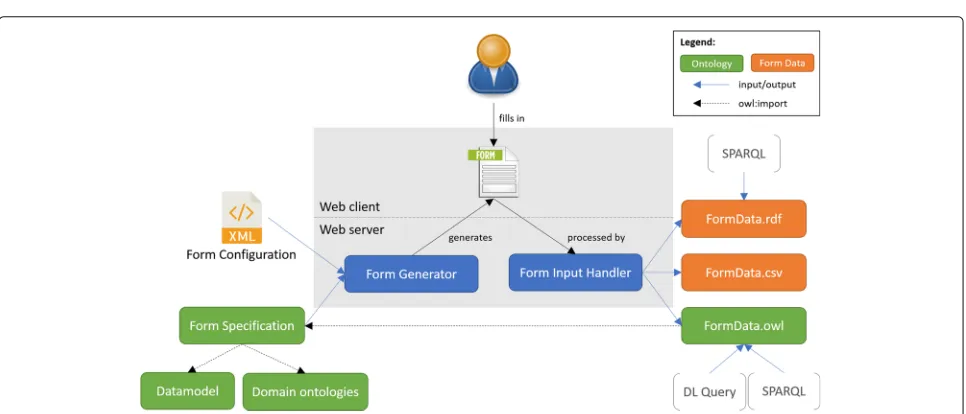
The architecture of the form generation and data acqui-sition system we implemented is depicted in Fig. 1. The tool takes as inputs an XML configuration file that speci-fies the form layout, and a form-specification OWL ontol-ogy that defines the content of the form (i.e., the actual questions, answer options, etc.). The tool then generates a form, and outputs answers to form questions in CSV, RDF and OWL formats. We implemented our tool in Java,
using the OWL API v4.0.1 [13],4 and its source code is
publicly available on GitHub.5A Web server is necessary to deploy the application, so the project ships with an embedded instance of Jetty.6The requirements to run the application are Java (v1.7 or above) and Apache Ant.7
To try out the software, we supply executable scripts for Windows and UNIX-based operating systems, which build and deploy the tool on the included Jetty Web server. These scripts are hosted in our GitHub repository. First, a user would clone the repository to their computer, and then from a command line execute the appropriate script for the operating system; use ‘run-generator.sh’ on UNIX-based systems and ‘run-generator.bat’ on Windows. Alter-natively, one can build the form-generator using Apache Ant, and then deploy it onto the provided instance of Jetty. The application will then be available to browse on the designated localhost port. In addition to the tool itself, we provide in the same GitHub repository 3 example form configurations, the ontologies that we developed, some of the data that we gathered via our tool, example SPARQL queries over that data, and finally the results of executing those queries on our data. Users can open the output data and query it with the example SPARQL queries we supply, using, for example, the Protégé ontology editor [2].
The two major stages in the application workflow are: form generation and form input handling, as described below.
(1) Form generation – Steps to produce a form:
(a) Process XML configuration file, gathering form layout information, IRIs and bindings to ontology entities
(b) Extract from the input form specification ontology all relevant information pertaining to each form element:
(b.1) Text to be displayed (e.g., section header, question text)
(b.2) Options and their corresponding text, where applicable
(b.3) The focus of each question
(c) Generate the appropriate HTML and JavaScript code
(2) Form input handling – Once the form is filled in and submitted:
(a) Process answer data and create appropriate individuals
(b) Produce a partonomy of the individuals created in (2.a) that mirrors the layout structure given in the configuration (c) Return the (structured) answers to the user
in a chosen format
An application can combine the data with the OWL ontologies to make description logic queries that inter-pret the data in terms of the semantics defined in the ontologies.
In order to use our tool, a user will have to model ques-tions and their descripques-tions in OWL, and then specify the layout and content of the resulting form in an XML file. In the following subsections, we will describe the OWL modeling and configuration components in detail.
Modeling
Our goal was to develop a set of light-weight ontologies and models with minimal ontological commitments, and postponing alignment with possible upper-level ontolo-gies to the future. Existing ontoloontolo-gies, such as the Infor-mation Artifact Ontology, do not provide a modeling of forms and questions that we could reuse. Further-more, what we need is an information model that states, for example, that the structure of a question on a form includes a specific text string, not an ontology that char-acterizes parts of information artifacts in terms of logical descriptions (e.g., modeling the text of a question as an instance of “textual entity" class).
The modeling component of our software consists of (1) a datamodel that specifies the structure of data-acquisition forms and of the resultant data, (2) form specifications that define specific data-acquisition forms in terms of the datamodel structures and concepts and relations in the domain ontologies, and (3) one or more
domain ontologiesthat define the concepts and relations in an application domain. The domain ontologies that
we developed are hosted and maintained in our GitHub repository.8
Datamodel
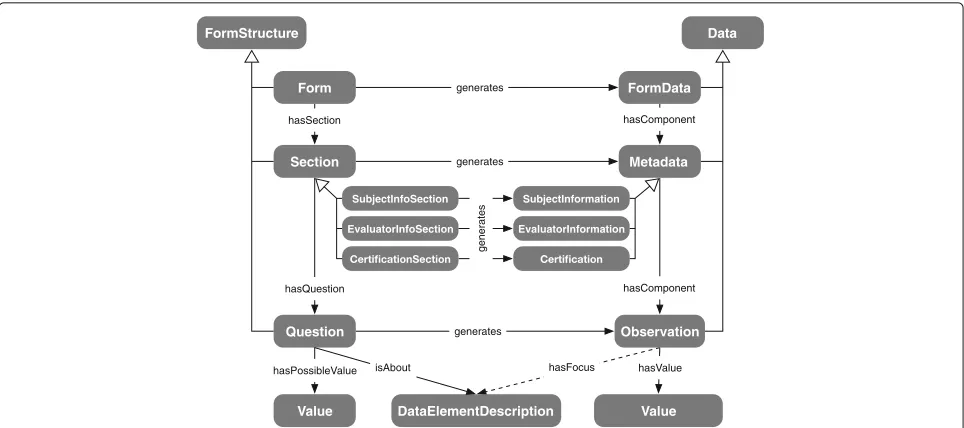
The datamodel, represented as an OWL ontology, is a generic, context-free description of the information struc-tures of a form. It models form elements such as sections and questions, and the data elements generated from a form (e.g., a string value from a text area, or val-ues from an enumerated value set). Figure 2 summarizes key aspects of our modeling: elements of a form are asserted as subclasses of FormStructure, such as Form,
Section andQuestion. Each kind of FormStructure gen-erates some kind of Data; every form submission gen-erates an instance of FormData, which references (via the hasComponent property) all instances of Data gen-erated in the process of parsing form answers. Specific sections such as SubjectInfoSection collect information pertaining to a subject, and these details are aggregated in an instance of SubjectInformation. An answer to an instance of Question gives rise to an instance of Obser-vation with a hasValueproperty assertion to the IRI of the selected answer. An instance of Observation will be inferred to have an outgoinghasFocusproperty assertion if theQuestioninstance it derives from encodes some kind of semantic description of the question’s meaning via the
isAbout relation. The semantic description is defined as
DataElementDescriptionin the domain ontologies. Each instance of Questionspecifies a set of possible (answer) values via a hasPossibleValue relation to an instance of
Value.
Form specifications
Theform specificationscontain the sets of OWL individu-als that define the content of forms to be generated. Each such form specification contains instances of Question,
Section, Form and other elements defined in the data-modelontology (shown in Fig. 2). Not only does the form specification rely ondatamodel(for form structuring pur-poses), it also relies on classes and individuals of domain ontologies for semantic descriptions of what the question “is about” (e.g., severity of pain in a body part), and for answer options to the question (e.g., values of a scale of severity of pain).
Domain ontologies
Form generates FormData
Observation Question
hasValue
Value
hasFocus
Section FormStructure
DataElementDescription
EvaluatorInformation generates
generates
Data
SubjectInformation hasSection
hasQuestion
Metadata
EvaluatorInfoSection SubjectInfoSection
generates
hasPossibleValue
hasComponent hasComponent
Value
isAbout
Fig. 2Modeling of thedatamodelontology. Excerpt of ontology classes and the relations between these. The classes on the left of the diagram are kinds ofFormStructure, such asQuestion, which generate instances of the correspondingDataclasses on the right (e.g., an answer to a question generates an instance ofObservation)
by a class expression involving various domain classes. In the domain of functional assessment that motivates our work, a question may be about some attribute of a body function of a person’s body part. If the question is about the severity of the pain sensation in the left lower leg, that question can be annotated with an individual com-posed as follows (1) assessed function “pain in body part”, (2) anatomical location “lower extremity” with laterality “left”, and (3) assessed attribute “severity”. To formalize the composition, the domain ontology would, at minimum, include classes for body functions, anatomical locations, and assessment attributes. Additional descriptors would require other ontology components.
The granularity of theisAboutrelation can be as coarse or as fine as necessary. In the aforementioned example, we may decide to leave out the laterality descriptor of a body part. Questions about pain in the right and left lower extremity will have the sameisAboutrelation. In this case, queries that rely on the structures of the domain ontol-ogy will not be able to distinguish between answers about right and left extremities. That may be sufficient for the purpose of the user application. As is often the case, we have to balance the precision of allowed queries with the required modeling effort.
Configuration File for Form Generation and Data Acquisition
The user-defined XML configuration file that drives the form generation process specifies: input and output infor-mation of the tool, bindings to ontology entities, and layout of form elements. A Document Type Definition
(DTD) schema defines the building blocks of such con-figuration files, imposing necessary constraints to ensure the configuration file can be suitably interpreted. The key XML elements to be configured by potential users are:
input: contains anontologychild element, and optionally a child elementimports
◦ ontology:absolute path or IRI to the form specification ontology
◦ imports:containsontology child elements, which have an attributeiri, giving the IRI of the imported ontology
output: contains the following child elements
◦ file:defines, via atitle attribute, the title of the form. Optionally, a path can be specified within thefile element pointing to where the HTML form file should be serialized to
◦ cssStyle:the CSS style class to be used in the output HTML
bindings: defines mappings to ontology entities, such as what data property is used to state the text of a question, or section headings
form: defines the layout and behaviors of the form, as described below
dropdown, horizontal checkbox, etc.), question-list lay-out (vertical or inline) and recurrence; one can specify that a collection of questions should be repeated any given number of times. Some more complex options include overriding the default (alphabetic) order of answer options, and triggering sub-questions when a specific answer is selected. The tool collects the list of answer options for each question from the ontology, and by default this list is ordered alphabetically for presen-tation. In a situation where there is a need to sort answer options differently, one can do so in the config-uration by specifying an attribute optionOrder for the question.
Within the form configuration element, we start by specifying the IRI of the OWL individual which represents the form, by means of anirielement; this is done so that one can, for example, analyze different submissions of the same form. Next we definesectionelements: eachsection
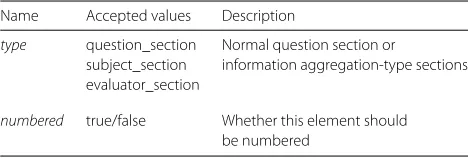
element has anirichild element with an IRI correspond-ing to an instance of theSectionclass in the form specifi-cation ontology. One can specify the type of section, and whether it is numbered, viatypeandnumberedattributes, accordingly (see Table 1).
In asectionwe can have two types of lists:questionList
andinfoList(distinguished in the paragraphs below). The way in which either of these lists are presented on the form can be modified via atypeattribute, which accepts ‘inline’ (horizontally laid out) and ‘normal’ (vertically laid out) types, as shown in Table 2. One can also state in arepeat
attribute how many times the list should be repeated, which is particularly useful when requesting the same kind of information multiple times, for example, patient symptoms, or previously diagnosed medical conditions.
The typical output of forms is a list of key-value pairs, i.e., the form output format enforces a one-to-one cor-respondence between questions and answers. Our tool supports this format with thequestionListelement. How-ever, there are situations where multiple questions in a form represent different aspects of the same entity. For example, personal information fields such as name, phone number, address, etc., are used to represent a single entity: a person. In such cases, we would like to be able to specify that a section of a form is specifically dedicated to gather-ing multiple details about the same thgather-ing. So, in addition
Table 1Acceptable attributes onsectionelements
Name Accepted values Description
type question_section Normal question section or
subject_section information aggregation-type sections evaluator_section
numbered true/false Whether this element should be numbered
Table 2Acceptable attributes onquestionListandinfoList elements
Name Accepted values Description
type inline/normal Present list elements horizontally (inline) or vertically (normal)
repeat positive integer Repeats the elements within this list the specified number of times
to the typical one-to-one format, we support a special kind of list, calledinfoList, that groups multiple answers about the same entity.
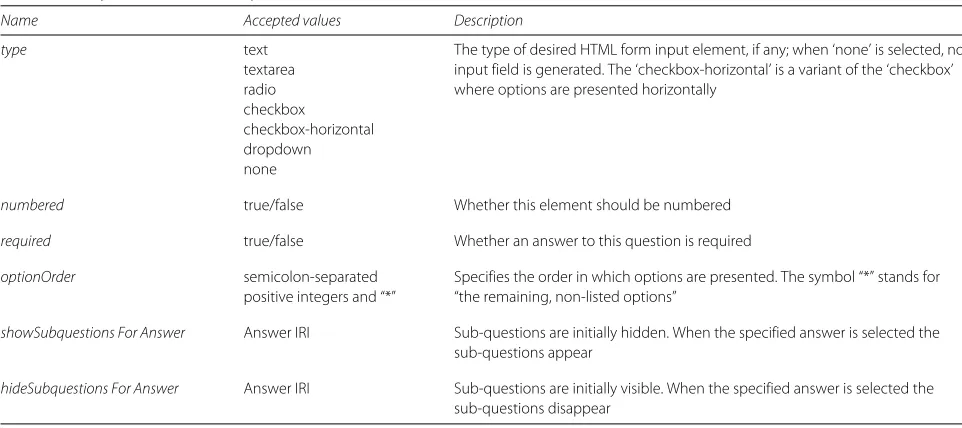
Each answer given to aquestionin aquestionListresults in a single instance ofObservationbeing created, that is, there is a one-to-one correspondence between input given to aquestionelement and an instance of data. Inside ques-tionListwe can have multiplequestionelements, each with a childirielement pointing to the OWL individual repre-senting the question. A question can have sub-questions, which are listed in aquestionListelement within the ques-tionelement. The attributes allowed onquestionelements are specified in Table 3.
In Table 3 we show the attributes for the key element that users configuring forms would have to define. One of those attributes is to modify the default—alphabetical— order in which answer options are displayed in the resulting form. For instance, we can say that the 4th option should be presented as the last one, like such:
optionOrder=“*;4”. To extend on that, we can also have the second element as the first:optionOrder=“2;*;4”.
Answers given to elements inside aninfoListare aggre-gated in order to describe a single OWL individual. Within
infoListelements one can specify multipleinfoelements. The input entered into aninfoelement becomes the filler of a data property assertion on the individual specified by the list. The IRI of the data property to be used in eachinfo
element is given as apropertyattribute on theinfoelement (see Table 4).
Application Domain
Table 3Acceptable attributes onquestionelements
Name Accepted values Description
type text The type of desired HTML form input element, if any; when ‘none’ is selected, no textarea input field is generated. The ‘checkbox-horizontal’ is a variant of the ‘checkbox’ radio where options are presented horizontally
checkbox
checkbox-horizontal dropdown none
numbered true/false Whether this element should be numbered
required true/false Whether an answer to this question is required
optionOrder semicolon-separated Specifies the order in which options are presented. The symbol “*” stands for positive integers and “*” “the remaining, non-listed options”
showSubquestions For Answer Answer IRI Sub-questions are initially hidden. When the specified answer is selected the sub-questions appear
hideSubquestions For Answer Answer IRI Sub-questions are initially visible. When the specified answer is selected the sub-questions disappear
as either blobs or non-standard data elements. While a standard such as LOINC® (Logical Observation Iden-tifiers Names and Codes) defines the syntactic struc-tures of assessment instruments as a hierarchy of panels with questions that have coded answers [16], it does not relate the semantic content of the questions and answers to standard terminologies and data models that allow meaningful querying and aggregation of acquired data.
In order to capture the semantic distinctions that are needed in functional assessment, we developed a Clin-ical Functional Assessment (CFA) ontology that models the concepts and relationships that occur in functional assessment instruments. Our ontologies reference the International Classification of Functioning, Disability and Health (ICF),9developed by the World Health Organiza-tion (WHO), and other reference terminologies such as SNOMED CT.10
CFAThe Clinical Functional Assessment (CFA) ontol-ogy models concepts and relationships that allow us to give formal descriptions of the findings, assessments, and measurements embodied in clinical functional assess-ment instruassess-ments. The ontology is divided into three main branches: (1) Finding: the entity that is the sub-ject of an observation or judgement, a subclass of the
DataElementDescription that is required for annotating form questions, (2)Valuethat defines collections of pos-sible qualifiers and values for findings, and (3) Subject-MatterOntologythat provides internally defined domain concepts that are either not available from standard termi-nologies, or are references to standard terms that need to be organized into taxonomies. TheFindingclass is further subdivided intoAssessment(those findings that have non-numeric result) and Measurement (those findings that
have numeric results). We also defineFunctionalFinding
(a subclass ofFinding) andFunctionalAssessment(a sub-class ofAssessment). In general, a functional assessment will have some assessed function that can be related to an ICF body function or activity (possibly as an exact match, specialization, or generalization), some assessed attribute, such as severity, that specifies the dimension of the function being assessed, and, optionally, some anatomical location of the assessment. Both findings and functions can be modified by qualifiers that further refine these entities. For example, a functional assessment may be made in the context of using assistive devices, and a function being assessed may have some temporal com-ponent (e.g., constant or intermittent pain). ICF being an imported ontology for CFA, all ICF categories, such as body structure, body function, activities and participation, and environmental factors are available for formalizing descriptions of functional assessments. For other standard terminologies such as SNOMED CT, ICD, and LOINC, instead of importing them as ontologies, we make ref-erences to them through an ExternallyCodedValue that specifies the terminology source and code. Queries that reference these codes require the availability of terminol-ogy services that relate these codes to other terms in the referenced terminologies.
Table 4Acceptable attributes oninfoelements in addition to thetype,required, andoptionOrderattributes, defined in Table 3, which can also be used forinfoelements
Name Accepted values Description
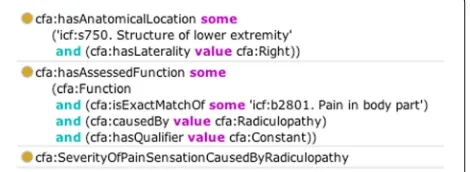
The modeling ofFindingis exemplified as follows, based on the “Back (Thoracolumbar Spine) Conditions” DBQ11 that we use as one of our exemplar assessment instru-ments; in the question on the severity of constant pain caused by radiculopathy12 on the right lower extrem-ity, we define a subclass of FunctionalAssessment that has the assessed attribute ‘severity’, the assessed func-tion ‘icf:b2801 Pain in body part’ that is qualified by a temporal quality ‘Constant’, and has anatomical loca-tion ‘icf:s750. structure of lower extremity’ with laterality ‘Right’. Figure 3 illustrates the modeling of this assess-ment. With the modeling of the dimensions of assessment instrument questions, we can make queries on, and aggre-gate data collected through the instruments, as will be shown in the Analyzing DBQ Submission Data Section.
Form Specifications
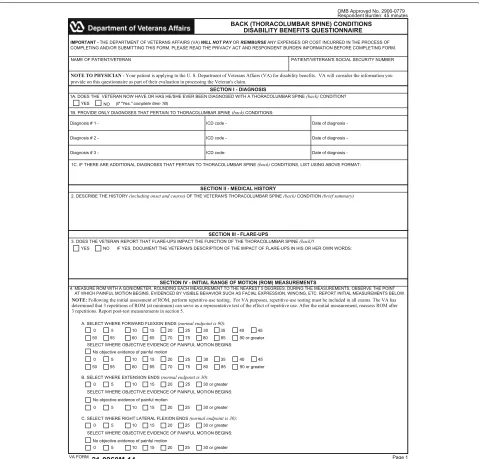
In our application scenario we use, as exemplars, the U.S. Department of Veterans Affairs (VA) Disability Benefits Questionnaires (DBQs). The top section of one such ques-tionnaire is shown in Fig. 4. DBQs are used to evaluate service members’ disabilities and to determine the ben-efits for which they are eligible. We start off with these DBQs as our initial form specifications, and design an ontology-based method for Web form generation and structured data acquisition, subsequently exemplifying how one would go about exploiting such data for immedi-ate orpost factoanalyses.
Results
The key output of the data acquisition tool is the OWL ontology, as it provides us with “semantically enriched” form data that can be used for aggregation and query-ing. The resulting data individuals are structured in OWL (via hasComponent relations) similarly to how the form is structured in the configuration, that is, if questionQis configured as having two sub-questions, then the Obser-vationindividual generated by Qwill have two outgoing
hasComponent relations to the instances ofObservation
generated by the two sub-questions of Q. The output
Fig. 3Modeling of the concept of “severity of constant pain caused by radiculopathy in the lower right extremity”. Example modeling from the CFA ontology, which specifies the anatomical location of the symptom (first axiom), and the function being assessed (second axiom)
ontology is modeled according to thedatamodelontology presented in the Modeling Section, which is a resource of the overall system distribution.
We configured the complete VA DBQ for ‘Back (Tho-racolumbar Spine) Conditions’ using our form generation system, together with the ontologies presented in the Implementation Section—this process is described in the Generating Web-based DBQs Section. The generated Web-based DBQ was validated in an iterative manner by one of the authors (Michael J. Tierney), and subse-quently filled in with sample data that we analyze in the Analyzing DBQ Submission Data Section.
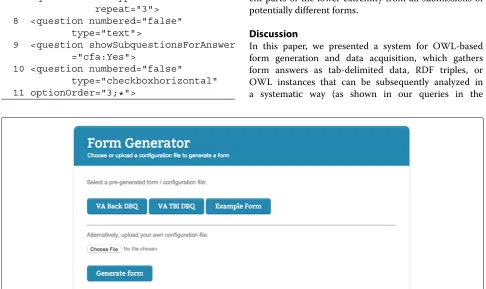
Our pre-configured DBQ forms, as well as an exam-ple form which aims at demonstrating all possible options to lay out and configure forms, are shown in the main interface of the form generator, as illustrated in Fig. 5.
Generating Web-based DBQs
To generate a “VA Back DBQ”, the corresponding XML configuration file is passed on to the service, which returns the HTML form—the top portion of the resulting form is presented in Fig. 6. Taking into account the ele-ments in Fig. 6, we now inspect how they were specified in the XML configuration (fragments of which are in Code Snippet 1). From top to bottom of Fig. 6 we have: a non-numbered patient-information section (see Line 1 of Code Snippet 1) and a numbered question-section of the DBQ (sectionelement without attributes). In the patient infor-mation section we have an inline inforinfor-mation list (Line 2) with two information inputs: a required “Patient Name” input (Lines 3-4), and an optional text input (norequired
attribute) which gives us fillers of thecfa:hasIDdata prop-erty. In the question section of the form there is question A: a radio-type question (Line 5), and question B which has type “none” (Line 6). Question B contains an inline, repeating question list (Line 7),13 featuring three, non-numbered text-type questions (Line 8). As it was in our case (in Fig. 6), one might want to know several aspects about a particular entity, such as patient conditions: when each condition was diagnosed, by whom, its ICD code, and so on. In this scenario, it makes little sense to repeat each question individually, but rather it would be prefer-able to repeat the whole set of questions in an ‘inline’ fashion, simulating a table.
Question A of Section 15 (see Fig. 7) is configured so that when the option “Yes”, corresponding to the OWL individual cfa:Yes, is selected (Line 9), it triggers the appearance of its sub-questions; a list of assistive devices, each of which when selected, triggers the appearance of a sub-question relating to the frequency of use of that particular assistive device.
Fig. 4Original VA DBQ. An example DBQ for assessing back (thoracolumbar spine) conditions in PDF format, as distributed by the VA
ordered alphabetically. However, ‘None’ would then appear between ‘Moderate’ and ‘Severe’, thus interrupt-ing a severity scale. So we added: optionOrder=“3;*” to thequestionelement in Line 16 of Code Snippet 1, which states that the third option (or would-be third option alphabetically) should appear first, and the remaining should be presented in default order.
Analyzing DBQ Submission Data
One of the authors (Michael J. Tierney), who is a physi-cian from the VA Palo Alto Healthcare System, verified the
generated OWL-based version of the DBQ form through-out its development, to ensure that, for example, a par-ticular question triggers the correct set of sub-questions when a specific answer is selected. This was done by man-ually inspecting the original Portable Document Format (PDF) version of the DBQ form, and comparing it with the generated Web form (taking into account the extended capabilities of our system).
support for SPARQL 1.1 querying and OWL 2 reasoning based on the Pellet reasoner [17]: Stardog v2.2.4.14
Since our data are both structured and semantically enriched, we are able to query the observations using SPARQL, classify them into criteria representing powerful OWL expressions, or manipulate them using SWRL. For example, Code Snippet 2 presents a simple SPARQL query that returns all instances ofObservationwhere a patient presented signs or symptoms due to radiculopathy. It is worth observing that this query is formulated in such a way that it is independent of the assessment instrument, including the particular formulation of the question, but rather uses the appropriate focus individual from our CFA ontology.
Code Snippet 1Samples from “VA Back DBQ” configu-ration
1 <section numbered="false" type="patient_section"> 2 <infoList type="inline">
3 <info property="cfa:hasPatientName" 4 required="true" type="text"/>
5 <question type="radio"> 6 <question type="none"> 7 <questionList type="inline"
repeat="3"> 8 <question numbered="false"
type="text">
9 <question showSubquestionsForAnswer ="cfa:Yes">
10 <question numbered="false"
type="checkboxhorizontal" 11 optionOrder="3;*">
Code Snippet 2SPARQL query for retrieving all observa-tions of radicular pain due to radiculopathy
SELECT ?obs WHERE {
?obs a datamodel:Observation . ?obs datamodel:isDerivedFrom ?q . ?q a datamodel:Question .
?q cfa:isAbout
cfa:signs_or_symptoms_due_to_ radiculopathy .
?obs cfa:hasValue cfa:Yes }
In order to query for all observations of severe pain anywhere in the lower extremity, one could formulate an OWL DL query such as that given in Code Snippet 3. The query makes use of the appropriate ICF codes for ‘pain in body part’ and ‘structure of the lower extremity’, while the remainder of the query exploits the instantiation ofObservation(from thedatamodelontology) as well as the clinical functional assessment-related modeling in the CFA ontology for, for example, the pain severity value and anatomical location.
In response to the query in Code Snippet 3, a DL rea-soner uses the semantic descriptions of the observation foci, which are derived from the isAbout property of questions, to aggregate answers for severe pain for differ-ent parts of the lower extremity from all submissions of potentially different forms.
Discussion
In this paper, we presented a system for OWL-based form generation and data acquisition, which gathers form answers as tab-delimited data, RDF triples, or OWL instances that can be subsequently analyzed in a systematic way (as shown in our queries in the
Fig. 6Top portion of the generated Web-based DBQ form for back conditions. The form contains two visible sections: (1) a patient information section, whose answers (name and social security) become data property assertions of the patient individual, and (2) a question section, consisting of a radio-type question and an inline, repeating question list containing 3 text input questions
Code Snippet 3OWL DL query for retrieving all obser-vations of severe pain anywhere in the lower extremity datamodel:Observation and
cfa:hasValue value cfa:severe and cfa:hasFocus some (cfa:Assessment and
(cfa:hasAssessedFunction some (cfa:isExactMatchOf some
‘icf:b2801. Pain in body part’)) and (cfa:hasAnatomicalLocation some
‘icf:s750. Structure of lower extremity’))
Analyzing DBQ Submission Data Section). Once the raw data is processed (by deriving the foci of observations from the isAbout field of the questions), the resulting data have no dependency on specific questions (except for provenance tracking), so even if the form specification is modified, previous form data are still comprehensible and sound (i.e., upon form specification changes the new data
and old data remain compatible). The value of data in such a structured format in any arbitrary domain is twofold: automating, or improving the automation of the process of arriving at desirable conclusions from questions in the form using Web standards, and for further analysis and querying of data associated with ontologies. For example, the acquired data can be readily checked for consistency with the associated ontologies.
Fig. 7Form question with hidden sub-questions that get triggered depending on the selected answer. Question on assistive devices consisting of a first question whose “Yes” answer triggers sub-questions. Similarly, when an assistive device is selected from the list, a sub-question appears prompting the user for the frequency of use of the respective device
the popularity of these existing tools, it is important to investigate how to annotate metadata that define these instruments with ontology terms [20]. Such annotations are analogous to the use of theisAbout property in our representation. The recent work of Jiang et al. [21] to create description logic expressions from definitions of cancer study common data elements (CDEs) is a first step to endow CDEs, which are commonly used in clinical research tools and standards, such as REDCap and Clin-ical Data Interchange Standards Consortium (CDISC), with ontology-based annotations. Jiang et al. created such expressions by using the SNOMED CT observable model [22] and the NCI Thesaurus [23, 24]. We can also cre-ate such definitions in the work presented here, using the datamodel and domain ontologies.
We presented our modeling of functional assessments and assessment instruments, and demonstrated (1) how to generate forms and acquire data based on these OWL ontologies and data models, and (2) how to make use of the data using queries on individual subjects and queries that aggregate population data. The modeling contri-butions include (1) datamodel: an information model that allows the specification of generic assessment forms
and the format of structured data acquired through the instruments, and (2) CFA: a clinical functional assess-ment domain ontology that allows defining questions being asked in an assessment instrument in terms of a rich ontology that integrates standard terminologies such as ICF and SNOMED CT, and provides the means for making detailed or aggregate queries on acquired data.
We have designed our output model to support the acquisition of structured data through Web forms, and for the potential to integrate the data inside EHRs. It is straightforward to transform the data we capture as instances of Observation, Certification, EvaluatorInfor-mation, andSubjectInformationinto, for example, Health Level Seven (HL7) Reference Information Model (RIM) standard compliant data [25]. Finally, we have shown that the problem of structured data acquisition can be suitably tackled using OWL; our solution, though applied to the clinical functional assessment domain for the context of this paper, is easily generalizable to an arbitrary domain.
In the future, we plan to build a user interface that would allow users to configure a form without any knowledge of XML—currently a potential obstacle for wider adop-tion. This user interface would reuse the form generation
engine presented in this paper. The current implementa-tion of the form generator could benefit from more UI diversity, for example, by providing more than one CSS style for the forms. There are other minor aspects of the tool configuration that we plan to enhance, for instance, the ability to overwrite the text of a question.
Conclusions
We presented a tool for generating Web forms based on OWL ontologies, and acquire instance data that relates to ontology terms with potentially complex class expressions associated with them. We use ontologies to specify the structure of Web-based forms and the structure of data to be acquired from the forms, and to semantically enrich the data elements in the forms. The system we developed, applied here to clinical functional assessment, can be eas-ily adapted for any other use case. Using our system, users can structure and acquire data in formats that are highly amenable to querying as well as reasoning, and therefore can be more easily analyzed and validated. Data elements in the forms, such as “severity of constant pain caused by radiculopathy in the lower right extremity”, are not repre-sented as opaque tokens, but have detailed descriptions in the domain ontology. As a consequence, the data acquired through the forms are fully integrated into the ontolo-gies. This integration enables inferences and queries on the data that are otherwise not feasible. Additionally, the consistency of the input data against the domain ontologies can be verified prior to, or upon submission of forms.
Endnotes
1https://github.com/information-artifact-ontology/
IAO
2The typical kinds of schema accepted are OWL and
RDFS.
3http://www.w3.org/TR/rdf-sparql-query 4http://owlapi.sourceforge.net
5http://github.com/protegeproject/facsimile 6http://www.eclipse.org/jetty
7http://ant.apache.org
8https://github.com/protegeproject/facsimile/tree/
master/ontology
9http://www.who.int/classifications/icf/en 10http://www.ihtsdo.org/snomed-ct
11
http://www.vba.va.gov/pubs/forms/VBA-21-0960M-14-ARE.pdf
12Radiculopathy is an irritation of or injury to a nerve
root that typically causes pain, numbness, or weakness in the part of the body which is supplied with nerves from that root.
13For presentational purposes, the third repetition is
omitted in Fig. 6.
14http://stardog.com
15https://www.limesurvey.org
Abbreviations
CFA: Clinical functional assessment; CSV: Comma separated values; CSS: Cascading style sheets; DBQ: Disability benefits questionnaire; DL: Description logic; DTD: Document type definition; EHR: Electronic health record; HTML: Hyper text markup language; HL7: Health level 7; IAO: Information artifact ontology; ICF: International classification of functioning, disability and health; ICD: International classification of diseases; IRI: Internationalized resource identifier; PDF: Portable document format; RDF: Resource description framework; RDFS: Resource description framework schema; RIM: Reference information model; SPARQL: SPARQL Protocol and RDF Query Language; SWRL: Semantic web rule language; SNOMED CT: Systematized nomenclature of medicine – clinical terms; LOINC: Logical observation identifiers names and codes; OWL: Web ontology language; VA: United States Department of Veterans Affairs; W3C: World wide web consortium; WHO: World Health Organization; WHO–FIC: World health organization family of international classifications; NCBO: National Center of Biomedical Ontology; XML: Extensible markup language
Acknowledgements
This paper is an extended version of the work presented at the International Conference on Biomedical Ontology (ICBO) in 2015.
Funding
This work is supported in part by contract W81XWH-13-2-0010 from the U.S. Department of Defense, and grants GM086587 and GM103316 from the U.S. National Institutes of Health (NIH).
Availability of data and materials
All materials related to this paper are stored and publicly available on GitHub, at: https://github.com/protegeproject/facsimile. The system is distributed under an open source license.
Authors’ contributions
RSG was responsible for the design, implementation, and evaluation of the form generation and data acquisition system. CIN oversaw and assisted in the design of the system. CIN and SWT designed and engineered the OWL ontologies used in this work. RSG performed minor modifications and refactorings to the ontologies. MJT and MAM provided subject-matter expertise throughout the project, as well as use cases. MJT participated in the design and evaluation of our methods, and MAM supervised and coordinated the work. All authors read and approved the final manuscript.
Ethics approval and consent to participate
Not applicable.
Consent for publication
Not applicable.
Competing interests
The authors declare that they have no competing interests.
Publisher’s Note
Springer Nature remains neutral with regard to jurisdictional claims in published maps and institutional affiliations.
Received: 9 February 2016 Accepted: 26 June 2017
References
1. Eriksson H, Puerta AR, Musen MA. Generation of knowledge-acquisition tools from domain ontologies. Int J Human-Comput Stud. 1994;41: 425–53.
for knowledge-based systems development. Int J Human-Comput Stud. 2003;58(1):89–123.
3. Horrocks I, Kutz O, Sattler U. The even more irresistibleSROIQ. In: Proceedings of the 10th International Conference on the Principles of Knowledge Representation and Reasoning (KR). AAAI Press; 2006. 4. Motik B, Patel-Schneider PF, Parsia B. OWL 2 Web Ontology Language:
Structural specification and functional-style syntax. W3C
recommendation. 2009;27(65):159. https://www.w3.org/TR/owl2-syntax. 5. Rector A. Axioms & templates: Distinctions & transformations amongst
ontologies, frames & information models. In: Proceedings of the 7th International Conference on Knowledge Capture (K-CAP). New York: ACM; 2013.
6. Giretzlehner M, Girardi D, Arthofer K. Ontology-guided data acquisition and analysis: Using ontologies for advanced statistical analysis. In: Proceedings of the 1st International Conference on Data Analytics. Barcelona: IARIA; 2012.
7. Stenzhorn H, Weiler G, Brochhausen M, Schera F, Kritsotakis V, Tsiknakis M, Kiefer S, Graf N. The ObTiMA system - ontology-based managing of clinical trials. Stud Health Technol Informatics. 2010;160: 1090–4.
8. Horridge M, Brandt S, Parsia B, Rector A. A domain specific ontology authoring environment for a clinical documentation system. In: Proceedings of the 27th IEEE International Symposium on
Computer-Based Medical Systems (CBMS). IEEE Computer Society; 2014. 9. Bona JP, Kohn G, Ruttenberg A. Ontology-driven patient history
questionnaires. In: Proceedings of the 6th International Conference on Biomedical Ontology (ICBO); 2015. http://icbo2015.fc.ul.pt/.
10. Gonçalves RS. Semantic wiki for travel and holidays using OWL. Master’s thesis, The University of Manchester. 2009.
11. Schaffert S, Westenthaler R, Gruber A. Ikewiki: A user-friendly semantic wiki. In: Proceedings of the 3rd European Semantic Web Conference (ESWC). Berlin: Springer-Verlag; 2006.
12. Bhagdev R, Chakravarthy A, Chapman S, Ciravegna F, Lanfranchi V. Creating and using organisational semantic webs in large networked organisations. In: Proceedings of the 7th International Semantic Web Conference (ISWC). Berlin: Springer-Verlag; 2008.
13. Horridge M, Bechhofer S. The OWL API: A Java API for working with OWL 2 ontologies. In: Proceedings of the 6th International Workshop on OWL: Experiences and Directions (OWLED); 2009. http://ceur-ws.org/. 14. Buyl R, Nyssen M. Structured electronic physiotherapy records. Int J Med
Inform. 2009;78(7):473–81.
15. Yates JW, Chalmer B, McKegney FP, et al. Evaluation of patients with advanced cancer using the Karnofsky performance status. Cancer. 1980;45(8):2220–4.
16. Vreeman DJ, McDonald CJ, Huff SM. Representing patient assessments in LOINC®. In: Proceedings of the American Medical Informatics Association (AMIA) Annual Symposium; 2010. https://knowledge.amia.org/. 17. Sirin E, Parsia B, Cuenca Grau B, Kalyanpur A, Katz Y. Pellet: A practical
OWL-DL reasoner. J Web Semantics. 2007;5(2):51–3.
18. McDonald CJ, Huff SM, Suico JG, Hill G, Leavelle D, Aller R, Forrey A, Mercer K, DeMoor G, Hook J, Williams W, Case J, Malone P. LOINC, a universal standard for identifying laboratory observations: A 5-year update. Clin Chem. 2003;49(4):624–33.
19. Harris PA, Taylor R, Thielke R, Payne J, Gonzalez N, Conde JG. Research electronic data capture (REDCap)—a metadata-driven methodology and workflow process for providing translational research informatics support. J Biomed Inform. 2009;42(2):377–81.
20. Musen MA, Bean CA, Cheung KH, Dumontier M, Durante KA, Gevaert O, Gonzalez-Beltran A, Khatri P, Kleinstein SH, O’Connor MJ, Pouliot Y, Rocca-Serra P, Sansone SA, Wiser JA, the CEDAR team. The center for expanded data annotation and retrieval. J Am Med Inform Assoc. 2015;22(6):1148–52.
21. Jiang G, Solbrig HR, Prud’hommeaux E, Tao C, Weng C, Chute CG. Quality assurance of cancer study common data elements using a post-coordination approach. In: Proceedings of the American Medical Informatics Association (AMIA) Annual Symposium; 2015. https:// knowledge.amia.org/.
22. International Health Terminology Standards Development Organisation. SNOMED CTTechnical Implementation Guide: January 2015 International Release. 2015. http://www.snomed.org/tig. Accessed 9 Apr 2017.
23. Noy NF, de Coronado S, Solbrig H, Fragoso G, Hartel FW, Musen MA. Representing the NCI Thesaurus in OWL: Modeling tools help modeling languages. Appl Ontol. 2008;3(3):173–90.
24. Sioutos N, de Coronado S, Haber MW, Hartel FW, Shaiu WL, Wright LW. NCI Thesaurus: A semantic model integrating cancer-related clinical and molecular information. J Biomed Inform. 2007;40(1):30–43.
25. Health Level Seven. HL7 Reference Information Model. 2015. www.hl7. org/implement/standards/rim.cfm. Accessed 9 Apr 2017.
• We accept pre-submission inquiries
• Our selector tool helps you to find the most relevant journal • We provide round the clock customer support
• Convenient online submission • Thorough peer review
• Inclusion in PubMed and all major indexing services • Maximum visibility for your research
Submit your manuscript at www.biomedcentral.com/submit