INTERNET OF THINGS BASED OFFICE
AUTOMATION SYSTEM USING ANDROID
Aparna S. Kapare
1, Prof S.A.Shaikh
2 1PG Student, Pravara Rural College of Engg, Loni
2
Associate Professor, Pravara Rural College of Engg, Loni
ABSTRACT
Nowadays, office automation is becoming an important and inspiring field that has shattered over past few
years. The current advances in electronics and communications Technologies have made office area more
convenient, efficient and more secure. The office automation refers to the monitoring and control of office
appliances by utilizing information technologies .With the rapid rise in the use and potential of internet, it can
be possible to handle, monitor and control different electrical devices in office areas. Embedded systems can be
interfaced with internet to accomplish the automation. The paper presents a smart office automation system
using Raspberry pi and based on internet of things technology.
The raspberry pi can provide a cost effective platform for integrating different electrical and electronics
appliances, through internet. This will ascertain a smart and reliable work environment.
Keywords: Internet of things, office automation, Raspberry Pi
I. INTRODUCTION
The internet of things is leading to the development of profusion of smart objects that can be intended to
remodel home or office into a smart home or smart office. In this leading modernization edge it is possible to
achieve automation with the advancements of information and communication technologies [1].The smart office
automation system is implemented in existing office area without making any major changes in the
infrastructure. In recent years the popularity of home automation has been increasing due to the low cost and the
simplicity can be achieved via use of smart phone .In this context the internet of things concept has been tied
with the office and home automation system.[2]
With the cutting edge advancements in mobile applications development, the smart mobile phones can be easily
accessed for smart office automation system.
Automation plays an increasingly important role in the global economy and in daily experience. Recently it can
be found that there is an increasing demand of automation and intelligent systems so as to achieve minimum
human intervention. With the growing request, comes the rising competition which has enforced the challengers
to come out with quick, effective, well organized and user friendly models. The electrical appliances can be
control or monitor medical care or weather condition with a tap finger.
A security system plays a very important role for an intelligent building .It provides safety for the entire working
stiff in an office or occupants.
II. INTERNET OF THINGS TECHNOLOGY
The internet of things intends to provide ease and safety at work. IoT is the set-up of “things” or physical
entities which includes electronics, software, sensors, actuators and web based connectivity.
The Internet of Things is defined as network of "things" that are connected to a same network path so as to
communicate, exchange data or control each other. The network path can be interrelated with the "things" being
embedded software, hardware or any sensor. It refers to the state where the things will have more and more data
and information associated with them and have a ability to communicate and transmit information and become
the integral part of the free world wide web.[3]
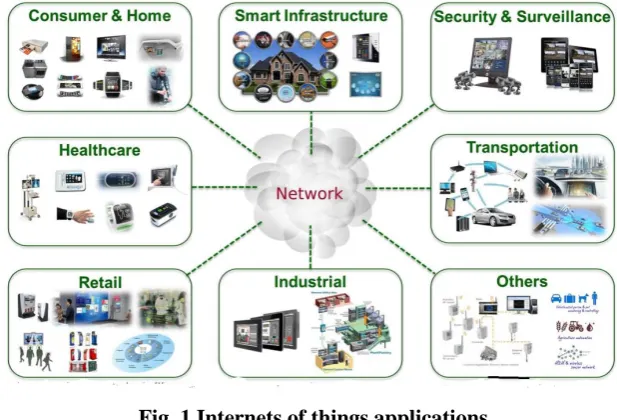
Fig .1 Internets of things applications
The internet of things greatly develop efficiency of home and office management. It also improves including
Intelligent Transportation Systems (e.g., smart mobility, vehicular automation for traffic control), smart grids,
street lighting management, traffic lights management, industrial waste management; environmental monitoring,
water management, surveillance/intelligence, smart services, and troop sensing (where the community at large
uses smartphones, wearable to collect and forward for collecting a variety of graphical, signal, and ecological
data).The objective of the project is to operate home and office devices smartly via an android application using
IoT(Internet Of Things)
III. RELATED WORK
IP based systems are supposed to be simpler to be accessed and easier to manipulate. Home automation
framework based on the IP is presented at low cost ,secure and flexible prototype implementation aimed at any
home appliances. In this framework, the communication protocol between the hardware and the consumer
electronics devices to be used in home automation have also been presented. The system proposes an optimized,
self-adaptive communication protocol. The designed system will be open to expansions, further developments,
protocol suggested. The system is designed to connect to a designated server for web accessibility without the
need for any setup on the user side. This feature makes this system uniquely simple and easy to operate.[4]
Internet of things (iot) provides a platform that allows devices to connect, sensed and controlled remotely across
a network infrastructure. In this paper we focus on home automation using smart phone and computer. The iot
devices controls and monitors the electronic electrical and the mechanical systems used in various types of
buildings.[5]
The proposed system provides a multi-protocol middleware that allows a transparent access to the
heterogeneous IoT technologies hiding the low level communication details. It is able to guarantee flexibility
and scalability, since it can be easily extended to new technologies. The business logic that manages the
environment status is, instead, executed by several location-aware services, which act in accordance with both
user-defined rules and users „movements. These services rely on a distributed indoor localization mechanism
that tracks the position of people in the house.[1]
The home is an eternal, heterogeneous, distributed computing environment (Greaves, 2002) which certainly
requires a careful study before developing any suitable Home Automation System (HAS).The paper presents an
architecture which uses an android phone, a laptop (computer), a microcontroller, and a switching circuit. The
android phone is used to track the aimed application so as to control the appliance. The Laptop acts as a server,
communicating the commands to the microcontroller, which in turn, switches the relay, turning on or off the
desired appliance. The paper presents an architecture which uses an android phone, a laptop (computer), a
microcontroller, and a switching circuit. The android phone is used to run the designed application to control the
appliance. [6]
This paper presents an integrated approach using SOAP protocol for effective web-service supported smart
home management systems. The projected smart home management system is said to be able to support multiple
services and devices integrated using embedded system. The embedded system is configured as domestic
gateway as well as interfacing with switching unit and distant client. The residential gateway resides in the
embedded system with a database module in the backend. The whole connectivity of the home management
system takes place through Ethernet. Ethernet is best for smart home environment because of its performance in
real-time.[7]
This paper presents the strategy and application of a Java-based automation system that can monitor and control
home appliances via the World Wide Web. The design is based on a stand-alone embedded system board
combined with a personal computer-based server at home. The home appliances are connected to the
input/output ports of the embedded system board and their position are provided to the server. The monitoring
and control software engine is based on the combination of Java Server Pages, JavaBeans, and Interactive C.
The home appliances can be supervised and measured locally by means of the embedded system board, or
remotely through a web browser from anywhere in the world provided that an Internet access is available.[8]
IV. PROPOSED MODEL
The proposed system is designed to overcome the drawbacks of wired system and to improve security,
flexibility, efficiency. The system is interactive to provide ease in day to day life, also saves electricity, human
Fig.2 shows Block schematic for proposed system
This system includes Raspberry Pi, relay, Key board, camera .The keyboard is used for entering password and
validation is shown on LCD display .The camera is used for surveillances in the work area. The system allows
the user to control appliances in the office from a smart phones and PC through an internet connection. In this
system, the control of appliances can be done with an option from a local server, using the Internet connection.
The system monitors electrical devices and controlling them through an android app as well as monitoring the
security of their office in case of unwanted entry.
An android based mobile app is developed that has preferences to controlling the switching of devices either
through touch mode. A relay is an electromagnetic switch .Relays is used to switch for ON-OFF the devices. It
is an on/off button.
The proposed system uses Raspberry Pi 3 board model B. The Raspberry Pi is said to be a credit-card-sized
single-board computer developed by the Raspberry Pi Foundation. It is developed with the intention of
promoting the directions of guidelines for basic computer science. The Raspberry Pi has a Broadcom BCM2837
system on a chip, which includes an 1.2GHz Quad-Core ARM Cortex-A53, Dual Core Video Core IV®
Multimedia Co-Processor, and memory of 1GB LPDDR2.[9]
Android Device is the device through which application interacts with different electrical appliances.
V. EXPECTED OUTCOMES
The proposed system uses relay make ON and OFF the devices in office. The appliances can be ON/OFF using
the graphical user interface on android mobile phone. The camera provides the security and monitoring from
unwanted entries. The system is employed using Raspberry pi board. The status of electrical devices can be
monitored using internet.
VI. CONCLUSION
With the increasing advancements, mobile phones can be used for controlling the various electrical devices. A
via internet. The internet of things concept allows the real world devices to communicate with each other.IOT
improves the quality of life and work. The system provides security and surveillances for unwanted entries, also
precise and safe control of electronic devices by enhancing the office automation through use of IOT.
REFERENCES
[1]. Luca Mainetti, Vincenzo Mighali, Luigi Patrono,” An IoT-based User-centric Ecosystem for
Heterogeneous Smart Home Environments”,IEEE ICC 2015 SAC-Internet of Things
[2]. A. ElShafee and K. A. Hamed, "Design and Implementation of WiFi Based Home Automation System",
World Academy of Science, Engineering and Technology, (2012), vol. 68
[3]. Jasmeet Chhabra, Punit Gupta ,”IoT based Smart Home Design using Power and Security
Management”,2016 1st International Conference on Innovation and Challenges in Cyber Security (ICICCS
2016)
[4]. Ali Ziya Alkar, John Roach, Dilek Baysal, “IP Based Home Automation System”, IEEE Transactions on
Consumer Electronics, Vol. 56, No. 4, November 2010
[5]. Shopan Dey , Ayon Roy ,Sandip Das “Home Automation Using Internet of Thing”, 2016 IEEE 7th Annual
Ubiquitous Computing, Electronics & Mobile Communication Conference (UEMCON).
[6] Nikhil Singh, Shambhu Shankar Bharti, Rupal Singh, Dushyant Kumar Singh” Remotely Controlled
Home automation System”IEEE International Conference on Advances in Engineering & Technology Research (ICAETR - 2014),
[7] Thinagaran Perumal, Md Nasir Sulaiman, Khaironi Yatim Sharif,Abd Rahman Ramli and Chui Yew
Leong,” Development of an Embedded Smart Home Management Scheme”, International Journal of Smart
Home ,2013
[8] A. R. Al-Ali, Member, IEEE & M. AL-Rousan” Java-Based Home Automation System”, IEEE
Transactions on Consumer Electronics, Vol. 50, No. 2, MAY 2004