Therapeutics and Clinical Risk Management
Dove
press
O R i g i n a l R e s e a R C h
open access to scientific and medical research
Open access Full Text article
Total endoscopic thyroidectomy versus
conventional open thyroidectomy in thyroid
cancer: a systematic review and meta-analysis
Cong Chen1,2
shumin huang3
aihua huang1,2
Yunlu Jia1,2
Ji Wang1,2
Misha Mao1,2
Jichun Zhou1,2
linbo Wang1,2
1Department of surgical Oncology,
sir Run Run shaw hospital, Zhejiang University school of Medicine, hangzhou, China; 2Biomedical
Research Center and Key laboratory of Biotherapy of Zhejiang Province, hangzhou, China; 3Department of
Pediatric health Care, The Children’s hospital, Zhejiang University school of Medicine, hangzhou, China
Background: Despite the considerable experience gained thus far using endoscopic technologies, the role of total endoscopic thyroidectomy (ET) for papillary thyroid cancer (PTC) remains controversial. We conducted a systematic review and meta-analysis to investigate the safety and effectiveness of total ET compared with conventional open thyroidectomy (OT) in PTC.
Methods: A systematic search was conducted using the PubMed, Embase and Cochrane Library electronic databases up to March 2018. The quality of included studies was evaluated using the Newcastle–Ottawa Scale. Review Manager software version 5.3 was used for the meta-analysis.
Results: Twelve studies including 2,672 patients were ultimately included in the systematic review and meta-analysis. ET was associated with longer operative time (P,0.00001), drain-age time (P,0.00001) and hospital stay (P=0.03), higher transient recurrent laryngeal nerve
(RLN) palsy rate (P=0.004) and a greater amount of drainage fluid (P,0.0001) compared with OT. Furthermore, no significant differences were detected between ET and OT in terms of retrieved lymph nodes (P=0.17), blood loss (P=0.22), transient hypocalcemia (P=0.84), permanent hypocalcemia (P=0.58), permanent RLN palsy (P=0.14), hematoma or bleeding (P=0.15) and seroma (P=0.54). In addition, the rates of tumor recurrence were comparable (P=0.18), whereas the proportions of stimulated thyroglobulin levels ,1 ng/mL measured after completion of thyroidectomy and radioactive iodine therapy were less (P=0.02) in the ET than in the OT group.
Conclusion: ET is not superior to OT in terms of operation and drainage time, amount of drain-age fluid, hospital stay or transient RLN palsy, but is comparable to OT in terms of retrieved lymph nodes and permanent complications. Despite the similar tumor recurrence rates between the two approaches, the level of surgical completeness in ET may not be as good as that for OT.
Keywords: endoscopic thyroidectomy, conventional open thyroidectomy, papillary thyroid carcinoma, meta-analysis
Background
Thyroid cancer is considered the most prevalent endocrine cancer, especially in women.1,2 Papillary thyroid cancer (PTC), the major histological subtype, constitutes
approximately 85% of all thyroid malignancies.3 Although conventional open
thyroi-dectomy (OT) is a standard surgery with low morbidity and minimal mortality for PTC,4 it requires a cervical incision in the neck. Nevertheless, the cosmetic outcome
may be a particular concern, especially in young women.
The popularity of endoscopic technologies has allowed surgeons to complete resection and simultaneously deliver cosmetic results. In 1997, Hüscher et al first Correspondence: linbo Wang;
Jichun Zhou
Department of surgical Oncology, sir Run Run shaw hospital, Zhejiang University school of Medicine, no 3 eastern Qingchun Road, hangzhou, Zhejiang, China Tel +86 571 8600 2170 Fax +86 571 8604 4817 email [email protected]; [email protected]
Journal name: Therapeutics and Clinical Risk Management Article Designation: Original Research
Year: 2018 Volume: 14
Running head verso: Chen et al
Running head recto: Total endoscopic vs conventional open thyroidectomy in thyroid cancer DOI: 183612
Therapeutics and Clinical Risk Management downloaded from https://www.dovepress.com/ by 118.70.13.36 on 27-Aug-2020
For personal use only.
Dovepress
Chen et al
performed endoscopic thyroidectomy (ET).5 Since then,
vari-ous ET approaches have evolved, such as breast,6 axillary,7
axillobreast,8 submental9 and oral cavity approaches.10
However, endoscopic techniques present some difficulties in obtaining adequate surgical views because of the small working space and two-dimensional operative views.11
In addition, surgical indications for ET remain ambiguous, and the benefits of ET are considered marginal for PTC.12,13
Some studies have even questioned the safety of ET for PTC and proposed that this method should be critically evaluated.14,15 Thus, it remains unsettled whether ET is
effec-tive and safe compared with OT.
To our knowledge, only one meta-analysis compar-ing outcomes between ET and OT has been published.16
However, the previous meta-analysis was conducted on five studies and focused on patients with papillary thyroid microcarcinoma (PTMC). Given the growing number of publications on this debatable subject and the extended indications for ET,7 it is necessary to perform a systematic
meta-analysis to compare the effectiveness and safety of ET with OT in PTC patients.
Materials and methods
This systematic review and meta-analysis was conducted in accordance with the PRISMA statement.17
search strategy
A systematic search was conducted using the PubMed, Embase and Cochrane Library electronic databases on 15 March 2018. We used the following keywords and Medical Subject Headings (MeSH) terms: “laparoscopy” or “endos-copy” or “minimally invasive surgery” or “video-assisted surgery” and “thyroidectomy” and “thyroid cancer”. We also reviewed the reference lists from the retrieved articles.
study selection
Two independent authors (CC and SMH) reviewed study titles and abstracts to exclude irrelevant articles, and studies meeting the inclusion criteria were selected for full-text assessment. Any discrepancy was resolved by consensus. The inclusion criteria were as follows: 1) English language; 2) comparative studies between ET and OT for patients with PTC; 3) studies comparing at least one outcome of surgery; and 4) multiple studies from the same institution were assessed and the highest quality and most up-to-date of these was retained. The exclusion criteria were as follows: 1) studies that were reviews, case reports, letters, confer-ences, editorials, or expert opinions; 2) studies that focused
on patients with thyroid cancer other than PTC; and 3) studies reporting on the pediatric population.
Data extraction and quality assessment
Data were extracted into prepared standardized forms by two independent reviewers.The primary data extracted from each study included the first author, year of publication, geographical region, study type, number of patients, patient demographics, pathological characteristics of PTC, operative details (extent of thyroi-dectomy, surgical approach), intraoperative outcomes, postoperative outcomes and oncological outcomes (stimu-lated thyroglobulin [sTg], tumor recurrences). Intraopera-tive outcomes included operaIntraopera-tive time, blood loss and the number of retrieved lymph nodes. Postoperative outcomes included hospitalization period after the operation, volume and duration of drainage, postoperative complications (transient hypocalcemia, permanent hypocalcemia, transient recurrent laryngeal nerve [RLN] palsy, permanent RLN palsy, hematoma or bleeding, and seroma). Total thyroi-dectomy (TT) included near-TT and TT, whereas less than total thyroidectomy (LTT) included hemithyroidectomy and subtotal thyroidectomy. The sTg level was measured after total completion of thyroidectomy and radioactive iodine therapy and defined as ,1.0 ng/mL as an indicator of surgical completeness. Any disagreement was resolved by discussion and consensus.
The quality assessment of nonrandomized studies was also performed by two independent reviewers using the Newcastle–Ottawa Scale, with some modifications to match the requirements of this study.18,19 The quality was assessed
based on three aspects: patient selection, comparability of groups and outcome assessment. Only studies awarded six or more stars were considered as high-quality studies.
statistical analysis
Review Manager software version 5.3 (The Nordic Cochrane Centre, The Cochrane Collaboration, Copenhagen, 2014) was used for data analysis. For continuous outcomes, the weighted mean differences (WMDs) with corresponding 95% CIs were calculated. For dichotomous outcomes, the ORs with corresponding 95% CIs were examined. The results were analyzed using fixed- or random-effects models, depending on the heterogeneity involved. The statistical heterogeneity was accessed by the Cochran Q test and evalu-ated the extent of inconsistency by the I2 statistic, which was
divided into three degrees including low (25%–49%), mod-erate (50%–74%) and high ($75%) levels.20 When P.0.1
Therapeutics and Clinical Risk Management downloaded from https://www.dovepress.com/ by 118.70.13.36 on 27-Aug-2020
Dovepress Total endoscopic vs conventional open thyroidectomy in thyroid cancer and I2,50%, a fixed-effects model was used; otherwise, a
random-effects model was applied. We used the following methods to explore sources of heterogeneity: 1) subgroup analysis (TT and LTT) and 2) sensitivity analysis conducted by excluding each of the included studies to identify which studies influenced the degree of heterogeneity. The possible presence of publication bias was estimated by Egger’s test and Begg’s test, investigated using STATA version 12.0 (Stata Corporation, College Station, TX, USA). P-values ,0.05 were considered statistically significant.
Results
study selection
The initial search yielded 2,633 potentially relevant articles. Seventeen potential articles were identified after screening titles and abstracts. After full-text review, an additional five articles were excluded for the following reasons: including cases of follicular thyroid cancer (n=1),21 cohorts may have
overlapped (n=2)22,23 and some conflicts in articles (n=2).24,25
Finally, 12 observational articles were obtained for final analysis (Figure 1).7,26–36
study and patient characteristics
Table 1 shows the total number of 2,672 PTC patients included, of whom 799 underwent ET and 1,873 underwent OT. Eight studies26–30,32–34 were performed in the Republic of
Korea and four studies7,31,35,36 in China. All 12 studies were
retrospective. In terms of surgical approach, in six studies the axillobreast approach (ABA) was performed,26–28,32–34
in three studies the bilateral breast approach (BBA) was performed,31,35,36 in two studies the transaxillary approach
(TAA) was performed,7,30 and in the remaining study
either ABA or TAA was performed for thyroidectomy.29
The pathological details of each study are summarized in Table 2.
Meta-analysis of intraoperative outcomes
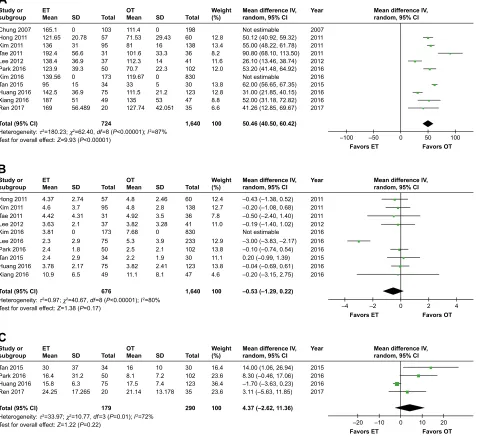
Eleven studies calculated operative times for ET vs OT,7,26–32,34–36 and the operation time in the ET group wassignificantly longer than that in the OT group (WMD 50.46, 95% CI 40.50 to 60.42, P,0.00001). However, there was a high level of heterogeneity among the studies (I2=87%, P,0.00001). The meta-analysis results remained unaf-fected when each individual study was removed from the data set.
Ten studies presented the number of retrieved lymph nodes,7,27–35 and the pooled data showed no significant
differ-ences between groups (WMD -0.53, 95% CI -1.29 to 0.22,
P=0.17). Furthermore, there was a high level of heterogeneity among the studies (I2=80%, P,0.00001). After excluding
the study by Lee et al,33 there were still no significant
dif-ferences between groups (WMD -0.14, 95% CI -0.47 to 0.20, P=0.42), but no heterogeneity was observed among the studies (I2=0%).
Four studies7,31,34,36 compared intraoperative blood loss and
the pooled data showed no significant differences between groups (WMD 4.37, 95% CI -2.62 to 11.36, P=0.22). In addition, there was a moderate level of heterogeneity
Figure 1 Flow diagram for study selection.
Abbreviation: FTC, follicular thyroid cancer.
UHFRUGVLGHQWLILHGWKURXJKGDWDEDVH VHDUFKLQJ3XE0HGQ
(PEDVHQ &RFKUDQH/LEUDU\Q
IXOOWH[WDUWLFOHVDVVHVVHGIRUHOLJLELOLW\
DUWLFOHVLQFOXGHGLQWKLVPHWDDQDO\VLV
UHFRUGVH[FOXGHGIRUWKHIROORZLQJUHDVRQV 'XSOLFDWHV
1RQ(QJOLVK 5HYLHZV &DVHUHSRUWV
/HWWHUFRQIHUHQFHHGLWRULDOVH[SHUWRSLQLRQV 2WKHUV
IXOOWH[WDUWLFOHVH[FOXGHG ,QFOXGHGFDVHVRI)7& 2YHUODSSLQJSDWLHQWFRKRUWV 6RPHFRQIOLFWVLQDUWLFOHV
Therapeutics and Clinical Risk Management downloaded from https://www.dovepress.com/ by 118.70.13.36 on 27-Aug-2020
Dovepress
Chen et al
Table 1
g
eneral characteristics of studies included in the meta-analysis
Study (first author, year)
Region
Study type No of patients
Age (years), mean
±
SD
Gender, M/F
Extent of thyroidectomy, TT/LTT Surgical approach
Matching
a
Quality score
ET OT ET OT ET OT ET OT Chung 2007 26 Korea R s 103 198 38.2 ± 8.2 47.2 ± 10.2 1/102 25/173 88/15 172/26 Ba Ba 4, 9 6 h ong 2011 27 Korea R s 57 60 39.60 ± 7.88 41.77 ± 9.61 6/51 11/49 0/57 0/60 Ba Ba /U a Ba
1, 2, 4, 7, 9
7 Kim 2011 28 Korea R s 95 138 39.9 ± 9.1 51.8 ± 8.9 2/93 34/104 95/0 138/0 Ba Ba 9 6 Tae 2011 29 Korea R s 31 36 36.2 ± 9.9 44.6 ± 11.8 1/30 11/25 3/28 0/36 U a Ba /T aa 4–9 7 lee 2012 30 Korea R s 37 41 42.3 ± 7.6 49.0 ± 10.8 0/37 3/38 0/37 0/41 T aa
2, 4, 5, 7–9
7 Tan 2015 31 China R s 34 30 30 (16–44) b 43 (25–76) b 2/32 4/26 0/34 0/30 BB a
2, 4, 9
7 h uang 2016 7 China R s 75 123 37.8 ± 10.6 39.2 ± 11.3 16/59 31/92 75/0 123/0 T aa 1–5, 7–9 7 Kim 2016 32 Korea R s 173 830 38.90 (17–57) b 49.53 (17–84) b 13/160 96/734 56/117 684/146 Ba Ba 2 5 lee 2016 33 Korea R s 75 233 42.2 ± 8.6 52.1 ± 9.3 3/72 15/218 0/75 0/233 Ba Ba /U a Ba
2, 4, 5, 7, 9
6 Park 2016 34 Korea R s 50 102 38.0 ± 9.4 50.8 ± 11.5 4/46 14/88 50/0 102/0 U a Ba
2, 4–7, 9
5 Xiang 2016 35 China R s 49 47 34.2 ± 7.0 46.9 ± 13.3 0/49 6/41 49/0 47/0 BB a 7, 9 6 Ren 2017 36 China R s 20 35 36.05 ± 7.536 36.06 ± 5.646 0/20 0/35 0/20 0/35 BB a 1–3, 9 6 Notes:
aFeatures matching
eT and OT: 1
=
age; 2
=
gender; 3
=
body mass index; 4
=
tumor size; 5
=
multiplicity; 6
=
bilaterality; 7
=
extrathyroidal extension; 8
=
tumor stage; 9
=
extent of thyroidectomy.
bMedian (range).
Abbreviations: B a Ba , bilateral axillobreast approach; BB a , bilateral breast approach; eT, endoscopic thyroidectomy; F, female; lTT, less than total thyroidectomy; M, male; OT, open thyroidectomy; R s, retrospective study; T aa
, transaxillary approach; TT, total thyroidectomy; U
a
Ba
, unilateral axillobreast approach.
among the studies (I2=72%, P=0.01). After removing the
study by Huang et al,7 the results became significant (WMD
7.24, 95% CI 1.66 to 12.82, P=0.01) and the heterogene-ity among the studies no longer existed (I2=0%) (Table 3
and Figure 2A–C).
Meta-analysis of postoperative outcomes
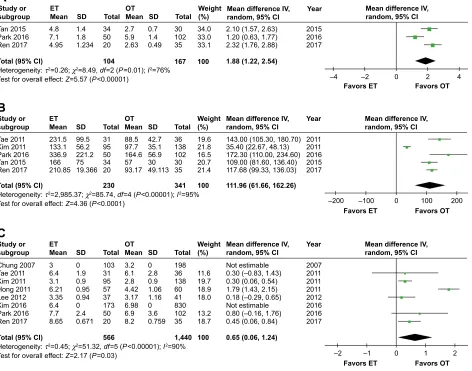
Three studies31,34,36 reported the duration of drainage andsuggested a longer drainage period in ET than in OT (WMD 1.88, 95% CI 1.22 to 2.54, P,0.00001). Furthermore, this result showed a high level of heterogeneity as well (I2=76%, P=0.01). After removing the study by Park et al,34 the
sig-nificance of the result was unchanged (WMD 2.20, 95% CI 1.82 to 2.59, P,0.00001), but no heterogeneity existed across the studies (I2=0%).
Five studies28,29,31,34,36 assessed the volume of drainage
and described a larger amount of drainage in the ET group (WMD 111.96, 95% CI 61.66 to 162.26, P,0.0001). In addi-tion, there was a high level of heterogeneity among the studies (I2=95%, P,0.00001). After removing the study by
Kim et al,28 the previously high heterogeneity dramatically
declined (I2=37%, P=0.19), but the significance of the result
was unaffected (WMD 121.54, 95% CI 107.76 to 135.33,
P,0.00001).
Eight studies described a hospitalization period after the operation.26–30,32,34,36 The combined results of these studies
showed that ET had a longer hospitalization period than OT (WMD 0.65, 95% CI 0.06 to 1.24, P=0.03), and this result was associated with significant heterogeneity among the studies (I2=90%, P,0.00001). After removing the study by
Hong et al,27 no heterogeneity existed (I2=0%), but the
sig-nificance of the result was unchanged (WMD 0.33, 95% CI 0.15 to 0.51, P=0.0003) (Table 3 and Figure 3A–C).
Meta-analysis of postoperative
complications
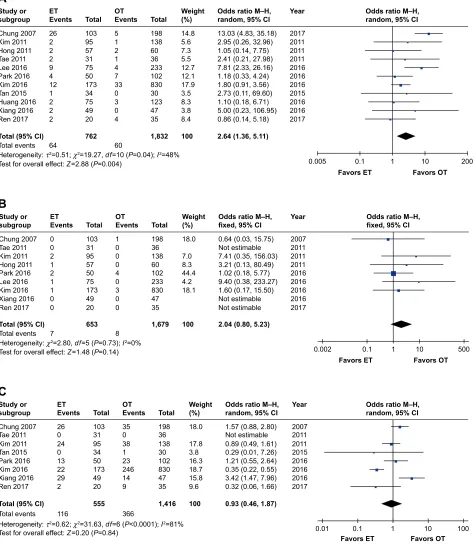
Eleven studies reported the transient postoperative RLN palsy rate,7,26–29,31–36 whereas nine reported permanent
post-operative RLN palsy rates.26–29,32–36 The cumulative transient
RLN palsy rate was significantly higher in ET (OR 2.64, 95% CI 1.36 to 5.11, P=0.004), and low heterogeneity (I2=48%, P=0.04) was observed among the studies. The significance of the result was unchanged when removing the study by Chung et al26 (OR 2.02, 95% CI 1.31 to 3.13, P=0.002), but
the heterogeneity among studies no longer existed (I2=0%).
In terms of permanent RLN palsy, no significant differ-ences were observed between the two groups (OR 2.04,
Therapeutics and Clinical Risk Management downloaded from https://www.dovepress.com/ by 118.70.13.36 on 27-Aug-2020
Dovepress Total endoscopic vs conventional open thyroidectomy in thyroid cancer
95% CI 0.80 to 5.23, P=0.14), and no heterogeneity existed (I2=0%).
Eight studies reported the transient postoperative hypocal-cemia rate,26,28,29,31,32,34–36 whereas seven reported permanent
postoperative hypocalcemia rates.26,28,29,32,34–36 No significant
differences were observed between the two groups in terms of transient hypocalcemia (OR 0.93, 95% CI 0.46 to 1.87,
P=0.84), but high heterogeneity existed (I2=81%, P,0.0001).
The meta-analysis results remained unchanged (OR 1.26,
95% CI 0.74 to 2.16, P=0.40) but a moderate decline in the heterogeneity (I2=53%, P=0.06) was observed when the
study by Kim et al was removed.32 In the case of permanent
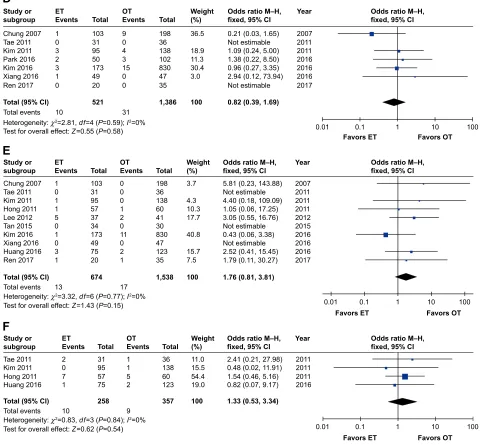
postoperative hypocalcemia, neither significant differences (OR 0.82, 95% CI 0.39 to 1.69, P=0.58) nor heterogeneity (I2=0%) were detected.
Regarding other complications, such as postoperative hematoma or bleeding (OR 1.76, 95% CI 0.81 to 3.81,
P=0.15) and postoperative seroma (OR 1.33, 95% CI 0.53
Table 2 Pathological characteristics of studies included in the meta-analysis
Study (first author, year)
Tumor size (mm) Multiplicity (n/N)
Bilaterality (n/N)
Extrathyroidal extension (n/N)
Positive LNs (n/N)
No of metastatic LNs
ET OT ET OT ET OT ET OT ET OT ET OT
Chung 200726 ,10 ,10 nR nR nR nR nR nR nR nR nR nR
hong 201127 7.25±2.30 7.10±2.65 nR nR nR nR 10/57 19/60 21/57 26/60 1.30±1.83 1.43±1.87
Kim 201128 6.0±2.0 7.0±2.0 nR nR nR nR nR nR nR nR 0.9±2.0 0.5±0.9
Tae 201129 7.6±4.9 6.4±2.3 2/31 2/36 0/31 0/36 2/31 1/36 4/16 2/12 nR nR
lee 201230 5.0±2.31 4.1±2.64 3/37 5/41 nR nR 1/37 2/41 5/37 1/41 nR nR
Tan 201531 7.0±3.0 8.0±4.0 nR nR nR nR nR nR 8/34 4/30 0.8±2.0 0.2±0.7
huang 20167 4.8±1.9 4.9±2.3 5/75 9/123 nR nR 2/75 4/123 9/75 11/123 nR nR
Kim 201632 nR nR nR nR nR nR 4/173 128/830 34/173 312/830 nR nR
lee 201633 5.8±3.5 6.2±3.7 12/75 30/233 nR nR 21/75 93/233 12/75 35/233 nR nR
Park 201634 8.0±3.7 7.6±1.9 7/50 19/102 10/50 18/102 28/50 70/102 nR nR 0.7±1.4 0.6±1.2
Xiang 201635 7.7±4.2 12.4±7.9 26/49 37/47 nR nR 3/49 8/47 20/49 40/47 nR nR
Ren 201736 ,10 ,10 nR nR nR nR nR nR nR nR nR nR
Overall 6.4±3.2 6.7±3.7 55/317 102/582 10/81 18/138 71/547 325/1,472 113/516 431/1,376 0.9±1.8 0.7±1.3 Abbreviations: eT, endoscopic thyroidectomy; ln, lymph node; nR, not reported; OT, open thyroidectomy.
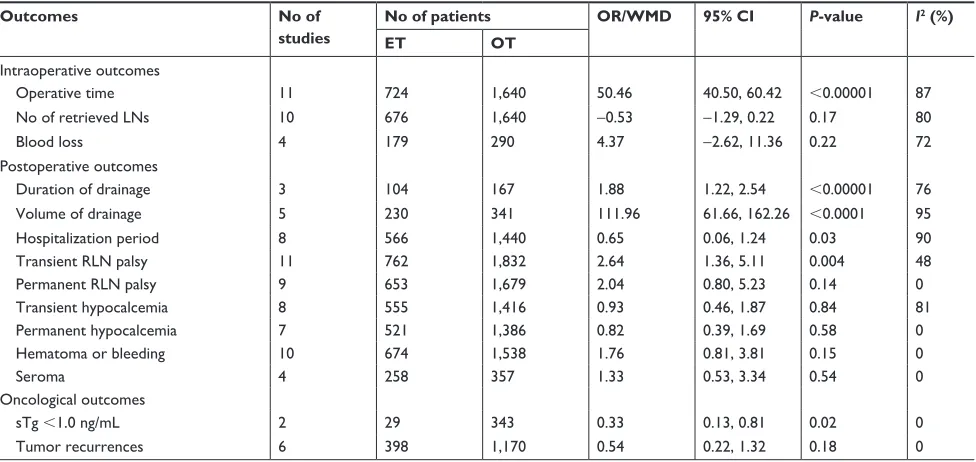
Table 3 Outcomes of meta-analysis comparing eT vs OT
Outcomes No of
studies
No of patients OR/WMD 95% CI P-value I2 (%)
ET OT
intraoperative outcomes
Operative time 11 724 1,640 50.46 40.50, 60.42 ,0.00001 87
no of retrieved lns 10 676 1,640 -0.53 -1.29, 0.22 0.17 80
Blood loss 4 179 290 4.37 -2.62, 11.36 0.22 72
Postoperative outcomes
Duration of drainage 3 104 167 1.88 1.22, 2.54 ,0.00001 76
Volume of drainage 5 230 341 111.96 61.66, 162.26 ,0.0001 95
hospitalization period 8 566 1,440 0.65 0.06, 1.24 0.03 90
Transient Rln palsy 11 762 1,832 2.64 1.36, 5.11 0.004 48
Permanent Rln palsy 9 653 1,679 2.04 0.80, 5.23 0.14 0
Transient hypocalcemia 8 555 1,416 0.93 0.46, 1.87 0.84 81
Permanent hypocalcemia 7 521 1,386 0.82 0.39, 1.69 0.58 0
hematoma or bleeding 10 674 1,538 1.76 0.81, 3.81 0.15 0
seroma 4 258 357 1.33 0.53, 3.34 0.54 0
Oncological outcomes
sTg ,1.0 ng/ml 2 29 343 0.33 0.13, 0.81 0.02 0
Tumor recurrences 6 398 1,170 0.54 0.22, 1.32 0.18 0
Abbreviations: eT, endoscopic thyroidectomy; ln, lymph node; OT, open thyroidectomy; Rln, recurrent laryngeal nerve; sTg, stimulated thyroglobulin; WMD, weighted mean difference.
Therapeutics and Clinical Risk Management downloaded from https://www.dovepress.com/ by 118.70.13.36 on 27-Aug-2020
Dovepress
Chen et al
to 3.34, P=0.54), no heterogeneity existed across studies (I2=0%), and no significant differences between the ET and
OT groups were observed (Table 3 and Figure 4A–F).
Meta-analysis of oncological results
The sTg levels were available in two studies.26,32 The ET
group had lower proportions of having sTg ,1.0 ng/mL (OR 0.33, 95% CI 0.13 to 0.81, P=0.02). No heterogeneity among studies existed (I2=0%).
Six studies recorded tumor recurrences,26,29–32,36 and three
studies reported no tumor recurrences during the follow-up period. Analysis of the pooled data showed that the two
groups did not differ significantly (OR 0.54, 95% CI 0.22 to 1.32, P=0.18). No heterogeneity among studies was observed (I2=0%) (Table 3 and Figure 5).
subgroup analysis
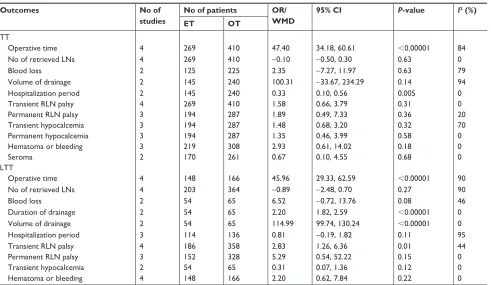
We conducted a subgroup analysis according to the extent of thyroidectomy. The results of the subgroup analysis were roughly consistent with the previous outcomes. However, the volume of drainage (WMD 100.31, 95% CI -33.67 to 234.29, P=0.14) and transient RLN palsy (OR 1.58, 95% CI 0.66 to 3.79, P=0.31) were comparable between the ET and OT groups in TT. In addition, the hospitalization period Figure 2 Forest plot and meta-analysis of (A) operative time; (B) number of retrieved lymph nodes; (C) blood loss.
Abbreviations: eT, endoscopic thyroidectomy; OT, open thyroidectomy.
–100 –50
Favors ET Favors OT
0 50 100
Total (95% CI)
Heterogeneity: τ2=180.23; χ2=62.40, df=8 (P<0.00001); I2=87%
Test for overall effect: Z=9.93 (P<0.00001)
Mean difference IV, random, 95% CI
A
Chung 2007 Hong 2011 Kim 2011 Tae 2011 Lee 2012 Park 2016 Kim 2016 Tan 2015 Huang 2016 Xiang 2016 Ren 2017 Study or subgroup 12.8 13.4 8.2 11.6 12.0 13.8 12.8 8.8 6.6 100 Weight (%) 0 20.78 31 56.6 36.9 39.3 36.9 56.489 15 51 0 SD 0 29.43 16 33.3 14 22.3 0 5 21.2 53 42.051 SD 20 49 75 34 173 50 37 31 95 57 103 724 Total 198 60 138 36 41 102 830 30 123 47 35 1,640 Total50.12 (40.92, 59.32) Not estimable
Not estimable 55.00 (48.22, 61.78) 90.80 (68.10, 113.50) 26.10 (13.46, 38.74) 53.20 (41.48, 64.92)
62.00 (56.65, 67.35) 31.00 (21.85, 40.15) 52.00 (31.18, 72.82) 41.26 (12.85, 69.67)
50.46 (40.50, 60.42) Mean difference IV, random, 95% CI
165.1 121.65 136 192.4 138.4 123.9 139.56 95 142.5 187 169 Mean ET 111.4 71.53 81 101.6 112.3 70.7 119.67 33 111.5 135 127.74 Mean OT 2007 2011 2011 2011 2012 2016 2016 2015 2016 2016 2017 Year –4 –2
Favors ET Favors OT
0 2 4
Total (95% CI)
Heterogeneity: τ2=0.97; χ2=40.67, df=8 (P<0.00001); I2=80%
Test for overall effect: Z=1.38 (P=0.17)
Mean difference IV, random, 95% CI
B
Hong 2011 Kim 2011 Tae 2011 Lee 2012 Kim 2016 Lee 2016 Park 2016 Tan 2015 Huang 2016 Xiang 2016 Study or subgroup 12.4 12.7 7.8 11.0 12.9 13.8 11.1 13.8 4.6 100 Weight (%) 2.74 3.7 4.31 2.1 0 2.9 6.5 1.8 2.17 2.9 SD 2.46 2.8 3.5 3.28 0 3.9 2.1 1.9 2.41 8.1 SD 49 75 34 50 75 173 37 31 95 57 676 Total 60 138 36 41 830 233 102 30 123 47 1,640 Total–0.43 (–1.38, 0.52)
–3.00 (–3.83, –2.17) –0.20 (–1.08, 0.68) –0.50 (–2.40, 1.40) –0.19 (–1.40, 1.02) Not estimable
–0.10 (–0.74, 0.54) 0.20 (–0.99, 1.39) –0.04 (–0.69, 0.61) –0.20 (–3.15, 2.75)
–0.53 (–1.29, 0.22) Mean difference IV, random, 95% CI
4.37 4.6 4.42 3.63 3.81 2.3 2.4 2.4 3.78 10.9 Mean ET 4.8 4.8 4.92 3.82 7.68 5.3 2.5 2.2 3.82 11.1 Mean OT 2011 2011 2011 2012 2016 2016 2016 2015 2016 2016 Year –20 –10
Favors ET Favors OT
0 10 20
Total (95% CI)
Heterogeneity: τ2=33.97; χ2=10.77, df=3 (P=0.01); I2=72%
Test for overall effect: Z=1.22 (P=0.22) Tan 2015 Park 2016 Huang 2016 Ren 2017 Study or subgroup 16.4 23.6 36.4 23.6 100 Weight (%) 31.2 17.265 37 6.3 SD 10 7.2 7.4 13.178 SD 20 75 50 34 179 Total 30 102 123 35 290 Total
14.00 (1.06, 26.94) 8.30 (–0.46, 17.06) –1.70 (–3.63, 0.23) 3.11 (–5.63, 11.85)
4.37 (–2.62, 11.36) Mean difference IV, random, 95% CI
30 16.4 15.8 24.25 Mean ET 16 8.1 17.5 21.14 Mean OT
C
2015 2016 2016 2017Year Mean difference IV,
random, 95% CI
Therapeutics and Clinical Risk Management downloaded from https://www.dovepress.com/ by 118.70.13.36 on 27-Aug-2020
Dovepress Total endoscopic vs conventional open thyroidectomy in thyroid cancer
was comparable between the two groups in LTT (OR 0.81, 95% CI -0.19 to 1.82, P=0.11). The concrete results of the subgroup analysis are summarized in Table 4.
Pooled surgical outcomes
Table 5 shows the pooled surgical outcomes of patients between ET and OT groups from all eligible studies.
Publication bias
Figure 6 shows a funnel plot of the studies reporting on transient RLN palsy. Begg’s test (P=0.276) and Egger’s test (P=0.753) showed no statistical publication bias in the studies reporting on transient RLN palsy.
Discussion
PTC is a subtype of differentiated thyroid cancer and surgery remains the primary therapeutic method for thyroid cancer.
However, an obvious scar on the neck left after conven-tional OT causes psychological concerns in patients. With the popularity of endoscopic instruments, ET has been an attractive alternative to open surgery for the treatment of PTC. Owing to the limited number of studies comparing the outcomes between ET and OT, the general application of ET for PTC remains controversial. Unlike the previous meta-analysis, which included patients with PTMC only,16
our study also recruited patients with tumor sizes larger than PTMC. Furthermore, many new studies with a greater number of patients have been published in recent years. Therefore, we aimed to perform a comprehensive systematic review and meta-analysis to identify the clinical value of ET in adult patients with PTC.
The results of our meta-analysis showed that the operative time in the ET group was longer than that in the OT group. This may be attributed to three reasons. First, more time is Figure 3 Forest plot and meta-analysis of (A) duration of drainage; (B) volume of drainage; (C) hospitalization period.
Abbreviations: eT, endoscopic thyroidectomy; OT, open thyroidectomy.
± ±
)DYRUV(7 )DYRUV27
7RWDO&,
7DQ 3DUN 5HQ
+HWHURJHQHLW\τ χ GI 3 ,
7HVWIRURYHUDOOHIIHFW= 3
0HDQ (7
0HDQ 27
6' 7RWDO 6' 7RWDO :HLJKW 0HDQGLIIHUHQFH,9UDQGRP&, <HDU 6WXG\RU
VXEJURXS 0HDQGLIIHUHQFH,9UDQGRP&,
$
± ±
)DYRUV(7 )DYRUV27
7RWDO&,
7DH .LP
5HQ 7DQ 3DUN
+HWHURJHQHLW\τ χ GI 3,
7HVWIRURYHUDOOHIIHFW= 3
0HDQ (7
0HDQ 27
6' 7RWDO 6' 7RWDO :HLJKW 0HDQGLIIHUHQFH,9UDQGRP&, <HDU 6WXG\RU
VXEJURXS 0HDQGLIIHUHQFH,9UDQGRP&,
%
± ±
)DYRUV(7 )DYRUV27
1RWHVWLPDEOH
± ± 1RWHVWLPDEOH ±
&KXQJ
7DH
3DUN 5HQ .LP .LP +RQJ /HH
7RWDO&,
+HWHURJHQHLW\τ χ GI 3,
7HVWIRURYHUDOOHIIHFW= 3
0HDQ (7
0HDQ 27
6' 7RWDO 6' 7RWDO :HLJKW 0HDQGLIIHUHQFH,9UDQGRP&, <HDU 6WXG\RU
VXEJURXS 0HDQGLIIHUHQFH,9UDQGRP&,
&
Therapeutics and Clinical Risk Management downloaded from https://www.dovepress.com/ by 118.70.13.36 on 27-Aug-2020
Dovepress
Chen et al
Figure 4 (Continued)
+HWHURJHQHLW\τ χ GI 3,
7HVWIRURYHUDOOHIIHFW= 3
)DYRUV27 )DYRUV(7 2GGVUDWLR0±+ UDQGRP&, (7 (YHQWV 7RWDO :HLJKW 1RWHVWLPDEOH 2GGVUDWLR0±+ UDQGRP&, <HDU 27 (YHQWV 7RWDO 7RWDOHYHQWV 7RWDO&, 5HQ ;LDQJ 7DQ .LP 3DUN 7DH .LP &KXQJ 6WXG\RU VXEJURXS
&
+HWHURJHQHLW\χ GI 3 , 7HVWIRURYHUDOOHIIHFW= 3
7RWDOHYHQWV )DYRUV27 )DYRUV(7 7RWDO&, &KXQJ .LP +RQJ 3DUN /HH .LP 7DH ;LDQJ 5HQ 1RWHVWLPDEOH 1RWHVWLPDEOH 1RWHVWLPDEOH (7 2GGVUDWLR0±+ IL[HG&, 27 (YHQWV 6WXG\RU
VXEJURXS 7RWDO (YHQWV 7RWDO :HLJKW 2GGVUDWLR0±+IL[HG&, <HDU
%
(7 2GGVUDWLR0±+ UDQGRP&, 27+HWHURJHQHLW\τ χ GI 3 ,
7HVWIRURYHUDOOHIIHFW= 3
7RWDOHYHQWV )DYRUV27 )DYRUV(7 7RWDO&, (YHQWV 6WXG\RU VXEJURXS 5HQ ;LDQJ +XDQJ 7DQ .LP 3DUN /HH 7DH +RQJ .LP &KXQJ 7RWDO :HLJKW 2GGVUDWLR0±+ UDQGRP&, <HDU (YHQWV 7RWDO
$
needed to create the skin flap.31,32 Second, the meticulous
bleeding control and careful lymph-node dissection require longer operation times.7,30 Third, surgeon experience and
skills affect the operation times.19,29,37 The volume of fluid
drainage and the time taken to remove the drainage tube in the ET group were much greater than in the OT group. It has been
suggested that more dissection is needed to achieve the neces-sary working space.28 Furthermore, the longer postoperative
hospitalization period in ET suggests a longer recovery period than for OT, especially when performing TT.
In terms of the number of lymph nodes dissected, our meta-analysis demonstrated that there was no significant
Therapeutics and Clinical Risk Management downloaded from https://www.dovepress.com/ by 118.70.13.36 on 27-Aug-2020
Dovepress Total endoscopic vs conventional open thyroidectomy in thyroid cancer
Figure 4 Forest plot and meta-analysis of (A) transient Rln palsy; (B) permanent Rln palsy; (C) transient hypocalcemia; (D) permanent hypocalcemia; (E) hematoma or bleeding; (F) seroma.
Abbreviations: eT, endoscopic thyroidectomy; M–h, Mantel–haenszel; OT, open thyroidectomy; Rln, recurrent laryngeal nerve. +HWHURJHQHLW\χ GI 3 ,
7HVWIRURYHUDOOHIIHFW= 3 7RWDOHYHQWV 7RWDO&, )DYRUV27 )DYRUV(7 2GGVUDWLR0±+ IL[HG&, (7 (YHQWV 7RWDO :HLJKW 1RWHVWLPDEOH 1RWHVWLPDEOH 2GGVUDWLR0±+ IL[HG&, <HDU 27 (YHQWV 7RWDO 5HQ ;LDQJ .LP .LP 3DUN &KXQJ 7DH 6WXG\RU VXEJURXS
'
(
+HWHURJHQHLW\χ GI 3 ,
7HVWIRURYHUDOOHIIHFW= 3
2GGVUDWLR0±+ IL[HG&, &KXQJ 7DH .LP +RQJ /HH 7DQ .LP ;LDQJ +XDQJ 5HQ 7RWDOHYHQWV 7RWDO&, 6WXG\RU VXEJURXS :HLJKW (YHQWV (7 (YHQWV 27 7RWDO <HDU 7RWDO 1RWHVWLPDEOH 1RWHVWLPDEOH 1RWHVWLPDEOH 2GGVUDWLR0±+ IL[HG&, )DYRUV(7 )DYRUV27
)
+HWHURJHQHLW\χ GI 3 ,
7HVWIRURYHUDOOHIIHFW= 3
:HLJKW (YHQWV (7 (YHQWV 27 7RWDO 7RWDO&, 7RWDOHYHQWV +XDQJ +RQJ .LP 7DH 6WXG\RU VXEJURXS <HDU 7RWDO 2GGVUDWLR0±+ IL[HG&, )DYRUV27 )DYRUV(7 2GGVUDWLR0±+ IL[HG&,
difference between the ET and OT groups. This finding may indicate that the clearance of lymph nodes is comparable between the two groups. The previous meta-analysis showed that the number of lymph nodes dissected is less in the ET group, but no significant difference existed in the subgroup analysis,16 which is in concordance with our result.
RLN palsy and hypocalcemia are the major complications of thyroid surgery. Our meta-analysis showed that ET was associated with a significantly greater risk of transient RLN palsy than OT, which was not consistent with the previous meta-analysis.16 In the sensitivity analysis, the significant
difference still existed. It is worth noting that endoscopic
magnification with high-definition monitors is better for detecting the RLN. However, the similar or even worse risk of transient RLN palsy in ET relative to OT remains disappointing.12,38 Chung et al reported that 25.2% (26/103)
of patients experienced transient RLN palsy and proposed that thermal damage caused by the ultrasonic scalpel may injure the RLN.26 Tan et al adopted the same viewpoint.31
Another reason may be that ET represents a different ana-tomic surgery approach, which is not familiar to traditional thyroid surgeons.39,40 Sun and Dionigi proposed that surgeons
must have an excellent understanding of the RLN in terms of identification and suggested that intraoperative neural
Therapeutics and Clinical Risk Management downloaded from https://www.dovepress.com/ by 118.70.13.36 on 27-Aug-2020
Dovepress
Chen et al
+HWHURJHQHLW\χ GI 3 , 7HVWIRURYHUDOOHIIHFW= 3
+HWHURJHQHLW\χ GI 3 , 7HVWIRURYHUDOOHIIHFW= 3
)DYRUV(7 )DYRUV27
)DYRUV(7 )DYRUV27
2GGVUDWLR0±+ IL[HG&,
2GGVUDWLR0±+ IL[HG&,
:HLJKW
:HLJKW
(YHQWV (7
(YHQWV (7
(YHQWV 27
(YHQWV 27
7RWDO
7RWDO
&KXQJ
.LP
7RWDOHYHQWV
7RWDO&, 6WXG\RU VXEJURXS
6WXG\RU VXEJURXS
7RWDOHYHQWV
7RWDO&,
7DQ 5HQ /HH .LP &KXQJ 7DH
7RWDO
7RWDO
<HDU
2GGVUDWLR0±+ IL[HG&,
2GGVUDWLR0±+ IL[HG&,
1RWHVWLPDEOH 1RWHVWLPDEOH 1RWHVWLPDEOH
%
$
Figure 5 Forest plot and meta-analysis of (A) number of sTg ,1 ng/ml; (B) number of tumor recurrences.
Abbreviations: eT, endoscopic thyroidectomy; M–h, Mantel–haenszel; OT, open thyroidectomy; sTg, stimulated thyroglobulin.
Table 4 Meta-analysis of the subgroups according to the extent of thyroidectomy
Outcomes No of
studies
No of patients OR/ WMD
95% CI P-value I2 (%)
ET OT
TT
Operative time 4 269 410 47.40 34.18, 60.61 ,0.00001 84
no of retrieved lns 4 269 410 -0.10 -0.50, 0.30 0.63 0
Blood loss 2 125 225 2.35 -7.27, 11.97 0.63 79
Volume of drainage 2 145 240 100.31 -33.67, 234.29 0.14 94
hospitalization period 2 145 240 0.33 0.10, 0.56 0.005 0
Transient Rln palsy 4 269 410 1.58 0.66, 3.79 0.31 0
Permanent Rln palsy 3 194 287 1.89 0.49, 7.33 0.36 20
Transient hypocalcemia 3 194 287 1.48 0.68, 3.20 0.32 70
Permanent hypocalcemia 3 194 287 1.35 0.46, 3.99 0.58 0
hematoma or bleeding 3 219 308 2.93 0.61, 14.02 0.18 0
seroma 2 170 261 0.67 0.10, 4.55 0.68 0
lTT
Operative time 4 148 166 45.96 29.33, 62.59 ,0.00001 90
no of retrieved lns 4 203 364 -0.89 -2.48, 0.70 0.27 90
Blood loss 2 54 65 6.52 -0.72, 13.76 0.08 46
Duration of drainage 2 54 65 2.20 1.82, 2.59 ,0.00001 0
Volume of drainage 2 54 65 114.99 99.74, 130.24 ,0.00001 0
hospitalization period 3 114 136 0.81 -0.19, 1.82 0.11 95
Transient Rln palsy 4 186 358 2.83 1.26, 6.36 0.01 44
Permanent Rln palsy 3 152 328 5.29 0.54, 52.22 0.15 0
Transient hypocalcemia 2 54 65 0.31 0.07, 1.36 0.12 0
hematoma or bleeding 4 148 166 2.20 0.62, 7.84 0.22 0
Abbreviations: eT, endoscopic thyroidectomy; ln, lymph node; lTT, less than total thyroidectomy; OT, open thyroidectomy; Rln, recurrent laryngeal nerve; TT, total thyroidectomy; WMD, weighted mean difference.
monitoring may be a good choice to avoid RLN palsy.41
It was an interesting finding that in the subgroup analysis, transient RLN palsy was comparable between the two groups in TT, but not in LTT. We consider that the risk of transient
RLN palsy can be greatly reduced as long as the surgeon is experienced in ET, and good exposure and protection of the RLN are achieved during surgery. In addition, there were no significant differences between the two groups in terms of
Therapeutics and Clinical Risk Management downloaded from https://www.dovepress.com/ by 118.70.13.36 on 27-Aug-2020
Dovepress Total endoscopic vs conventional open thyroidectomy in thyroid cancer
Table 5 Pooled surgical outcomes between eT and OT groups from all eligible studies
Outcomes ET OT References
intraoperative outcomes
Operative time (minutes) 142.0±45.9 92.3±36.6 7, 27–31, 34–36
no of retrieved lns 4.3±4.1 4.7±4.0 7, 27–31, 33–35
Blood loss (ml) 19.6±24.5 14.5±9.8 7, 31, 34, 36
Postoperative outcomes
Duration of drainage (days) 5.9±1.9 4.6±2.0 31, 34, 36
Volume of drainage (ml) 202.3±142.0 112.7±56.9 28, 29, 31, 34, 36
hospitalization period (days) 5.3±2.5 4.8±2.9 27–30, 34, 36
Transient Rln palsy, n (%) 64 (8.3) 60 (3.3) 7, 26–29, 31–36
Permanent Rln palsy, n (%) 7 (1.1) 8 (0.5) 26–29, 32–36
Transient hypocalcemia, n (%) 116 (20.9) 366 (25.8) 26, 28, 29, 31, 32, 34–36
Permanent hypocalcemia, n (%) 10 (1.9) 31 (2.2) 26, 28, 29, 32, 34–36
hematoma or bleeding, n (%) 13 (1.9) 17 (1.1) 7, 26–32, 35, 36
seroma, n (%) 10 (3.9) 9 (2.5) 7, 27–29
Oncological outcomes
sTg ,1.0 ng/ml, n (%) 9 (31.0) 176 (51.3) 26, 32
Tumor recurrences, n (%) 6 (1.5) 31 (2.6) 26, 29–32, 36
Abbreviations: eT, endoscopic thyroidectomy; ln, lymph node; OT, open thyroidectomy; Rln, recurrent laryngeal nerve; sTg, stimulated thyroglobulin.
permanent RLN palsy, transient hypocalcemia, permanent hypocalcemia, hematoma or seroma.
Oncological outcomes, such as tumor recurrences and completeness of thyroid resection, are highly valued by surgeons. According to the American Thyroid Associa-tion guidelines, sTg may be helpful in predicting disease status.42 Only two studies recorded the number of patients
with sTg ,1 ng/mL,26,32 and our results demonstrated that
the OT group may be associated with cleaner resection. Similarly, Kim et al found that the ET group showed higher postoperative thyroglobulin levels (2.4±6.3 ng/mL) than the OT group (0.8±2.0 ng/mL).28 This indicates that OT
is superior to ET in sTg levels presenting completeness of thyroid resection. In contrast, Jeong et al enrolled 275 PTMC patients who underwent ET and reported that all
±
/RJ25
)XQQHOSORWZLWKSVHXGR FRQILGHQFHOLPLWV
6(RIORJ25
Figure 6 Funnel plot of transient recurrent laryngeal nerve palsy in all included
thyroidectomized patients had ,1 ng/mL of postoperative serum thyroglobulin.24 With regard to tumor recurrences,
the results showed no significant differences between the two groups, and three studies reported no tumor recurrences during the follow-up period.29,31,36 However, the results should
be interpreted with caution. This is because, first, there were still insufficient available data on sTg levels. Second, data on postoperative follow-up were lacking and follow-up times were too short, because most PTCs have a slow progression and a good prognosis, with a 10-year survival rate of more than 90%.43 Third, tumor characteristics such as tumor size
were not well matched between the two groups. Thus, unlike surgical-related outcomes, oncological outcomes are difficult to compare. Randomized controlled trials with long-term follow-up assessment are needed to further evaluate onco-logical outcomes.
There are several limitations in our meta-analysis. First, all studies included were non-randomized controlled trials, which could lead to a higher risk of potential selection and reporting bias than randomized controlled trials. Second, some heterogeneity was observed for certain results. This may be related to differences among patient and tumor characteristics, the surgeons’ experience and the surgical approaches. Third, transoral endoscopic thyroidectomy (TOET) has received attention in recent years, but no reports have compared OT with TOET in total thyroid cancer. Most patients who undergo TOET have benign lesions,44 and
many reports are on initial experiences45,46 or robot-assisted
surgery.47,48 In addition, cosmetic results and quality of life
are difficult to assess because of the few well-accepted tools available to study such outcomes.
Therapeutics and Clinical Risk Management downloaded from https://www.dovepress.com/ by 118.70.13.36 on 27-Aug-2020
Dovepress
Chen et al
Conclusion
Compared with OT, ET is disappointing in terms of opera-tion and drainage time, amount of drainage fluid, hospital stay and transient RLN palsy, whereas other complications appear comparable. In addition, despite the similar tumor recurrence rates, the level of surgical completeness in ET may not be as good as that in OT. Therefore, the application of ET for patients with PTC should be conducted carefully, and further prospective studies with longer follow-up are needed to evaluate the oncological effectiveness of ET.
Acknowledgments
This work is supported by the National Natural Science Foun-dation of China (numbers 81602471, 81672729 and 8167284), the Natural Science Foundation of Zhejiang Province (numbers LY19H160281, LY15H160020 and Q16H160010) and a grant from a sub-project of the China National Program on Key Basic Research Project (973 Program) (number 2014CB744505).
Author contributions
J Zhou and L Wang designed the study; J Zhou and C Chen wrote the manuscript; C Chen, S Huang, A Huang, Y Jia and J Wang analyzed the data and interpreted the results. All authors contributed to data analysis, drafting and revising the article, gave final approval of the version to be published, and agree to be accountable for all aspects of the work.
Disclosure
The authors report no conflicts of interest in this work.
References
1. Davies L, Welch HG. Current thyroid cancer trends in the United States.
JAMA Otolaryngol Head Neck Surg. 2014;140(4):317–322.
2. Siegel RL, Miller KD, Jemal A. Cancer statistics, 2018. CA Cancer
J Clin. 2018;68(1):7–30.
3. Shore SL. Thyroid Cancer Pathology. In: Vinjamuri S, editor. PET/CT
in Thyroid Cancer. Cham: Springer; 2018:9–13.
4. Tan CT, Cheah WK, Delbridge L. “Scarless” (in the neck) endoscopic thyroidectomy (SET): an evidence-based review of published techniques.
World J Surg. 2008;32(7):1349–1357.
5. Hüscher CS, Chiodini S, Napolitano C, Recher A. Endoscopic right thyroid lobectomy. Surg Endosc. 1997;11(8):877.
6. Ohgami M, Ishii S, Arisawa Y, et al. Scarless endoscopic thyroidectomy: breast approach for better cosmesis. Surg Laparosc Endosc Percutan
Tech. 2000;10(1):1–4.
7. Huang JK, Ma L, Song WH, Lu BY, Huang YB, Dong HM. Quality of life and cosmetic result of single-port access endoscopic thyroidectomy via axillary approach in patients with papillary thyroid carcinoma.
Onco Targets Ther. 2016;9:4053–4059.
8. Shimazu K, Shiba E, Tamaki Y, et al. Endoscopic thyroid surgery through the axillo-bilateral-breast approach. Surg Laparosc Endosc Percutan
Tech. 2003;13(3):196–201.
9. Ding Z, Deng X, Fan Y, Wu B. Single-port endoscopic thyroidectomy via a submental approach: report of an initial experience. Head Neck. 2014;36(7):E60–E64.
10. Yang J, Wang C, Li J, et al. Complete Endoscopic Thyroidectomy via Oral Vestibular Approach Versus Areola Approach for Treatment of Thyroid Diseases. J Laparoendosc Adv Surg Tech A. 2015;25(6): 470–476.
11. Kandil EH, Noureldine SI, Yao L, Slakey DP. Robotic transaxillary thyroidectomy: an examination of the first one hundred cases. J Am
Coll Surg. 2012;214(4):558–564.
12. Dionigi G, Boni L, Duran-Poveda M. Evolution of endoscopic thyroi-dectomy. Surg Endosc. 2011;25(12):3951–3952.
13. Lang BH, Lo CY. Technological innovations in surgical approach for thyroid cancer. J Oncol. 2010;2010:490719.
14. Terris DJ. Surgical Approaches to the Thyroid Gland. JAMA
Otolar-yngol Head Neck Surg. 2013;139(5):515–517.
15. Kim JH, Choi YJ, Kim JA, et al. Thyroid cancer that developed around the operative bed and subcutaneous tunnel after endoscopic thyroidec-tomy via a breast approach. Surg Laparosc Endosc Percutan Tech. 2008;18(2):197–201.
16. Wang Y, Liu K, Xiong J, Zhu J. Total endoscopic versus conventional open thyroidectomy for papillary thyroid microcarcinoma. J Craniofac
Surg. 2015;26(2):464–468.
17. Moher D, Liberati A, Tetzlaff J, Altman DG; PRISMA Group. Pre-ferred reporting items for systematic reviews and meta-analyses: the PRISMA statement. PLoS Med. 2009;6(7):e1000097.
18. Shen H, Shan C, Qiu M. Systematic review and meta-analysis of transaxillary robotic thyroidectomy versus open thyroidectomy.
Surg Laparosc Endosc Percutan Tech. 2014;24(3):199–206.
19. Wang YC, Liu K, Xiong JJ, Zhu JQ. Robotic thyroidectomy versus conventional open thyroidectomy for differentiated thyroid cancer: meta-analysis. J Laryngol Otol. 2015;129(6):558–567.
20. Higgins JP, Thompson SG, Deeks JJ, Altman DG. Measuring incon-sistency in meta-analyses. BMJ. 2003;327(7414):557–560.
21. Cho MJ, Park KS, Cho MJ, Yoo YB, Yang JH. A comparative analysis of endoscopic thyroidectomy versus conventional thyroidectomy in clini-cally lymph node negative thyroid cancer. Ann Surg Treat Res. 2015; 88(2):69–76.
22. Koh YW, Park JH, Kim JW, Lee SW, Choi EC. Endoscopic hemithy-roidectomy with prophylactic ipsilateral central neck dissection via an unilateral axillo-breast approach without gas insufflation for unilateral micropapillary thyroid carcinoma: preliminary report. Surg Endosc. 2010;24(1):188–197.
23. Im HJ, Koo Doh, Paeng JC, et al. Evaluation of surgical completeness in endoscopic thyroidectomy compared with open thyroidectomy with regard to remnant ablation. Clin Nucl Med. 2012;37(2):148–151. 24. Jeong JJ, Kang SW, Yun JS, et al. Comparative study of endoscopic
thyroidectomy versus conventional open thyroidectomy in papillary thyroid microcarcinoma (PTMC) patients. J Surg Oncol. 2009;100(6): 477–480.
25. Kim EY, Lee KH, Park YL, et al. Single-incision, gasless, endoscopic trans-axillary total thyroidectomy: A feasible and oncologic safe sur-gery in patients with papillary thyroid carcinoma. J Laparoendosc Adv
Surg Tech A. 2017;27(11):1158–1164.
26. Chung YS, Choe JH, Kang KH, et al. Endoscopic thyroidectomy for thyroid malignancies: comparison with conventional open thyroidec-tomy. World J Surg. 2007;31(12):2302–2306.
27. Hong HJ, Kim WS, Koh YW, et al. Endoscopic thyroidectomy via an axillo-breast approach without gas insufflation for benign thyroid nodules and micropapillary carcinomas: preliminary results. Yonsei
Med J. 2011;52(4):643–654.
28. Kim WW, Kim JS, Hur SM, et al. Is robotic surgery superior to endoscopic and open surgeries in thyroid cancer? World J Surg. 2011; 35(4):779–784.
29. Tae K, Ji YB, Cho SH, Kim KR, Kim DW, Kim DS. Initial experience with a gasless unilateral axillo-breast or axillary approach endoscopic thyroidectomy for papillary thyroid microcarcinoma: comparison with conventional open thyroidectomy. Surg Laparosc Endosc Percutan
Tech. 2011;21(3):162–169.
Therapeutics and Clinical Risk Management downloaded from https://www.dovepress.com/ by 118.70.13.36 on 27-Aug-2020
Therapeutics and Clinical Risk Management
Publish your work in this journal
Submit your manuscript here: http://www.dovepress.com/therapeutics-and-clinical-risk-management-journal
Therapeutics and Clinical Risk Management is an international, peer-reviewed journal of clinical therapeutics and risk management, focusing on concise rapid reporting of clinical studies in all therapeutic areas, outcomes, safety, and programs for the effective, safe, and sustained use of medicines. This journal is indexed on PubMed Central, CAS,
EMBase, Scopus and the Elsevier Bibliographic databases. The manuscript management system is completely online and includes a very quick and fair peer-review system, which is all easy to use. Visit http://www.dovepress.com/testimonials.php to read real quotes from published authors.
Dovepress
Dove
press
Total endoscopic vs conventional open thyroidectomy in thyroid cancer
30. Lee H, Lee J, Sung KY. Comparative study comparing endoscopic thyroidectomy using the axillary approach and open thyroidectomy for papillary thyroid microcarcinoma. World J Surg Oncol. 2012;10:269. 31. Tan Z, Gu J, Han Q, et al. Comparison of conventional open thyroidec-tomy and endoscopic thyroidecthyroidec-tomy via breast approach for papillary thyroid carcinoma. Int J Endocrinol. 2015;2015:1–5.
32. Kim SK, Kang SY, Youn HJ, Jung SH. Comparison of conventional thyroidectomy and endoscopic thyroidectomy via axillo-bilateral breast approach in papillary thyroid carcinoma patients. Surg Endosc. 2016;30(8):3419–3425.
33. Lee MC, Park H, Lee BC, Lee GH, Choi IJ. Comparison of quality of life between open and endoscopic thyroidectomy for papillary thyroid cancer. Head Neck. 2016;38:E827–E831.
34. Park KN, Jung CH, Mok JO, Kwak JJ, Lee SW. Prospective comparative study of endoscopic via unilateral axillobreast approach versus open conventional total thyroidectomy in patients with papillary thyroid carcinoma. Surg Endosc. 2016;30(9):3797–3801.
35. Xiang D, Xie L, Li Z, Wang P, Ye M, Zhu M. Endoscopic thyroidectomy along with bilateral central neck dissection (ETBC) increases the risk of transient hypoparathyroidism for patients with thyroid carcinoma.
Endocrine. 2016;53(3):747–753.
36. Ren X, Dai Z, Sha H, Wu J, Hong X, Xiu Z. Comparative study of endoscopic thyroidectomy via a breast approach versus conventional open thyroidectomy in papillary thyroid microcarcinoma patients.
Biomedical Research. 2017;28(12):5315–5320.
37. Lin S, Chen ZH, Jiang HG, Yu JR. Robotic thyroidectomy versus endo-scopic thyroidectomy: a meta-analysis. World J Surg Oncol. 2012; 10(1):239.
38. Dionigi G, Duran-Poveda M. New approaches in thyroid surgery: is there an increased risk of nerve injury? Ann Surg Oncol. 2011;18(3): 252–253.
39. Anuwong A, Ketwong K, Jitpratoom P, Sasanakietkul T, Duh QY. Safety and outcomes of the transoral endoscopic thyroidectomy vestibular approach. JAMA Surg. 2017;153(1):21–27.
40. Lang BH, Wong CK, Tsang JS, Wong KP, Wan KY. A systematic review and meta-analysis comparing surgically-related complications between robotic-assisted thyroidectomy and conventional open thyroi-dectomy. Ann Surg Oncol. 2014;21(3):850–861.
41. Sun H, Dionigi G. Endoscopic thyroid surgery requires surgeons, patient candidacy & neural monitoring. Int J Endocr Oncol. 2018; 5(1):IJE02.
42. Haugen BR, Alexander EK, Bible KC, et al. 2015 American Thy-roid Association Management Guidelines for Adult Patients with Thyroid Nodules and Differentiated Thyroid Cancer: The American Thyroid Association Guidelines Task Force on Thyroid Nodules and Differentiated Thyroid Cancer. Thyroid. 2016;26(1):1–133.
43. Yan S, Zhao W, Wang B, Zhang L. Standardization of simple auxiliary method beneficial to total endoscopic thyroidectomy on patients with PTC, based on retrospective study of 356 cases. Endocrine. 2018; 61(1):51–57.
44. Anuwong A, Ketwong K, Jitpratoom P, Sasanakietkul T, Duh QY. Safety and Outcomes of the Transoral Endoscopic Thyroidectomy Vestibular Approach. JAMA Surg. 2018;153(1):21.
45. Yi JW, Yoon SG, Kim HS, et al. Transoral endoscopic surgery for papillary thyroid carcinoma: initial experiences of a single surgeon in South Korea. Ann Surg Treat Res. 2018;95(2):73–79.
46. Müller V, Mogl M, Seika P, et al. How I do it: new dissector device allows for effective operative field in transoral endoscopic thyroid surgery using vestibular approach. Surg Innov. 2018;25(5):444–449. 47. Russell JO, Noureldine SI, Al Khadem MG, et al. Transoral robotic
thyroidectomy: a preclinical feasibility study using the da Vinci Xi platform. J Robot Surg. 2017;11(3):341–346.
48. Aidan P, Arora A, Lorincz B, Tolley N, Garas G. Robotic thyroid surgery: current perspectives and future considerations. ORL J
Otorhinolaryngol Relat Spec. Epub 2018 May 22.
Therapeutics and Clinical Risk Management downloaded from https://www.dovepress.com/ by 118.70.13.36 on 27-Aug-2020