149 | P a g e
Study on Waste Tyre Rubber as Aggregates in Concrete
KulkarniVishwas P
1,KulkarniParag P
2, Pagar Chetan B
1
Civil Engineering Department AVCOE Sangamner (India)
2,3
Civil Engineering Department Sandip Polytechnic Nashik (India)
ABSTRACT
At present the disposal of waste tyres is becoming a major waste management problem in the world. It is estimated that 1.2 billion of waste tyre rubber produced globally per year. It is estimated that 11% of post-consumer tyres are exported and 27% are sent to landfill, stockpiled or dumped illegally and only 4% is used for civil engineering projects. Hence efforts have been taken to identify the potential application of waste tyres in civil engineering projects. In this context, our present study aims to investigate the optimal use of waste tyre rubber as coarse aggregate in concrete composite. A total of 24 cubes and 12 prisms are casted of M25 grade by replacing 10, 20 and 30 percent of tyre aggregate with coarse aggregate and compared with regular M20 grade concrete. Fresh and hardened concrete strength were identified.
Keywords: Tyre, Rubber, Rubberized Concrete, Rubcrete, Water proof.
I. INTRODUCTION
150 | P a g e of waste particles and the waste replacement volume on the fresh and hardened properties of concrete. Investigations carried out so far reveal that tyre waste concrete is specially recommended for concrete structures located in areas of severe earthquake risk and also for applications submitted to severe dynamic actions like railway sleepers. This material can also be used for non-load-bearing purposes such as noise reduction barriers. Investigations about rubber waste concrete show that concrete performance is very dependent on the waste aggregates. Further investigations are needed to clarify for instance which are the characteristics that maximize concrete performance.
II. EXPERIMENTAL INVESTIGATION
2.1 Objective
With the increase in urbanization ion of countries like INDIA ÐIOPIA, the number of vehicles and consequently theamount of used tire is going to increase significantly in the near future. Hence, the no environmental nature of these wastes is going to be a potential threat.
1. This study can show an alternative way of recycling tires by incorporating them into concrete construction. Of course, the concept that the problem emerges from urbanization and the solution goes along with it can also be appreciated.
2. Therefore, it is the aim of this study to introduce an environmental friendly technology, which can benefit the society and the nation.
3. Application of used tires in concrete construction is a new technology Through this study, it is intended to arrive at a suitable mix proportion and percent replacement using locally available materials by partial replacement of the natural coarse aggregates with recycled coarse rubber aggregates. Hence the possibility of using waste tires as an alternative construction material will be investigated by conducting different laboratory tests on prepared specimens; it is intended to analyze the results.
2.2. Materials Used
The basic materials for mixing Concrete are required such as
Cement,
Sand,
Aggregate and
Tyre rubber.
The cement used for the present investigation was ordinary Portland cement.Sand is of Zone-II as per IS: 383-1970, Crushed aggregate and rubber aggregate both are 20 mm graded aggregates as per IS: 383-1970. The physical properties of aggregate were considered according IS: 2386(1963).
III. TYRE RUBBER
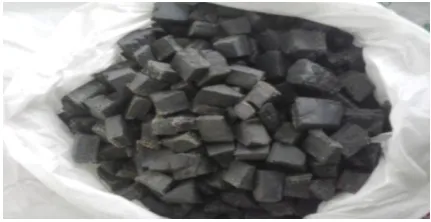
151 | P a g e the rubber aggregate is recycled tyres which were collected from the local market. For uniformity of the concrete production and convenience, all the tires collected are from medium truck tire. The reason for choosing medium truck tires is that they can give the required shape and size which is similar to the common natural gravel. This study has concentrated on the performance of a s ingle gradation of rubber prepared by manual cutting. The maximum size of the rubber aggregate was 20 mm as shown in Figure 1. Specific gravity test was conducted on the rubber aggregate chips and found to be 1.123. The rubber aggregates used in the present investigation are made by manually cutting the tire in to the required sizes. It is very laborious, time consuming and is not easy to handle at the initial stages. However, all this complications can be easily sorted out if a large scaleProduction is devised and proper cutting tools and machineries are made for this particular usage
Figure 1 Rubber aggregates used in the present investigation
IV. MIX PROPORTION
In this study four different types of mixes or combination is being considered and designed as per Indian
Standard Specification IS: 10262(2009)
Water cement rat io- The water cement ratio must be optimum m according to the grade of concrete
chosen and mix design has to be done
Quality aggregates – The quality of aggregates must be high. The other three concrete mixes were made by
Replacing the coarse aggregates with 10%, 20% and 30% of d discarded tyre rubber by weight
V. EXPERIMENTAL PROGRAM WORKABILITY ASPECT
The replacement of coarse aggregate by scrap tyre rubber effects on the workability of the concrete. The workability of rubberized concrete shows an increase in slump with increase of waste tyre rubber content of total aggregate volume. The result of the normal concrete mix showed an increase in workability, but it can be summarized that the workability is adversely affected by the incorporation of chipped tyre rubber. The results of the slump test are as shown
Workability of the Concrete in terms of Slump Value
Sr.No. Test Series Workability
1 Normal Concrete 85mm
2 Rubberized Concrete (10%) 100mm
3 Rubberized Concrete (20%) 125mm
152 | P a g e
VI. HARDENED CONCRETE PROPERTIES
6.1 Compressive Strength
Compression test according to IS:516(1959) is carried out on these cubes. The specimens were loaded at a constant strain rate until failure. The compressive strength is decreased with an increase in the percentage of the tyre rubber chips. The results of compressive strength of cubes for 7 days and 28 days are as follows
COMPRESSIVE STRENGTH OF RUBBERIS ED CONCRETE
Type of Mix (W/C Ratio =0.5 Compressive Strength (Mpa)
7days 28 Days
Normal Concrete 30 35
Rubberized Concrete (10%) 27 32
Rubberized Concrete (20%) 24 28
Rubberized Concrete (30%) 18 22
6.2 Flexural Strength
Prismatic specimens 100 × 100 × 500 mm were tested according to IS: 516(1959). The flexural
strength is decreased with an increase in the percentage of the tyre rubber chips. The results of
flexural strength of cubes for 28 days curing are as follows
FLEXURAL STRENGTH OF
RUBBERIS ED CONCRETE
Type of Mix (W/C Ratio =0.5
Flexural Strength (Mpa)
28daysNormal Concrete 4.1
Rubberized Concrete (10%) 4.0 Rubberized Concrete (20%) 3.7 Rubberized Concrete (30%) 3.3
Rubberized concrete reduces the concrete strength, however, this may be used where M-10 and M-15 grade concrete is needed. Further researches are needy for its use in RCC Work.
VII. DETERMINATION OF UNIT WEIGHT
153 | P a g e Unit Weight of Rubberized Concrete
Type of Mix (W/C Ratio =0.5 Unit Weight(Kg) % reduction
Normal Concrete 8.2 0
Rubberized Concrete (10%) 7.62 0.9
Rubberized Concrete (20%) 7.37 1.1
Rubberized Concrete (30%) 7.2 1.3
VIII. CONCLUSION
[1]
From the experimental study we conclude that despite the reduced compressive strength of
rubberized concrete in comparison to conventional concrete, there is a potential large market for
concrete products in which inclusion of rubber aggregates would be feasible which will utilize the
discarded rubber tyres the disposal of which is a big problem for environment pollution.
[2]
. Rubberized concrete strength may be imp roved by improving the bond properties of rubber
aggregates. In India, out of 36 tyre manufacturers the tyre recyclers are around 20, the major
contribution is only by four or five.. Among these, M/S Gu jarat Reclaim has an annual
turnover of over Rs.15 Crore from its Harid war (Uttarakhand, India) tyre recycling plants,
[3]
With a p production of 20 tons of reclaims rubber per day. The tyre recycling factories should
supply quality rubber aggregates in 20-10mm, 10-4.75mm and 4.75mm down sizes to be used as
cement concrete aggregate.
[4]
The light unit weight qualities of rubberized concrete may be suitable for architectural
application, false facdes, stone baking, interior construction, in building as an earthquake shock
wave absorber, where vibration damping is required such as in foundation pads for mach inery
railway station, where resistance to impact or explosion is required, such as in jersey barrier,
railway buffers, bunkers and for trench filling.
[5]
One of the possible applications of
rubcrete
may be its application in rendering of roof top
surfaces for insulation and waterproofing. With proper Mixed Design a 20 mm thick rendering on
roof top surfaces may be done with 4.75 mm down rubber aggregate
REFERENCES
[1] Negarit gazette “The use of recycled rubber tires”.
[2] Topeu I.B. “The properties of rubberized concrete” cement and concrete research 1995, 25(2), 304-310.II. [3] A. Turatsinze, S. Bonnet, J. Granju, Potential of rubber aggregates to modify properties of Cement
based-mortars: Improvement in cracking shrinkage resistance. Constr Build Mat 2, (2007) 176-181.VI
[4] IS: 383-1970- “Specifications for coarse and fine aggregates from natural sources for concrete” (Second revision) BIS, New Delhi. & IS: 2386(1963).IX.