
A Brief History of Cloud Application Architectures
From Deployment Monoliths via Microservices to Serverless Architectures
and Possible Roads Ahead - A Review from the Frontline (invited paper)
Nane Kratzke1ID
1 Lübeck University of Applied Sciences, 23562 Lübeck, Germany
* Correspondence: [email protected]
Academic Editor: name
Version July 16, 2018 submitted to Preprints
Abstract:This paper presents a review of cloud application architectures and its evolution. It reports 1
observations being made during the course of a research project that tackled the problem to transfer 2
cloud applications between different cloud infrastructures. As a side effect we learned a lot about 3
commonalities and differences from plenty of different cloud applications which might be of value for 4
cloud software engineers and architects. Throughout the course of the research project we analyzed 5
industrial cloud standards, performed systematic mapping studies of cloud-native application related 6
research papers, performed action research activities in cloud engineering projects, modeled a cloud 7
application reference model, and performed software and domain specific language engineering 8
activities. Two major (and sometimes overlooked) trends can be identified. First, cloud computing 9
and its related application architecture evolution can be seen as a steady process to optimize 10
resource utilization in cloud computing. Second, this resource utilization improvements resulted 11
over time in an architectural evolution how cloud applications are being build and deployed. A shift 12
from monolithic servce-oriented architectures (SOA), via independently deployable microservices 13
towards so called serverless architectures is observable. Especially serverless architectures are more 14
decentralized and distributed, and make more intentional use of independently provided services. In 15
other words, a decentralizing trend in cloud application architectures is observable that emphasizes 16
decentralized architectures known from former peer-to-peer based approaches. That is astonishing 17
because with the rise of cloud computing (and its centralized service provisioning concept) the 18
research interest in peer-to-peer based approaches (and its decentralizing philosophy) decreased. 19
But this seems to change. Cloud computing could head into future of more decentralized and more 20
meshed services. 21
Keywords: cloud computing; service-oriented architecture; SOA; cloud-native; serverless; 22
microservice; container; unikernel; distributed cloud; P2P; service-to-service; service-mesh 23
1. Introduction 24
Even very small companies can generate enormous economical growth and business value by 25
providing cloud-based services or applications: Instagram, Uber, WhatsApp, NetFlix, Twitter - and 26
much astonishing small companies (if we relate the modest headcount of these companies in their 27
founding days to their noteworthy economical impact) whose services are frequently used. However, 28
even a fast growing start-up business model should have its long-term consequences and dependencies 29
in mind. A lot of these companies rely on public cloud infrastructures – currently often provided 30
by Amazon Web Services (AWS). But will AWS be still the leading and dominating cloud service 31
provider in 20 years? The IT history is full of examples that companies fail: Atari, Hitachi, America 32
Online, Compaq, Palm. Even Microsoft – still a prospering company – is no longerthedominating 33
software company it was used to be in the 1990’s, and 2000’s. Microsoft is even a good example for 34
a company, that has evolved and transformed into a cloud service provider. Maybe because cloud 35
providers becoming more and more critical for national economies. Cloud providers run a large amount 36
of mission critical business software for companies that no longer operate their own data-centers. 37
And it is very often economical reasonable if workloads have a high peak-to-average ratio [1]. So, 38
cloud providers might become (or even are) a to-big-to-fail company category that seems to become 39
equally important for national economies like banks, financial institutions, electricity suppliers, public 40
transport systems. Although essential for national economies, these financial, energy, or transport 41
providers provide just replaceable goods or services – commodities. But the cloud computing domain 42
is still different here. Although cloud services could be standardized commodities, they are mostly 43
not. Once a cloud hosted application or service is deployed to a specific cloud infrastructure, it is 44
often inherently bound to that infrastructure due to non-obvious technological bindings. A transfer 45
to another cloud infrastructure is very often a time consuming and expensive one-time exercise. A 46
good real-world example here is Instagram. After being bought by Facebook, it took over a year for 47
the Instagram engineering team to find and establish a solution for the transfer of all its services from 48
AWS to Facebook datacenters. Although no downtimes were planned noteworthy outages have been 49
observed during that period. 50
The NIST definition of cloud computing defines three basic and well accepted service categories 51
[2]: Infrastructure as a Service (iaaS), Platform as a Service (PaaS), and Software as a Sevice (SaaS). 52
IaaS provides maximum flexibility for arbitrary consumer created software but hides almost no 53
operation complexity of the application (just of the infrastructure). SaaS on the opposite hides operation 54
complexity almost completely but is to limited for a lot of use cases involving consumer created 55
software. PaaS is somehow a compromise enabling the operation of consumer created software with a 56
convenient operation complexity but at the cost to follow resource efficient application architectures 57
and to accept to some degree lock-in situations resulting from the platform. 58
Throughout the course of a project called CloudTRANSIT we searched intensively for solutions 59
to overcome this "cloud lock-in" – to make cloud computing a true commodity. We developed and 60
evaluated a cloud application transferability concept that has prototype status but already works for 61
approximately 70% of the current cloud market, and that can be extended for the rest of the market 62
share [3]. But what is more essential: We learned some core insights from our action research with 63
practitioners. 64
1. Practitioners prefer to transfer platforms (and not applications). 65
2. Practitioners want to have the choice between platforms. 66
3. Practitioners prefer declarative and cybernetic (auto-adjusting) instead of workflow-based 67
(imperative) deployment and orchestration approaches. 68
4. Practitioners are forced to make efficient use of cloud resources because more and more systems 69
are migrated to cloud infrastructures causing steadily increasing bills. 70
5. And practitioners rate pragmatism of solutions much higher than full feature coverage of cloud 71
platforms and infrastructures. 72
All these points influence ulteriorly how practitioners nowadays construct cloud application 73
architectures that are intentionally designed for the cloud. This paper investigates the observable 74
evolution of cloud application architectures over the last decade. 75
2. Methodology and Outline of this Paper 76
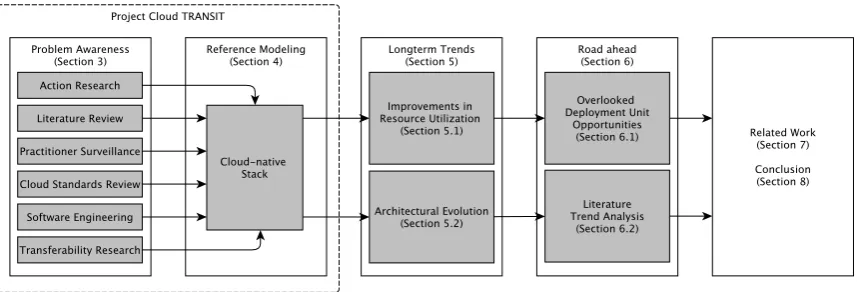
Figure1presents the research methodology for this paper. The reminder of this paper follows 77
basically this structure. Section3 presents an overview of the research project CloudTRANSIT 78
that build the foundation of our cloud application architecture problem awareness. The project 79
CloudTRANSIT tackled intentionally the cloud lock-in problem of cloud-native applications and 80
analyzed how cloud-applications can be transfered between different cloud infrastructures at runtime 81
without downtime. From several researcher as well as reviewer feedbacks, we get to know that the 82
insights we learned about cloud architectures merely as a side-effect might be of general interest for 83
Figure 1.Research methodology
One thing we learned was the fact, that cloud-native applications – although they are all different – 85
follow some common architectural patterns that we could exploit for transferability.Section4presents 86
a reference model that structures such observable commonalities of cloud application architectures. 87
Based on that insight, the obvious question arises what longterm trends exist that influence current 88
shapes of cloud application architectures?Section5will investigate such observable long-term trends. 89
In particular we will investigate the resource utilization evolution inSection5.1and the architectural 90
evolution inSection5.2. This ends to some degree the observable status quo. But the question is, 91
whether these longterm trends will go on in the future and can they be used for forecasts? Although 92
forecasts are tricky in general and our research has not invented a crystal ball,Section6will take a 93
look on the road ahead mainly by extrapolating these identified trends. Some aspects can be derived 94
from the observed long-term-trends regarding optimization of resource efficiency inSection6.1and 95
architectural changes by a Scopus based literature trend analysis inSection6.2. Obviously this paper 96
is not the only one reflecting and analyzing cloud application architecture approaches and the reader 97
should take related work inSection7into account as well. Finally we look at our brief history of cloud 98
architectures and long-term trends. Assuming that these long-term trends will go on in the future for a 99
while, we draw some conclusions on the road ahead inSection8. 100
3. Problem Awareness (from the research project Cloud TRANSIT) 101
Our problem awareness result mainly from the conducted research project CloudTRANSIT. This 102
project dealt with the question how totransfer cloud applications and services at runtimewithout 103
downtime across cloud infrastructures from different public and private cloud service providers to 104
tackle the existing and growing problem of vendor lock-in in cloud computing. Throughout the course 105
of the project more than 20 research papers have been published. But the intent of this paper is not to 106
summarize these papers. The interested reader is referred to the corresponding technical report [3] 107
that provides an integrated view of these outcomes. 108
This paper strives to make a step back and review the observed state-of-the-art how cloud-based 109
systems are being build today and how they might be build tomorrow. But obviously, it is of interest 110
for the reader to get an impression how the foundation for these insights have been derived by 111
understanding the mentioned research project. 112
The project analyzed commonalities of existing public and private cloud infrastructures via a 113
review of industrial cloud standards and of cloud applications via a systematic mapping study of 114
cloud-native application related research [4]. This was accompanied by action research projects with 115
practitioners. Latest evolutions of cloud standards and cloud engineering trends (like containerization) 116
were used to derive a reference model that guided the development of a pragmatic cloud-transferability 117
2 2
2 4 6
7 7
7 7 11 11
1 1
2 4 7
10 14
21 26 42 44
0% 10% 20% 30% 40% 50% 60% 70% 80% 90% 100%
2006 2007 2008 2009 2010 2011 2012 2013 2014 2015 2016
Re
la
tio
n
of
c
on
sid
er
ed
s
er
vi
ce
s
considered by CIMI, OCCI, CDMI, OVF, OCI, TOSCA not considered
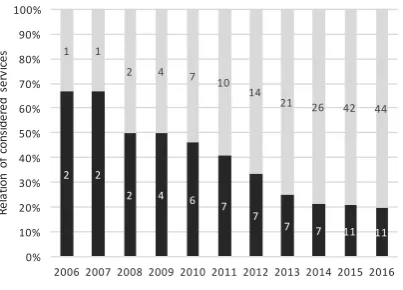
Figure 2.Decrease of standard coverage over years (by example of AWS)
activities [5]. This solution intentionally separated theinfrastructure-agnostic operationof elastic 119
container platforms (like Swarm, Kubernetes, Mesos/Marathon, etc.) via amulti-cloud-scalerand 120
the platform-agnostic definition of cloud-native applications and services via an unified cloud 121
application modeling language. Both components are independent but complementary and provide 122
a solution to operate elastic (container) platforms in an infrastructure-agnostic, secure, transferable, 123
and elastic way. This multi-cloud-scaler is described in [6,7]. Additionally we had to find a solution to 124
describe cloud applications in an unified format. This format can be transformed into platform specific 125
definition formats like Swarm compose, Kubernetes manifest files, and more. This unified cloud 126
application modeling language UCAML is explained in [8,9]. Both approaches mutually influenced 127
each other and therefore have been evaluated in parallel by deploying and transferring several cloud 128
reference applications [10] at runtime [7,9]. This solution supports the public cloud infrastructures 129
of AWS, Google Compute Engine (GCE), and Azure and open source infrastructure OpenStack. This 130
alone covers approximately 70% of the current cloud market. Because the solution can be extended 131
with cloud infastructure drivers also the rest of the market share can be supported by additional 132
drivers of moderate complexity. 133
But what is more essential: We learned some core insights about cloud application architectures 134
in general by asking the question how this kind of applications can be transferred without touching 135
their application architectures. Let us investigate this in the following Section4. 136
4. Reference modeling – how cloud applications look like 137
Almost all cloud system engineers focus a common problem. The core components of their 138
distributed and cloud-based systems like virtualized server instances and basic networking and 139
storage can be deployed using commodity services. However, further services – that are needed to 140
integrate these virtualized resources in an elastic, scalable, and pragmatic manner – are often not 141
considered in standards. Services like load balancing, auto scaling or message queuing systems 142
are needed to design an elastic and scalable cloud-native system on almost every cloud service 143
infrastructure. Some standards like AMQP [11] for messaging (dating back almost to the pre-cloud 144
era) exist. But especially these integrating and "glueing" service types – that are needed for almost 145
every cloud application on a higher cloud maturity level (see Table1) – are often not provided in a 146
standardized manner by cloud providers [12]. It seems that all public cloud service providers try to 147
stimulate cloud customers to use their non-commodity convenience service "interpretations" in order 148
to bind them to their infrastructures and higher-level service portfolios. 149
What is more, according to an analysis we performed in 2016 [13], the percentage of these 150
commodity service categories that are considered in standards like CIMI [14], OCCI [15,16], CDMI 151
Table 1.Cloud Application Maturity Model, adapted fromOPEN DATA CENTER ALLIANCE [22]
Level Maturity Criteria
3 Cloud - Transferable across infrastructure providers at native runtime and without interruption of service.
- Automatically scale out/in based on stimuli.
2 Cloud - State is isolated in a minimum of services. resilient - Unaffected by dependent service failures.
- Infrastructure agnostic.
1 Cloud - Composed of loosely coupled services. friendly - Services are discoverable by name.
- Components are designed to cloud patterns. - Compute and storage are separated.
0 Cloud - Operated on virtualized infrastructure. ready - Instantiateable from image or script.
the fact that new cloud service categories are released faster than existing service categories can be 153
standardized by standardization authorities. Figure2shows this effect by example of AWS over the 154
years. That is how mainly vendor lock-in emerges in cloud computing. For a more detailed discussion 155
the reader is referred to [5,13,21]. 156
Therefore, all reviewed cloud standards focus a very small but basic subset of popular cloud 157
services: compute nodes (virtual machines), storage (file, block, object), and (virtual private) 158
networking. Standardized deployment approaches like TOSCA are defined mainly against this 159
commodity infrastructure level of abstraction. These kind of services are often subsumed as IaaS and 160
build the foundation of cloud services and therefore cloud-native applications. All other service 161
categories might foster vendor lock-in situations. This all might sound disillusioning. But in 162
consequence, a lot of cloud engineering teams follow the basic idea that a cloud-native application 163
stack should be only using a very small subset of well standardized IaaS services as founding building 164
blocks. Because existing cloud standards cover only specific cloud service categories (mainly the 165
IaaS level) and do not show an integrated point of view a more integrated reference model that take 166
best-practices of practitioners into account would be helpful. 167
Very often cloud computing is investigated from a service model point of view (IaaS, PaaS, SaaS), 168
a deployment point of view (private, public, hybrid, community cloud) [2]. Or one can look from an 169
actor point of view (provider, consumer, auditor, broker, carrier) or a functional point of view (service 170
deployment, service orchestration, service management, security, privacy) as it is done by [23]. Points 171
of view are particular useful to split problems into concise parts. However, the above mentioned view 172
points might be common in cloud computing and useful from a service provider point of view but not 173
from cloud-native application engineering point of view. From an engineering point of view it seems 174
more useful to have views on technology levels involved and applied in cloud-native application 175
engineering. This is often done by practitioner models. However, these practitioner models have been 176
only documented in some blog posts1and do not expand into any academic papers as far as the author 177
is aware. 178
Taking the insights from our systematic mapping study [24] and our review of cloud standards 179
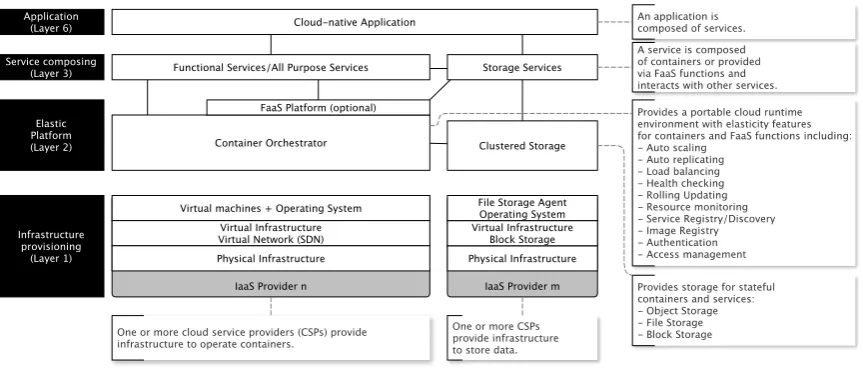
[5] we compiled a reference model of cloud-native applications. This layered reference model is shown 180
and explained in Figure3. The basic idea of this reference model is to use only a small subset of well 181
1 Jason Lavigne, "Don’t let a PaaS you by - What is a PaaS and why Microsoft is excited about it", seehttp://bit.ly/2nWFmDS(last
access 13th Feb. 2018)
Figure 3.Cloud-native stack observable in a lot of cloud-native applications
standardized IaaS services as founding building blocks (Layer 1). Four basic view points form the 182
overall shape of this model. 183
1. Infrastructure provisioning: This is a view point being familiar for engineers working on the 184
infrastructure level. This is how IaaS can be understood. IaaS deals with deployment of isolated 185
compute nodes for a cloud consumer. It is up to the cloud consumer what it is done with these 186
isolated nodes (even if there are provisioned hundreds of them). 187
2. Clustered elastic platforms:This is a view point being familiar for engineers who are dealing 188
with horizontal scalability across nodes. Clusters are a concept to handle many Layer 1 nodes 189
as one logical compute node (a cluster). Such kind of technologies are often the technological 190
backbone for portable cloud runtime environments because they are hiding complexity (of 191
hundreds or thousands of single nodes) in an appropriate way. Additionally, this layer realizes 192
the foundation to define services and applications without reference to particular cloud services, 193
cloud platforms or cloud infrastructures. Thus, it provides a foundation to avoid vendor lock-in. 194
3. Service composing:This is a view point familiar for application engineers dealing with Web 195
services in service-oriented architectures (SOA). These (micro)-services are operated on a Layer 2 196
cloud runtime platform (like Kubernetes, Mesos, Swarm, Nomad, and so on). Thus, the complex 197
orchestration and scaling of these services is abstracted and delegated to a cluster (cloud runtime 198
environment) on Layer 2. 199
4. Application:This is a view point being familiar for end-users of cloud services (or cloud-native 200
applications). These cloud services are composed of smaller cloud Layer 3 services being operated 201
on clusters formed of single compute and storage nodes. 202
For more details we refer to [3,5]. However, the remainder of this paper is aligned to this model. 203
5. Observable Longterm-Trends in Cloud Systems Engineering 204
Cloud computing emerged some 10 years ago. In the first adoption phase existing IT systems were 205
simply transferred to cloud environments without changing the original design and architecture of 206
these applications. Tiered applications were simply migrated from dedicated hardware to virtualized 207
hardware in the cloud. Cloud system engineers implemented noteworthy improvements in cloud 208
platforms (PaaS) and infrastructures (IaaS) over the years and established several engineering trends 209
currently observable. But often these engineering trends listed in Table2seem somehow isolated. We 210
Table 2.Some observable software engineering trends coming along with CNAs
Trend Rationale
Microservices Microservices can be seen as a "pragmatic" interpretation of SOA. In addition to SOA microservice architectures intentionally focus and compose small and independently replaceable horizontally scalable services that are "doing one thing well". [25–29]
DevOps DevOps is a practice that emphasizes the collaboration of software developers and IT operators. It aims to build, test, and release software more rapidly, frequently, and more reliably using automated processes for software delivery [30,31]. DevOps foster the need for independent replaceable and standardized deployment units and therefore pushes microservice architectures and container technologies.
Cloud Modeling Languages
Softwareization of infrastructure and network enables to automate the process of software delivery and infrastructure changes more rapidly. Applications and services and their elasticity behavior that shall be deployed to such infrastructures or platforms can be expressed by cloud modeling languages. There is a good survey on this kind of new "programming languages" [32].
Standardized Deployment Units
Deployment units wrap a piece of software in a complete file system that contains everything needed to run: code, runtime, system tools, system libraries. This guarantees that the software will always run the same, regardless of its environment. This is often done using container technologies (OCI standard []) Unikernels would work as well but are not yet in widespread use. A deployment unit should be designed and interconnected according to acollection of cloud-focused patternslike thetwelve-factor appcollection [33],
thecircuit breakerpattern [34] orcloud computing patterns[35,36].
Elastic Platforms Elastic platforms like Kubernetes [37], Mesos [38], or Swarm can be seen as a unifying middleware of elastic infrastructures. Elastic platforms extend resource sharing and increase the utilization of underlying compute, network and storage resources for custom but standardized deployment units.
Serverless The term serverless is used for an architectural style that is used for cloud application architectures that deeply depend on external third-party-services (Backend-as-a-Service, BaaS) and integrating them via small event-based triggered functions (Function-as-a, FaaS). FaaS extend resource sharing of elastic platforms by simply by applying time-sharing concepts [39–41].
State Isolation Stateless components are easier to scale up/down horizontally than stateful components. Of course, stateful components can not be avoided, but stateful components should be reduced to a minimum and realized by intentional horizontal scalable storage systems (often eventual consistent NoSQL databases) [35].
Versioned REST APIs
REST-based APIs provide scalable and pragmatic communication, means relying mainly on already existing internet infrastructure and well defined and widespread standards [42].
• In Section5.1we will investigate cloud application architectures from a resource utilization point 212
of view over time. 213
• And in Section5.2we will investigate cloud application architectures more from an architecture 214
evolutionary point of view. 215
In both cases we will see, that the wish to make more efficient use of cloud resources had impacts 216
on architectures and vice versa. 217
5.1. A review of the resource utilization evolution and its impact on cloud technology architectures 218
Cloud infrastructures (IaaS) and platforms (PaaS) are build to be elastic. Elasticity is understood 219
as the degree to which a system adapts to workload changes by provisioning and de-provisioning 220
resources automatically. Without this, cloud computing is very often not reasonable from an economic 221
point of view [1]. Over time, system engineers learned to understand this elasticity options of modern 222
cloud environments better. Eventually, systems were designed for such elastic cloud infrastructures, 223
which increased the utilization rates of underlying computing infrastructures via new deployment 224
and design approaches like containers, microservices or serverless architectures. This design intention 225
is often expressed using the term ”cloud-native”. 226
Bare Metal Server VM
Bare Metal Server
A A
Bare Metal Server
VM VM
Container Engine
A B
Bare Metal Server
VM VM
Container Engine FaaS Runtime
A B ... ... A ...
Virtualization Containerization Microservices
Time-Sharing Dedicated Server
In case of dedicated servers applications (A, B) are deployed on physical servers. In consequence, the servers are often over dimensioned and have inefficient utilization rates.
Machine virtualization is mainly used to consolidate and isolate applications on virtual machine instead of dedicated servers. This increases the application density on bare metal servers but the virtual machine images (deployment unit) are very large.
To pragmatically operate more than one application per virtual machine, containerization established as a trend. A container starts faster than a virtual machine and shares the operating system with other containers, thus reducing deployment unit sizes and increasing application density per virtual machine.
But a container still requests a share of CPU, memory, and storage – even if the provided service is hardly requested. It is more resource efficient, if services would consume resources only if there are incoming requests. FaaS runtime environments enable that services can timeshare a host. However, this involves to follow a serverless architecture style.
1 2 3 4
Serverless, FaaS
Bare Metal Server
B
VM VM
B
Figure 4.The cloud architectural evolution from a resource utilization point of view
Figure4shows an observable trend over the last decade. Machine virtualization was introduced 227
to consolidate plenty of bare metal machines in order to make a more efficient utilization of physical 228
resources. This machine virtualization forms the technological backbone of IaaS cloud computing. 229
Virtual machines might be more lightweight than bare metal servers but they are still heavy, especially 230
regarding their image sizes. Containers improved a standardized way of deployment but also increased 231
the utilization of virtual machines, mainly because containers are more fine grained. Nevertheless, 232
although containers can be scaled easily they are still always-on components. And "recently", 233
Function-as-a-Service (FaaS) approaches emerged and applied time sharing of containers on underlying 234
container platforms. Using FaaS only units are executed that have requests to be processed. Using 235
this time-shared execution of containers on the same hardware. FaaS enables even a scale-to-zero 236
capability. This improved resource efficiency can be even measured monetarily [43]. So, over time the 237
technology stack to manage resources in the cloud got more complex and harder to understand but 238
5.1.1. Service-oriented Deployment Monoliths 240
An interesting paper the reader should dive into is [44]. Service-Oriented Computing (SOC) is a 241
paradigm for distributed computing and e-business processing and has been introduced to manage 242
the complexity of distributed systems and to integrate different software applications. A service offers 243
functionalities to other services mainly via message passing. Services decouple their interfaces from 244
their implementation. Workflow languages are used to orchestrate more complex actions of services 245
(e.g. WS-BPEL). Corresponding architectures for such kind of applications are called consequently 246
Service-Oriented Architectures (SOA). A lot of business applications have been developed over the 247
last decades following this architectural paradigm. And due to its underlying service concepts these 248
applications can be deployed into cloud environments without much problems. So, they arecloud 249
ready/friendlyaccording to Table1. But the main problem for cloud system engineers emerges from 250
the problem that – although these kind of applications are composed of distributed services – their 251
deployment is not! These kind of distributed applications are conceptually monolithic applications 252
from a deployment point of view. Dragoni et al. define such monolithic software as: 253
"A monolithic software application is a software application composed of modules that are not 254
independent from the application to which they belong. Since the modules of a monolith depend on said 255
shared resources, they are not independently executable. This makes monoliths difficult to naturally 256
distribute without the use of specific frameworks or ad hoc solutions [...]. In the context of cloud-based 257
distributed systems, this represents a significant limitation, in particular because previous solutions 258
leave synchronization responsibilities to the developer [44]". 259
In other words, the complete distributed application must be deployed all at once in case of 260
updates or new service releases. This even leads to situations where complete applications are simply 261
packaged as one large virtual machine image. That fits perfectly to situations shown in Figure4(1 262
+ 2). But depending on the application size, this normally involves noteworthy downtimes of the 263
application for end users and limits the capability to scale the application in case of increasing or 264
decreasing workloads. While this might be acceptable for some services (e.g. some billing batch 265
processes running somewhere in the night), it might be problematic for other kind of services. What 266
if messaging services (e.g. WhatsApp), large scale social networks (e.g. Facebook), credit card 267
instant payment services (e.g. Visa), traffic-considering navigational services (e.g. Google Maps), or 268
ridesharing services (e.g. Uber) would go down for some hours just because of a new service release 269
or a scaling operation? 270
It is obvious that especially cloud-native applications come along with such 24x7 requirements 271
and the need to deploy, update, or scale single components independently from each other at runtime 272
without any downtime. Therefore, SOA evolved into a so called microservice architectural style. One 273
might mention that microservices are mainly a more pragmatic version of SOA. But what is more 274
essential, microservices are intentionally designed to be independently deployable, updateable, and 275
horizontally scalable. This has some architectural implications that will be investigated in Section5.2.1. 276
But deployment units should be standardized and self-contained as well in this setting. We will have a 277
look on that in the following Section5.1.2. 278
5.1.2. Standardized and Self-contained Deployment Units 279
While deployment monoliths are mainly using IaaS resources in form of virtual machines that 280
are deployed and updated in a less frequent manner, microservice architectures split up the monolith 281
into independently deployable units that are deployed and terminated much more frequently. What 282
is more, this deployment is done in a horizontal scalable way that is very often triggered by request 283
stimuli. If there are a lot of requests hitting a service, more service instances are launched to distribute 284
the requests across more instances. If the requests are decreasing, service instances are shut down to 285
free resources (and save money). So, inherent elasticity capabilities of microservice architectures are 286
Figure 5.Comparing containers and virtual machines (adapted from Docker website)
the key success factors that microservice architectures gained so much attraction over the last years 288
might be the fact, that the deployment of service instances could be standardized as self-contained 289
deployment units – so called containers [45]. Containers make use of operating system virtualization 290
instead of machine virtualization (see Figure5) and are therefore much more lightweight. Containers 291
enable to make scaling much more pragmatic, and faster and because containers are less resource 292
consuming compared with virtual machines, the instance density on underlying IaaS hardware could 293
be improved. 294
But even in microservice architectures the service concept is an always-on concept. So, at least 295
one service instance (container) must be active and running for each microservice2at all times. Thus, 296
even container technologies do not overcome the need for always-on components. And always-on 297
components are one of the most expensive and therefore avoidable cloud workloads according to 298
Weinmann [1]. Thus the question arises, whether it is possible to execute service instances only in the 299
case of actual requests? And the answer leads to Function-as-a-Service concepts and corresponding 300
platforms that will be discussed in Section5.1.3. 301
5.1.3. Function-as-a-Service 302
Microservice architectures propose a solution to efficiently scale computing resources that are 303
hardly realizable with monolithic architectures [44]. The allocated infrastructure can be better tailored 304
to the microservices’ needs due to the independent scaling of each one of them via standardized 305
deployment units addressed in Section5.1.2. But microservice architectures face additional efforts 306
like to deploy each single microservice, and to scale and operate them in cloud infrastructures. To 307
address these concerns container orchestrating platforms like Kubernetes [37], or Mesos/Marathon [46] 308
emerged. But this shifts mainly the problem to the operation of these platforms and these platforms 309
are still always-on components. Thus, so called Serverless architectures and Function-as-a-Service 310
platforms have emerged in the cloud service ecosystem. The AWS lambda service might be the most 311
prominent one but there exist more like Google Cloud Functions, Azure Functions, OpenWhisk, Spring 312
2 And microservice architectures make use of plenty of such small services. To have a lot of small services is the dominant
Figure 6.The double spending problem resulting from the Serverless trilemma [41]
Cloud Functions to name just a few. But all (commercial platforms) follow the same principle to 313
provide very small and fine grained services (just exposing one stateless function) that are billed on a 314
runtime-consuming model (millisecond dimension). The problem with the term Serverless is that it 315
occurs in two different notions. 316
1. "Serverless was first used to describe applications that significantly or fully incorporate third-party, 317
cloud-hosted applications and services, to manage server-side logic and state. These are typically 318
“rich client” applications—think single-page web apps, or mobile apps—that use the vast ecosystem 319
of cloud-accessible databases, authentication services, and so on. These types of services can described as 320
“Backend as a Service (BaaS) [39]". 321
2. "Serverless can also mean applications where server-side logic is still written by the application developer, 322
but, unlike traditional architectures, it’s run in stateless compute containers that are event-triggered, 323
ephemeral (may only last for one invocation), and fully managed by a third party. One way to think of 324
this is “Functions as a Service” or "FaaS". AWS Lambda is one of the most popular implementations of a 325
Functions-as-a-Service platform at present, but there are many others, too [39]". 326
In this Section the term Serverless computing is used in the notion of FaaS and we will mainly 327
investigate the impact on resource utilization. The upcoming Section5.2.2will investigate Serverless 328
more in architectural terms. FaaS was specifically designed for event-driven applications that require 329
to carry out lightweight processing in response to an event [47]. FaaS is more fine grained than 330
microservices and facilitates the creation of functions. Therefore, these fine-grained functions are 331
sometimes called nanoservices. These functions can be easily deployed and automatically scaled, 332
and provide the potential to reduce infrastructure and operation costs. Other like the deployment 333
unit approaches of Section5.1.2– that are still always-on software components – functions are only 334
processed if there are active requests. Thus, FaaS can be much more cost efficient than just containerized 335
deployment approaches. According to a cost comparison of monolithic, microservice and FaaS 336
architectures case study by Villamizar et al. cost reductions up to 75% are possible [43]. On the 337
other hand, there are still open problems like the Serverless trilemma identified by Baldini et. al.. 338
The Serverless trilemma"captures the inherent tension between economics, performance, and synchronous 339
composition"[41] of serverless functions. One evident problem stressed by Baldini et al. is the "double 340
spending problem" shown in Figure6. This problem occurs when a serverless function f is calling 341
another serverless functiongsynchronously. In this case, the consumer is billed for the execution of 342
f andg- although onlygis consuming resources because f is waiting on the result ofg. To avoid 343
this double spending problem a lot of serverless applications delegate the composition of fine grained 344
the scope of FaaS platforms. This leads to new – more distributed and decentralized – forms of 346
cloud-native architectures that will be discussed in Section5.2.2. 347
5.2. A review of the architectural evolution 348
The reader has seen in Section5.1that Cloud-native applications strived for a better resource 349
utilization mainly by applying more fine-grained deployment units in shape of lightweight containers 350
(instead of virtual machines) or in shape of functions in case of FaaS approaches. And these 351
improvements of resource utilization rates had impact on how architectures of cloud applications 352
evolved. Two major architectural trends of Cloud application architectures could be observed in the 353
last decade. We will investigate Microservice architectures in Section5.2.1and Serverless architectures 354
in Section5.2.2. 355
5.2.1. Microservice architectures 356
Microservices form"an approach to software and systems architecture that builds on the well-established 357
concept of modularization but emphasizes technical boundaries. Each module — each microservice — is 358
implemented and operated as a small yet independent system, offering access to its internal logic and data 359
through a well-defined network interface. This increases software agility because each micro service becomes 360
an independent unit of development, deployment, operations, versioning, and scaling [29]". According to 361
[28,29] often mentioned benefits of microservice architectures are faster delivery, improved scalability 362
and greater autonomy. Different services in a microservice architecture can be scaled independently 363
from each other according to their specific requirements and actual request stimuli. What is more, 364
each service can be developed and operated by different teams. So microservices do not only have an 365
technological but also an organizational impact. These teams can make localized decisions per service 366
regarding programming languages, libraries, frameworks, and more. So, best-of-breed breaches are 367
possible within each area of responsibility on the one hand – on the other hand this might increase 368
obviously the technological heterogenity across the complete system and corresponding longterm 369
effects regarding maintainability of such systems might be not even observed so far [4]. 370
Alongside microservice architectures several other accompanying trends could be observed. We 371
already investigated containerization as such a trend in Section5.1.2.First generation microservices 372
formed of individual services that were packed using container technologies (see Figure7). These 373
services were then deployed and managed at runtime using container orchestration tools, like Mesos. 374
Each service was responsible for keeping track of other services, and invoking them by specific 375
communication protocols. Failure-handling was implemented directly in the services’ source code. 376
With an increase of services per application, the reliable and fault-tolerant location and invocation 377
of appropriate service instances became a problem itself. If new services were implemented using 378
different programming languages, but that made reusing existing discovery and failure-handling 379
code became increasingly difficult. So, freedom of choice and "polyglott programming" is an often 380
mentioned benefit of microservices but obviously has its drawbacks that needs to be managed. 381
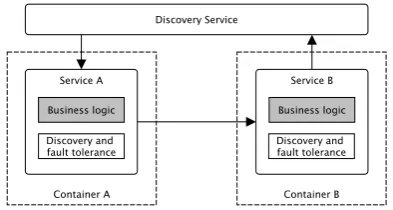
Therefore,second generation microservice architectures(see Figure7) made use of discovery 382
services and reusable fault-tolerant communication libraries. Common discovery services (like Consul) 383
were used to register provided functionalities. During service invocation, all protocol-specific and 384
failure-handling features were delegated to an appropriate communication library, such as Finagle. 385
This simplified service implementation and reuse of boilerplate communication code across services. 386
Thethird generation(see Figure7) introduced service proxies as transparent service intermediates 387
with the intent to improve software reusability. So called sidecars encapsulate reusable service 388
discovery and communication features as a self-contained services that can be accessed via existing 389
fault-tolerant communication libraries provided by almost every programming language nowadays. 390
Because of its network intermediary conception, sidecars are more than suited for monitoring the 391
behavior of all service interactions in a microservice application. This is exactly the idea behind 392
Figure 7.Microservice architecture evolution - adapted from [29]
to provide a more integrated service communication solution. Using service meshs operators have 394
much more fine-grained control over the service-to-service communication including service discovery, 395
load balancing, fault tolerance, message routing, and even security. So, beside the pure architectural 396
point of view, the following tools, frameworks, services, and platforms (see Table3) form our current 397
understanding of the termmicroservice: 398
• Service discovery technologies let services communicate with each other without explicitly 399
referring to their network locations. 400
• Container orchestration technologies automate container allocation and management tasks and 401
abstracting away the underlying physical or virtual infrastructure from service developers. That 402
is the reason we see this technology as an essential part of any cloud-native application stack 403
(see Figure3). 404
• Monitoring technologies that are often based on time-series databases to enable runtime 405
monitoring and analysis of the behavior of microservice resources at different levels of detail. 406
• Latency and fault-tolerant communication libraries let services communicate more efficiently 407
and reliably in permanently changing system configurations with plenty of service instances 408
permanently joining and leaving the system according to changing request stimuli. 409
• Continuous-delivery technologies integrate solutions often into third party services that automate 410
many of the DevOps practices typically used in a web-scale microservice production environment 411
[30]. 412
• Service proxy technologies encapsulate mainly communication-related features such as service 413
discovery and fault-tolerant communication and exposes them over HTTP. 414
• Finally, latests service mesh technologies build on sidecar technologies to provide a fully 415
integrated service-to-service communication monitoring and management environment. 416
Table 3 shows that a complex tool-chain evolved to handle the continuous operation of 417
Table 3.Some observable microservice engineering ecosystem components (adapted from [29])
Ecosystem component
Example tools, frameworks, services and platforms(last access 11/07/2018)
Service discovery
Zookeeper (https://zookeeper.apache.org), Eureka (https://github.com/Netflix/eureka), Consul (https://www.consul.io), etcd (https://github.com/coreos/etcd, Synapse (https:
//github.com/airbnb/synapse)
Container orchestration
Kubernetes (https://kubernetes.io, [37]), Mesos (http://mesos.apache.org, [46], Swarm
(https://docs.docker.com/engine/swarm), Nomad (https://www.nomadproject.io)
Monitoring Graphite (https://graphiteapp.org), InfluxDB (https://github.com/influxdata/influxdb), Sensu (https://sensuapp.org), cAdvisor (https://github.com/google/cadvisor), Prometheus (https://prometheus.io), Elastic Stack (https://elastic.co/elk-stack)
Fault tolerant communication
Finagle (https://twitter.github.io/finagle), Hystrix (https://github.com/Netflix/Hystrix), Proxygen (https://github.com/facebook/proxygen), Resilience4j (https://github.com/ resilience4j)
Continuous delivery services
Ansible (https://ansible.com), Circle CI (https://circleci.com/), Codeship (https:// codeship.com/), Drone (https://drone.io), Spinnaker (https://spinnaker.io), Travis CI (https://travis-ci.org/)
Service proxy Prana (https://github.com/Netflix/Prana), Envoy (https://www.envoyproxy.io)
Service meshs Linkerd (https://linkerd.io), Istio (https://istio.io)
5.2.2. Serverless Architectures 419
Serverless computing is a cloud computing execution model in which the the allocation of 420
machine resources is dynamically managed and intentionally out of control of the service customer. 421
The ability to scale to zero instances is one of the key differentiators of serverless platforms compared 422
with container focused PaaS or virtual machine focused IaaS services. This enables to avoid billed 423
always-on components and therefore excludes the most expensive cloud usage pattern according to 424
[1]. That might be one reason why the term "serverless" is getting more and more common since 2014 425
[29]. But what is "serverless" exactly? Obviously, servers must still exist somewhere. 426
So called serverless architectures replace server administration and operation mainly by using 427
Function-as-a-Service (FaaS) concepts [39] and integrating 3rd party backend services. Figure4showed 428
the evolution of how resource utilization has been optimized over the last 10 years ending in the latest 429
trend to make use of FaaS platforms. FaaS platforms apply time-sharing principles and increase the 430
utilization factor of computing infrastructures, and thus avoid expensive always-on components. As 431
already mentioned at least one study showed, that due to this time-sharing, serverless architectures 432
can reduce costs by 70% [43]. The core capability of a serverless platform is that of an event processing 433
system (see Figure8). According to [41] serverless platforms take an event (sent over HTTP or received 434
form a further event source in the cloud), determine which functions are registered to process the 435
event, find an existing instance of the function (or create a new one), send the event to the function 436
instance, wait for a response, gather execution logs, make the response available to the user, and stop 437
the function when it is no longer needed. Beside API composition and aggregation to reduce API calls 438
[41], especially event-based applications are very much suited for this approach [48]. 439
Serverless platform provision models can be grouped into the following categories: 440
• Public (commercial) serverless services of public cloud service providers offer compute 441
runtimes, also known as function as a service (FaaS) platforms. Some well known type 442
representatives include AWS Lambda, Google Cloud Functions, or Microsoft Azure Functions. 443
All of the mentioned commercial serverless computing models are prone to create vendor lock-in 444
(to some degree). 445
• Open (source) serverless platformslike Apache’s OpenWhisk or OpenLambda might be an 446
Figure 8.Blueprint of a serverless platform architecture (adapted from [41])
• Provider agnostic serverless frameworksprovide a provider and platform agnostic way to 448
define and deploy serverless code on various serverless platforms or commercial serverless 449
services. This is an option to avoid (or reduce) vendor lock-in without the necessity to operate an 450
own infrastructure. 451
So, on the one hand, serverless computing provides some inherent benefits like resource and 452
cost efficiency, operation simplicity, and a possible increase of development speed and improved 453
time-to-market [39]. But serverless computing comes also along with some noteworthy drawbacks, like 454
runtime constraints, state constraints and still unsatisfactorily solved function composition problems 455
like the double spending problem (see Figure6). What is more, resulting serverless architectures 456
have security implications. They increase attack surfaces and shift parts of the application logic 457
(service composing) to the client-side (which is not under complete control of the service provider). 458
Furthermore, FaaS increases vendor lock-in problems, client complexity, as well as integration and 459
testing complexity. Table4summarizes some of the most mentioned benefits but also drawbacks of 460
FaaS from practitioner reportings [39]. 461
Furthermore, Figure9shows that serverless architectures (and microservice architectures as well) 462
require a cloud application architecture redesign, compared to classical e-commerce applications. Much 463
more than microservice architectures, serverless architectures integrate 3rd party backend services like 464
authentication or database services intentionally. To reduce own development efforts, only very service 465
specific, security relevant, or computing intensive functionality is provided via functions on FaaS 466
platforms. In fact all functionality that would haven been provided classically on a central application 467
server is now provided as a lot of isolated micro- or evennanoservices. The integration of all these 468
isolated services as meaningful end user functionality is delegated to end devices (very often in the 469
shape of native mobile applications or progressive web applications). In summary, we can see the 470
following observable engineering decisions in serverless architectures: 471
• Former cross-sectional but service-internal (or via a microservice provided) logic like 472
authentication or storage is sourced to external 3rd party services. 473
• Even nano- and microservice composition is shifted to end user clients or edge devices. That 474
means, even service orchestration is not done anymore by the service provider itself but by 475
the service consumer via provided applications. This has two interesting effects: (1) Resources 476
needed for service orchestration are now provided by the service consumer. (2) Because the 477
service composition is done outside the scope of the FaaS platform, still unsolved FaaS function 478
composition problems (like the double spending problem) are avoided. 479
Table 4.Serverless architecture benefits and drawbacks (mainly compiled from [39])
Benefits Drawbacks
RESOURCE EFFIENCY(service side)
- auto-scaling based on event stimulus - maximum function runtime is limited
- reduced operational costs - startup latencies of functions must be considered - scale to zero capability (no always-on) - function runtime variations
- functions can not preserve a state across function calls - external state (cache, key/value stores, etc.) can
compensate this but is a magnitude slower
- double spending problems (FaaS functions call other FaaS functions)
OPERATION(service side)
- simplified deployment - increased attack surfaces
- simplified operation (see auto-scaling) - each endpoint introduces possible vulnerabilities - missing protective barrier of a monolithic server
application
- parts of the application logic are shifted to the client-side (that is not under control of the service provider) - increased vendor lock-in (currently no FaaS standards
for API gateways and FaaS runtime environments)
DEVELOPMENT SPEED(service side)
- development speed - increased client complexity
- simplified unit testing of stateless FaaS functions - application logic is shifted to the client-side
- better time to market - code replication on client side across client platforms - control of application workflow on client side to avoid
double-sending problems of FaaS computing - increased integration testing complexity - missing integration test tool-suites
• Endpoints of very service specific functionality is provided via API gateways. So, HTTP- and 481
REST-based/REST-like communication protocols are generally preferred. 482
• Only very domain or service specific functions are provided on FaaS platforms. Mainly when this 483
functionality is security relevant and should be executed in a controlled runtime environment by 484
the service provider, or the functionality is too processing or data-intensive to be executed on 485
consumer clients or edge devices, or the functionality is so domain-, problem-, or service-specific 486
that simply no external 3rd party service exists. 487
Finally, the reader might observe the trend in serverless architectures that this kind of architecture 488
is more decentralized and distributed, makes more intentional use of independently provided services, 489
and is therefore much more intangible (more cloudy) compared with microservice architectures. 490
6. The road ahead 491
So far, we have identified and investigated two major trends. First, cloud computing and its related 492
application architecture evolution can be seen as a steady process to optimize resource utilization in 493
cloud computing. This was visualized in Figure4and discussed in Section5.1. Second, in Section5.2 494
it was emphasized that this resource utilization improvements resulted over time in an architectural 495
evolution how cloud applications are being build and deployed. We observed a shift from monolithic 496
SOA, via independently deployable microservices towards so called serverless architectures that 497
are more decentralized and distributed, and make more intentional use of independently provided 498
services. 499
The question is, whether and how are these trends continuing? To forecast the future is difficult, 500
but having current trends and the assumption that these trends will go on to some degree makes it a 501
Client (Browser)
Application Server
Relational Database
Purchase Function
Search Function API Gateway
Authentication Service
Purchase Database
Product Database Native
mobile app
1
3 2
4 5 The authentication logic can be
replaced with a 3rd party authentication BaaS (like Auth0).
The client is allowed direct access to a subset of our database. The database is fully 3rd party hosted.
Server application logic now moves to the client application, making it often a native mobile app or a single-page web application.
Some functionality might be kept in the „server“. It might be compute intensive or requires access to a significant amount of data like a search function.
Such functionality is provided as FaaS functions that often respond to HTTP requests.
Some functionality might be kept in the „server“ for security reasons or for interfacing further 3rd party BaaS.
6
An API Gateway is basically a web server that receives HTTP requests and routes them to subsequent FaaS functions or other backend services.
Figure 9.Serverless architectures result in a different and less centralized composition of application components and backend services compared with classical tiered application architectures.
will take a look how cloud application architectures may evolve in the future simply by extrapolating 503
the existing SOA-microservice-serverless path. 504
6.1. Unikernels - the overlooked deployment unit? 505
The resource utilization optimization trend has been massively influenced by operating system 506
virtualization based container technologies. However, containers are not about virtualization from a 507
cloud application deployment point of view. They are about a standardized and self-contained way to 508
define deployment units. But are containers the only solution and the most resource efficient solution 509
already existing? The answer is no, and roads ahead might follow directions with the same intent to 510
define standardized and self-contained deployment units but with a better resource utilization. 511
One option would be unikernels. A unikernel is a specialized, single address space machine 512
image constructed via library operating systems. The first such systems were Exokernel (MIT Parallel 513
and Distributed Operating Systems group) and Nemesis (University of Cambridge, University of 514
Glasgow, Swedish Institute of Computer Science and Citrix Systems) in the late 1990s. The basic idea 515
is, that a developer selects a minimal set of libraries which correspond to the OS constructs required for 516
their application to run. These libraries are then compiled with the application and configuration code 517
to build sealed, fixed-purpose images (unikernels) which run directly on a hypervisor or hardware 518
without an OS. So, unikernels are self-contained deployment units like containers we investigated in 519
Section5.1.2with the advantage to avoid a container overhead, a container runtime engine, and a host 520
operating system (see Figure5). So, interesting aspects to investigate on the road ahead would be: 521
• Because unikernels make operating systems and container runtime engines obsolete this could 522
further increase resource utilization rates. 523
• FaaS platforms workers are normally container based. However unikernels are a deployment 524
option as well. An interesting research and engineering direction would be, how to combine 525
unikernels with FaaS platforms to apply the same time-sharing principles? 526
However, although there is research following the longterm trend to improve resource utilization 527
[49,50], most cloud computing related unikernel research [51–54] mainly investigates unikernels 528
as a security option to reduce attack surfaces (which are increased by serverless and microservice 529
architectures as we have seen in Section5.2). But the resource optimization effect of unikernels might 530
be still not aware to cloud engineers. Other than container technology, unikernel technology is not 531
1995 2000 2005 2010 2015 Year
0.0 0.2 0.4 0.6 0.8 1.0
Frequency (normed to max)
cloud-computing (max: 7606, total: 48769) serverless (max: 46, total: 211)
peer-to-peer (max: 2591, total: 23157) blockchain (max: 868, total: 1577)
Figure 10.Trends of papers dealing with the terms cloud-computing, serverless, P2P, and blockchain (as latest P2P based trend). Retrieved from Scopus (limited to computer science), 2018 extrapolated.
6.2. Overcoming conceptual centralized approaches 533
This Section investigates some longterm trends in cloud and service computing research. This 534
is done by support of a quantitative trend analysis. Scopus has been used to count the number of 535
published papers dealing with some relevant terms over the years. This search has been limited to the 536
computer science domain. The terms that have been searched in titles, abstracts, or keywords were: 537
• Cloud computing- to collect the amount of cloud computing related research in general. 538
• SOA- to collect the service computing related research which is still a major influencing concept 539
in cloud computing. 540
• Microservices- to collect microservice related research (which is more modern and pragmatic 541
interpretation of SOA and very popular in cloud computing). 542
• Serverless - to collect serverless architecture related research (which is the latest observable 543
architecture trend in cloud computing). 544
• Peer-to-peer- to collect P2P related research (because recently more decentralizing concepts are 545
entering cloud computing). 546
• Blockchain- to collect blockchain related research (which is the latest observable P2P related 547
research trend/hype). 548
The presented architectural evolution can be seen as the perpetual fight of centralism and 549
decentralism. Centralized architectures are known since decades. These kind of architectures 550
make system engineering easier. Centralized architectures simply have less problems with data 551
synchronization and data redundancy. They are easier to handle from a conceptual point of view. The 552
client-server architecture is still one of the most basic but dominant centralized architectural style. 553
However, at various point in times centralized approaches are challenged by more decentralized 554
approaches. Take the mainframe versus personal computer as one example dating back to the 555
1980’s. Figure 10 shows the amount of papers per year for research that is dealing with cloud 556
computing in general, and relates it with serverless architectures, P2P based related research (including 557
blockchains as latest major P2P trend). We see a rise of interest in research about peer-to-peer (that 558
means decentralized) approaches starting in 2000 that reached its peak in 2010. What is interesting, 559
peer-to-peer based research decreased with the starting increase of cloud computing related research in 560
2008. So, cloud computing (mainly a concept to provide services in a conceptually centralized manner) 561
decreased the interest in peer-to-peer related research. P2P computing is a distributed application 562
architecture that partitions tasks or workloads between peers. Peers are equally privileged and 563
1995 2000 2005 2010 2015 Year
0.0 0.2 0.4 0.6 0.8 1.0
Frequency (normed to max)
cloud-computing (max: 7606, total: 48769) soa (max: 2084, total: 14592)
microservice (max: 150, total: 370) serverless (max: 46, total: 211)
Figure 11. Trends of papers dealing with cloud-computing, SOA, microservices and serverless. Retrieved from Scopus (limited to computer science), 2018 extrapolated.
power, disk storage or network bandwidth, directly available to other network participants, without 565
the need for central coordination by servers or stable hosts. So, peers are both suppliers and consumers 566
of resources, in contrast to the cloud computing consumer-service model. 567
One astonishing curve in Figure10is the research interest in serverless solutions. Although on a 568
substantial lower absolute level, a constant research interest in serverless solutions can be observed 569
since 1995. To have "serverless" solutions seems to be a long standing dream in computer science. The 570
reader should be aware that the notion of serverless changed over time. Serverless has been used until 571
2000 very often in file storage research contexts. With the rise of P2P based solutions it has been mainly 572
used alongside P2P based approaches. And since 2015 it has been gained a lot of momentum alongside 573
cloud-native application architectures (see Figure11). So nowadays, it is mainly used in the notion 574
described in Sections5.1.3and5.2.2. 575
Figure11shows some further interesting correlation. With the rise of cloud computing in 2008 576
there is a steady decline in SOA related research. So, to deploy monolithic SOA applications in the 577
cloud was not seen useful from the very beginning of cloud computing. However, it took almost 578
five years in research that further and more cloud suited application architectures (microservice and 579
serverless architectures) have been investigated. 580
If we look at the Figures10and11we see a decline of classical architecture approaches like SOA 581
and an rising interest in new architecture styles like microservice and serverless architectures. It was 582
already mentioned that especially serverless architectures come along with some decentralizing 583
philosophy that is observable in P2P based research as well. The author does not think, that 584
cloud application architectures will strive for the same level of decentralizing and distribution like 585
peer-to-peer based approaches. But a more distributed service-to-service trend is clearly observable in 586
cloud application architecture research [55]. So, the cloud computing trend started a decline in SOA 587
(see Figure11) and P2P (see Figure10). But if we compare SOA and P2P (including blockcain related 588
research), we see an increasing interest in decentralized solutions again (see Figure12). 589
If we are taking all this together to forecast the road ahead, we could assume that service 590
computing will be dominated by new architecture styles like microservices and serverless architectures. 591
And SOA seems to die. But we see a resurgence of interest in decentralized approaches known 592
from P2P related research. Therefore, the author assumes that especially serverless architectures will 593
more and more evolve into cloud application architectures that follow distributed service-to-service 594
1995 2000 2005 2010 2015 Year
0.0 0.2 0.4 0.6 0.8 1.0
Frequency (normed to max)
soa (max: 2084, total: 14592) p2p (max: 1982, total: 18190)
Figure 12.Trends of papers dealing with SOA, and P2P (including blockchain). Retrieved from Scopus (limited to computer science), 2018 extrapolated.
7. Related work 596
As far as the author knows, there is no survey that focused intentionally observable trends in 597
cloud applications architectures over the last decade from a "big picture" architectural evolution point 598
of view. This paper grouped that evolution mainly into the following point of views. 599
• Resource utilization optimization approaches likecontainerizationandFaaSapproaches have 600
been investigated in Section5.1. 601
• The architectural evolution of cloud applications that is dominated by microservices and 602
evolving intoserverless architectures. Both architectural styles have been investigated in Section 603
5.2. 604
For all of these four specific aspects (containerization, FaaS, microservices, serverless architectures) 605
there exist surveys that should be considered by the reader. The studies and surveys [45,56–58] deal 606
mainly with containerization and its accompanying resource efficiency. Although FaaS is quite young 607
and could be only little reflected in research so far, there exist first survey papers [41,59,60] dealing 608
with FaaS approaches deriving some open research questions regarding tool support, patterns for 609
serverless solutions, enterprise suitability and whether serverless architectures will extend beyond 610
traditional cloud platforms and architectures. 611
Service computing is quite established and there are several surveys on SOA related aspects 612
[61–65]. However, more recent studies focus mainly microservices. [27,29,44] focus especially the 613
architectural point of view and the relationship between SOA and microservices. All these papers 614
are great to understand the current microservice "hype" better. It is highly recommended to study 615
these papers. However, these papers are somehow bound to microservices and do not take the "big 616
picture" of general cloud application architecture evolution into account. [29] provides a great overview 617
on microservices and even serverless architectures, but serverless architectures are subsumed as a 618
part of microservices to some degree. The author is not quite sure whether serverless architectures 619
do not introduce fundamental new aspects into cloud application architectures that evolve from 620
the "scale-to-zero" capability on the one hand and the unsolved function composition aspects (like 621
the double spending problem) on the other hand. Resulting serverless architectures push former 622
conceptually centralized service composing logic to end user and edge devices out of direct control of 623
![Table 1. Cloud Application Maturity Model, adapted from OPEN DATA CENTER ALLIANCE [22]](https://thumb-us.123doks.com/thumbv2/123dok_us/1051304.1605377/5.595.155.443.110.280/table-cloud-application-maturity-model-adapted-center-alliance.webp)



![Figure 6. The double spending problem resulting from the Serverless trilemma [41]](https://thumb-us.123doks.com/thumbv2/123dok_us/1051304.1605377/11.595.139.461.96.254/figure-double-spending-problem-resulting-serverless-trilemma.webp)
![Table 3. Some observable microservice engineering ecosystem components (adapted from [29])](https://thumb-us.123doks.com/thumbv2/123dok_us/1051304.1605377/14.595.76.527.118.347/table-observable-microservice-engineering-ecosystem-components-adapted.webp)
